All posts by Barbara Nevins Taylor

Call To Put Credit Scores On Credit Statements

This idea is bright ray of sunshine that takes a big chunk of the mystery out of the credit score industry. The Consumer Financial Protection Bureau (CFPB) wants credit card companies to put your credit score on your monthly statement. Some are already doing this and recently, CFPB Director Richard Cordray asked the other top U.S. credit card companies to do the same.

Cordray says, “Making consumers’ credit scores freely available on their monthly statement or online makes it easier for them to spot problems with their credit report. We will continue to work to ensure that credit report disputes are fully investigated, errors are fixed, and consumers are treated fairly.”

The three big credit reporting companies, Experian, Trans Union and Equifax keep track of our credit activity and history. Each has a files on over 200 million consumers. The information from those files is turned into the credit score number that ranges from about 350 to 850. The higher the number the better the score.

Your credit report is available to you for free three times a year. You can visit annualcreditreport.com to get it. But one in five Americans check their credit report in any given year. And this can be a problem. Monitoring your credit report helps to protect against identity theft and allows you to discover inaccuracies.

That’s a big deal because many people, who look at their reports, find that there are serious mistakes.
The top three problems:

1. Incorrect information including debts listed as outstanding when they are already paid.

2. Inaccurate personal information.

3. Debts or accounts that don’t belong to you.
 

Twenty-Somethings Top Identity Theft Victims


Identity theft tops the 2013 list of consumer complaints to the Federal Trade Commission and young people between 20 and 29 represent the largest number of victims along with members of the military.

In most cases, thieves used other peoples’ identities to steal government benefits, tax refunds and paychecks, commit credit card fraud or steal the use of utilities. Florida, Georgia and California take the honors as hot beds of identity fraud in the U.S.

The FTC says that more than two million people filed complaints about a variety of frauds in 2013, with a staggering loss of $1.6 billion dollars.

2013 TOP 10 CONSUMER COMPLAINTS


  1. Identity Fraud
  2. Debt Collection
  3. Imposter Scams
  4. Identity Theft
  5. Telephone and Mobile Services
  6. Prizes, Sweepstakes and Lotteries
  7. Auto Related Complaints
  8. Shop-at-Home and Catalog Sales
  9. Television and Electronic Media
  10. Advance Payment for Credit Services

Florida is the nation’s leader in overall frauds followed by Nevada and Georgia.

Throughout the country most people said frauds were initiated with telephone call or an email.

All this reminds us that it is extremely important to stay on top of our personal information and check for signs of identity theft.

How do you know?

1. You see strange withdrawals from your bank account.

2. Your bills and other mail stops arriving.

3. Strange calls from debt collectors about bills you don’t owe.

4. Strange charges on your credit card for things you didn’t buy or order.

5. You get medical bills for services you never used.

6. Your health plan rejects your legitimate claims.

7. A health insurer won’t cover you because records show a condition you don’t have.

8. The IRS tells you someone’s filed in your name.

9. You learn about a data breach involving a company where you shop.

If you see any of these signs request a free copy of your credit report. They may be a guide to suspicious activity.

1. CONTACT ONE THE THREE CREDIT REPORTING COMPANIES.

EQUIFAX 1-800-525-6285
EXPERIAN 1-888-397-3742  

TRANSUNION 1-800-680-7289
 

2.  IMMEDIATELY ASK THE CREDIT REPORTING COMPANY TO PUT A FRAUD ALERT ON YOUR REPORT.

3.  ASK THE CREDIT REPORTING COMPANY TO NOTIFY THE OTHER TWO CREDIT REPORTING COMPANIES.

Keep track of all of your conversations and your correspondence with the reporting companies. The fraud alert remains on your file for 90 days and you can renew it. So you want to stay on top of the dates.

4.  File a complaint with FTC: https://www.consumer.ftc.gov/articles/0277-create-identity-theft-report


A Gift For Aging Skin

by Barbara Nevins Taylor
My face felt dry and my skin seemed to cry out for a remedy to moisturize and revitalize it. I have a regular routine and generally take pretty good care of my skin. But the extremely cold weather, the wind and my age combined to make me feel as though I really needed help.

My nightly regimen is drying. Three nights a week I use Tretinoin Cream .025 percent to reduce the appearance of fine lines. This is a RetinA type product by Rouses Point Pharmaceuticals that, like Renova, requires a prescription. I also use Hydroquinone 4 percent along with it to try to reduce blotchiness and dark marks.

To counterbalance the drying, I apply a thick day cream from Erno Lazlo in the morning. But this winter nothing helped. It was clearly time to get a facial, something I haven’t indulged in for quiet awhile.

I got my first facial in my late teens when I worked as an assistant beauty editor at the now-defunct McFadden-Bartell magazines. During a research trip, I discovered Georgette Klinger, her salons and products and I was hooked.

I loved these facials so much that my mom always gave me a gift certificate for my birthday and I treated myself, my sister, my  aunt, my god-daughter and anyone I cared about who might benefit.

But after Mrs. Klinger died, her daughter sold the business and in 2008, it went under. The well-trained, talented facial specialists scattered. And I got out of the habit. I did have the occasional facial at a resort and locally. But nothing seemed as good as the Klinger facial by esthetician Camille Braun.

Camille was special by any measure. While she seemed to have a natural gift and hands perfectly suited for her profession, she took pride in her training. She learned the art of the European facial in Targues Mares, Romania, in 1954, after a nightmare life during the holocaust. I met her in 1979 when she went to work for Mrs. Klinger.

Not long ago, I ran into a makeup artist who worked at Klinger for years. He reminded me that Camille works several days a week at a place called Sothys on 57th Street in Manhattan.

Sothys

Then, my husband and I walked past Sothys on our way to somewhere else. I stopped and said, “Nick, if you ever want to give me a real present, give me a facial. Camille is here.”  He did.


I had a gift for my aging skin, and this was the time to use it. It was a thrill to see Camille, and even better to be back in her good hands.

As soon as she began to cleanse and massage my face, I felt relieved. After the massage, Camille steamed my skin and applied a mask. It was so relaxing, quiet and soothing in the white room that I fell asleep. Beyond the basic facial, she suggested a glycolic-salicylic acid peel, “I always say a peel makes the difference. It stimulates the skin and makes it much brighter,” she said

Barbara After FacialAnd she was right. My skin felt felt soft and supple and it glowed when I looked at my reflection in the dressing room mirror. Days later, it still feels healthier and looks much better.

This is another must-have maintenance tool. I vow to stay in the facial routine and recommend it as a gift for your skin, especially to those of us over 55.

I’m now on the quest for creams and serums that may be designed for Baby Boomers to help us protect and improve our skin as best we can.

Let me know if you have any favorites. Leave a comment.


Work At Home Mystery Shopper Scam Shut Down

It sounded like a perfect set-up. You could work independently from your home and visit retail stores to make money as a mystery shopper to check on store employees and then report back to their bosses. But it was an elaborate scam that took money from people who wanted to earn money and left them with very little.

The Federal Trade Commission (FTC) says a group of companies and individuals sent text messages and advertised on the web claiming, “Mystery Shoppers Make Up to $150 a Day,” and “Make Insane Profit.” 

When people responded, the scammers used telemarketers, based in Sri Lanka, to make their pitch. The sales people, working from a script created by the their U.S. bosses, promised a list of stores close to home and said those who signed up would earn $50 for a store visit.

To participate, you had to pay $2.95 for a seven-day trial period. After that, you were charged $49.95 a month to get access to the list.

But it didn’t end there. There was another pitch. Those who signed on also had the chance to get a personal webstore, designed by one of the companies, with products supplied by another company. Again, there was a short trial period, and then another $49.95 a month was charged.

Once people realized there was nothing in it for them, the FTC says it was very difficult to get refunds and stop the monthly  payments.

The FTC charged Shopper Systems LLC, Revenue Works LLC (also doing business as Surplus Supplier), EMZ Ventures LLC, The Veracity Group LP, Brett Brosseau, Michael Moysich and Keith R. Powell with misleading consumers and deceptive practices.

The good news is that the FTC  reached a settlement that imposes a judgment of more than $40.5 million against the defendants and their companies. The settlement also bans them from participating in similar types of businesses.

In addition, the FTC filed an amended complaint adding Concept Rocket LLC and Shopper Select LLC as defendants, and Georgia Farm House Land Holdings LLC, PKP Holdings, Stephanie Powell, and Sportsmen of North America LP as defendants who profited from the scheme but did not participate in it.


HAVE YOU RUN ACROSS A WORK AT HOME SCHEME LIKE THIS?

TELL US ABOUT IT.

Malware Steals Files for Ransom

Criminals are using a particularly creepy and potentially damaging malware to steals files for ransom . The Federal Trade Commission and the FBI want you to be aware of something called Cryptolocker.

The malware program goes into play, on Microsoft Windows 8, 7, Vista and XP operating systems, when you click on a link that may look harmless.

Victims report clicking on what turned out to be phony tracking notices for UPS, or FedEx.  They then discovered that a drive-by download went into gear and encrypted everything on the hard drive and in shared folders.

The FBI says this malware can also encrypt files in USB drives, some Cloud storage drives and external hard drives.

After the files are stolen the thieves send a ransom note that demands payment via Bitcoin or MoneyPak. They say they will provide the encryption key if you pay up within three days. But some victims say they paid the money and received nothing.

That’s why it’s important to back up your files as frequently as possible.

Security

Protect yourself against the drive-by downloads by upping your browser’s security setting. The FTC says medium is a good setting for Internet Explorer.

Take Care Sharing Network Passwords

Be extra careful about sharing administrative privileges. The FTC warns that, “If malware compromises one of those VIP accounts, the damage can be even worse.”

Update Your System

Keep your software, anti-virus and operating systems updated.

 Look at File Extensions

.exe is a risky extension. Hackers may add a .pdf, or jpeg to it. But take a look and make sure that it doesn’t have the .exe at the end.
Double extensions can spell double trouble. 

Don’t Follow Unsolicited Links

A little paranoia is useful. Be careful about the links that you follow in email, especially when the email comes from someone you don’t know.

If you’ve been victimized, the U.S. Internet Crime Complaint Center is the place to contact. It coordinates for the FBI and other federal agencies that will investigate.


Do You Still Care About the Post Office?

Are the post office and the postal service still important to you? The Inspector General of the U.S. Postal Service David C. Williams wants to know. It’s part of his examination of the future role of a financially troubled institution that most of us take for granted.

It’s curious that the board of directors of the postal service doesn’t seem to be involved in the dialogue. At least they are not reaching out to the public in the same way. Recently the inspector general,who operates outside of the postal service, proposed using local post offices to offer some financial services.  The ideas that he and his team propose are interesting and worth talking about and taking seriously.

We’re republishing the blog from Williams’ office. He’s an oddly modest Washington official and doesn’t sign these pieces. Analysts on his team contribute to the research and the writing.

Here it is:

by the U.S. Postal Service Inspector General

“There’s no lack of opinions in Washington about what the U.S. Postal Service should do to get out of its precarious financial situation. Cut this, add that, restructure these, and so on. But what about the public? What do Americans want – expect – from the Postal Service?

Our office commissioned focus groups across the nation, speaking with scores of people young and old, from rural areas and big cities. The goal was to gauge perceptions of the Postal Service to understand what Americans not only want from the Postal Service, but also need from it. The results are compiled and analyzed in our new white paper, What America Wants and Needs from the Postal Service.

One key finding was that (a), many participants mistakenly believed that the Postal Service receives taxpayer funding, and (b), when they learned the Postal Service is in fact self-funded, much like any other business, nearly everyone’s views and expectations began to soften, allowing for greater flexibility and compromise on service.

Photo by ConsumerMojo.com

Overall, we found that Americans were most willing to accept a reduction in a particular service they are currently pleased with. For instance, most rural participants were open to – even excited by – the possibility of shifting to cluster box delivery because it could provide more security in locations where mail theft and mail box vandalism are common. Reduced number of delivery days was also acceptable to almost all participants.

Among other key findings, all but two of the total 101 participants said they would, in general, be affected to some degree if the Postal Service were to disappear. And rural participants viewed post offices as community centers, while urban participants saw them as a convenience.

The big take-away: We found that what Americans need from the Postal Service is much less than what they want, and they are willing to make trade-offs to maintain a certain level of service. What America Wants and Needs from the Postal Service [link] details the trade-offs, highlighting some of the different preferences that emerge when urban and rural populations are compared. And yet, among the differences, a common theme is also evident – Americans still value the Postal Service.”
Tell us your thoughts:

What do you need and want from the Postal Service?
Did you know that the Postal Service is self-funded?
Does that knowledge affect your opinion or expectations regarding Postal Service services?”

You can reach them at https://www.uspsoig.gov/blog

readmoreUse The Postal Service Instead of a Payday Lender

Better Save For Your Funeral


Cousin Marilyn died a few days short of her 90th birthday. Marilyn never married and had no children. About seven years ago, she asked me to take care of her while she lived and handle her affairs after she died. It was my pleasure, and sometimes not, to help her.

Marilyn July 4th 2013

But like everything that’s not particularly pleasant, you don’t dwell on the details of what comes at the very end until you must. I’d forgotten about the cost of funerals. And this time, when I tallied everything up, I was again surprised about how expensive it is to die and have even a modest burial.


The take-away for me and for everyone is that you’d better save for your funeral.

Marilyn was in a rehab nursing home and we hoped she would get better. She’d been hospitalized with pneumonia and recovered from that. She was feisty and strong-willed and really seemed to want to live. But during the last weeks, she just wore out and faded away. I saw her an hour before she died and she was clearly going and ready.

A few days earlier she said, “I’m fed up.” And then she asked, “What am I supposed to do?” I said, “Just be.”  She repeated, “Just be,” and shook her head.

It wasn’t a surprise when the nursing supervisor called me with the news. We agreed that I would contact a funeral home to get her.

I called the Greenwich Village Funeral Home in our neighborhood. The funeral director, Peter DeLucca, was lovely and professional. He assured me they would pick up Cousin Marilyn and handle all of the details. The funeral home was three blocks from the nursing home. And I felt comfortable.

The next day, I visited the funeral home to go over the details with Gregory Zanitto, the funeral director assigned to us.  Although Marilyn had loving cousins and good friends, most were far flung or not healthy enough to attend a cold weather funeral. Consequently, we decided against a service in the funeral home chapel and scheduled a graveside ceremony. 

The rabbi from the temple I sometimes frequent was unavailable and Gregory suggested Rabbi Charles Rudansky. He’s the director of pastoral care at Metropolitan Jewish Hospice and had visited my Aunt Ethel in the hospice, and at home, when she was dying and then conducted her funeral. He was wonderful and this was great news.

Then Gregory and I went over the bill. 

No item really stands out. 

Transferring the body from the nursing home to the funeral home was $675

The hearse to the cemetery was $650

Supervising and other stuff was $595

The modest casket was $2195

We also had a Jewish ritual washing that included a burial shroud that added up to about $375

And there were more charges including the transportation permit and the death certificates, which the funeral home paid. That all came to $1,949. 

The total funeral home bill was $7,605.

The cemetery fee was separate. It cost $1,564.


Photo by ConsumerMojo.com

Marilyn had purchased the plot next to her mother years ago and that was a good thing. Plots at Old Montefiore Cemetery sell for about $4,500 and according to the Forward there’s a black market in funeral plots at this and other Jewish cemeteries.


So the total cost minus the Rabbi’s fee, which I paid separately, was $9,554.

Now again, the funeral home was terrific and did everything right. Marilyn’s burial was treated with dignity and respect and the graveside service that Rabbi Rudansky conducted was touching, personal and spiritual.  I appreciate everything that everyone involved did.

It’s just really expensive to die and saving for your funeral seems to make a lot of sense.

Oh, one more thing. Old Montefiore is a relatively small cemetery. There’s one road in and the same road out. It snowed the night before the funeral and snow and ice clogged the road. We had to wait our turn to go to the grave and as we followed the silver hearse, we were suddenly brought to a halt. 

The black hearse that was leaving after another funeral got stuck in the ice and needed all hands on the road to dig it out.

Summer funerals might be easier.


watchmoreLiving! Get Inspired


readmore Boomers Stretch and Roll to Keep the Competitive Edge


readmoreWhy Boomers continue to Play Sports

Get Health Insurance to Begin March 1st

You have until 3 p.m. today, Saturday, February 15th to sign up for Obamacare health insurance coverage that begins March 1st.

Go to Health.gov and start the process. Because of the President’s Day holiday, you’ll have to call Healthcare.gov on Tuesday to make sure your application is complete:  1-800-318-2596.


TIPS FOR USING HEALTHCARE.GOV

1. Use the best browser for your computer.

2. Clear the history, cookies and cache.

3. Make sure your computer will accept cookies. You’ll get a big pop-up window.

4. You may not be able to use a mobile device. Best to stick with a desktop, or laptop if you can.

IF YOU TRIED TO SIGN UP AND COULDN’T

1. Clear your history, cookies and cache.

2. Sign in with a new user name, email and password.

3. If you have a problem this time, check your junk email file for a notice.

DON’T HAVE A COMPUTER?

If you don’t have a computer at home, there is still time to apply on the phone.  You can call 1-800-318-2596, or you can call that number and find out about local people in your community who are working with others to navigate the system.

You can also call and ask for help at 1-800-318-2596.

Be aware that Healthcare.gov will be down from 3:00 p.m. Saturday 15, 2014 until February 18, 2014 at 5:00 a.m. EST because it’s connected to the Social Security Administration’s  website and that site is undergoing maintenance.

But again you can use the hotline  1-800-318-2596.


If you don’t make the February 15th deadline, you can still enroll in Obamacare without penalty until March 31st. So far more than 3.3 million people have signed up for insurance through the program and the Obama administration and insurers are hoping that at least 7 million sign up by the enrollment deadline. 

Obamacare Attracts More Young Adults

Obamacare is slowly but surely attracting more young adults. Young people represent a growing number of the 3.3 million Americans who signed up, since October 15, 2013, for health insurance through one of the state marketplaces or Healthcare.gov.

In a telephone conference call, Health and Human Services Secretary Kathleen Sibelius said that 18-34-year-olds represent 27 percent of those who selected health insurance plans in January. And surprisingly, they went for the plans with more frills

Most chose silver, gold or platinum plans that offer more inclusive and comprehensive insurance coverage. Sibelius also said that overall, 82 percent who applied will pay a reduced rate because of the tax subsidies that are offered.

More good news comes from a recent Gallup Poll that indicates Obamacare is doing what it was created to do. Gallup found the percentage of uninsured Americans dropped to 16 percent so far in 2014 compared to 17.1 percent in last months of 2013.

Gallup also reports that the number of uninsured 18-25-year-olds is declining faster than any other age group. Still, 25.7 percent of these young people remain insured. They are the primary targets of the Obama administration’s marketing efforts. There is an aggressive ad and online campaign to attract them and convince their moms to get them to sign up.

If you know someone who’s young and uninsured, encourage them to take a look at Healthcare.gov.

TIPS FOR USING HEALTHCARE.GOV

1. Use the best browser for your computer.

2. Clear the history, cookies and cache.

3. Make sure your computer will accept cookies. You’ll get a big pop-up window.

4. You may not be able to use a mobile device. Best to stick with a desktop, or laptop if you can.

IF YOU TRIED TO SIGN UP AND COULDN’T

1. Clear your history, cookies and cache.

2. Sign in with a new user name, email and password.

3. If you have a problem this time, check your junk email file for a notice.

DON’T HAVE A COMPUTER?

If you don’t have a computer at home, there is still time to apply on the phone.  You can call 1-800-318-2596, or you can call that number and find out about local people in your community who are working with others to navigate the system.

You can also call and ask for help at 1-800-318-2596.


Still Time to Sign Up For Obamacare

There is still time to sign up for Obamacare and get health insurance that starts on March 1, 2014. You have until February 15th to apply and choose an insurance plan. The process is much easier now than it was at the launch of Health.gov.

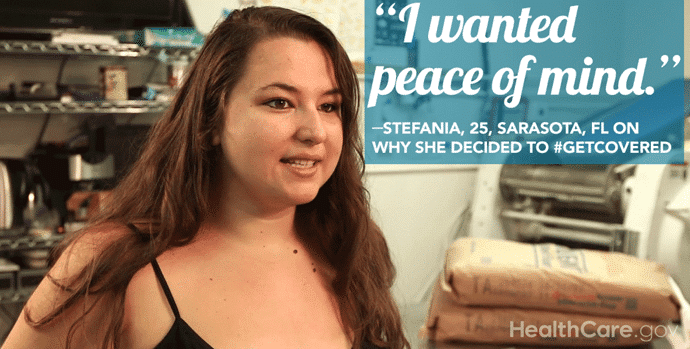
Put aside the political noise and try the site to see for yourself.  The Department of Health and Human Services posted this story by a young Florida woman who has insurance because of Obamacare. We think it’s worth re-posting.

PERSONAL STORY

“I’m Stefania Fochi. I’m 25 years old, I live in Sarasota, Fla., and for the past four years I didn’t have health insurance.

It made me very nervous, because I work with heavy machinery when I make empanadas and pasta in my family’s business. There have been times when I’ve been using the big 2,000-pound kneader and almost caught my hand and thought: If I had to go to the emergency room, what would I do?

Also, there’s a history of ovarian cancer in my mother’s family: My great-grandma died of it, my grandma had it and my Mom had it, so I need to keep up on the checkups. But I wasn’t able to because I didn’t have health insurance. I rarely was able to go to a doctor in the four years since I quit my job with a corporation to start an empanada business. Please see my story here:

Now I have health insurance that gives me peace of mind and financial security. I logged onto the Health Insurance Marketplace at HealthCare.gov and found an affordable policy with excellent coverage. Because I was eligible for lower costs, my policy costs only $98 a month, with a deductible of $750.

I think it’s very important for 20 year-olds to have insurance even though many of them think they are too young and that nothing can happen. You never know. You could get into a car accident. Not having health insurance puts you instantly in a hole.

Having health insurance is going to help me achieve my goals of creating an empanada empire because I will have the peace of mind knowing that I don’t have to spend any time worrying about what if something happens to me. I will be able to focus on what’s important, which is going to be my business.

We opened our first pasta and empanada store on Monday. Having a business is hard. We work a lot but it is definitely a labor of love. And having health insurance is absolutely making it possible for me to chase my dream.”

A Spanish version of the blog is also available here: http://www.hhs.gov/healthcare/facts/blog/2014/02/stefanias-enrollment-story-es.html.

Use the Postal Service Instead of a Payday Lender

Here’s a great idea — use neighborhood post offices to provide some banking services and offer a safe way to pay bills and get money to people who don’t always have access to a bank, or don’t have good enough credit for a credit card, .

The Inspector General of the Postal Service, David Williams, made the pitch in a report in late January. It was essentially overlooked until Massachusetts Senator Elizabeth Warren (D) endorsed the concept.

Basically, the proposal is an effort to use neighborhood post offices, make money for the Postal Service and help 68 million people in more than a quarter of American households who don’t have bank accounts, or credit cards.

This could be a big boon for people who don’t have traditional banking relationships, and resort to payday and title loans to get quick cash to pay bills.

HOW IT WOULD WORK

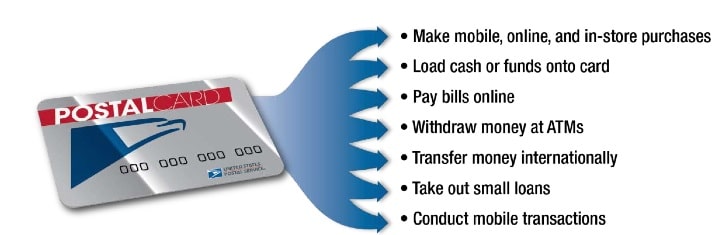
Inspector General Williams proposes a Postal Card that would allow you to do the following:

Make mobile and online purchases

Put cash on a card

Pay bills online

Withdraw money at ATMs

Transfer money internationally

Get small loans

The Postal Card would be similar to a bank card. You could load your paycheck on it, withdraw cash, pay bills, receive or make tax payments and send money internationally.

PAYDAY LOAN ALTERNATIVE

The card could also be used as a payday loan alternative. Inspector General Williams suggests, “People could borrow up to 50 percent of their gross paycheck. For a person who earns $18,000 per year and gets paid twice a month, that is $375. Every borrower could be required to pay a minimum of 5 percent of their gross pay from each paycheck until the loan is paid off. In this scenario, that would be $38 from each paycheck.”

The Postal Service would automatically withhold loan payments from borrowers’ paychecks before putting the difference on their Postal Card.

If the Postal Service charged a $25 upfront loan fee and a 25 percent interest rate, the borrower would pay off the loan in 5 1⁄2 months, paying a total of $48 in interest and fees across the life of the loan.

That’s a big difference from a traditional payday loan. If you were to borrow $375 in a payday loan you’d pay $520.

To make this happen, the Postal Service wouldn’t go it alone. It would partner with banks, and the deposits would be covered by the FDIC.

Right now, this is just an idea. We’re waiting to see how it can become reality.

Veterans Asked to Complain About Education Ripoffs

The G.I. Bill is supposed to allow veterans and military members to take advantage of good educational opportunities.

But, and there is a big but. Many for-profit-colleges with attractive advertising campaigns lure veterans into programs that often cost too much and offer little of real value.

Now government agencies teamed up with the Federal Trade Commission (FTC) and the Consumer Financial Protection Bureau (CFPB) to help. They want veterans, service members and their families who use the GI Bill to complain about education ripoffs.

You  can file complaints with the VA and DOD directly about the cost of attendance, marketing, graduation rates, program quality, employment prospects, and course credit. The Department of Education will take email complaints on these topics.

The complaints won’t just sit there. They’ll get forwarded to the FTC’s Consumer Sentinel Network database.  2,000 law enforcement agencies nationwide use the data base to pursue cases and your complaints will help the government identify and go after the bad-actors and companies involved in fraudulent and deceptive practices.

Jessica Rich, director, FTC’s Bureau of Consumer Protection says,“Veterans should get truthful information when they choose how and where to use their military education benefits. Unfortunately, that may not always be the case.”

To file a complaint in English or Spanish, visit the FTC’s online Complaint Assistant or call 1-877-FTC-HELP (1-877-382-4357).

TIPS FOR CHOOSING A COLLEGE

If there’s a high pressure sales pitch be very careful. Make sure that if you do sign up, you  can cancel, without any penalty, within a few days.

10 QUESTIONS YOU WANT TO ASK

1. Will the program use all my G.I. benefits?

2. How do I pay for what the G.I. Bill doesn’t cover?

3. Do you expect me to get a loan to pay for what my benefits don’t cover?

4.  Are books and other things included, or do I pay extra?

5. Do I pay for individual courses, or do I pay a blanket sum?

6. Are there extra fees for adding or dropping courses?

7. What’s the percentage of recent grads from your school who took a loan and are delinquent repaying the loan.

8. Can I transfer credit from this school to another school?

9. Is this school accredited?

10. Is it accredited in a way that allows me to transfer to a state or city school?


The FTC also compiled a list of suggestions to help you figure out how to choose a college.

 Why Veterans Should Avoid For Profit Collegeswatchmore

What To Do After A Data Breach


First there was the Target data breach affecting as many 110 million people. Then there was the Neiman Marcus data breach that hit over 1.1 million credit card holders.  And the latest warning about a breach comes from the Texas-based arts and crafts retailer Michaels Stores.

Clearly, this is a big problem that requires our individual vigilance.

Did you know?

Federal law and other rules say consumers are generally not responsible for unauthorized debits or charges to credit or debit card accounts, as long as they report them quickly to their bank or card providers.

That’s why it’s important to stay on top of your accounts. To help, the Consumer Financial Protection Bureau (CFPB) issued an alert that offers useful advice:

  • Monitor accounts for unauthorized charges or debits.


  • Regularly review accounts online if possible, and at a minimum examine monthly statements closely.


  • Report even small problems immediately. Some thieves may process a small charge or debit just to see if the account is live or whether the consumer notices.


  • Be aware that fraudulent charges may occur many months after information is stolen.


  • Even if you think the PIN on your debit card was not stolen, consider changing the PIN to be on the safe side.


  • Alert your bank or card provider immediately if you suspect fraud.


  • Alert your bank or card provider immediately if you suspect an unauthorized debit or charge.


  • If you find  fraudulent charges, ask the card provider to close access to the account and issue a new card before more transactions come through.


  • Follow up with the bank or card provider and maintain records. Call the bank or credit card provider first, also ask about how you can follow up in writing. Make sure you keep a copy of your correspondence.

If you don’t like the way your bank is handling things, the CFPB says,If consumers are unsatisfied with how their bank or card provider responds to a report of fraudulent charges, they can submit a complaint to the CFPB. Card providers should investigate charges and respond quickly. Consumers have a right to see the results of the bank’s or card company’s investigations.”

You can file a complaint at  www.consumerfinance.gov/complaint, or by phone (855) 411-CFPB (2372) or TTY/TDD phone number at (855) 729-CFPB (2372), or

by fax  (855) 237-2392, or      

by letter to Consumer Financial Protection Bureau, P.O. Box 4503, Iowa City, Iowa 52244

Pete Seeger’s Summer Camp Legacy

by Barbara Nevins Taylor

Seeger Fest, the five day festival of song in New York City and the Hudson Valley, honoring Peter Seeger and his wife Toshi reminded us of the importance  of his legacy of inspiration and activism.  He touched people in big and small ways. My small brush with Pete Seeger came when I was a very young girl.

The video and photo are of Pete at the Surprise Lake Camp just north of Cold Spring, New York in the Hudson Valley. They are relatively recent and many campers of many ages are likely to have photos, videos and film that stretch back decades.

Pete lived nearby in Dutchess County and often visited the camp and sang with the young people who spent a few weeks there every year in July and August.

I went to Surprise Lake in the fifties and Peter Seeger was one of the unexpected gifts of summer. I had no idea who he was at the time, but he influenced me greatly.

Our family was very poor and camp seemed like a vacation for the rich kids in two-parent households. But our mother was resourceful. She went to work after our father left and managed to make the most of  the $45 a week she earned at first.

She wanted what she called “a normal life” for her daughters and summer camp was part of that. She jumped at the opportunity when someone in a support group called Parents Without Partners told her about Jewish Federation camps.

She learned that they considered your income and charged what you could afford. I remember her in the breakfast nook of our little kitchen filling out the papers and calculating the cost. I think she paid something like $18 dollars for me for three weeks, and another $18 dollars for my sister who went to a camp called Wel-Met.

I loved Surprise Lake. It introduced me to the woods, hiking, running, swimming in a cold deep lake and crafts that I fumbled with. Every day was special and action-packed. In the early evening, campers and counselors sat around the flagpole near the lake and sang the songs that shaped the way I think about America, other people and responsibility.

Sometimes a counselor led the singalongs and other evenings Pete Seeger appeared like a magician, seemly out of nowhere. He strummed his banjo and sang in that sweet, clear voice:

“If I had a hammer,

I’d hammer in the morning,

I’d hammer in the evening,

All over this land,

I’d hammer out danger,

I’d hammer out a warning,

I’d hammer out love between my brothers and my sisters,

All over this land.”

I heard the message. I knew I wasn’t a singer. Other campers at other times, like Neil Diamond, were inspired to sing by Pete Seeger, to really sing.  But I did hear the words and got it. I was inspired by the message and the feeling of empathy and compassion.

Speaking up for what’s right and fair made a lot of sense to me. It still does.

I am just one of millions touched by Pete Seeger, but I appreciate what he passed on to me and others and will continue to singalong in my way.

Thank you, Pete. You live on.


 watchmoreLiving! Get Some Inspiration

Making Sense of Annuities for Retirement

by Barbara Nevins Taylor

Phil K thinks his life is about to change and he wants to plan for what may happen. He’s a senior vice president at a California electronics company that has steadily lost business as its U.S. tech customers outsourced work to China and other cheap labor markets.

The firm’s realignment may leave Phil without a job. He’ll be 65 then and eligible to collect Social Security. But he faces a steep income drop and that’s a big concern.

So he sat down and calculated. “I put down all of my statistics and sources of income. I looked okay. But I wanted to increase my cash flow so that I would never have to look over my shoulder and I would know that my cash flow, my income, would exceed my expenses,” he explains.

Phil and his wife Susan, who is 61 and still works as a registered nurse, own their home in Ventura County, California. They also own an  investment property and have a portfolio of stocks and bonds.

But Phil worries about his monthly income and when someone suggested an annuity, he took a look.

“After doing a lot of research, I found out annuities are very complex and complicated. You can talk to 100 people and get more than 100 opinions,” he says.

Phil’s right. It seems as though someone really smart, or linguistically confused, stayed up late to create a language and a series of  investment plans that befuddle most of us.

Yet, I was surprised to learn from the Insured Retirement Institute (IRI) that the word and annua, and  the concept of this kind of investment, first popped up in ancient Rome. Apparently, Romans could make a one-time payment in a contract called an annua and in return get an annual payment for the rest of their lives.

Today annuity’s are generally sold through life insurance companies, although they are not life insurance.

watchmore

LIVING! GET SOME INSPIRATION


Here’s How it Works

Basically, you invest a specific amount of money and you’re guaranteed a specified return. Annuities are attractive to a lot of people because you invest, you get a return and you avoid the volatility of the financial markets. After the  fiscal crisis of 2007-2008, a study by the Insurance Retirement Institute and Cogent Research found 63% of investors said market swings make them more likely to consider an annuity.

If you start to think about this early when you’re in thirties, forties or fifties you’re  likely to choose a Deferred Annuitiy. That allows you to invest a lump sum or make regular payments in a tax deferred plan. When you set this up, you can decide the age when you want your annuity payments to begin.

Then, when that time rolls around, you’ll get a check every month. There are a number of variations on this theme that include variable investments that connect your investment to market or company performance.

Depending upon the contract you make, you might be able to withdraw money early, or take partial payments before you retire.

For people like Phil, nearing retirement age, immediate or almost immediate gratification is the key.

And that’s when an Immediate Annuity might make sense. You put a specified amount of money in and the annuity payments begin right away. You can do this with a lump sum from savings, or from an IRA or 401 (k) plan.

You can also choose an annuity for a specific period of time, say ten years. You receive money every month and when the ten years are up, the payments, or pay out, equal your original investment.

With some plans, monthly payments continue for as long as you live. But as with many other investments, you’ll generally have to pay fees or charges associated with your annuity.

After Phil learned about the many choices he had, he realized he needed help.

His banker gave him a brochure about variable annuities and it made him nervous. He says, “I read the 200 pages and I went back to the banker and said it’s too complicated and risky and it’s exactly why I don’t want something like this.”

Then, he realized that he had a valuable resource he hadn’t yet tapped.

Savings and Retirement Sign

CALLING A TRUSTED RESOURCE

He called his long-time insurance consultants in New York at the Blank Financial Group. He had worked with the husband and wife team Howard and Wendy Blank for years. He sent them a four page spread sheet, which outlined his financial situation, and they had what they needed to make a sensible recommendation.

Wendy explains, “We went over the financials with Phil and took a look at how he had his investments allocated and what his income might be when he retired. We advised that  he take a small portion of his investment portfolio from his IRA and put it into an annuity that guaranteed income.”

That was language that Phil understood and he moved quickly on the advice. He took about $100,000 from his IRA and put it into a New York Life annuity called a Guaranteed Lifetime Income Annuity with a guaranteed minimum term of 15 years.

While this is an immediate annuity, Phil deferred the payments he’ll receive by about a year. So that beginning August 2014, he’ll get $560.56 every month. That monthly payment continues for the rest of his life.  

By the time he’s 80, the payments he will have received will equal his investment. And the money he continues to receive will be like frosting on the cake.

He feels it’s a win-win for him. ” I’m gonna get cash every month for the rest of my life. How can this be anything but good?” he asks.

Wendy Blank says, “Putting money that’s sitting in an IRA or 401 (k) into an annuity is a pain free way to generate income and you can start with an investment of as little as $10,000. But everyone’s situation is different and that’s why it’s really important to get advice.”

There is one thing that you might want to consider before following Phil’s lead.

He calculated what he thinks he needs to live on, but he also has investments that he can turn into cash if he has a medical emergency, or some other unexpected event that his insurance doesn’t cover. University of Pennsylvania Wharton School Economists Felix Reichling and Kent Smetters suggest that only 37% of American households should turn their income into annuities because the rest won’t have enough cash on hand when they need it.

So this is something that you really want to look at. That’s why it’s a good idea to get advice from people who have your best interests at heart.

watchmore  8 Tips for Retirement Planning


watchmore Figuring Out Medicare Choices


How To Appeal Medicare Denials

It’s easy to throw up your hands and say, “Okay,” when a Medicare insurer denies coverage for a medication your doctor has prescribed, a visit to a specialist, or a treatment regimen. We get it. We’ve been there. We don’t like to give up.

You deserve the coverage and if you appeal you have a really good chance of winning. The process is a lot easier than you think. More than 60 percent of those who do appeal get what they want, according to Joe Baker, President of the Medicare Rights Center.

In our short video Baker explains what you need to do when you appeal. Here are a few essentials:

The law gives you the right to appeal denials for:

  • Prescription drugs
  • Health care services
  • Health care supplies you need

You can appeal if you’re denied approval, or if Medicare or the insurer stops paying while you’re using the medication or getting the health care service.

Where to start

  • If you’re denied, ask your doctor for help. A physician’s participation in the appeal is extremely important.
  • Call your plan. A lot of denials are overturned after you call and ask for reconsideration.

If a phone call doesn’t work

Every time you’re denied you receive an instruction notice about appealing.

Follow the instructions on the notice and attach documentation from your doctor. A letter explaining why you need the treatment or medication often does the trick.

Medicare Advantage and Medicare Plan Appeals

If you have Medicare Advantage or another Medicare plan, the insurer can take up to 14 days to decide your case. But you can ask for a speedier response.

Your letter, or email, from the doctor must say your health will be harmed if you wait for the 14 days. The insurer is required to respond within 72 hours.

Prescription Drugs

If your insurer denies a particular medication, the pharmacist can’t tell you why. The Medicare Rights Center is advocating to change this policy, but for now you need to consult your doctor about other options.

He or she may prescribe a generic drug. If a generic medication is unsuitable, ask your doctor to write an appeals letter, or email, explaining why you need the brand-name medication.

If the drug isn’t included in the insurer’s list of covered drugs, or formulary, you and your doctor can ask for an exception for you. The request must include an explanation of why you need the medication and why your health or life will be jeopardized without it.

Similarly, if the medication is too expensive you might be able to get the insurer to agree to a lower payment. But again, the doctor has to offer a compelling explanation about why you need the medication.

If the insurer continues to deny coverage

It probably won’t get that far. But there are five levels of appeal.

1. Review by Medicare or the insurer.

2. Review by what Medicare calls an Independent Review Entity.

3. Review by an administrative law judge.

4. Review by the Medicare Appeals Council.

5. Review by a federal district court judge.

Don’t be put off by this long list. In most cases, you don’t have to go through all the hassle.

watchmoreFiguring Out Medicare Choices


watchmoreLiving! Get some Inspiration