All posts by Barbara Nevins Taylor

What Hillary Said The Day After


Thank you.

Last night, I congratulated Donald Trump and offered to work with him on behalf of our country. I hope that he will be a successful president for all Americans.

This is not the outcome we wanted or we worked so hard for, and I’m sorry we did not win this election for the values we share and the vision we hold for our country. But I feel pride and gratitude for this wonderful campaign that we built together –- this vast, diverse, creative, unruly, energized campaign. You represent the best of America, and being your candidate has been one of the greatest honors of my life.

I know how disappointed you feel, because I feel it too. And so do tens of millions of Americans who invested their hopes and dreams in this effort. This is painful, and it will be for a long time.

But I want you to remember this: Our campaign was never about one person or even one election. It was about the country we love — and about building an America that’s hopeful, inclusive, and big-hearted. We have seen that our nation is more deeply divided than we thought. But I still believe in America –- and I always will.

And if you do, too, then we must accept this result -– and then look to the future. Donald Trump is going to be our president. We owe him an open mind and the chance to lead.

Our constitutional democracy enshrines the peaceful transfer of power, and we don’t just respect that, we cherish it. It also enshrines other things –- the rule of law, the principle that we’re all equal in rights and dignity, and the freedom of worship and expression.

We respect and cherish these things too — and we must defend them. And let me add: Our constitutional democracy demands our participation, not just every four years, but all the time. So let’s do all we can to keep advancing the causes and values we all hold dear: making our economy work for everyone, not just those at the top; protecting our country and protecting our planet; and breaking down all the barriers that hold anyone back from achieving their dreams. We’ve spent a year and a half bringing together millions of people from every corner of our country to say with one voice that we believe that the American Dream is big enough for everyone — for people of all races and religions, for men and women, for immigrants, for LGBT people, and people with disabilities. Our responsibility as citizens is to keep doing our part to build that better, stronger, fairer America we seek. And I know you will.

I am so grateful to stand with all of you. I want to thank Tim Kaine and Anne Holton for being our partners on this journey. It gives me great hope and comfort to know that Tim will remain on the front-lines of our democracy, representing Virginia in the Senate.

To Barack and Michelle Obama: Our country owes you an enormous debt of gratitude for your graceful, determined leadership, and so do I.

To Bill, Chelsea, Marc, Charlotte, Aidan, our brothers, and our entire family, my love for you means more than I can ever express. You crisscrossed this country on my behalf and lifted me up when I needed it most –- even four-month old Aidan traveling with his mom.

I will always be grateful to the creative, talented, dedicated men and women at our headquarters in Brooklyn and across our country who poured their hearts into this campaign. For you veterans, this was a campaign after a campaign — for some of you, this was your first campaign ever. I want each of you to know that you were the best campaign anyone has had. To all the volunteers, community leaders, activists, and union organizers who knocked on doors, talked to neighbors, posted on Facebook – even in secret or in private: Thank you. To everyone who sent in contributions as small as $5 and kept us going, thank you.

And to all the young people in particular, I want you to hear this. I’ve spent my entire adult life fighting for what I believe in. I’ve had successes and I’ve had setbacks -– sometimes really painful ones.

Many of you are at the beginning of your careers. You will have successes and setbacks, too. This loss hurts. But please, please never stop believing that fighting for what’s right is worth it. It’s always worth it. And we need you keep up these fights now and for the rest of your lives.

To all the women, and especially the young women, who put their faith in this campaign and in me, I want you to know that nothing has made me prouder than to be your champion. I know that we still have not shattered that highest glass ceiling. But some day someone will -– hopefully sooner than we might think right now.

And to all the little girls watching right now, never doubt that you are valuable and powerful and deserving of every chance and opportunity in the world.

Finally, I am grateful to our country for all it has given me. I count my blessings every day that I am an American. And I still believe, as deeply as I ever have, that if we stand together and work together, with respect for our differences, strength in our convictions, and love for this nation -– our best days are still ahead of us.

You know I believe we are stronger together and will go forward together. And you should never be sorry that you fought for that. Scripture tells us: “Let us not grow weary in doing good, for in due season, we shall reap, if we do not lose heart.” My friends, let us have faith in each other. Let us not grow weary. Let us not lose heart. For there are more seasons to come and there is more work to do. I am incredibly honored and grateful to have had this chance to represent all of you in this consequential election. May God bless you and god bless the United States of America.

Hillary

hillary-thank-you

What To Do When The Debt Collector Calls


When a debt collector calls, stay calm and find out how much you actually owe. It sounds obvious. But aggressive debt collectors turn their jobs into performance art and lie to scare people into shelling out money whether they owe it or not. That’s why you can hang up on them, and contact the company or institution they mentioned directly. Find out what they have in their records and get the real story.

A lawsuit by the Consumer Financial Protection Bureau and the New York State Attorney General highlights the bad practices of a network of companies operating a collection scheme all across the country that brings in tens of millions of dollars a year. The lawsuit alleges that they continue to “harass, threaten and deceive millions of consumers across the nation into paying inflated debts or amounts they may not owe.”

Northern Resolution Group, Enhanced Acquisitions, and Delray Capitals, all based in Buffalo, N.Y., purchased millions of dollars of consumer debt. Under the oversight of Douglas MacKinnon and Mark Gray, the lawsuit alleges that since at least 2009, the companies ran ” a massive collections scheme that routinely inflated consumer debts and relied on illegal tactics to extract as much money as possible from consumers.”

CFPB Director Richard Cordray said, “Living with debt is difficult enough as it is, without the added stress of being harassed and threatened by debt collectors.”

According to the lawsuit the debt collectors:

  • Inflated the amount people owe. In some cases the companies inflated the debt by 600 percent. They also added $200 to every account they attempted to collect. 
  • Falsely threatened legal action and arrests. Company representatives sometimes identified themselves as government officials. In one instance in Los Angeles, a debt collector claimed he represented the “Los Angeles County Courts” and told a consumer she didn’t have time to get a lawyer and faced arrest the next day if she didn’t pay up immediately. The same collection agent continued to harass her and her relatives demanding payment.

In other instances, collectors called and demanded immediate payment and harassed people at work and called their relatives to tell them about lawsuits filed against them. In fact, the companies did not file lawsuits and apparently didn’t intend to do so.

The CFPB and the New York Attorney General asked a federal judge in the Western District of New York to stop the company from doing business and to order them to pay penalties and restitution to the victims.

As the case winds it way through the legal process, we’ll have a better idea of when people will get money back and how much.

In the meantime, if you think these companies took money from you illegally, get in touch with the New York State Attorney General:  1-800-771-7755, or the Consumer Financial Protection Bureau or the consumer advocate in your state.


Did You Fall For The IRS Caller Scam?

It took a three-year investigation, but law enforcement officials finally caught up with a group of IRS call center scammers. If you ever received one of these calls, you know how maddening, threatening and frightening they could be if you believed, and people did. 

More than 15,000 people fell victim and lost hundreds of millions of dollars, according to an indictment brought by the U.S. Attorney in the Southern District of Texas that named 61 people in an alleged scheme that operated in India and the United States. FBI agents, working with agents from the IRS and the Department of Homeland Security, arrested 20 people in the United States and 32 in India at five call centers. Immigration officials have another man in custody in Florida.

The indictment describes an elaborate scam organized in India with a network of call centers in Ahmedabad. It details how the creepy callers used information from data brokers and others to find potential victims and impersonate IRS agents or U.S. Citizenship and Immigration Services agents.

Call center operators threatened potential victims with arrest, imprisonment, fines or deportation if they did not pay taxes or penalties to the government, 

And here’s where it got really bad.

When victims agreed to pay, the call centers would turn to a network of U.S.-based co-conspirators to launder the extorted funds quickly by purchasing prepaid debit cards or using wire transfers.

The U.S. Attorney said,  “…prepaid debit cards were often registered using misappropriated personal identifying information of thousands of identity theft victims, and the wire transfers were directed by the criminal associates using fake names and fraudulent identifications. “

Scammers used “hawalas,” in which money is transferred internationally outside of the formal banking system, to direct the extorted funds to accounts belonging to U.S.-based individuals. According to the indictment, these individuals were expecting the hawala transfers but did not know how their partners got the money. The co-conspirators also allegedly kept a percentage of the proceeds for themselves.

Who Fell For the IRS Scam

The indictment says an 85-year-old victim from San Diego, California, paid $12,300 after scammers threatened her with arrest if she did not pay fictitious tax violations. 

A man in Hayward, California, shelled out $136,000 after scammers called him many times over a 20-day period. They told him he owed the IRS money and demanded that he pay. He followed their instructions and bought 276 stored value cards. The scammers transferred the money to reloadable debit cards. They purchased some of those cards using the stolen IDs of Americans.

In some cases, scammers offered short-term loans or grants. They asked for deposits to show “good-faith” that people would make payments. And then, of course, the people who paid never received any money.

U.S. Attorney Kenneth Magidson said,“This indictment will serve to not only seek the conviction of those involved, but will send a message around the world that no one is safe from prosecution for participating in such pervasive transnational fraud schemes.”

Did You Fall For The IRS Caller Scam?

If you became a victim of one of these scams, the Department of Justice wants to hear from you.  It asks that you contact the Federal Trade Commission to file a complaint and get yourself listed. 


And Future Income Payments Shut Down In New York State And Will Repay


by Barbara Nevins Taylor

Good news for people in New York who ended up at the wrong end of a Future Income Payments (FIP) pension advance scheme. The New York State Department of Financial Services (DFS) ordered the company to stop doing business in the state, refund money, collect only what people actually borrowed and pay a fine of $500,000.

California-based Future Income Payments and its owner, Scott Kohn, set up an elaborate scheme between people who needed quick cash and borrowed against their pensions, and investors who lent the money. We have posted about the dangers of pension advance programs for people who need money and those who lend it

But here’s what happened in this case in New York State, 282 people borrowed $283 million dollars through FIP. Some borrowed as little as $2,500. Others took loans of as much as $58,000. If everything went as planned, Future Income Payments would make a profit of 250 percent and pocket $8.8 million.

The company advertised online and worked through third-party lead generators.

They called these loans pension cash advances, lump sum payments, pension buyouts and structured cash flows. But the Financial Services Department found a loan by another name adds up to a loan. DFS ruled the company violated lending law because it’s not licensed to make loans in New York State. DFS Superintendent Maria Vullo also found the company charged more interest than the state allows.

As the result of a consent agreement with the state:

  • Future Income Payments will revise the amount of money for New Yorkers to what they actually borrowed. That means no interest.
  • Anyone who already completed paying off the loan, minus the interest, will not have to pay anymore. The company will confirm that in writing.
  • Future Income Payments will refund what people paid in interest beyond what they actually borrowed.
  • Future Income Payments will stop doing business in New York and will put that fact on websites, advertising and other solicitations.

HOW DO YOU GET YOUR MONEY BACK?

New York State will pick an administrator to oversee the details and after that Future Income Payments has 45 days to make the refunds and adjust payment schedules.

The agreement with the state requires Future Income Payments and the administrator to get in touch with borrowers. But in the meantime, if you borrowed against your pension with Future Income Payments and you live in New York, call the DFS hotline (800)342-3736 or go to www.dfs.ny.gov  for help.

Unfortunately, this agreement and individual court cases and rulings in other states that found pension advance schemes amount to loans affect only people in those cases and states. 

Just in case anyone gets confused, Future Income Payments went by the name Pension Annuities & Settlements and used marketing companies called Cash Flow Investment Partners, BuySellAnnuity and Pension Advance LLC..  All the companies operated from the same address in Irvine, California.


Phone Calls Soliciting Your Money

We can’t say it enough. Hang up on that telemarketer! Nothing good can come of phone calls soliciting your money. 

The latest painful lesson comes in the form of a $9 million scam that targeted thousands of retired people and retired military personnel all across America. A Federal Trade Commission (FTC) complaint filed in federal district court in Arizona lays out the scheme that offered a sure-fire way to make money.

Telemarketers offered the opportunity to invest in e-commerce websites or websites that link to popular sites like Amazon. They promised a risk-free, high-profit investment with a money-back guarantee.  

Consumers who fell for the sales pitch made payments of hundreds of dollars to as much as $20,000 by credit card.  When consumers called to check on their investments during the first 90 days, the FTC says scammers reassured them. They allegedly told consumers they held the money in secure accounts that continued to earn more money. But after 90 days, when most credit card companies limit the ability of consumers to dispute charges, the company stopped responding to calls or email queries.

The FTC’s complaint says Susan Rodriguez, Matthew Rodriguez and William “Matt” Whitley used six corporations: Advertising Strategies LLC, Internet Advertising Solutions LLC, Internet Resource Group Inc., Network Advertising Systems LLC, Network Professional Systems LLC, and Network Solutions Group Inc.

They also disguised their location by using mail-forwarding services and they changed their business name and mailing and physical addresses to avoid detection by law enforcement.

The FTC says the defendants most recently have done business as Titan Income. They previously did business as Building Money Network and buildingmoney.cash, Prime Cash and Primecash.net, and Wyze Money and wyzemoney.net.

A federal judge froze their assets while the case is under review. 

Speak Up About Payday Lending


Barbara Nevins Taylor


If payday lending makes you angry, if you’ve seen someone hurt by this kind of predatory lending, or if you became a victim because you needed money to pay a bill, now is the time to speak up and speak out. 

The Consumer Financial Protection Bureau (CFPB) will make new rules to regulate this wildcat industry and they want to hear from real people.

Payday lenders typically lend some amounts of money at interest rates that often climb to 300 percent. When a borrower has trouble repaying they may renew the loan and add fees and interest on the interest. So these loans become a no-win situation. 

The Center for Responsible Lending issued a rallying cry and set up a way for you to let the CFPB know what you think.

Here’s what they say: 

“These are the final days to let the Consumer Financial Protection Bureau (CFPB) know what you think about proposed rules that, if strengthened, could rein in the worst abuses of payday and car-title lending.

The proposed rules are based on the ability-to-repay principle – the common-sense idea that if lenders make loans, they must ensure the borrower can repay those loans without re-borrowing or defaulting on expenses. The problem is that there are exceptions within CFPB’s proposed rules, loopholes the payday lenders can wiggle through, which they have shown themselves so good at doing over the years.

Time is running out to make our voices heard. So act now to add your voice! Tell the CFPB: don’t give payday lenders room to wiggle around the ability-to-repay requirements!”

Add your comment BY FRIDAY to stop the debt trap!


Sarah Ludwig of The New Economy Project, formerly NEDAP, an advocacy group that helps people who fall victim to financial scams, made this video for us about the dangers of taking a payday loan.


Protection In Nursing Homes

The first time my cousin Marilyn went from the hospital into a nursing home, I discovered that if something happened, we had little recourse. The contract the facility required me, as the person responsible for her, to sign included the fine print detail that if their treatment hurt her in any way, we would have no recourse in the courts. Binding arbitration would settle all complaints.

Of course, I hoped they would treat her well but this made me incredibly uncomfortable. It certainly didn’t seem like the greatest place and I pushed to get her out of there and back to the assisted living facility where she lived as soon as possible.

Many other families did not have that good fortune and found their ability to hold nursing homes accountable limited by binding arbitration. They could not sue. 

Finally, that changed. The Centers for Medicaid and Medicare Services (CMS), the federal agency that sets the rules for nursing homes, stepped up and created a new rule it calls “Protecting Residents’ Rights.” It will affect the 1.5 million people in more than 15,000 long-term care facilities. 

Protecting Residents’ Rights

Here’s what the Centers for Medicaid and Medicare Services said:

“Our final rule will prohibit the use of pre-dispute binding arbitration agreements. This means that facilities may not require residents to sign pre-dispute arbitration agreements as a condition of admission to that long-term care facility.

Facilities and residents will still be able to use arbitration on a voluntary basis at the time a dispute arises.

Even then, these agreements will need to be clearly explained to residents, including the understanding that these arbitration agreements are voluntary, and that these agreements should not prevent or discourage residents and families from talking to authorities about quality of care concerns.”


Thinking About Taking a Title Loan

When you own your car or vehicle outright, it may seem irresistible to borrow against it when you need money. But if you are thinking about taking a title loan, watch out. It can cost you much more money than you think.

The latest action by the Consumer Financial Protection Bureau (CFPB) highlights what a nightmare a title loan can become. It fined TitleMax and its parent company TMX, LLC $9 million for its bad practices.

Customers who visited one of the 1300 TitleMax storefronts in 18 states learned they could borrow money against their cars for 30 days. But the interest rate was 300 percent. And often, salespeople encouraged them to spread out the payments using a “Voluntary Payment Plan.” It might have sounded great, but those plans brought the finance charges even higher and put people deeper and deeper in debt.

The CFPB charged Savanah, Georgia-based TMX Finance, LLC,  parent company of TitleMax, with, “. . . luring consumers into costly loan renewals by presenting them with misleading information about the deals’ terms and costs.”

The CFPB looked at loans from July 21, 2011 to the present and found a pattern of abusive debt collection. When people failed to make payments on time, TitleMax employees made what they described as “field visits.” They went to people’s homes and offices. They embarrassed them, but worse, they shared their personal financial information with employers, relatives and friends.

As a result of its unfair lending and collection practices, TMX Finance, parent company of TitleMax, will pay a fine of $9 million.

No one goes to jail here, but the company did agree to stop its abusive practices and must submit a plan within 90 days to the CFPB outlining how it will put reforms into place.


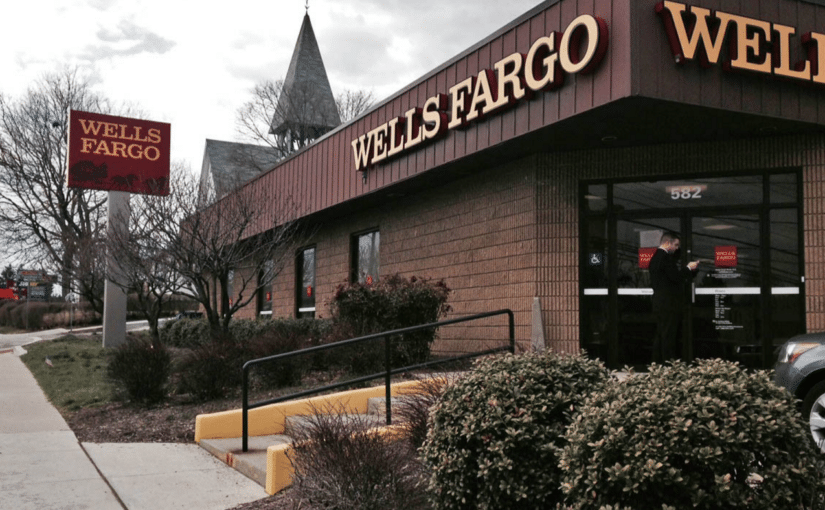
Does Wells Fargo Owe You Money Again?


updated December 28, 209

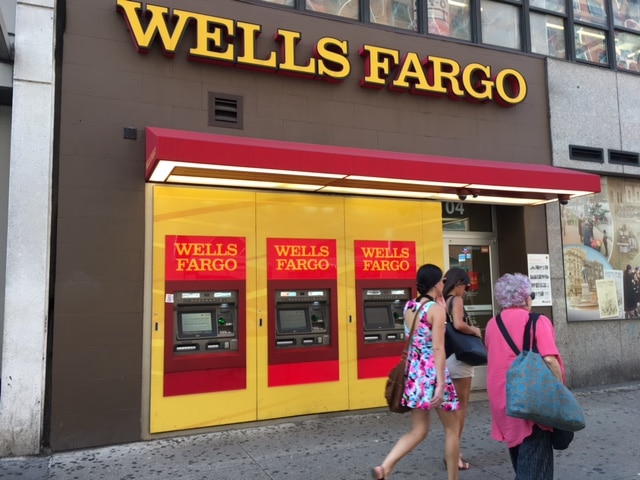
Wells Fargo paid out money for bad behavior in the past and Wells Fargo may owe you money again. We describe all the reasons on this page. But if you need more information about the latest, you can find it here.

Why does Wells Fargo possibly owe you money? Because the friendly person in the Wells Fargo branch neglected to tell you that, or she, opened a credit card in your name. The bank recently announced it discovered an additional 1.4 million accounts affected bringing the total to 3.5 million.

That stunt added to the employee’s bonus and cost you fees you didn’t want and might not have even realized you had to pay. They did this from January 2009 to September 2016.

Employees opened these 3.5 million accounts, without approval, for people who already banked with them and didn’t ask for new accounts or credit cards. That gave the employees extra cash in bonuses, while consumers ended up with unauthorized charges on their accounts.  

They dishonestly created false email accounts for consumers so that the new accounts would get approved without a hitch.

Consumer Financial Protection Bureau (CFPB) Director Richard Cordray said, “Because of the severity of these violations, Wells Fargo is paying the largest penalty the CFPB has ever imposed,”as the result of a settlement.

Wells Fargo’s former CEO John Stumpf told members of the Senate Banking Committee that he was “deeply sorry” and that he took “full responsibility” for the unethical behavior.  Stumpf “retired” in October 2016. 

But come on. Who was minding the store?

Stumpf blamed about 5,300 employees for the behavior that cost customers money. He said they’d been fired. But former employees said they felt pressured from higher-ups to bend the rules.

The current C.E.O., Tim Sloan said in September 2017, “I want to assure you that we will take swift action to make things right for every a affected customer. We will issue refunds, provide assistance correcting credit reporting, and compensate customers for broader financial impacts.” And we entered into a $142 million settlement agreement to compensate eligible customers.

Actually, Wells Fargo will pay more than $185 million dollars in fines and penalties. A $100 million fine goes into the CFPB’s Civil Penalty Fund, which pays victims restitution for financial frauds.

But Wells Fargo will also refund, or has already, at least $2.5 million to consumers who found their accounts manipulated. In addition it will pay $35 million to the U.S. Comptroller of the Currency and $50 million to the county and city of Los Angeles, which sued the bank along with CFPB.

Does Wells Fargo owe you money?

If Wells Fargo owes you money under the settlement, it is required to reach out to you. It needs to do the work.

If you think Wells Fargo owes you money and you do not hear from the bank or receive the money, contact the CFPB. (855)-411-2372.


Why Waste Money On A Credit Repair Company?


by Barbara Nevins Taylor

Somewhere out there a credit repair company may exist that actually does the job. But all of those I’ve encountered seem ready to charge you fees and add to the debt you already owe. So why waste money on a credit repair company?

The latest example of why credit repair companies may not help at all comes from the Consumer Financial Protection Bureau (CFPB). It sued a national, California-based, credit repair operation whose tactics seem to come straight from the playbook of other rip-off artists.

The CFP alleges that Prime Market Holdings, also known as Park View Credit, National Credit Advisors, and Credit Experts, broke the law by charging fees in advance, misleading people about what they could actually do, and misleading consumers about the benefits of the service.

Telemarketers from the company called consumers who filled out online loan applications having nothing to do with credit repair. They also contacted people who responded to their web ads for credit repair services, according to a lawsuit filed in United States District Court in central California.

To get help, consumers had to pay a fee for consultation or for a credit report. (You can get a free credit report online three times a year at annualcreditreport.com). But the illegality comes from charging an upfront fee before you actually help someone repair their credit.

Consumers who paid the fee and signed a contract found themselves billed $89 a month for services that didn’t accomplish what the company claimed, according to the complaint.

Many did not know they would face a monthly charge and that the company set a time limit for cancelling the contract.

In addition, Prime Market Holdings could not, as it claimed, remove all negative information from credit reports nor could it raise credit scores by more than 100 points in all cases. 

The CFPB asked the court to stop Prime Market Holdings and its companies from doing business and to refund consumers’ money. 

We’ve seen this before. The company gets sued and the owners often turn up doing the same thing again using a different corporate name. 

WATCH OUT FOR SCAMMERS

While it may have a better ending this time, others out there play the same game that’s ultimately dangerous for consumers. So take care before you respond to a radio ad, an online come-on or any other promise that a company or individual can help you repair your credit for a fee.

Susan Shin from the New Economy Project (once called NEDAP) recorded this warning for us. 


NYPD and FBI Looking For Ahmad Khan Rahami

The NYPD and FBI are  looking for Ahmad Khan Rahami in connection with the Chelsea bombing on Saturday night that injured 29 people.  They consider the 28-year-old Afghan-born American citizen armed and dangerous. 

Mayor Bill de Blasio said on CNN, “We need to get this guy in right away.” Police and the FBI focused the search on Elizabeth, New Jersey, his last known address.

They describe Rahami as 5’6″ and weighing about 200 pounds. He has brown eyes and brown hair. 

If you have information about Rahami call 911 or 800-577-TIPS (8477).

In another development, a bomb exploded near the Elizabeth train station as an FBI bomb squad used a robot to try to disarm it. Elizabeth Mayor Christian Bollwage told the Associated Press that two men spotted a pipe and wires coming out of a backpack. 

Law enforcement officials now seem to feel the bombs found in Chelsea, in Seaside Heights, New Jersey, and in Elizabeth, New Jersey share similar elements. They contained small ball bearings “intended to cause maximum damage,” flip phones and tiny Christmas lights to set the bombs off. 

Mayor de Blasio on WNYC said, “The public has a crucial role to play here. There is a very extensive effort to find him (Rahami) and bring  him in.” He said, “We have not yet formally connected . . .” the New York bombing with the bombings in New Jersey.

The mayor said, “It could be a lone wolf. It could be a group. But right now we have to get this individual in.”


NYPD Takes 5 People Into Custody

The FBI, using a drone, spotted a suspicious vehicle on the Belt Parkway near the Verrazano Bridge and detained five people in connection with the bombing in Chelsea, and  the discovery of a second explosive device, on Saturday night.

Agents took the five in for questioning. 

State Senator Marty Golden posted the information on his Twitter account and said the stop occurred about 9:30 p.m. 

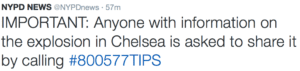
The NYPD continues to ask anyone with information to call: 1800577TIPS


Tense NYC As Police Investigate Bombing in Chelsea

Tense New Yorkers in lower Manhattan heard police sirens blare through the night as the NYPD investigated an explosion that occurred about 8:30 Saturday night in front of 131 West 23rd Street near 6th Avenue. The blast injured 29 people, one seriously.  

Shattered windows and flying debris sent people on the street scrambling. A local police patrol responded immediately and the bomb squad followed.  Police say they found the device in a toolbox in a dumpster. A short while later, a police search found a pressure cooker attached to wiring and a cellphone in a plastic bag on West 27th Street. The NYPD bomb squad removed the unexploded device using a robot

Mayor Bill de Blasio said the blast was “an intentional act.” But he said there was no known terrorist connection.  The FBI Joint Terrorist Task Force and the NYPD continue to investigate.

Saturday, a pipe bomb exploded near the site of a military charity run in Seaside Heights, New Jersey. No injuries occurred because rain delayed the race.

nypd-tip-line

On Twitter, the NYPD asks for anyone who might have seen something or anyone who has information to call the tip line, 800-577-TIPS (8477).

As of about 10 o’clock Sunday morning, the injured from the blast were treated and released from the hospital.

The investigation continues to affect traffic. Police closed off crosstown streets from 14th to 32nd streets as they continue search for evidence or individuals involved. 

 Questions continue about whether terrorists set the bombs. New York Governor Andrew Cuomo called it an “act of terrorism,” but apparently not “international terrorism.”

Wells Fargo $100 Million Fine Reminds Us To Check Statements

Does Wells Fargo owe you money?

Bad practices of a banking giant remind us all to check our banking statements regularly for fishy items that we didn’t authorize. The Consumer Financial Protection Bureau (CFPB) fined Wells Fargo $100 million for secretly opening unauthorized deposit and credit card accounts.

Turns out that Wells Fargo employees, eager to make sales targets and earn bonuses, opened about 1.5 million additional accounts, without approval, for people who already banked with them and didn’t ask for the services. While the employees got their payday, consumers ended up with unauthorized charges on their accounts.  

The employees creatively and dishonestly created false email accounts for consumers so that the new accounts would get approved without a hitch.

Consumer Financial Protection Bureau Director Richard Cordray said, “Because of the severity of these violations, Wells Fargo is paying the largest penalty the CFPB has ever imposed.”

Wells Fargo took full-page newspaper ads to apologize to consumers and said, “We truly regret and take full responsibility for any such instances and have refunded those consumers who incurred fees.”

The bank detailed a list of employee training improvements and customer notification systems that it put into place to try to prevent fraud in the future.

The $100 million dollar fine goes into the CFPB’s Civil Penalty Fund, which pays victims restitution for financial frauds. But Wells Fargo will also refund, or has already, at least $2.5 million to consumers who found their accounts manipulated. In addition it will pay $35 million to the U.S. Comptroller of the Currency and $50 million to the county and city of Los Angeles, which sued the bank along with CFPB.


Does Wells Fargo owe you money?

If Wells Fargo owes you money, under the settlement, it is required to reach out to you. If you think Wells Fargo owes you money and you do not hear from the bank or receive the money contact the CFPB. (855)-411-2372.

REMINDER

Again you may find it tedious, but this story points out why we need to check our online or paper bank statements every month. 


When Medicare Scammers Call

Even the smartest among us can fall for scam phone calls that target older people. When Medicare scammers call, they work hard to keep you on the line because they want you to give up your personal information so that they can steal your money.

This may sound overly dramatic, but we’re not nearly as over-the-top as the callers. 

Callers try to scare you. They persist and goad you into giving up information that you should not give to strangers. 

At a hearing before the Senate Judiciary Committee, Lois Greisman, Associate Director of the Federal Trade Commission’s (FTC) Division of Marketing Practices, said that the government imposter scams were the top complaint of people over 60.

She described how one company, SunBright Ventures, allegedly called people and claimed that they were from Medicare. They told people that they needed to provide their bank account information so that they could get new Medicare cards.

Once the scammers got the information, the FTC says they debited bank accounts remotely even though consumers never authorized the withdrawals. The FTC reached an agreement with the company but no one went to prison.

While the FTC brought 38 cases against companies since 2005, that seems like a drop in the bucket considering the wide swath these scammers cut through our lives. 

Many of the scammers operate from other countries and specifically target older adults in the U.S.. That’s why we need to remain vigilant to protect ourselves and those we love and care for.

If you get a call from someone asking for your personal information, hang up the phone. Disconnect. Press END. Do not engage in conversation with them. Don’t even bother trying to get to the bottom of the scam to find out who these people are. 

Hang up. File a complaint with the Federal Trade Commission. You can do it online here.  Or you can call 1-877-FTC-Help, 1-800-447-8477.

A Tip

In our house we don’t answer the landline when it rings unless the caller ID says it’s someone we know. Instead we check messages. 

The FTC produced this video featuring a retired teacher who explains how the scammers reached her.