Medicare Open Enrollment runs from October 15th through December 7th. Now is your chance to review your Medicare choices if you’re enrolled in a private health or drug plan. You can change your plan for another or sign up for the first time.
The Medicare Rights Center advises, “Even people who are currently happy with their plan should do so, because plans make changes to their benefit packages every year. Those enrolled in Original Medicare can also decide at this time to switch to a private plan.”
You can change your Medicare health and drug coverage without penalty now as long as you do it on or before December 7, 2014. Your new benefit plan will go into effect on January 1, 2015.
Joe Baker, President Emeritus of the Medicare Rights Center, told us, “Medicare beneficiaries need to be aware of any changes to their current plan and carefully review all of their options in time to make a decision by December 7. While reviewing your options, it is important that you contact the plan to confirm any information you find. Once you have made your decision, you can enroll in the plan by calling 1-800-MEDICARE.”
Why review your Medicare plan? Some insurance companies plan to raise monthly premiums in 2020 and that’s one big reason for you to take a look.
It’s also a good idea to review the medications the insurer plans to cover in 2020
They may drop your medication and that’s a pretty good reason to seek out another company. The booklet they sent you announcing changes should include the “formulary.” That’s what insurers call their list of covered medications.
It may contain only a partial list, so it’s wise to follow the instructions they offer and try to communicate with a representative to find out if the plan includes what you need for 2020
My back ached and nothing seemed to help. I tried to recall everything that had worked to ease back tension in the past. Then it came to me. I remembered Finis Jhung and his kitchen sink stretch.
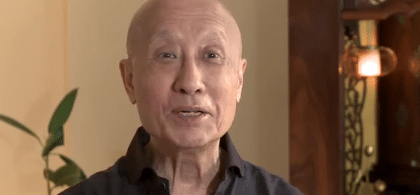
A few years ago, we produced a video about the renowned ballet teacher, who was then 77, for our “Living!” series. Finis Jhung inspired me in the same way that he has inspired thousands of others who have taken his classes and watched his videos. I began to do the stretch and it felt great. My back eventually eased up and parts of me moved more fluidly. Thinking about Finis made me smile and I got in touch to find out how he was doing.
At 83, he’s retooled his teaching and, because of the pandemic, designed classes for people to do at home through Zoom. He said, “Since the shut-in, we’ve been doing online classes and now we are in our 30th week of Zoom classes five days a week. I actually enjoy Zooming because I can see so many students from all over the U.S. as well as Hong Kong, Canada, the UK and Portugal. I have 2 TEAM FINIS demonstrators who lead the class so I can watch and correct.”
Finis had been teaching regularly at the Ailey School and that’s where we shot his classes and interviewed students. But now he can come to you directly through his regularly scheduled Zoom sessions as well as through the videos that he has produced.
When you watch our video, you’ll find that Finis treats his students like professionals and helps them get the most out of their bodies and their time with him.
At the time he explained, “Working with adult beginners at the Ailey School has been wonderful for me because you are dealing with adults who for the most part have never danced. They don’t have ballet bodies, they don’t have ballet minds. But they are people who love ballet.
“They have always wanted to learn and they work so hard. And they start to change,” he told us. Finis thinks many of us, especially as we age, need to pay more attention to our posture and how we move.
He said, “If people could have some kind of awareness about posture, so that they balance their body properly, they are then able to walk more smoothly. Many of us get caught up in moving around without considering how we hurl ourselves through life.
“I can look out my window and I watch people walking on the street, and a lot of people are just kind of constantly in the state of falling forward and trudging,” he continued.
Looking at our devices as we walk, sit on a bus or subway or in front of our computers often causes our heads to droop and puts pressure on our necks and shoulders. That affects the way we walk when we stand up.
Finis offers this tip: “If I had one tip to give you about posture, it has to do with your head, because you must remember that your brain is in your head, so it is very important. Yet with most people the head is falling. What I teach my beginners is: Lace your fingers and put your fingers on the back of your head.”
Finis Jhung’s kitchen sink stretch offers a prescription for staying healthy. When we made this video three years ago, Finis demonstrated and explained that it’s part of his routine. He wakes up every morning, spends time in mediation and prayer and then stretches. “I stretch every part of my body,” he told ConsumerMojo.
The renowned ballet teacher thinks all of us can benefit from a good basic stretch, especially people over 65. He demonstrates a stretch that you can do at home in your kitchen. You don’t need any special props, or tools.
All you need is the kitchen sink. But you want to make sure to ask your doctor or health professional if this is okay for you to try.
Finis Jhung’s Kitchen Sink Stretch
1. Grip the edge of your sink and hold on tight. You want to make sure you don’t slip.
2. Stand with your feet planted hip width apart about two feet away from the sink.
3. Pull your belly in and push all the way back. Keep your arms straight.
4. Keep your head down, in neutral, as though you are floating in water.
5. Hold for a count of 15-30.
6. Keep your head down. Tilt your pelvis forward. Push in with your stomach. Press down into the floor.
7. Bend your knees. Keep your arms straight and push up while you press your feet down.
8. Stand slowly.
9. Now you want to go the other way.
10. Pull your stomach in.
11. Look up. Be careful if you have neck problems. (Ask your doctor if you can do this,)
12. Lean into the sink. Arms bent. Shoulders down.
13. Arch your back.
Be careful if you have lower back problems. (Ask your doctor if you can do this.)
14. Don’t go too far.
Then you can stand up straight and Finis says, “You feel a lot taller.”
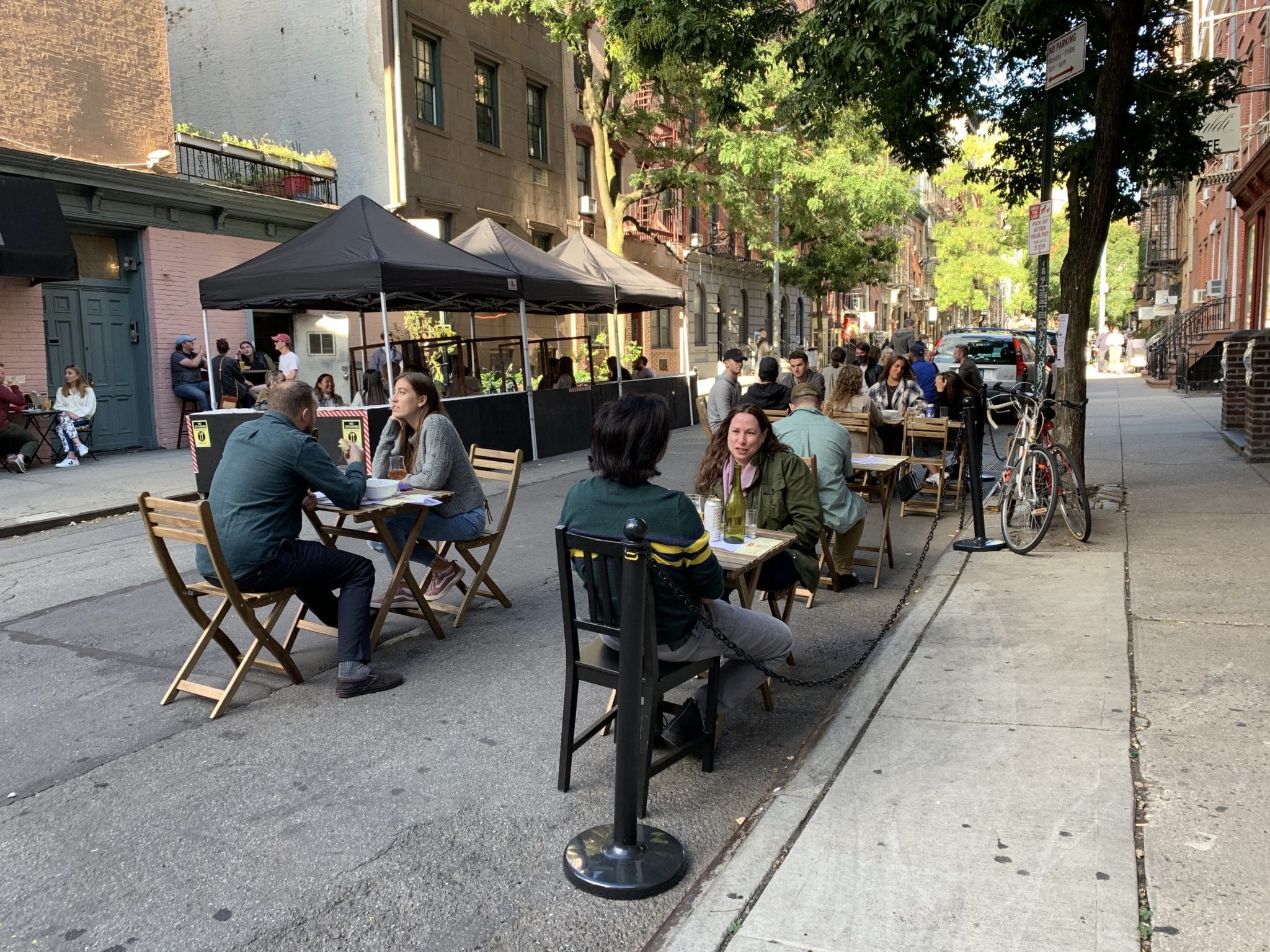
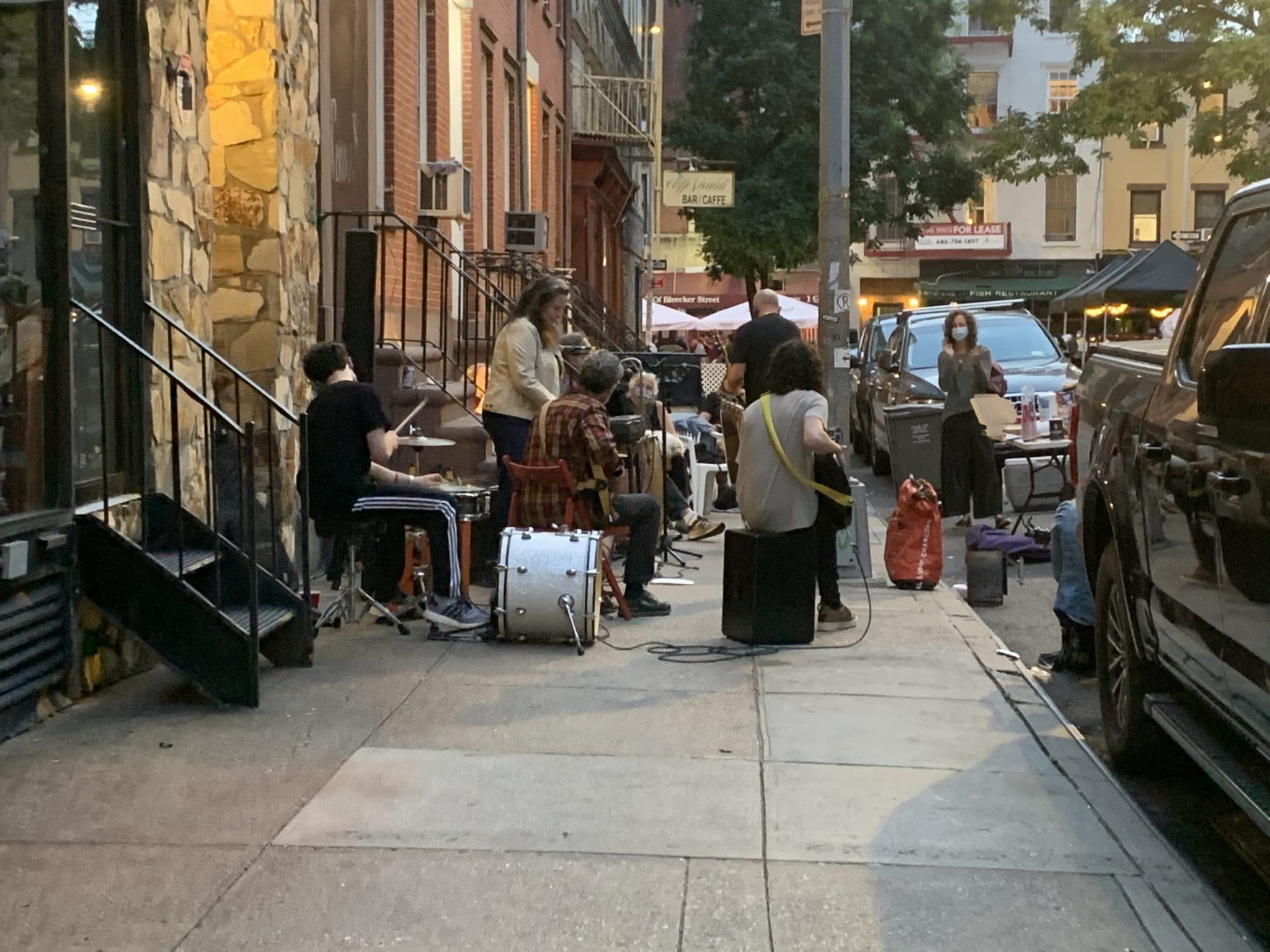
Live music bounced through our closed windows and it sounded like people were having fun outside. This wasn’t the muted noise we usually hear on weekends with the pandemic in full swing. We live in Greenwich Village and our street closes at noon on Saturdays because the bar at the corner sets up tables outside for food and drink.
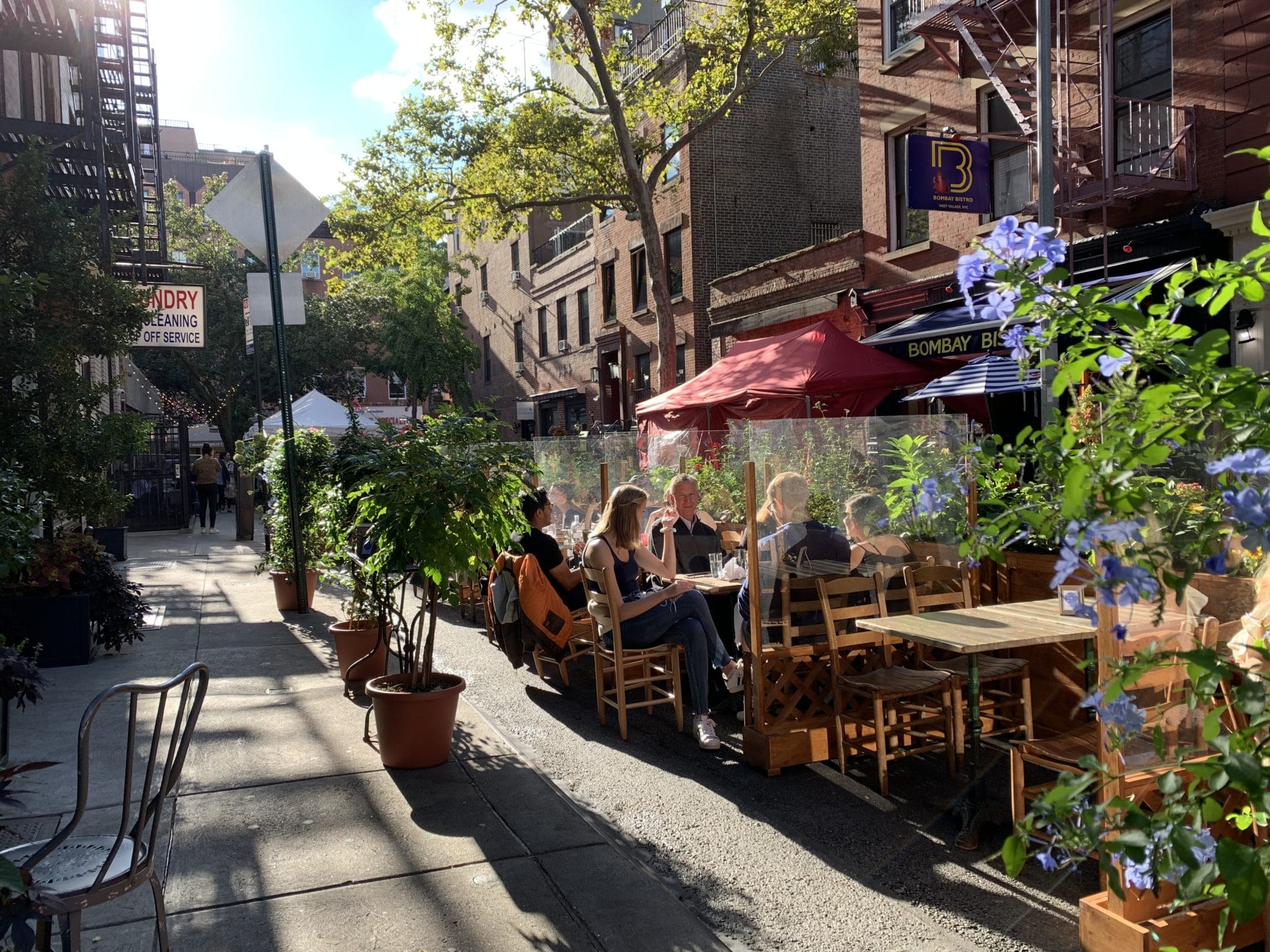
Restaurants on the surrounding streets Bleecker, West Fourth and Cornelia have attractive setups outside too and we root for them to survive and make it past COVID-19.
But this music was different, more exuberant, and when I went to do an errand with darkness falling in the early evening I found out why.
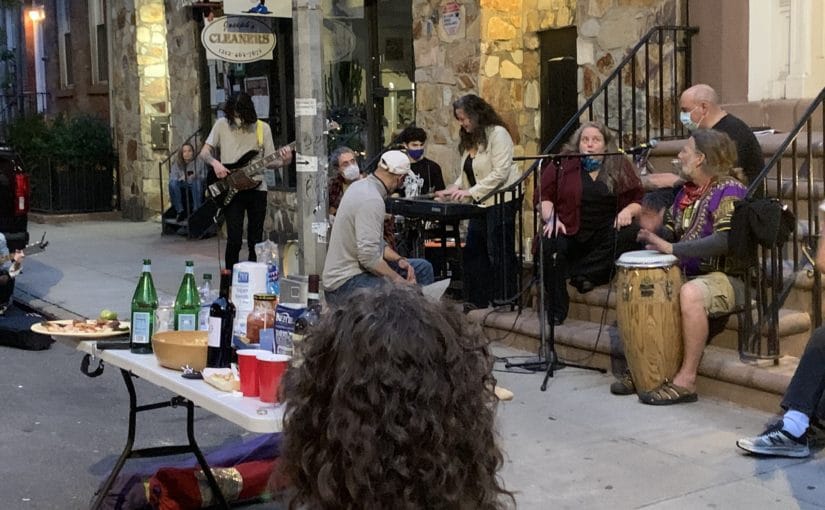
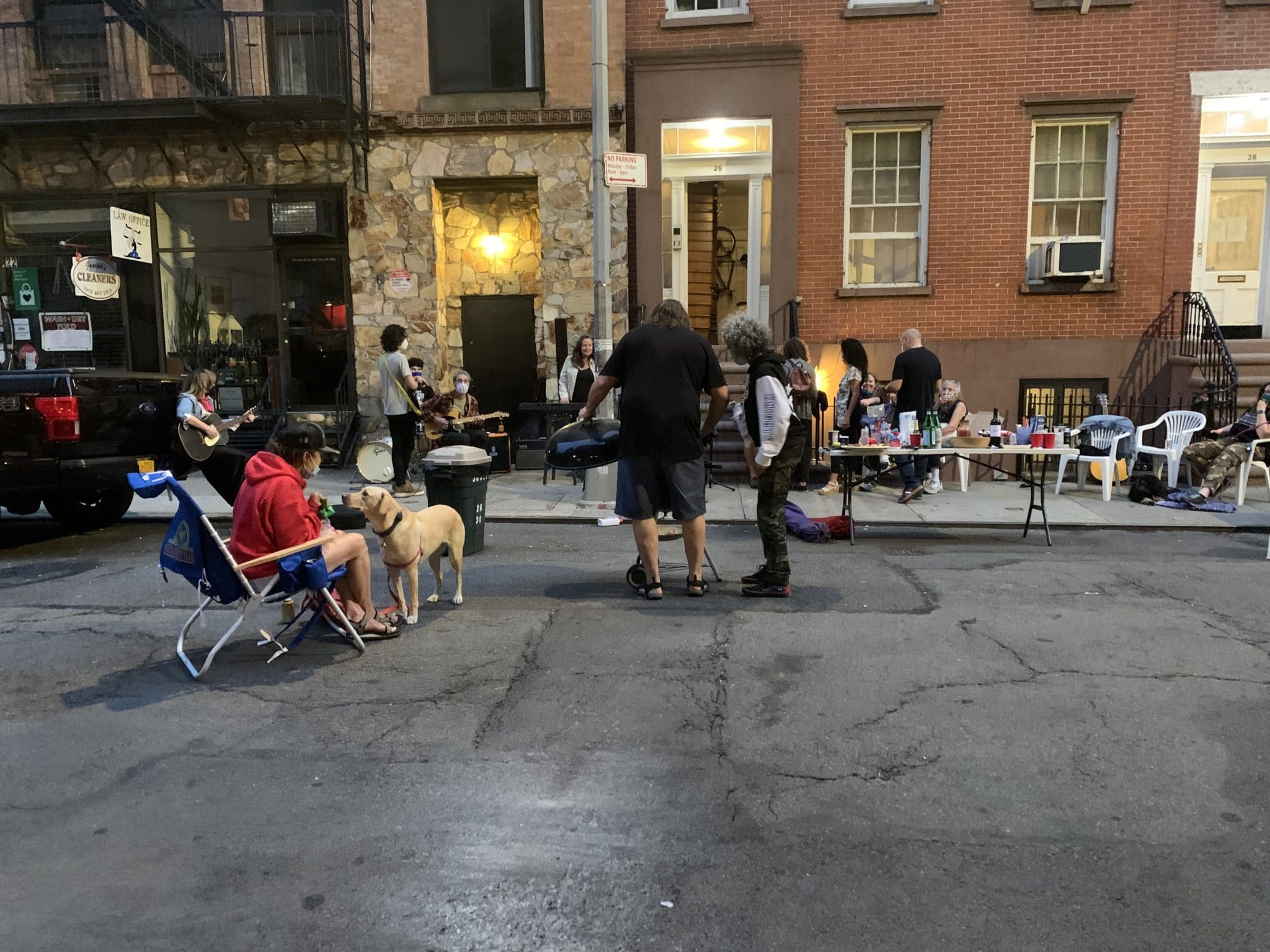
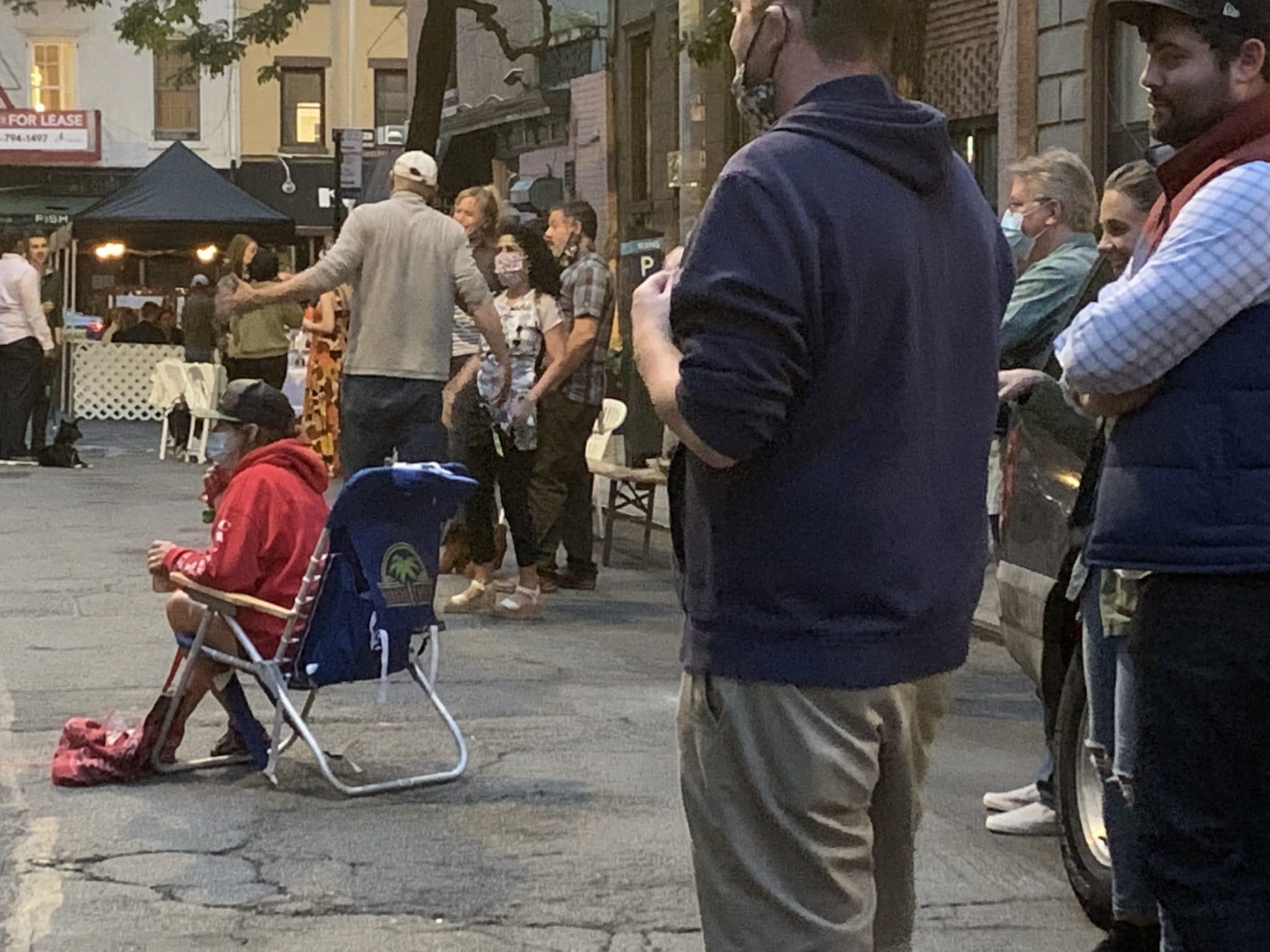
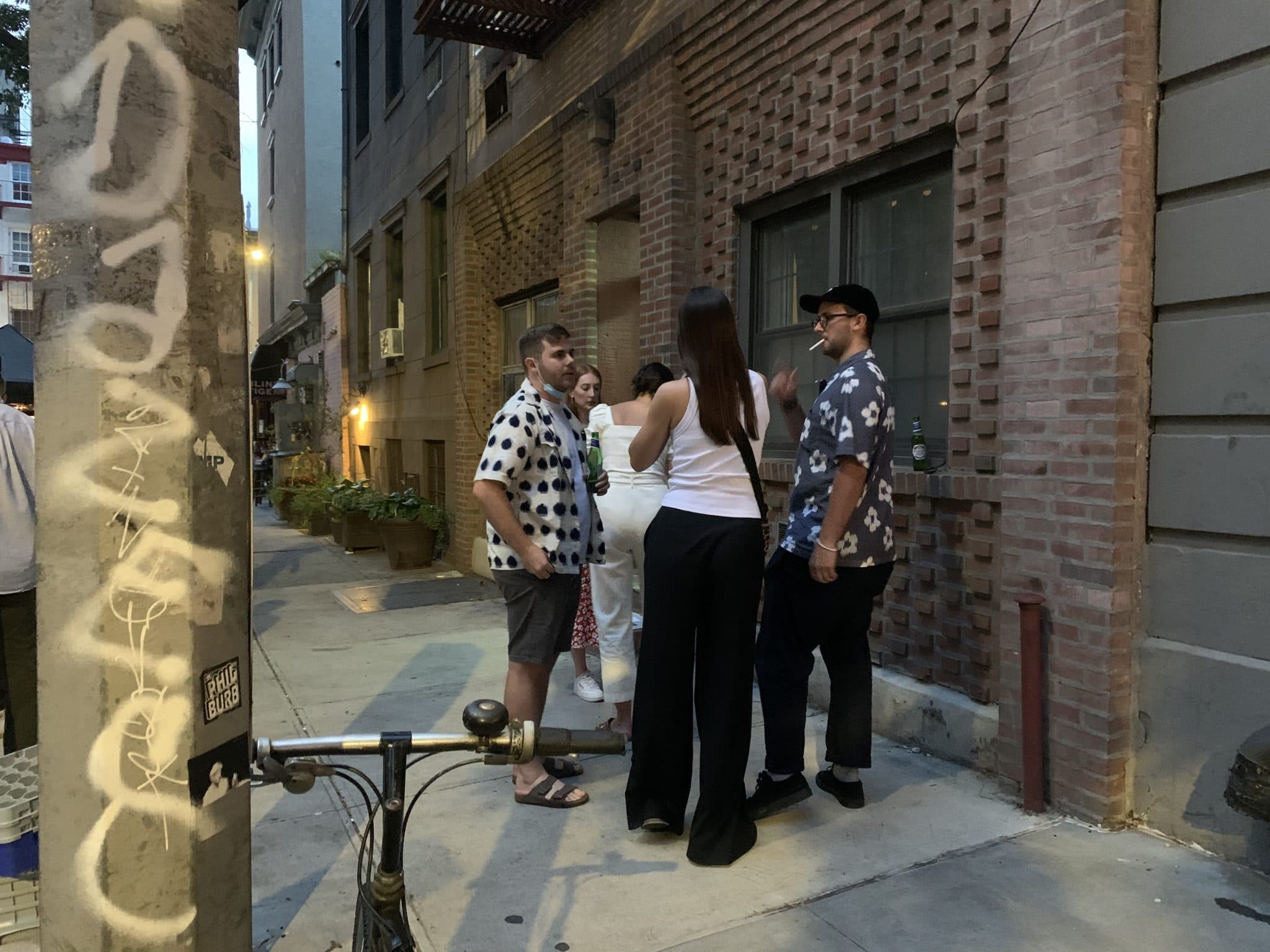
Despite coronavirus, our neighbors had set up for a jam and a mini block party. Most of the band members wore masks, and some of the onlookers did, but others didn’t.
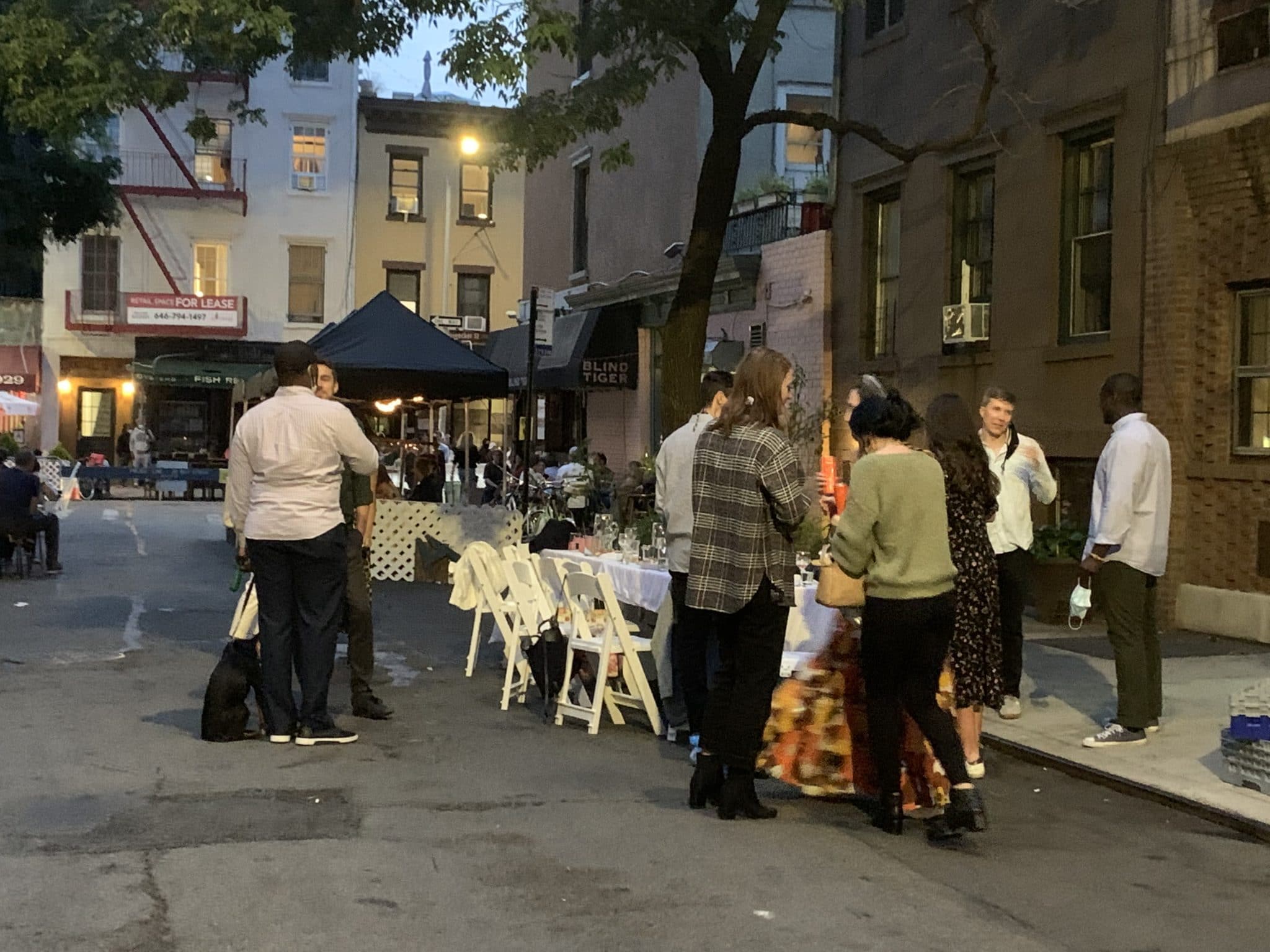
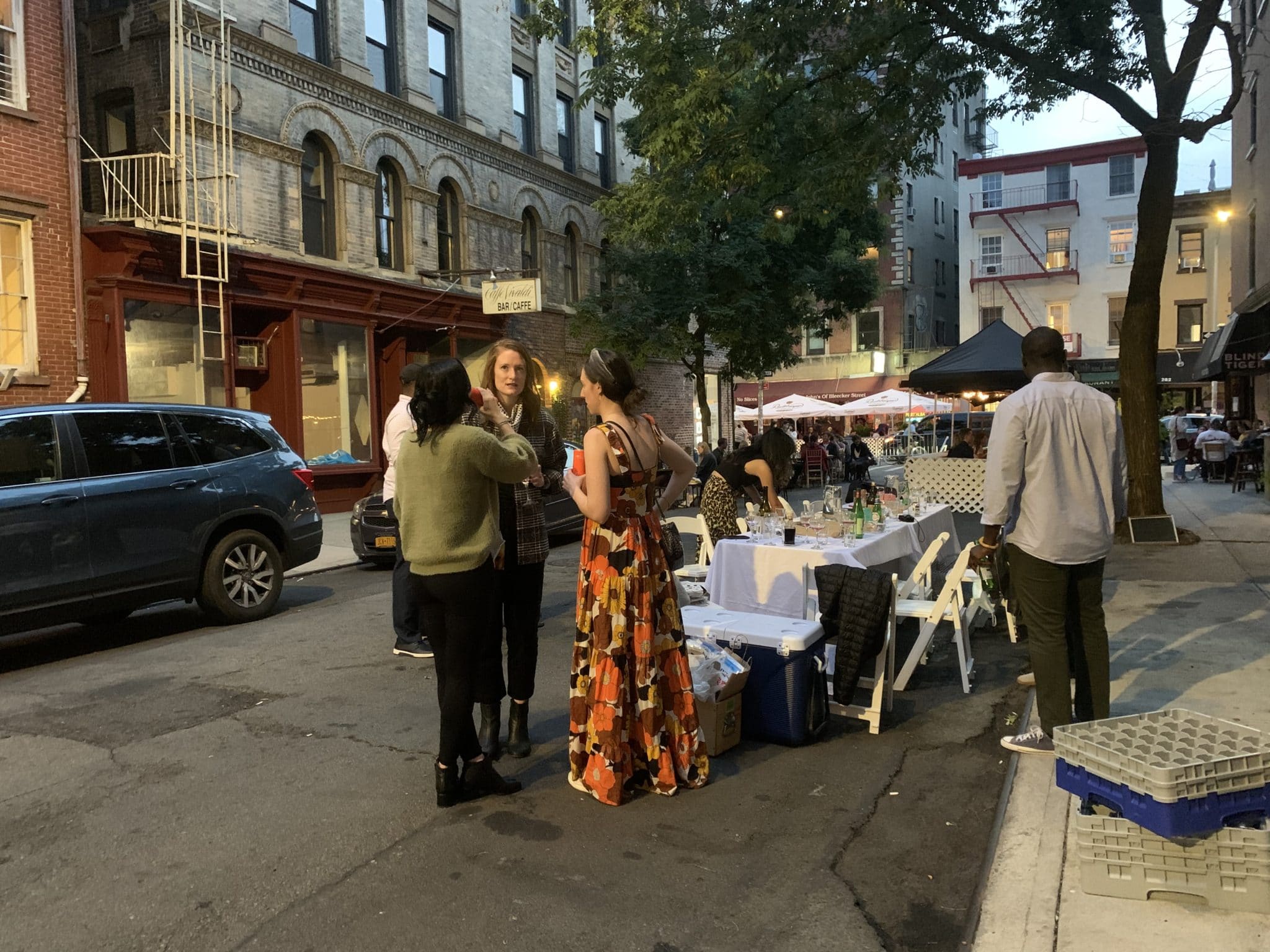
A couple of guys tended a barbecue grill. A little farther down the street a group that didn’t seem connected had set up an al fresco dinner party table. The folks who looked like they were part of it stood around with their masks dangling from their ears or tucked under their chins.
A guy I usually chat with came up to me as I took some photos and said, “It’s great, isn’t it? The music made me come outside.” I muttered through my mask, “Yeah. But look at the people not wearing masks.” He said quickly, “You’re wearing a mask and so am I.”
I nodded, but I felt out-of-step and like a kill-joy for worrying about the spread of coronavirus at a block party. I had to keep my distance from all. My 9/11 scarred lungs will be challenged by coronavirus and I, like millions of others, have taken care to protect myself.
My friend turned toward the dinner party table and said, “And look at that. It’s really cool, isn’t it?”
Really cool, in another era when a potentially deadly virus doesn’t drift through the air. I stepped farther away and took some more photos. A woman I know well sat hunkered down in a lawn chair. Something made her turn toward me and her eyes brightened over her mask. “Great fun, isn’t it? How are you?”
Her partner stopped working at the barbecue grill and came toward me. “If you can’t beat ’em, join ’em,” he said. Just last week, he told me he worried about the party atmosphere on the surrounding streets.
But I guess COVID fatigue got to him and the others. I can’t blame them for wanting to be outside at the block party, to socialize and to have fun. So far in our zip code 419 people have tested positive. That’s a relatively small number compared to other communities. Here 29 people have died and that doesn’t come close to the suffering in Corona and Elmhurst and parts of the Bronx.
But we’ve gotten this far. Coronavirus rates are rising in other parts of the city. The coolest case for a block party would be to celebrate the end of the virus, when it is really gone. Until then, I’ll take a few photos from a distance, stay away and continue to feel that I am out-of-step.
Those poor lonely women. All young, all single, all good-looking in a cookie cutter kind of way. And with the most exotic names! My goodness, the double vowels alone simmer with the mystery of foreign shores just waiting to be discovered and explored.
And yet they have no friends on Facebook. This is why they’ve come to my attention. They searched the site, were captured by my winning smile, sensed my natural empathy and online bedside manner, and understood that I’m older but saw me as a potential mentor. I’m sure that’s why they reached out to friend me.
This has happened quite a bit lately. So much so that I decided to ask my actual Facebook friends what they thought was up. I got a lot of answers. People have been having the same problem, and not just men of a certain age being trolled by bots pretending to be beautiful young women.
One woman friend wrote that she got friend requests from guys claiming to be widowed. Another said she gets a lot from older single guys, of whom her favorite was named “Ari Zona.” She went on to describe a pattern of men wearing military or medical uniforms, with usually a close-up of a flower thrown in. A third said she also was hearing from foreign men in uniform.
And of course I got some snarky — and funny — answers like: “I thought Natasha was interested only in me.”
But the most succinct — and I’m sure accurate — response was: “They’re all crooks, from around the world, just trying to get access to your friends list and otherwise get access to and abuse your personal information.”
Another to-the-point remark was “Don’t download anything from them. Nothing. Delete and run for cover!”
Of course, as November 3 nears with the news that Russia continues to tamper with voters using Facebook and other social media to turn the election in Trump’s favor, it’s more important than ever to protect yourself online.
Fortunately, Facebook recognizes this problem and has a setting that lets you decide from whom you want to see friend requests. The link will let you choose to see requests only from people with whom you have mutual friends.
Sorry, Bikilaa and Margaa. It was fun while it lasted.
9/11 lives inside me although I try not to think about it. This week, I had to write a statement about 9/11 for the Victim Compensation Fund. The images remain indelible. But I tried to keep my response simple.
What do you remember about being there at the time?
When you ask a question like this, I close my eyes and sigh. 9/11 was a Tuesday, election day, and I was listening to the news on the radio and putting on makeup getting ready to go vote. A low-flying plane roared over our house in Greenwich Village and the small building shook. The radio went dead. My husband Nick Taylor came in from outside, breathless, and said that a plane had crashed into the North Tower of the World Trade Center. I said, “You have to come with me.” I called my office and Assignment Editor Elaine Higgins agreed that I should head to the towers. I put on a black dress, sneakers and grabbed a backpack.
Outside some of our neighbors huddled in groups looking shocked and confused. Others stood at the corner of Seventh Avenue South and Bleecker Street where they could see the burning North Tower
I remember the bright blue, cloudless sky as Nick and I headed south along Seventh Avenue South, which becomes Varick Street. Hundreds of people ran north and passed us without looking at us. We walked against this sea of people toward the towers. I called my office and learned that it was terrorist attack. Another plane had flown into the South Tower, one had struck the Pentagon, and a fourth had crashed in Pennsylvania.
Where were our intelligence people? Why weren’t they paying attention? Nick and I wondered.
As we got close an acrid smell filled the air and burned in our nostrils. We saw jagged flames shooting out of the North Tower and looked up to see people, tiny images in windows waving white flags, or shirts hoping to signal rescuers. Fire trucks, EMS, and police surrounded the buildings. We stood on Vesey Street near the foot of the North Tower and two sets of plainclothes detectives appeared beside us. They said they had been in their cars on the Brooklyn Bridge and like us had come to try to do something, me to report, they to help. We stood there together for a few minutes and then a creaking sound followed by a roar told us something was happening.
One of the detectives yelled, “Run! She’s coming down.” We ran north on Greenwich Street as the South Tower collapsed. Clouds of dust and debris shot around the corners of the buildings behind us. People ran beside us screaming. A heavy-set woman wearing heels fell and pushed herself to her feet again and kept running. Nick and I stopped at the corner. The burning smoky smell filled the air. I tried to reach my office but my analog phone did not work. The assignment editor had told me they were trying to get a camera crew for me and I wanted to connect with them.
It felt like a bad dream where everything slows down and you can’t move. Dust and shreds of paper filled the air. Nick and I stood close to the curb and looked up at the North Tower and watched the flames shoot out of the middle of the building. A helicopter flew close to the corner of the north windows. It wobbled. People high up near the top appeared like little white dots. The helicopter rocked back and forth. I thought and wished that the pilot would rescue people. Then the helicopter flew away. A second or maybe a minute later someone jumped, “No. Don’t do that,” I screamed as the body tumbled out of the window. A man near us said, “Maybe they don’t have a choice.” One person tumbled into the air after another. Sometimes it was two people together, holding hands.
We stood there unable to make a difference, to help. I knew the one thing that I could do was tell the story. I had to find a phone. We walked to Chambers Street. The area seemed oddly deserted. The sky was still bright blue and cloudless but smoke floated in the air. I saw someone in the closed McDonald’s and knocked on the door. The manager was alone and let me use the handset of his fax machine to call my office. The Assistant News Director Michael St. Peter told me that the WNYW-Fox5 truck was getting into place on Avenue of the Americas a little north of where I was. They were waiting for me to do a live report.
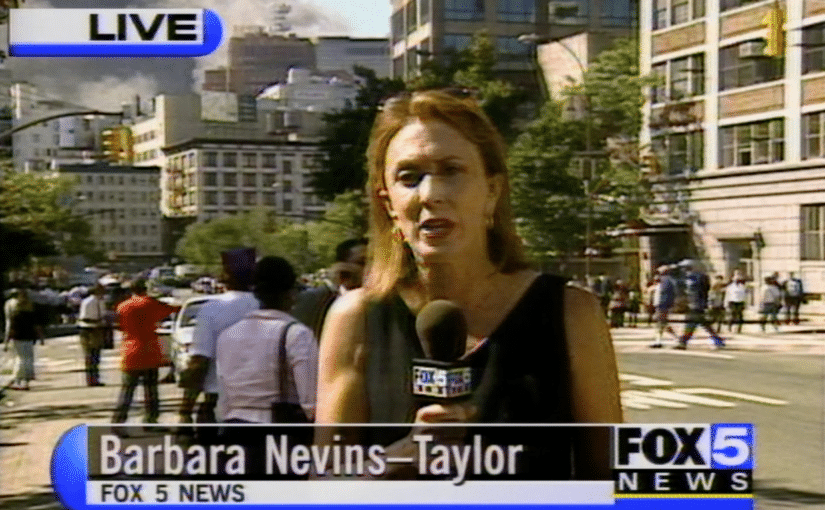
Nick and I headed up Church Street. A crackle and roar tore through the air. We turned to see the North Tower collapsing straight down like an accordion closing. Black dust and debris chased us. I thought for a minute that the scaffolding on the front of the Department of Human Resources building would fall on us. We kept running and just north of Canal Street reached the Fox5 truck and the crew where I began to report live for the rest of the day.
Here’s an outrageous story reported by The New York Daily News about how the federal government withheld money from the funds dedicated to provide healthcare for fire fighters who responded to 9/11.
It starts like this:
“The Trump administration has secretly siphoned nearly $4 million away from a program that tracks and treats FDNY firefighters and medics suffering from 9/11 related illnesses, the Daily News has learned.
The Treasury Department mysteriously started withholding parts of payments — nearly four years ago — meant to cover medical services for firefighters, emergency medical technicians and paramedics treated by the FDNY World Trade Center Health Program, documents obtained by The News reveal.” Read More.
A friend I know from college posted something on her Facebook page the other day that was so stunningly eloquent in pain and outrage that it crystallized a moment.
Here is what Betty Jo Allen, a mother, grandmother and lifelong teacher in Lincolnton, North Carolina, now retired, wrote:
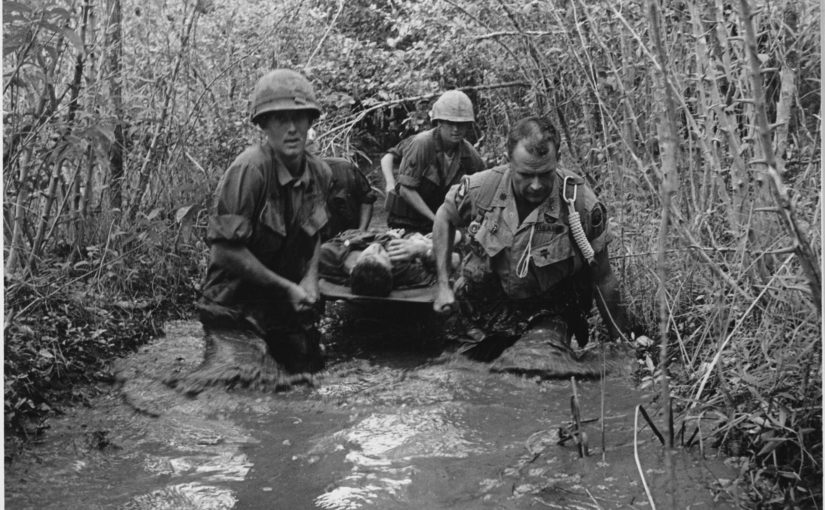
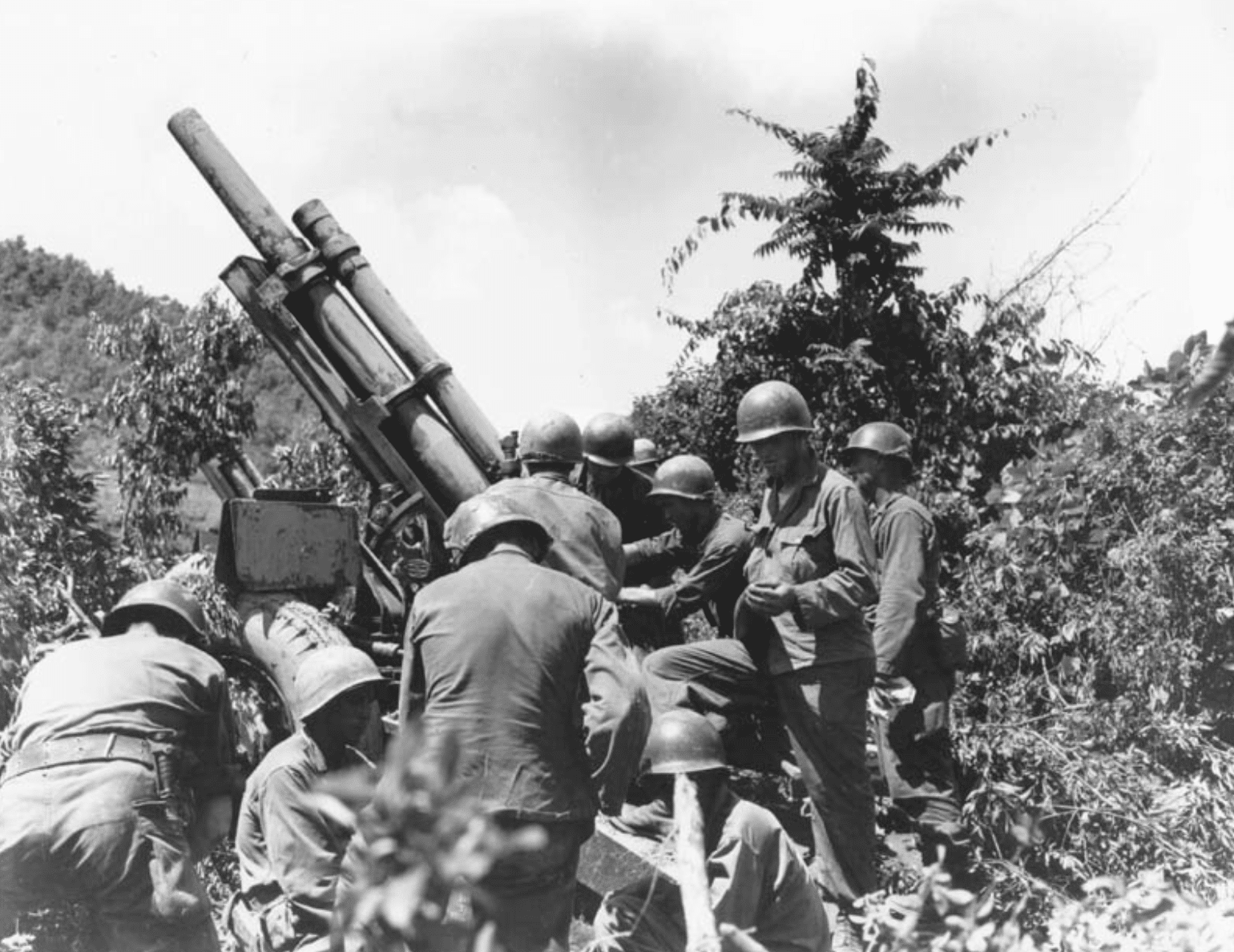
“I am at a loss for words over the latest revelation about Trump in The Atlantic, and do not doubt for one minute the truth of that article. As I heard about the article, heard the words of Trump about his opinion of people who serve in the military, people who are wounded, and those who gave their life in service to our country, my body shook, and tears welled in my eyes, for never have I heard any comments so despicable regarding the U.S. military. All I could think about were my dear friends who so bravely, courageously, and proudly served during the Vietnam War, some of whom were physically injured, all of whom carry with them to this day, the impact of that war. I think of my father’s generation, their service in WWII and Korea, where they also proudly, courageously, and bravely fought for our country.
Korean War 1950. U.S. Military Photo
From the communication I have had with a few of those men, I am well aware they also carry scars from their service. But, I do not doubt for one moment if they had the opportunity to serve again, they would, because of their love of our country and their willingness to sacrifice all, if necessary, to preserve our freedoms.
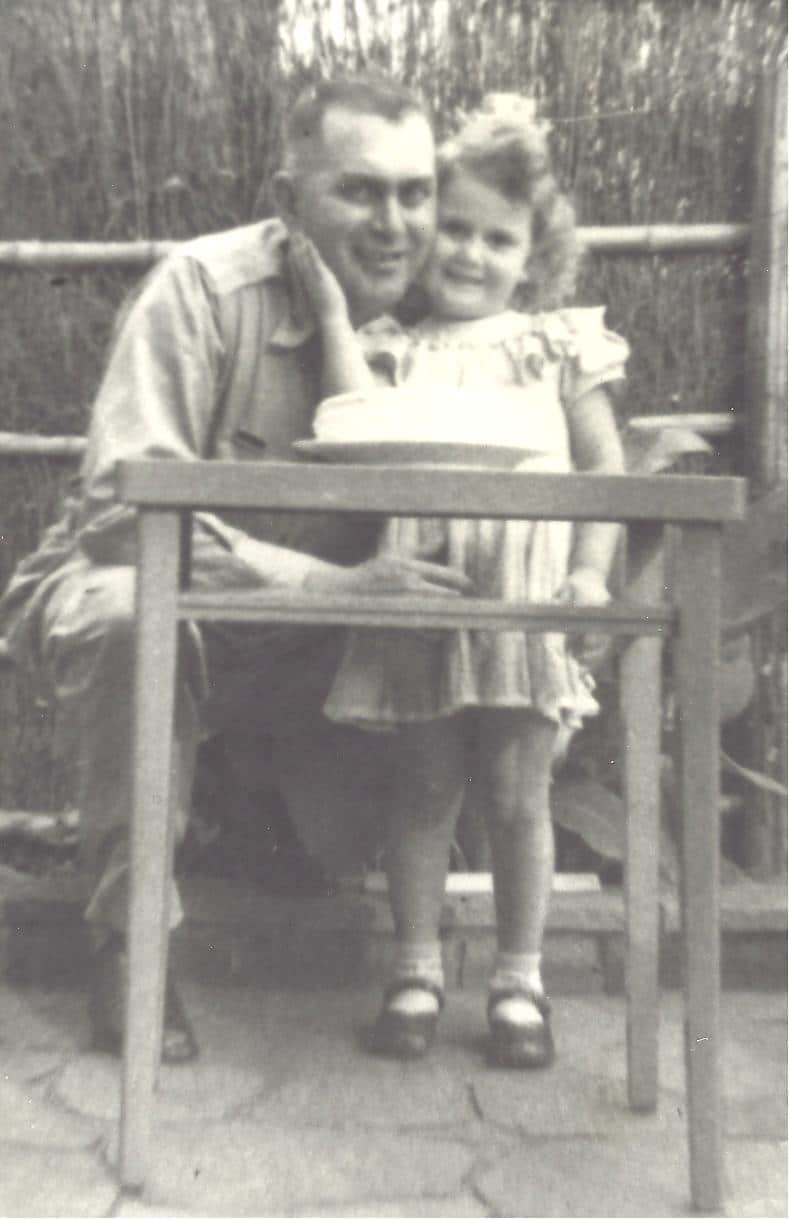
“And of course, my father Claude Evans Allen, my hero, is never far from my mind on almost any day. I was not blessed with a father in my home because he was killed in action in Korea, when I was only four.
Betty Jo Allen and her dad Claude Evans Allen. Photo Courtesy Betty Jo Allen
Now to hear that the President of the U.S. considers men like him to be losers and not smart because they gave their lives for a cause greater than themselves, is almost more than I can stand.
“As I shared above, when I heard of this report, the lifelong grief I have felt over the loss of one so dear to me, one I loved as only a little girl could love a father she adored, emotion welled up within me. How could anyone be so hardened to goodness, unselfishness, duty, love of country, to ever say such things against our military? It is unthinkable in my mind! And yet, once again this man has shown us who he is. This time, I do pray more people will actually see it and believe it.
“He has been telling us his whole life, and yet, some have refused to believe.”
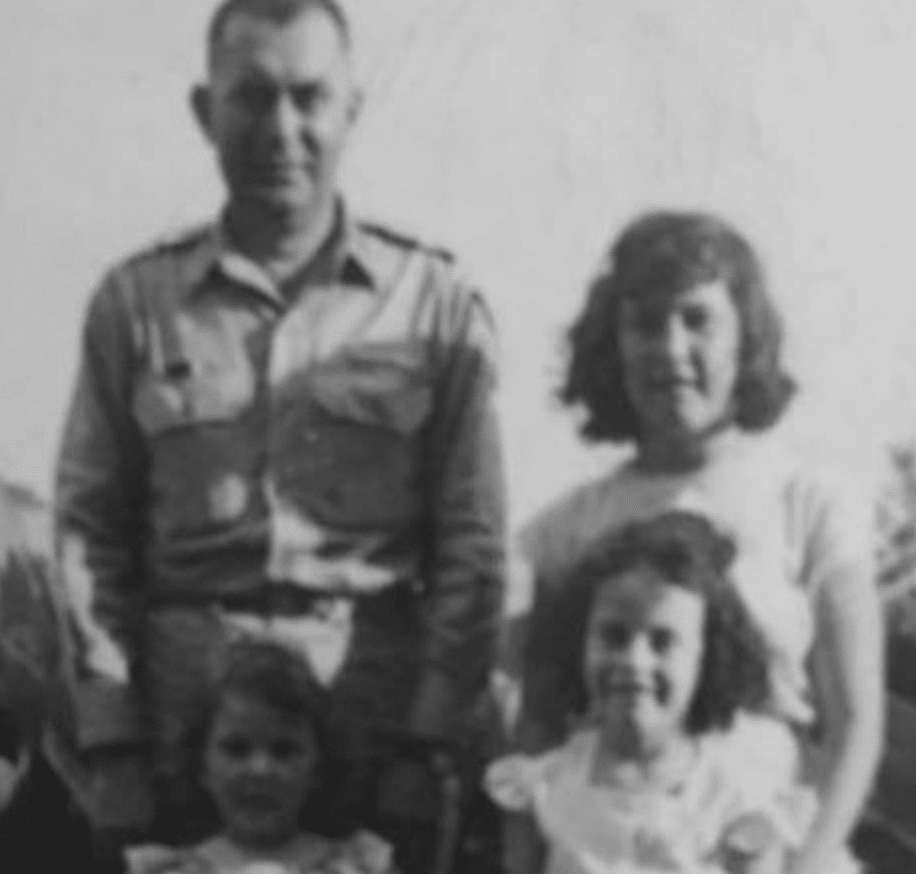
Major Claude Evans Allen was 36 years old when he was killed in action in Korea. He received a Bronze Star for his service in World War II and another for Korea. He received the Silver Star for his service in Korea and was posthumously promoted to Lt. Colonel.
Betty Jo Allen, Major Claude Evans Allen, sisters Margie and Sonni. Photo Courtesy Betty Joe Allen.
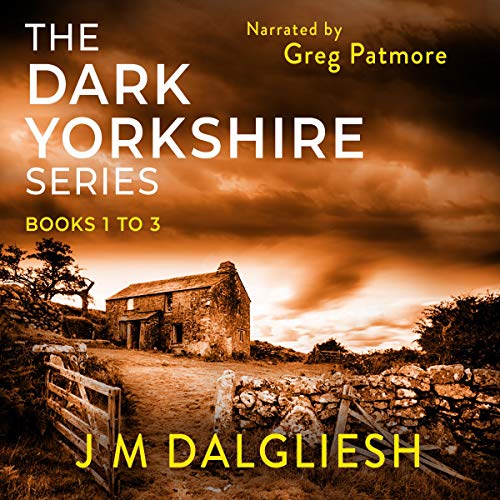
A series of British police procedural thriller audiobooks turned me into a compulsive listener of one author. I had never heard of J.M. Dalgliesh before an offer from Audible popped up on my phone. At first I thought the author’s name might be a riff on the Adam Dalgliesh character created by the great P.D. James.
Turns out I was late to the party. British author Jason Dalgliesh had success with the Dark Yorkshire Crime Series in 2018. He wrote six books about Yorkshire Detective Inspector Nathaniel Caslin. The first of the thriller audiobooks showed up in early 2019.
I usually branch out and listen to different authors, genres and narrators. But recently, maybe because of COVID-19 and all of the uncertainty the virus created, I seemed to need the comfort of Greg Patmore’s compelling narration that wrapped me deep in the life of D.I. Caslin.
Audible promoted The D.I. Caslin Box Set by J.M. Dalgliesh, which had three books narrated by Greg Patmore. Each book takes you further into Caslin’s life and the extreme and maybe unlikely danger and violence that finds him with every case. I was willing to suspend belief. On his website, Dalgliesh describes his work as crime thrillers with a “touch of Scandinavian Noir.”
In the books, the dedicated cop often seems dedicated to going his own way and that takes him away from his family. So you have a complicated cop and crimes that involve newsy victims like refugees, grown children trying to connect with the past of absent parents, and villains including mobsters from the Balkans and twisted deep state intelligence officers.
###
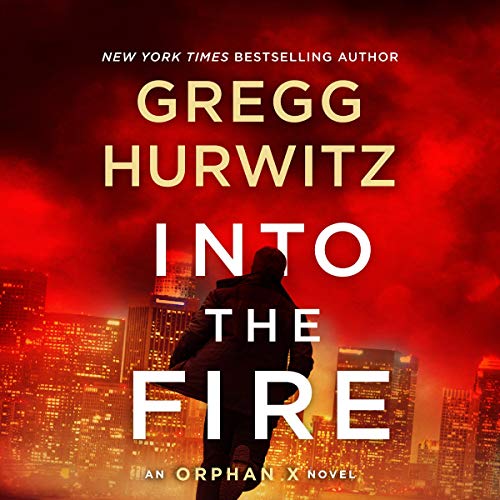
If thrillers with violence hook you, I also like the Orphan X series created by Gregg Hurwitz and narrated by Scott Brick.
Into the Fire may not be everyone’s audiobook of choice. But I have enjoyed every macho, action-packed book in this violent series. Scott Brick narrates the breathless story of the last adventure of Evan Smoak. It’s not a spoiler to tell you that Smoak is a renegade government assassin. He’s a good guy, recruited from an orphanage when he was a child and trained to kill. But his handler also taught him to have a soul and that’s what make the series compelling.
Into the Fire is supposed to be Smoak’s last mission as a do-gooder defending someone who desperately needs help. Every time Smoak thinks he’s smote the dragon for his client, some other bad guy pops up. Horowitz builds the tension and excitement and while some of the situations are absolutely implausible, this audiobook was great entertainment. But full disclosure: I earned a black belt in full contact Japanese karate way back in the ’90s.
###
For more thrillers try the Cormoran Strike novels written by J.K.Rowling as Robert Galbraith. You can read about them here.
Helicopters whirr over our neighborhood. Protestors’ chants come at us like the dull roar of distant waves. COVID keeps me in the house away from the protests, away from physically reporting about them, or participating, which I want to do.
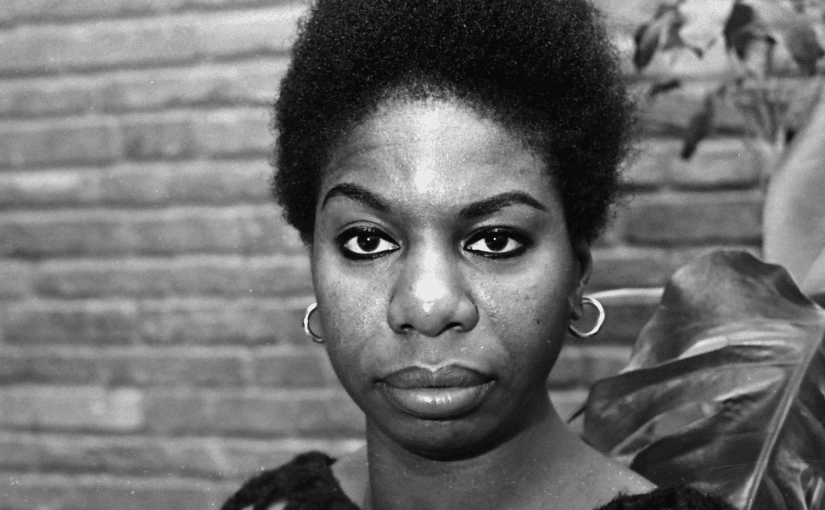
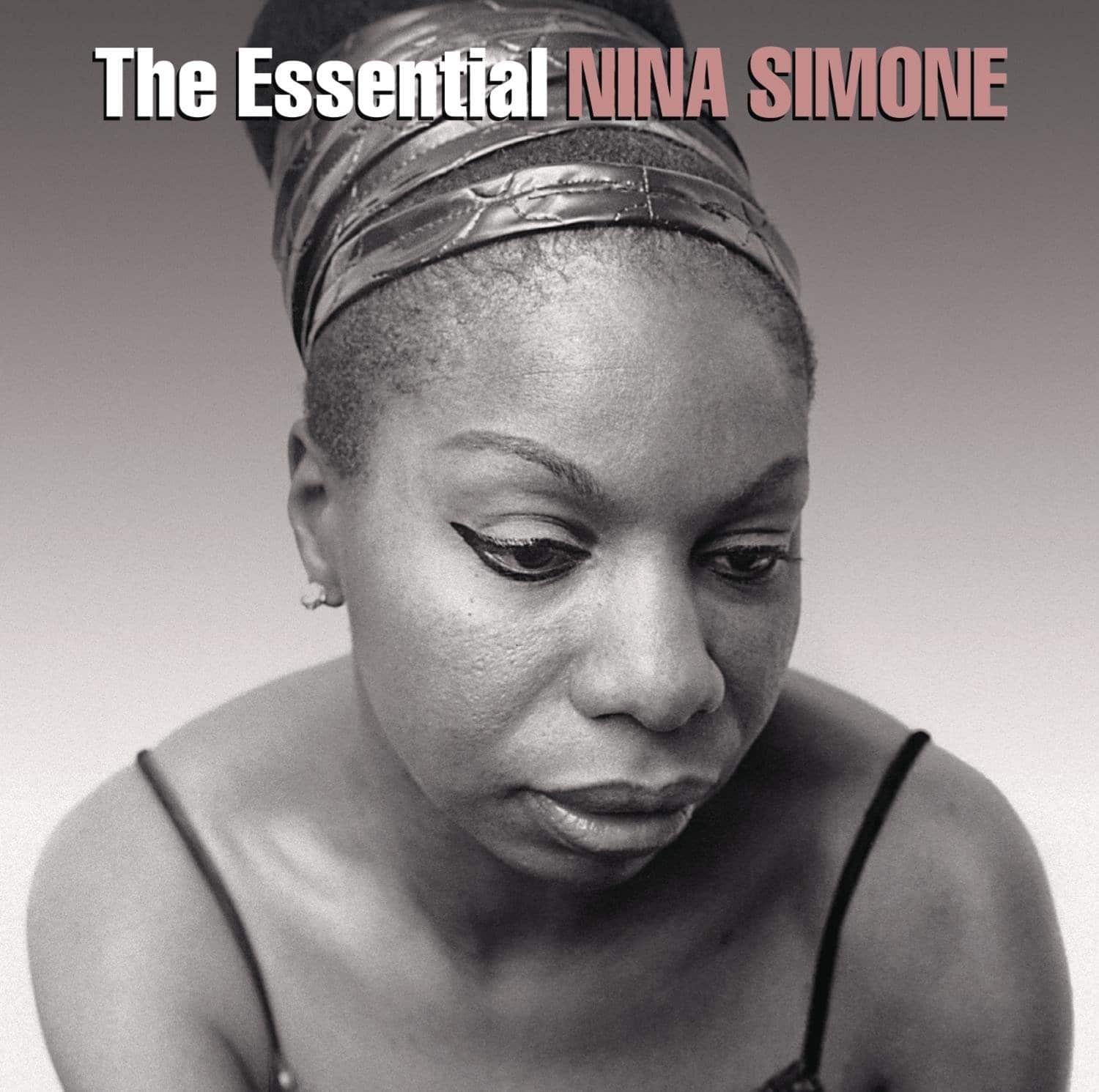
This morning I picked Nina Simone as the soundtrack for my COVID times birthday. The Essential Nina Simone, compiled and released by SONY Legacy in 2011, seemed to have all the right songs.
The music blew us back to the ’60s when we protested and marched for change. The songs made me furious all over again The lyrics sounded a call to action that felt as fresh and as right as they did when they were written and performed during the great civil rights era.
Backlash Blues, written by Langston Hughes, tells a story that still hits hard today. Here’s a sample of what I’m talking about.
Mr. Backlash, Mr. Backlash,
Just who do think I am?
You raise my taxes, freeze my wages,
And send my son to Vietnam.
You give me second class houses
And second class schools.
Do you think that all the colored folks
Are just second class fools?
It goes on.
You probably know about Mississippi Goddam, the song Nina Simone recorded at Carnegie Hall in 1964. Simone called it her “first civil rights” song. The lyrics highlight the frustration she and other black and brown people felt then, and there’s a loud echo in today’s Black Lives Matter movement. Here’s the refrain and a little more:
‘Do it slow’
Desegregation
‘Do it slow’
Mass participation
‘Do it slow’
Reunification
‘Do it slow’
Do things gradually
‘Do it slow’
But bring more tragedy
‘Do it slow’
Why don’t you see it?
Why don’t you feel it?
I don’t know.
I don’t know.
You don’t have to live next to me,
Just give me my equality.
Much has changed since I first listened to these songs over and over again and marched in the ’60s. Optimism and expectation fueled us then. We felt certain that what we did, what we said and the support we gave would make a difference. Being out there mattered.
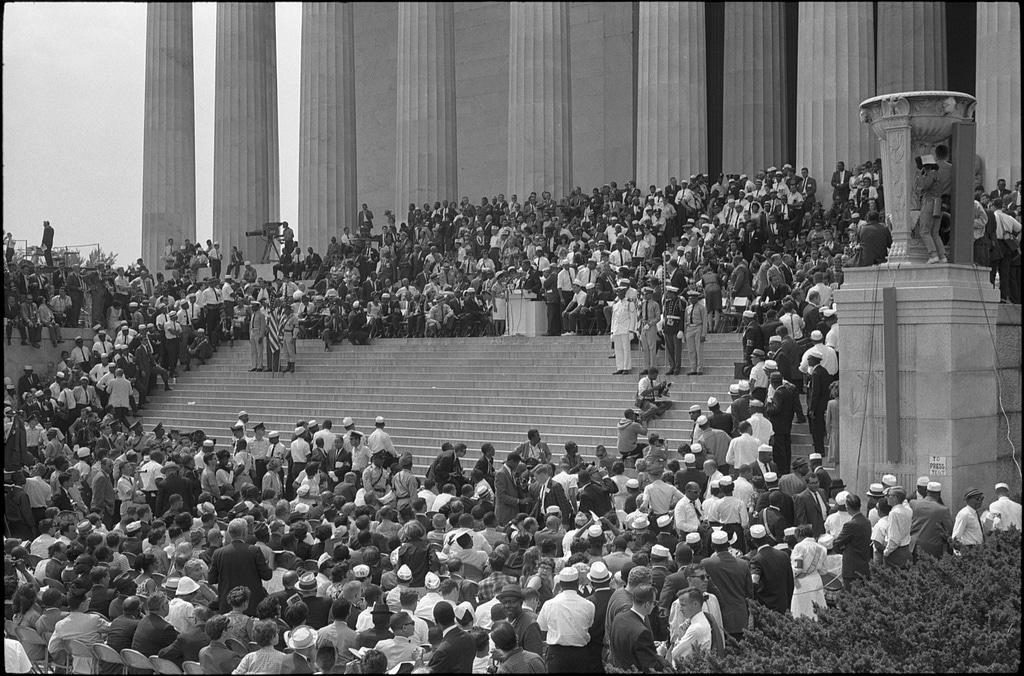
March on Washington 1963. Library of Congress Photo. Public Domain.
The Civil Rights Act changed things. The Voting Rights Act changed things. Federal and local anti-discrimination laws improved opportunity. But when you honestly look around you see that people of color still get treated like second class citizens. That’s wrong.
Why should a young black or brown man or woman fear for their life when they see a police officer? It’s wrong. But it’s real.
The actions and the indignities heaped on us by the Trump administration compound the historical problem. They make optimists like me fear for the future. Trump’s war against the people is a preview. His efforts to roll back voting rights, women’s rights, environmental protection, the right to healthcare, immigration reform and more touch every area we fought for. They undermine progress on broad fronts we have made over many decades.
It is infuriating all over again. I am glad that young people, the Portland Moms, and others are back in the streets even if I can’t be out there with them making “good trouble,” as the great John Lewis put it. They are a gift for my COVID times birthday.
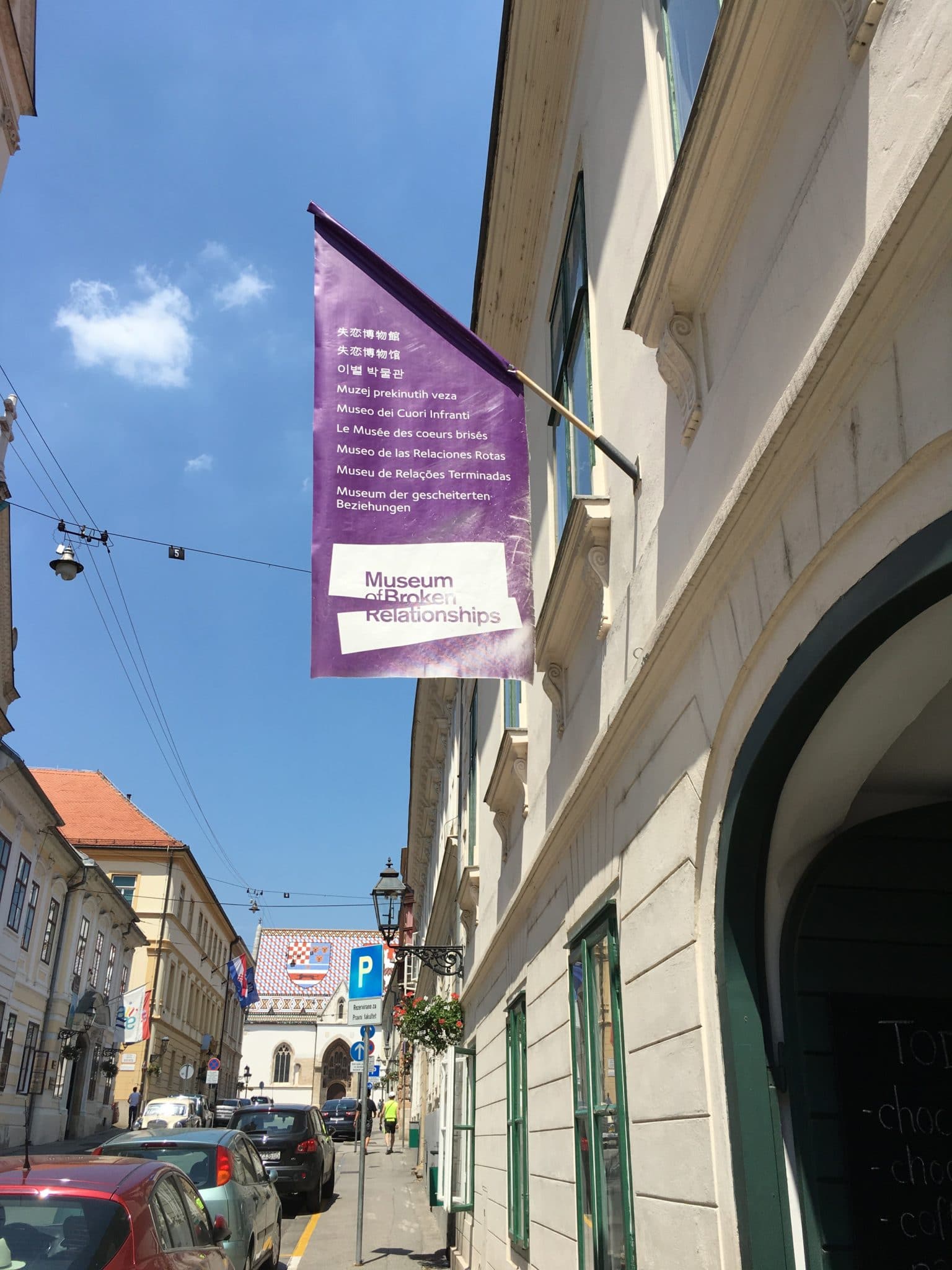
A few years ago in Zagreb, Croatia, Barbara and I visited the Museum of Broken Relationships. It was a compelling little place. Its displays told stories of passions grown cold, of devotion reconsidered.
Museum of Broken Relationships in Zagreb. Photo by ConsumerMojo.com
Old love letters crumpled for the waste can. Torn photographs. Objects once shared and now discarded. It was sad and heartening, recognizable and human. The message it sent is that people reassess and move on.
Right now a whole lot of people are reassessing some statues.
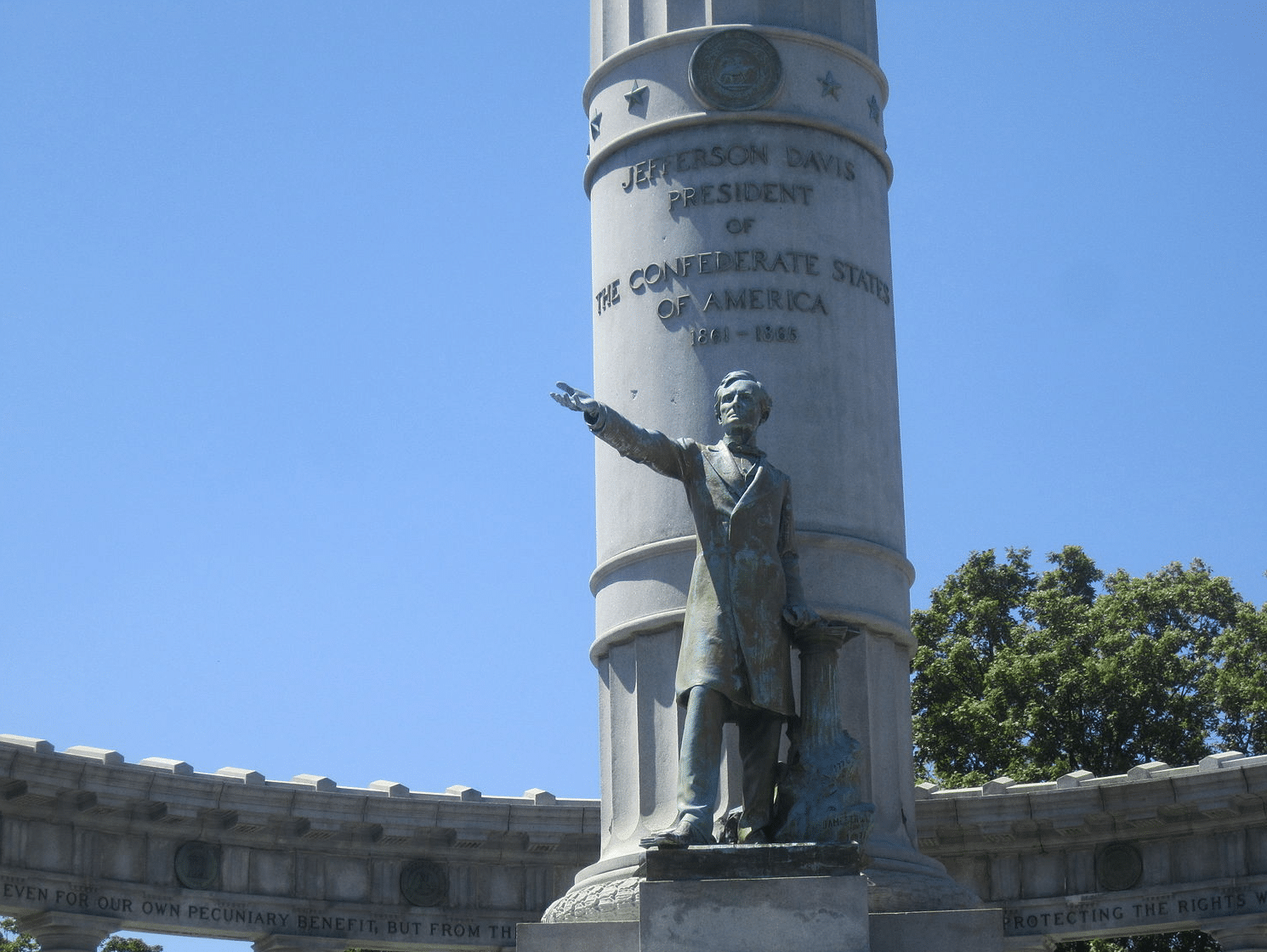
They depict men — they’re ALL men — we’re not so sure about as we once were. Confederate generals most of all.
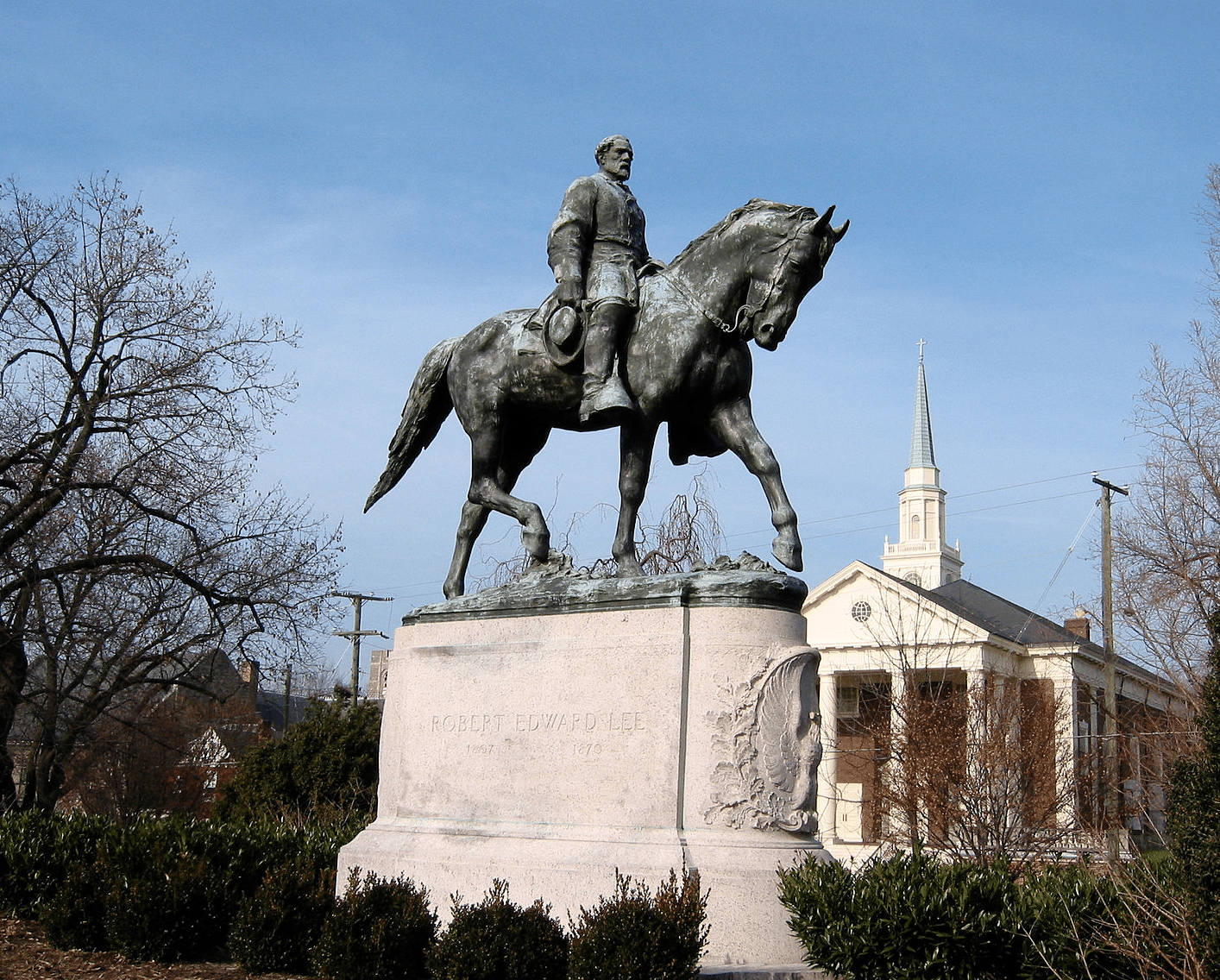
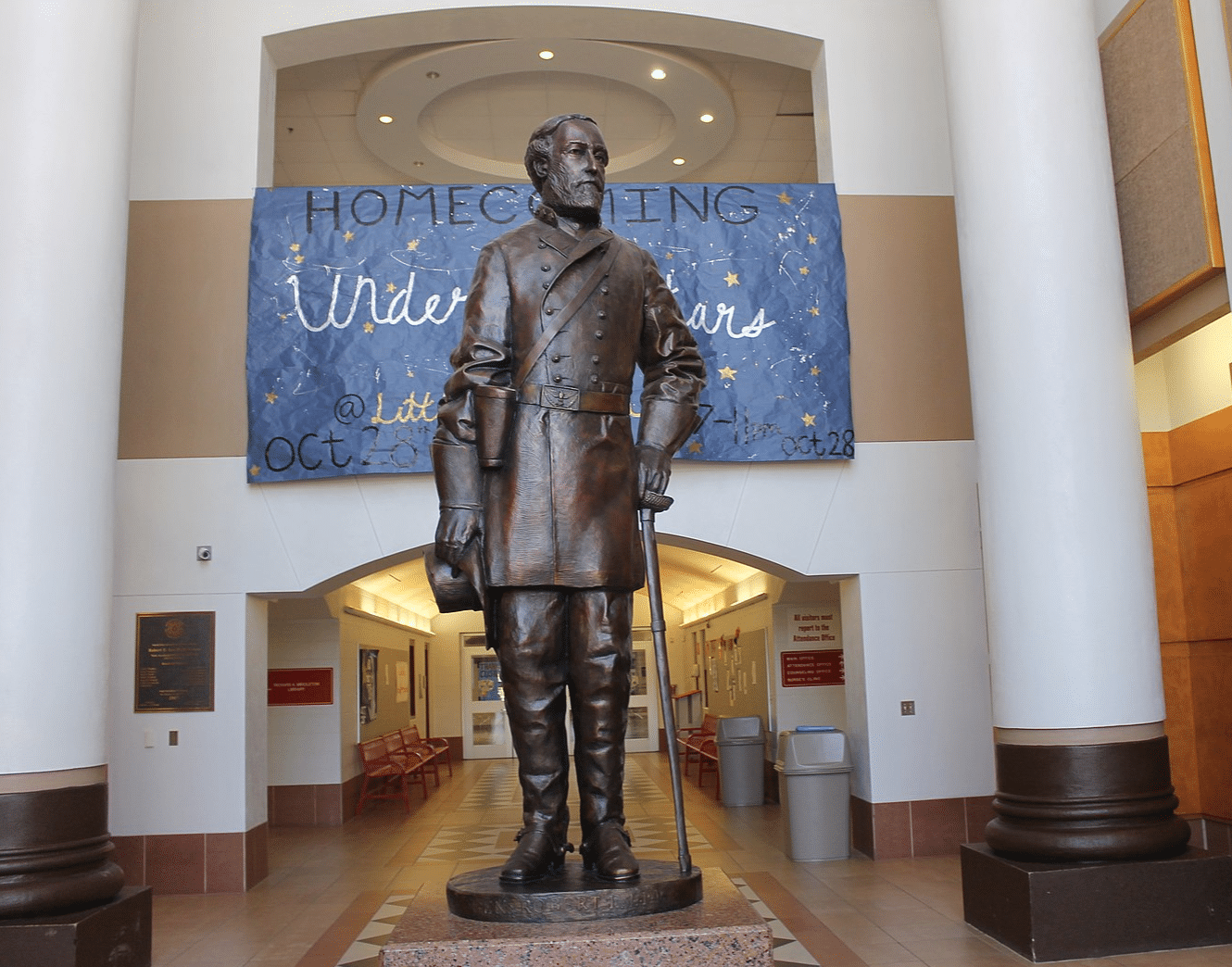
Robert E. Lee, Charlottesville, Virginia. Public Domain photo.
Explorers who pillaged what they found. Colonial overlords. Slave holders who penned eloquent words about freedom and equality. Expansionists who stole tribal lands and murdered their people.
These were men of their times. They did what they did in the context of their eras. Some of them stood for higher ideals than their times reflected, ideals better often than they lived.
We stuck with them for quite a while. But now they’re like old lovers we at last see clearly and face the whole truth of who they were. Here and there we’ll see things to still admire. But it’s time to remove them from the pedestal for history’s sake.
The Museum of Broken Relationships is a good model for these statues. Don’t tear them down and break them up. I propose a better place: a Museum of Reconsidered Statues.
In the Museum of Reconsidered Statues, Robert E. Lee astride his horse Traveler can still cut the figure of a brilliant general. But he’ll be gone from the courthouse squares where the Daughters of the Confederacy elevated him to reassert white supremacy after post-Civil War reconstruction gave way to anti-black Jim Crow laws.
A plaque will describe when and why his statue appeared throughout the South. It will describe his West Point career and his service in the Mexican-American War, his devotion to education as a college president, his respectful treatment of his slaves, his chivalry toward women, and his role as a traitor who took up arms against his country to preserve slavery.
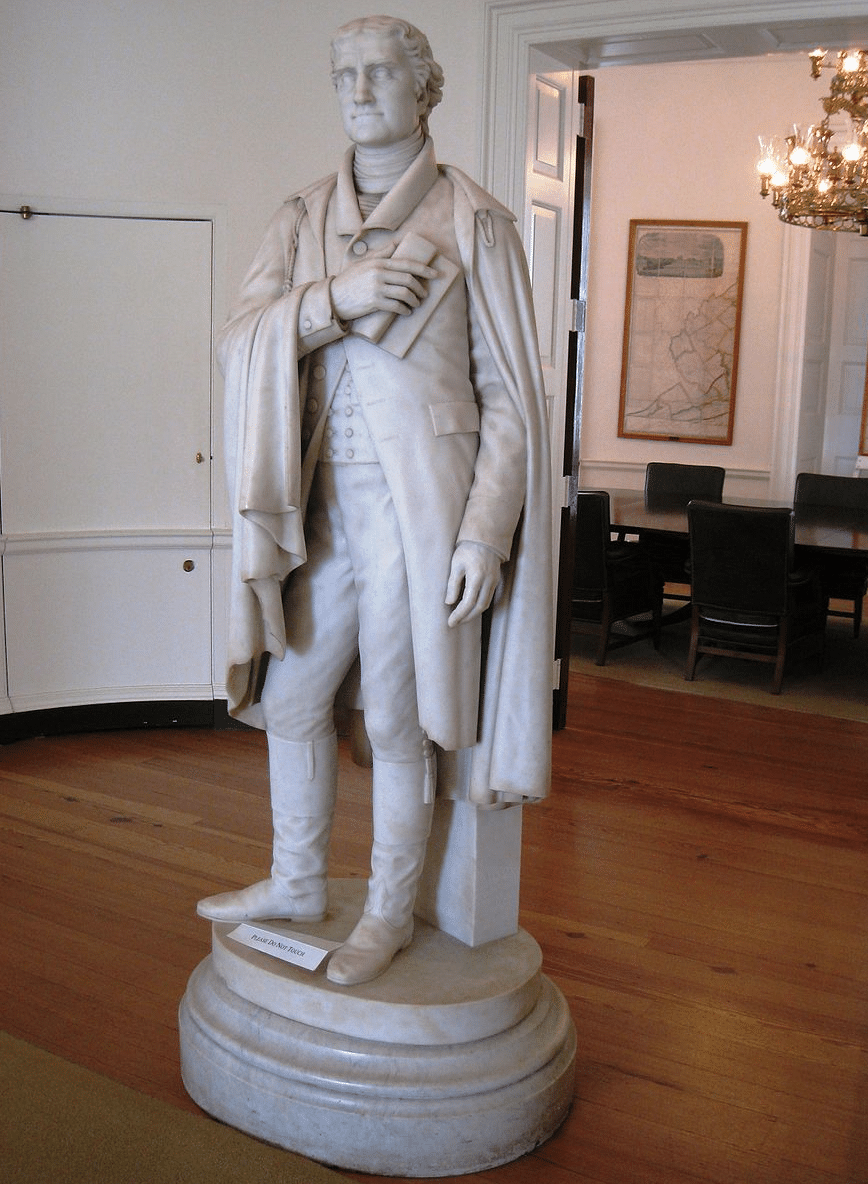
Thomas Jefferson Statute by Alexander Galt. Photo by Alexander Galt, Public Domain.
Thomas Jefferson deserves a place in the Museum of Reconsidered Statues. The founder and third president wrote the ringing words in the Declaration of Independence, “All men are created equal.” Yet the Constitution he helped write valued slaves three-fifths as much as whites for apportionment and Electoral College votes. Even this diminished value gave southern states political power slaves had no access to. Jefferson owned hundreds of slaves in his lifetime, sold them to pay his debts, believed they were inferior to whites, and believed they should be freed and recolonized to Africa. The plaque on his statue will give him extra points for irony.
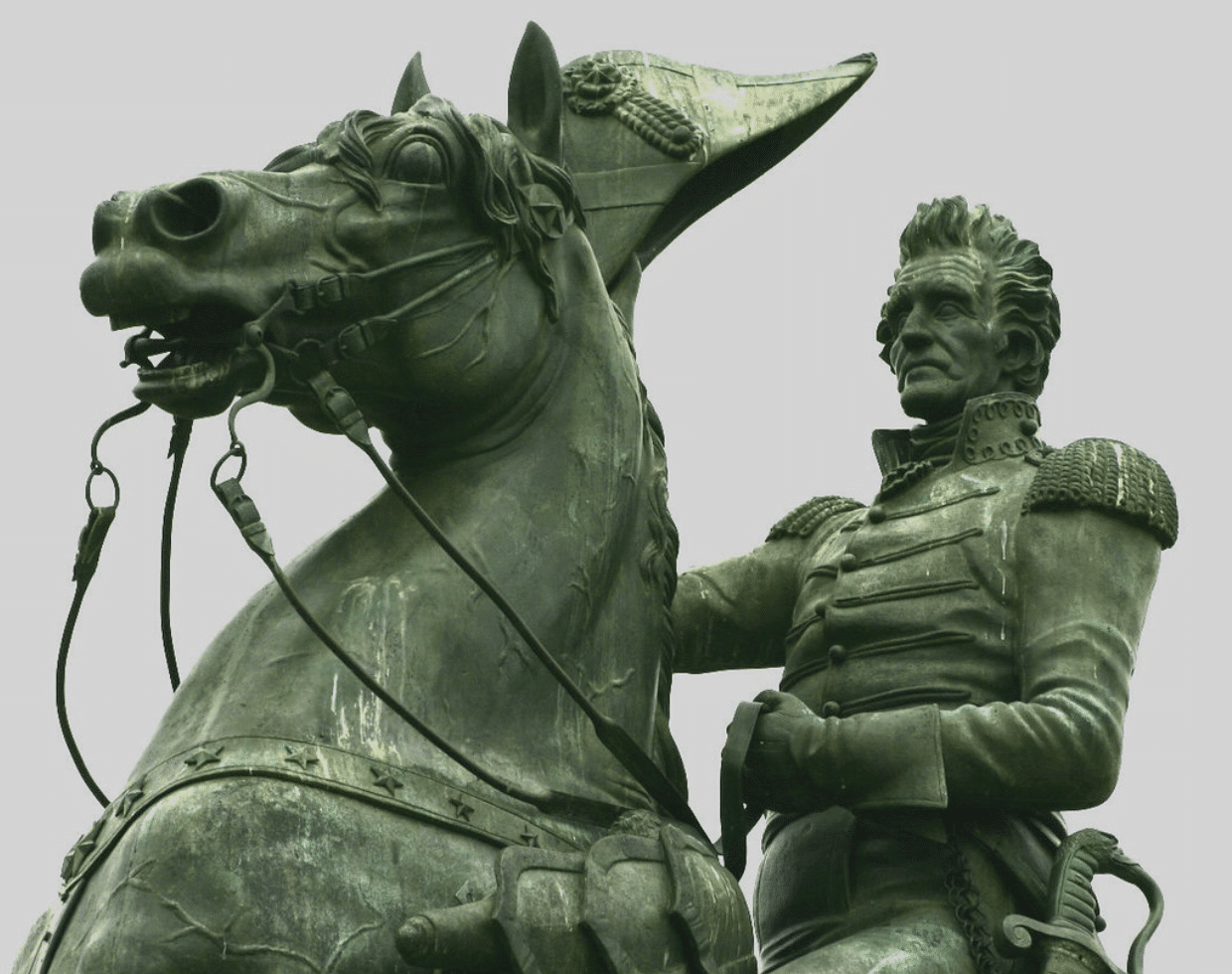
Andrew Jackson is another former president bound for the Museum of Reconsidered Statues. He was a slaveholder, a soldier who defeated the British in the Battle of New Orleans, and a rough-hewn populist. As the seventh president he paid off the national debt.
But his ticket to the Museum of Reconsidered Statues is the Indian Removal Act of 1830. This cleared native American tribes from the eastern United States so that whites could settle on their lands. Creeks, Choctaws, Seminoles, Chickasaws, and Cherokees were forced to resettle west of the Mississippi, and thousands died on forced marches collectively known as the Trail of Tears. The City of New Orleans has already reconsidered and taken down the Jackson statue that was there, so we have a place for it.
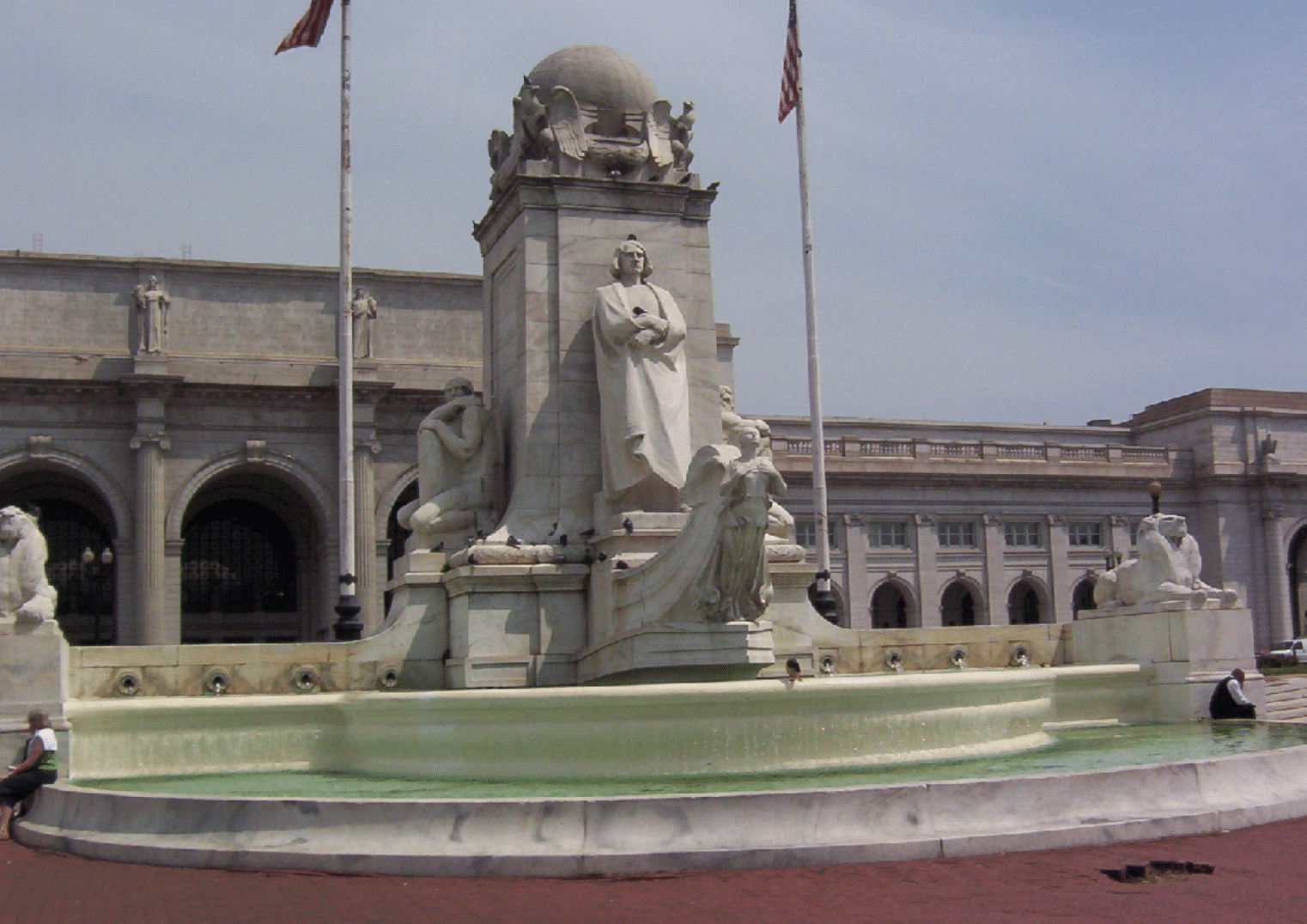
In the International Room of the Museum of Reconsidered Statues, visitors will find Christopher Columbus.
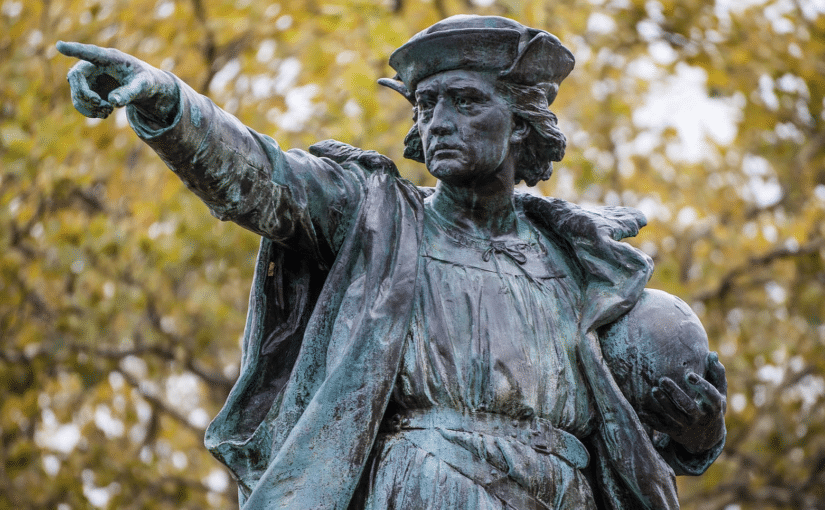
Christopher Columbus Statue, Union Station, Washington, D.C. Photo in the Public Domain, Courtesy Wikimedia.
Columbus, the Italian navigator who reached the New World about 500 years after Leif Erickson, was trying to reach the Indian Ocean and the riches of the East without going around Africa. That’s why the indigenous people he found became known as Indians. He made four voyages sailing for the Spanish crown, whose investment sought a return in gold, slaves and, since the Inquisition was in full swing, “godless savages” converted into Christians. The European presence brought by Columbus to the Caribbean islands and the rim of South America he touched devastated the native people by disease, war and enslavement to a fraction of their population.
The world we Americans live in grew up around notions of white civilization and religion. It’s past time to put those notions in perspective and see the harm they brought to native people and those brought here against their will. The Museum of Reconsidered Statues will help clarify our history.
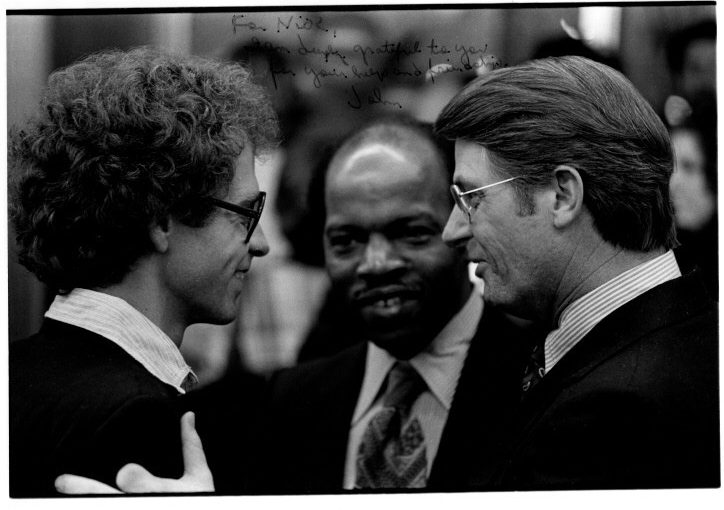
I worked as press secretary for John Lewis during his first campaign for Congress. The election in early 1977 was to fill the seat left by Andrew Young after Jimmy Carter appointed him U.N. ambassador. It was a crazy race.
You would think that in Atlanta John Lewis would be a shoo-in. But that was then, before the best-selling autobiography and graphic novels, before the honorary doctorates and commencement speeches, before the Presidential Medal of Freedom. His fame was narrower. You had to have followed the civil rights movement, which he joined as a teenager causing his elders including Dr. Martin Luther King to call him “the Boy from Troy,” his Alabama hometown where he grew up the son of sharecroppers. Unlike today, few knew of his courage on behalf of equality and voting rights, his lunch counter sit-ins, his Freedom Rides on segregated buses, his march into brutal attacks by Alabama troopers, his fierce address at the 1963 March on Washington. And few knew of his humility and selflessness.
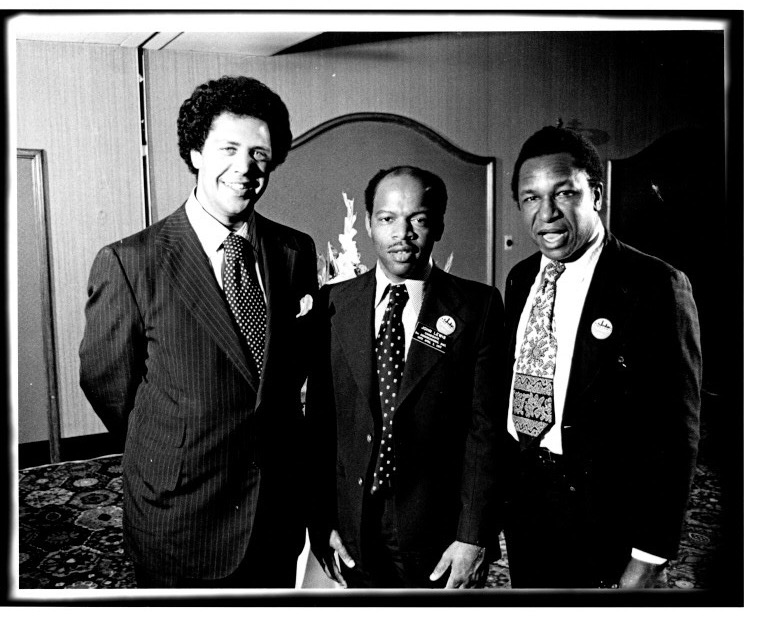
Atlanta Mayor Maynard Jackson poses with John Lewis, then a candidate for Congress, and Stanley Wise, a friend and aide.
Twelve candidates from both parties were first tumbled into a March non-partisan primary. It included another civil rights leader, Rev. Ralph David Abernathy, and future Republican Representative and Senator Paul Coverdell. Another Black candidate was John’s most vicious attacker. State Representative Billy McKinney said “his wife feeds him cue cards” and worse, “He’s just not smart enough to be congressman.” On the morning of the primary, we reached John’s strip mall headquarters to find it had been broken into overnight, the phone lines cut and the lists of volunteer drivers stolen. These drivers were key to an election in Atlanta. They picked people up from their homes and drove them to the polls to vote. The tradition was so ingrained that without a ride, some just couldn’t get to vote.
But enough of them did. John and the white Atlanta City Council President Wyche Fowler finished in the top two slots. McKinney got 2 percent of the vote, and John and Fowler headed into an April runoff.
John and our team campaigned nonstop moving from one campaign event to another, meeting voters, handing out literature, shaking hands at factory shift changes, and doing interviews. We were always behind schedule because John leaned in and listened to everyone who wanted to talk to him.
Atlanta billed itself as The City Too Busy To Hate and while Maynard Jackson was the mayor and had easily won a second term, there was still a lot of prejudice. This was barely a decade after the Civil Rights Act was signed into law and not enough respect was given. Even though John headed the Voter Education Project in the years before the race, a reporter at the Atlanta Constitution called John a “former civil rights leader.” John objected, saying he still worked for civil rights. He won the Constitution’s endorsement. But Atlanta sanitation workers went on strike a week before the runoff. John took their side against the mayor, and people in the suburbs didn’t like their garbage piling up.
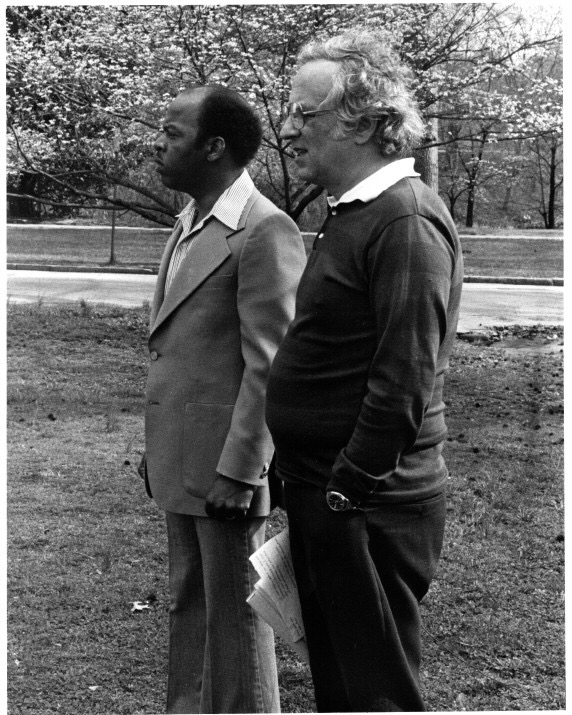
John Lewis and Media Strategist Marvin Kaminsky, 1977
Fowler won the runoff. That night John told the big crowd in a ballroom at the Atlanta Internationale Hotel, “We won tonight a kind of victory. Two months ago, nobody knew who John Lewis was. This is only the beginning.”
After the work of the campaign, we spent time with John and his beautiful, smart and very focused wife Lillian in their art-filled southwest Atlanta home. Their son John Miles was an infant and he kept everybody busy.
John kept his dream of elective office. After the campaign, he headed ACTION, the federal volunteer agency, under Carter and in 1981 won a seat on the Atlanta City Council. When Barbara and I got married in 1983, John and Lillian came to our wedding.
The next year Barbara got her dream job as a reporter for WCBS-TV and we went looking for apartments in New York. The only apartment that compared to the one we owned in Atlanta, was a duplex in a small house on Jones Street in the Village. We saw that it was a competitive situation. Many people came to see, and many people wanted it. The building owner, Harley Jones, an architect told us we’d need letters of reference.
Architect Harley Jones in front of his home on Jones Street.
Who would sway him, we wondered. We covered politics in Atlanta and it was a small city where we knew everyone. Then-Governor Joe Frank Harris wrote us a recommendation, but we thought that wouldn’t be enough. Mr. Jones was an African-American man who had clear memories of the civil rights movement. We asked John.
A few days later, Barbara got a call at WAGA, the TV station where she worked. It was Harley Jones. He said, “I just got a letter of reference for you from John Lewis. Anyone who is recommended by John Lewis can live in my building.”
What a relief.
John and Lillian made us a going away party at their home and Julian Bond, Sharon Adams, Tom Houck and other good friends were there.
Two years later, in 1986, John beat Julian in the Democratic primary and went on to win Georgia’s Fifth District congressional seat.
John got the respect that he deserved in Congress and we remained in touch. I took a young friend, Terrence Darby, to Washington to meet John in his office in the early ’90s. The smart teenager was having a lot of trouble reconciling his intellect and blackness. Book smarts weren’t prized on the streets of New York then.
John took the time and gave TD his full attention. That attention is the gift John always gives you.
When Columbia University awarded him an honorary degree — one of some fifty he received before he died — in 1997, he and Lillian invited us to join them for the ceremony and the lunch that followed. His sponsor was at the table, a white man whose name I don’t remember. He said he didn’t know John, just admired him and thought Columbia should, too.
Then last spring, 2019, John received an honorary degree from City College of New York, where Barbara graduated and now is the acting journalism director. While the proud parents and the graduates gathered on seats on a broad lawn in Harlem, I found John inside the Spitzer School of Architecture building waiting to put on the robe signaling another new doctorate. I felt lucky to have the chance to hug him and celebrate his latest honor.
John’s commencement speech to the graduates was his life message to us all: Find “good trouble” to get into. Look around you, see what’s wrong, and do what’s right. And fight every day. Don’t give up. Never give up.
I spoke to John early this year when I learned that he was diagnosed with pancreatic cancer. He said he was starting treatment and felt upbeat about his chances. Not long before he died he was photographed, wearing a mask against the COVID-19 pandemic, with Washington’s Black Lives Matter street mural in the background.
John Lewis never gave up. Remembering him, we remember that we can never be complacent, that we can never assume that rights achieved won’t be stripped away. We have to fight for the things that matter every day.
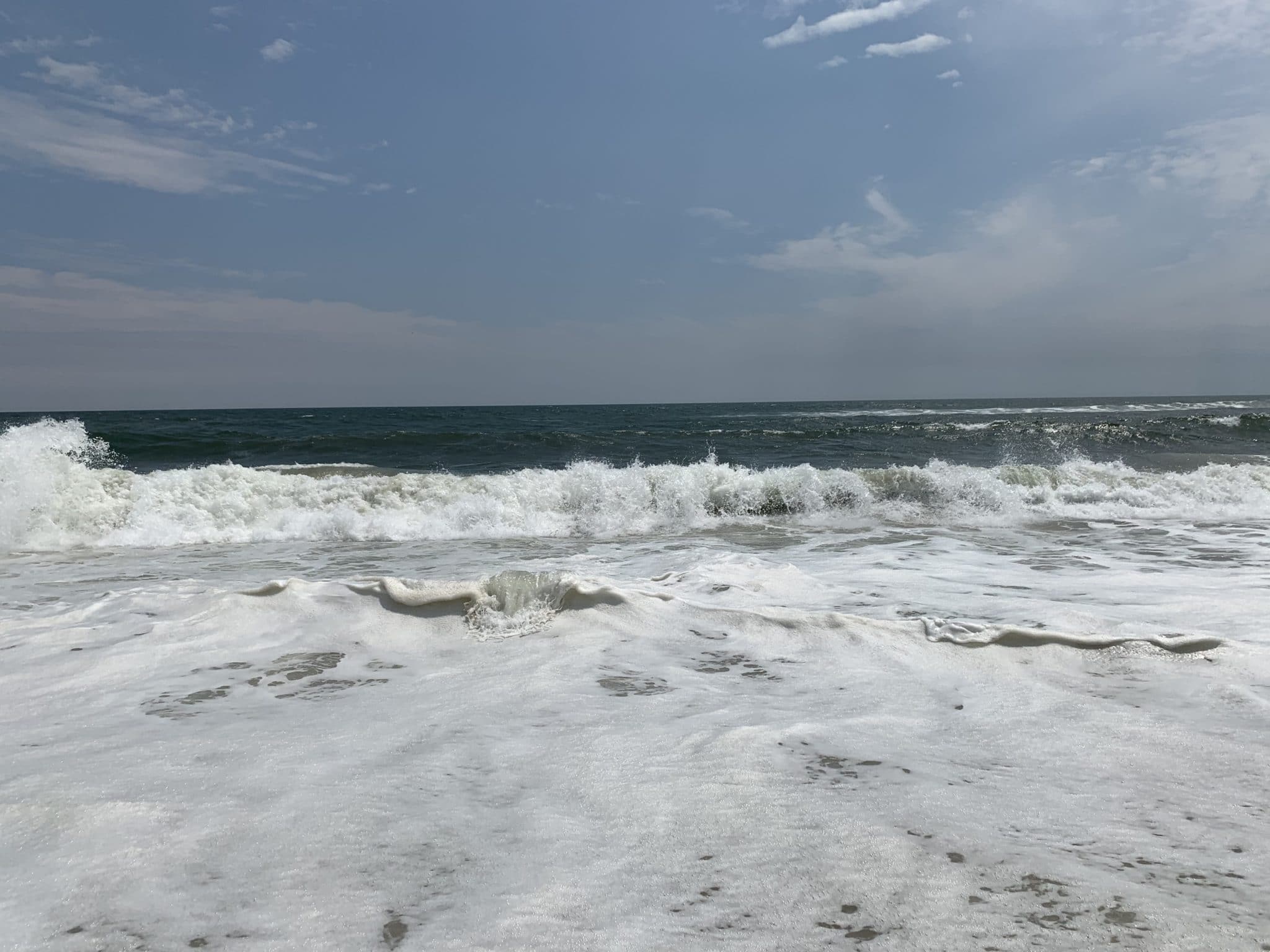
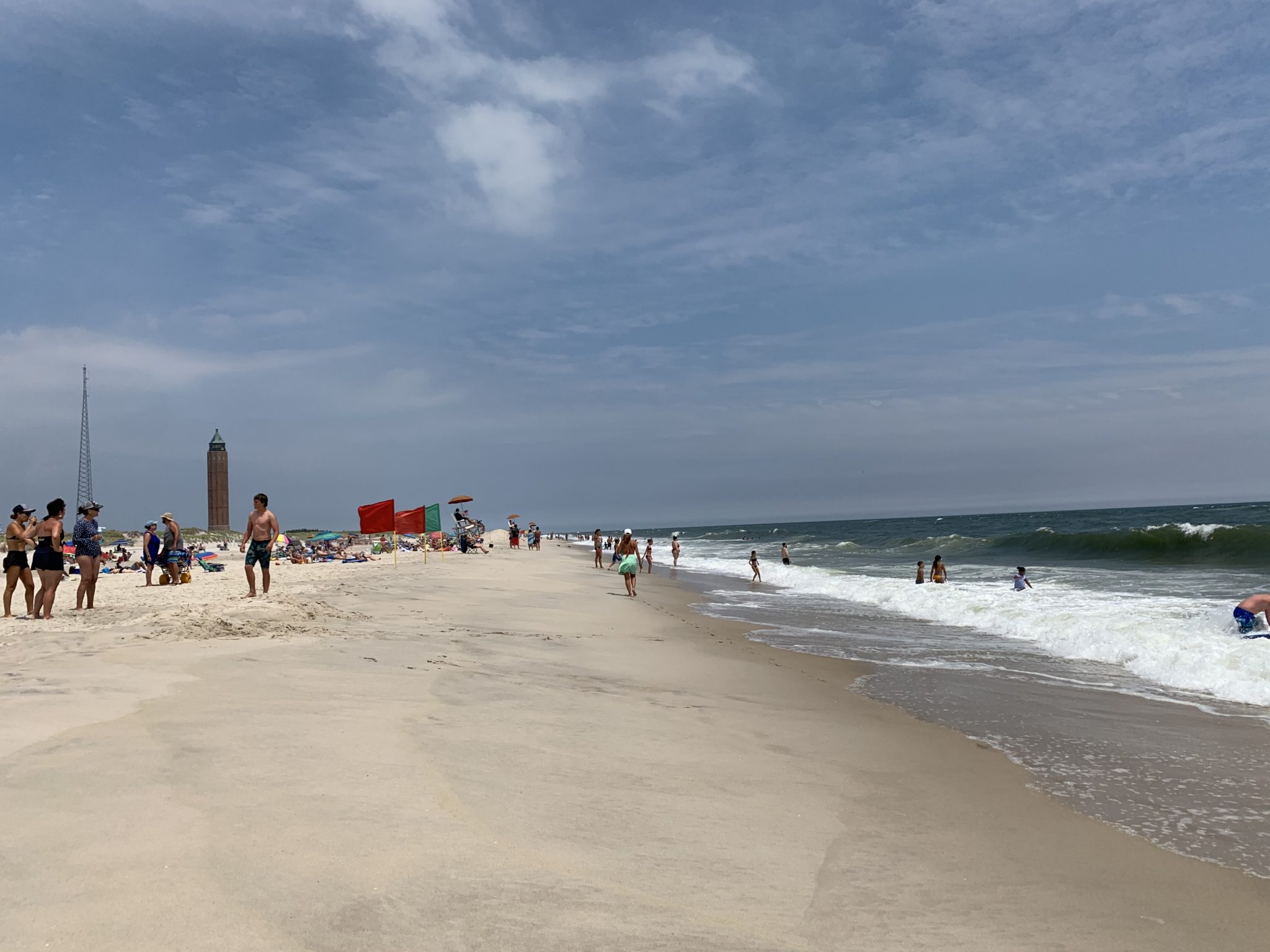
We left our relatively safe Zip Code in Manhattan yesterday to visit my mom’s grave for her birthday and her Yarzheit. The cemetery is about fifteen minutes from the beach and we heard the ocean calling to us.
The Atlantic Ocean, Robert Moses State Park, Babylon, Long Island. Photo by ConsumerMojo.com
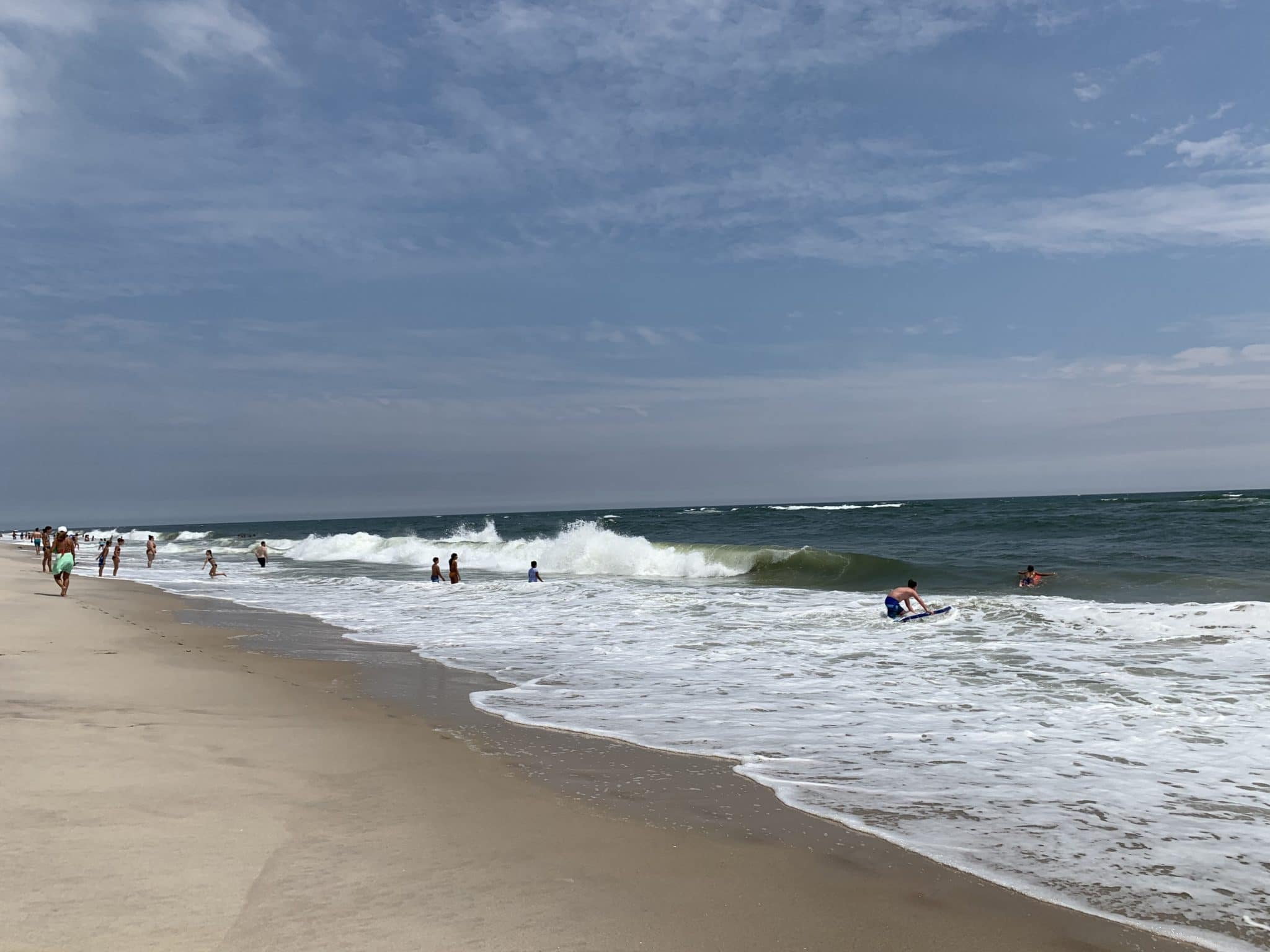
If you haven’t been there, the causeway across the Great South Bay to Robert Moses State Park is worth the ride and it leads to a beautiful beach. Nick grew up on Estero Island, or Fort Myers Beach, Florida and as a kid I went to the beach at Far Rockaway in Queens almost every summer day. We love the beach.
People enjoy the water at Robert Moses State Park. Photo by ConsumerMojo.com
We don’t want to bake in the sun any more. But we do want to put our feet in the surf and feel the rush of pleasure when your toes sink into the sand and the surf laps against your ankles.
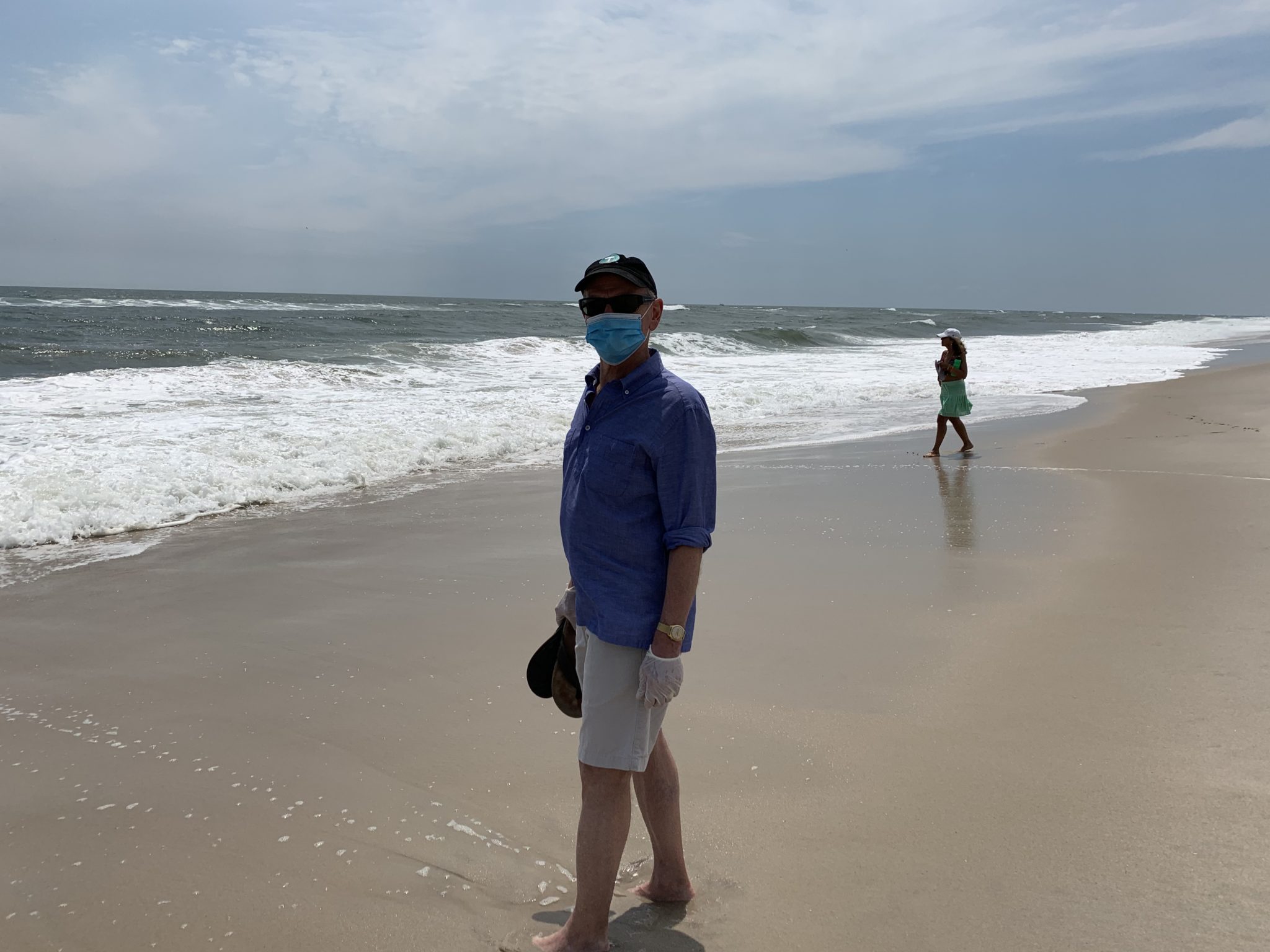
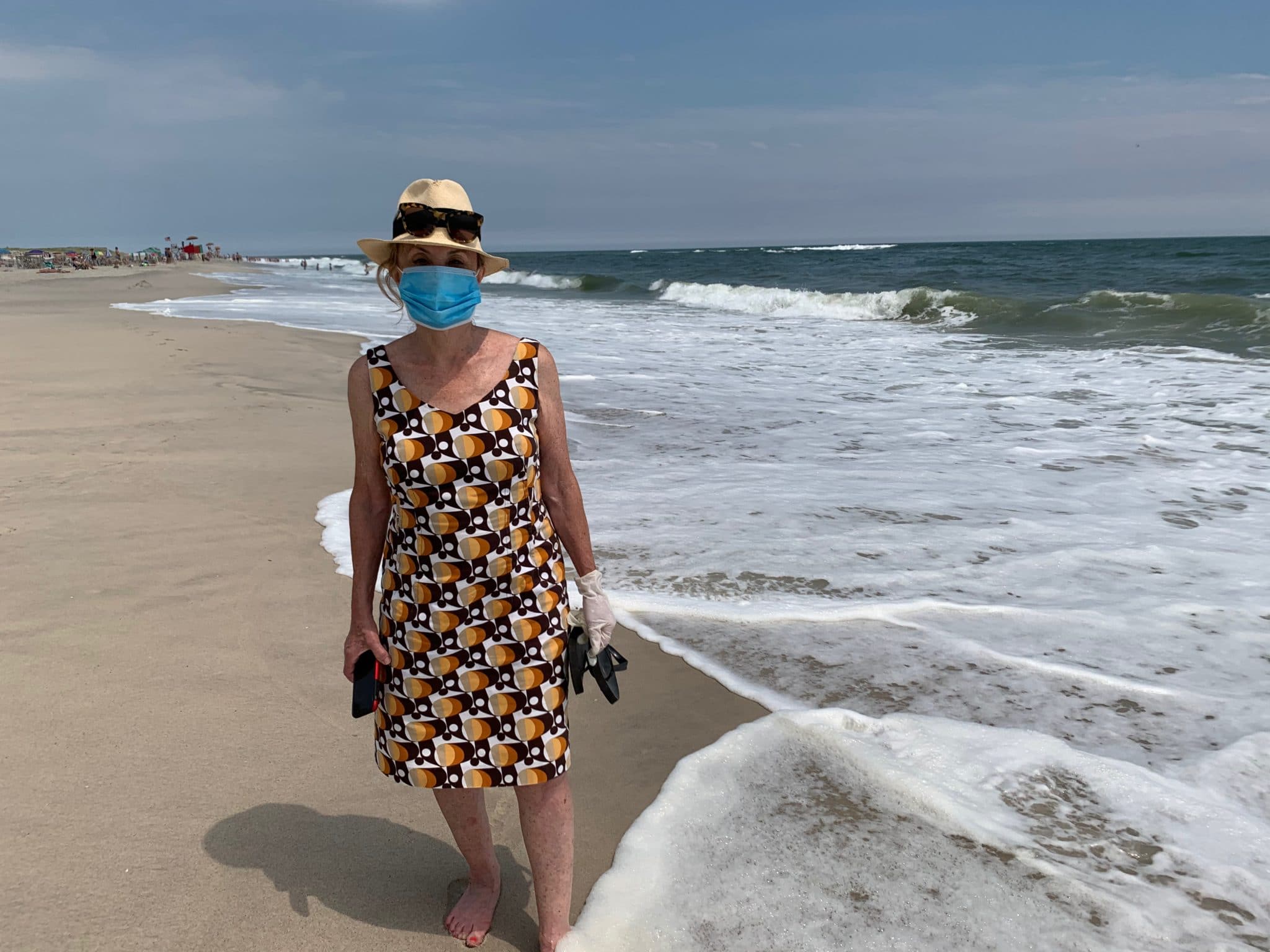
Nick Taylor waiting for surf at Robert Moses State Park. Photo by ConsumerMojo.comWearing mask and one glove at Robert Moses State Park. Photo by ConsumerMojo.com
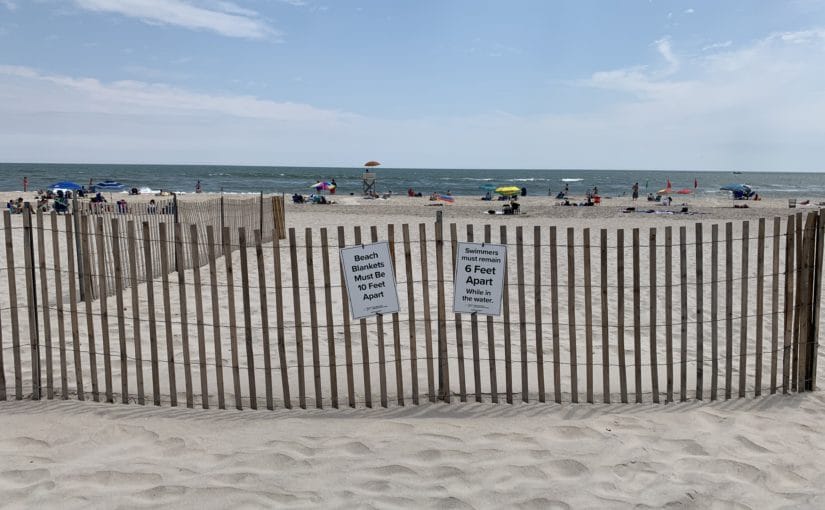
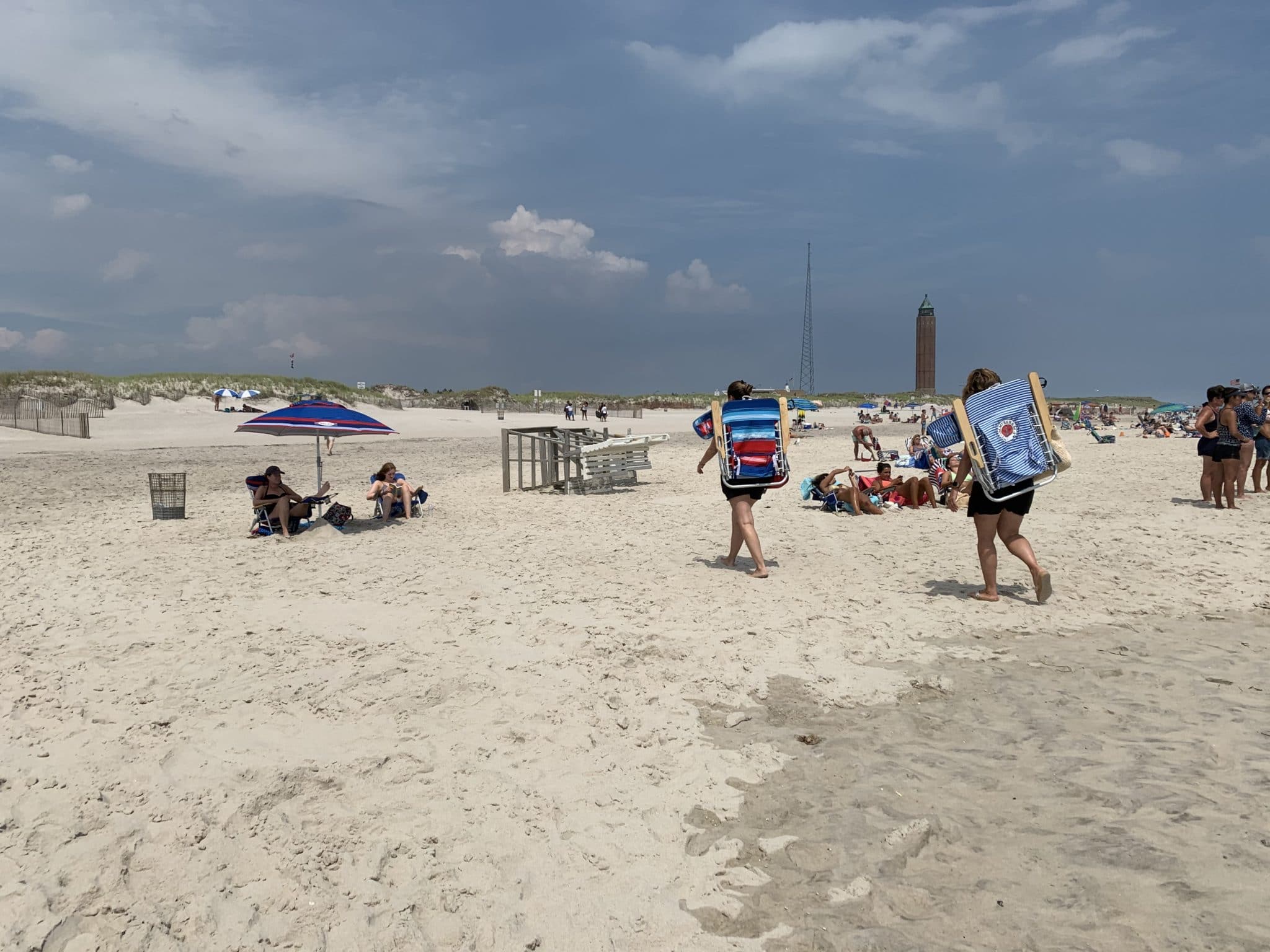
Sure we felt a little crazy because we wore masks and gloves, just in case. On the beach people, for the most part, did spread out and social distance.
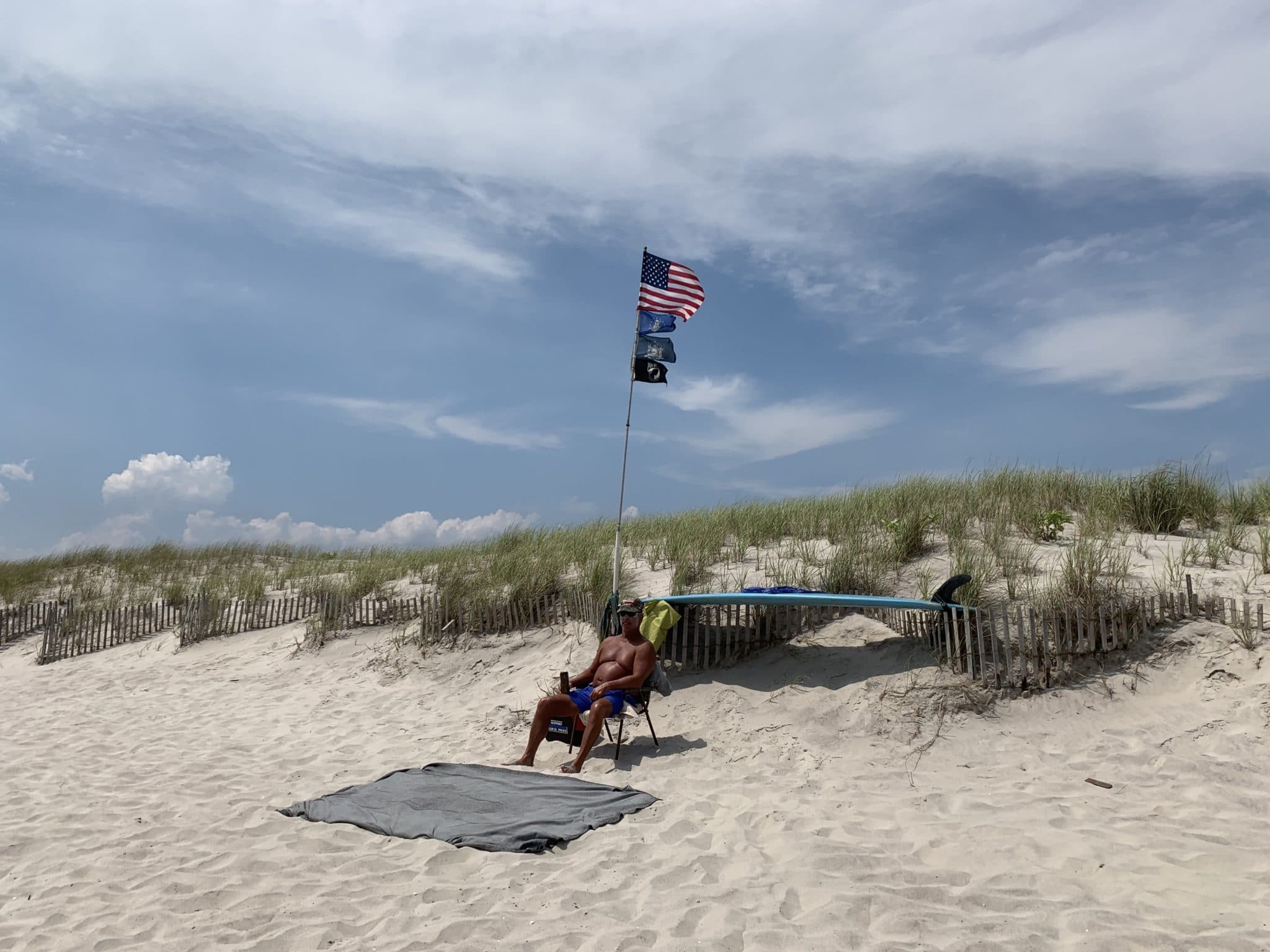
Baking in the sun at Robert Moses State Park. Photo by ConsumerMojo.com
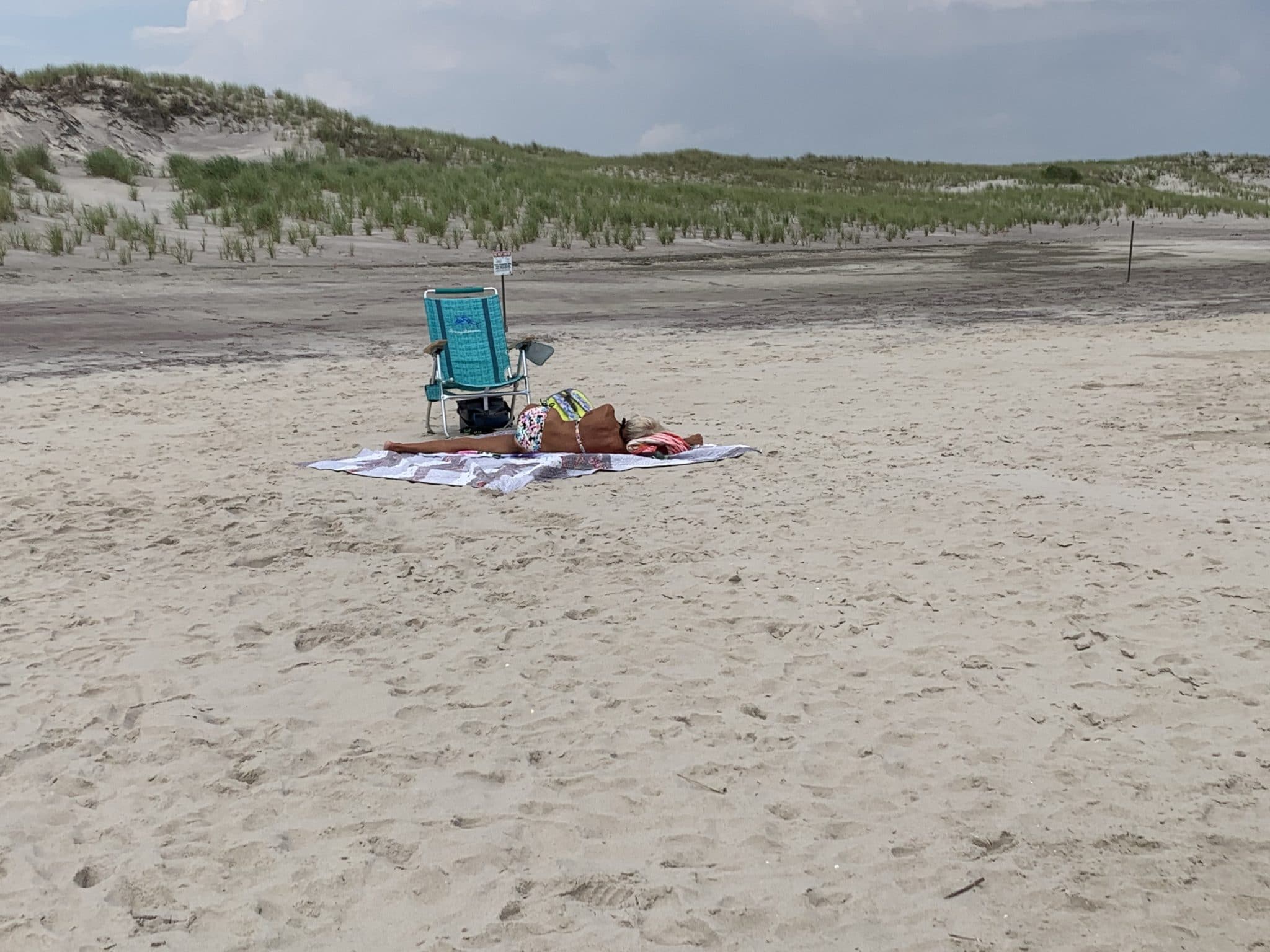
But there were enough people who didn’t wear masks to make us want to head away from them.
People without masks on the beach at Robert Moses State Park. Photo by ConsumerMojo.comPeople lounging, standing and not wearing masks on the beach at Robert Moses State Park. Photo by ConsumerMojo.com
COVID-19 cases had been going down on Long Island. But we found out later that on July 13, the day we went to the beach, 102 people in Suffolk County tested positive for the virus.
New York Governor Andrew Cuomo, in a news release, said, “It’s also clear based on contact tracing that many of the new cases in New York are a result of a lack of compliance during the July 4 weekend and illustrate how quickly the virus spreads, with one party, for example, infecting more than a third of attendees,” Cuomo continued. “I cannot be more clear: Look at what’s happening in the rest of the country — if we are not smart, if we don’t wear masks and socially distance, cases will spike. No one wants to go back to the hell we experienced three months ago, so please stay vigilant.”
The party Cuomo referred to was in Suffolk County. State and local contact tracing found that 35 percent of people who attended the Fourth of July party became infected with COVID-19.
Back in our Zip Code, we still feel safe despite people flocking to bars and drawing more complaints for COVID-19 non-compliance than anywhere in Manhattan. We’ll continue to watch the numbers and see where and when it’s safe to go the beach again.
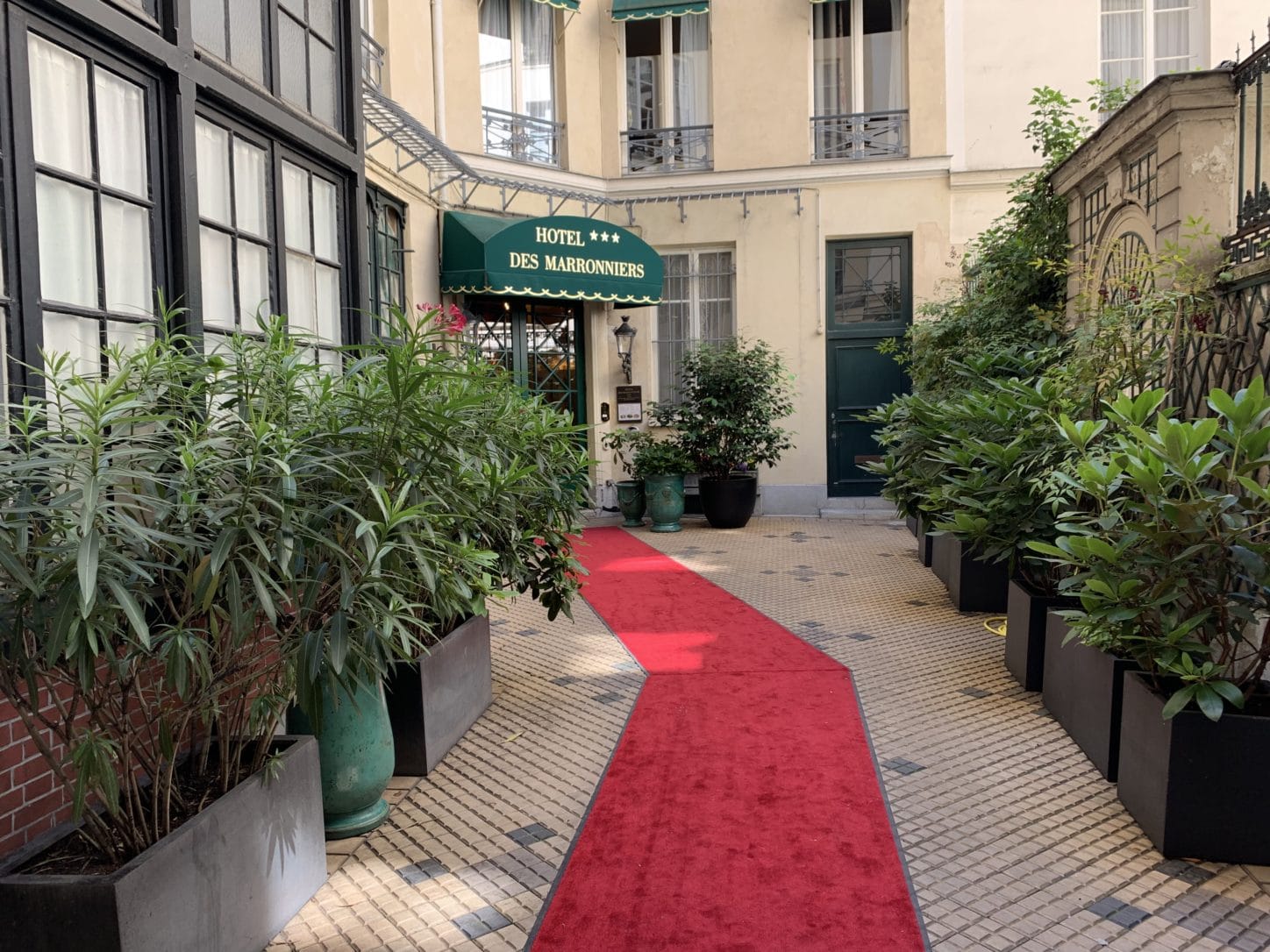
We received an invitation from Paris we wish we could accept. The Hotel des Marroniers on the Rue Jacob emailed to invite us back.
This time last year, though it seems much longer now, we stopped in Paris returning from a trip to Greece and spent three nights at the delightful small hotel.
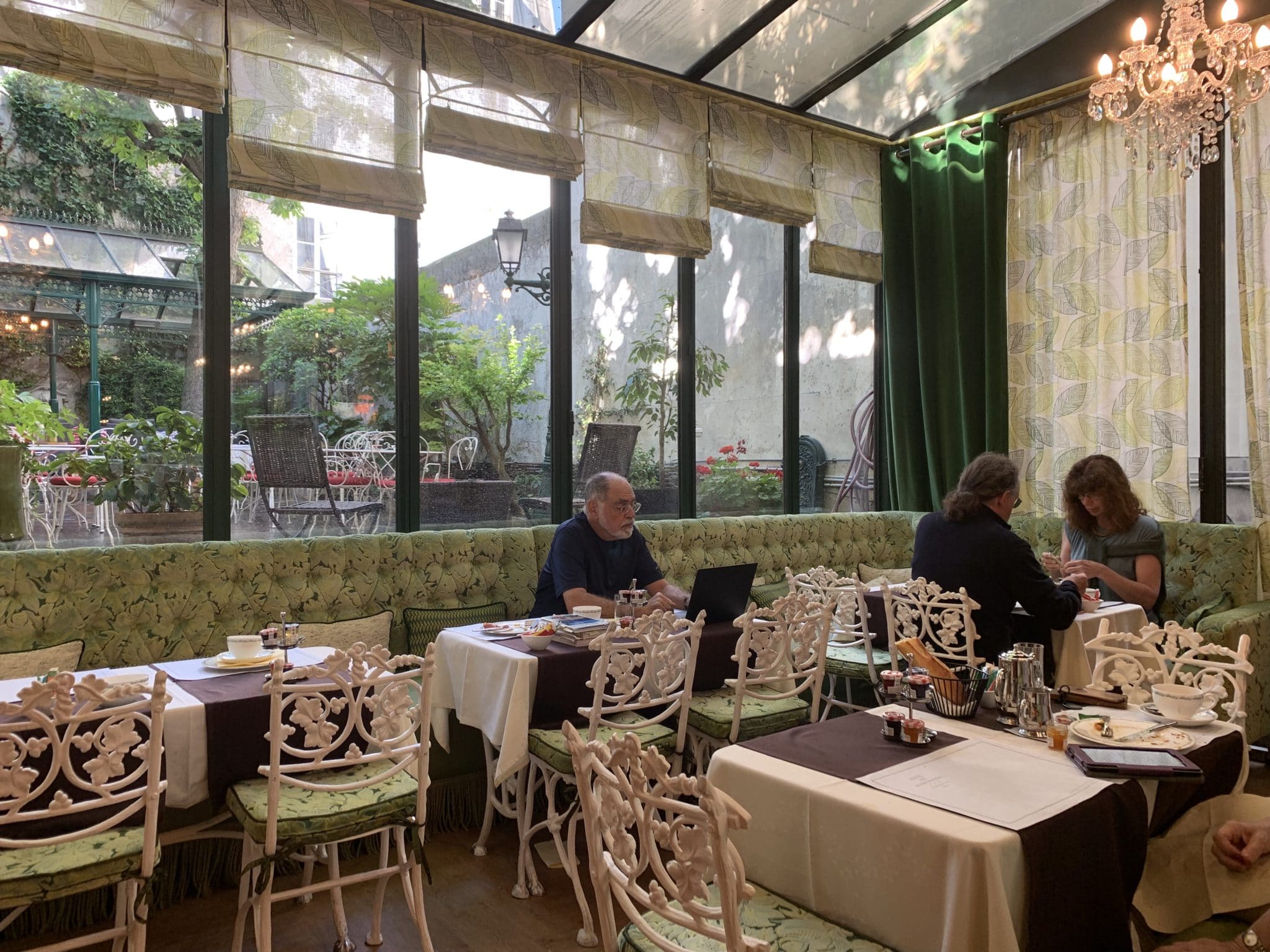
Hotel des Marronniers on Rue Jacob. Photo by ConsumerMojo.com.
Cozy describes it best. We stepped around the suitcases we stacked in a corner of our room, held our breath in the tiny elevator, and chatted with the receptionist on duty as we handed and retrieved our key across a narrow counter.
Best of all, we fanned out to absorb the delights of wonderful Paris — walks along the Seine and in the Luxembourg Gardens, the Musee d’Orsay, people watching at Cafe Deux Magots, popping into galleries and exhibitions.
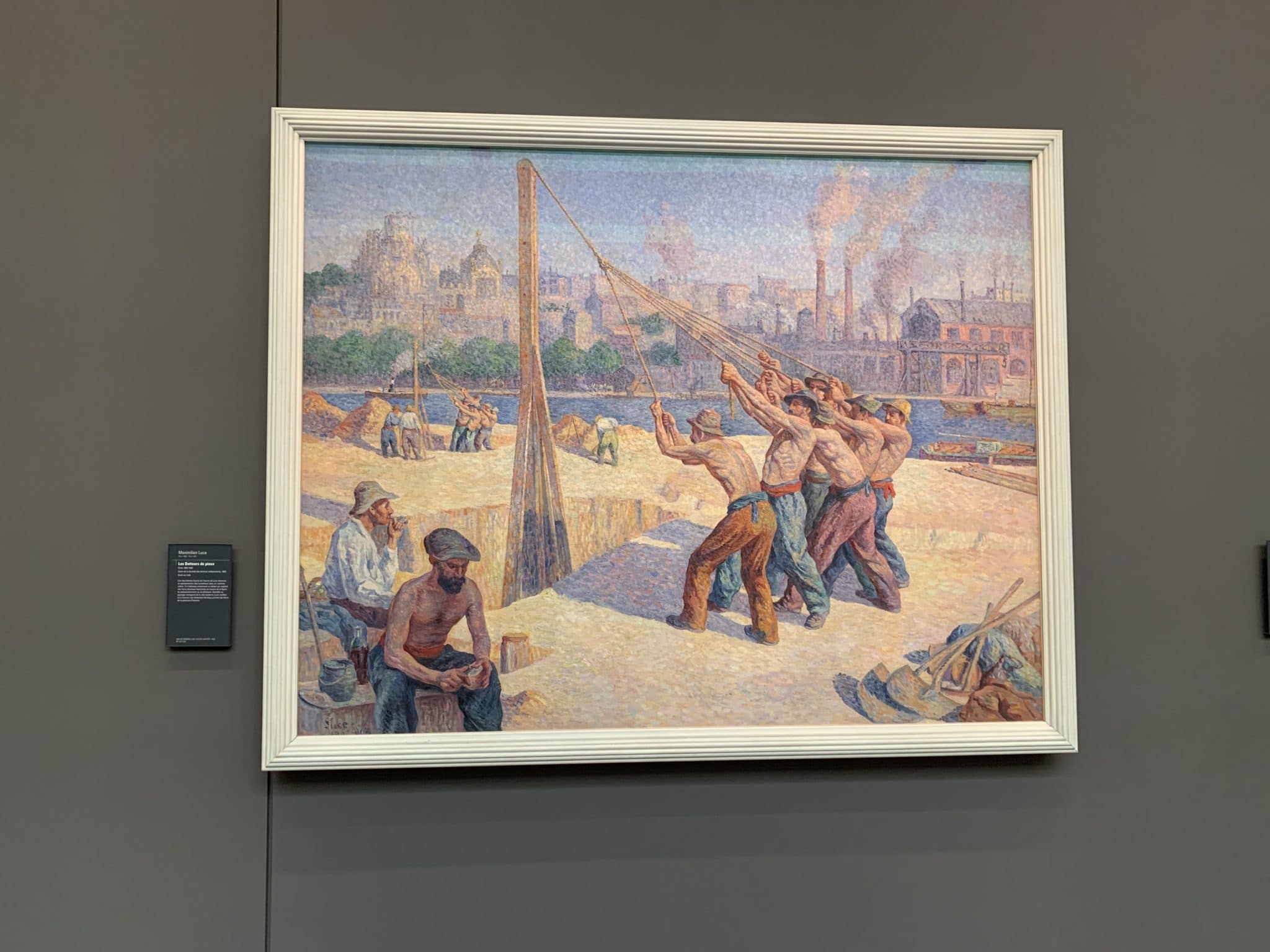
Into The Light by Maximilen Luce in the Musee D’Orsay, Photo by Consumer Mojo.com
That was before . . .
Paris, like New York, adopted drastic measures to fight the COVID-19 pandemic that swept — is still sweeping — the world disrupting lives and commerce. Cities felt the problem worst. The urban joys of density and mingling were suddenly forbidden and potentially fatal. Sneezing, coughing, and just talking spread the virus. Elbow bumps replaced handshakes, and then no contact at all — stay six feet away from other people. Wear gloves. Wear a mask. Restaurants, bars and theaters closed, concerts canceled, offices emptied. People were told to stay home, so nobody went anywhere unless they escaped to the countryside. Here in New York, front line health care workers were bivouacked in hotels. In Paris, hotels housed the homeless.
The shutdown in Paris and throughout France was severe enough to stop COVID-19 in its tracks. The same throughout the European Union.
Now Europe is coming back to life. “Travel to Paris in total security!” said the Hotel des Marronier’s invitation announcing its July 1 reopening.
The Left Bank hotel isn’t the kind of place where social distancing is possible. Its compactness is part of its charm, at least for us. The hotel’s reopening announcement detailed its COVID-19 hygiene and safety protocol — masks, gloves, sanitizing gel, disinfecting all the things you touch, and so on. A continental breakfast will replace the buffet.
Guests can pay without touching anything, and get receipts by email. So we’d probably survive being in its close three-star quarters.
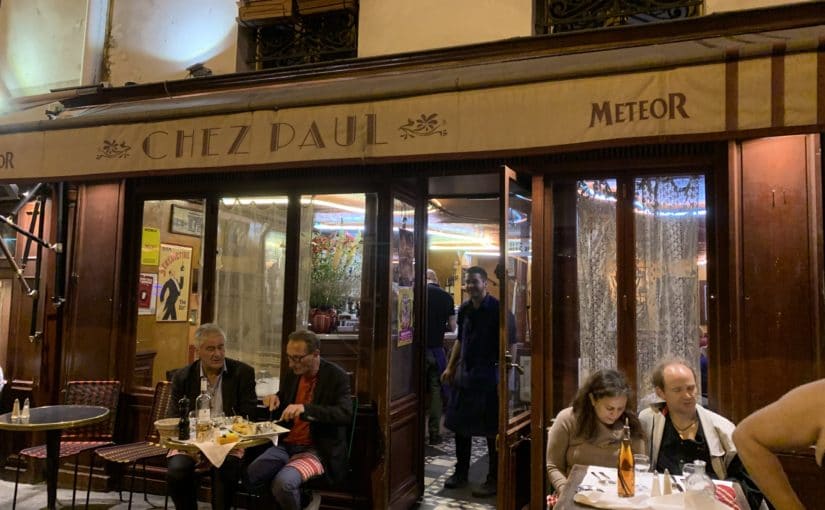
It would be fun to be a part of Paris coming back to life. In New York, the city is closing streets so restaurants can set up tables to keep people far enough apart. In Paris, restaurants are used to that, tables spilling from sidewalks onto streets and cars mercifully absent. And Paris allowed its cafes to fully reopen in mid-June.
But we can’t go. Europe doesn’t want Americans. New York got its COVID-19 case and death count down by wearing masks, avoiding crowds, and reopening slowly. We know where the European Union’s coming from. Now New York and its neighbors New Jersey and Connecticut, early pandemic hot spots, are watching cases spiking in the South and West where things opened up too soon and folks weren’t careful. Fifty thousand new cases, the highest yet, were reported in the country on July 2. Our governors are asking visitors from sixteen states including Texas and Florida to quarantine themselves for two weeks if they come here. Good luck. Americans don’t need a passport to cross state borders.
Americans traveling to France, or to anywhere in the Eurozone, is another story. The European Union, reacting to the soaring case counts in this country, won’t admit most travelers from the United States. Thanks to an utter lack of national leadership and reckless governors defying health experts, the United States is in the Banned Travelers Hall of Fame along with such international paragons as Russia and Brazil.
Even people who have homes in France, like our our friends artist Pierre Clerk and his wife Linda Mandel, find themselves up against the lockout, too.
Barbara Nevins Taylor, Nick Taylor Linda Mandel, Pierre Clerk in Pomerol, France. Photo by ConsumerMojo.com
They need to get back for business reasons. Pierre has a show scheduled in Belgium in the fall and his dealer wants to choose the pieces from his studio in southwest France.
Courtyard at Bordeaux home of Pierre Clerk and Linda Mandel. Photo by ConsumerMojo.com
You can watch a video Barbara did when Pierre was 85, here. It gives a good idea of what their beautiful home looks like, and Pierre’s striking work.
But back to travel to France. The French Consulate in New York offers an elaborate explanation about who can enter France. Americans would have to quarantine for fourteen days, but the European Union ban on Americans superseded that.
Even before the full impact of the pandemic hit home, and before protests erupted worldwide over racist killings of black men in the United States, the State Department issued a Level 2 travel advisory for France urging “increased caution.” Unions had been waging strikes and protests over pension reforms, but we don’t remember news of terrorism. And even traveling cautiously won’t be possible until we COVID-19 pariahs in the U.S. can get back to Paris and Europe again.
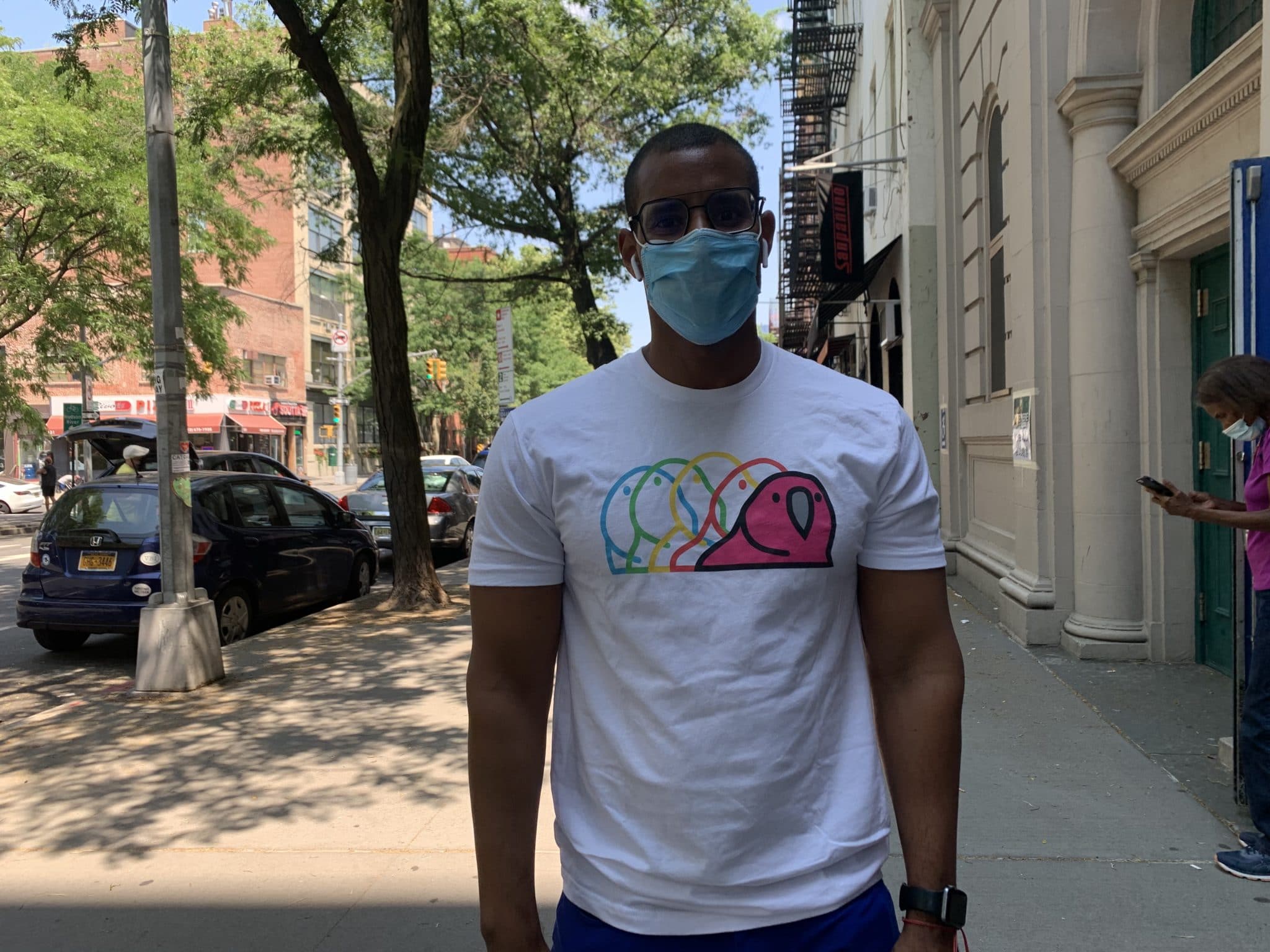
Gavin Murphy showed up at his polling place in Greenwich Village to vote in the June 23 primary. But he would have preferred to vote by mail with an absentee ballot.
“I received my ballot too late to make the deadline,” he said, and he wasn’t alone. Many New Yorker did not receive their absentee ballots in time to vote by mail.
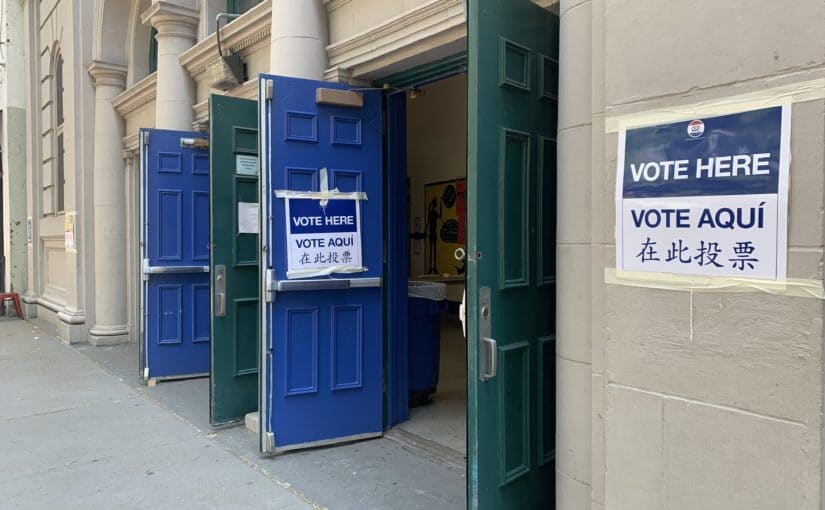
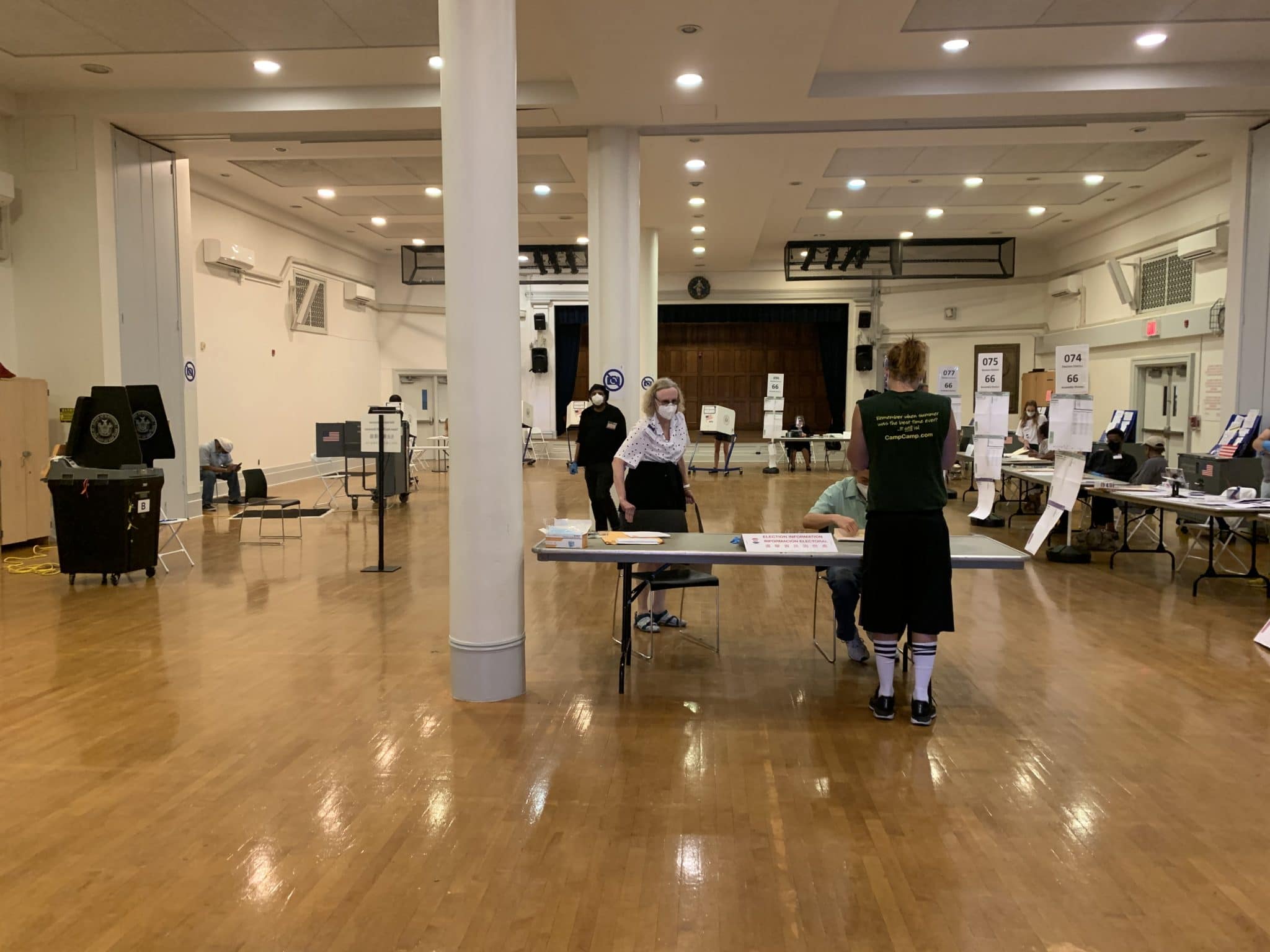
A little before noon, few people showed up at this polling place in Greenwich Village.
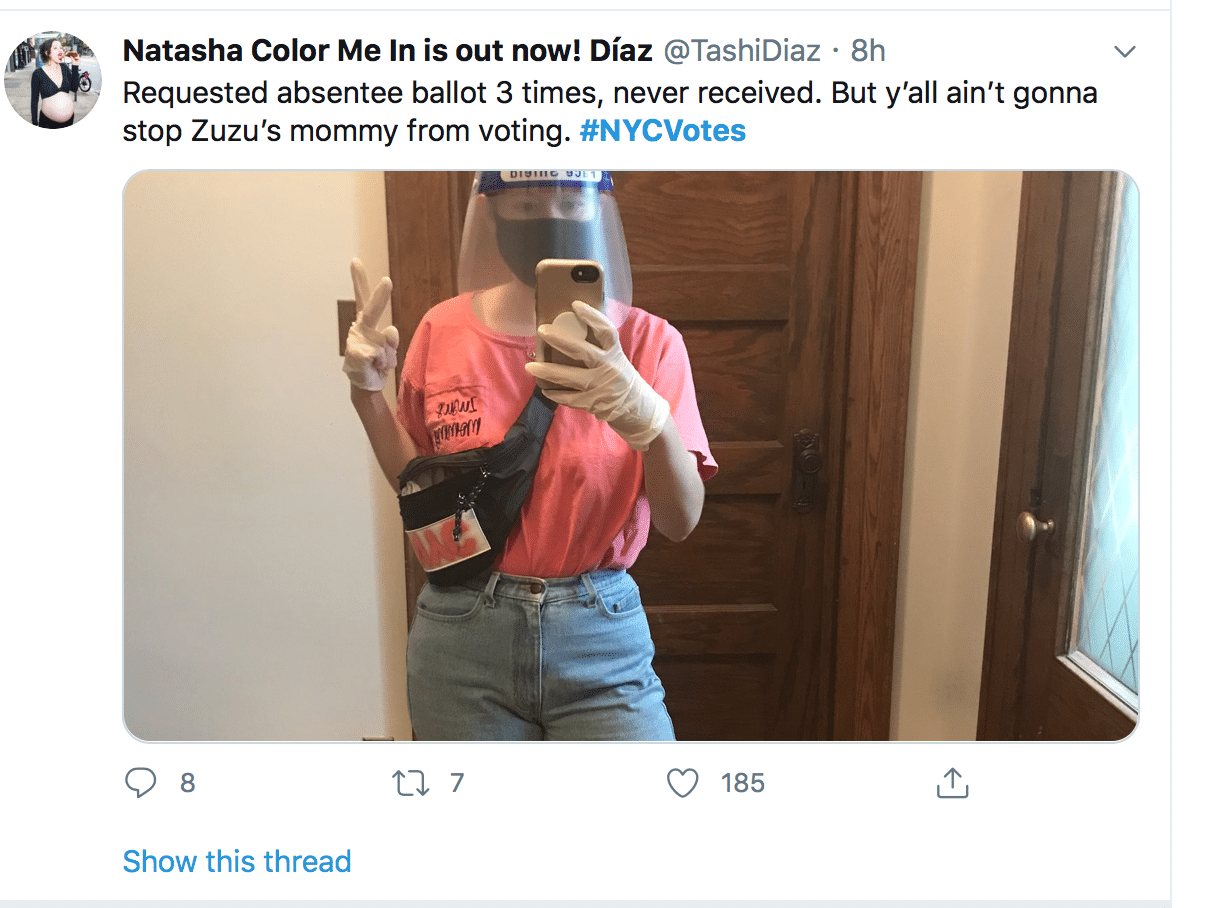
The New York City Board of Elections (BOE), an appointed board which runs elections in the city, seemed to have a big problem keeping up with the switch to absentee voting. The New York Times reported that three days before the primary, 29,000 voters who had requested ballots had failed to receive them. Others reported on social media that they had received ballots with no return envelope, or with no ballot.
My husband and I received the applications for absentee ballots, filled them in and mailed them at the same time. He received his ballot the Saturday before election day, filled out his ballot and put it in the mail by Monday’s deadline. It needed to be postmarked by June 22, the day before election day, in order to be counted. My ballot failed to arrive. That meant I had to vote in person.
At my polling place in Greenwich Village, there were few people voting. You can say that was a good thing for social distancing. But if people had trouble getting ballots and then didn’t show up to vote that doesn’t bode well for the November election. If this was a dress rehearsal, there’s a lot of work to do before the big show.
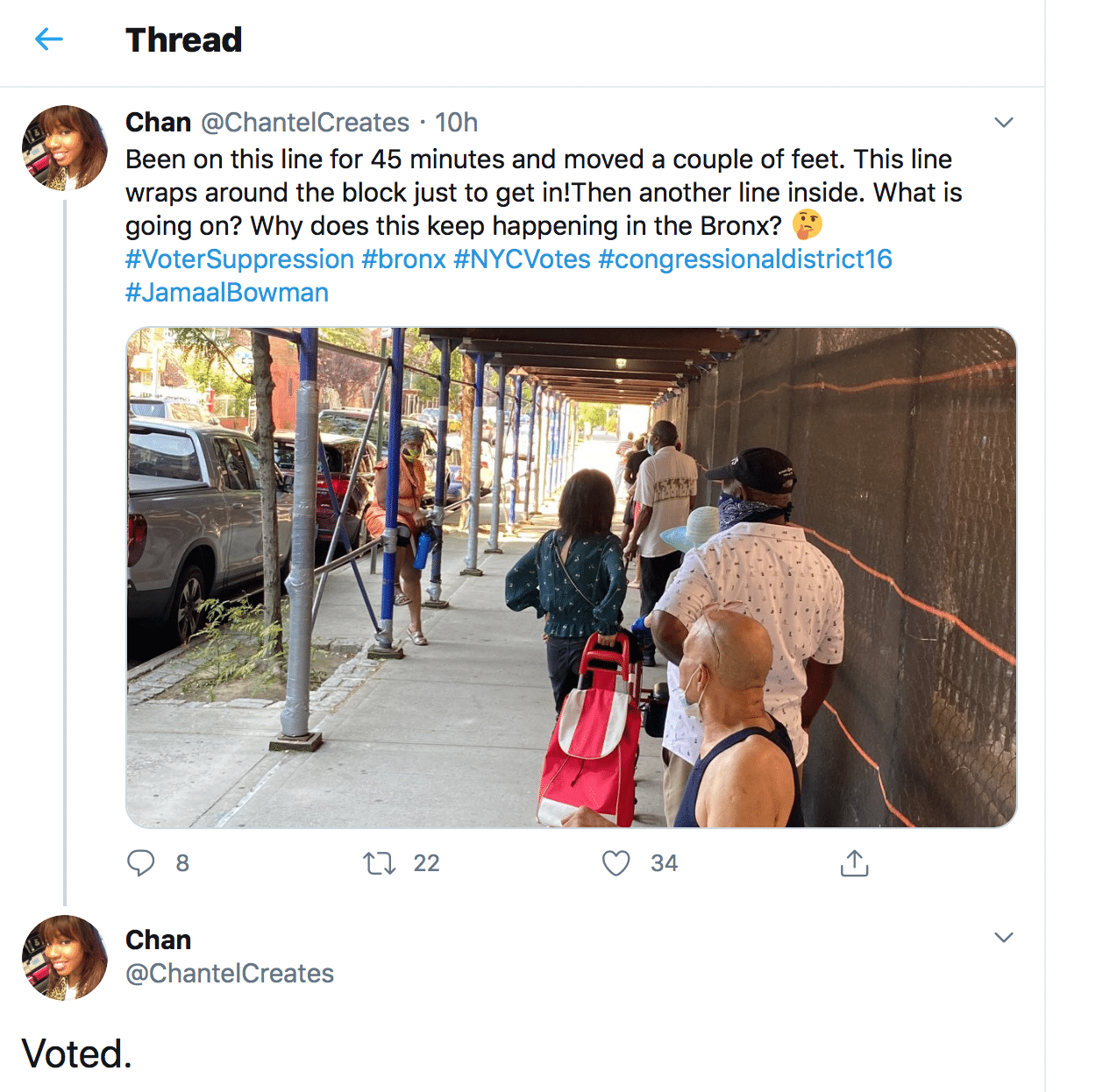
In the Bronx, some voters complained about long lines and long waits. A woman who posts as Chan said it took two hours to get to vote.
The polls stay open until 9 p.m. and as we write this, there is still time to vote. But BOE’s handling of the absentee ballots puts the spotlight on an election board that has had a history of errors with wrongly purged voters, broken machines and long lines.
Voters like Gavin Murphy want the BOE to get its act together before absentee ballot applications go out for the general election. “If we are going to be prepared for the actual election in November,” he said, “we need much stronger infrastructure to be able to deliver on the actual vote by mail. Many people are going to be a little concerned about their health and they should be able to exercise their right to vote without having to sacrifice health concerns.”
The Board of Elections did not respond to our request for comment.
We went out this afternoon to look around. Television coverage has shown us New York City streets in chaos. During the day marches, including those here in New York, are peaceful.
Protestors march down Seventh Avenue. Photo by ConsumerMojo.com
But when night falls, looters and thieves take over from peaceful marchers. Like most Americans, we have watched and agonized about this since Memorial Day, when George Floyd died in Minneapolis with a police officer’s knee on his neck for almost nine minutes.
The large gatherings give the bad actors cover. Like politicians, the looters and thieves never let a crisis go to waste. It’s organized street crime. They rush in with crowbars, smash windows, rob stores, and throw their loot into cars and vans summoned by phone or text or social media. Luxury goods, mobile phone, and liquor stores seem to be the main targets, but they’re not the only ones. Bodegas that often are the only shops that serve their neighborhoods have been victims, too.
Just smashing things sometimes is the only object. Destruction for the thrill of it. Pick up a Citi Bike and throw it through a window. Turn over a trash can and set it on fire. The chaos aids the looters.
Surveillance cameras, which might be a small deterrent in normal times, are as good as blind. Everyone wears masks these days to prevent the spread of the coronavirus. The thieves and window smashers look like health conscious citizens until they take out their crowbars.
We hear helicopters all the time now in our part of New York City. On Sunday night the looters hit stores in Soho. Mayor Bill de Blasio declared a curfew in response, from 11 p.m. Monday to 5 the next morning. The thieves didn’t wait until 11. They started as soon as it got dark, hitting stores on Broadway and in the East Village and as close as Bleecker Street near Sixth Avenue. Where were the police? In the television coverage, they looked outmaneuvered by kids on bikes and skateboards. In some cases, local citizens were the only thing standing between the thieves and the stores they wanted to hit.
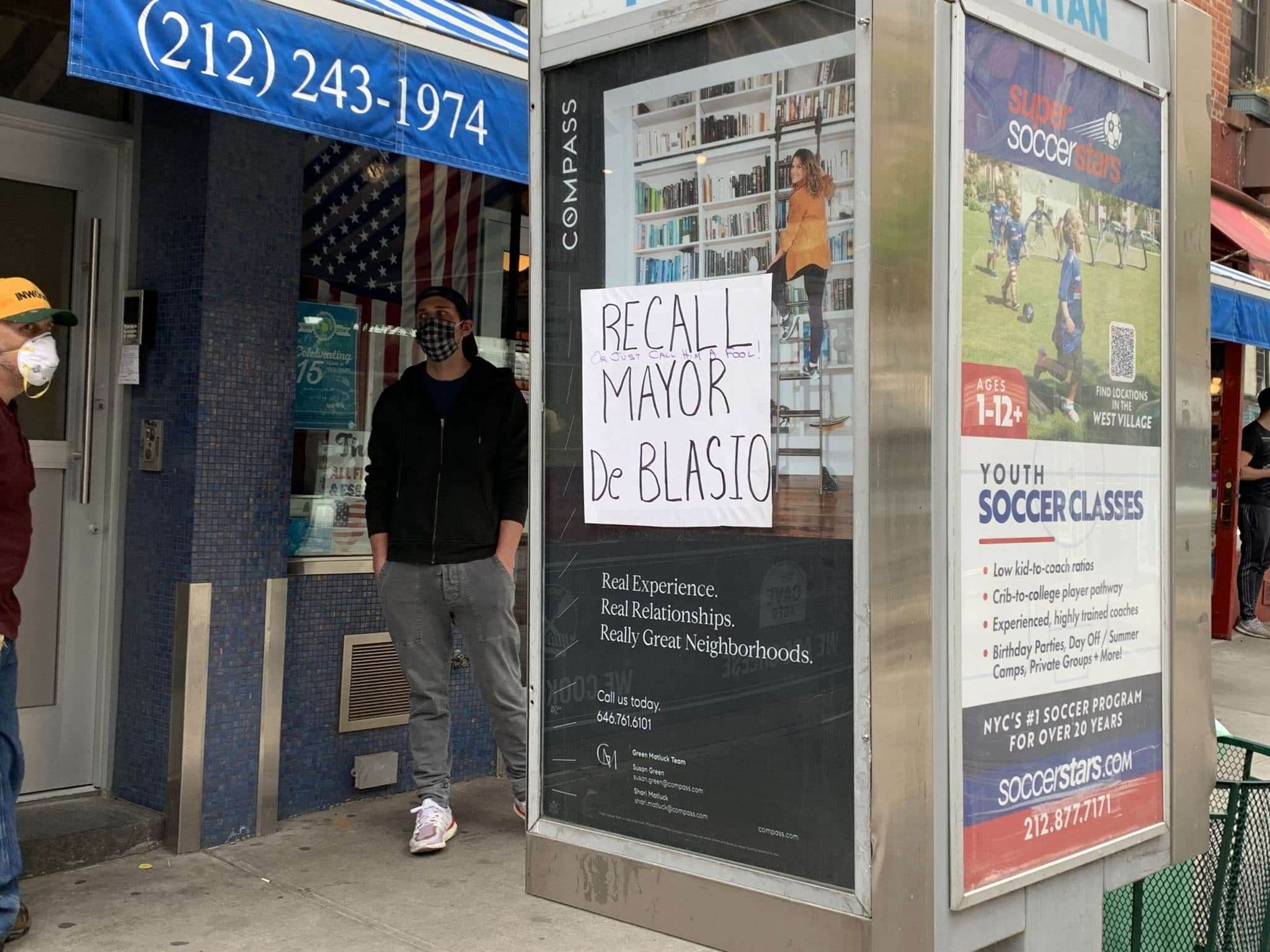
A sign appeared on Bleecker Street calling for the recall of Mayor Bill de Blasio. Photo by ConsumerMojo.com
After the looting we saw a sign on Bleecker Street for a recall of de Blasio. People support the protesters and are furious about the looting.
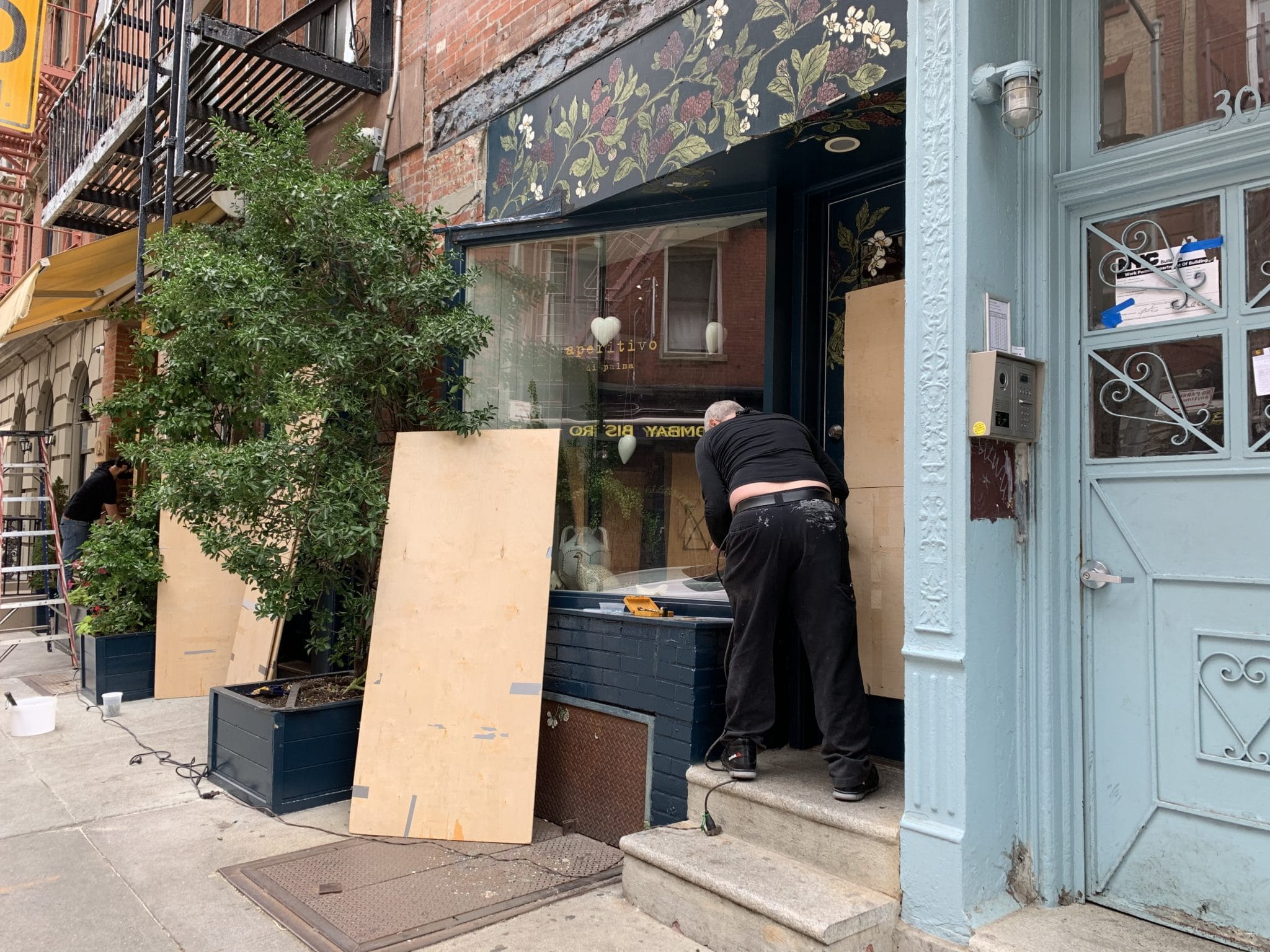
Worker boarding up a restaurant on Cornelia Street as precaution. Photo by ConsumerMojo.com
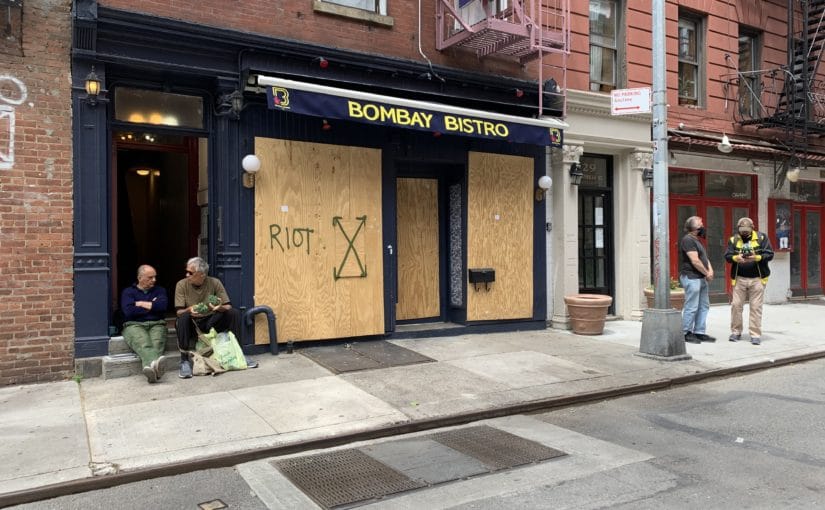
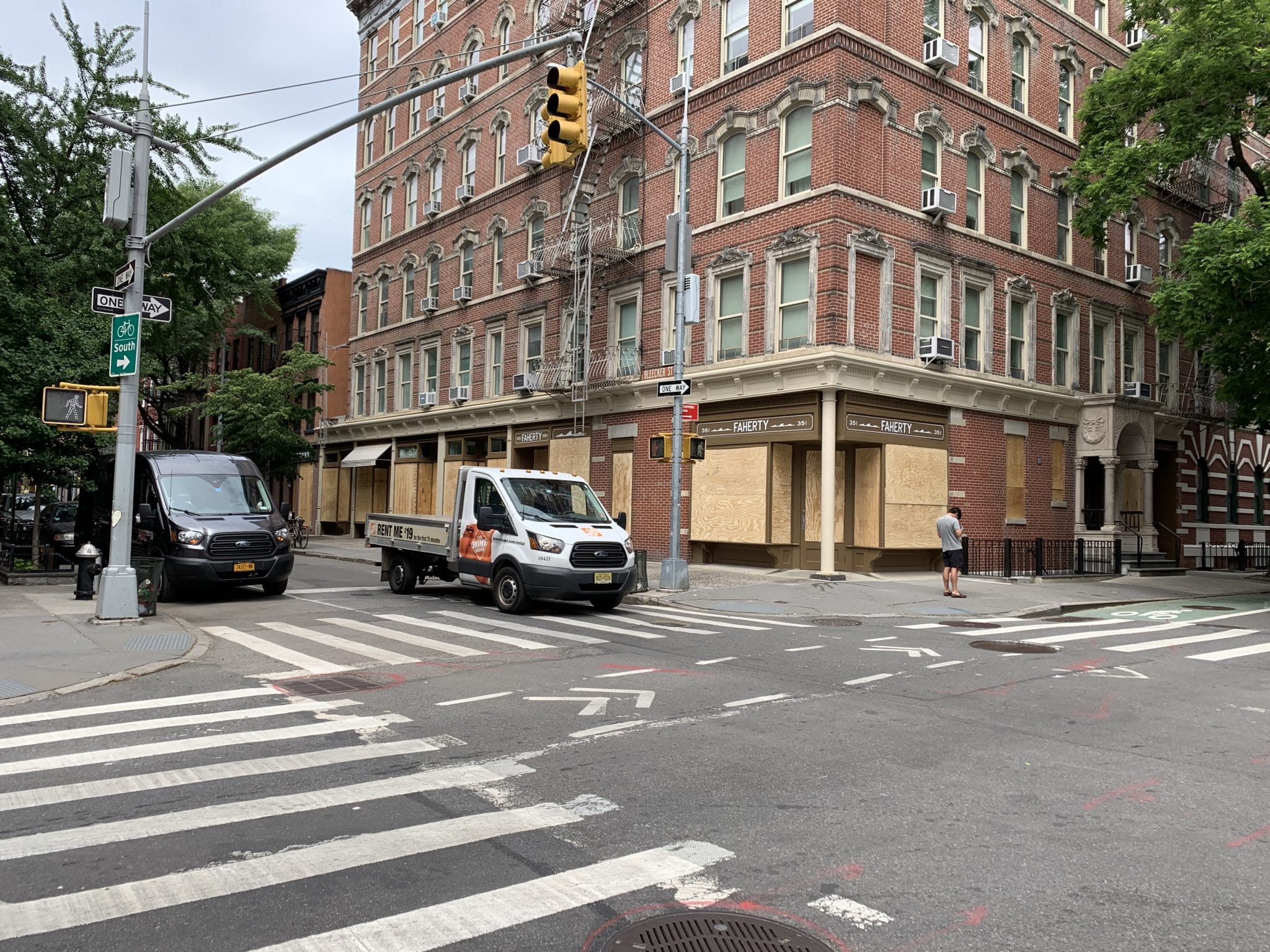
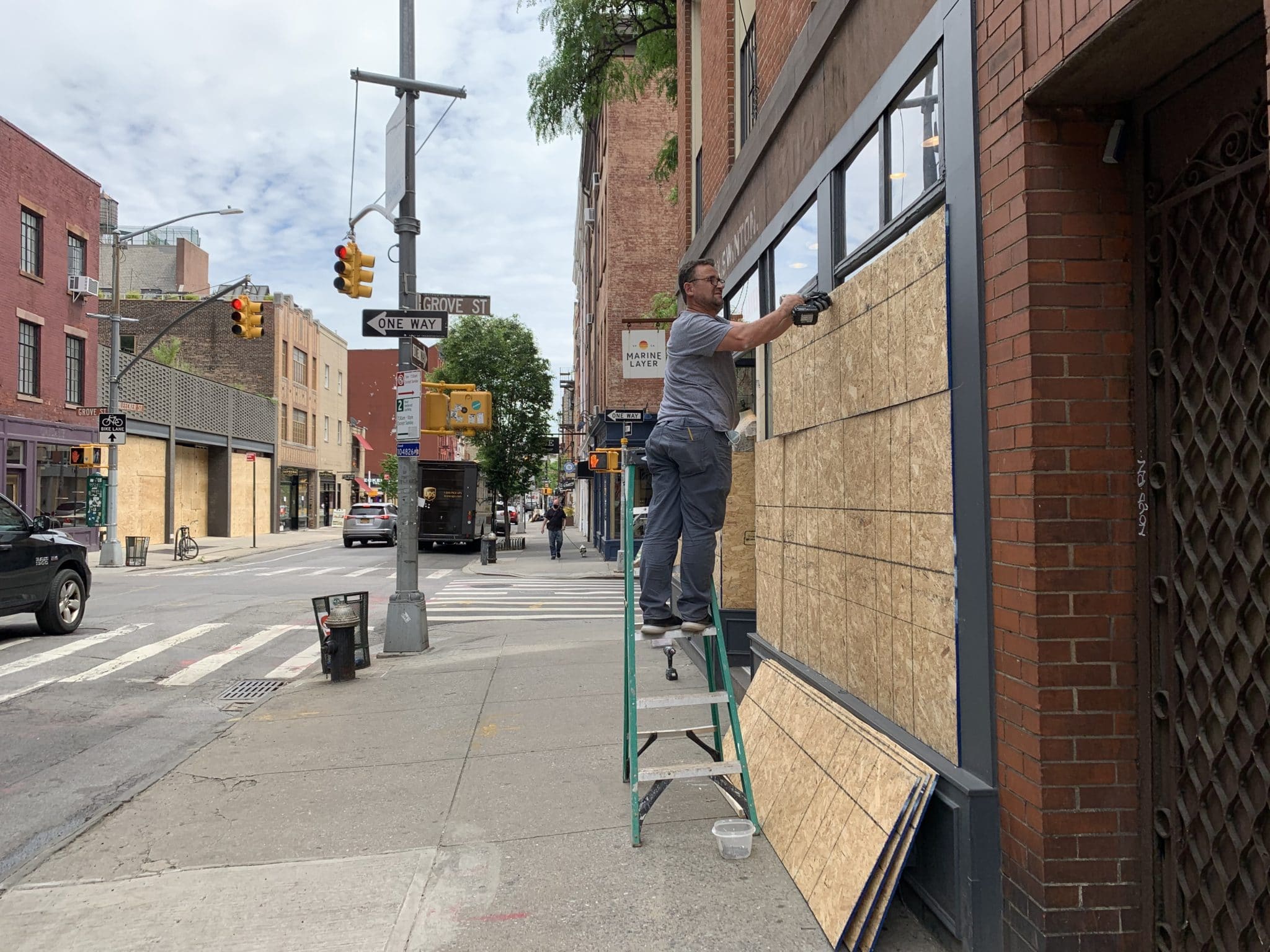
As we walked from street to street in the West Village, we saw plywood-covered windows and men with saws and nail guns hard at work boarding up restaurants and retail stores.
Iconic Bleecker Street with stores boarded up.Worker boarding up a store on Bleecker Street. Photo by ConsumerMojo.com
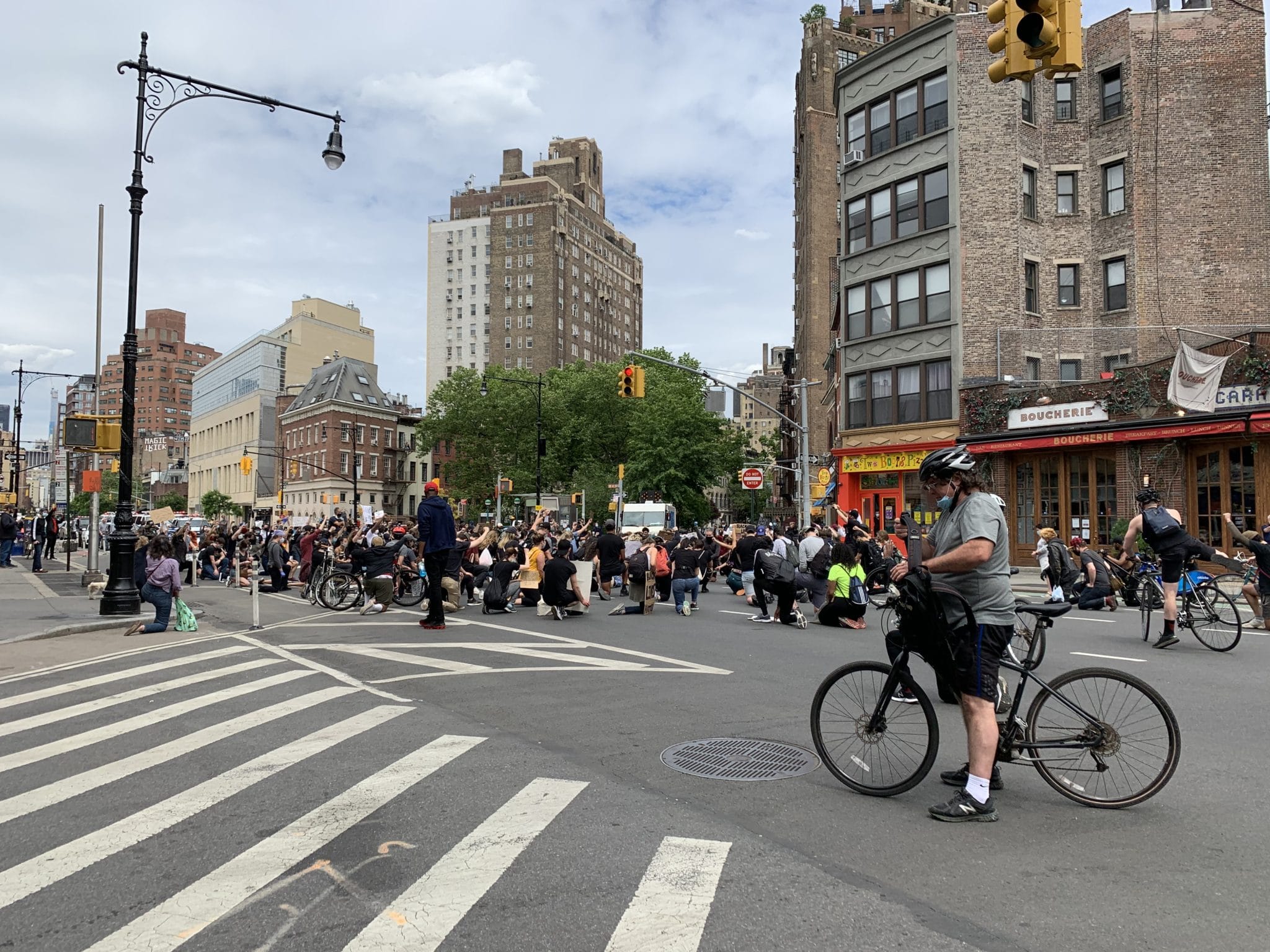
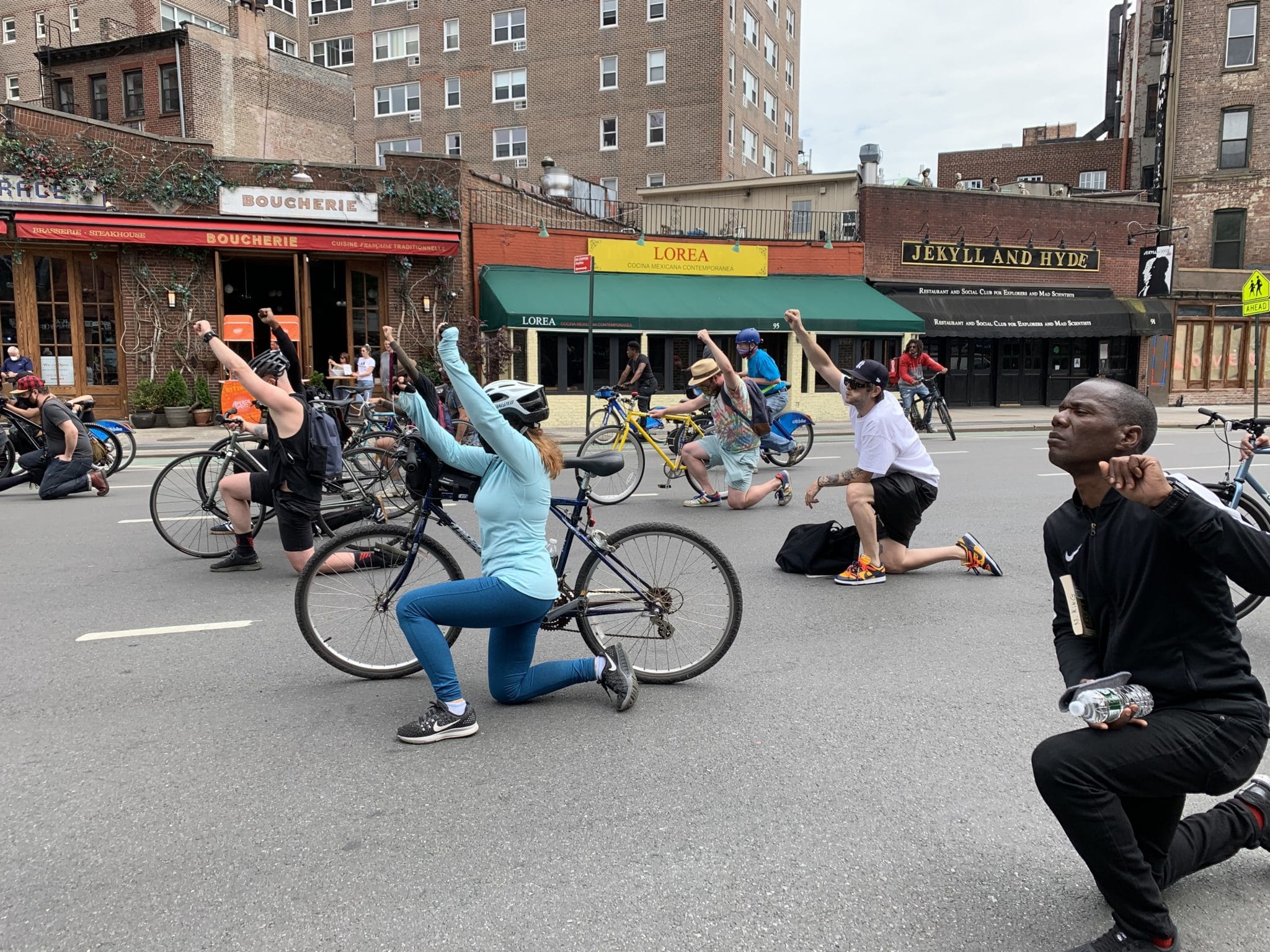
Against this backdrop, a group of 50 or 100 protesters marched down Seventh Avenue chanting, “Hands up. Don’t shoot.” They knelt in the street and police cars shielded them from traffic.
Protestors taking a knee at Sheridan Square. Photo by ConsumerMojo.com
Governor Andrew Cuomo said in his Tuesday news conference the police were so poorly deployed against the nighttime looting he wanted to send in the National Guard, but the mayor declined the offer. De Blasio moved the curfew start up to 8 p.m. and the NYPD announced a ban on vehicles below 96th Street. But if the looters continue to rule the streets and the police stay absent, the governor may have no choice.
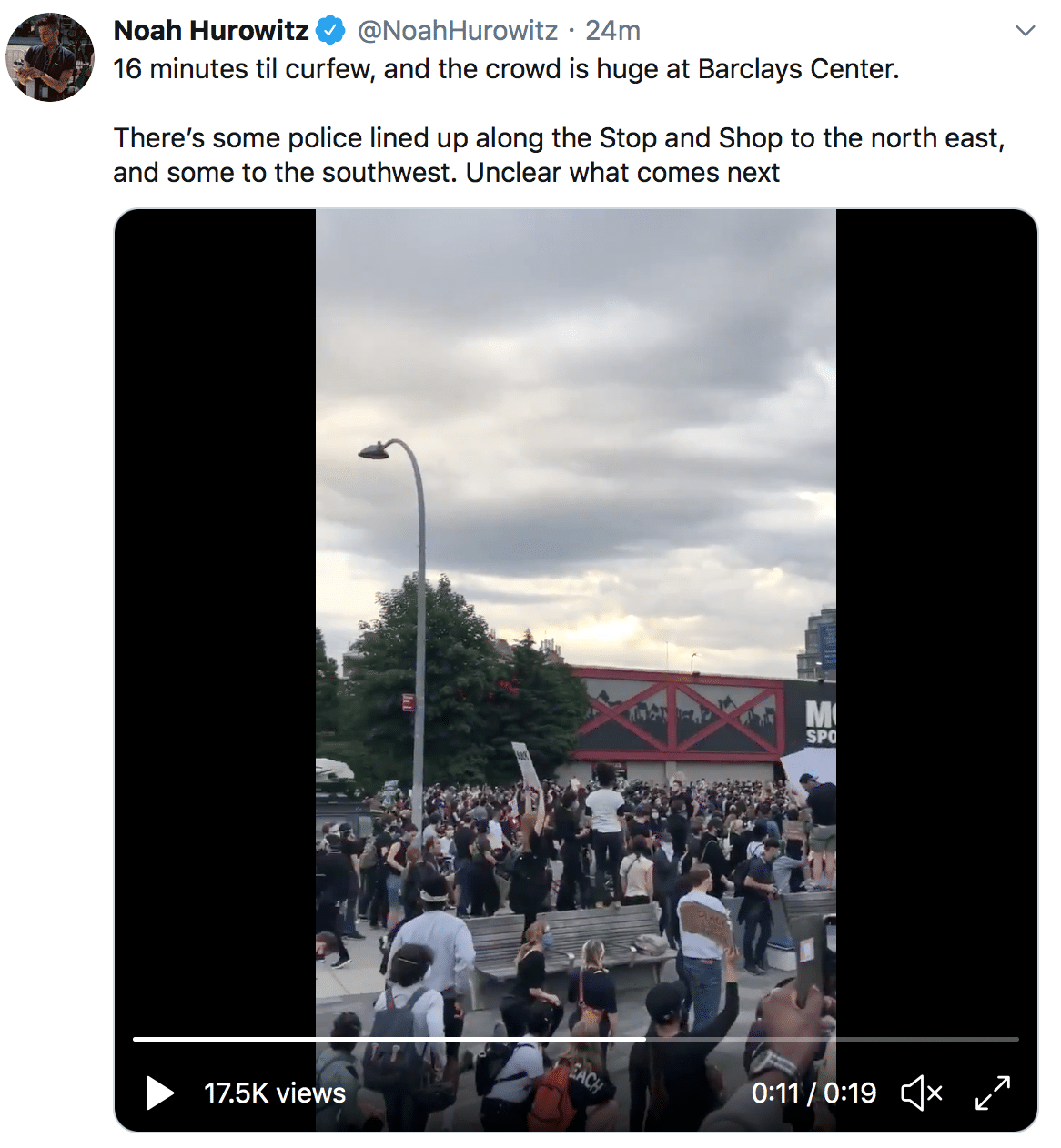
This tweet appeared right before the 8 p.m. curfew.
At 8:28 p.m. on Monday, our phones buzzed. It was an alert warning us that a curfew in New York City would go into effect at 11 o’clock. Governor Andrew Cuomo and New York Mayor Bill de Blasio declared the curfew after five days of protests were hijacked on Sunday by looters, vandals and people attacking the police.
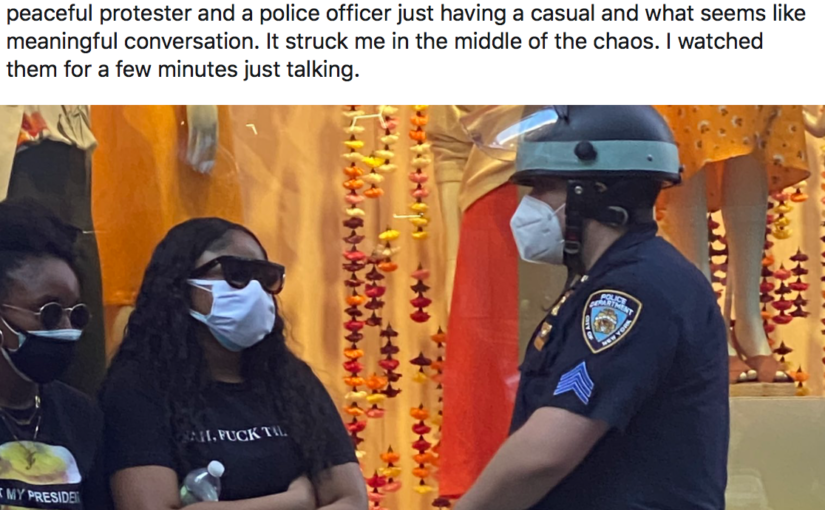
If we weren’t older and worried about contracting the coronavirus, we would have been out there with the peaceful protestors calling for fair treatment by the police and in life for black and brown people. The death of George Floyd in Minneapolis, by a police officer pressing the life out of him with his knee for almost nine minutes while other officers stood by, brought people in cities throughout the country to the streets.
In New York, some police officers caught on video crossed the line, shoving protestors to the ground, driving into a crowd, and waving a gun. We hope they are prosecuted.
But on Sunday and Monday night things in New York got uglier. Thugs smashed windows and looters stole from local businesses and international brands. These opportunists, who cared nothing for George Floyd, hijacked protests that demanded the justice he deserved.
For three nights we fell asleep to the sound of helicopters. The helicopters woke us again at 4 o’clock on Monday morning, and that was because of the looting. Announcing the curfew, the governor distinguished between the support for protestors and people who clearly have jumped in to steal or simply cause violence.
“I stand behind the protestors and their message, but unfortunately there are people who are looking to distract and discredit this moment,” Governor Cuomo said. “The violence and the looting has been bad for the city, the state and this entire national movement, undermining and distracting from this righteous cause. While we encourage people to protest peacefully and make their voices heard, the safety of the general public is paramount and cannot be compromised. Tonight the mayor and I are implementing a citywide curfew, starting at 11 p.m., and doubling the NYPD presence across the city.”
We support the protestors calling for change. We abhor the violence by the police and the people who are taking advantage of a tense situation.