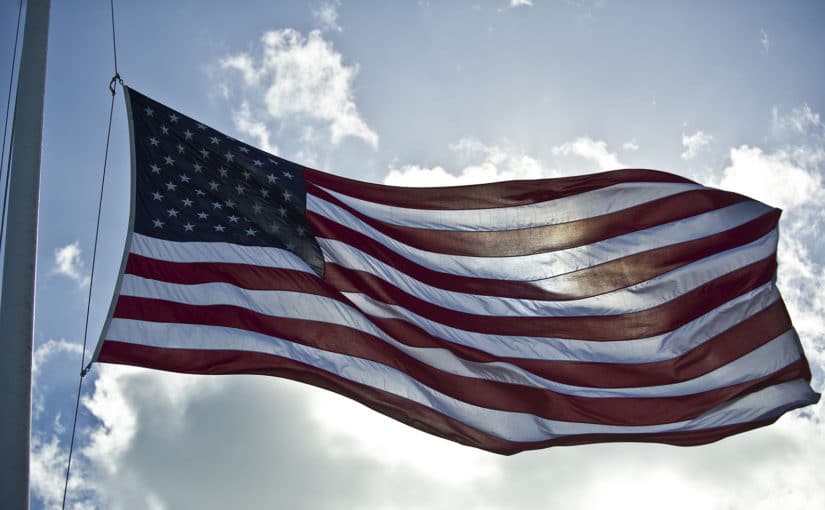
Nearly 100,000 COVID-19 deaths and the U.S. has now lowered its flags for Memorial Day. The White House says that this year, dropping the flag also honors the pandemic victims
We called for this action a month ago, when the death toll was almost 50,000. Memorial Day is when we remember America’s war dead, but we also lower the flag at times of national tragedy. We are a nation in mourning. In normal years, for many, Memorial Day is about personal mourning. My friend Gerry Chambers and others I know spend the days this weekend decorating the graves of their loved ones. And now we have the horrific personal loss for 100,000 families. Their losses are ours.
The New York Times devoted its front page on the eve of Memorial Day to the names of COVID-19 victims. That wasn’t enough space. The story jumped and filled two inside pages, too.
The tradition of lowering the flag to half-staff is codified. USA.gov says, “The United States flag flies at half-staff (or half-mast) when the nation or a state is in mourning. The president, through a presidential proclamation, a state governor, or the mayor of the District of Columbia can order flags to fly at half-staff. Most often, this is done to mark the death of a government official, military member, or first responder; in honor of Memorial Day or other national day of remembrance; or following a national tragedy.”
Let us grieve for those who have died, and let us show our concern for the health care and other essential workers who put themselves in danger every day. And let us pray that the federal administration’s chaotic, uncoordinated, failed response to this contagion gives way to actual leadership that so far as been pitifully lacking.
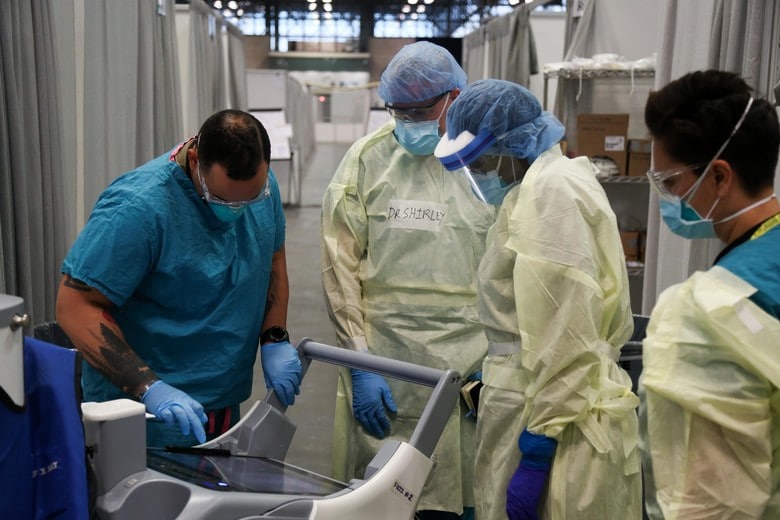
Service members assigned to the Javits New York Medical Station perform an X-ray scan on a COVID-19 patient in the facility’s intensive care unit. U.S. Army Photo by Sgt. Deonte Rowell.
There’s no end in sight for the tragedy we are experiencing. The death count continues as real people, our loved ones, die. In four months we have gone beyond the 58,000 American deaths in eleven years of the Vietnam War. Soon we will have doubled the 53,000 Americans who died in two years in World War II.
Mr. Trump tells us he’s a wartime president. He first floated the notion on March 18, when he tweeted that “we are at war with an invisible enemy.
But no effective national war is being fought against this virus. That President Trump has failed to take the battle to the enemy is clear. His battle plan consists of spin and deflection. He won’t take responsibility. The tools at the federal government’s disposal lie unused. At the coronavirus task force briefings, he has stood before the cameras and bragged about his TV ratings and the number of his Facebook followers. He has wondered out loud if household disinfectants could be injected and ultra-violet light beamed inside the body to kill the virus, triggering a chorus of corrections to keep people from killing themselves. He told us he takes an unproven prophylactic drug that has caused fatal side effects.
What the president seldom expresses is any convincing sense of empathy for those fallen in the war he says he leads.
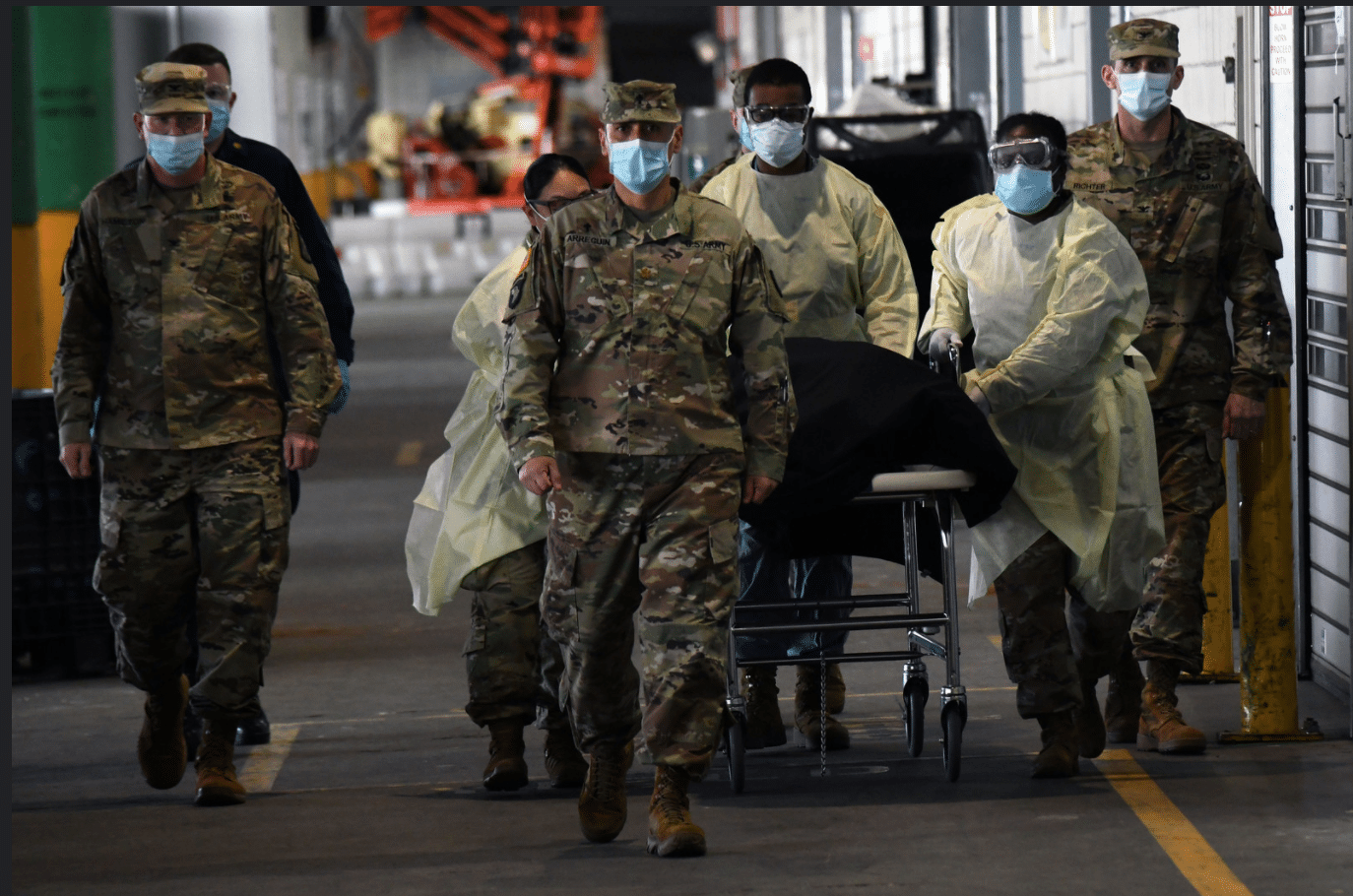
U.S. Army Chaplain and Healthcare Workers Escorting A Covid-19 Victim in New York City. Photo by U.S. Air National Guard Major Patrick Cordova.
Empathy has arisen from the health care workers, from governors and other leaders, from the vast majority of Americans. This sense of togetherness, that we share a sadness for the COVID-19 victims, we share the grief of their survivors, we share concern for the doctors and nurses and other workers who make our lives livable — the grocery store clerks, the police and firefighters, the delivery workers, the sanitation crews — while we shelter at home, all of this demands a high measure of respect.
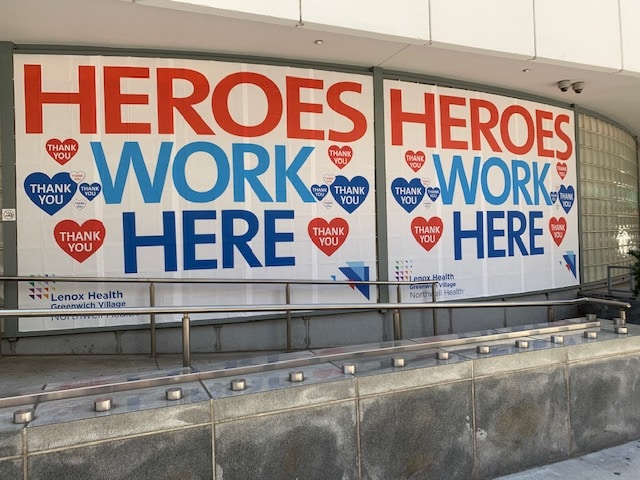
Northwell Health Urgent Care, Greenwich Village. Photo by ConsumerMojo.com
Each night at seven, New Yorkers lean out their windows to clap and cheer and bang pots and pans for the nurses and doctors working in the storm of Covid-19 infections. We’re saluting people who put their own health on the line to keep others from dying.
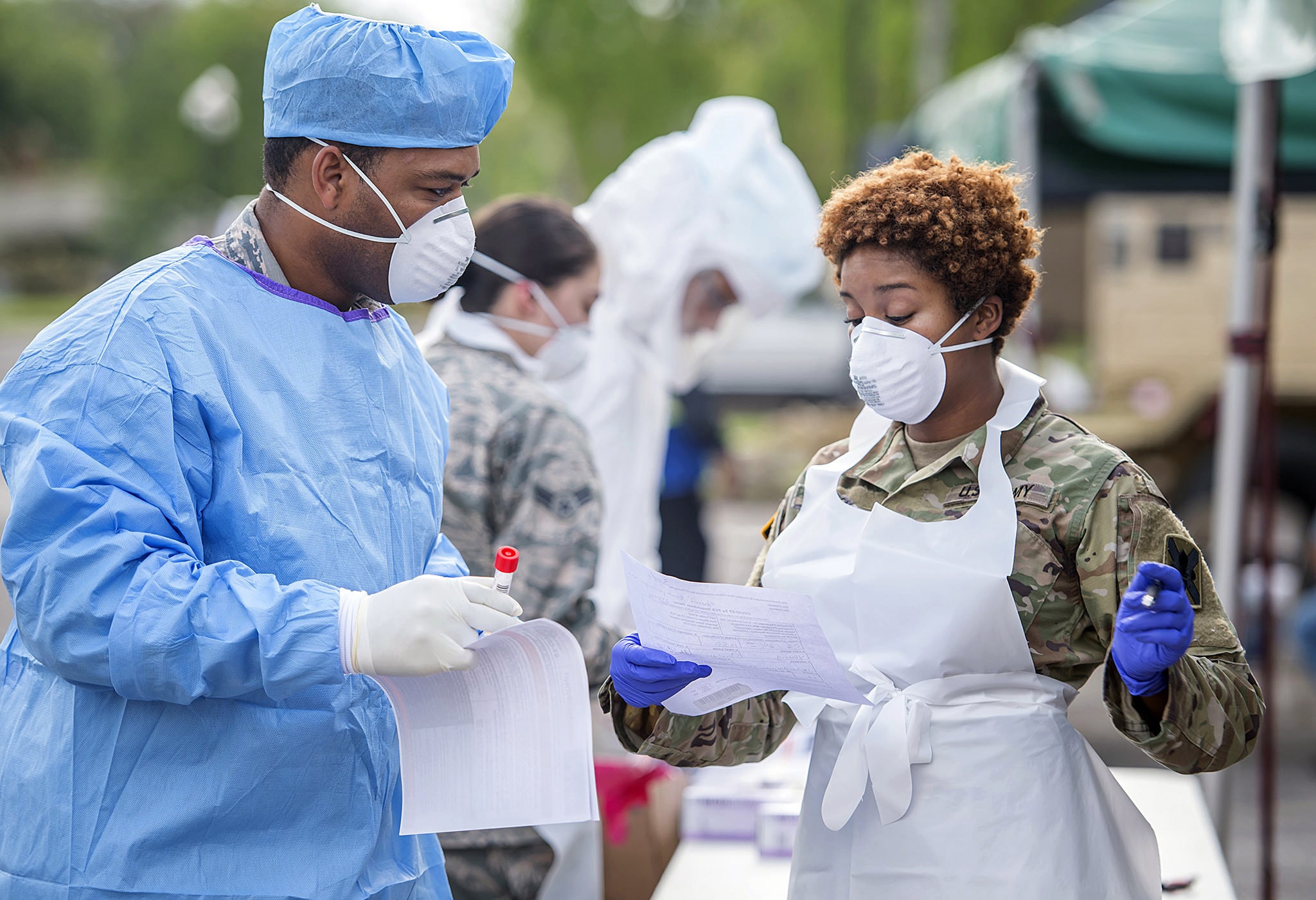
Louisiana National Guard Soldiers and Airmen collect nasal swabs from patients during a drive-through, community-based COVID-19 testing site located in New Orleans, La., U.S. Air National Guard photo by Senior Master Sgt. Dan Farrell.
They can’t stay at home like the rest of us. They’re often short protective gear, they work brutal hours that leave them exhausted and, before they go home at risk to their own families, far too often they’re the last person a coronavirus victim sees. And the virus has killed too many of them.
Our evening demonstrations are a small way to honor these true heroes. We can do better, though. Let’s keep our flags lowered. There’s no higher measure of respect than to lower our flags to honor our fighters, all the ones we’ve lost and the ones still fighting every day.
We won’t get a proclamation from this president to mourn his administration, so we should do it on our own. We have that right. Let us continue to mourn the victims of the war that the president won’t fight and mourn his failure as a leader.
Even as shelter-in-place orders are eased and we try to tiptoe back towards normal, the death count keeps rising. Let’s look to the flags flown at half-height and remember that we’re experiencing an ongoing national tragedy. Maybe then we’ll remember to protect ourselves and others until we can raise our flag on high again.
Coronavirus turned our lives upside down and made reliable journalism more important than ever. The online summer session of Introduction to Journalism rises to the challenge of our times. The class will immerse students in journalism fundamentals and teach them how to research, report and write stories that have significance for their communities. Their best work will be featured on HarlemView, a website funded in part by the Moxie Foundation to stimulate community engagement.
Students from every discipline and walk of life can benefit from this deep dive. You will learn how to write clearly, concisely and tell a meaningful story. These skills transfer to all aspects of your lives and the class will help you communicate your ideas and concepts more successfully.
Those who saw it say the Nazis and local collaborators rounded up their family members, neighbors and friends and led them to a clearing in the woods not far from the center of Ivye in what is now Belarus.
On May 12, 1942, Nazis shot 2,524 Jewish people and buried them, piled on top of one another, in a mass grave in this small area.
My grandmother was born in Ivye. Her family left for the United States long before the Holocaust. But my great-grandfather Jacob Abrons stayed in touch and tried to send money to help those who remained behind. It was a time, despite reports of mass killings, concentration camps and pogroms aimed at exterminating Jewish people, when the United States and other countries refused entry to refugees from Europe and especially Jews.
That seems just like the way we look at refugees in the United States today. Even though we have this relatively recent example of the cruelty of that kind of policy, the Trump administration and many in Congress are refusing to remember.
History teaches us that our anti-immigrant, anti-refugee policy can only lead to the ugliest consequences for vulnerable people trying to escape annihilation.
We study history to help us make better decisions. Remembering the Holocaust should help us also remember our responsibility to today’s “huddled masses, yearning to breathe free,” as Emma Lazarus wrote in 1883.
In 1992, my husband Nick Taylor and I visited Ivye and the memorial to the victims. We had contacted Dr. Maria Shapira, who still lived in Ivye then, through the American Gathering of Holocaust Survivors.
Maria survived the Holocaust in the woods, scrambling and fighting as one of the famous Vilna partisans. When the war ended she remained, went to medical school and served as the pediatrician in her community, which had only four Jewish families left.
She and her daughter’s family, who lived in a larger city, told us they planned to move to Israel. The memorial and a synagogue that was converted into a community center were the only things that remained of Jewish life in Ivye.
Danielle McDonald-Vanty found a community of people on Facebook to try to get answers about what happened to their stimulus payments. “I’m in these groups to communicate with others in the same boat,” she told me in a message. It’s a good outlet, but ultimately no substitute for the money they haven’t gotten yet, money they need to keep their families afloat.
It may be awhile before Danielle’s family and millions of others get the stimulus money. The IRS can only make a direct deposit into your bank account if you gave them direct deposit information for refunds when you filed tax returns in 2018 or 2019. The IRS made direct deposits beginning the week of April 13. It will continue for the next several weeks as it steers money to 80 million Americans, says the House Ways and Means Committee.
But if you used a tax preparer, the IRS is not likely to have your direct deposit information. Danielle used a preparer. They received the direct deposit, she explained, “. . . so they could deduct their fees and advance loan before putting the remainder of the refund on my bank card.”
Coronavirus and the stay-at-home orders threw their family into financial limbo. Before the virus struck, they had decided to move from Springfield, Massachusetts to the Fayetteville, North Carolina area. Her husband Clarence was recovering from an accident at the wholesale grocery warehouse where he worked. She planned to transfer her IHop job as a waitress/shift supervisor to North Carolina. “My new location was closed when we got here,” she said. Since March they have been living with her in-laws because they haven’t been able to move into an apartment of their own. “It’s a big mess. My three children can’t even go to school,” Danielle said.
So the $3900 from the stimulus CARES Act would really help. But the IRS and Treasury officials acknowledge the money will be slow reaching families like Danielle’s. In 2019, 64 million taxpayers, or 41 percent, did not provide bank or financial account information to the IRS, according to the IRS taxpayer advocate.
The House Ways and Means Committee estimates that 101 million Americans will receive paper checks, including Social Security recipients, veterans and others. Treasury Secretary Steve Mnuchin told Jake Tapper on CNN on April 19 that the checks will have President Trump’s signature on them. It’s estimated 5 million checks will go out a week and it will take approximately 20 weeks to get them all out. The people with the lowest incomes will get the checks first.
How Can You Speed Things Up?
The IRS is encouraging people to log on to Get My Payment to update their information.
You can update your address if you have moved or provide direct deposit information.
You should also use this app if you have not filed taxes and the IRS has no record of you.
Danielle just signed on to the app and the message said that the IRS will give her a deposit date when they have one. “I’m keeping my fingers crossed along with the thousands of people I have met on Facebook,” she said.
I belong to two volunteer sewing groups. One sews garments for Jewish burial and one, called Days for Girls, sews bags for menstrual kits for girls in countries where they would not be able to leave the house without it. When I heard that people on the front lines against COVID-19 needed personal protective equipment (PPE) and that hospitals needed people to make masks, I thought, “That’s an army I can join!”
I have a gazillion sewing machines — actually more like nine, of which four work — and a degree in Fashion Design from the Fashion Institute of Technology.
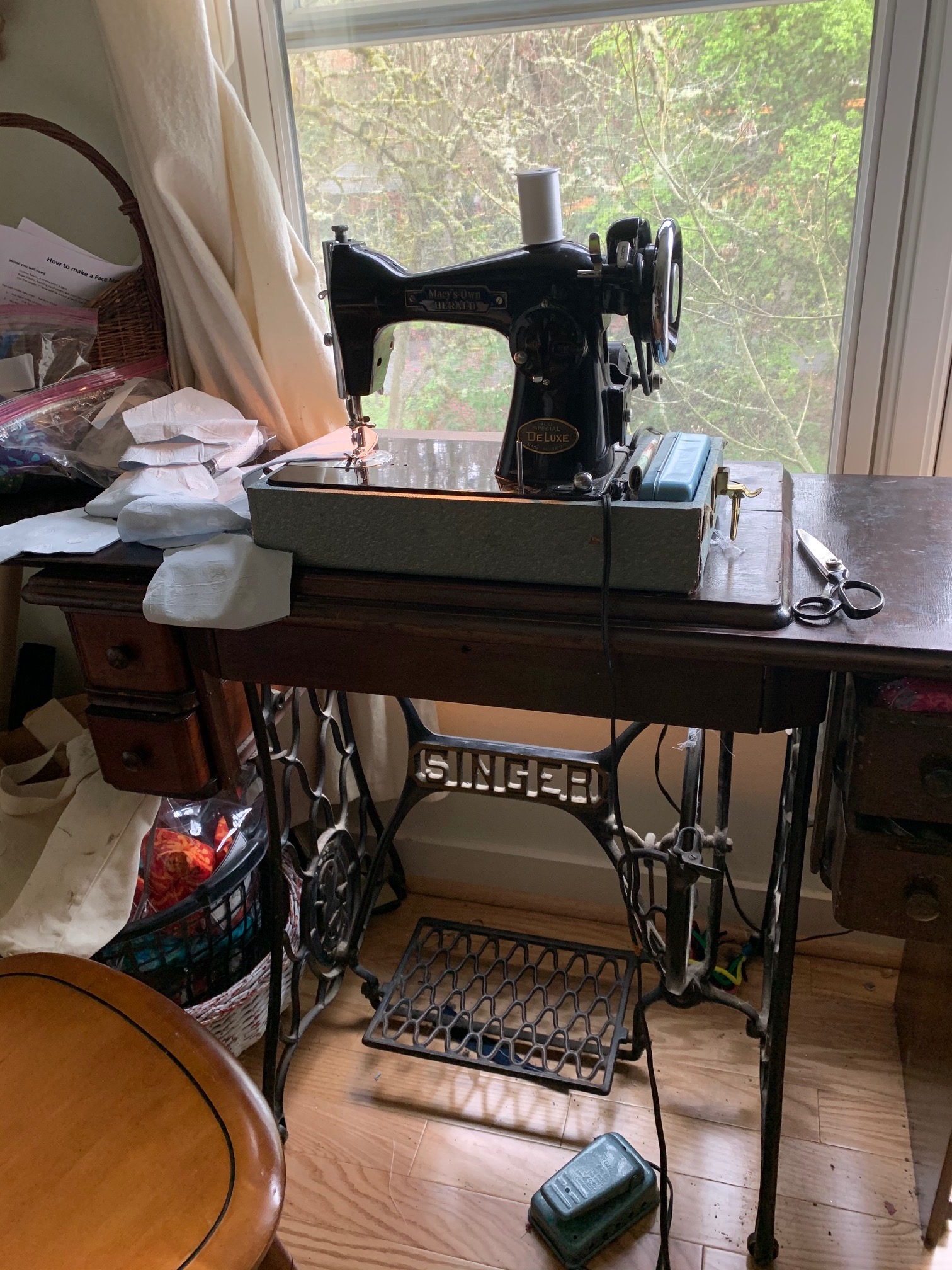
One of Jeanne Robin’s sewing machines.
I’ve had many hand-made craft jobs that required an assembly line mentality where you do one action at a time on many pieces. A lot of people in Portland, Oregon, where I live, started sewing maks immediately. But I wanted to do some research before I started so that I could make the most effective and comfortable masks.
The Fabric Patch, a quilt store in Ephrata, Washington, had two mask patterns on its website. They had consulted medical folks and tested different fabrics and closures. One is a rectangular pattern that saves fabric; it’s easier to make but less effective. I landed on the pattern with two layers of cotton fabric and an interior layer of a non-woven fabric. They are protective, washable, snug-fitting and comfortable, not to mention kind of trendy and cute.
You could make them with elastic strands that wrap around the ears, but those can hurt, especially if they’re worn for hours at a time. And the elastic is impossible to find these days. That made me try other options such as grosgrain ribbon, cotton laces and parachute cord. I have the ties loop around the back of the head and tie at the nape of the neck.
Then things got crazy!
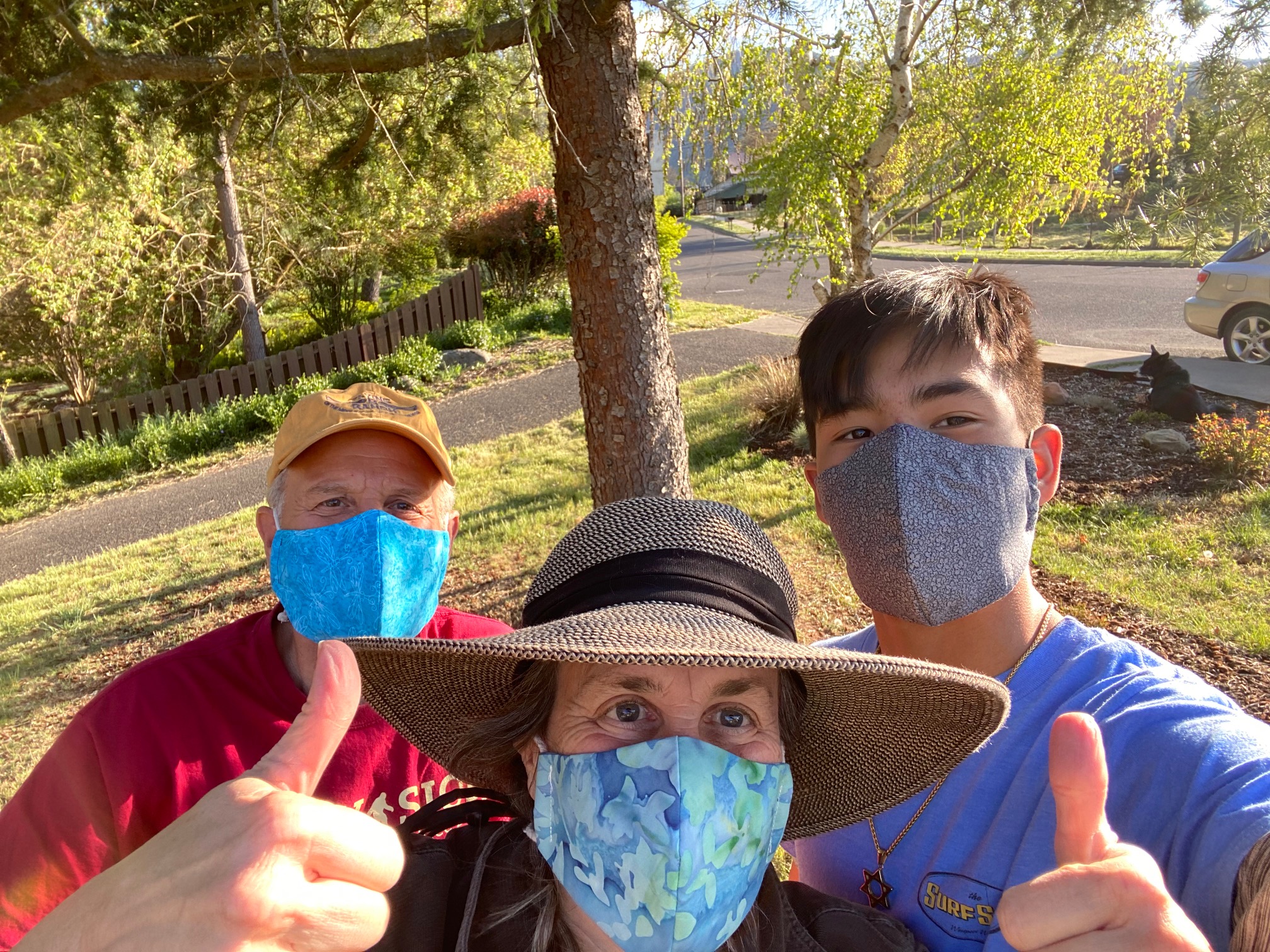
My boyfriend Bob asked if I’d make masks for him and his son. I did.
Jeanne’s boyfriend Bob
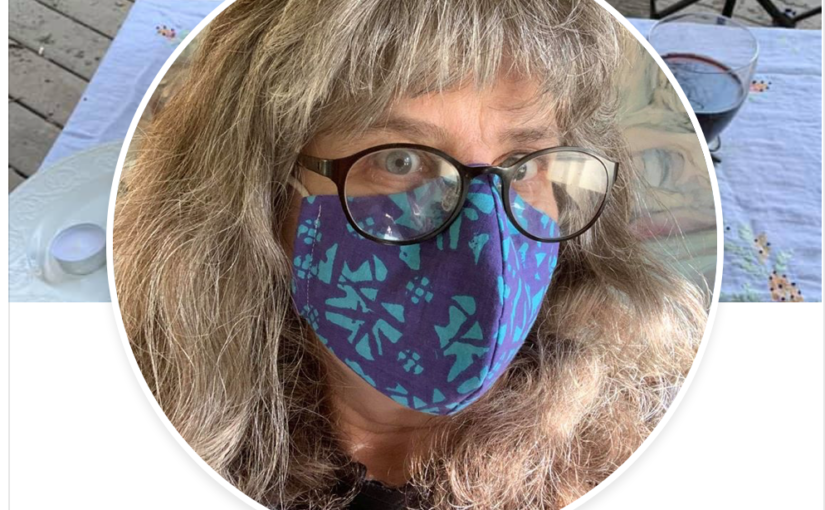
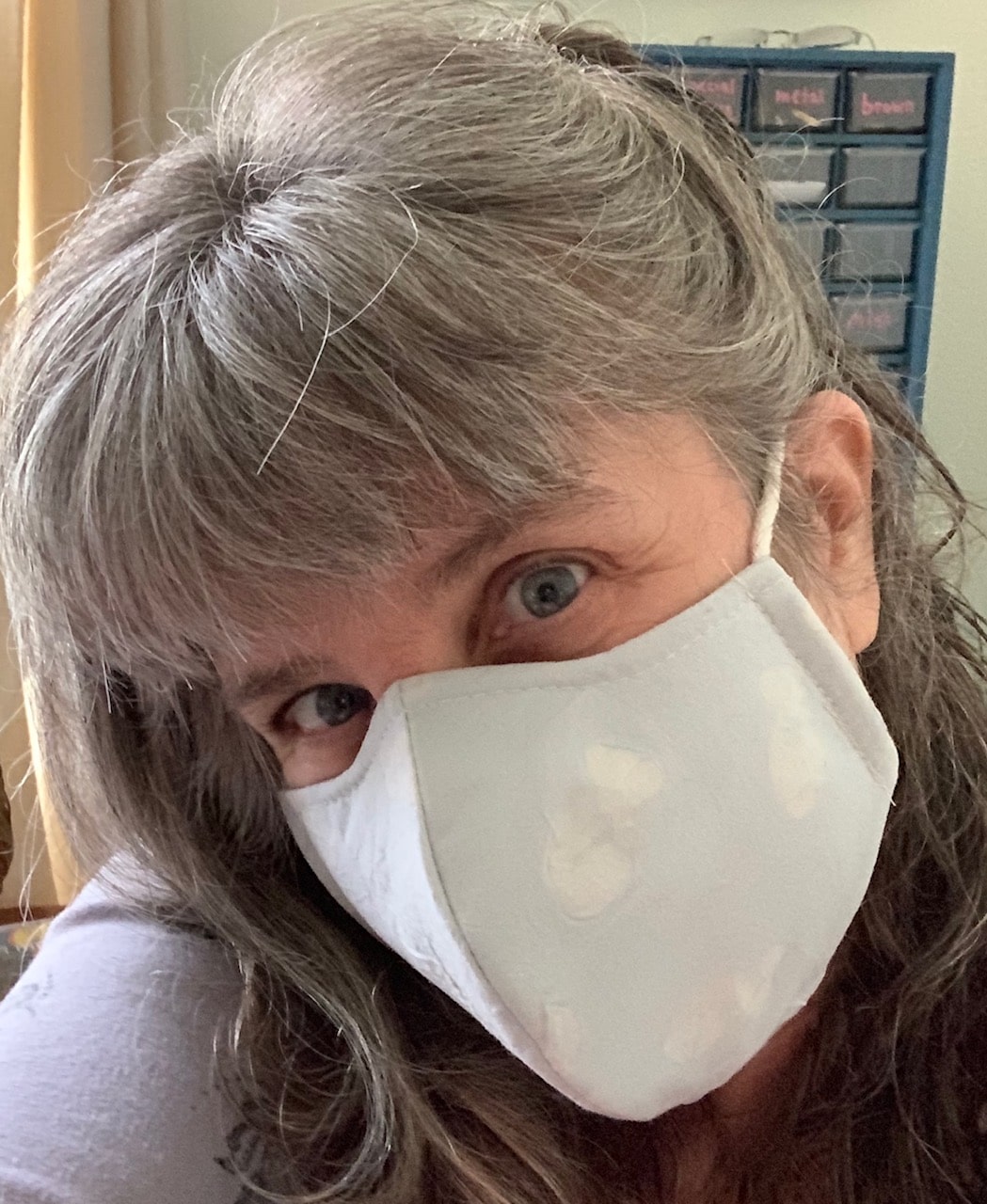
And while I was doing it I made one for myself. I put mine on, snapped a selfie, and in a flight of fancy decided to post it as my Facebook pic with a nod to the J. Peterman Catalog from “Seinfield” that featured the weird and wonderful.
Jeanne Robin
My post read: Seamstress/model: N95 style mask. Cotton fabric exterior, 1 layer non-woven interfacing (breathable but small particles can’t pass), whatever works ties.
I clicked on “Post” with a sense of the absurd. It was a gag!
My Facebook blew up!
“Are you making these?” “Can I get one?” “Three?” “Five?” Twelve?”
I was shocked and thought people were kidding. Who knew?
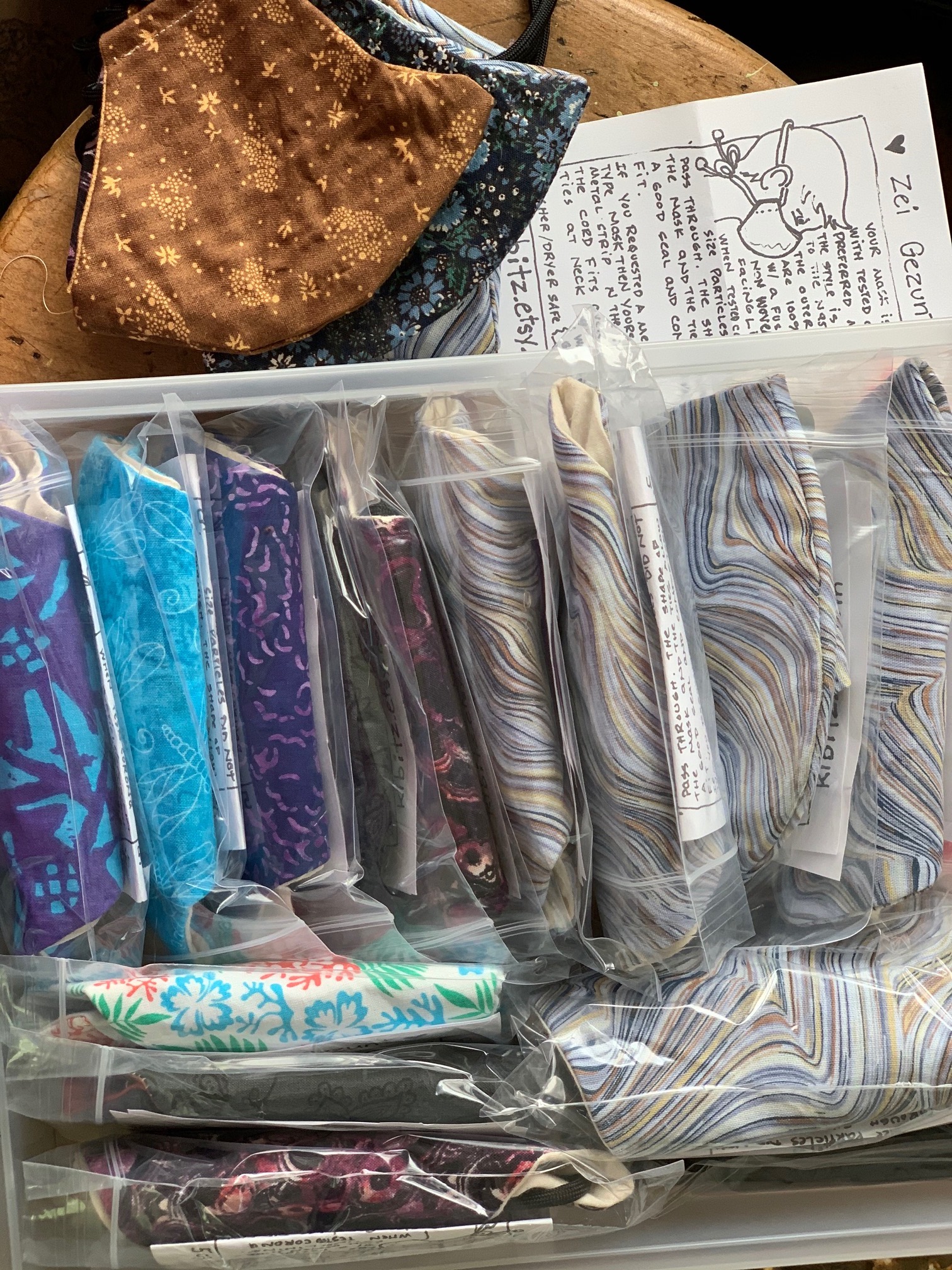
In the next three days I had 134 mask orders from family and friends all across the country. Four went to Israel where people are mandated to wear them and masks are unavailable. I charged $10 per mask to cover material costs, shipping and to cover donated masks.
I inventoried the materials I had in my house. I only had enough to make thirty masks. I had to prioritize who got them first. People were anxious. A friend runs a preschool that serves medical families. Her staff decided they wanted to remain open for the families. They were opening on Monday. That order jumped ahead of the friends-and-family line. I made twelve masks with a pocket for a replaceable filter (coffee filter or paper towel) for her teachers.
Who was next? My nephew Zach, who works in a grocery store? My nieces, Arianna and Sofia, who are going to the store for their parents? My sister Laura, who is a doctor and lives with her son Ari in Ashland, Oregon?
Laura Robin, Ari Bandoroff and Scott Bandoroff
My friends who are nurses, my friends with auto immune diseases, my elderly friends at the nursing homes where my mom lived, or my friend who just finished her chemo? Now I had to order more materials and figure out how to pack and send. I tried to order more but it seemed the whole world was making these. Everything was back-ordered.
So I ordered a few different secondary materials and hoped that something would arrive. The fabric I bought at the fabric store or craft store had to be ordered and picked up curbside a day or two later. There is presently a limit of two yards of interfacing per customer. I’ve done all my shopping trips in my slippers with the dog in the car.
Making the first batches took a while to figure out. People were texting and calling out of the woodwork: “Can I get a mask? I really need one!”
I can’t believe I had to say, “I have 120 orders in front of you. Can you tell me why you need one so badly?”
“I work for the Oregon Health Authority and I’m an epidemiologist.”
I felt like a drug dealer. “Okay… I’ll put it in the basket on the porch. Come by tonight. Just leave the money in the can.” I’ve never had so many people come to my house!
My friend who makes the gorgeous Jewish shawls called tallitot told me she was making masks and was looking for tips. I told her about my assembly line and she climbed on board. Now we’re both cranking out awesome masks.
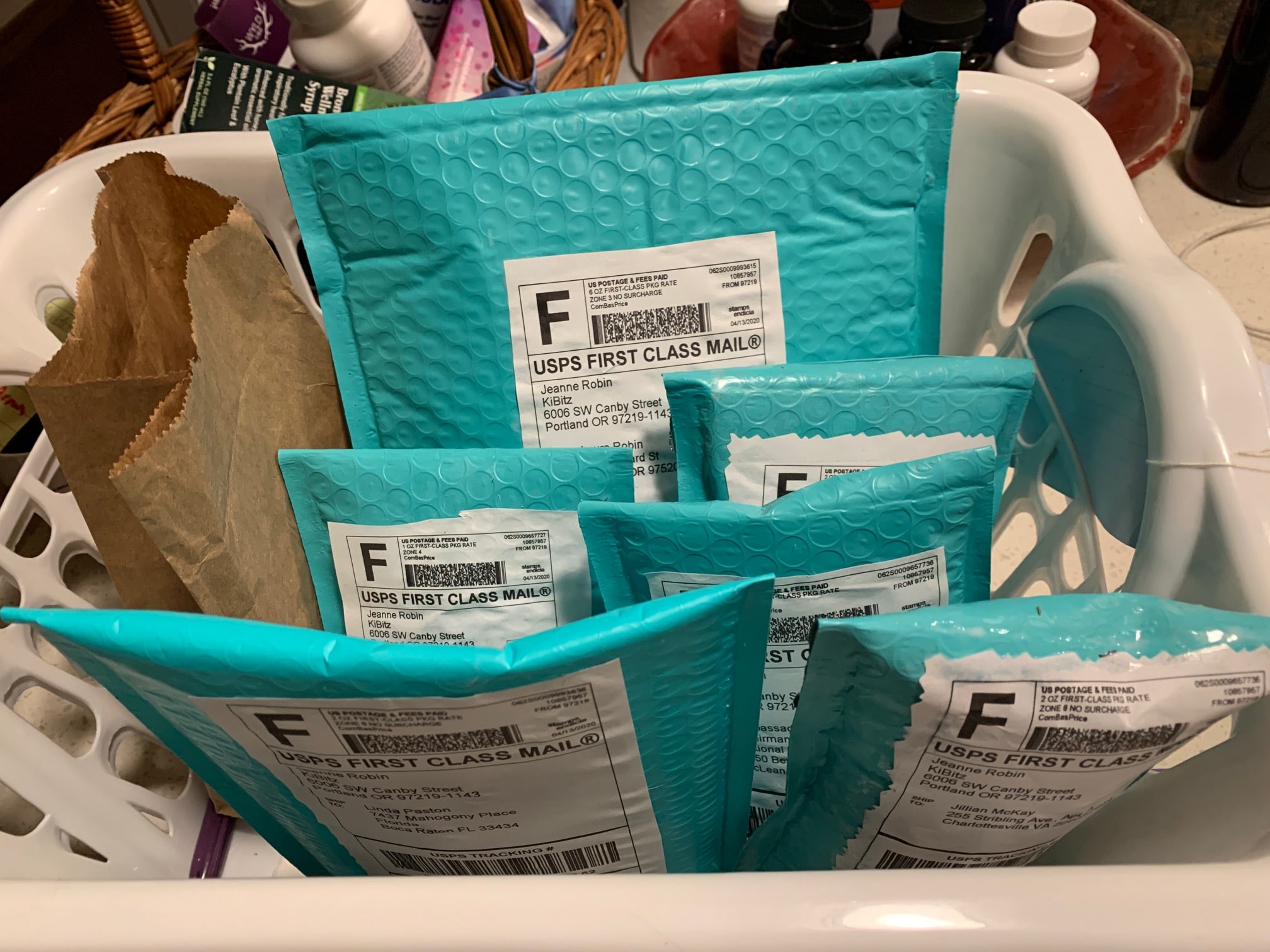
I’ve finished all of the family and friend masks at this point. I am using Stamps.com so I do not need to go into a post office and can just drop them into the drive thru mailboxes. I left one for my mail carrier. I gave a few to my elderly friends via social distancing — I had to call the front desk of the retirement community and someone came to my car and collected them. I sent some to a nurse.
I could not have imagined how much getting a good mask means to the people who receive them. You would have thought I gave them a pot of gold. It gives them, and me, great comfort. People tell me that when wearing the mask, if they happen to brush within six feet of someone in a store they don’t feel panicky. When they told me the masks are comfortable but a little hard to tie, I discovered spring loaded closures. That way they don’t need to be tied or retied. I keep sewing faster and better and making modifications.
I also belong to a group of crafters who are doing projects for good. The call went out for all the sewers to make masks for the retirement community where my mom lived. They asked for 900 masks. There are also calls for gowns and other PPE. Donated fabric is on the porch of the woman who leads both these groups. I have finished 150 masks. I created a site with limited merchandise on Etsy(KiBitz) to sell to friends of friends and anyone who comes across it. Right now I do not want a lot of Etsy orders.
Now that my friends and family feel a little more secure, I want to focus on making masks to give away. They’ll go to Cedar Sinai Park, the hospital, the delivery folks and other people who are doing the work in the world. They need all the thoughtfulness and comfort we have to offer. Seeing where this pandemic brings us, I may expand what I offer on Etsy, but the next few weeks will focus on donations until more commercial PPE is available to those who need it.
Gabrielle Carson sat up in bed one March morning, shortly after New York Governor Andrew Cuomo’s “Pause” order, and said, “I’m going to make masks.” She, like many other New Yorkers, had closed her business to comply with social distancing. Her shop sells made-to-order party clothing of her own design.
She realized she could mobilize the team of freelance people who sew for her regularly, provide them employment and also help healthcare workers. Gab, as her friends call her, reached out to political contacts and offered to make the N-95 masks that healthcare workers need to treat Covid-19 patients. But she couldn’t break through the bureaucracy.
Undaunted, she thought, “Why don’t we just make regular masks? Maybe people will wear cotton masks and leave the surgical masks for our healthcare workers.”
So she called suppliers. She started with a notions store, Daytona Trim, in New York’s garment district. The owner, a man she knows only as Abraham, said he could supply the elastic. “He’s the nicest guy. He told me to come on a day when everyone who needed elastic for masks would come. But he would leave everything outside.”
Then Gab went online looking for cotton. She settled on Japanese cotton from B&J Fabrics, which specializes in sustainable fabrics. She ordered it and they too told her they would leave it outside of their door on Seventh Avenue.
But then she had a problem. Before she could cut the fabric, she wanted to wash it. “All the laundromats are closed. I began calling friends asking if I could come over to use their washing machines, or the washing machines in their buildings.” Several agreed and with the cotton washed, she was ready to make the pattern and cut the pieces to give the people who sew for her.
“All of my contractors are either Chinese or French and they have been working with me for many, many years,” she said. “But everyone seemed to have a problem that made it impossible for them to do the work.” So she began calling people who knew people. “I called a factory owner in midtown and he persuaded women to come in and work. But then he closed the factory and the women took the work home.”
Her approach changed. If she couldn’t find a central location, she’d go to the people who do the work. Now, she said, “We cut the pieces in the studio and then I have to deliver them to the women doing the sewing and later pick them up.” She laughed as she told me the story, talking on her cell phone as she headed to pick up a bundle of freshly made masks on the Lower East Side.
“We have 100 washable masks coming in every other day,” she said, sounding amazed. “But we need that number coming in each day. Suddenly, I became the mask lady.” When she started out, she hadn’t realized that the masks would catch on like they have. She sent an email with a photo to her clients.
The orders started coming in immediately. “Some people order twenty, some order one. I’ll ship two for a couple and then they order for the lady next door. One lady bought 500 for everyone in her company.”
While President Trump won’t wear a mask, and said the federal government is not a “shipping clerk,” Gabrielle Carlson wears a mask and acts as her own shipping clerk.
“I placed 85 packages on the counter at the post office and the lady said, ‘What’s this?’ I said masks and she smiled and started to process them.” This new business has made her acutely aware of how kind and resilient people can be. “I’m grateful for those who are willing to work, cut and sew. We’re seeing extraordinary humanity.”
First it was $2 trillion in “stimulus” as business dried up and jobs disappeared with social distancing. Now there’s talk of more trillions being shoveled into infrastructure. Wherever the coronavirus crisis takes us, it’s clear that the infrastructure we invest in anticipates as best we can whatever the new normal proves to be. And some of it we can do some of it now while we are social distancing.
FDR’s New Deal jobs programs didn’t end the Great Depression of the 1930s. World War II did that. But those programs and what they built moved America from the 19th into the 20th century.
New and refurbished roads and bridges were only part of it. Hundreds of airports ushered in the age of commercial aviation. Dams harnessed water power that brought electricity to vast portions of the rural south and west. Water and sewer systems replaced hand pumps and outhouses. New hospitals put more people within reach of medical care. Students learned better in new and rebuilt schools. Local, state and national parks welcomed families to enjoy leisure as they never had before.
And the roads and bridges weren’t just make-work. They sped workers to jobs, farmers to markets, and trucked goods to consumers.
When the war ended and citizens finally could take stock of their new country, they learned the infrastructure programs that had given work to the Depression’s jobless had accomplished much more. A people that traveled more, placed more stock in education and health, and had more leisure to enjoy now had a country that allowed those things.
The infrastructure we need now should move us fully into the 21st century.
My wife Barbara now teaches her journalism and video reporting classes at CCNY virtually, using Zoom. Quarantine cocktail parties are big on Zoom, too. Late night hosts using Webex and Skype for guest interviews from their basements. Social distancing will be with us for a while, and we’ll continue to connect virtually even when it’s over.
Extending broadband coverage into every corner of the country is one of the infrastructure investments we must make. An internet connection today is like electricity a century ago, and there’s no excuse for everyone not having it.
The post-pandemic world will need more access to health care. Astronomic unemployment from the shutdown is throwing millions off their health insurance. If jobs don’t come back soon the population on Medicaid will soar. People will need to find preventive and corrective health care. They’ll need community health centers they can walk into without having to drive miles to reach. This is infrastructure that will keep people at work as the economy tries to recover from a body blow the likes of which we’ve never seen.
Some of our infrastructure investment must shore up defenses where we are vulnerable: our electric grid, our largely online financial world, our voting systems, our social media that can be manipulated to turn Americans against one another. Attacks in these sectors will only ramp up as we emerge to a new version of normal.
Much physical infrastructure work can’t be done under social distancing rules designed to stop coronavirus spreading. The work that can be done, should be. Meanwhile, the work on our virtual infrastructure needs that can be done at computer keyboards should go forward. We want an infrastructure that fits our new world when the crisis lifts and we can emerge into that world.
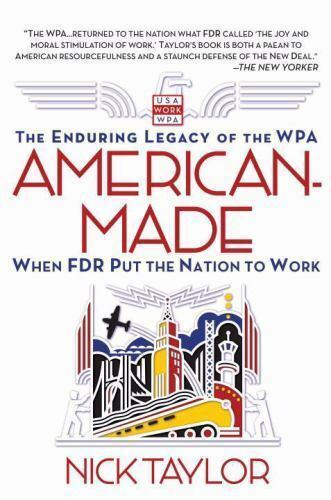
For more on the New Deal and the jobs program read my book American-Made.
Our friends Mike and Donna Ambrose from Savannah were on a wine tour in New Zealand when the coronavirus started shutting down travel all over the globe. This is Mike’s story about their tour and trip home to an altered world.
by Michael Ambrose
We had been looking forward to this trip for over a year. We started out in Sydney, Australia, for two days and then flew to New Zealand for sixteen days of wine tasting and touring the amazing countryside. Our guides Per and Britt Karlsson own BKWine Tours. We traveled the wine regions of South Africa with them in 2018 and Argentina and Chile the year before.
We loved this trip, but it ended far differently than we expected. The coronavirus stalked us throughout our entire visit, and finally caught up with us one day before our journey ended. But first, the good parts.
Donna and Mike Ambrose vacationing in New Zealand.
Sydney was our first stop. It is a beautiful, exciting city. We toured the spectacular Opera House.
Sydney Opera House, Photo by Mark Yang. Public Domain.
And we visited both the Zoo and Aquarium. The restaurants along the harbors served excellent food and very good wines. We saw news that infections of COVID-19 were increasing around the globe, but at the time, there were very few cases in either Australia or New Zealand.
When we flew out of Sydney to Auckland, the city was operating normally. But one day later, Tom Hanks reported that he and his wife, Rita Wilson, had both contracted the virus. She thought she’d been exposed while performing at the Sidney Opera House twenty-four hours after our visit to the site. The next day, Australia began shutting down, limiting incoming visitors.
Auckland, New Zealand, Photo by Holgi. Courtesy Pixabay.
Meanwhile, our tour of New Zealand started in Auckland. For sixteen days we traveled south, more than one thousand miles to Queenstown on New Zealand’s South Island. Six of our group of twenty-four were from the U.S. and the rest were Europeans. We took in beautiful sights including national parks and museums.
But the primary purpose of our trip was to visit wineries, and of course, taste wines. Our schedule included the Mondillo, Carrick, Arum and Gibbston Valley wineries. This area called Central Otago is known for Pinot Noir, Riesling, Pinot Grigio and some Gewurztraminer. Harvest had begun and we tasted grapes right from the vines.
New Zealand grapes, Photo by Step2228. Courtesy Pixabay
The scenery in the area was breathtaking and every afternoon, we found ourselves lodging in beautiful, modern hotels. Life was good.
Rotorua Thermal Area, North Island of New Zealand. Photo by Michael Ambrose.Mt. Cook, New Zealand’s South Island. Photo by Michael Ambrose.
When Donna and I turned on the TV, we heard the growing concern from country leaders all around the world. But it seemed remote. About a week into the trip the White House started urging Americans to return home as soon as possible. We decided to delay, especially after viewing the massive lines of Americans trying to find flights back to the US. Our return tickets were confirmed and we felt pretty safe.
In the second week of our New Zealand trip, our anxiety increased as several airlines started cancelling flights. Many of our friends on the trip were worried. Florinda, from a small town outside of Rome, was locked out of returning home when Italy shut the doors. As the week progressed, our friends from Paris and Sweden had their flights cancelled. Singapore joined Australia in shutting out incoming flights. Some airlines cancelled all of their flights.
We reached Queenstown with only three days left on our trip.
Vineyards near Queenstown cluster near Lake Wanaka to the north and Central Otago to the northeast. We were headed to Central Otago for a tasting when Per and Britt got word the Rippon Winery had cancelled. Responding to the coronavirus, New Zealand’s government was restricting group sizes and there were too many of us. Back in Queenstown, we stopped at an Italian restaurant that told us they needed our names, current address and email. Later at the hotel, we joined friends in the bar for a drink and the bartender demanded the same information. This was our introduction to what we now know is called contact tracing, how epidemiologists track the spread of a pandemic.
The next morning, the Peregrine Winery cancelled our visit, but we were able to have lunch and two winery tastings. Back in town, the hotel called off our final night’s banquet. Walking the streets of the resort town, we found all of the restaurants closed. The only two eating establishments open were McDonalds and KFC. They were serving takeout only.
Carrick Sauvignon Blanc enjoyed with KFC in Queenstown. Photo by Michael Ambrose.
So instead of a farewell dinner with our friends, Donna and I dined in our room with a box of eight chicken wings, coleslaw, and a good bottle of Carrick Sauvignon Blanc from Central Otago. By the way, chicken and Sauvignon Blanc pair well together. To top off the evening, we were notified that our flight from Washington, D.C., to Savannah was cancelled. Meanwhile, our friends from Europe were stranded. They could not make connections.
Our hotel, the Millennium, then announced that it would close its doors on March 25th. It was the evening of March 23rd. What had been a mild worry suddenly took center stage. But late that night, I got notification that we had been rebooked to Newark and from there, we would fly to Savannah. Other couples were not so lucky. Some had booked flights to Sydney, but those were cancelled when it was discovered that they could stay in the airport no more than eight hours. If their connection was longer, they would have to stay in quarantine for fourteen days.
Queenstown streets emptied by coronavirus
On departure day, March 24th, we walked down into town. Streets that were packed with tourists two days earlier were utterly deserted. We wanted to get to the airport early for our late afternoon flight out, but were told that passengers were not allowed into the terminal more than three hours before their departure, so we were unable to confirm our other flights: Queenstown to Auckland to Los Angeles to Newark to Savannah. It was a tense experience, but we were lucky. Six of our friends are still stranded in Auckland and will probably be there until mid-April.
We changed planes at a deserted LAX
Changing planes at LAX, we walked through an almost empty terminal. Our flight to Newark, on a plane that normally carries three hundred passengers, had fewer than fifty on board. Our flight to Savannah, on a plane that carries seventy-five, had only seven. We were never questioned in any way about our travel destinations, nor were we tested for fever or have blood samples taken. Because we had the mobile passport app on our phones, we were fast-tracked through customs and immigration.
We got home on March 25th and are glad to be here. We decided to self-quarantine for two weeks because we worry that traveling through so many airports might have exposed us, even though we wore gloves and masks. And I think we will all be homebodies for a good while. The planet is not what it was sixty days ago.
I hope this information helps you on your travel plans whenever they’re possible again. Best of luck to all of you.
Michael Ambrose is a wine expert and consultant who had a long career in the food and beverage industry.
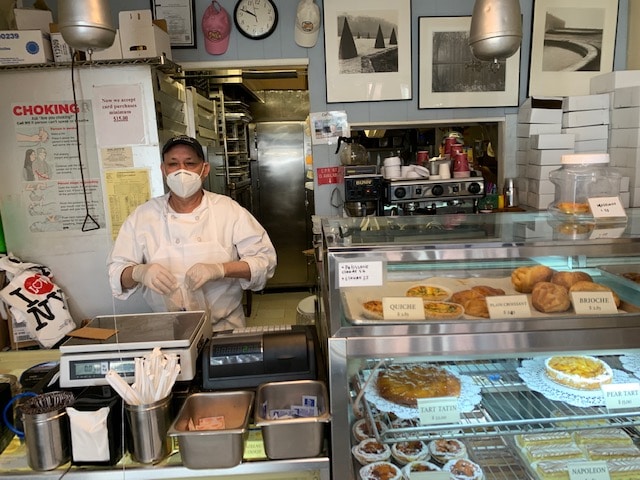
Life seems bleak in New York. But there are a few bright spots. Pablo Valdez still bakes every day at Patisserie Claude on West Fourth Street. And New York Governor Andrew Cuomo serves as a beacon of light in the middle of denial and muddled action from the White House about the spread of the coronavirus. In his latest news conference, Cuomo offers inspiration. It may be what we intuit, but it’s worth hearing.
Millions Of Older Americans Live In Counties With No ICU Beds As Pandemic Intensifies
Fred Schulte, Kaiser Health News and Elizabeth Lucas, Kaiser Health News and Jordan Rau, Kaiser Health News and Liz Szabo, Kaiser Health News and Jay Hancock, Kaiser Health News
More than half the counties in America have no intensive care beds (ICU), posing a particular danger for more than 7 million people who are age 60 and up ― older patients who face the highest risk of serious illness or death from the rapid spread of COVID-19, a Kaiser Health News data analysis shows.
Intensive care units have sophisticated equipment, such as bedside machines to monitor a patient’s heart rate and ventilators to help them breathe. Even in communities with ICU beds, the numbers vary wildly ― with some having just one bed available for thousands of senior residents, according to the analysis based on a review of data hospitals report each year to the federal government.
Consider the homes of two midsize cities: The Louisville area of Jefferson County, Kentucky, for instance, has one ICU bed for every 442 people age 60 or older, while in Santa Cruz, California, that number stands at one bed for every 2,601 residents.
Differences are vast within each state as well: San Francisco, with one bed for every 532 older residents, and Los Angeles, with 847 residents per bed, both have greater bed availability than does Santa Cruz.
Even counties that rank in the top 10% for ICU bed count still have as many as 450 older people potentially competing for each bed.
The KHN findings put in stark relief a wrenching challenge hospitals in many communities — both urban and rural ― could face during the coronavirus pandemic: deciding how to ration scarce resources.
“This is just another example of geography determining access to health care,” Arthur Caplan, a bioethics professor at NYU Langone Medical Center, said when told of KHN’s findings.
Overall, 18 million people live in counties that have hospitals but no ICU, about a quarter of them 60 or older, the analysis shows. Nearly 11 million more Americans reside in counties with no hospital, some 2.7 million of them seniors.
Dr. Karen Joynt Maddox, a professor at Washington University School of Medicine in St. Louis, said that hospitals with larger numbers of ICU beds tend to cluster in higher-income areas where many patients have private health insurance.
“Hospital beds and ICU beds have cropped up where the economics can support them,” she said. “We lack capacity everywhere, but there are pretty big differences in terms of per capita resources.”
Doctors in rural counties are bracing for the possibility they may run out of critical care beds. Northern Light Sebasticook Valley Hospital, in central Maine, has one ventilator and 25 beds. Two of those are “special care” beds that don’t meet full requirements for intensive care but are reserved for the sickest people. Such patients are often transferred elsewhere, perhaps to the city of Bangor, by ambulance or helicopter.
But that may not be possible if COVID-19 surges across the state “because they’re going to be hit just as hard if not harder than we will be,” said Dr. Robert Schlager, chief medical officer at the hospital in rural Pittsfield. “Just like the nation, we probably don’t have enough, but we’re doing the best we can.”
Hospitals also say they can quickly devise plans to transfer cases they can’t handle to other facilities, though some patients may be too ill to risk the move.
Certainly, being in a county with few or no ICU beds may not be as dire as it seems if that county abuts another county with a more robust supply of such beds.
In Michigan, health planners have determined that rural counties with few ICU beds, such as Livingston and Ionia, in the central part of the state, would be served by major facilities in nearby Lansing or Detroit in a major crisis.
Dr. Peter Graham, executive medical director for Physicians Health Plan in Michigan, is affiliated with Sparrow Health System in Lansing. He is making no assumptions. It’s possible central Michigan could take overflow COVID-19 patients from Detroit if that’s where the disease clusters, he said. Or patients might have to be transferred hundreds of miles away.
“It’s just obvious people are going to need to move” if local facilities are overwhelmed, he said. “If we’re able to find a ventilator bed in Indianapolis, in Chicago or Minneapolis or wherever, it is go, get them there!”
Yet experts warn that even areas comparatively rich in ICU beds could be overwhelmed with patients struggling to breathe, a common symptom of seriously ill COVID-19 patients.
“No matter how you look at it, the numbers [of ICU beds] are too small,” said Dr. Atul Grover, executive vice president of the Association of American Medical Colleges. “It’s scary.”
Lenard Kaye, director of the University of Maine Center on Aging, a state with a large older population and relatively few ICU beds, agreed. “The implications are tremendous and very troubling,” he said. “Individuals are going to reach out for help in an emergency, and those beds may well not be available.”
Health workers might need to resort to “triaging and tough decisions,” Kaye said, “on who beds are allocated to.”
That concern isn’t lost on Linnea Olsen, 60, who has lung cancer and knows she is especially vulnerable to any respiratory virus.
Olsen worries about a potential shortage of ventilators and ICU beds, which could lead doctors to ration critical care. Given her fragile health, she fears she wouldn’t make the cut.
“I’m worried that cancer patients will be a low priority,” said Olsen, a mother of three adult children, who lives in Amesbury, Massachusetts.
Olsen, who was diagnosed with lung cancer almost 15 years ago, has survived far longer than most people with the disease. She is now being treated with an experimental medication — which has never been tested before in humans ― in an early-stage clinical trial. It’s her fourth early clinical trial.
“I’m no longer young, but I still would argue that my life is worthwhile, and my three kids certainly want to keep me around,” she said.
She said she has “fought like hell to stay alive” and worries she won’t be given a fighting chance to survive COVID-19.
“Those of us with lung cancer are among the most vulnerable,” Olsen said, “but instead of being viewed as someone to be protected, we will be viewed as expendable. A lost cause.”
The total number of ICU beds nationally varies, depending on which source is consulted and which beds are counted. Hospitals reported 75,000 ICU beds in their most recent annual financial reports to the government, but that excludes Veterans Affairs’ facilities.
The United States has about three times as many ICU beds per capita as Italy and 10 times as many as China, two countries ravaged by COVID-19, according to a new report from the Society of Critical Care Medicine. The supply of ventilators also exceeds other developed countries, another study found. But as with ICU beds, “there is wide variation [in ventilators available] across states,” the study found.
Many experts predict that demand may soon exceed the supply. Over a period of months, the country may need 1.9 million ICU beds — 20 times the current supply ― to treat COVID-19 patients, according to the American Hospital Association.
Dr. Tia Powell, who co-chaired a 2007 New York State Department of Health group that set guidelines for rationing scarce ventilators, said preventing wildfire-like spread of disease is critical to keeping sick patients from overcrowding hospitals.
“If it spreads slowly, you’re much less likely to run short of critical supplies,” she said. “If you need all of your ventilators right now, this week, that’s what makes trouble.”
Even slowing the pandemic does not guarantee hospitals can cope. While some hospitals are planning to treat patients with less serious illness in tents, it’s far more difficult to create intensive care units or even expand existing ones, said Dr. Greg Martin, president-elect of the Society of Critical Care Medicine, which represents intensive care doctors.
Martin said ventilators need to be hooked up to oxygen and gas lines to supply the appropriate mix of air patients need. To convert a standard hospital unit to an ICU, “you would literally need to tear down the wall and run the piping in,” he said.
Few areas — such as operating rooms, emergency department and units used for post-anesthesia care ― have the hookups needed, according to Martin.
Intensive care units also require specially trained doctors, nurses and respiratory therapists. While nurses in other areas of the hospital may care for six patients, ICU nurses typically focus on one or two, Martin said.
“Mechanical ventilation of a fragile patient is rather dangerous if provided by someone other than these trained ICU professionals, which is why mechanical ventilation is not typically done outside of the ICU,” the group said.
Bob Atlas, president and CEO of the Maryland Hospital Association, noted that hospitals and government officials have been discussing ways to boost staffing levels, such as calling on doctors with expired medical licenses, or those licensed to practice in other states, to treat patients in viral hot spots.
Also up for discussion: loosening rules for “scope of practice,” regulations that spell out the duties medical professionals are permitted based on their training.
Atlas and others said they hope steps hospitals have taken to free up beds, such as deferring nonessential surgery, will keep the system from collapsing.
“It’s not as if every Medicare beneficiary will need an ICU bed,” he said. He also said hospitals could wind up treating only the sickest patients.
Greg Burel, the former director of the Strategic National Stockpile, said he hoped that hospitals lacking ICU beds could quickly iron out transfer agreements to move critically ill patients.
“Let’s hope we don’t get there,” he said.
Novant Health Brunswick Medical Center, on North Carolina’s coast, ordered additional ventilators two months ago in case COVID-19 went global. It has six and expects four more, said Shelbourn Stevens, its president. But it has only five intensive care beds among its 74-bed total.
Drawing on decades of experience with emergency care after hurricanes, the hospital’s staff is decreasing elective-surgery cases and preparing to rapidly increase screening for the new coronavirus.
“I’m very comfortable with our plans right now,” Stevens said. “Disaster planning is in our bones, so to speak. Our team knows how to react.”
But the hospital’s critical-care capacity is limited. North Carolina’s Brunswick County, where it is located, has one bed for every 2,436 residents 60 and older. Such a population could overwhelm the facility in a COVID-19 surge.
If necessary, patients could be transferred to the larger New Hanover Regional Medical Center, a short helicopter ride away, in Wilmington, North Carolina, Stevens said. But with 57 intensive care beds, New Hanover County, which includes Wilmington, still ranks in the lower two-thirds of counties for ICU beds per senior residents.
If the pandemic becomes severe, no amount of critical-care beds will be enough, experts say.
“I liken it to sitting on a Gulf shore when a hurricane is offshore,” said Dr. Graham, from Michigan. “It’s a question of how soon and how hard.”KHN senior correspondent JoNel Aleccia contributed to this report.
METHODOLOGY
Kaiser Health News evaluated the capacity of intensive care unit (ICU) beds around the nation by first identifying the number of ICU beds each hospital reported in its most recent financial cost report, filed annually to the Centers for Medicare & Medicaid Services. KHN included beds reported in the categories of intensive care unit, surgical intensive care unit, coronary care unit and burn intensive care unit.
KHN then totaled the ICU beds per county and matched the data with county population figures from the Census Bureau’s American Community Survey. KHN focused on the number of people 60 and older in each county because older people are considered the most likely group to require hospitalization, given their increased frailty and existing health conditions compared with younger people.For each county, KHN calculated the number of people 60 and older for each ICU bed. KHN also calculated the percentage of county population who were 60 or older.
KHN’s ICU bed tally does not include Veterans Affairs hospitals, which are sure to play a role in treating coronavirus victims, because VA hospitals do not file cost reports. The total number of the nation’s ICU beds in the cost reports is less than the number identified by the American Hospital Association’s annual survey of hospital beds, which is the other authoritative resource on hospital characteristics. Experts attributed the discrepancies to different definitions of what qualifies as an ICU bed and other factors, and told KHN both sources were equally credible.
*This article is republished from Kaiser Health news.
You’d think the the U.S. Chamber of Commerce would put itself on the side of the fight against COVID-19. But it doesn’t change its stripes. Even with the country facing a level of disaster unseen since the Great Depression, the Chamber of Commerce stands against an effective fight against the coronavirus. It sided with corporate over central decision-making about how to produce scarce protective gear and speed it to health workers where it’s needed most. It did the same kind of thing during the Great Depression when it opposed the creation of the Works Progress Administration (WPA).
This time around it let Washington and the White House know it opposes a government move to invoke the Defense Product Act (DPA). The Korean War-era law allows the government to order the production of wartime supplies. In this case, the supplies are gloves and masks, other protective coverings, and disinfecting wipes, the war is the war against coronavirus, and the troops are the nurses and doctors and intake workers on the front lines. Every model of the path of the pandemic suggests the number of patients sickened by the virus will explode in the near weeks ahead, and the workers at most risk will need every protection they can get.
New York City, California, and Washington State are seeing the most cases, and will have the greatest need. But there’s no coordination of either the production of the needed equipment or delivering it to where it needs to be.
On March 20, 2020, a chamber news release said it supported a study of the need to invoke the DPA. Neil Bradley, Executive Vice President and Chief Policy officer of the chamber, said, “We have insufficient stockpiles of medical countermeasures and other critical products, but we must avoid domestic production mandates that could inadvertently reduce supplies of critical products in the short term. While the administration is working closely with industry to address immediate needs, we need a firmer analysis before proceeding with the reported domestic production executive order that could be counterproductive. Further, such moves could deprive vibrant U.S. companies of access to international markets and inputs in a way that could undermine economic recovery,”
President Trump said he didn’t need to use the Defense Production Act because companies are already working with the government to make and deliver the medical supplies. The chamber told The New York Times that corporate executives were working “hand in glove” with the government.
New York Governor Andrew Cuomo painted a more dire picture to Wolf Blitzer on CNN. He said, “They [the federal government] should take over the acquisition of all the medical supplies. You hear all day long about how people are running out of masks and PPE and protective gear, ventilators, et cetera. We now have a situation where every state on its own is trying to acquire these goods, and, Wolf, we’re actually competing against each other. So we find a mask manufacturer, I’m trying to contract with them, California’s trying to contract with them, Texas is trying to contract with them. Masks that we paid 85 cents for, we’re now paying $7. Okay? Why have all of these states competing against each other to buy the equipment and have hospitals saying, we’re going to close down if we don’t get the equipment? Let the federal government take over that responsibility. A situation like this, you do what you can and everyone does what they do best. Here, the federal government should say, ‘I’ll do all the acquisition, stop competing against each other,’ and then the federal government allocates that equipment, depending on need.”
During the Great Depression, the Chamber of Commerce also chose business over dramatic action in the crisis. President Franklin Roosevelt’s New Deal administration had proposed the Works Progress Administration to put millions of unemployed Americans back to work and rebuild the national infrastructure. Its jobs and pay would not compete with private industry. But the chamber opposed creating the WPA, saying it would be cheaper to write checks to the unemployed than put them to work.
FDR didn’t listen. The WPA’s investment gave the country new roads, bridges, airports and hospitals, and a workforce with the skills to meet the demands of World War II.
Using the Defense Production Act today would be a similar investment, an investment in the brave souls working in the face of the enemy and in the health they need to keep the rest of us safe.
For more on central action in a crisis, read my book American-Made.
Like most of us, I look for distraction in this era of coronavirus. I take the risk seriously and find that audiobooks ease my coronavirus anxiety. For those of us staying close to home, sheltering in place or taking a “pause,” audiobooks can take you into another world, provide diversion, entertainment and education. They are easy to download — no touching — and you get hours worth of listening.
Recently, I listened to a couple of best sellers. But I’m also going to share audiobooks that I love and have posted about before. Please enjoy.
John Grisham knows how to tell a story and The Guardians delivers. It’s a lawyer procedural/thriller that takes you deep into wrongful conviction territory. We join Cullen Post, a lawyer who dropped out of the profession and became an Episcopal priest, and then dedicated his life to fighting to exonerate the wrongfully convicted on death row.
He travels between Savanah, Georgia, Alabama and Florida working for a non-profit with a skeleton staff and a budget to match. But he is effective. This is a Grisham novel and there are plenty of twists and turns, evil doers and nail biters. I’m not a big fan of lawyer novels. But this is a good story and Grisham tells the harrowing tale of the wrongfully convicted and the difficulty of getting them exonerated. He also spices up the story with the involvement of a drug cartel, voodoo, skeletons and sleazy law enforcement officials. Michael Beck is a talented narrator. His characters sound real and you believe you are in their orbit.
####
Into the Fire, An Orphan X Novel by Greg Hurwitz and narrated by Scott Brick, may not be everyone’s audiobook of choice. But I have enjoyed every macho, action-packed book in this violent serious. Scott Brick narrates the breathless story of the last adventure of Evan Smoak. Without giving a giant spoiler alert, I can tell you that Smoak is a renegade government assassin. He’s a good guy, recruited from an orphanage when he was a child and trained to kill. But his handler also taught him to have a soul and that’s what make the series compelling.
Into the Fire is supposed to be Smoak’s last mission as a do-gooder defending someone who desperately needs help. Every time Smoak things he’s smote the dragon for his client, some other bad guy pops up. Horowitz builds the tension and excitement and while some of the situations are absolutely implausible, this audiobook was great entertainment. But full disclosure: I earned a black belt in full contact Japanese karate way back in the ’90’s.
####
For something totally different, why not try The Dutch House by Ann Patchett, narrated by Tom Hanks. It is a wonderful story brilliantly read.
A beautiful house in Elkins Park, Pennsylvania, anchors a messy multi-generational family story that is all at once unique, familiar, and optimistic. Ann Patchett has told interviewers that she writes the same story of blended families over and over again. In 2016 in The Guardian she said, “…you’re in one family, and all of a sudden, you’re in another family and it’s not your choice and you can’t get out.”
But back to the house for a minute. Neighbors and the family call it the “Dutch House” because the original owners, the VanHoebeeks, were from the Netherlands. They died without heirs and left behind their ornate furniture and a couple of beautiful portraits. Enter Cyril Conroy. He buys the house for his wife and family right after World War II, when he leaves the military and they have very little money. She hates the big house and after a bit, vanishes to go work with the poor. So dad hires two local women to help with the house and Danny and his sister Maeve, who although only seven years older is something like a mother to the boy. The story is told from Danny’s perspective as he looks back and describes how he drives around with Cyril on Saturdays collecting rent and learning about the small real estate empire Cyril has built. Danny loves the idea of real estate and owning and images a future in his father’s business. But you know things will change, which they do when Cyril Conroy marries again and adds a young stepmother and two step-sisters to the mix.
What happens next pitches Maeve and Danny into a battle with their stepmother that changes their lives and rages for years. If I write more, you’ll learn the entire story here and that’s not fair. Listen instead.
###
The Man Who Saw Everything, by Deborah Levy, was a Booker Prize nominee in 2019. It seems like a straightforward story at first. We begin in 1988 with a young, good-looking, narcissistic historian, Saul Adler, headed to East Berlin to do research and lecture on Eastern European Communism, including Stalin’s sex life. But first his girlfriend Jennifer Moreau, an art student, will take his picture crossing Abbey Road. They stage the photo just like the Beatles album cover because he plans to give it as a gift to his host’s sister. But during the shoot he is grazed by a car and knocked down. Stuff scatters in the road, including a mysterious object with a voice that comes out of it that says, “I hate you. Don’t come home.”
Saul Adler brushes himself off and the story goes on. Back at Jennifer’s apartment they make love and she takes photos of his body parts. He complains to her, and to himself, that she treats him like an object. He is her muse. She considers him beautiful and has photographed him over and over again. She tells him that he never asks about her work, that he assumes it’s all about him and explains that’s why she is breaking up with him. A few days later, he is off to East Berlin, disoriented by the fall caused by the car accident.
In Germany, things happen quickly. He begins a sexual relationship with Walter, the translator, also a Stasi agent or watchdog, who meets him at the train. Walter takes him to his mother’s home, and Saul also has sex with Walter’s sister. Saul seems to become more and more disoriented even as he researches and teaches a course at the university. And then the story takes a dizzying twist and seems to start again. Now we are in 2016 and Saul is hit by the same car again. Or is he? The story rewinds in his mind as he lies in a hospital bed in London confused, maybe dying, trying to make sense of his life and loves.
Jennifer Moreau, now grey-haired and a famous artist, is at his bedside. A doctor seems like a Stasi watcher, his dead father sits at his bedside and talks. The driver of the car, a man named Wolfgang, is also there paying for the private room. It turns out Wolfgang was having a fight with his wife on his cell phone when he knocked Saul down. Remember that mysterious object from 1988.
Through the morphine haze Saul tries to piece together his life. Maybe he gets it right, and maybe he doesn’t. Narrator George Blagden keeps the story going and makes you want to listen.
Some Canada geese flew into New York to nibble on the grass this week, but the coronavirus is giving human travelers second thoughts about taking to the air.
We put our summer vacation trip to Scandinavia on hold. We’d have to fly there, and the best advice for people our age is not to fly. Even if we could get there, we’d want to board a ship to explore the fjords. Not happening. The only thing worse than flying with coronavirus in the air has got to be spending time on a cruise ship, even a small one. The Centers For Disease Control and Prevention (CDC) recommends that “…travelers, particularly those with underlying health issues, defer all cruise ship travel worldwide.” They say that cruise ship passengers are at greater risk of . . . person-to-person spread of infectious diseases, including COVID-19.”
Concern goes beyond cruise ships and people our age. A younger neighbor put off a trip to the UK to visit her mother. And another neighbor, a physician who teaches, cancelled a flight to Sweden with her husband. Her university banned faculty from all non-essential travel. She’ll miss her husband’s big art opening and she’s worried about his health.
President Trump’s ban against non-U.S. citizens flying from Europe (but not England and Ireland) puts another substantial crimp in air travel.
The airlines want us to keep flying, though, and they have been filling our in-boxes with reasons why we should. Delta Airlines assured us about their new cleaning and disinfecting procedures and their really fine air filtration systems. And some of them are doing the previously unthinkable. An email from United offered, “To give you the greatest flexibility, when you book any flight with us now through March 31, you can change it for free over the next 12 months – any ticket, any fare type, any destination.”
Jet Blue promised the same: “No change or cancellation fees with any fare if you book by 3/31 and travel by 9/8/20.”
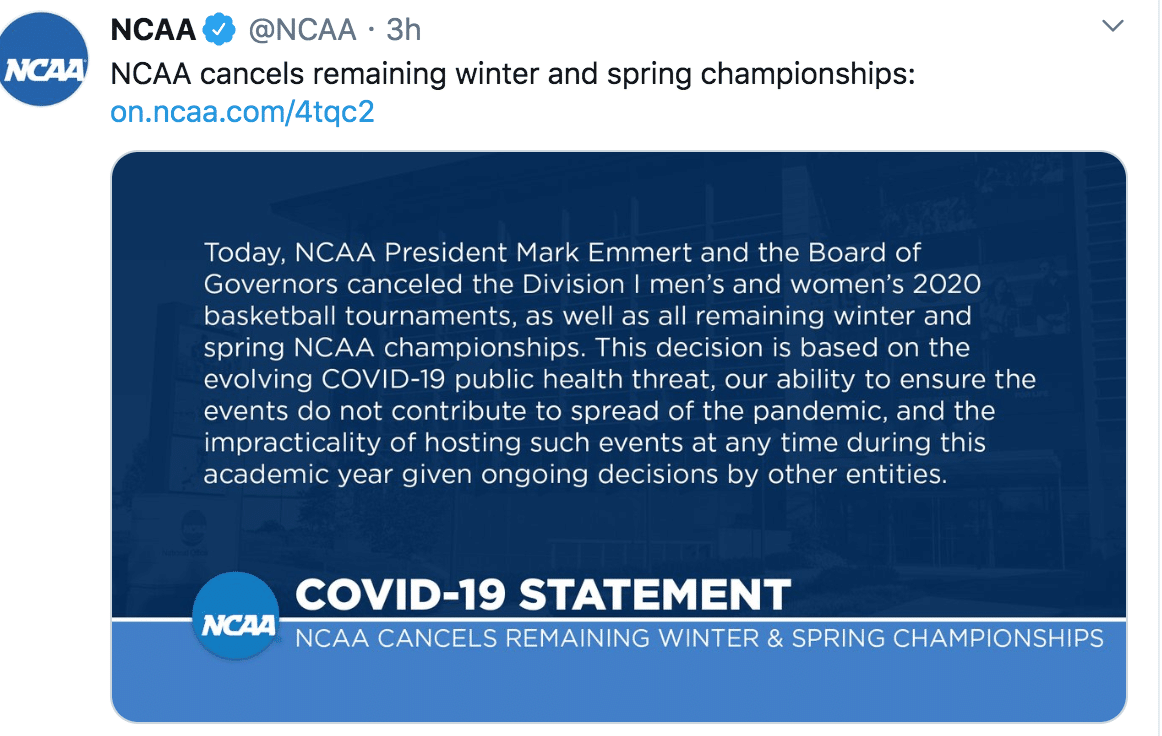
But where would you go? Italy is on lockdown. The rest of Europe is worried. Asia is a concern and here in the United States, organizers are cancelling or postponing big gatherings. Austin, Texas, Mayor Steve Adler declared “a local disaster” because of the Coronavirus and ordered the cancellation of South by Southwest (SWXW), the popular film and music showcase. Coachella and Stagecoach, two popular arts and concert events, postponed until the fall. The NCAA’s “March Madness” college basketball playoffs were first to be played in empty arenas and then cancelled altogether.
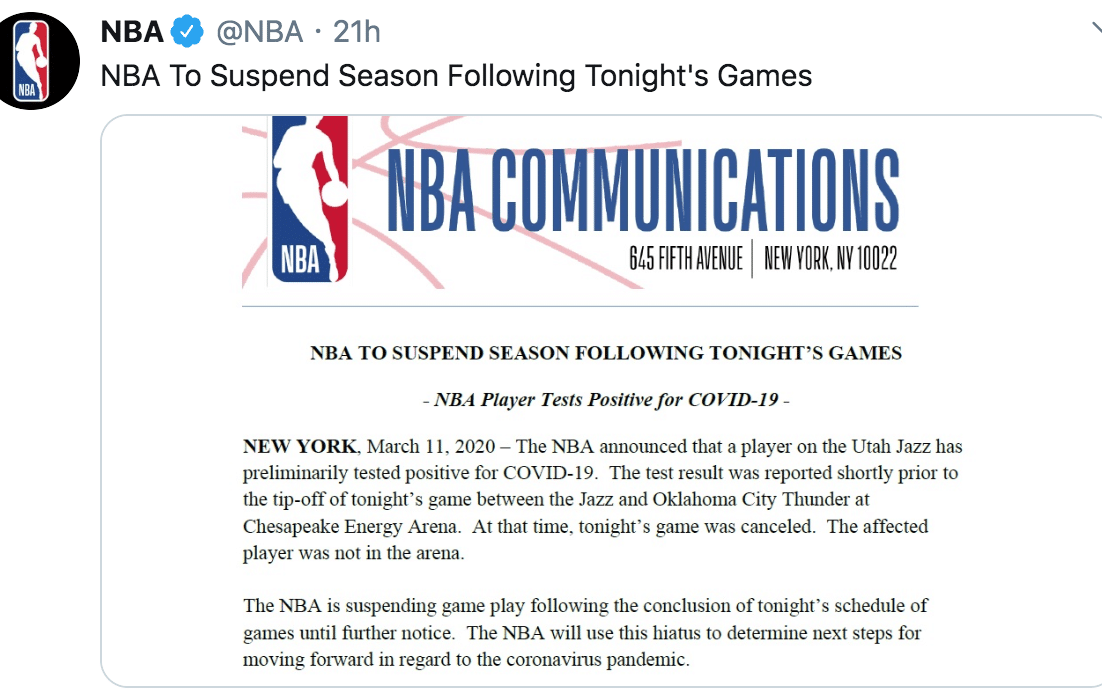
The NBA suspended its games for the foreseeable future.
So did the National Hockey League, and Major League Baseball put the start of its season off two weeks. Disneyland and Disney World closed.
The governor of Colorado, Jared Polis, asked older people and those with underlying health issues to stay away from the mountain ski areas.
In Boston, Mayor Marty Walsh also did something close to the unthinkable. In that most Irish of American cities, he canceled the St. Patrick’s Day parade.
New York Mayor Bill de Blasio at first resisted cancelling New York’s parade, which typically draws 2 million spectators. But Governor Andrew Cuomo and the parade sponsors agreed to put it off until the coronavirus picture gets clearer.
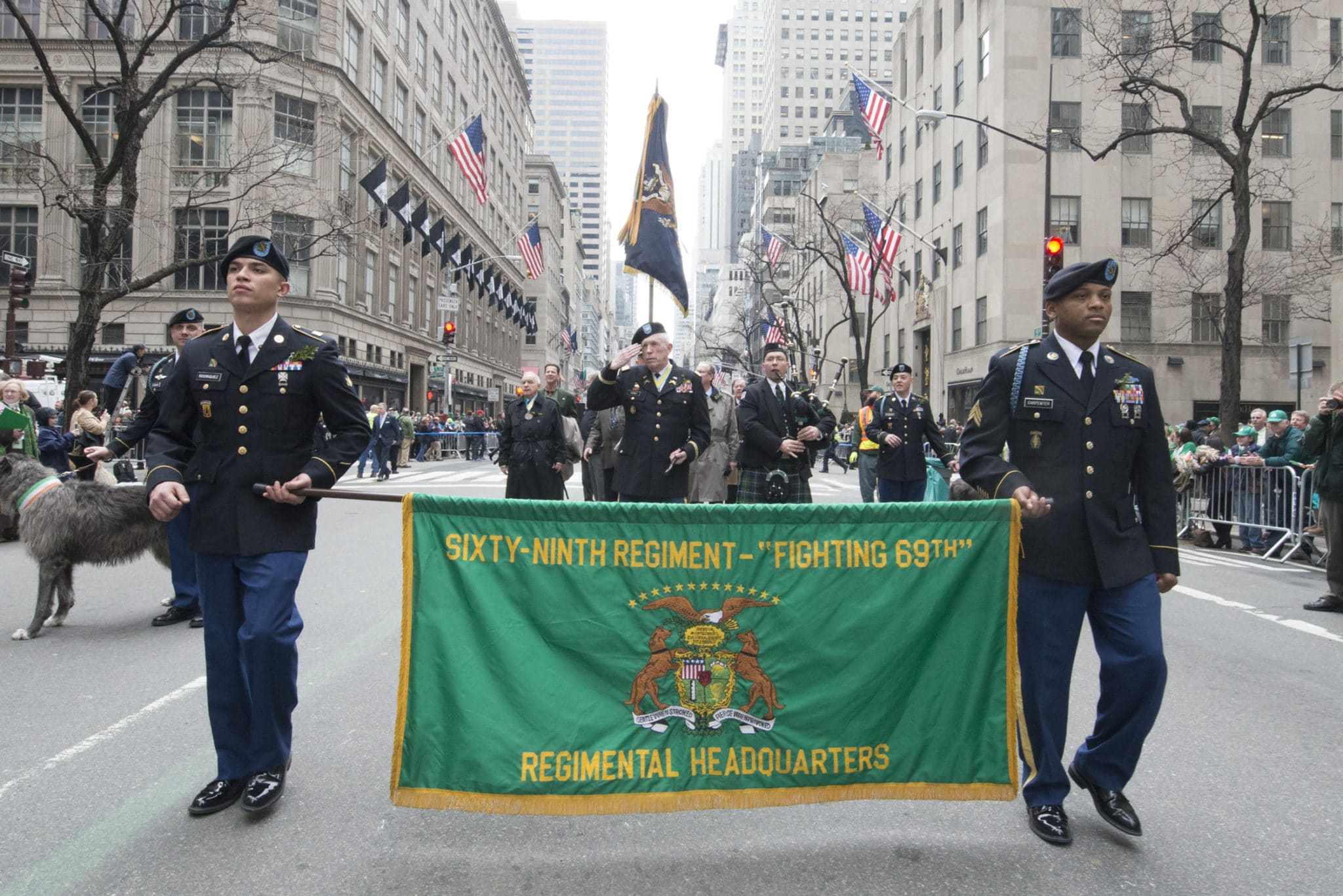
New York Army Guard “Fighting 69th” unit marches in the St. Patrick’s Day parade in New York City, NY, March 17, 2015. (DOD photo by D. Myles Cullen. Public Domain.
De Blasio did call for New Yorkers to avoid other big crowds. “Those who take the subways at rush hour should consider commuting to work via alternative modes of transportation, like biking or walking, if possible,” he said. Commuters groaned and we heard more than one person say, “That’s crazy.”
Day after day saw fewer people on the streets and on the subways.
Broadway audiences dropped off. Shows grossed $27,700,956 the week of March 8, compared to $29,195,910 the week before, according to The Broadway League, the industry’s association. Fast Company reported that producers of five major shows including “To Kill a Mockingbird” and “West Side Story,” two shows we recommend, are offering discounts. Then on March 12, after the governor banned gatherings of more than 500 people, Broadway announced that it’s shutting down for a month. The Public Theater, a downtown institution, and other Off-Broadway theater groups also announced month-long shut-downs.
De Blasio declared the same day a state of emergency in New York City.
We don’t know everything that that will mean. We had theater tickets for next week but we might have erred on the side of caution anyway by staying home. We’ll still get tickets for shows we want to see, but later. We’re avoiding large gatherings, and are riding the subways cautiously. The New York Post reports that subway ridership dropped 18 percent from the same time last year.
Restaurants are reaching out to stay in business. Carravagio, an Upper Eastside Italian restaurant we like, emailed to say, “Due to the Corona Virus, Carravagio is offering pickup and/or delivery service for both lunch and dinner in an effort to help everyone stay safe.”
Right around the corner from us, star chef John Fraser caters to a younger crowd at The Loyal.
They emailed to offer a takeout menu on the apps Caviar and Postmates. “So you can enjoy all your favorites without lifting a finger,” the email said.
We like tourists in New York and we like to travel. So we hope for containment of the virus. We follow this closely. The overall infection rate and number of deaths from COVID-19 are low so far in the U.S. because testing is limited. But while vigilance is important, we also need to keep our heads on straight.
But there’s also a lot we don’t know. This coronavirus is new, like SARS and Ebola were when they came on the scene. That’s why we need to take precautions. China’s isolation of entire cities and Italy’s closing of its borders may seem drastic, but we must learn more about the virus’s potential and our vulnerabilities it.
In the meantime, the CDC offers simple advice.
Avoid contact with sick people. Avoid touching your eyes, nose, or mouth with unwashed hands. Clean your hands often by washing them with soap and water for at least 20 seconds or using an alcohol-based hand sanitizer that contains 60–95 percent alcohol.
Soap and water should be used if hands are visibly dirty.
It is especially important to clean hands after going to the bathroom; before eating and after coughing, sneezing or blowing your nose.
Avoid traveling if you are sick.
If you get sick with fever or new or worsening cough or difficulty breathing during your cruise, stay in your cabin and notify the onboard medical center immediately.
Did you have travel plans?
Share with us. We’d like to know if you had travel plans and cancelled or postponed.
And if you’d like to enjoy some armchair travel read this.
Yes, you can appeal Medicare Part D medication denials and get reversals. It’s slightly time consuming, but if you do it, you have a shot at getting coverage for the prescriptions you need. Why do you need to appeal? You may have gotten a new prescription, or your insurer may have dropped your medication from its formulary, or list of covered drugs, for 2020.
Even if you are not a fighter or a contentious person, this is worth the effort.
Nick uses Vyzulta, a prescription eye drop that reduces pressure in the eye and is prescribed for glaucoma or ocular hypertension. The medication is saving his sight and it’s expensive. He recently paid $412 dollars for a small vial — 5 milliliters, or about a teaspoon — that lasts for perhaps a month. The website of the manufacturer, Bausch and Lomb, points out that there is no generic substitute. His Part D insurance company does not cover the medication because it is not included in its formulary. So Nick thought he’d just have to suck it up and he’s been paying.
But he recently appealed. Here’s how the appeals process works.
1. You have to ask your pharmacist to fill the prescription under your Part D insurance plan. The pharmacist or your plan will give you a formal denial notice.
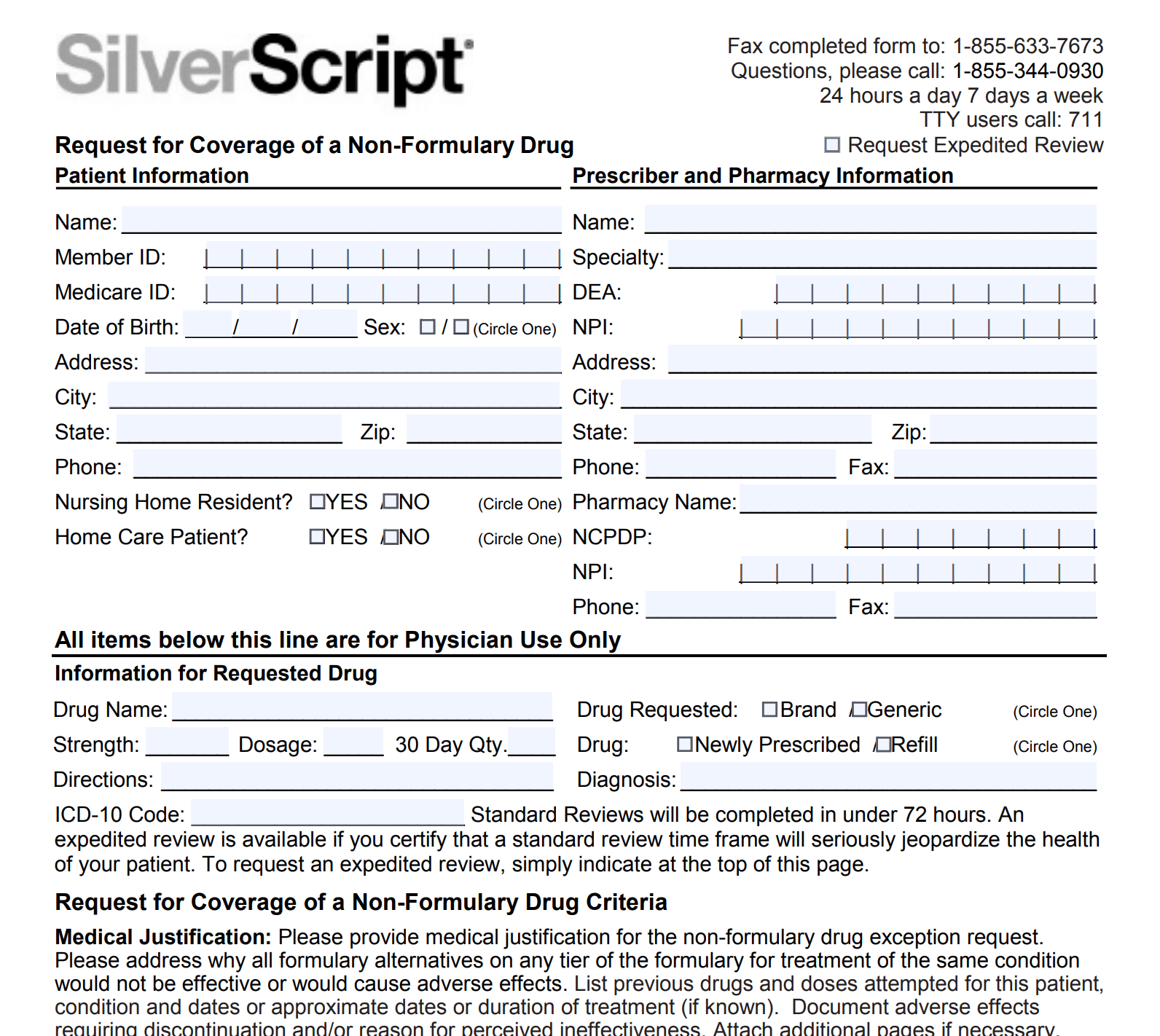
2. Once you get the denial notice, you must contact your plan and find out how to file an exception request. It’s likely that you can find the form online. Google the name of your plan and formulary exemption form.
3. Your doctor will have to help out here. She or he needs to fill out the form or write a letter explaining why you need the medication. You should get an answer in 72 hours.
4. You can request expedited exception if your life or health will be threatened if you don’t get the medication. A speeded up request should get an answer within 72 hours.
If they approve it, great. If not, things get a little stickier and you need to do more work.
1. If you get a denial you can appeal to the Independent Review Entity (IRE). That is now a company the Centers for Medicare and Medicaid Services hires to review appeals. That company is now Maximus Federal Services and you can contact them here.
2. Maximus must respond within 72 hours.
3. If they rule against you, you still have the opportunity to request a hearing with an administrative law judge.
Nick didn’t have to take all these steps. He recently changed pharmacies, and his ophthalmologist wrote a new prescription with a note that the Vyzulta was medically necessary. There was no generic and no substitute eyedrop that he can tolerate. SilverScript replied promptly to say they were “pleased to inform you that, upon review of the information provided by you or your doctor, we have approved the requested [Non-Formulary] coverage . . .
The approval will cut his monthly cost almost in half, to $209 for a month’s supply. That’s a big saving, and shows the benefit of going through the appeals process to try to get coverage for the drugs you need.
My favorite audiobooks to start 2020 hark from last year. All have strong stories, good writing and narrators whose voices won’t drive you crazy as the action moves forward.
The Dutch House by Ann Patchett, narrated by Tom Hanks, is a wonderful story brilliantly read.
A beautiful house in Elkins Park, Pennsylvania, anchors a messy multi-generational family story that is all at once unique, familiar, and optimistic. Ann Patchett has told interviewers that she writes the same story of blended families over and over again. In 2016 in The Guardian she said, “…you’re in one family, and all of a sudden, you’re in another family and it’s not your choice and you can’t get out.”
But back to the house for a minute. Neighbors and the family call it the “Dutch House” because the original owners, the VanHoebeeks, were from the Netherlands. They died without heirs and left behind their ornate furniture and a couple of beautiful portraits. Enter Cyril Conroy. He buys the house for his wife and family right after World War II, when he leaves the military and they have very little money. She hates the big house and after a bit, vanishes to go work with the poor. So dad hires two local women to help with the house and Danny and his sister Maeve, who although only seven years older is something like a mother to the boy. The story is told from Danny’s perspective as he looks back and he describes how he drives around with Cyril on Saturdays collecting rent and learning about the small real estate empire Cyril has built. Danny loves the idea of real estate and owning and images a future in his father’s business. But you know things will change, which they do when Cyril Conroy marries again and adds a young stepmother and two step-sisters to the mix.
What happens next pitches Maeve and Danny into a battle with their stepmother that changes their lives and rages for years. If I write more, you’ll learn the entire story here and that’s not fair. Listen instead.
###
The Man Who Saw Everything, by Deborah Levy, was a Booker Prize nominee in 2019. It seems like a straightforward story at first. We begin in 1988 with a young, good-looking, narcissistic historian, Saul Adler, headed to East Berlin to do research and lecture on Eastern European Communism, including Stalin’s sex life. But first his girlfriend Jennifer Moreau, an art student, will take his picture crossing Abbey Road. They stage the photo just like the Beatles album cover because he plans to give it as a gift to his host’s sister. But during the shoot he is grazed by a car and knocked down. Stuff scatters in the road, including a mysterious object with a voice that comes out of it that says, “I hate you. Don’t come home.”
Saul Adler brushes himself off and the story goes on. Back at Jennifer’s apartment they make love and she takes photos of his body parts. He complains to her, and to himself, that she treats him like an object. He is her muse. She considers him beautiful and has photographed him over and over again. She tells him that he never asks about her work, that he assumes it’s all about him and explains that’s why she is breaking up with him. A few days later, he is off to East Berlin, disoriented by the fall caused by the car accident.
In Germany, things happen quickly. He begins a sexual relationship with Walter, the translator, also a Stasi agent or watchdog, who meets him at the train. Walter takes him to his mother’s home, and Saul also has sex with Walter’s sister. Saul seems to become more and more disoriented even as he researches and teaches a course at the university. And then the story takes a dizzying twist and seems to start again. Now we are in 2016 and Saul is hit by the same car again. Or is he? The story rewinds in his mind, as he lies in a hospital bed in London confused, maybe dying, trying to make sense of his life and loves.
Jennifer Moreau, now grey-haired and a famous artist, is at his bedside. A doctor seems like a Stasi watcher, his dead father sits at his bedside and talks. The driver of the car, a man named Wolfgang, is also there paying for the private room. It turns out Wolfgang was having fight with his wife on his cell phone when he knocked Saul down. Remember that mysterious object from 1988.
Through the morphine haze Saul tries to piece together his life. Maybe he gets it right, and maybe he doesn’t. George Blagden keeps the story going and makes you want to listen.
###
I’m hooked on Nazi-era thrillers and the stories of the people who fought back. The Accomplice, by Joseph Cannon and narrated by Jonathan Davis, begins in 1962 in Hamburg. Max Weill, a holocaust survivor and Nazi hunter, is trying to convince his nephew Aaron to continue his work. Aaron, an American who works for the U.S. State Department, resists his uncle’s cajoling. But as they sit at a sidewalk café, Max stands up and points in horror. He insists that he saw a Nazi doctor, an assistant or accomplice to the evil Dr. Josef Mengele, who tortured prisoners at Auschwitz with medical experiments. Max, also a doctor, is sure that it is Otto Schramm. In the excitement of recognition, Max suffers a heart attack and as he lies dying in the hospital convinces Aaron to take up the search for Schramm.
The next part of the story takes Aaron and a German-Jewish reporter to Buenos Aires on the hunt for Shramm. The story is full of twists, suspense and danger and both Kannon and narrator Jonathan Davis keep you interested and rooting for Aaron to survive and succeed.
###
Walter Mosley takes you a different kind of trip in John Woman, and narrator Dion Graham is perfect in every way. Fans of Mosley’s detective stories, prepare yourselves for an unexpected ride. John Woman is a young mixed-race history professor at a southwestern university. He lectures about the unreliability of history and asks his students to question facts and truth.
And Woman’s own life is a mashup of invention. He began life as Cornelius Jones in Brooklyn, the son of an invalid audodidact who to teaches his son to read literature, philosophy and history and to question everything. His beautiful Italian-American mother is mostly absent. She wanders in and out of the story talking about sex and love. His father, born poor in Mississippi, speaks perfect and precise English and tells him, “…the person who controls history controls their fate. The man who can tell you what happened or did not happen is lord and master of all he surveys.”
The father works as a projectionist at an East Village movie theater. When cancer treatment prevents him from returning to his job, the teenage Cornelius fills in for him without the knowledge of the theater owner. The deception leads to sex, violence and menace, what we expect of a Mosley novel. What Cornelius does changes his life, and when his father dies and his mother disappears he erases himself and writes a new personal story complete with an Ivy League degree.
But it’s not as simple as that, and we listen wondering if his true history will catch up with him.
The ads tout Medicare Advantage as the perfect choice for you. Is that right? For some, it may work just fine. For others it’s not ideal and could end up costing you more, or require you to fight for the care you need. So during this time of open enrollment until December 7, 2019, it’s a smart idea to figure out if Medicare Advantage, often called Part C, is right for you.
First of all, Medicare Advantage is an alternative to traditional Medicare where you might get a Part F supplemental Medigap program to cover what Medicare doesn’t. Part F has been popular with Baby Boomers because it covers that 20 percent of the costs that Medicare doesn’t. You can also choose your own doctors and hospitals.
If you have it, you won’t lose it. But as of 2020, anyone who hasn’t already signed up for Part F will not be able to get it. Why? Because Congress passed a law in 2015 cutting it to reduce the federal deficit. Why weren’t we screaming? And what about the Trump tax break for the rich that will raise the deficit to $984 billion this year?
Okay. Back to Medicare Advantage
Medicare Advantage is run by private companies and functions pretty much like an HMO, or PPO. You have to use the doctors and hospitals in their networks. With traditional Medicare you can choose your own doctor or hospital.
The Trump Administration and the Centers for Medicare and Medicaid Services (CMS) are pushing Medicare Advantage plans for 2020. They rightly point out that you have more choices and premiums have declined. About a third of Medicare beneficiaries enrolled in Medicare Advantage in 2019, and these plans do work well for many people. Some offer coverage for basic dental checkups and some cover an annual vision exam. Others offer wellness programs.
Medicare Advantage plans are great if you are healthy.
Downside
If you get sick you could end up with higher out-pocket-expenses for short hospital stays or something you need, like oxygen.
You may be asked to pay a higher premium for drug costs.
It’s possible your insurer will try to deny services you need.
There is a financial incentive for them to do so. Medicare Advantage plans receive a set fee for every member and if medical expenses exceed these payments, they’ll lose money.
Also
If you travel and get sick or have a medical emergency, the plan may not cover your care beyond an emergency room visit.
And
If you enroll in a Medicare Advantage plan and don’t like it, you have to wait a year to get out of it.
Medicare Advantage plans have apparently overcharged the government $30 billion over the last three years. And in September, Ohio Senator Sherrod Brown and others, including Senator Bernie Sanders and Senator Amy Klobuchar, wrote to the Centers for Medicare and Medicaid administrator demanding better oversight.
Brown and advocates for Medicare have also criticized CMS for promoting Medicare Advantage plans. He asked, “Why did CMS engage in this inappropriate ’tilting of the scales’ through repeated emails to individuals highlighting the benefits of MA over traditional Medicare?”
The question remains unanswered. But it’s a good one and it’s a red flag to those of us thinking about choosing a Medicare Advantage plan.
The Center For Medicare Rights has a simple breakdown of the differences between Medigap plans and Medicare Advantage. You can find that here.

































 So did the National Hockey League, and Major League Baseball put the start of its season off two weeks. Disneyland and Disney World closed.