All posts by Barbara Nevins Taylor

Robocaller Out Of The Game


We’re on the Do Not Call Registry list and yet the phone rings all day with robocallers offering to lower credit card interest rates, or some other thing that we don’t need.  We’ve got caller I.D. and don’t pick up the phone, but it is maddening anyway. 

So it’s a relief to know that one robocaller is out of the game.  The Federal Trade Commission reached a settlement with Roy M. Cox, Jr. who allegedly was behind robocalls for credit interest rate reductions, vehicle warranties, and home security systems. 

Cox didn’t admit that he broke the law.  But the settlement bans him from telemarketing.  The FTC also slapped him with a $1.1 million fine, which he won’t have to pay because according to the FTC, he doesn’t have the money.

Let’s see how long he stays away. In the meantime, the Federal Trade Commission produced a video that offers 5 tips for blocking robocalls. It’s hard to say that they are all perfect, but they do offer some defense against a really insidious practice.

Do Not Call Registry

Robocalls are more than simple annoyances. The people behind them often sell scams that seem attractive at the moment and it’s difficult for many of us to resist the temptation. 

It’s far better to try to block the calls and prevent these fast talking scammers from wiggling their way into our wallets.

watchmore 5 Tips to Block Robocalls

Immigrants Path To Citizenship


by Tanvir Toy

Reports of President Obama’s immigration plan concern me. U.S. A. Today and the New York Times report that a plan floated by the administration would require undocumented immigrants to wait on line for 8 years to apply for their green cards. The proposal does shorten the path for young people brought here brought by their parents. And that’s a good start.

Immigrants Under One Umbrella

But the bad thing is that the plan we’re reading about  puts all immigrants under one umbrella which is not fair.   There are many undocumented immigrants who have been in this country for years, speak English, pay their taxes, maintain steady jobs, and may I add, do not take any hand outs from the government. They will be grouped together with all other undocumented immigrants. They’ll have to wait eight years just to apply for their green cards and then wait five more years to become citizens.  Thirteen years or more.  Come on.


Create a Better Path to Citizenship

We might not have the resources to look at 11 million people on a case to case basis, but I’m sure we can come up with something better. Undocumented immigrants have been waiting for years, some as long as 20 years. Don’t make them wait longer.

I’m not an expert but I am one of the millions who wants to be legal, work, earn as much money as I can contribute to the U.S. economy and my community. I want my family members, who have worked in this country and paid taxes and never broken a law to qualify for a green card. That will allow them to work legally, get on the road to citizenship and travel outside of the U.S. to see family members.  Maybe a better path to citizenship would allow the people who have been here a certain time to get their green card before the recent arrivals.

I think I speak for many undocumented immigrants when I say, shorten the time for a green card. Undocumented immigrants are willing to pay fines, back taxes, not take welfare. But please don’t pile more years of waiting on what we’ve already endured.

Let us know what you think.

How To Apply For Deferred Action


Immigration attorney Ryan Muennich walks you through the application process for the U.S. Deferred Action Program for Childhood Arrivals program. He says in many cases you don’t need to pay a lawyer to fill out the paperwork for. Ryan also warns that you must follow all of the rules after you make yourself known to immigration authorities.  That means you have to update them about where you live.

Deferred Action.  You only need to get legal assistance from a qualified immigration attorney if you have a problem. Ryan tells you the circumstances in which you do need help in Dream Act Immigrants- Apply Without a Lawyer.

You are eligible if you were under 31-years-old as of June 15, 2012, came to the U.S. before you were 16,  continuously lived in the U.S. since June 15, 2007,  were physically present in the U.S. on June 15, 2012, your visa expired,  you’re in school, graduated from high school, or have a GED and haven’t been convicted of a felony or a significant misdemeanor and are not a threat to the U.S.

HERE ARE THE STEPS TO TAKE

  1. Log on to U.S.C.I.S website. Read the guidelines and instructions.
  2. Go to the side of the panel and click on form I821D.  You’ll have to download it and the instructions. Again, read the instructions carefully before you fill out the form.
  3. Fill out the form and sign it.
  4. Download the form I-765.  This is the application for the work permit or Employment Authorization.  It will ask the basis for the application.  In other words, they want know why you should get a work permit. The basis is the Deferred Action Program for Childhood Arrivals. So be sure to put that in when you fill out the form.  Attach this form to the I821D form.
  5. Download the form I-765WS.  It’s the worksheet that will accompany the other two forms. This will ask about your income and your assets. It will also ask you to list the reasons that you are requesting the work permit.  Again, your reason is the Deferred Action Program for Childhood Arrivals and your plan to get a job as soon as possible.
  6. You’ll need 2 passport photos.  You can do this at a neighborhood shop, or through one of the online services. Write your name and your alien receipt number on the back of each photos.  Attach the photos to the forms.
  7. Make sure you collect all of your documentation:

             a. You need proof that you are under 31-years old as of June 15, 2012-your passport or school records.

             b. You need proof that you came to the U.S. before you were 16-your passport, Visa or school records.

             c. You need proof that your Visa expired-a copy of your Visa.

            d. You need to show that you are in school- report cards, transcripts work. If you graduated, make a copy of your diploma and attach it. If you earned a G.E.D., make a copy of the certificate and attach it

            .e. To show that you lived in the U.S. continuously since June 15, 2007, you need school documents, credit card receipts, paid bills, or other official documents.

             f. To show that you were in the U.S. on June 15, 2012, you need credit card receipts, school documents, or other official papers.

Again, make sure that you have answered all of the questions with the documentation. More is better than less.

  1. Write a check, or get a money order made out to the U.S. Department of Homeland Security for $465.
  2. Put all of the forms, photos and documentation together with the check.  Mail the package to the address that’s listed for your region on the forms.
  3. You should receive a receipt in less than month.
  4. Be patient. The next step could take four to six months, although people report quicker action.

You can download all of this information in Facts To Go-Deferred Action

Ignore This Identity Theft Alert


by Barbara Nevins Taylor

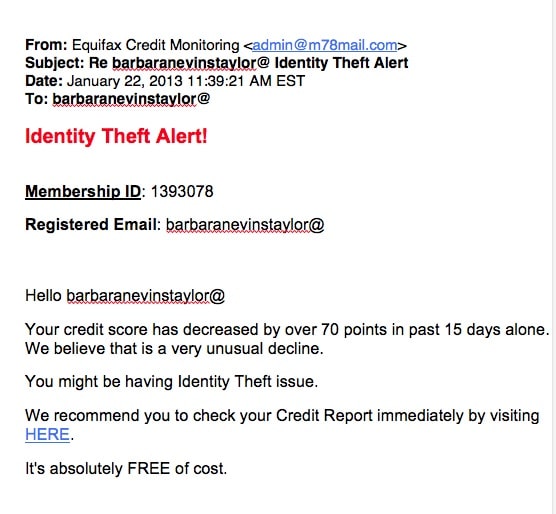
An “Identity Theft Alert,” from something called Equifax Credit Monitoring wormed its way into my inbox recently.  And I admit it made me look twice. First of all, it told me  my credit score had decreased by 70 points in the past 15 days.  But I knew it wasn’t true because I hadn’t done anything to lower my score.  Yet, the scammers are clever. The email suggested I might have an Identity Theft issue and recommended I click HERE to check my credit report. Oh, and it was “Free,” too.

That irritated me. I don’t click links, or follow instructions from unsolicited emails.  I checked the sender box again.  Equifax is one of the credit reporting agencies that collects financial data and creates reports  But the company doesn’t use “credit monitoring” in its name.

I sent the email to Equifax and got a quick response from spokeswoman Michele Cadac-Jones. She said,  “I can confirm that the email you received did not come from Equifax and is indeed a phishing email scam. The Equifax Security and Operations teams are now aware of this and are in process of investigating it.”

Since then, I received two more emails just like the first.  So beware and ignore this identity theft alert. Erase it and do not click on the links.

If you suspect a phishing email scam, the Federal Trade Commission recommends the following:

1. Don’t reply, and don’t click on links or call phone numbers provided in the message These messages direct you to spoof sites – sites that look real but whose purpose is to steal your information so a scammer can run up bills or commit crimes in your name.2

2. Area codes can mislead, too. Some scammers ask you to call a phone number to update your account or access a “refund.” But a local area code doesn’t guarantee the caller is local.

3. If you’re concerned about your account or need to reach an organization you do business with, call the number on your financial statements or on the back of your credit card.


New Mortgage Rules And You


by Barbara Nevins Taylor

It will be a year until new rules to protect mortgage borrowers go into effect.The Consumer Financial Protection Bureau (CFPB) is drafting them and plans to work with lenders to make sure everyone is on the same page.

MORTGAGE RULES AND YOUR ISSUES

But in the meantime it’s a great idea to be aware of the issues that can make mortgage borrowing hellish and what these new mortgage rules will mean to you. One of the most important proposals is the Ability-to-Repay rule.  Sounds like common sense.  But  there are people out there who are ready to talk folks into mortgages they can’t afford.  That’s what happened in the lead-up to the housing crash. So the new rule will require lenders to try to make sure the borrower can make the payments.

CLASSIC STORY

I reported  a TV story about a woman whose broker told her to pick out any house she wanted.  She worked at department store cosmetics counter, and her husband was a New York City cab driver.  They already had a house with a  mortgage and planned to keep it.  She found her dream home with a price tag of  about $800,000.  And although her family’s income was less than $75,000, somehow the mortgage was arranged.  A year later, she was facing foreclosure and claimed that she was tricked.

That’s the kind of thing the new rules are supposed to prevent. Additional rules will also clamp down on low interest “teaser” interest rates that quickly jump to unaffordable levels.

The CFPB plan also calls for new rules to deal with appraisals, high cost loans and  upfront fees charged to arrange mortgages.

If you are looking for a mortgage now, go slow. Ask a lot of questions, make sure everything is spelled out clearly and be certain that you understand all of the fees and details.

Our video “How to Shop for Mortgage” walks you through process. If you’re refinancing How Do I Refinance My Mortgage explains it all.


College Still Key to Success


In case you doubted it, a college education can help point you to a more successful life. That means that
despite all of the grim news about college debt, a college education is worth the money.

A new Wells Fargo study says that even though debt is a big burden, “…a college education still appears to be the surest way to economic success.”   Economists found college educated workers are less likely than those without college to be unemployed and their economic prospects are brighter.

Researchers did factor in the 37 million, the New York Federal Reserve says are struggling to pay their outstanding student loan debt.  And they noted that it’s taking young people longer to move out of their parents’ homes, get married and buy their own homes. But they say the overall picture remains rosier for college grads than it does for those with just a high school education.

A particularly interesting insight in this report questions the value of for-profit-colleges.  It says, “…the significantly higher rate of defaults seen at for-profit institutions does little to allay concerns over whether these institutions are indeed bettering their students’ economic prospects.”


watchmoreHow to Pay Down Your Student Loan


watchmoreWhy Veterans Should Avoid For Profit Colleges

5 Percent Of Consumers Have Credit Report Errors

It may seem tedious and you may want to put it off for another day. But it really is a smart idea to check your credit report for errors.

The Federal Trade Commission found that five percent of consumers had errors on their credit reports.  

These errors downgrade your credit score and can affect the way you’re treated by  bankers, insurers, car dealers, landlords and the entire financial world that uses credit reports as a measurement for your credit-worthiness.

Three private companies, Experian, TransUnion and Equifax collect information and create separate credit reports. You can view those reports for FREE three times a year at annualcreditreport.com

“These are eye-opening numbers for American consumers,” said Howard Shelanski, Director of the FTC’s Bureau of Economics.  “The results of this first-of-its-kind study make it clear that consumers should check their credit reports regularly.  If they don’t, they are potentially putting their pocketbooks at risk.”

ADDITIONAL FINDINGS

  • One in four consumers identified errors on their credit reports that might affect their credit scores
  • One in five consumers had an error that was corrected by a credit reporting agency (CRA) after it was disputed, on at least one of their three credit reports
  • Four out of five consumers who filed disputes experienced some modification to their credit report
  • Slightly more than one in 10 consumers saw a change in their credit score after the CRAs modified errors on their credit report
  • Approximately one in 20 consumers had a maximum score change of more than 25 points and only one in 250 consumers had a maximum score change of more than 100 points.

If you find something wrong on your credit report dispute it in writing. Our video How to Fix My Credit-No Lies walks you through the process.

Happy Chinese New Year!

by Barbara Nevins Taylor

The Dragon is gone.  Welcome  another reptile. 2013 is the Year of the Black Snake. The Chinese say that means it’s time for discipline, steady progress and attention to detail.  And according to some,  Chinese custom suggests a snake in the house means good luck because they’ll always be something to eat.  Maybe that’s why snake sales are up in Hong Kong according to Taipei Times.

WHAT THE SNAKE MEANS

The snake is the sixth of twelve signs in the the Chinese zodiac and while it follows the dragon, it is far less beloved and exalted.  There’s conflicting information about the symbolism of the snake on a variety of Chinese websites.  But we take the most positive approach here.  We like what Hanban.com has to say.  It calls the water snake 2013’s cosmic symbol.  And they say, water snakes are good with money and seem to have plenty of it coming their way.

So the message seems to be: pay attention to detail, focus. work hard and this may be a prosperous year. Nothing wrong with that.

Grandson Scam


It sounds so appealing and because we love our family members, sometimes our emotions cloud our judgment.

The grandson scam is the latest reminder of the need to be careful about who we, or our elderly parents, trust and how we handle money. 

How it Works

Scammers call and say, “Your grandson, or granddaughter is in trouble and needs money for a hospital emergency, to leave a foreign country, or to get out of jail”  They suggest you wire the money via Western Union right away. Don’t do it. 

The Federal Trade Commission (FTC) advises that we slow down and resist the urge to act immediately, no matter how dramatic the story.

Verify the person’s identity by asking questions that a stranger couldn’t possibly answer. It could be something particular about your grandson like, “What’s his nickname,” or “Do you know what we call him,” or, “Do you know where he was last Christmas.”

Call a phone number for your grandson, or whomever they are calling about,that you know to be genuine.
Check the story out with someone else in your family or circle of friends, even if you’ve been told to keep it a secret.
Don’t wire money — or send a check or money order by overnight delivery or courier.
Report possible fraud to the Federal Trade Commission, or by calling 1-877-FTC-HELP.

If you are concerned about taking care of your money, or how an elderly parent is managing theirs take a look at our video, Choosing Power of Attorney Tips.

Financial Complaint Help For Newark Residents

If you live in Newark, there’s a fabulous resource that can help you figure out your finances. It doesn’t cost you anything. There are no strings attached and it is not a scam. The Consumer Financial Protection Bureau (CFPB) in Washington wants to help you.

The CFPB is the relatively new federal government bureau that is designed to educate consumers. It also is a watchdog against financial fraud and aggressively goes after scammers who target poor people and others who might be susceptible to fast cash schemes.

The bureau recognizes there is a need in Newark and it arranged to set up a way for Newark residents to get in touch with CFPB directly.

It will use the city’s 4311 hotline to allow consumers to connect to the bureau and  get answers and file complaints.  4311 is a non-emergency phone line that  Newark residents  use to access local services. Now everyone with a financial complaint will be re-routed to the CFPB.

“The CFPB’s job is to help consumers navigate the often confusing financial marketplace and to hold financial institutions accountable,” said CFPB Director Richard Cordray. “Through this coordination, we will be able to reach and to help consumers who may not have found us otherwise.”

Why not give them a call and see what they have to say about the issues that concern you.


Mortgage Rates Inching Up

It’s still a great time to refinance your mortgage even though interest rates are inching up.  Rates are extremely low and it’s possible that you can get a good deal. The Mortgage Banker’s Association‘s weekly survey found the refinancing index increased 4 percent from the previous week.

The interest rate for a 30-year-fixed-rate mortgage increased for the last seven out of eight weeks.
The average  interest rate for 30-year fixed-rate mortgages of $417,500 or less increased to 3.73 percent from 3.67 percent.
The average interest rate for 30-year fixed-rate mortgages for a  jumbo loan, $417,500 plus, increased to 3.96 percent from 3.95 percent.
Our video “How Do I Refinance My Mortgage,” walks you through the whole process.

Student Loans Riskier Than Ever

It’s more important then ever to think about how your student loan debt will affect the rest of your life and figure out a plan to pay it down.

Research by FICO Labs says as a  group those who take out student loans today are more likely to default than students who borrowed a few years ago. 

FICO is the company that created the measurement for widely used credit scores.  So they are looking at how this will ruin a lot of people’s ability to borrow, rent, pay bills and even get a job.

Researchers found the amount of debt is likely to be higher than ever. The  average U.S. student loan debt was $17,233 in 2005 and .jumped to more than $27,253 by 2012, according to Fico.  That’s an increase of 58 percent in seven years.  In contrast, credit card debt and car loan debt decreased.

In addition, 60% of bankers surveyed said they expect defaults to go up over the next six months.

Dr. Andrew Jennings, FICO’s chief analytics officer and head of FICO Labs says the debt levels are unsustainable.  He said, “As more people default on their student loans, their credit ratings will drop, making it harder for them to access new credit and help grow the economy.

Even people who stay current on their student loans are dealing with very large debts, which reduces the money they have available to spend elsewhere.

The stakeholders in the student lending industry have to take a hard look at the terms and repayment rules for student loans, and the industry may have to develop a new lending model to prevent a bad situation from getting completely out of hand.”

watchmoreHow To Pay Down Your Student Loan


Latest Financial Scams


Our willingness to innovate is attracting attention, and sometimes from all the wrong people. Con artists have jumped on the crowd sourcing bandwagon and it’s now one of the latest financial scams.

As you may know, crowd sourcing is a great way to fund a project, or get work done by putting out the word to a large number of people online. But it is also at the top of the list of the North American Securities Administrators Association’s financial scams.
Inappropriate advice from investment advisers is second on the list followed by scam artists encouraging you to put money into self-directed IRA’s that turn out to be frauds. The IRA scams mask schemes that often go undetected for a long time because we tend to let our money sit in IRA’s to avoid early withdrawal penalties.

Scammers also use the Immigrant Investor Program to bilk investors. The legitimate program offers visas to immigrants who invest over $500,000 in a new project. Sounds great. But some fraudsters get investors and even cities and local governments to cough up money for bogus projects with the promise that foreign cash is on the way. And in those cases, the foreign money never arrives.

Gold and precious metals scams continue to be high on the list.

Risky oil and gas drilling schemes are next.

Promissory notes, or investments in private loan agreements, fraudulent real estate schemes, and investments in so-called private placements regularly lure investors into financially destructive schemes.

Here’s the warning from Jack E. Herstein, NASAA President and Nebraska’s Assistant Director of Banking and Finance, Bureau of Securities, “Investors should insist on working only with licensed brokers and investment advisers in dealing with both traditional and alternative securities investments…”


Pyramid Scheme Warning


It may sound tempting when someone offers you a way to make money by selling and recruiting others to sell the product too.  Watch out though. 

floating money

It may be  an illegal pyramid scheme that will cost you more than you earn.  The Federal Trade Commission (FTC) is using its most recently action to issue a pyramid scheme warning. 

The FTC filed a complaint again Fortune Hi-Tech Marketing, Inc. (FHTM) for allegedly scamming consumers out of $169 million. The FTC alleged that the Kentucky-based company operated an illegal pyramid scheme disguised as a multi-level marketing program. 

Apparently the company claimed anyone who joined could earn a substantial income.  The FTC’s investigation found more than 90% of the members earned less than $15 in a year and most paid more to join FHTM than they earned.

The FTC says, “The company structured its business in a way that guarantees most people who join would lose money. The compensation plan is confusing, and commissions on product sales are very small.

There’s no training on how to sell the products — things you might be familiar with and can buy elsewhere — like subscriptions to DISH Network, cell phone services, or dietary supplements. According to the FTC, the only way to make any money working for FHTM is to recruit other employees.”

Photo by Don Hankins

Here’s what you need to know if you consider buying into a multi-level marketing plan

1. Don’t be fooled by claims of people getting rich quick.

2. Don’t be fooled by celebrity endorsements.

3. Do you research before you sign up. Find out what people earn and if they earn it by selling a product or service.

What’s the difference between a multi-level marketing plan and a pyramid scheme.

If the money you make is based on your sales to the public, it may be a legitimate multilevel marketing plan. If the money you make is mainly based on the number of people you recruit and your sales to them, it’s a pyramid scheme.