All posts by Barbara Nevins Taylor

We Chose Paris as European Travel Hub


by Nick Taylor and Barbara Nevins Taylor

When we started to plan our our trip to Greece last summer, we looked at the possibilities and Barbara said, “This may sound crazy, but why don’t we go through Paris?”

It did sound crazy, but not for long.  We looked for flights on AARP Travel, where we’ve found some great deals, and we learned of an airline called La Compagnie.  It owns two airplanes, equipped for business class only, and they stopped their Newark-London flight because they said, “route economics remains fragile.” Brexit anyone?  So they highlighted their Newark-Paris route and promoted it for $1,299 round trip.  Without the promotion, it would have cost twice as much or more. Stops in Paris seemed like taking a bonus vacation.

We settled into our sleeper seats after La Compagnie 103 took off on the night of June 17.  It felt a little like riding on a big private jet with a bunch of strangers. We landed at Paris-Orly the next morning, a Tuesday, at 11.

A little while later, we sat in the back of a taxi headed for the city where we hadn’t been for years.  The countryside gave way to leafy suburbs and then dense city streets and familiar landmarks jogged memories about how much we loved the times we’ve spent in Paris.  We entered the Left Bank from the south, crossed the Boulevard Saint-Germain, and our taxi dropped us at the Hotel d’Angleterre Saint-Germain on Rue Jacob where we’d reserved for two nights.
Paris Twice
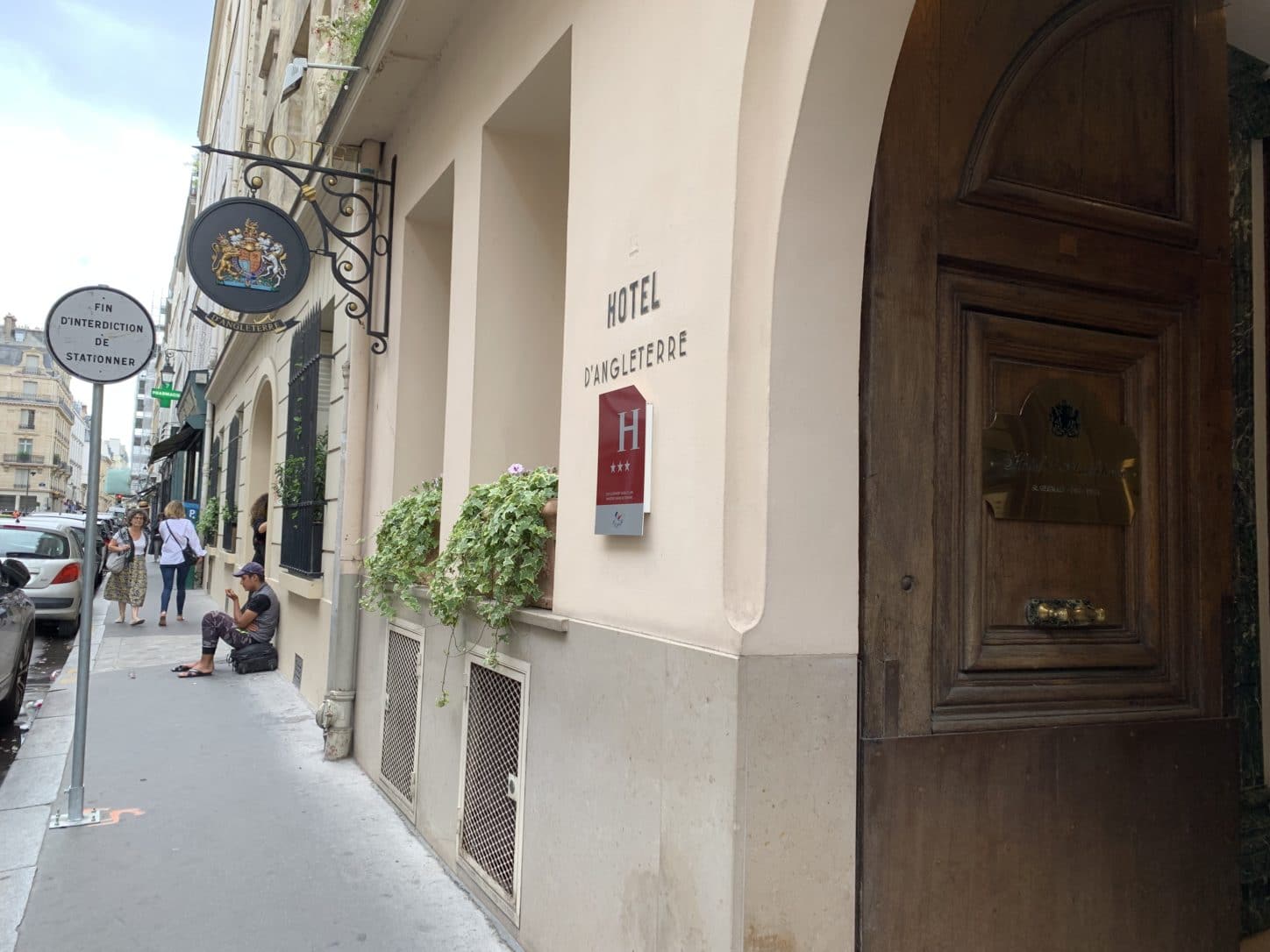
Hotel d’Angleterre St.-Germain, Rue Jacob, Paris. Photo by ConsumerMojo.com

This funkily elegant old hotel lets you know with a photo on the wall that Ernest Hemingway once stayed there.  Not much has changed since then.  Over the king-sized bed in our room on the second floor, massive dark wood beams ran like a music staff along the ceiling.  A couch and chairs faced windows that overlooked the small courtyard off the lobby.  The windows were open.  There was no air conditioning, just a fan.

On our way to explore we met fellow Americans, from Washington D.C. taking a break in the garden.
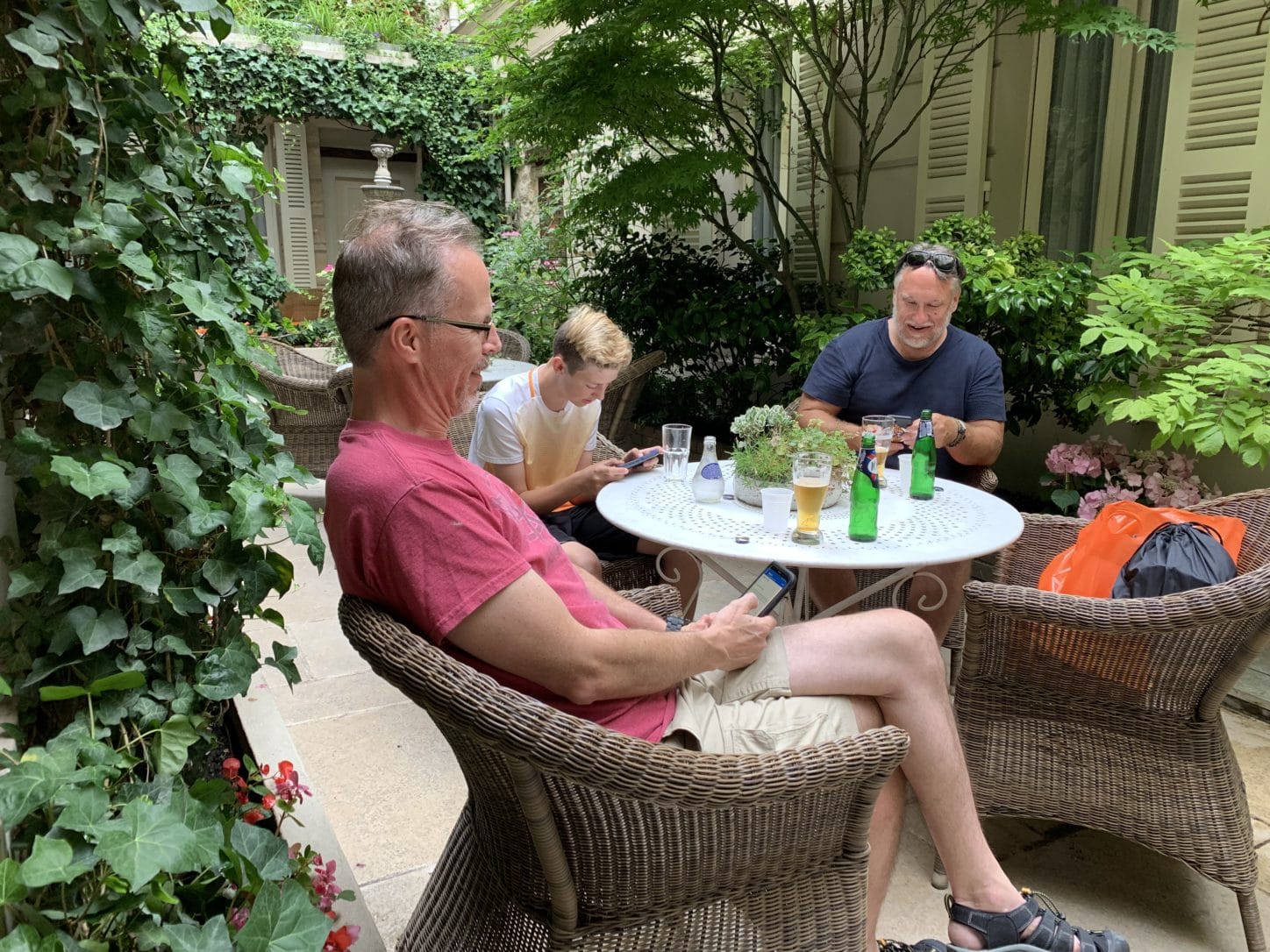
Enjoing the garden at Hotel d'Angleterre, Photo by ConsumerMojo.com
Enjoing the garden at Hotel d’Angleterre. Photo by ConsumerMojo.com

We chatted for a bit and then went to reacquiant ourselves with the neighborhood. We’d made a lot of memories in those streets. One night we dressed for the red carpet — Nick in a tux and Barbara in a Giorgio di Sant’ Angelo gold and black costume — and dined at La Tour d’Argent overlooking the Seine.  We met another American couple there, and after dinner we all walked to Ruby’s Samba Club on Rue Dauphine just off the river.  The place was packed but we looked so good they had to let us in, and we danced deep into the night.

This time, walking east on Rue Jacob, we looked up a side street to see a children’s clothing store called Finger in the Nose.  
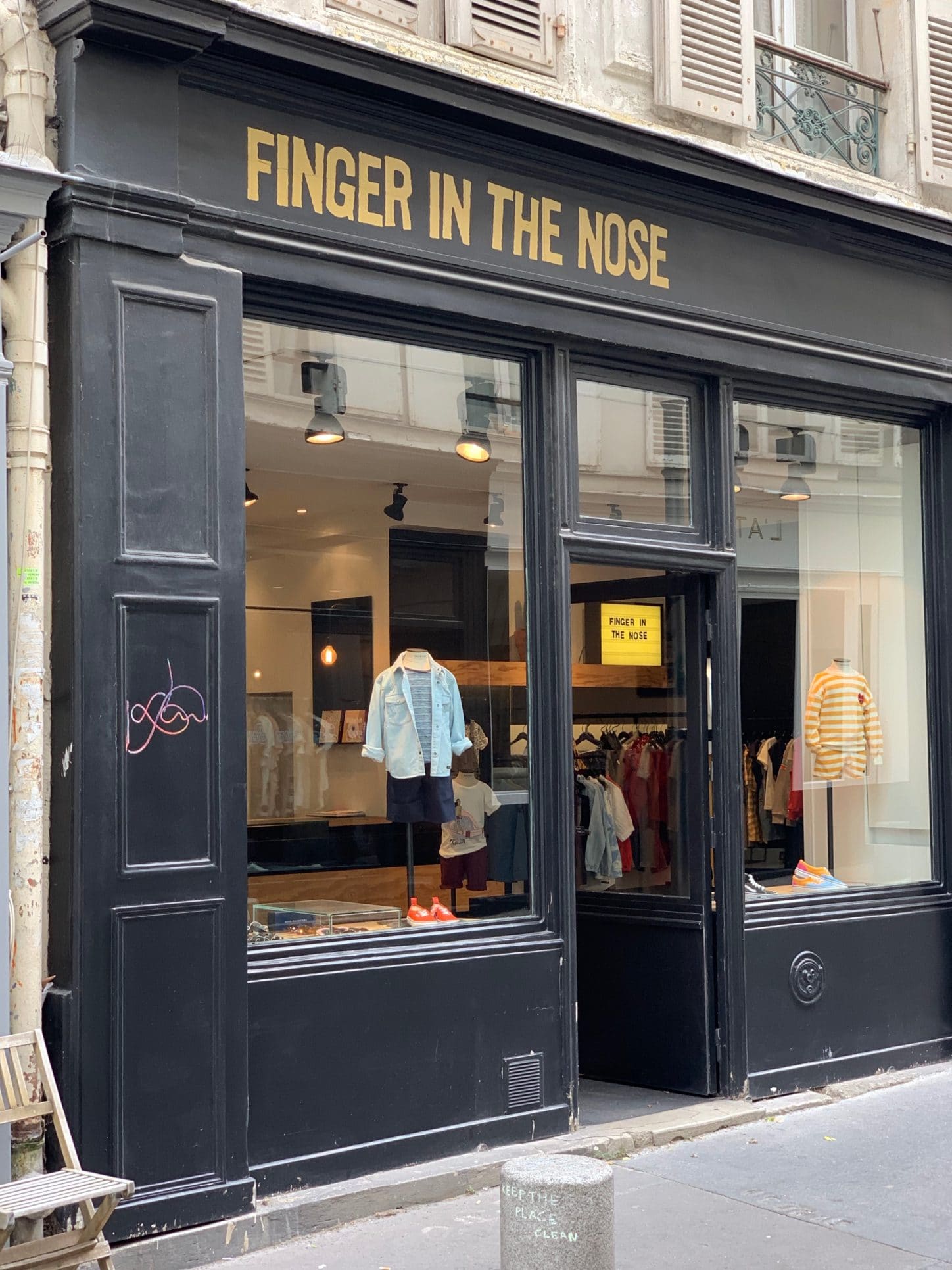
Children’s clothing store in St.-Germain des Pres. Photo by ConsumerMojo.com

Barbara had made our restaurant reservations before we left New York.  Investigative reporter that she is, she asked for recommendations from her French Tai Chi classmates at their studio in Chinatown and also from our friends with French passport stamps.  

That first night we reserved at Pramil, a favorite of artist Pierre Clerk and Linda Mandel, who split their time between New York and Bordeaux.  We napped a bit to bring our circadian rhythms up to speed and set off for the other side of Paris.

The warm summer night brought Parisians to the streets and the cafes that line them with life and talk and laughter.  Our taxi ride reminded us that our memories may lie in the Left Bank but a lot of Paris is vibrant in far-flung arrondissements. 
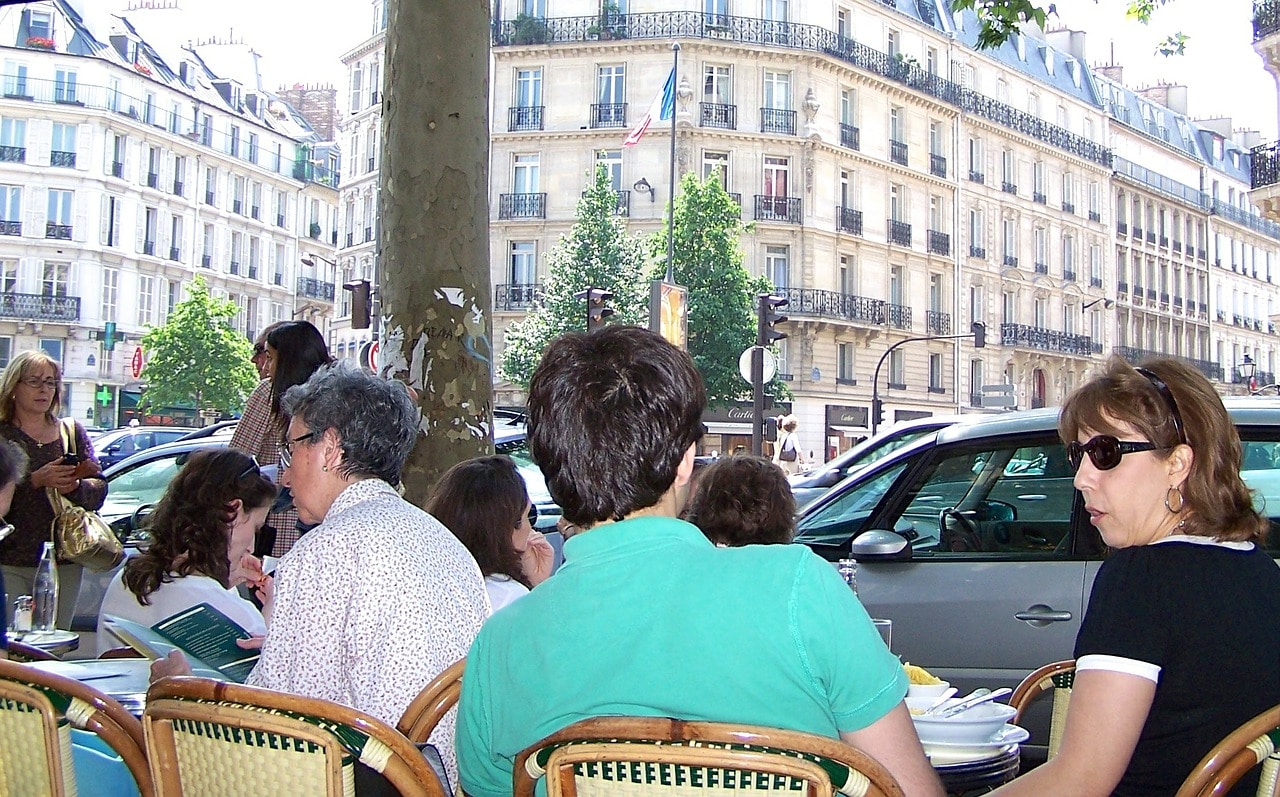
Paris Cafe
Paris Cafe. Photo by Leslie Anneliese. Courtesy Pixabay.

Our trip took us across the Seine and through the Tuileries Garden past the Louvre to the 3rd arrondissement.  We stepped out in front of Pramil on Rue du Vertbois.  No outdoor tables here; the sidewalks were too narrow. We were about to become familiar with “bistronomie,” a small affordably priced bistro with inventive cuisine, often created by chefs with classical training.  

The long room contained two rows of tables divided by a center aisle.  We sat down at a table for two and ordered a bottle of Sancerre.
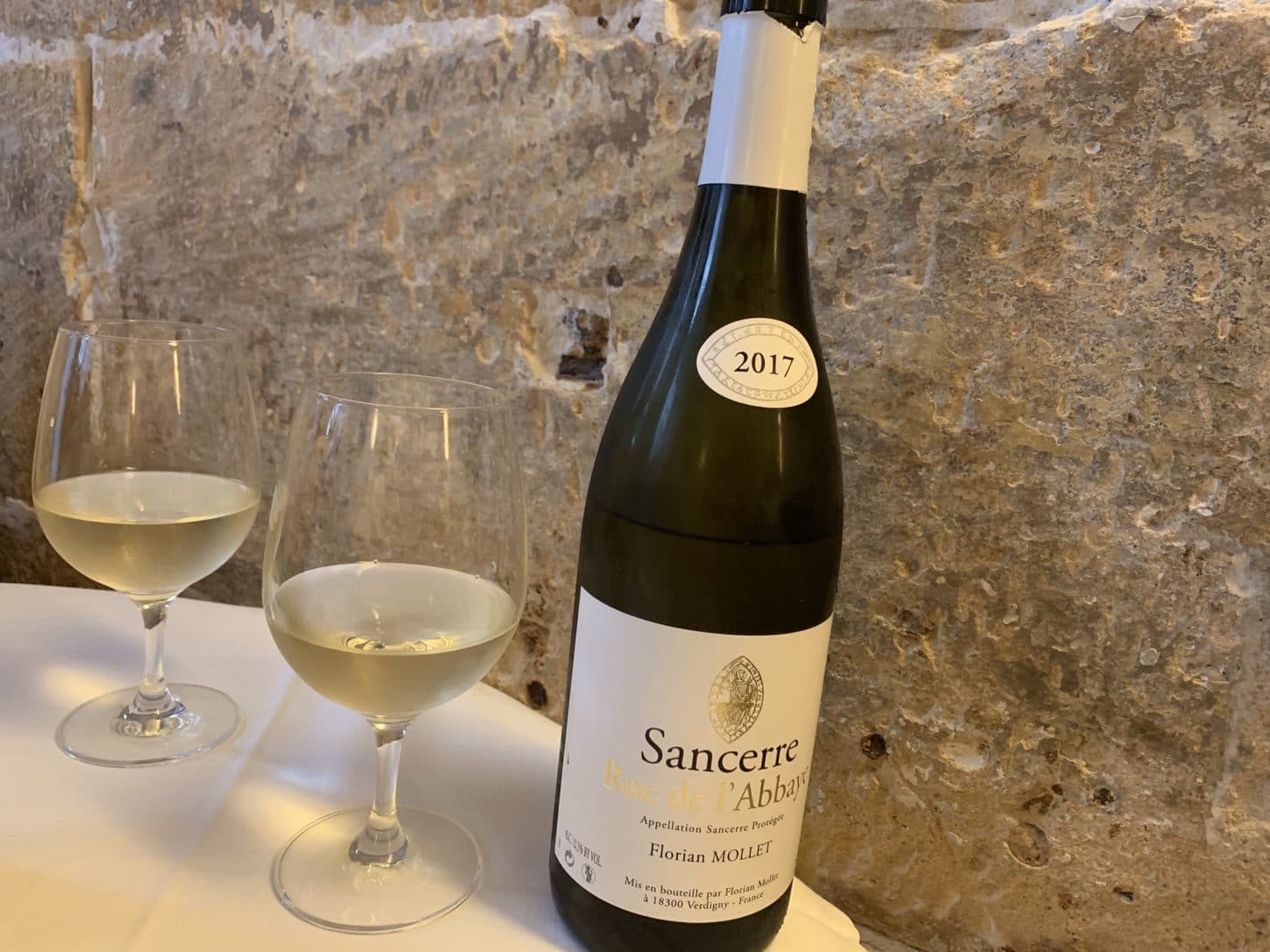
Paris Twice
Bottle of Sancerre at Pramil, Paris. Photo by ConsumerMojo.com

Nick started with baby asparagus baked with parmesan cheese over bresaola ham. Barbara had a salad of shrimp with ice plant — a relative of kudzu that got its name because it sparkles in the sun — and cherry tomatoes.  
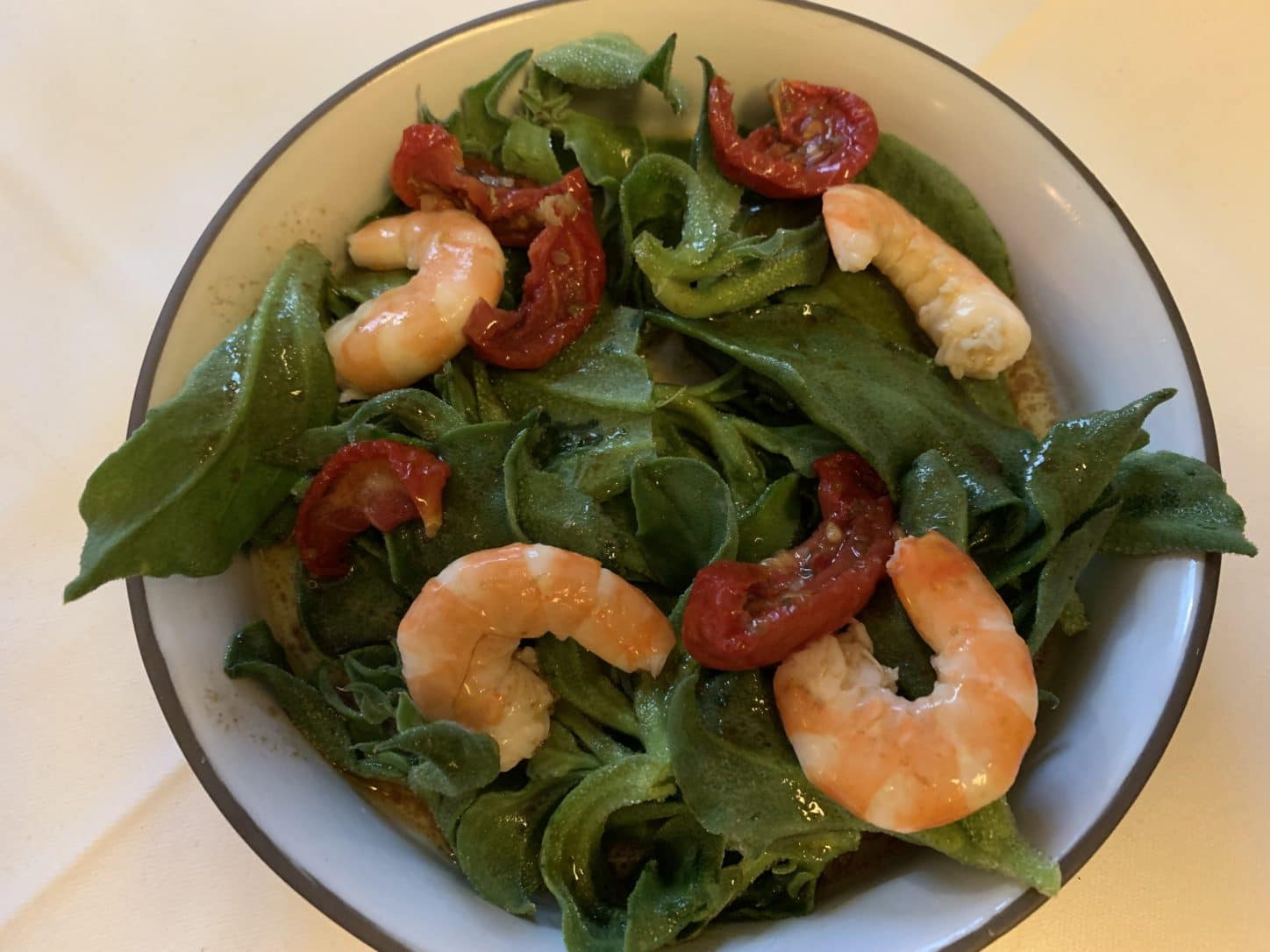
Paris Twice
Shrimp with Ice Plant, Pramil, Paris. Photo by ConsumerMojo.com

For his main Nick chose boneless rabbit with artichokes and kalamata olives, and Barbara ordered a veal steak with mushrooms and pureed potatoes.
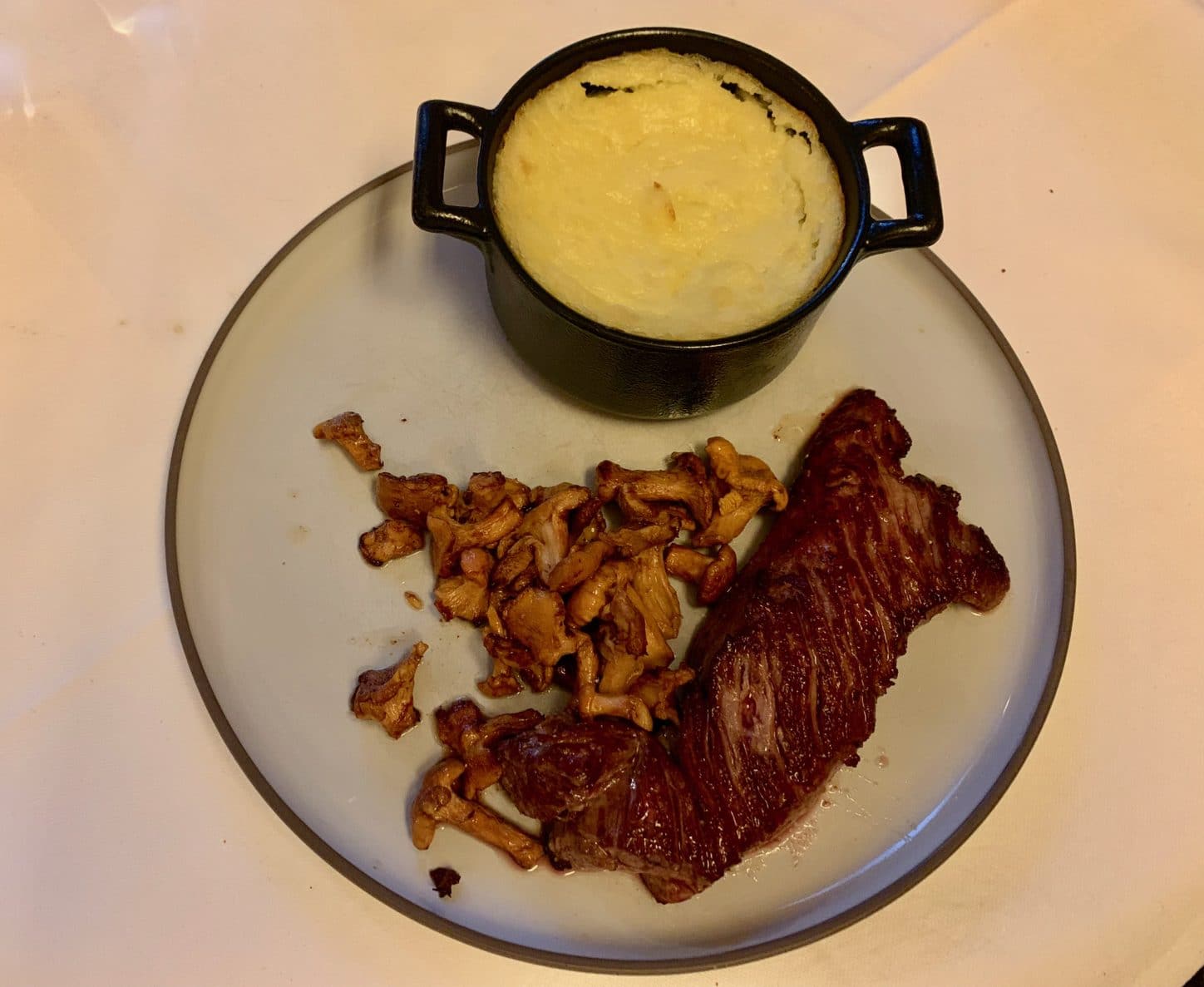
ParisTwice
 Veal Steak at Pramil, Paris. Photo by ConsumerMojo.com

While we enjoyed a dessert of roasted apricots and cherries with ice cream on the side, Alain Pramil, a former physics professor with a passion for food and fresh products, came out of the kitchen to greet diners.
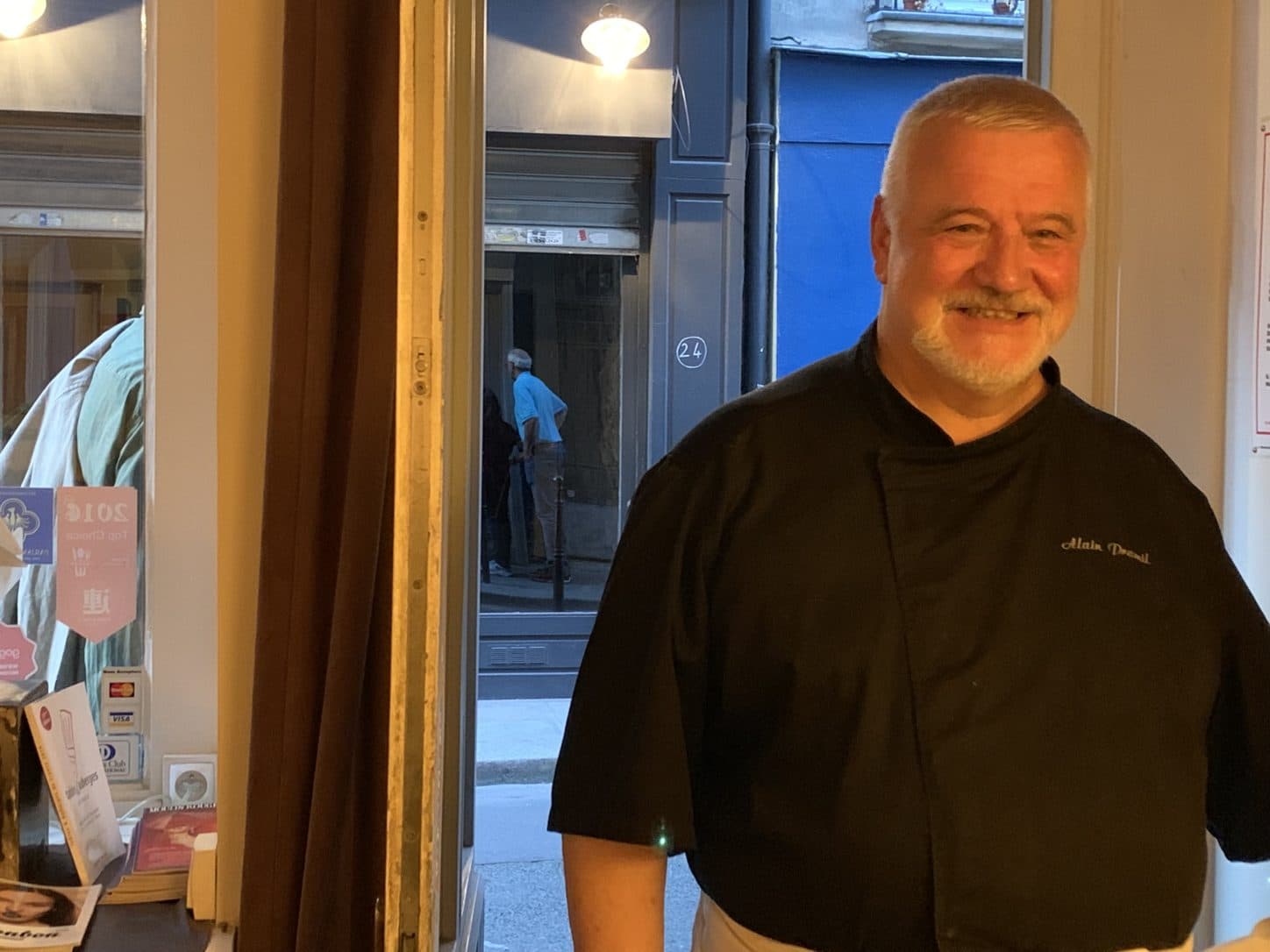
Chef Alain Pramil at Pramil, Paris. Photo by ConsumerMojo.com

We told him our friends were regulars when they were in Paris and we felt glad they had sent us to him.  Glasses of dessert wine appeared while we waited for a taxi, and when it arrived we weaved across the sidewalk and climbed in.

We barely made the 10 o’clock breakfast cutoff the next morning.  Travelers should know that if you book directly through the hotel’s website, breakfast is free. We had reserved through booking.com, and paid ten euros each. We’ve learned that some hotels want you to book directly with them so that they don’t have to pay the fees. And some will give you special deals.

After breakfast we hailed a taxi and told the driver we were going to the Foundation Louis Vuitton Museum. Hearing our superb French accents, he took us to the Louis Vuitton flagship retail store on the Champs-Elysees. 

Fortunately, the store was on the way to its namesake’s foundation museum in the Bois de Boulogne, the sprawling forest and park on Paris’s western outskirts. We rode out the Champs-Elysees, rounded the Arc de Triumph, and after a few minutes entered the park. Suddenly the greenery cleared and there stood the Frank Gehry-designed museum.
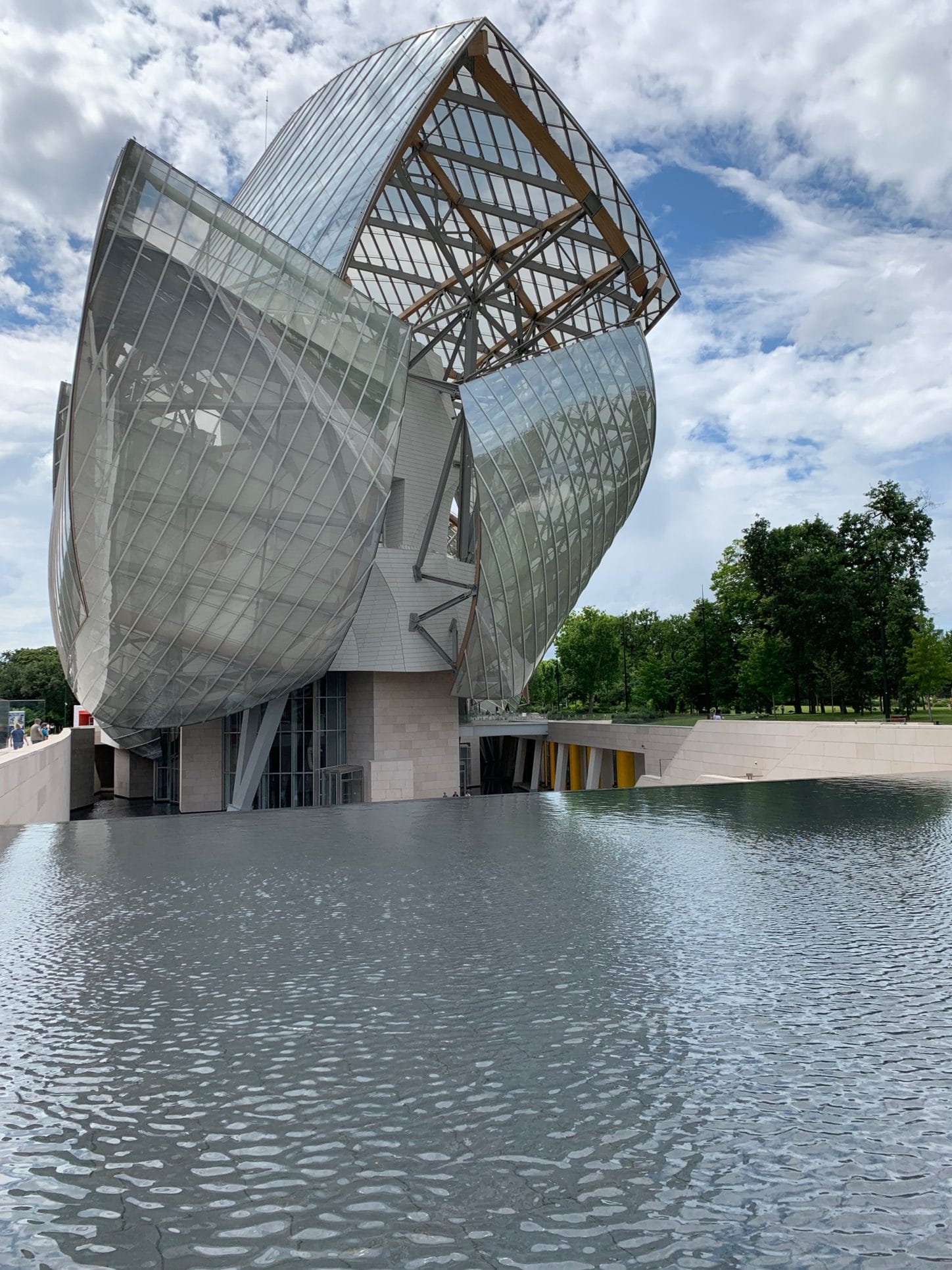
Paris Twice
Foundation Louis Vuitton Museum, Bois de Bologne, Paris. Photo by ConsumerMojo.com

Its glass curves sparkled in the sun and seemed poised to leap across the pool and green landscape like a ship straining under full sail in a stiff breeze.

Inside, the billowing sails dissolved into painstakingly joined angles of wood and steel under the glass. Steps led to terraces and overlooks that showed a different Paris.
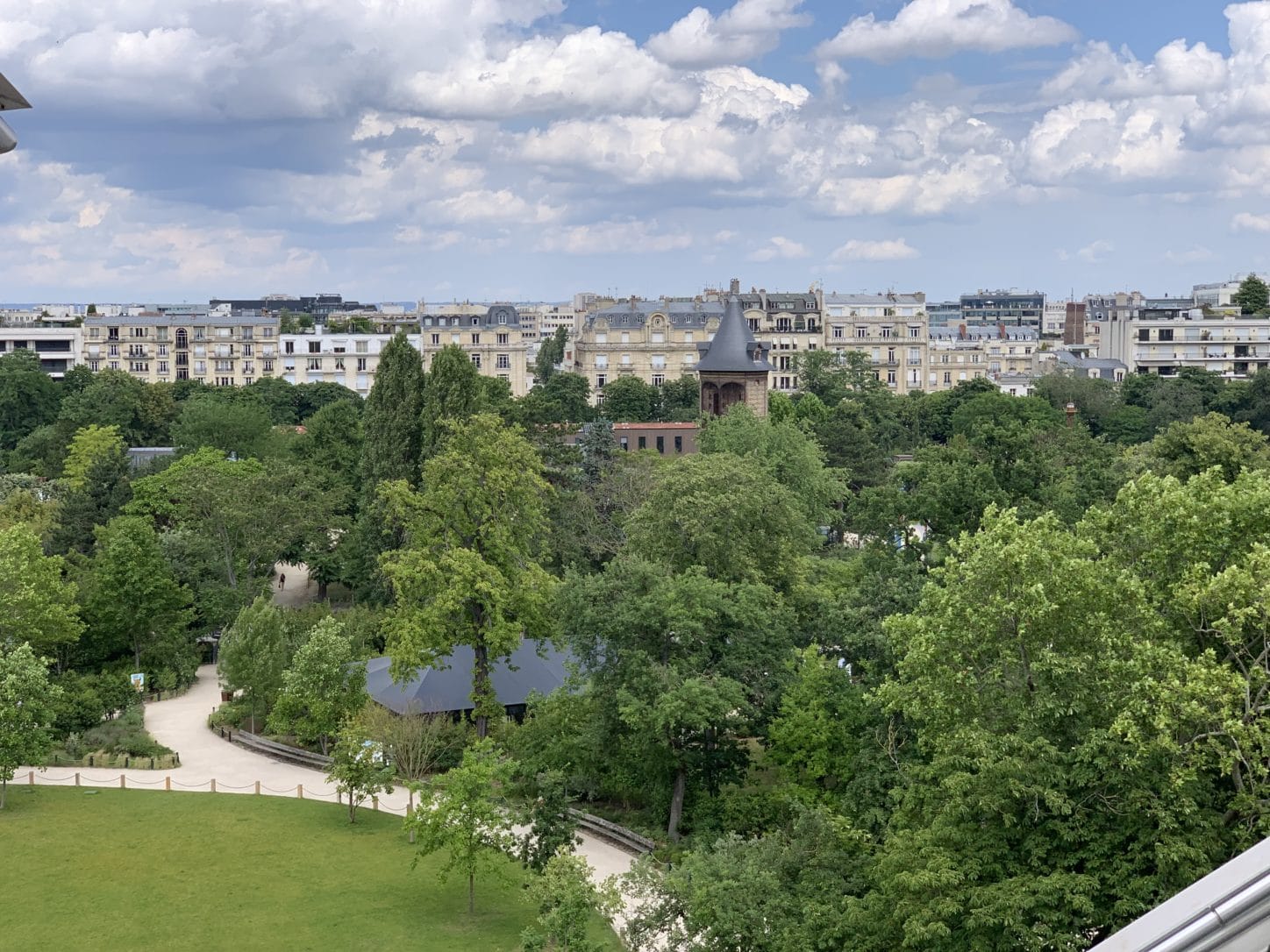
Paris outskirts from the Louis Vuitton Foundation Museum. Photo by ConsumerMojo.com

We began with a climb to the top and spotted peacocks picking for food in the bushes below. Look to the right above the sign.
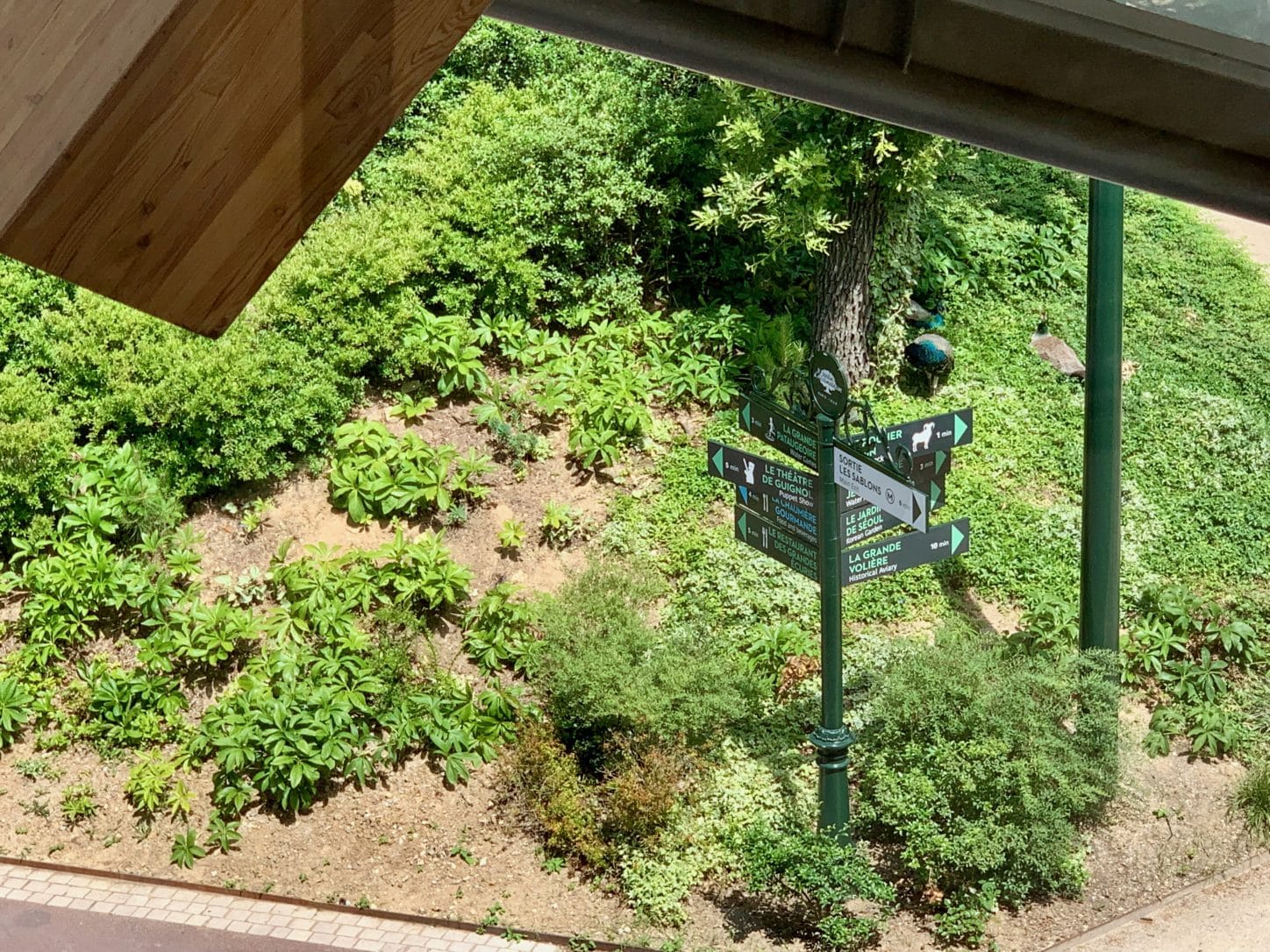
Paris Twice
Peacocks in Bois de Bologne from Foundation Louis Vuitton. Photo by ConsumerMojo.com

On the west terrace, Adrián Villar Roja’s living sculpture, with its organic elements, changes with the seasons and that caught our interest.

Living Sculpture by Adrián Villar Rojas, Foundation Louis Vuitton. Photo by ConsumerMojo.com

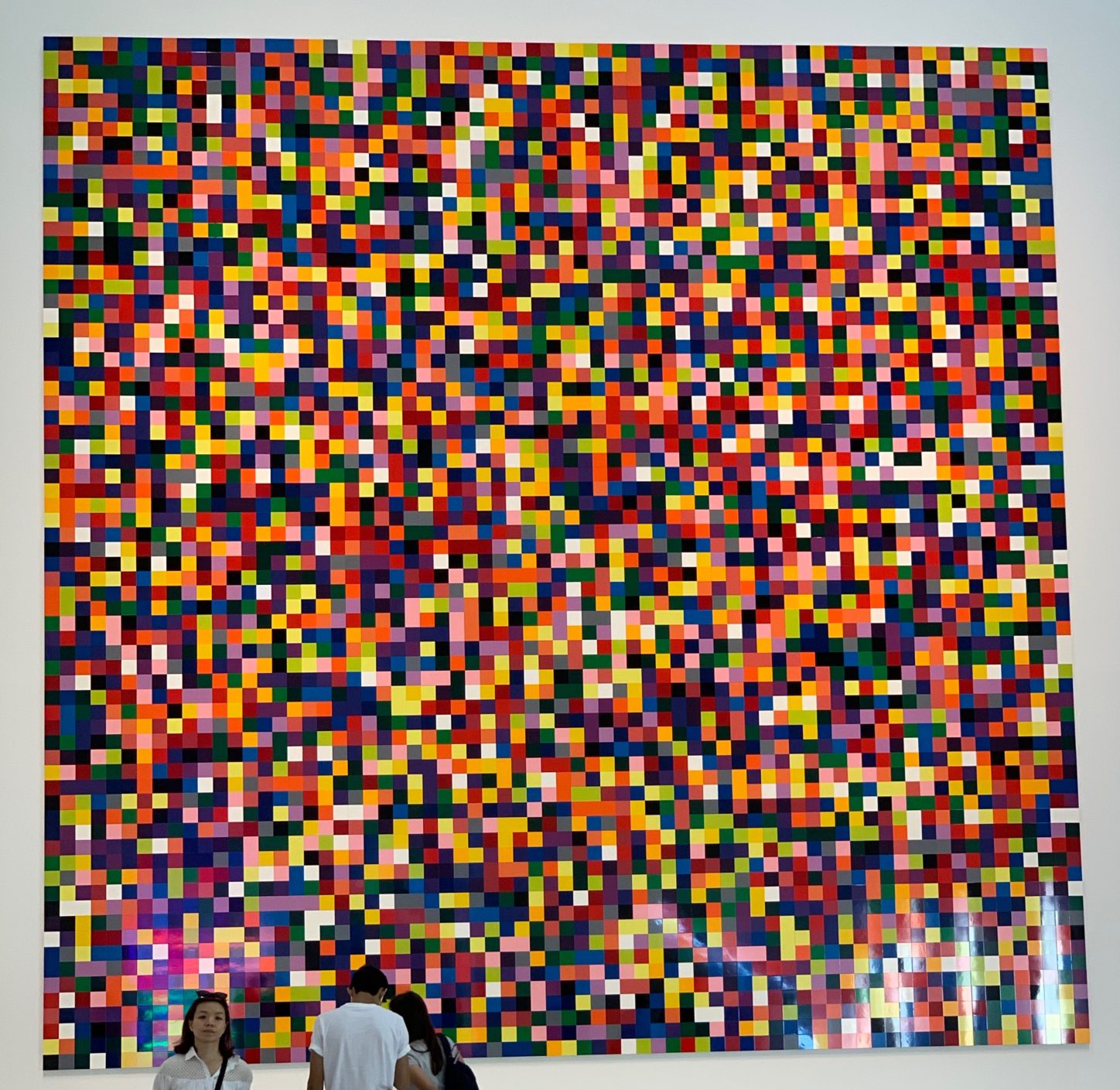
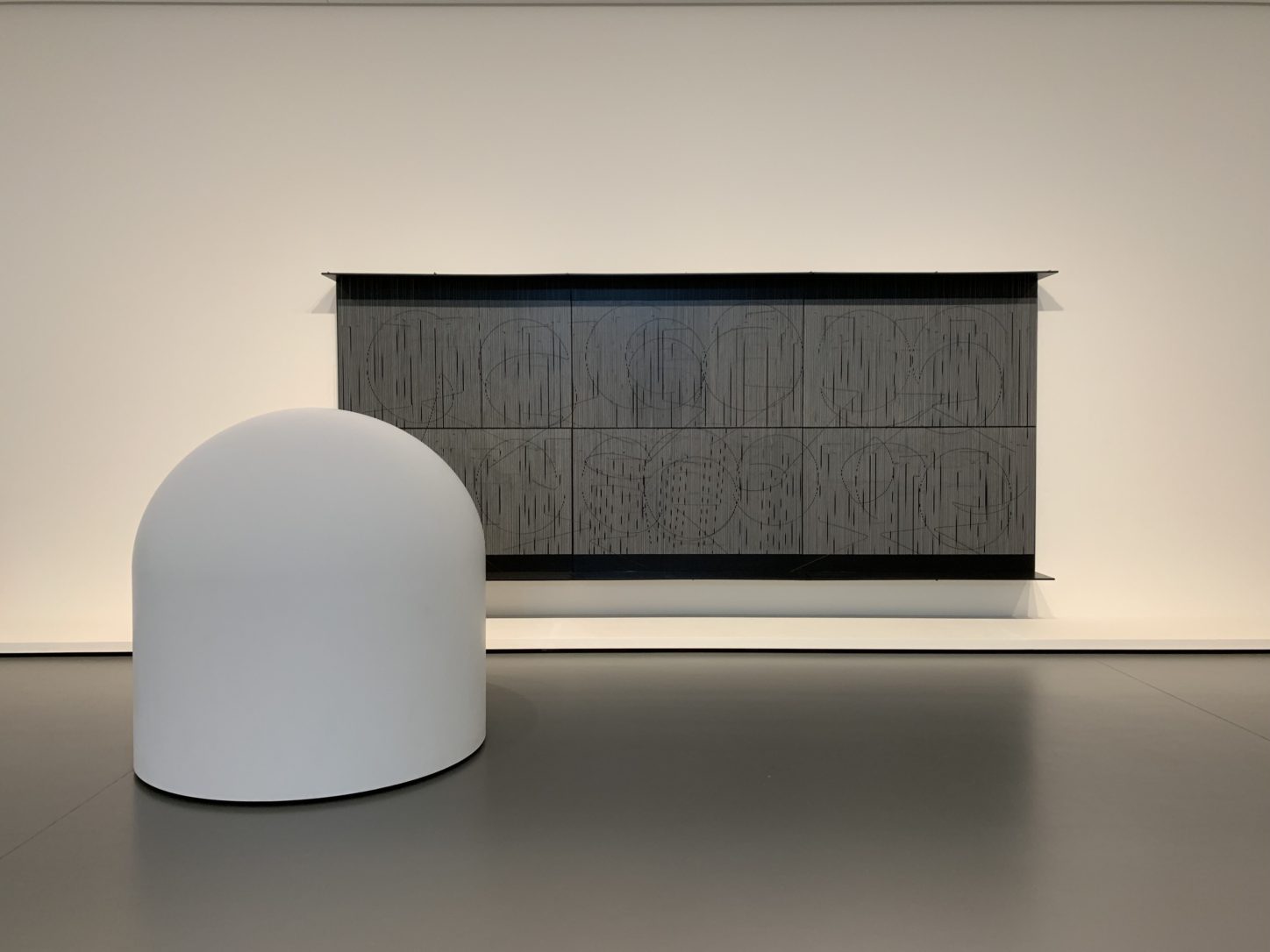
We headed back down into one of the museum’s first floor  galleries and lingered with the works of 20th century modernists. A young girl stared up at Joan Mitchell’s “Red Tree” from 1976.  Gerhard Richter’s “4600 Farben” splashed colored squares against the wall.  Robert Breer created a moving dome called “Float” that creeps glacially into fields with other artworks, as it did with us against Jesus Rafael Soto’s “Grande scripture noire,” and then moves on to create new combos.   
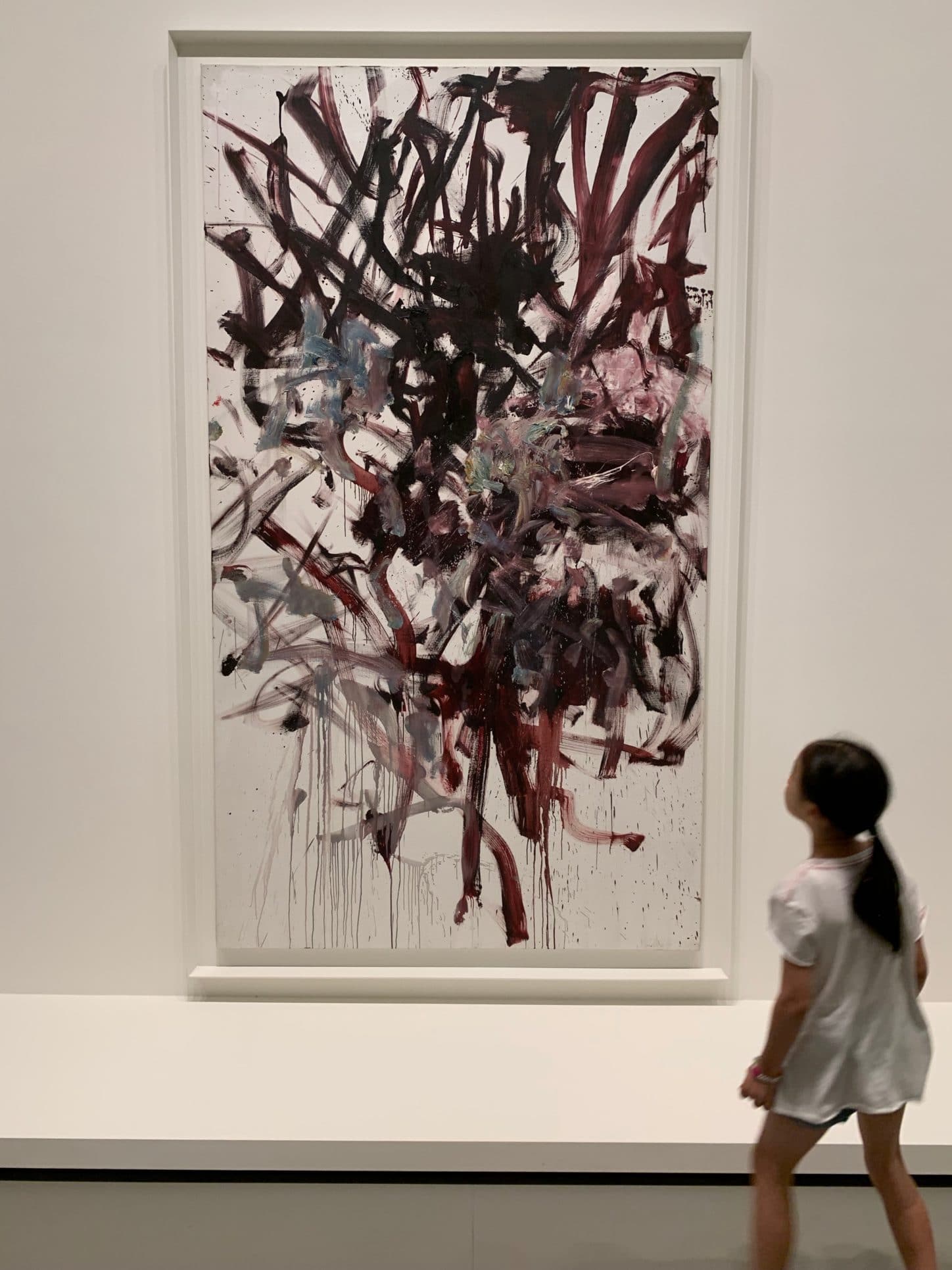
Girl looking at Joan Mitchell’s “Red Tree.” Photo by ConsumerMojo.com
Gerhard Richter’s “4900 Farben” at the Louis Vuitton Foundation Museum. Photo by ConsumerMojo.com.
Robert Breer’s “Float” against Jesus Rafael Soto’s “Grande ecriture noire.” Photo by ConsumerMojo.com.

We moved downstairs, where Olafur Eliasson installed forty-three vertical mirrored columns that reflect their painted sides and the wall beside them and dance in the pool below.  The installation, called “Inside the Horizon,” was part of the museum when in opened in 2014.
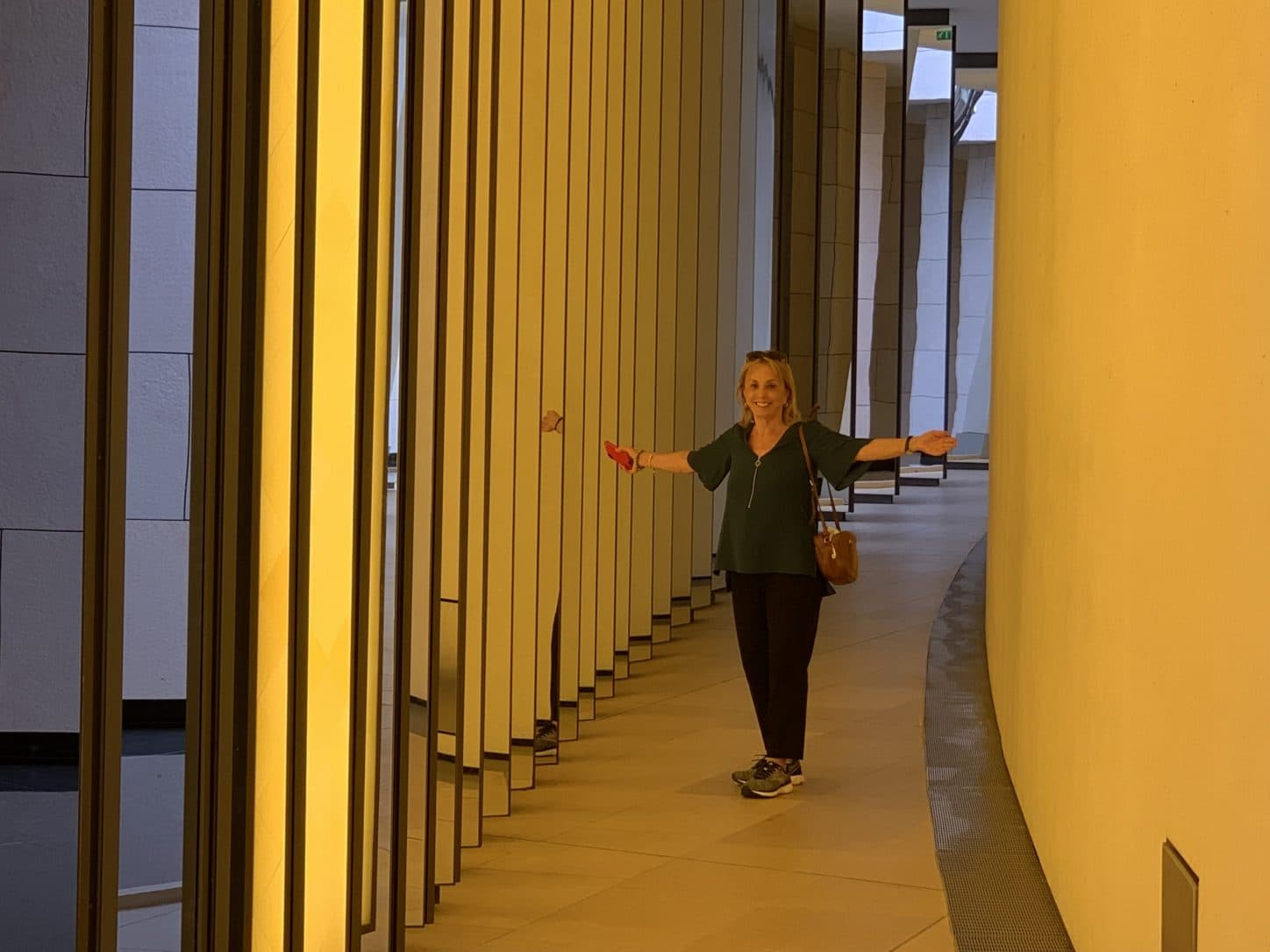
Barbara Nevins Taylor “Inside the horizon” at Foundation Louis Vuitton. Photo by ConsumerMojo.com.

Beyond the sculpture just outside, water spills down a wide set of shallow steps in a waterfall-but-not that seems hypnotic.

Pulling ourselves away, we walked from the museum into the adjoining Jardin d’Acclimatation. Families with children gathered at the animal enclosures, others boarded the carousel and rides that spoke of the sweetness of childhood.
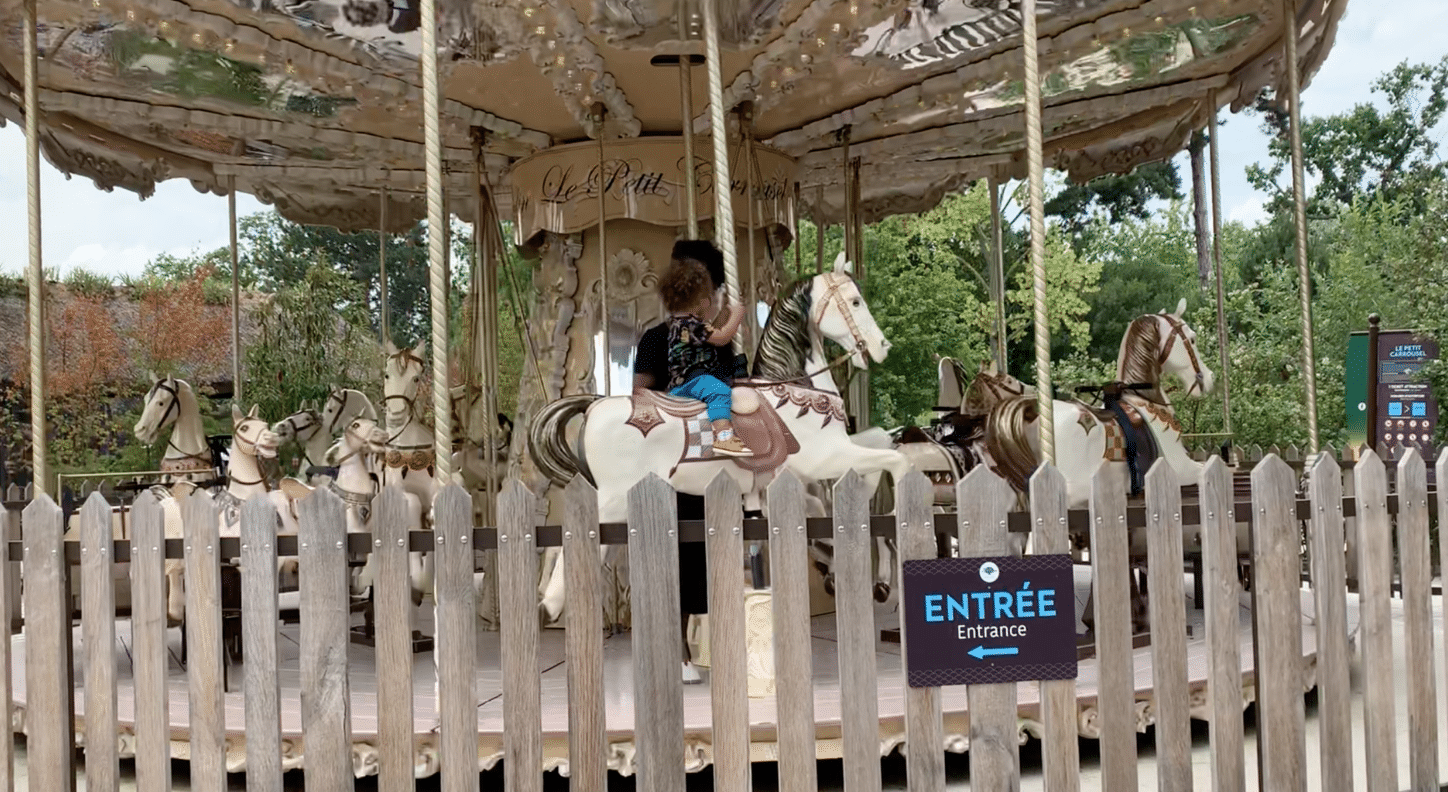
Carousel in Jardin d’Acclimation, Paris, France. Photo by ConsumerMojo.com

 We enjoyed the sweetness in the air of this lovely park,  ate a quick lunch and went off in search of a taxi. 

A Turkish Airlines ad adorned the side of the first car in the taxi line. We got in and met Alexis Vettier. He spoke good English and explained,”It’s my car and me. I don’t have to work for anyone and this is a good way to make a living.” We had plenty of time to get to know him as we crawled back to the city center on Paris’s car-choked streets.  He said that although he grew up in Paris, he had moved his wife and kids out to the suburbs where things were less expensive.  The airline ad supplemented his fare income.  When he finally dropped us off we’d arranged for him to pick us up the next morning for our flight to Athens out of Charles de Gaulle airport.

Nick went back to the hotel to rest and Barbara went shopping. The hot weather made her crave something light and breezy.  She had spotted on Nina Kendos shop on Rue de Buci and the cool colors and floaty styles called to her. The small boutique was filled with women of a certain age looking for comfort and color. 
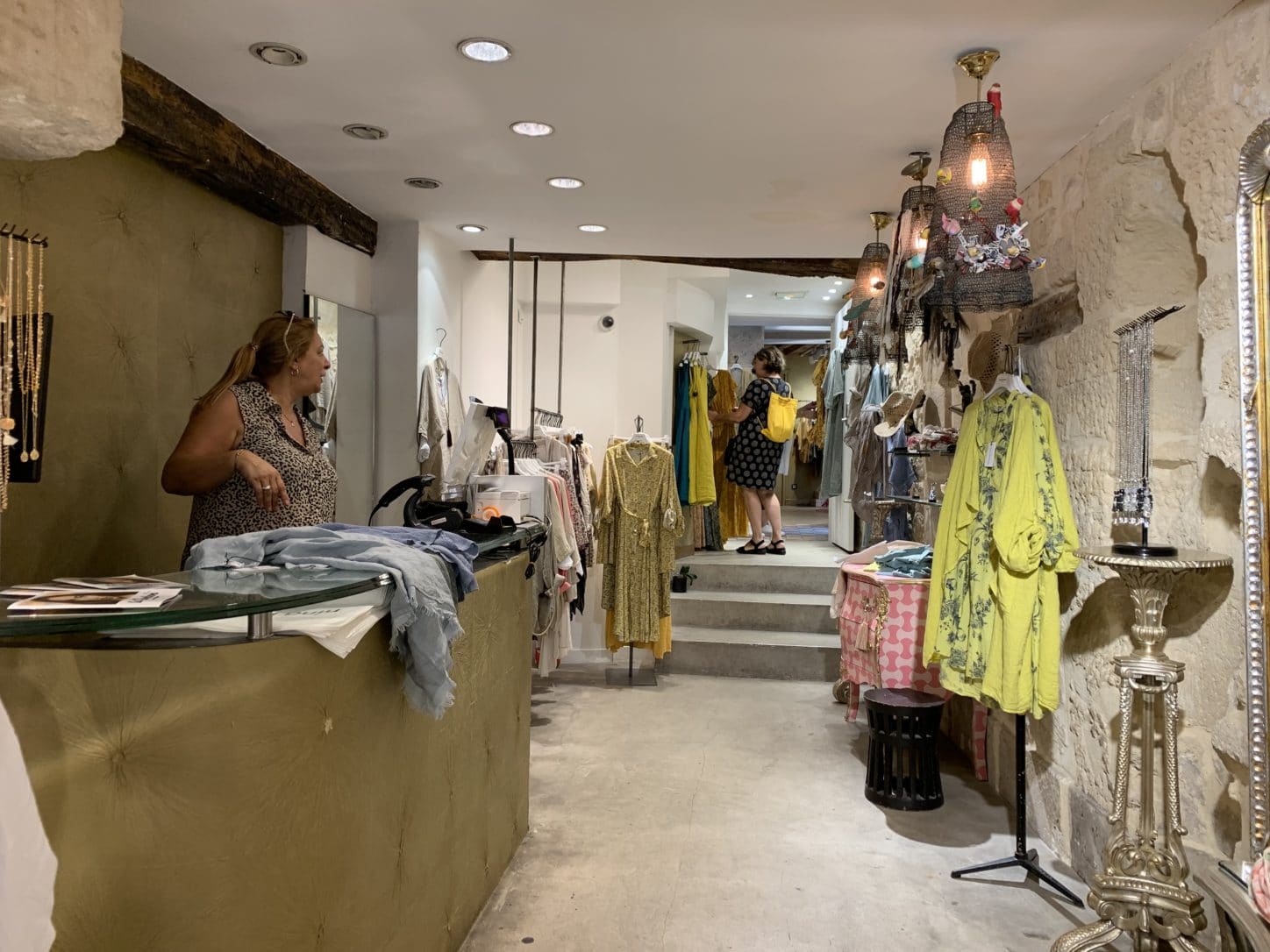
Nina Kendosa Boutique, Paris, France, Photo by ConsumerMojo.com

Barbara’s Tai Chi classmate Albert Delamour, an artist, had recommended a restaurant called Chez Paul.  We got dressed and stopped at a sidewalk bistro for champagne, then waved down a taxi.

Chez Paul was a twenty-minute taxi ride to Rue de Charonne in the 11th arrondissement. 
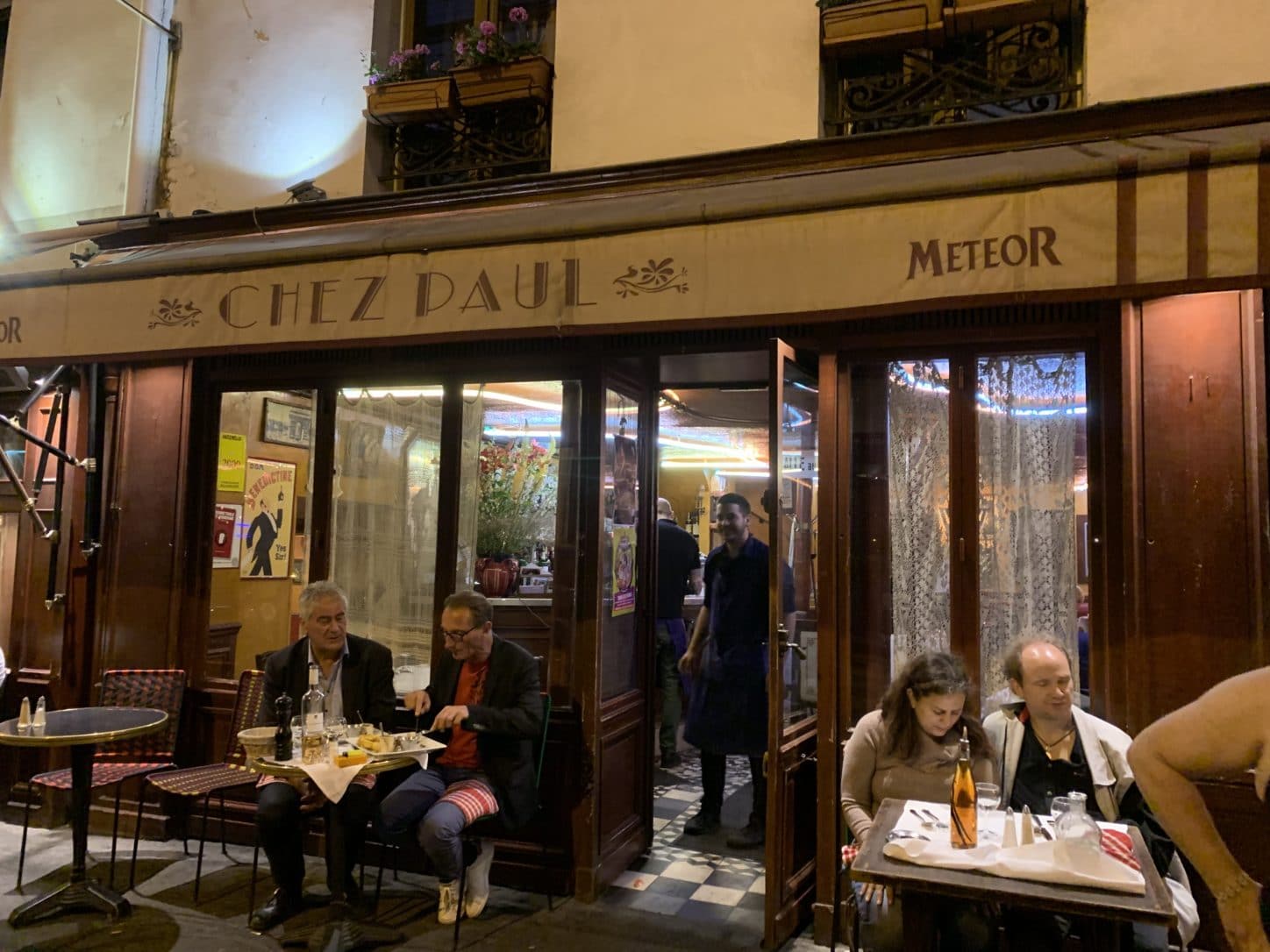
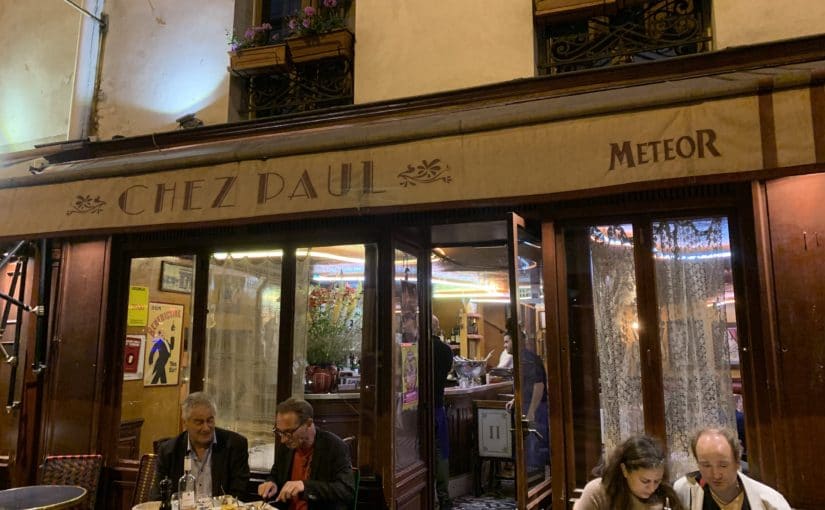
Outside of Chez Paul Rue de Charrone, Paris, France, Photo by ConsumerMojo.com
Chez Paul, Paris, France. Photo by ConsumerMojo.com

The hostess Valery came out from behind the bar and greeted us with a warm smile and seated us at an inside table.
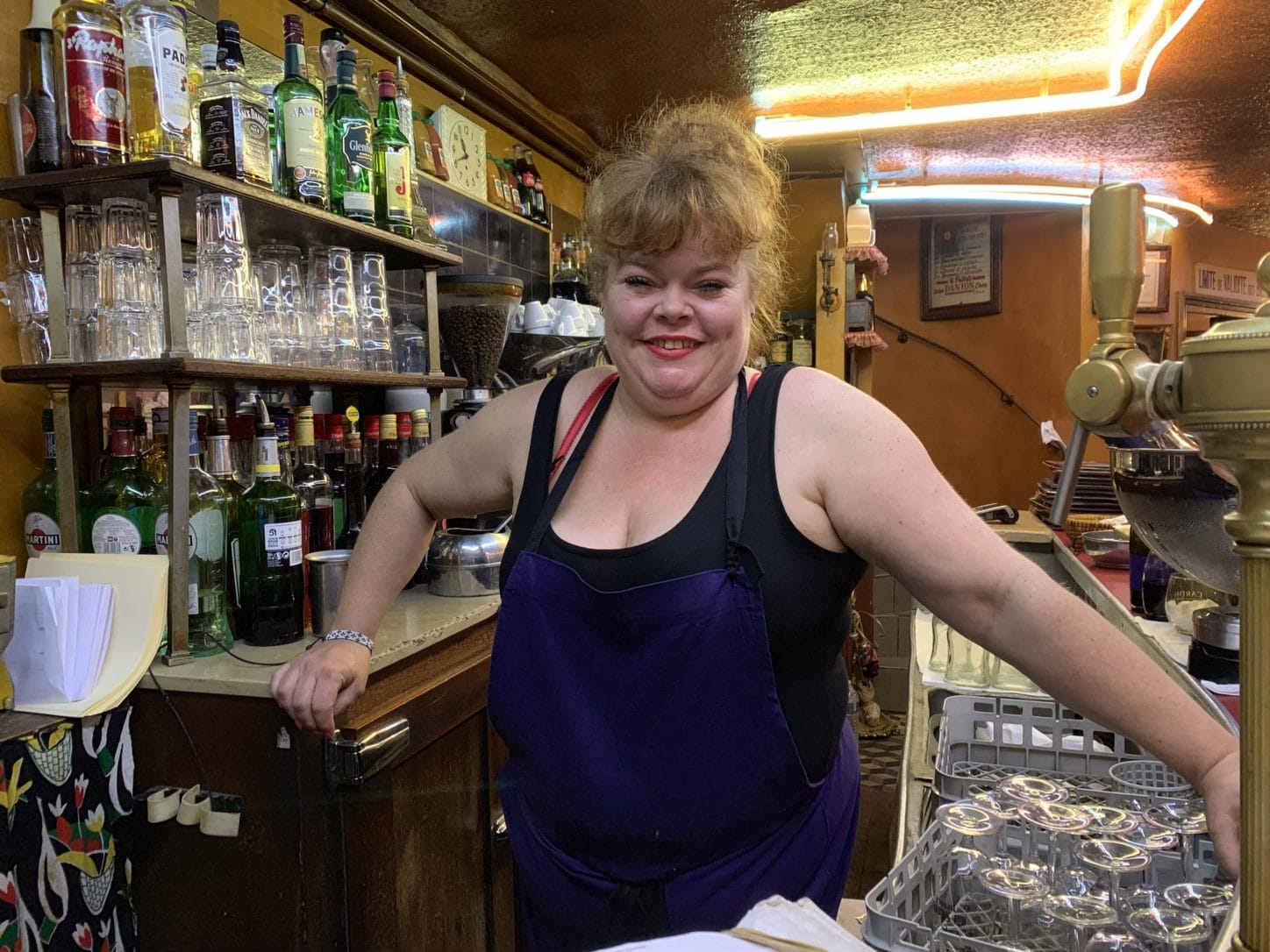
Valery at Chez Paul behind the bar. Paris, France. Photo by ConsumerMojo.com
Valery at Chez Paul, Paris. Photo by ConsumerMojo.com

The traditional bistro proudly says it dates to 1900 and it took us back into vintage Paris in the best way. The two rooms were filled with locals, which we took as a good sign.We started with snails and a bottle of Sancerre from the Loire Valley. 
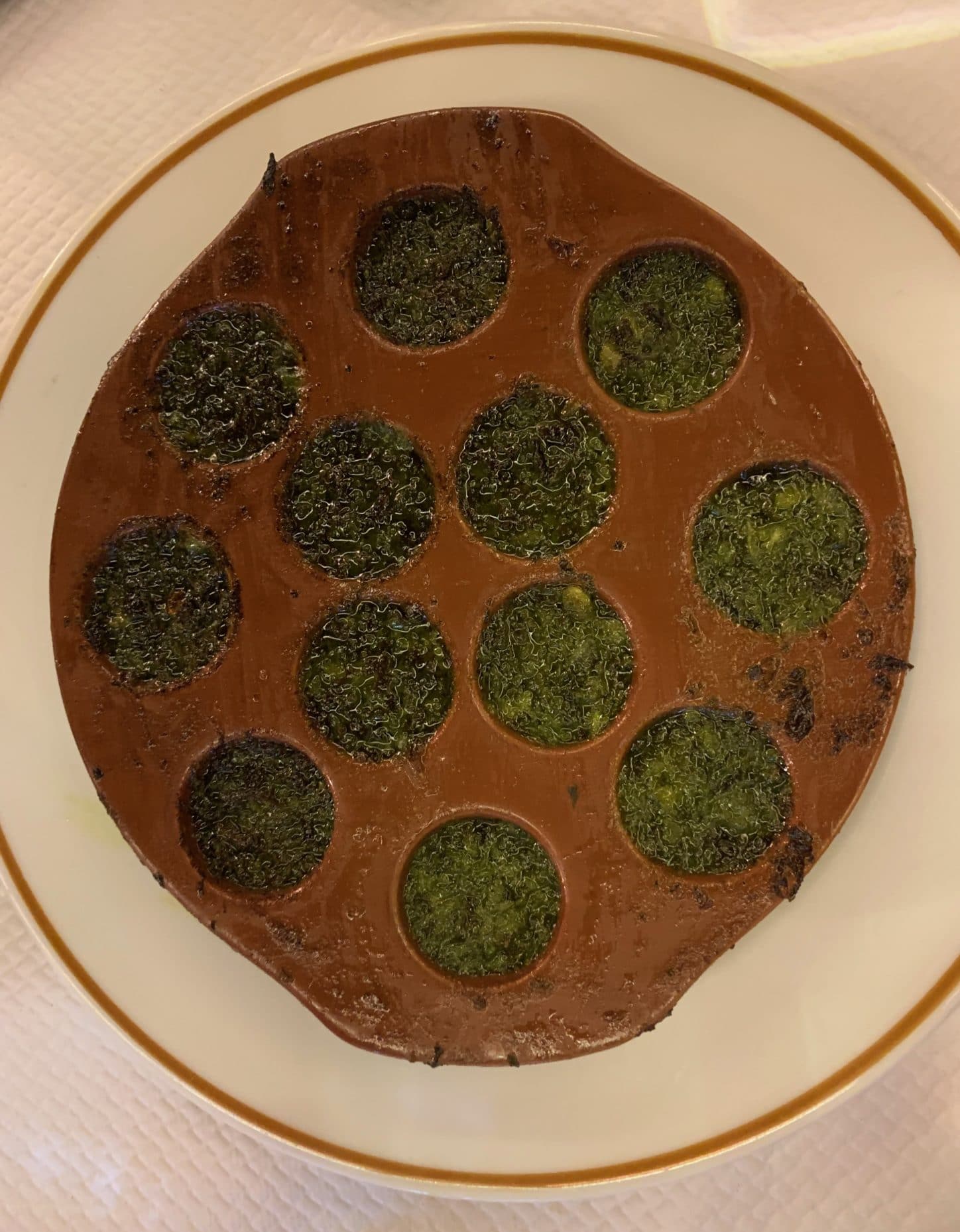
Plate of snails at Chez Paul, Paris, France.
Snails at Chez Paul, Paris, France. Photo by ConsumerMojo.com

Meat dishes dominated the menu.  We pondered ever so briefly the Saint Antoine’s temptation — breaded and grilled foot, snout, ear and pig’s tail — and head of veal with gribiche sauce, before Barbara ordered a rabbit stew and Nick chose steak au poivre. 
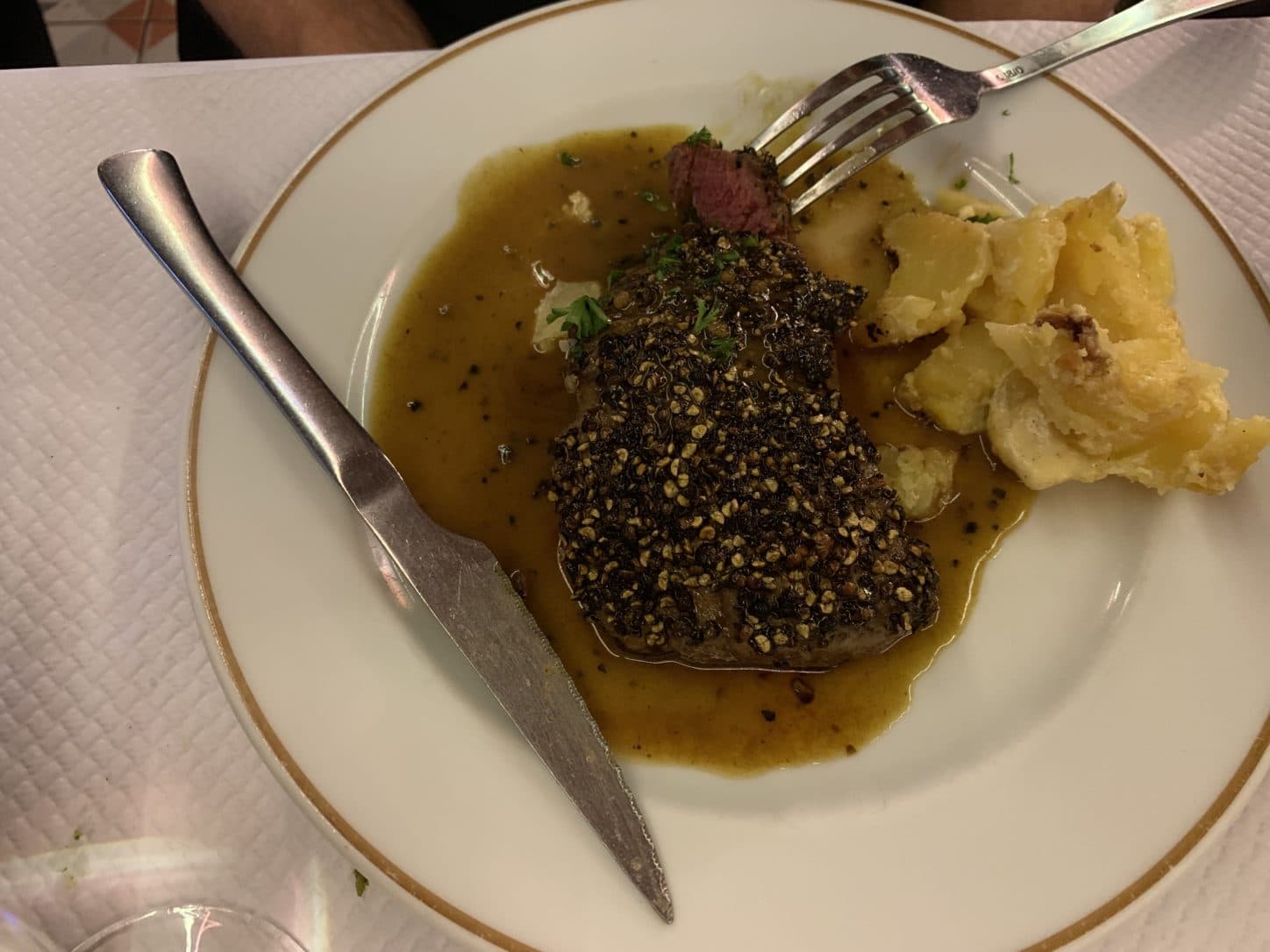
Steak au poivre at Chez Paul, Paris, France
Steak au Poivre at Chez Paul, Paris. Photo by ConsumerMojo.com

Two brothers sat at the next table and we began an easy conversation when they heard us speaking English.  They grew up in Paris and the brother visiting from Seattle had longed for a Parisian entrecote. So there they were.  The Seattle brother said he was working on a new project, secret, for Amazon.  His older brother opened child care facilities for a franchising company and the younger was trying to convince him to move to the states. “Better business opportunities in the U.S.,” the younger brother said. 

We left Chez Paul happy and sated and went off in search of a taxi back to the Left Bank. The next morning Alexis, the taxi driver, picked us up and we were off to Charles de Gaulle airport and Athens. And you can read about our travels in Athens here

Our Second Bonus Vacation

Eleven days later, on July 1, we landed back at Charles de Gaulle. While we’d been in Athens, the Peloponnese Peninsula and Corfu, France and the rest of western Europe had endured a scorching heat wave. People died, and Paris had opened public cooling rooms.  Greece wasn’t exactly cool, but we always had a breeze from the sea or the mountains.  On our return the worst of the heat wave had worn itself out.

Alexis picked us up, as we’d arranged by email, and we plunged into the traffic crawling toward Paris on the multi-lane A-1. In Paris earlier, in Athens, and now again in Paris, we saw cars choking city life. Electric bikes and scooters darted between and around clotted traffic arteries and seemed to be taking over city streets.

An hour and a half later, Alexis dropped us in front of the Hotel des Marroniers on Rue Jacob. We like this street and the neighborhood because it reminds us of our street in New York’s West Village.
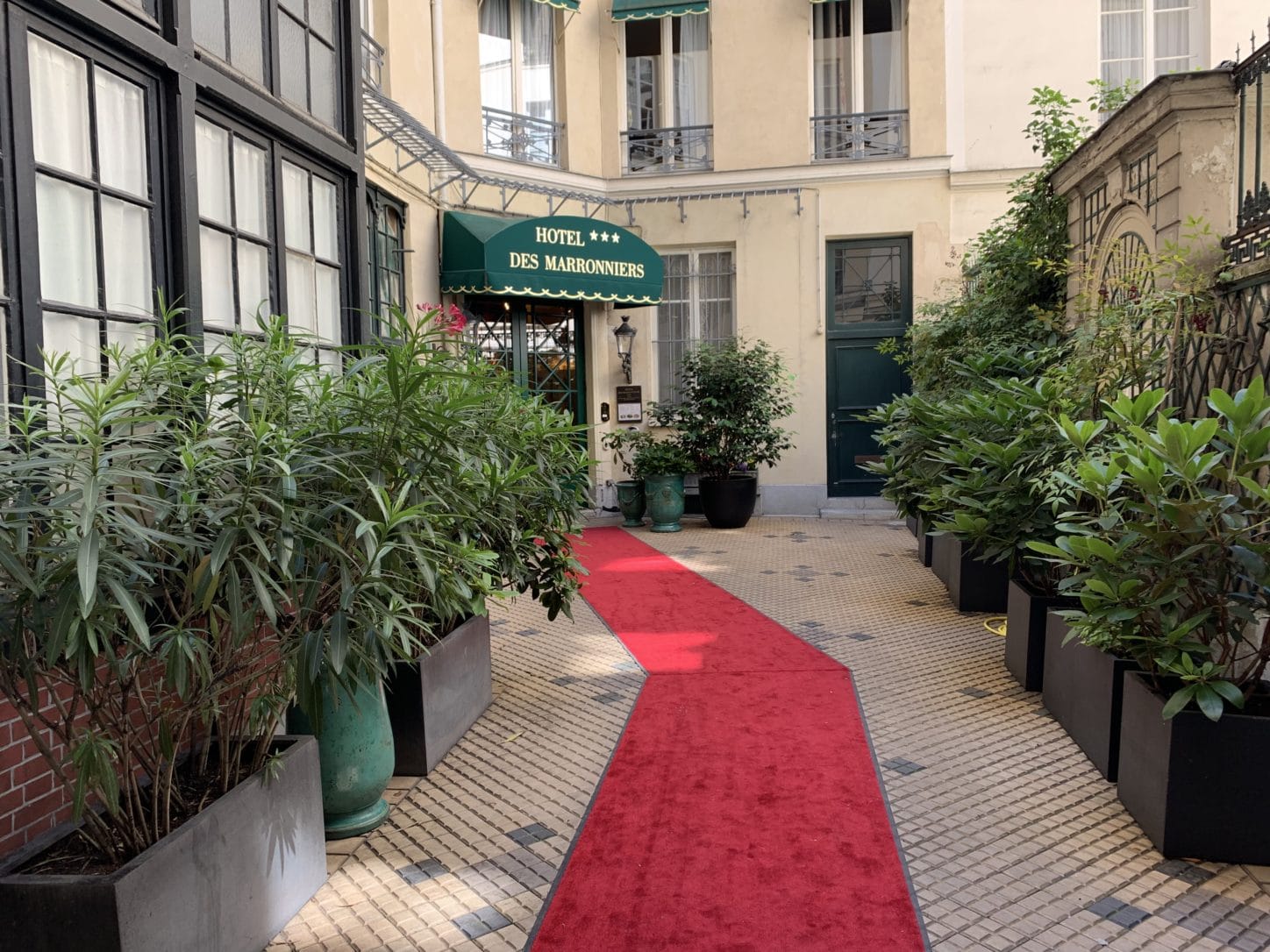
Red carpet entry way of Hotel des Marroniers. Photo by ConsumerMojo.com
Hotel des Marronniers on Rue Jacob. Photo by ConsumerMojo.com.

We pulled our bags into the lobby and received a key to a room too small to open them.  When you tried to get into the bathroom the door you hit the other person in the butt. But it was air conditioned.

We managed, bumping into each other every time we turned around, to get dressed for dinner.  And we tried to smile and be sweet.
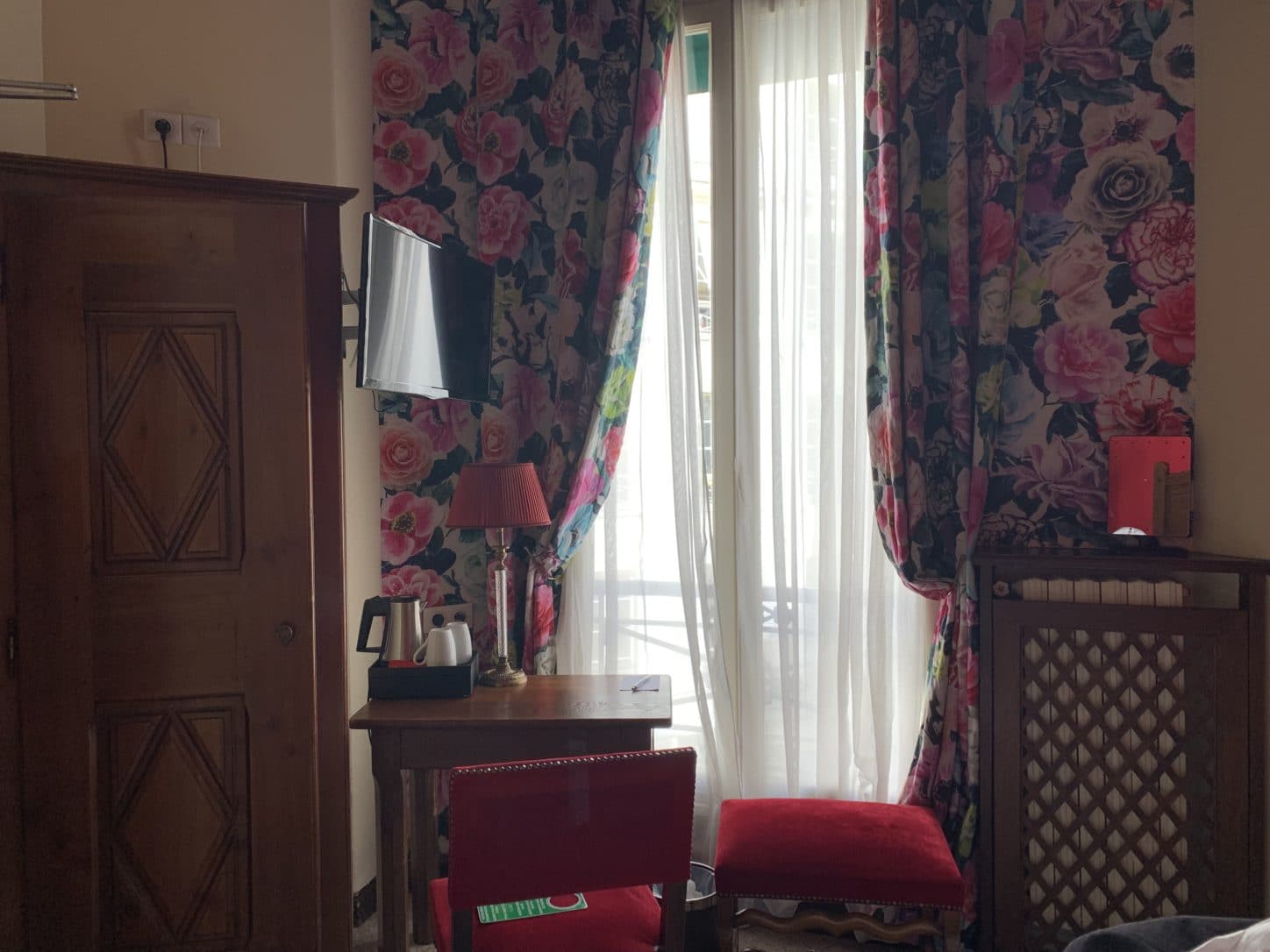
Small room at Hotel des Marroniers, Paris, France. Photo by ConsumerMojo.com
Small room at Hotel des Marroniers, Paris. Photo by ConsumerMojo.com

We filled out a note on the hotel’s website and asked for a larger room. And then put it out of our minds.

A ten-minute taxi ride took us across the Seine, past the Louvre and into the 2nd arrondissement to Verjus at 52 Rue de Richelieu.  It’s one of the best of the bistronomie restaurants that wed bistro casual with gastronomic refinement, usually in multiple small portions.  Chef Braden Jenkins and his partner Laura Aidran, two Americans, started the restaurant after entertaining diners in their home and calling the arrangement Hidden Kitchen.
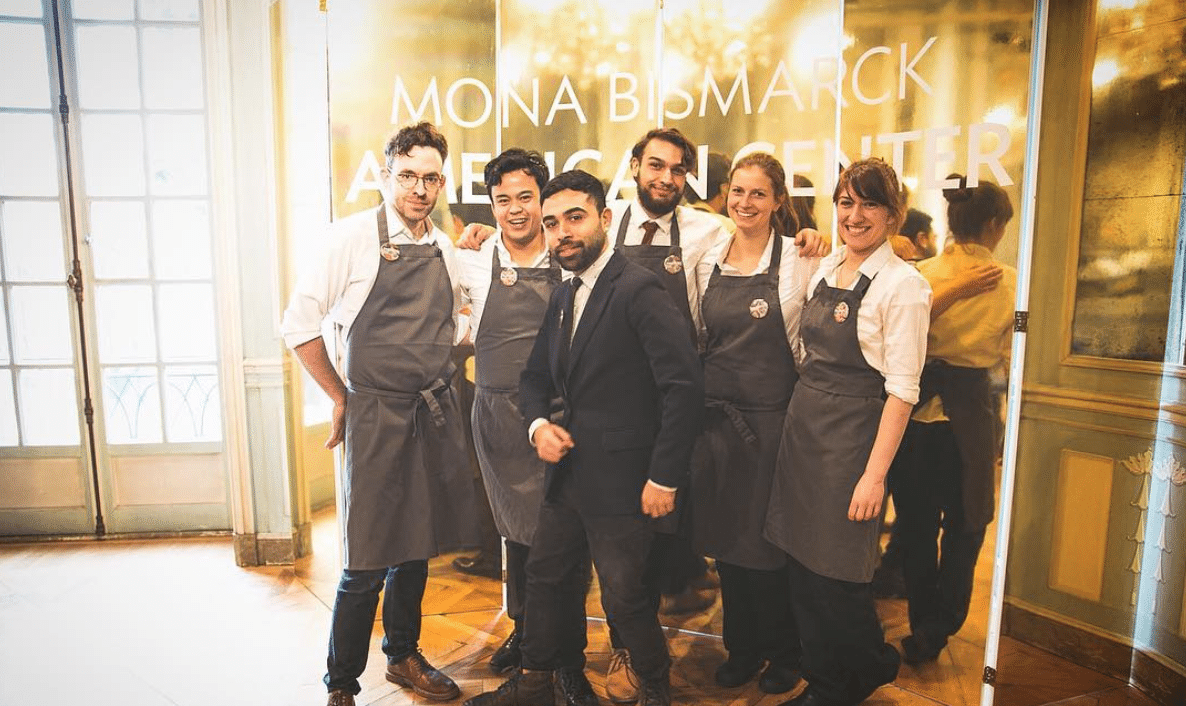
Verjus staff. Photo Courtesy Verjus via Instagram.
Verjus staff.  That’s Perkins on the left in front. Photo Courtesy Verjus via Instagram.

Verjus almost goes incognito.  There’s a tiny sign, and a staffer with a clipboard waits outside a gate into an alley and checks your name on the list before she lets you in. 

We walked up the alley and into a little jewel box: small tables unadorned except for napkins and flowers; a red banquette along one wall; each seating close but somehow intimate.
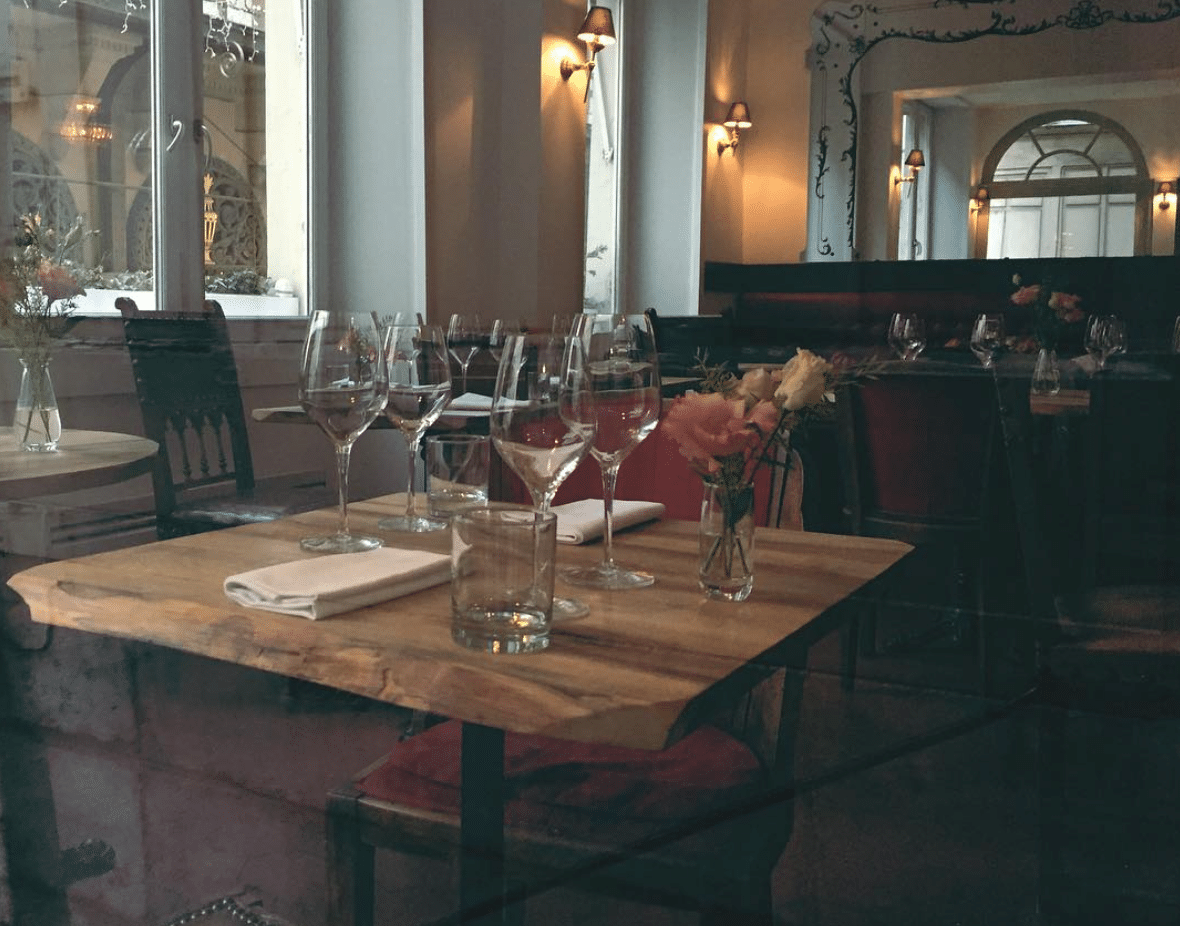
Verjus dining doom before service. Photo courtesy Verjus via Instagram

The prix fixe menu included five courses for 78 euros, and wine pairings for an additional 55 euros.  You could order a la carte but we went whole hog.
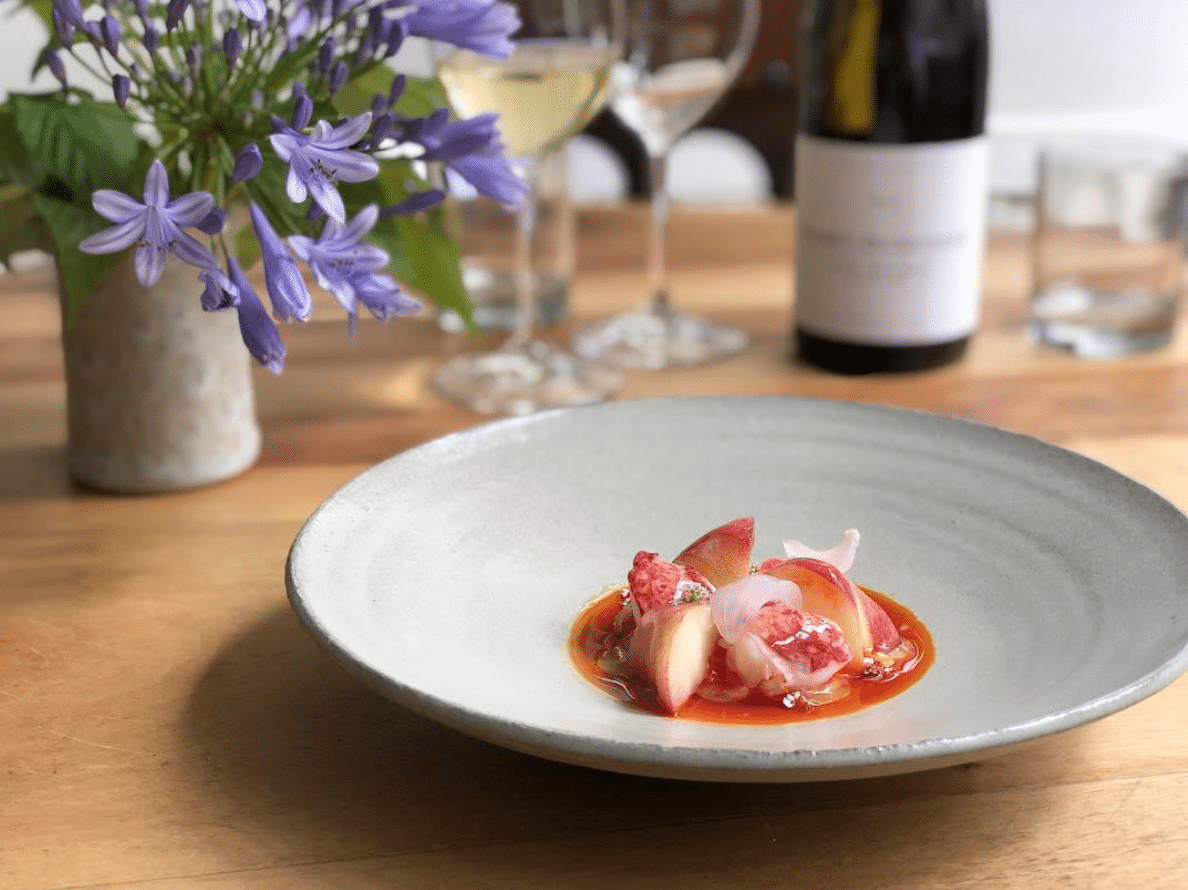
Verjus Lobster, Photo Courtesy Verjus, Via Instagram

The young, friendly, attractive wait staff made us — and probably the whole dining room — feel like we were sharing a delicious secret. It was that good. 

We got up early the next morning because we planned to visit Giverny and Monet’s garden.
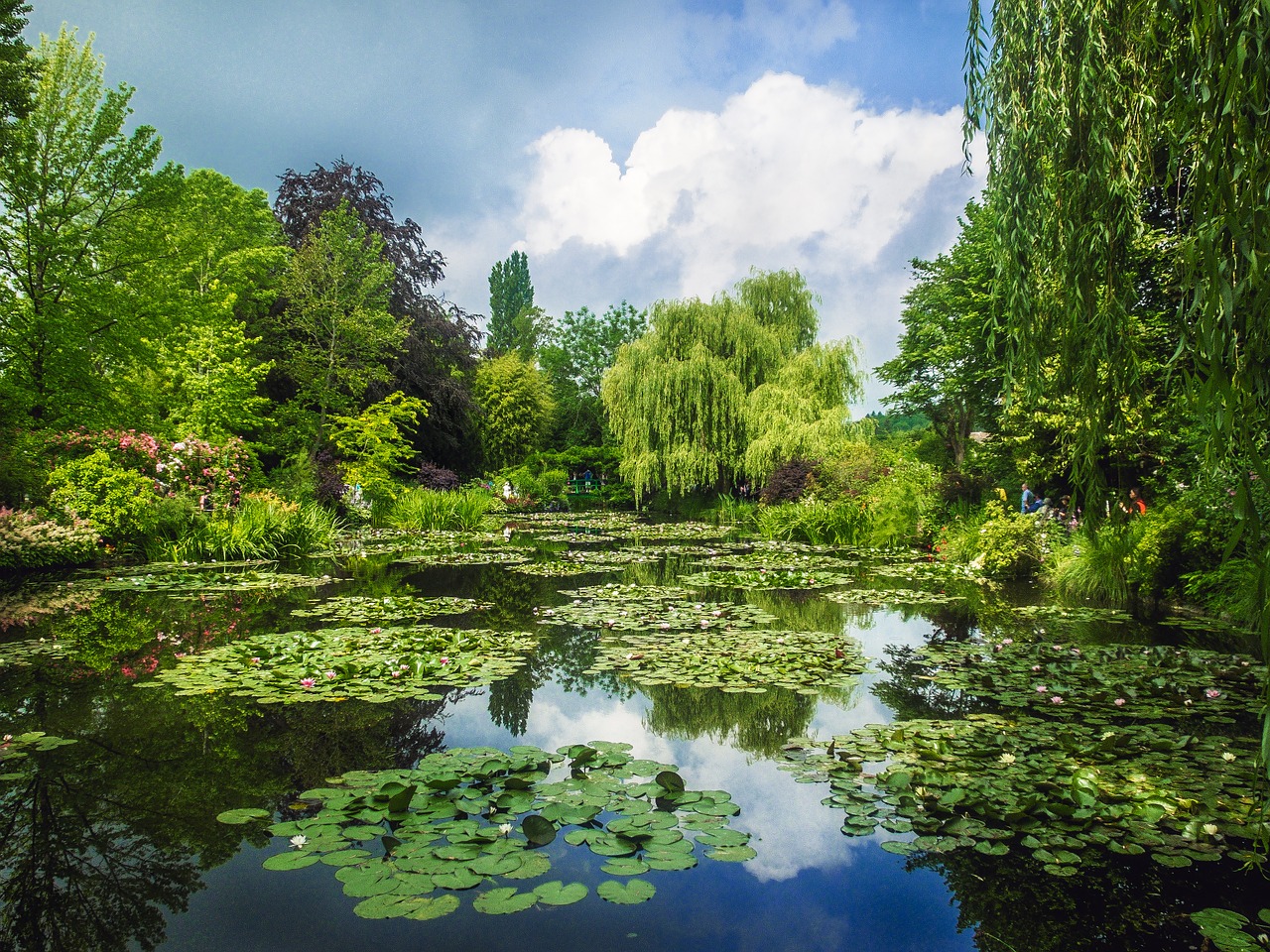
Claude Monet’s garden at his home in Giverny, France. Photo by Nadrog. Courtesy Pixabay.

Nick had booked a tour that started with a train ride at Gare St. Lazare at nine. He thought. Before heading for the train station, we double-checked and saw we were supposed to be there by eight. Our hearts weren’t in it after our late dinner.

We also found a note from Judith, the hotel concierge. She responded to our online request for a larger room.  “All our rooms are small. But this is a different configuration,” she wrote. That did it. We blew off Giverny and walked to Cafe Deux Magots on Place St.-Germain des Pres for coffee and croissants and sat people-watching until we could shift to our new room.  
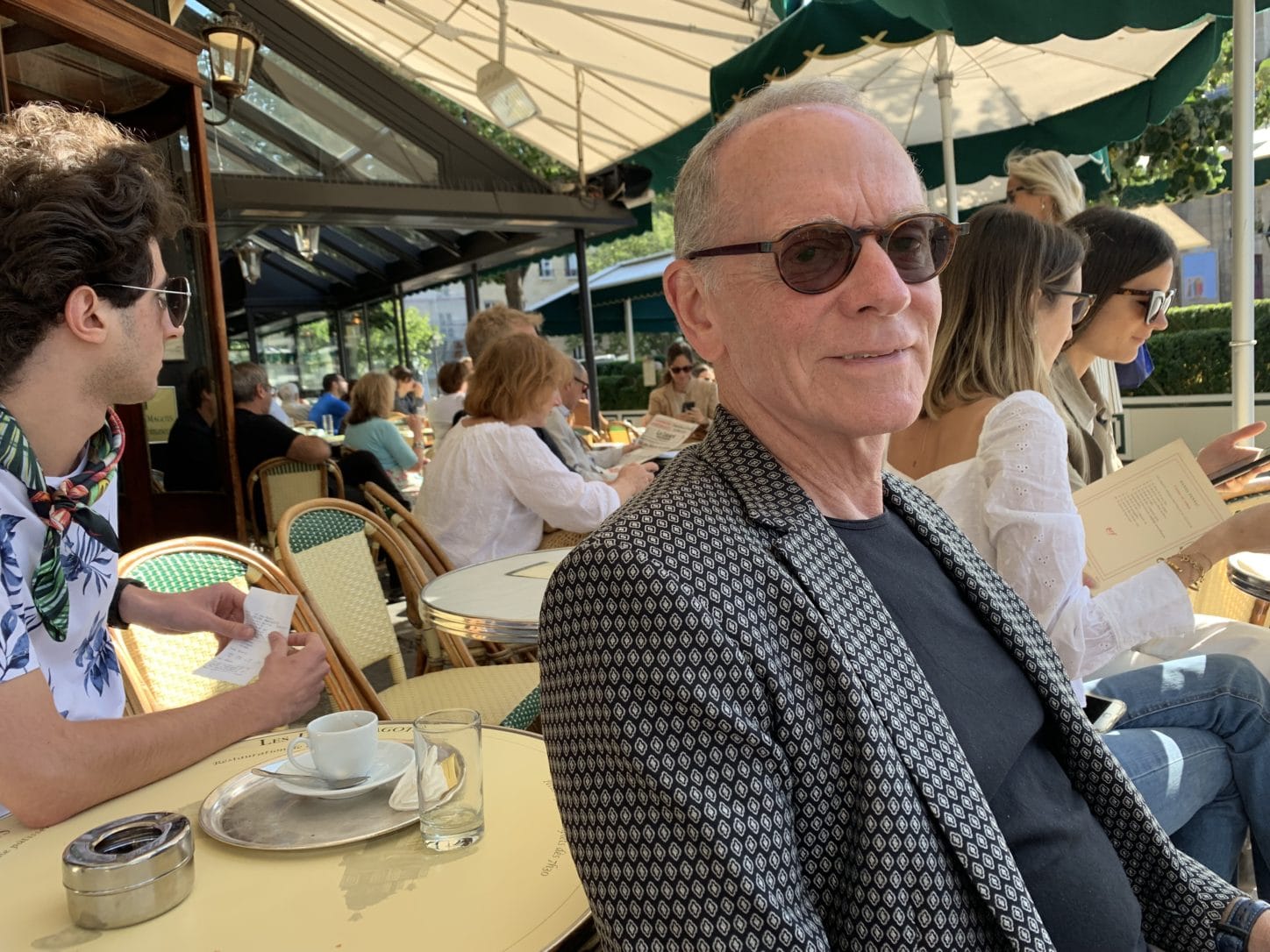
Nick Taylor at Deux Magots, Paris, France. Photo by ConsumerMojo.com
Nick Taylor at Deux Magots, Paris. Photo by ConsumerMojo.com

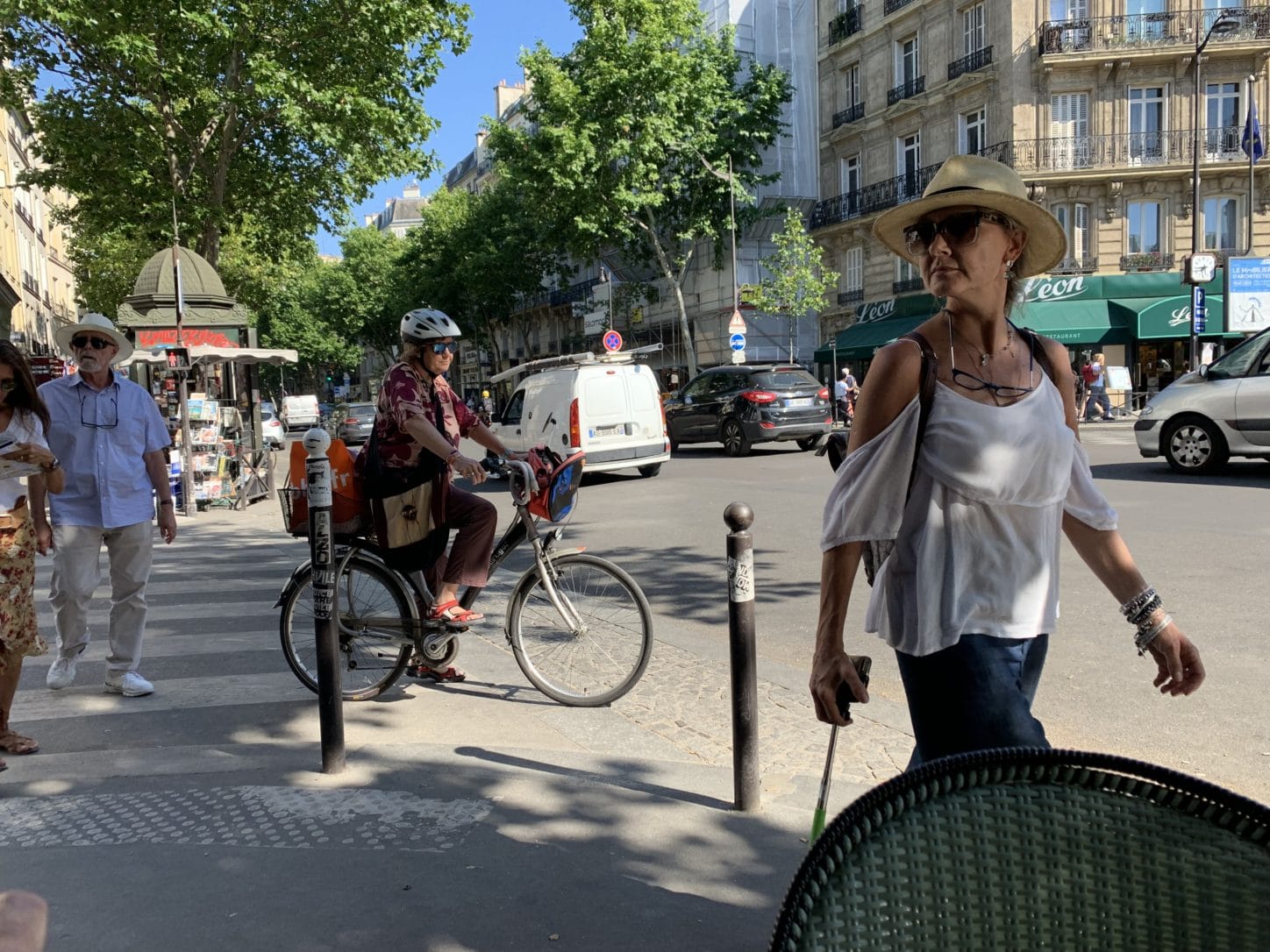
The traffic on the boulevard revealed the new realities of urban transportation.
Biking in Paris, Photo by ConsumerMojo.com

We saw more bikes, electric bikes and scooters darting past the cars inching along the traffic lanes. Even people coming from the nearby Metro station carried scooters, unfolding them and going on their way when they reached the street.

Electric scooter riding in Paris. Photo by ConsumerMojo.com

If tourists want to dodge traffic, too, they can rent electric bicycles or scooters to explore the Paris streets. Check out Freescoot for electric bikes and Rent&go for electric scooters.


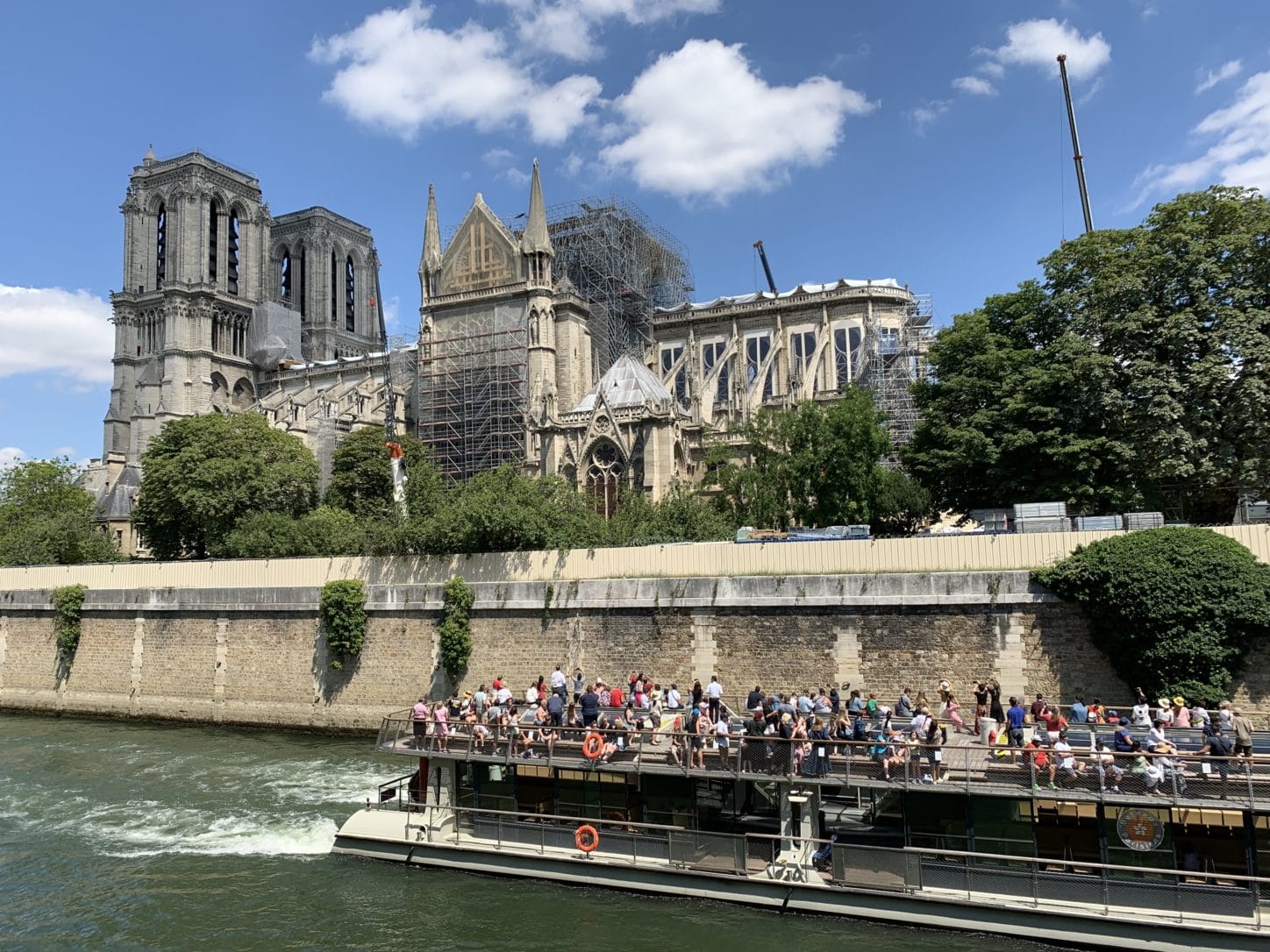
Back at the hotel, we unpacked in our more spacious room and hit the streets again. We walked east and north until we reached the Seine across from Notre Dame.  If any building anywhere seemed to wear the armor of permanence, it was this one.  But our view across the river told us different. The Gothic cathedral, a virtual cornerstone of Paris since the 13th century, was draped in scaffolding after the April 2019 fire that destroyed its roof and central spire.

Notre Dame without it's spire, Paris, France, Photo by ConsumerMojo.com
Notre Dame Cathedral without its roof and spire. Photo by ConsumerMojo.com

Its iconic south rose window, a forty-two-foot circle of intricate stained glass that was damaged in the fire, lay invisible behind the skein of platforms. We descended from the street and lingered on the riverbank as the bateaux mouches, the tourist boats that ply the Seine, gave their guests an even closer view of the cathedral.
Notre-Dame Cathedral under repair after April 2019 fire damage. Photo by ConsumerMojo.com.

We walked along the river for awhile, climbed back to street level and headed toward the Musee d’Orsay. We stopped on Rue de l’Universite at a bistro of the same name for lunch.

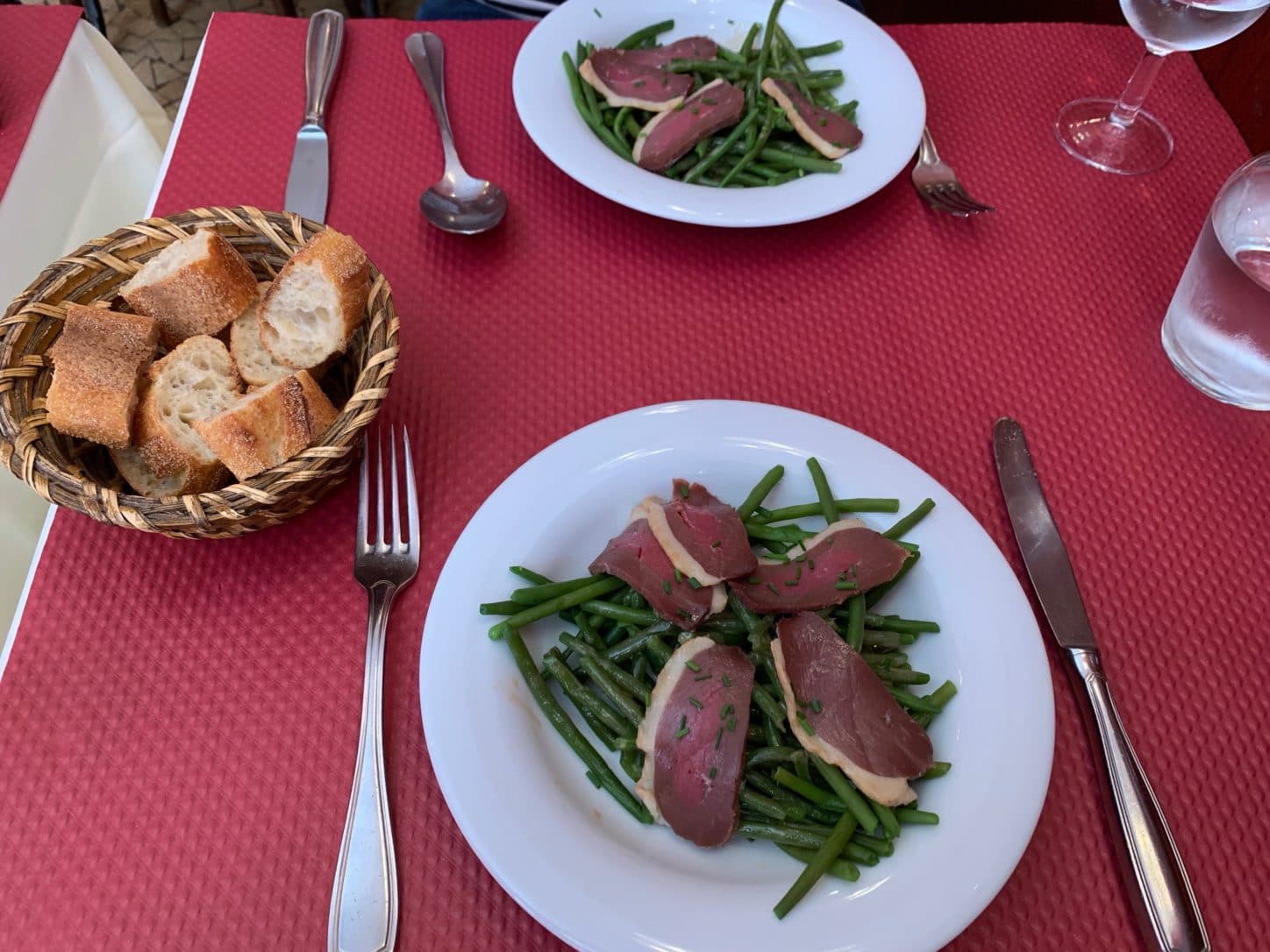
 Slices of smoked duck breast over green beans made a perfect lunch.
Smoked duck breast over green beans at Le Bistrot de l’Universite, Paris. Photo by ConsumerMojo.com.

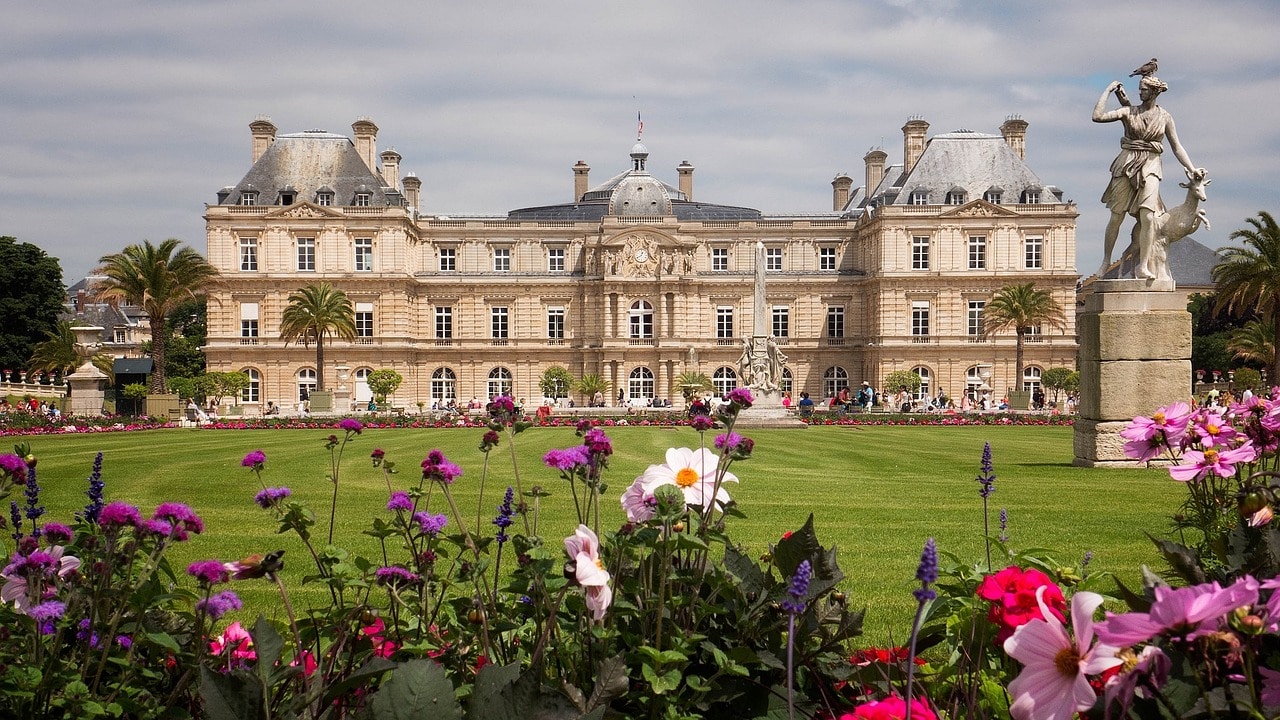
Barbara’s back started to act up. So we put off our museum trip. She retreated to the hotel for a lie-down with a rub of CBD, and Nick went wandering. Turning away from the river on Rue de Seine and crossing Blvd. St.-Germain, the dome of Luxembourg Palace, where the French Senate meets, seemed like the place go.
Garden and Luxembourg Palace, Paris, France. Photo by Skeeze. Courtesy Pixabay.
Luxembourg Palace, Paris, France. Photo by Skeeze. Courtesy Pixabay

 Cafes and small art galleries lined the street on the walk south, and a right turn on Rue de Vaugirard led to an entrance to the Luxembourg Gardens.
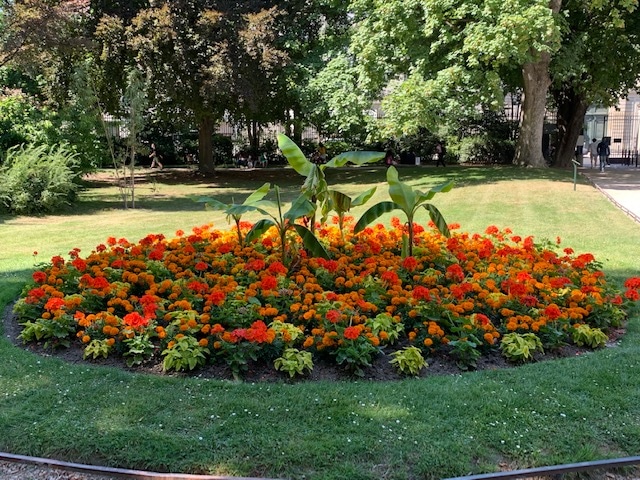
Red and orange flowers in the Luxembourg Gardens, Paris, France. Photo by ConsumerMojo.com
A Perfect bed of red and orange flowers in the Luxembourg Gardens, Paris. Photo by ConsumerMojo.com

The perfect landscaping and design showcased the summer flowers in their glory. The sound of tennis balls on a hard court called to Nick but instead of a vigorous match, he found a couple of guys hitting with a kid and moved on.

Barbara found the CBD worked and we caught up with each other at L’Atelier d’Artistes on Rue de Seine and spent some time admiring the delightfully absurd collages of the late Czech artist Bohumil Stepan.

We stopped at a bistro for a glass of wine, browsed some more galleries, and returned to the hotel on Rue Jacob to get ready for dinner. Le Chateaubriand on Ave. Parmentier in the 11th arrondissement was another recommendation from Barbara’s Tai Chi class.

Despite its name, which sounds like a traditional steak house, Le Chateaubriand, is part of the bistronomie movement along the lines of Verjus, offering a fine dining tasting menu in a relaxed and casual atmosphere.  It boasts one Michelin star.  
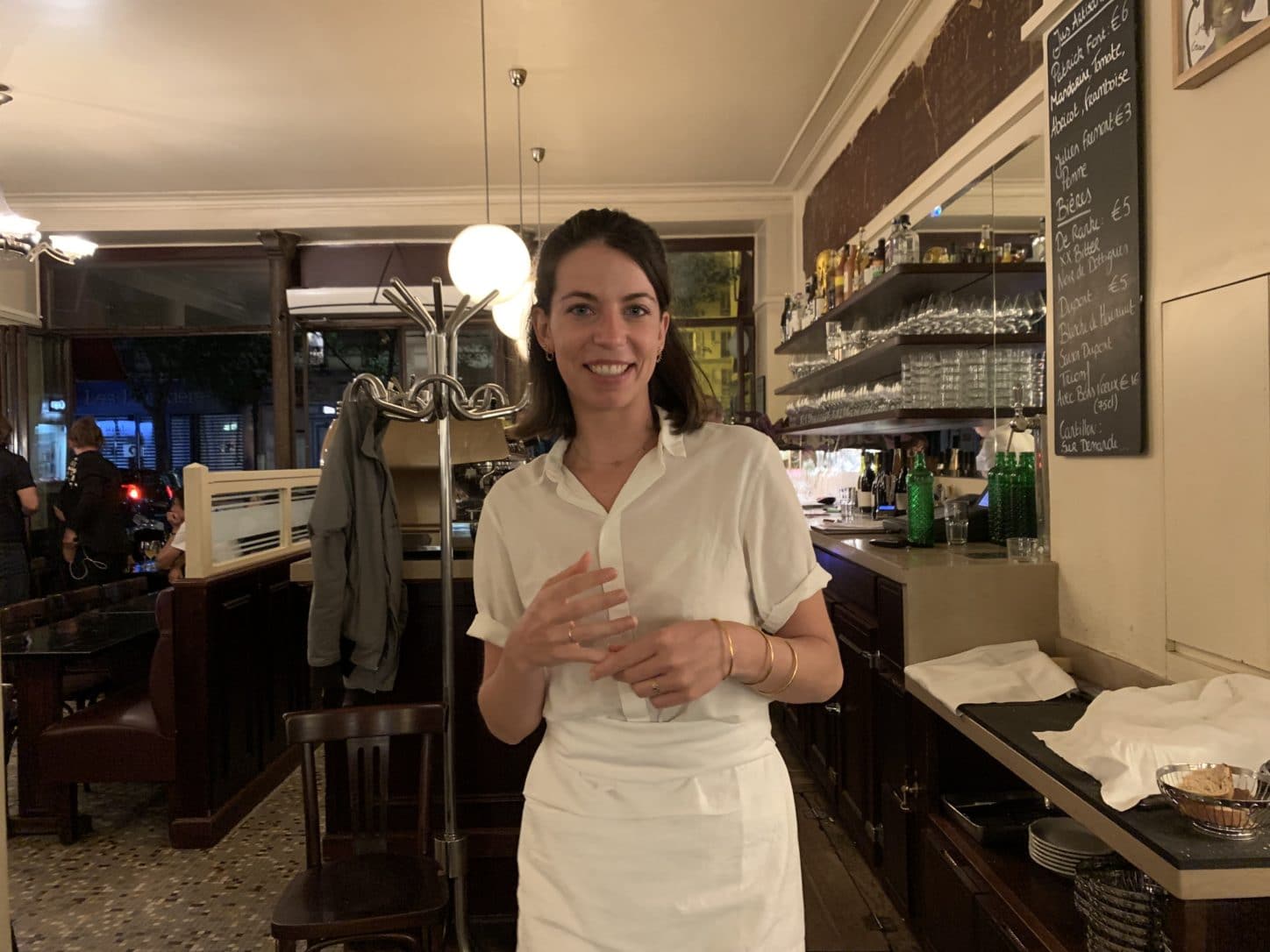
Server at Le Chateaubriand Restaurant, Paris, France. Photo by ConsumerMojo.com
Server at Le Chateaubriand Restaurant, Paris. Photo by ConsumerMojo.com

We skipped the accompanying flight of wines this time, and more than made do with a Cheverny Blanc (a blend of Chardonnay and Sauvignon Blanc) called La Bodice.

Hearing American accents at the next table, we began a a conversation with fellow New Yorkers, a young couple who live in Williamsburg, Brooklyn, and run a graphic design business that they started. On the other side of us a young French couple celebrated an anniversary.

July 3 would be our last full day in Paris, and we started it again over coffee and croissants at a corner table outside Deux Magots and people watching.
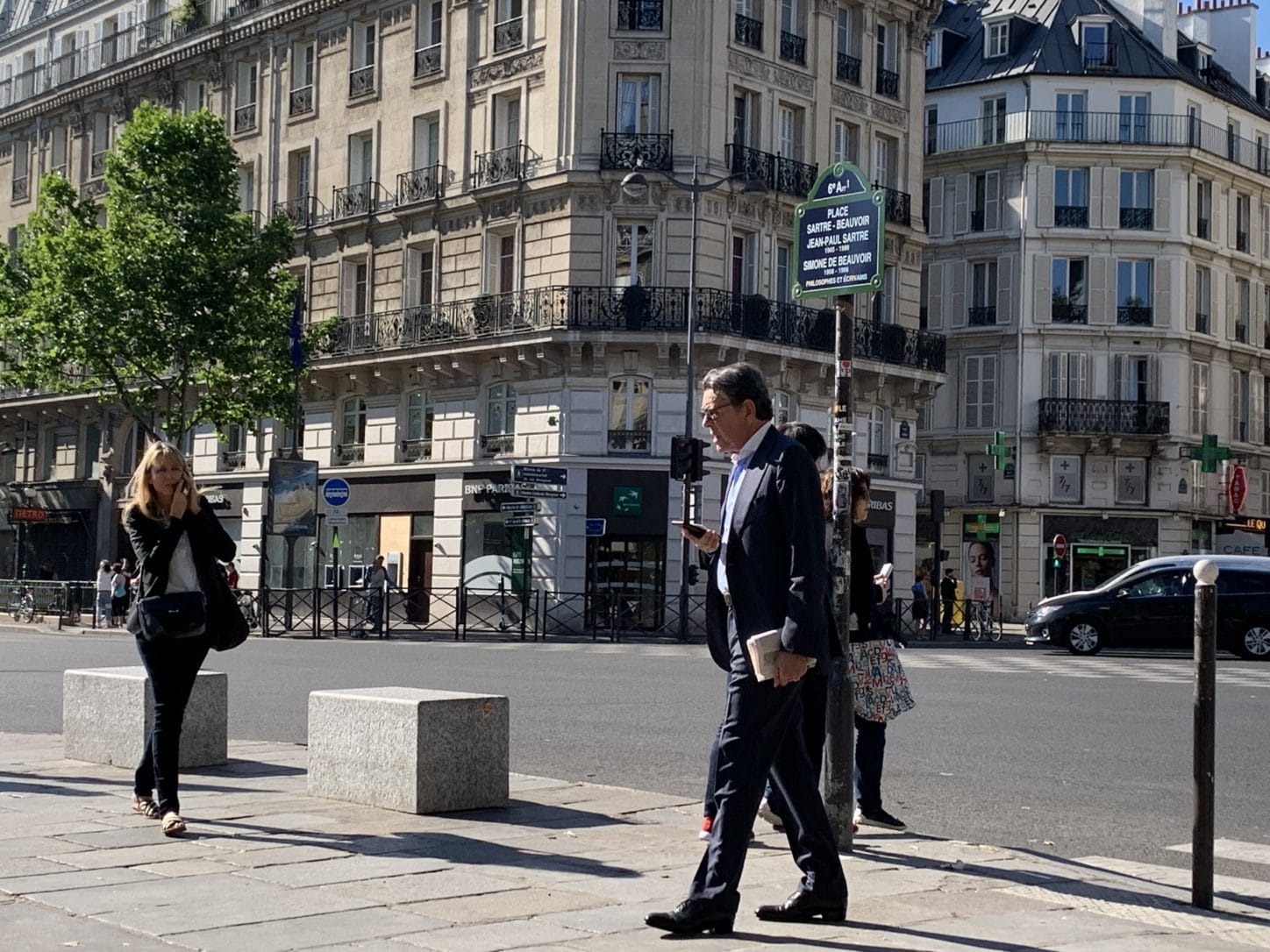
People watching from Cafe Deux Magots, Paris, France. Photo by ConsumerMojo.com
People-watching from Cafe Deux Magots, Paris. Photo by ConsumerMojo.com

Then we headed to the Musee d’Orsay for a taste of the museum’s strong suit, its Impressionist and post-Impressionist paintings. We made the mistake of failing to order tickets online. So while we waited to buy our tickets, we glimpsed the reverse evolution of human posture as small screens take us back to all fours.
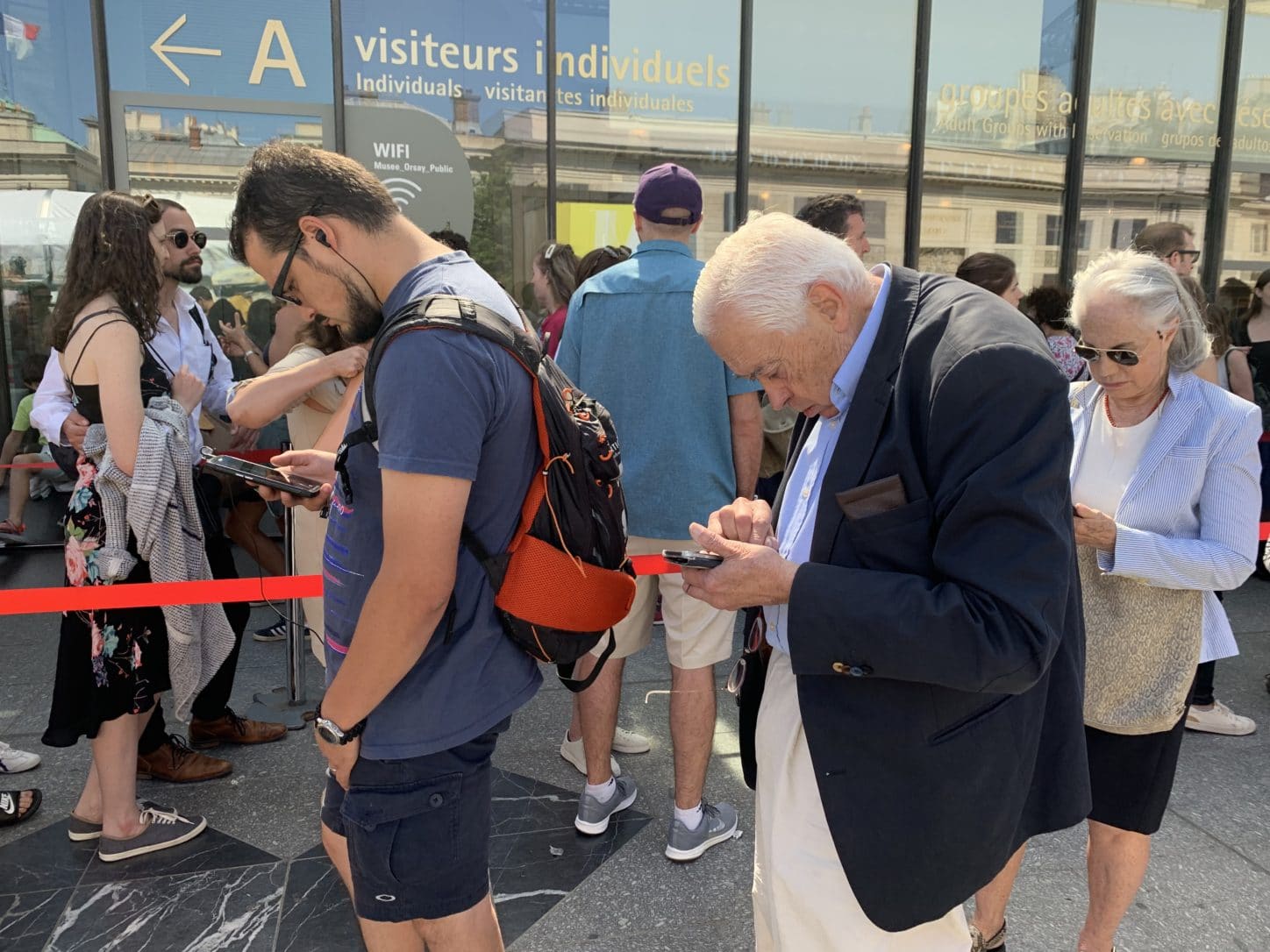
The reverse evolution of human posture outside the Musee d’Orsay. Photo by ConsumerMojo.com.

Inside the museum, you walk right into reminders of the train station the museum had been before it opened in 1986, like the huge clock on a restaurant wall.  
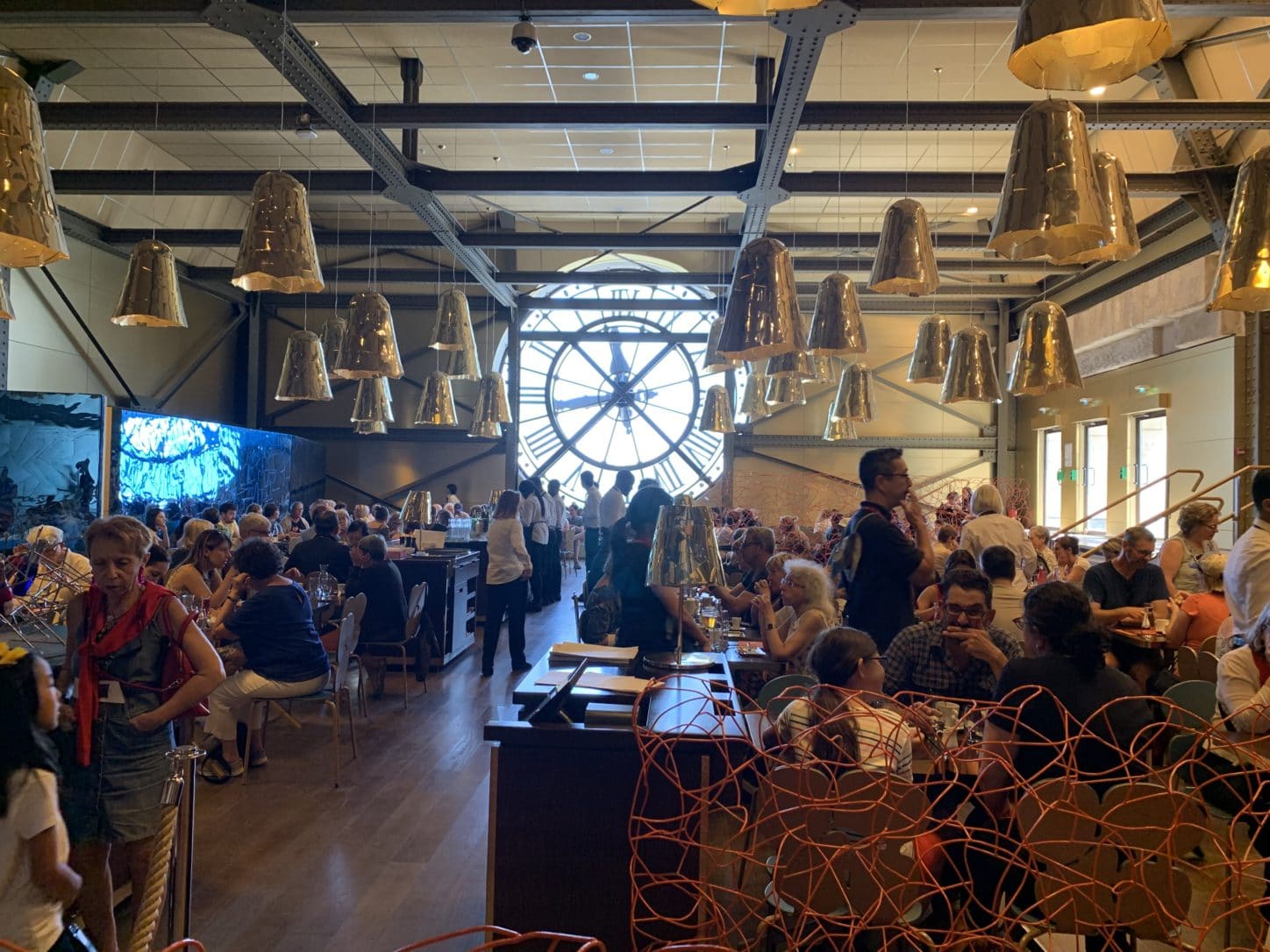
Clock shows Musee d’Orsay was once a train station. Photo by ConsumerMojo.com

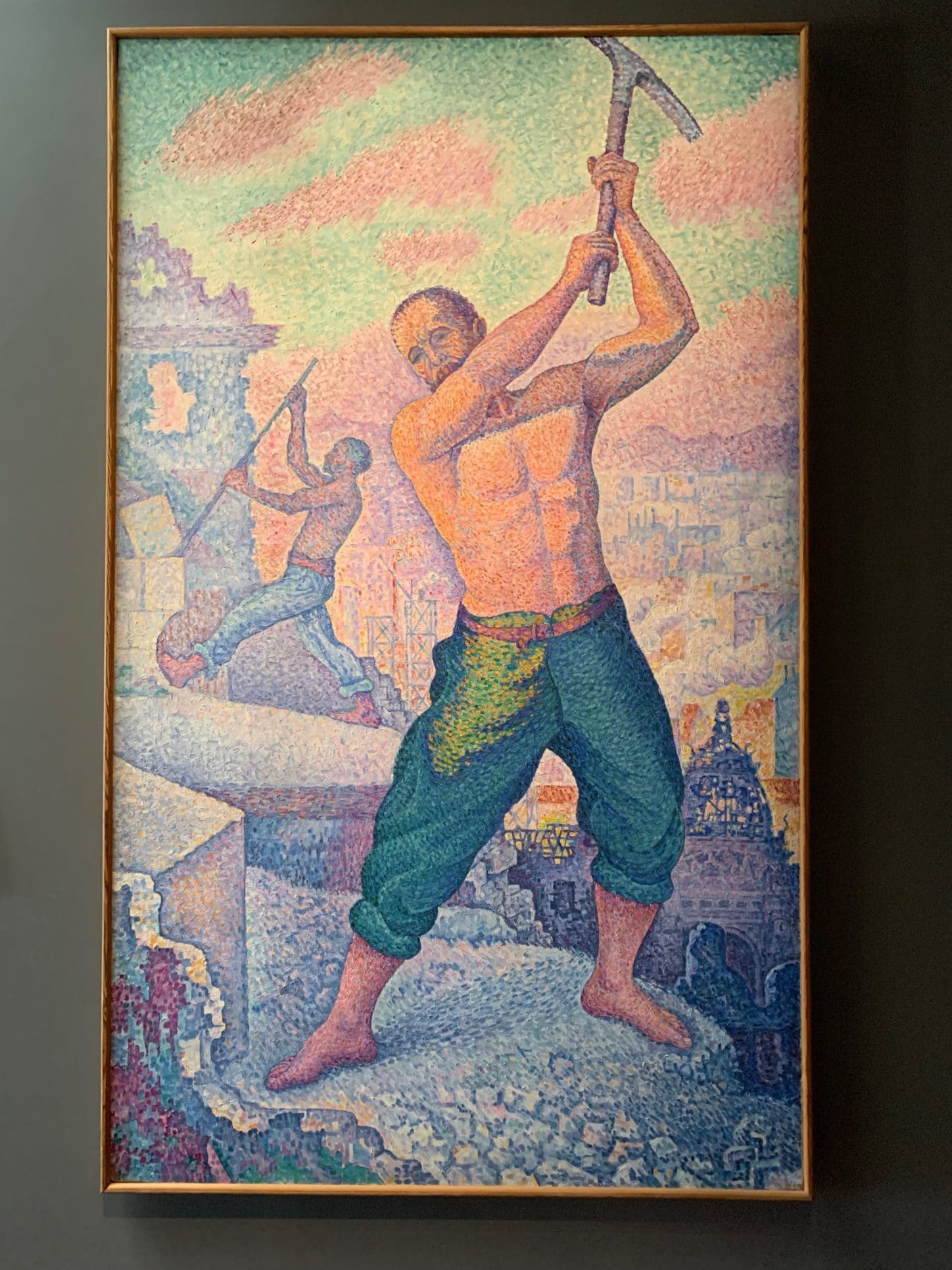
The galleries took us into the world of the Impressionists. Paintings by Edgar Degas, Camille Pissarro, Pierre-Auguste Renoir, Claude Monet, Edouard Manet, Toulouse Lautrec and others.  The pointillist works by Georges Seurat and his student Paul Signac seemed to call to Nick, especially the worker-oriented art that reminded him of WPA work done in the states in the 1930’s. 
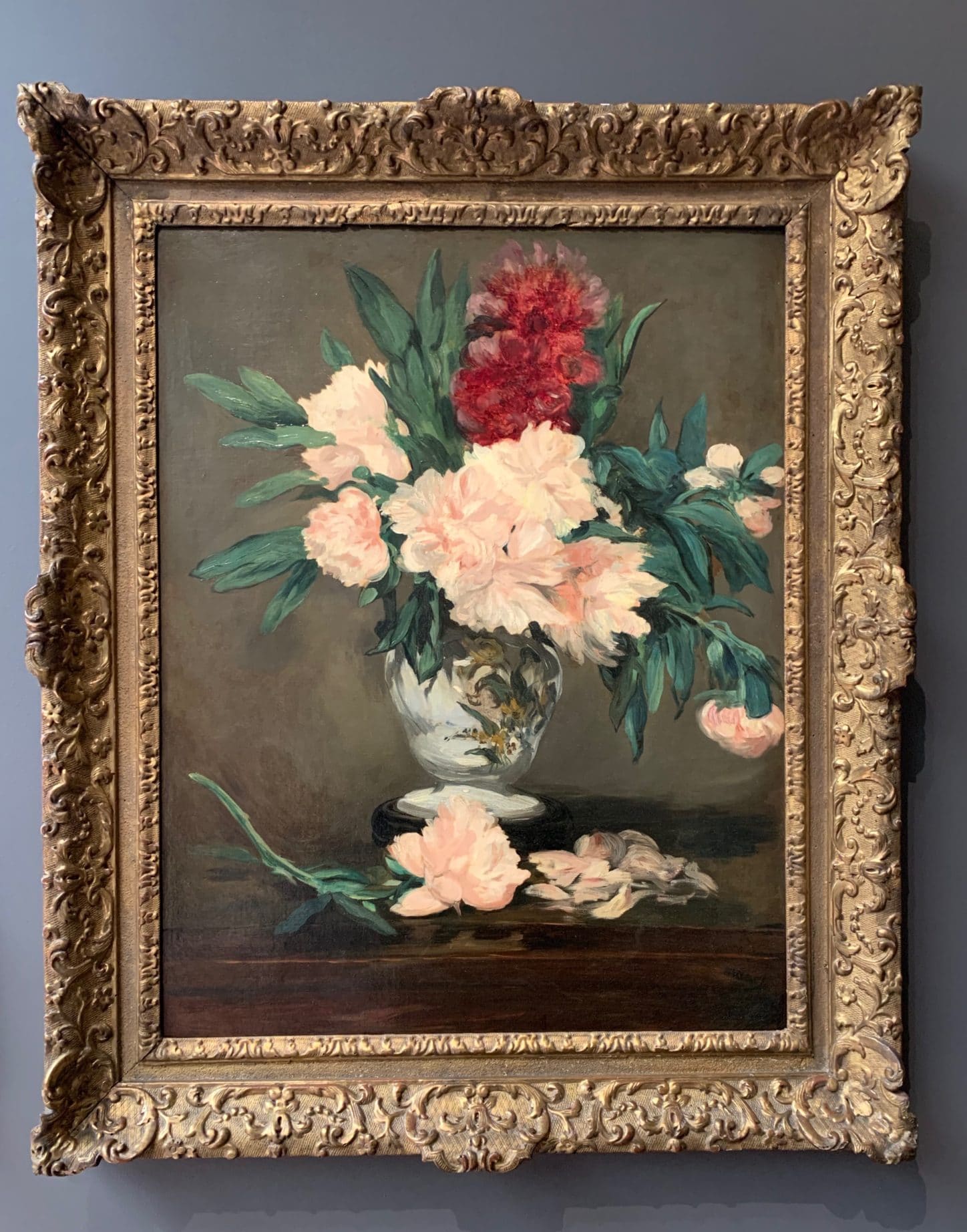
Vase of Peonies on a Small Pedestal by Edouard Manet. Photo by ConsumerMojo.com.
The Demolition Worker by Paul Signac. Photo by ConsumerMojo.com.

And the Musee d’Orsay was so much more.  It’s called a little sister to the more famous Louvre, but it seemed to be several museums under one large roof.  Sculptures on the main floor barely registered as we passed through on our way out to the street.  And we completely missed the mini-tour of Paris you can take as you cross a glass floor looking down upon a model of the city.  Fortunately, our Facebook friend Fredric Alan Maxwell captured it. 
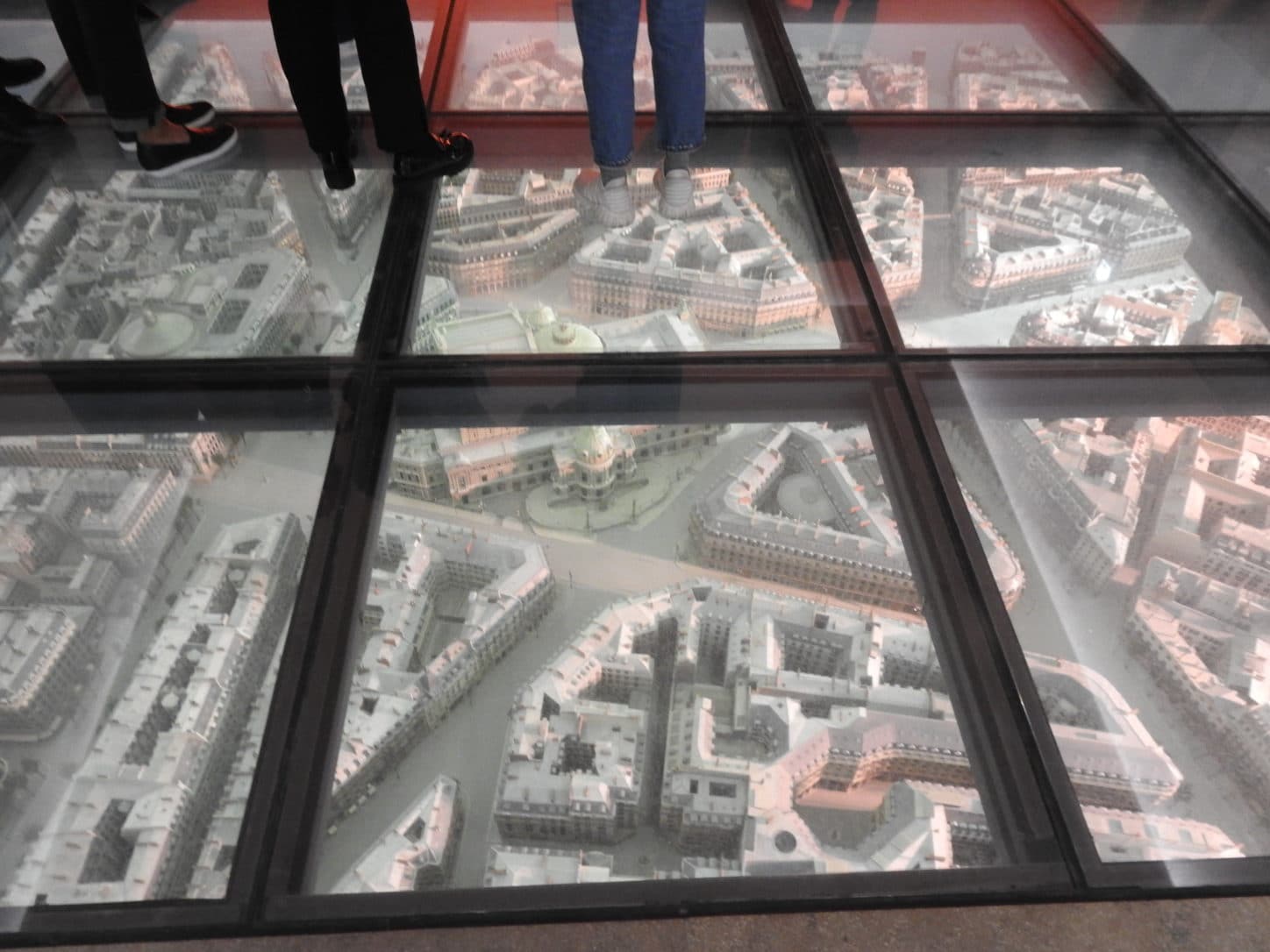
 Model of Paris seen through the floor of the Musee d’Orsay. Photo by Fredric Alan Maxwell.

We left the museum with regret and a promise to return soon.

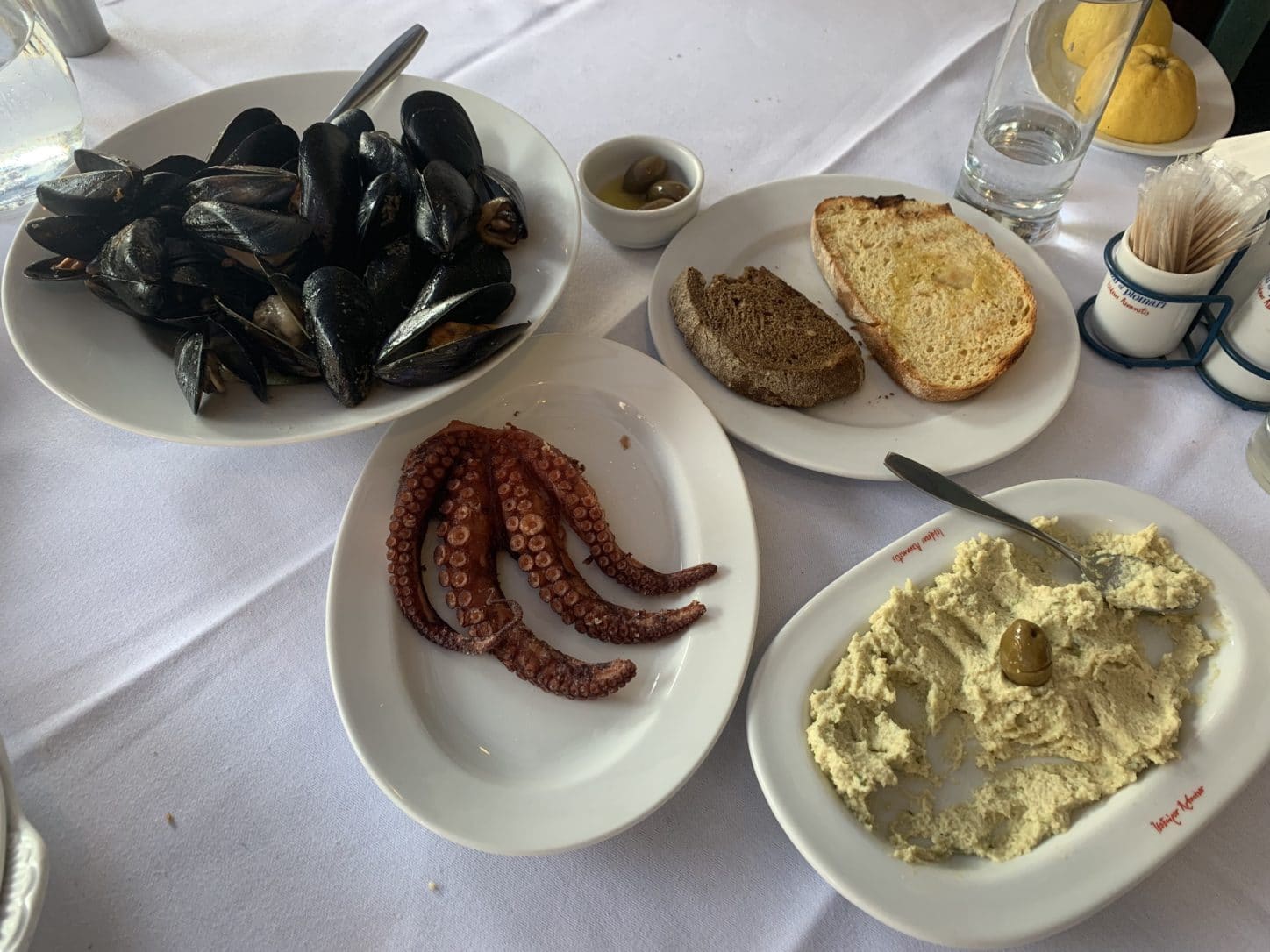
We wanted to try one of the restaurants in the Marche Saint-Germain, but it was mid-afternoon and they were closed. We backtracked to Huguette, a seafood bistro on Rue de Seine close to Rue Jacob, where we ordered frito misto and steamed mussels and drank, for a change, just water.
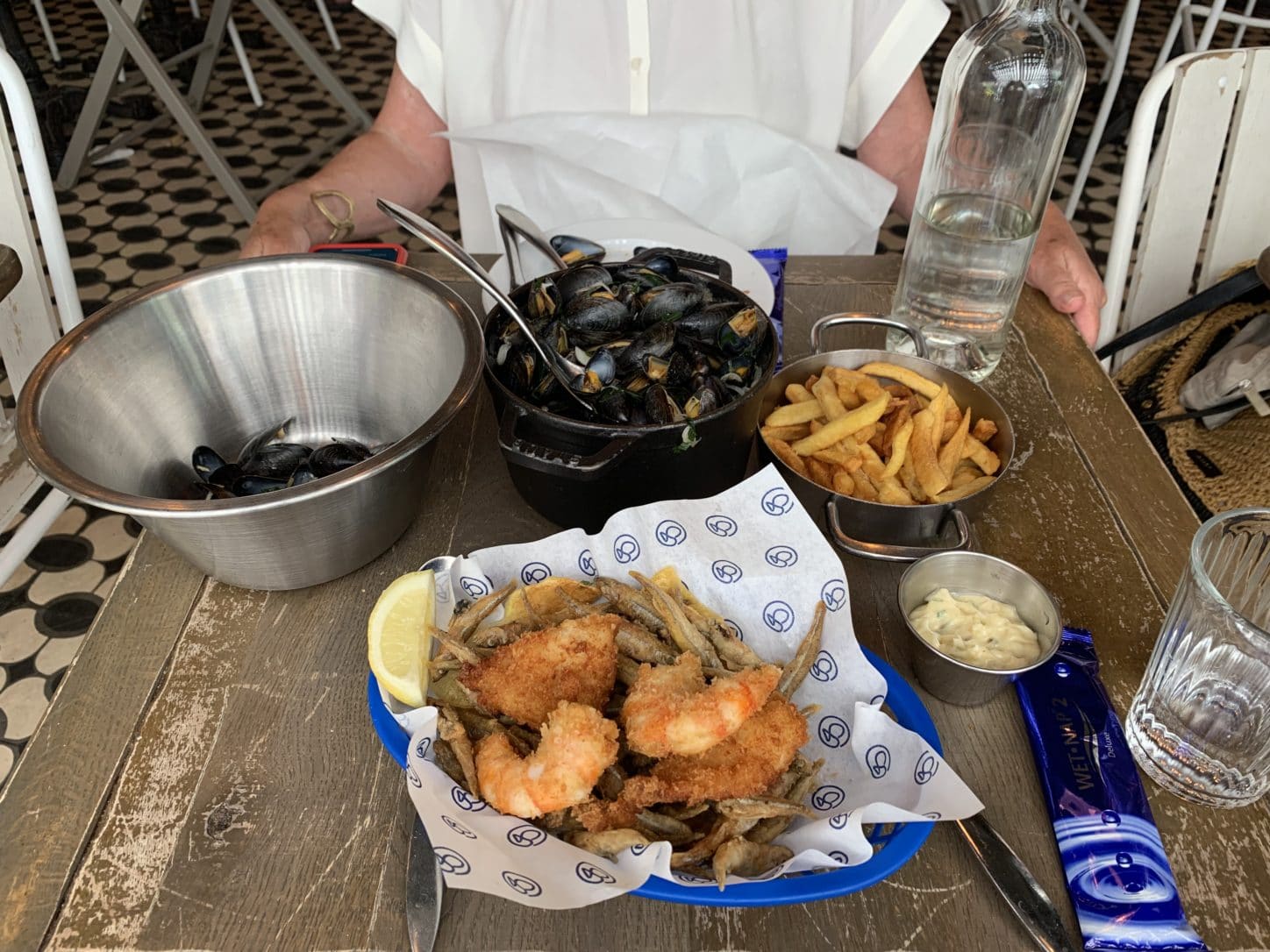
Frito misto and steamed mussels at Huguette. Photo by ConsumerMojo.com.

Barbara had an appointment for a blow-out and Nick rested at the hotel before we spiffed ourselves up for our final Paris dinner of this trip

We’d reserved at L’Apibo, another bistronomie recommendation of our friends Linda and Pierre. It was in the 2nd arrondissement, not far from the Louvre, in the Rue Montoguiel neighborhood in central Paris. Our cab driver told us the obvious, when he pulled up. “It’s there. I can’t go down the street,” he said.  And we stepped out into a vibrant scene of boutiques, bars and restaurants that line a pedestrian area also known for some of the best fish and meat markets.
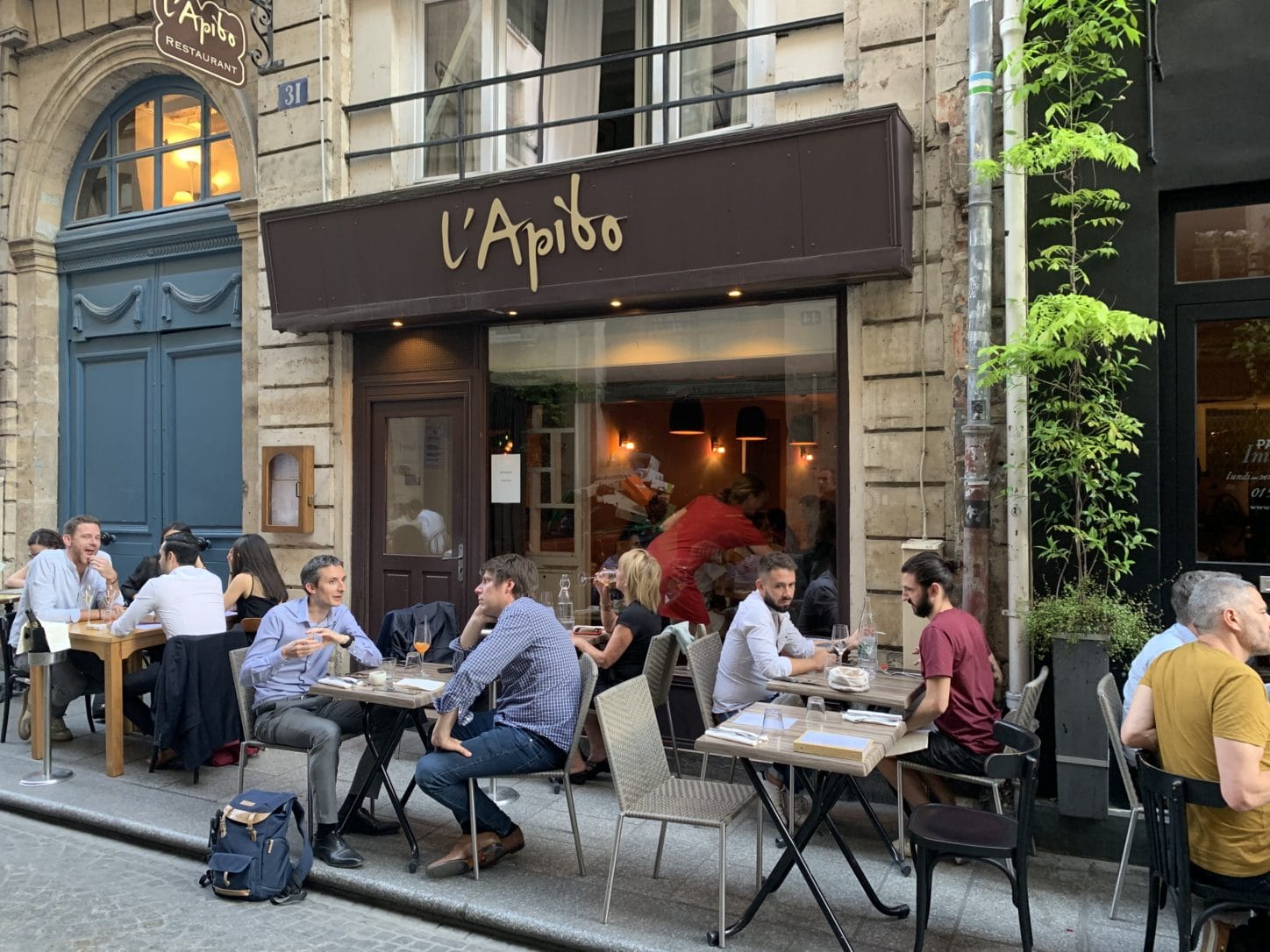
Outdoor dining at L'Apibo Paris, France. Photo by ConsumerMojo.com
Outdoor dining at L’Apibo Paris. Photo by ConsumerMojo.com

Minutes later we were seated at an outside table, a bottle of Sancerre in front of us and identical dishes on the way — ceviche of split prawns with fava beans to start and a house favorite, boneless sea bass filets, to follow.

If you look closely at the photo you’ll see Barbara near the window enjoying her Sancerre. After splitting a dessert of chocolate mouse we found a street the allowed cars and got a taxi back to the hotel.

Our flight was supposed to leave at 10:30 in the morning of July 4, but it was cancelled and we had a 2:30 p.m. flight instead. That gave us a final morning of people watching outside Deux Magots. Then we picked up our bags at the hotel and said goodbye to Paris as we headed to Orly.  Until the next time, which can’t come soon enough.
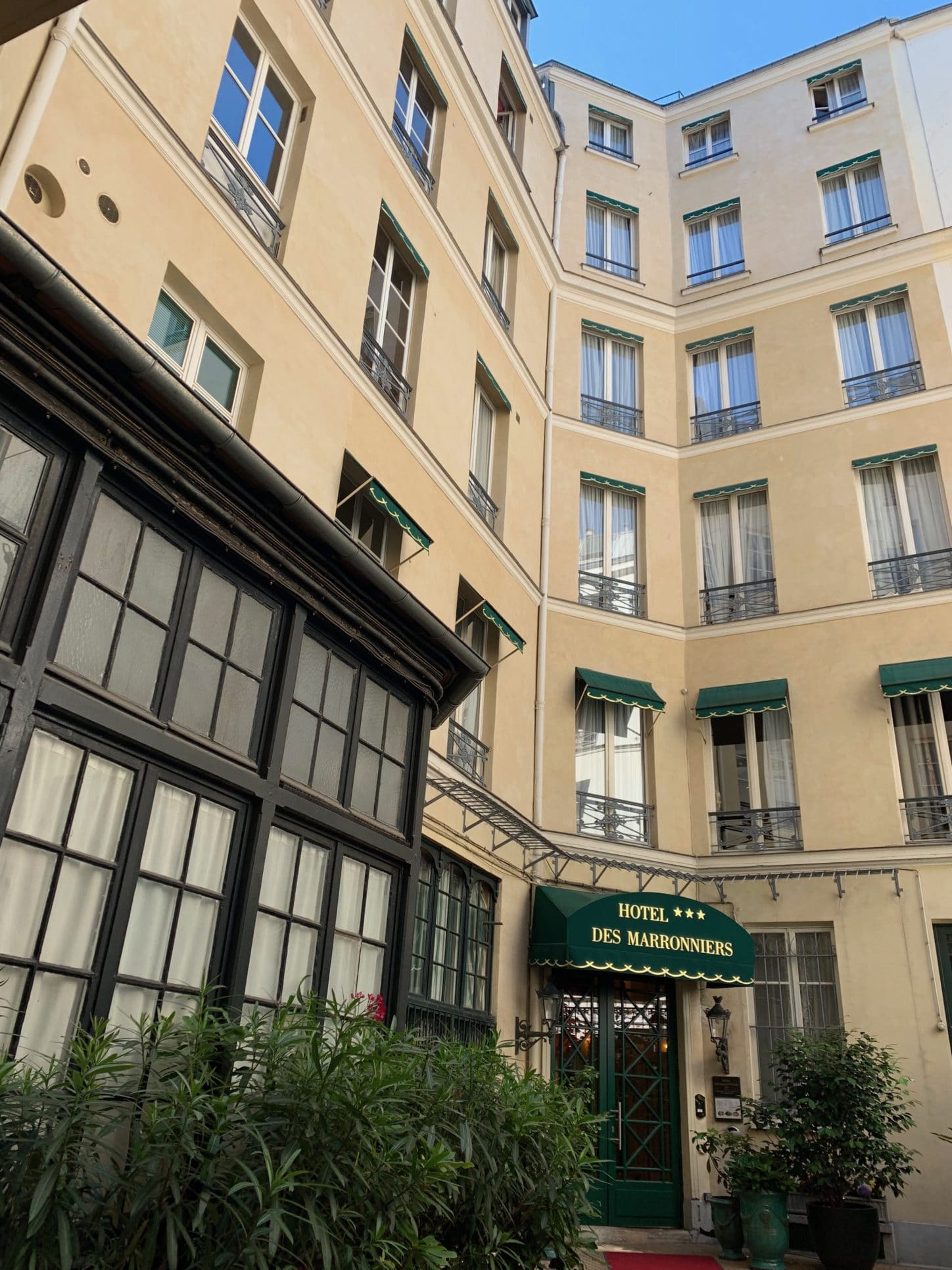
Hotel Des Marroniers, Paris, France. Photo by ConsumerMojo.com


Three Days on Corfu


by Nick Taylor and Barbara Nevins Taylor

A native of Corfu told us it was beautiful and a good alternative to the Aegean Greek Islands. We were just a day’s drive away in southwest Greece on the Peloponnese peninsula.

Three Days on Corfu
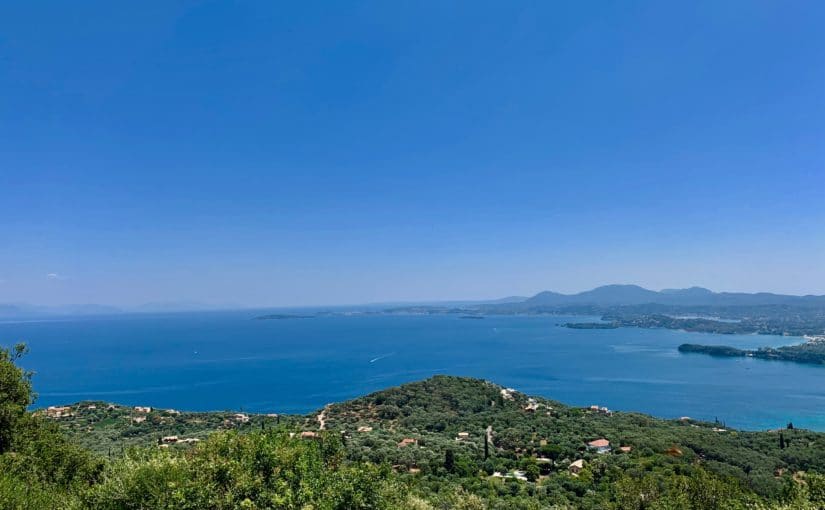
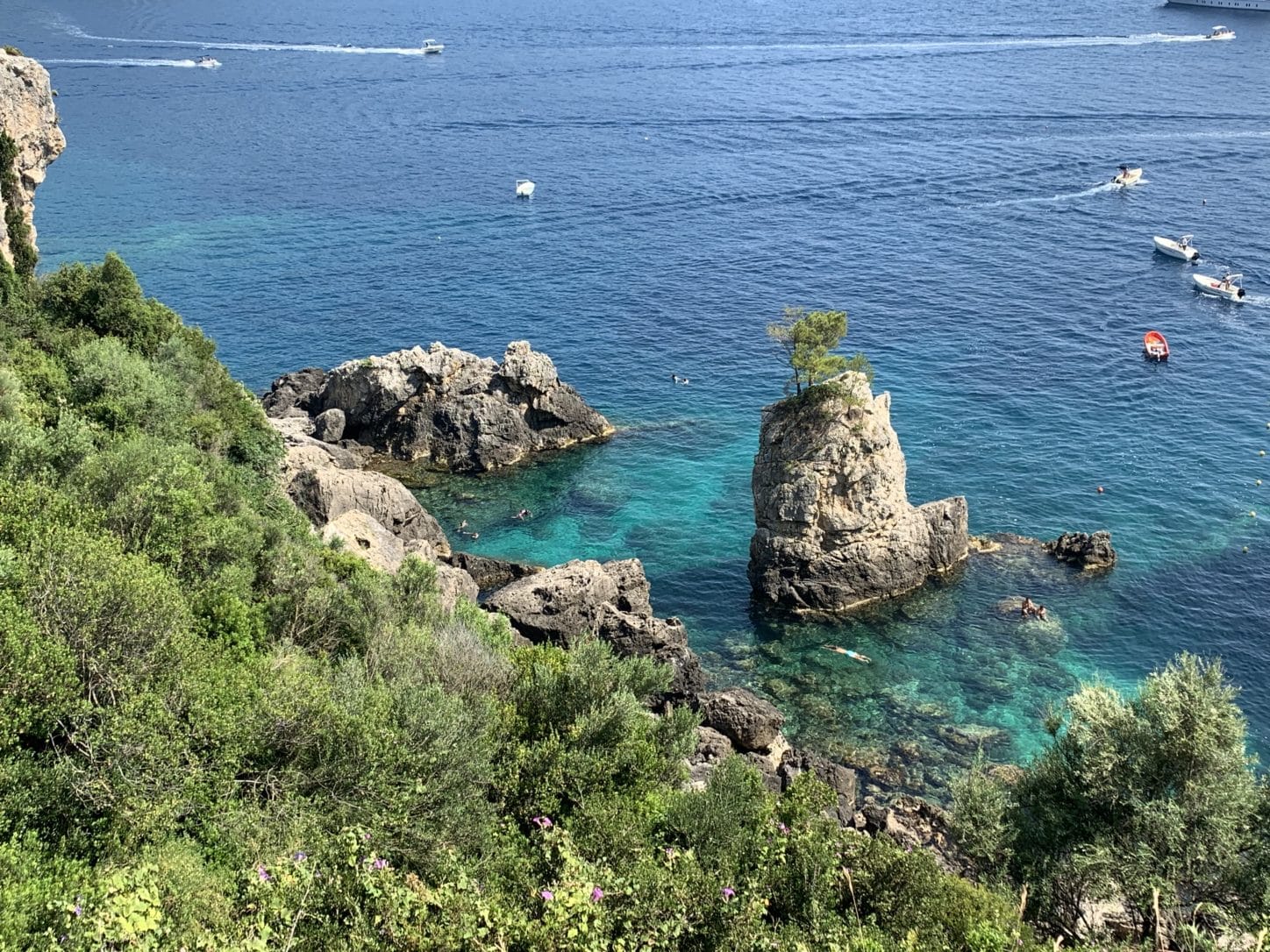
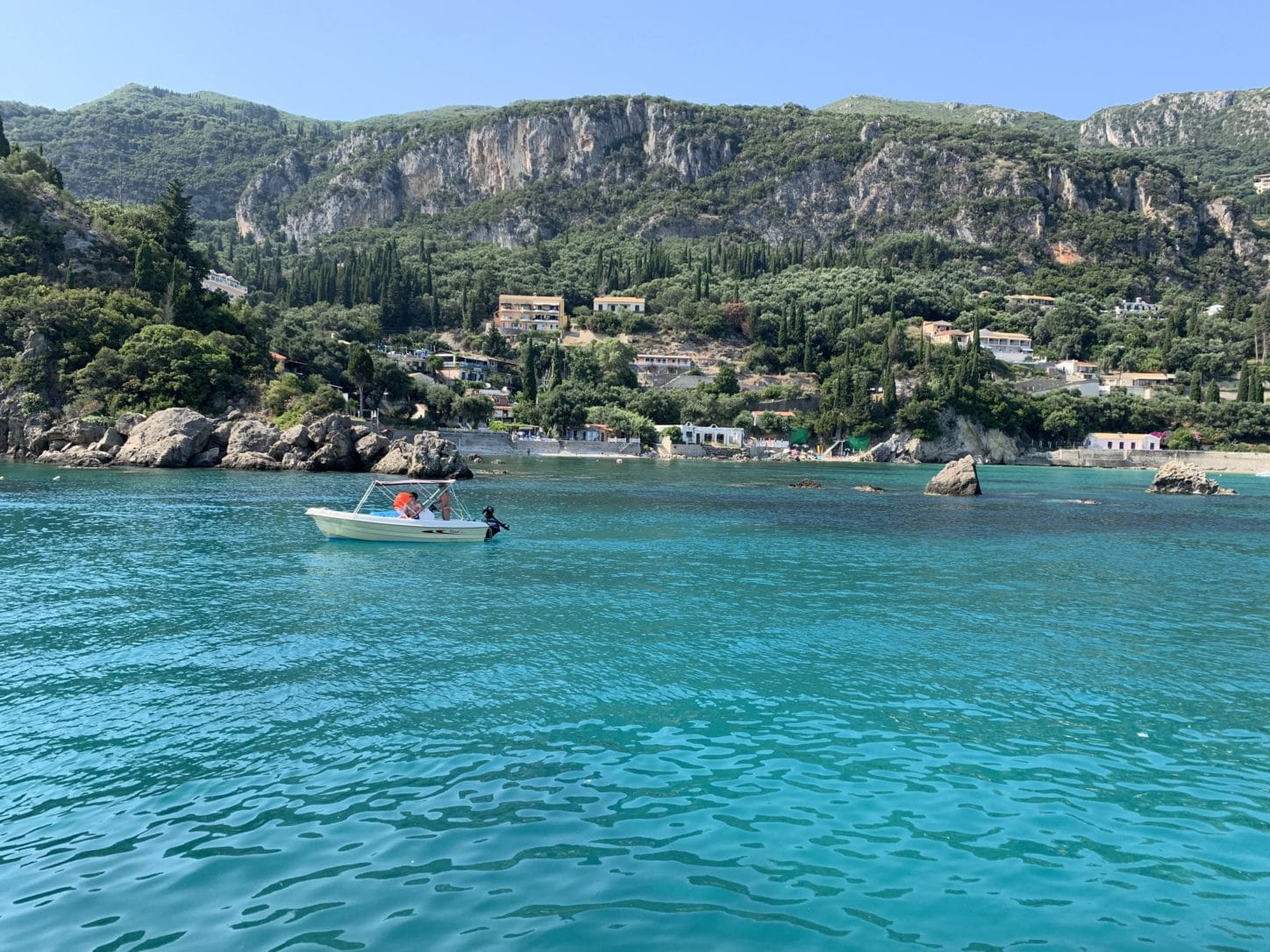
 The coast of Palaiokastritsa, Corfu, Greece. Photo by ConsumerMojo.com

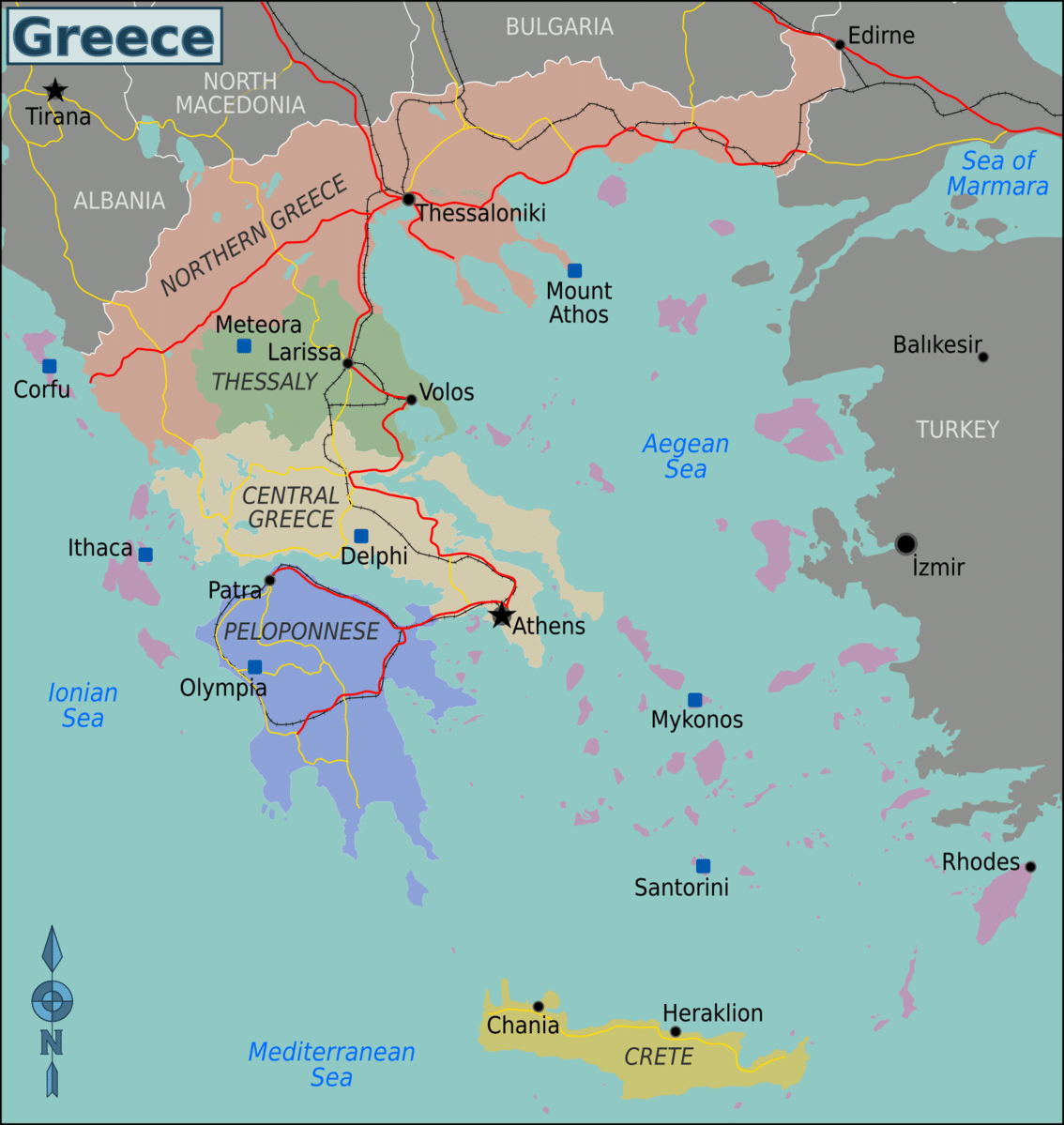
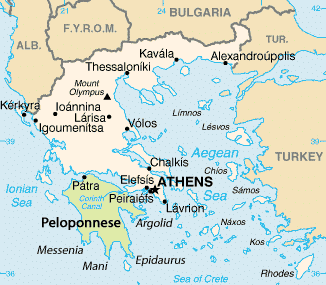
And when we looked a map, Corfu seemed like the perfect island stop.

Three Days on Corfu, Map of Greece and Corfu, Peterfitzgerald (Peter Fitzgerald), Shaundd
Corfu in pink off northern Greece. Map by Peterfitzgerald (Peter Fitzgerald), Shaundd, Creative Commons License

Most Americans know Corfu from Masterpiece Theatre’s “The Durrells in Corfu,” from Gerald Durrell’s book My Family and Other Animals and its sequels. A widowed mother takes her three sons and a daughter from bleak, rainy England to a sunny Greek island where they hilariously stumble, change and grow. Why should the Durrells have all the fun? we thought.

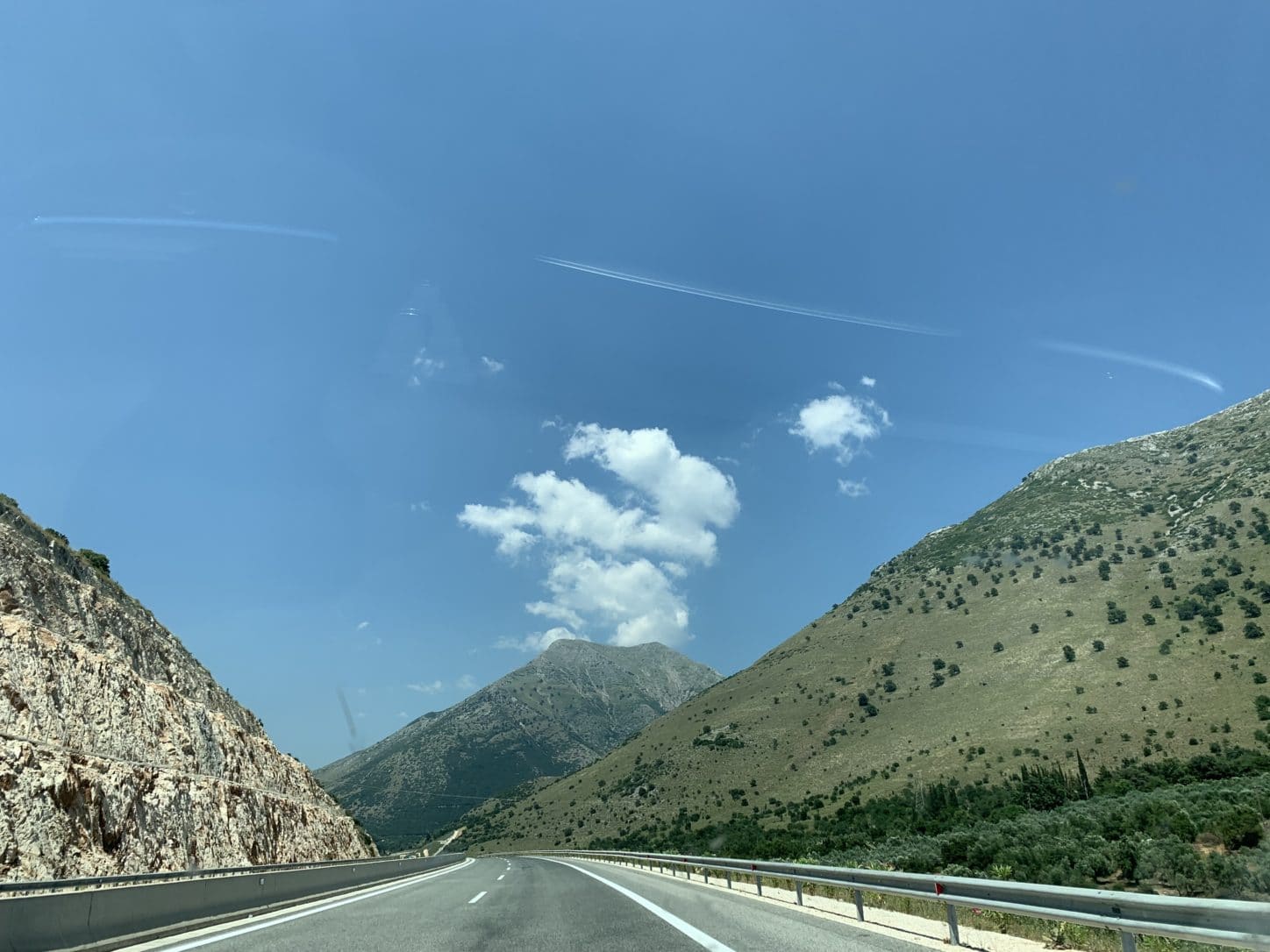
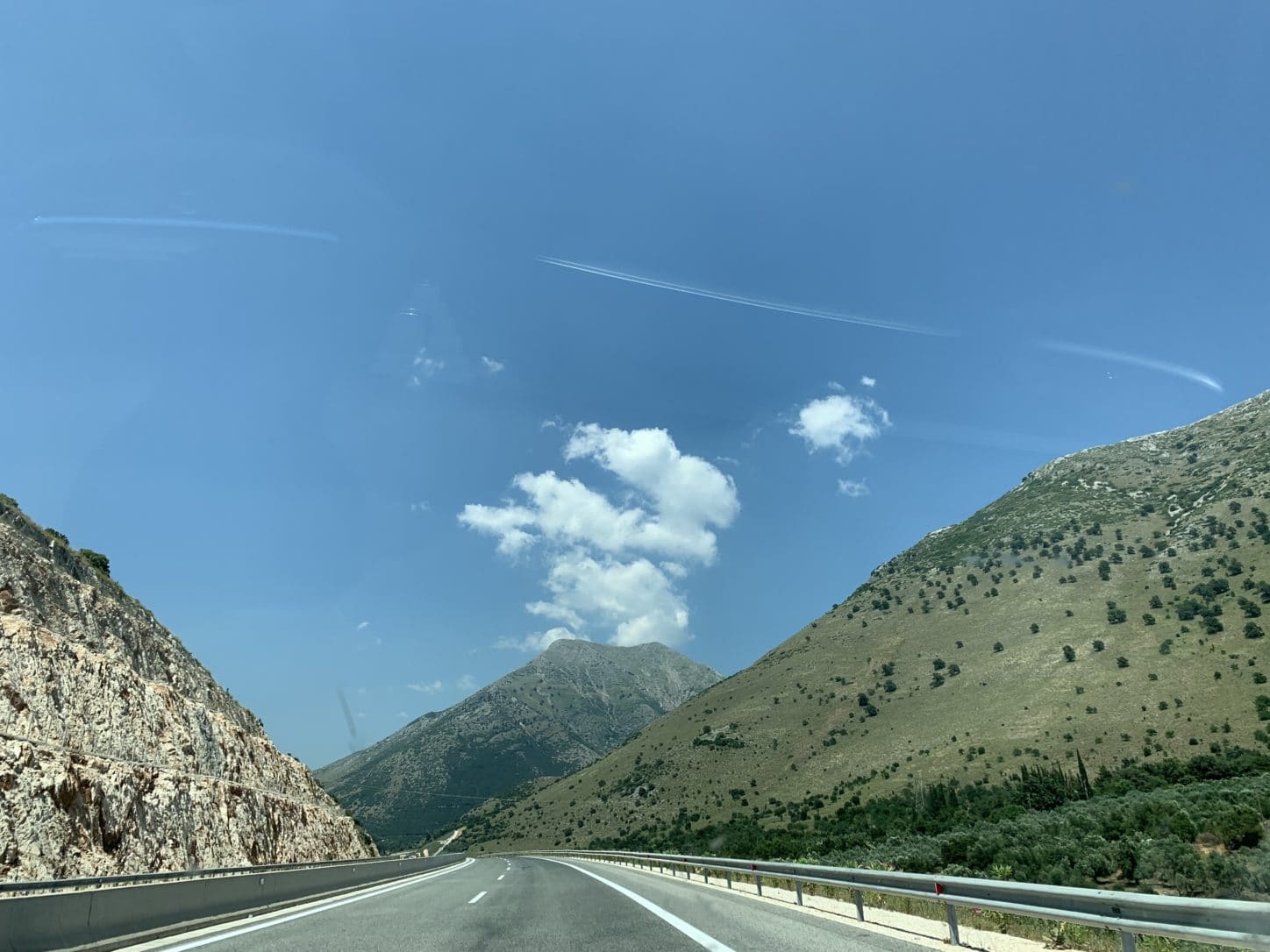
The road from Nafplio put us on the tollway toward Corinth, where we made a westward swerve and followed the Gulf of Corinth toward Patra.

Three Days in Corfu
Toll Road, Peloponnese Peninsula, Greece. Photo by ConsumerMojo.com

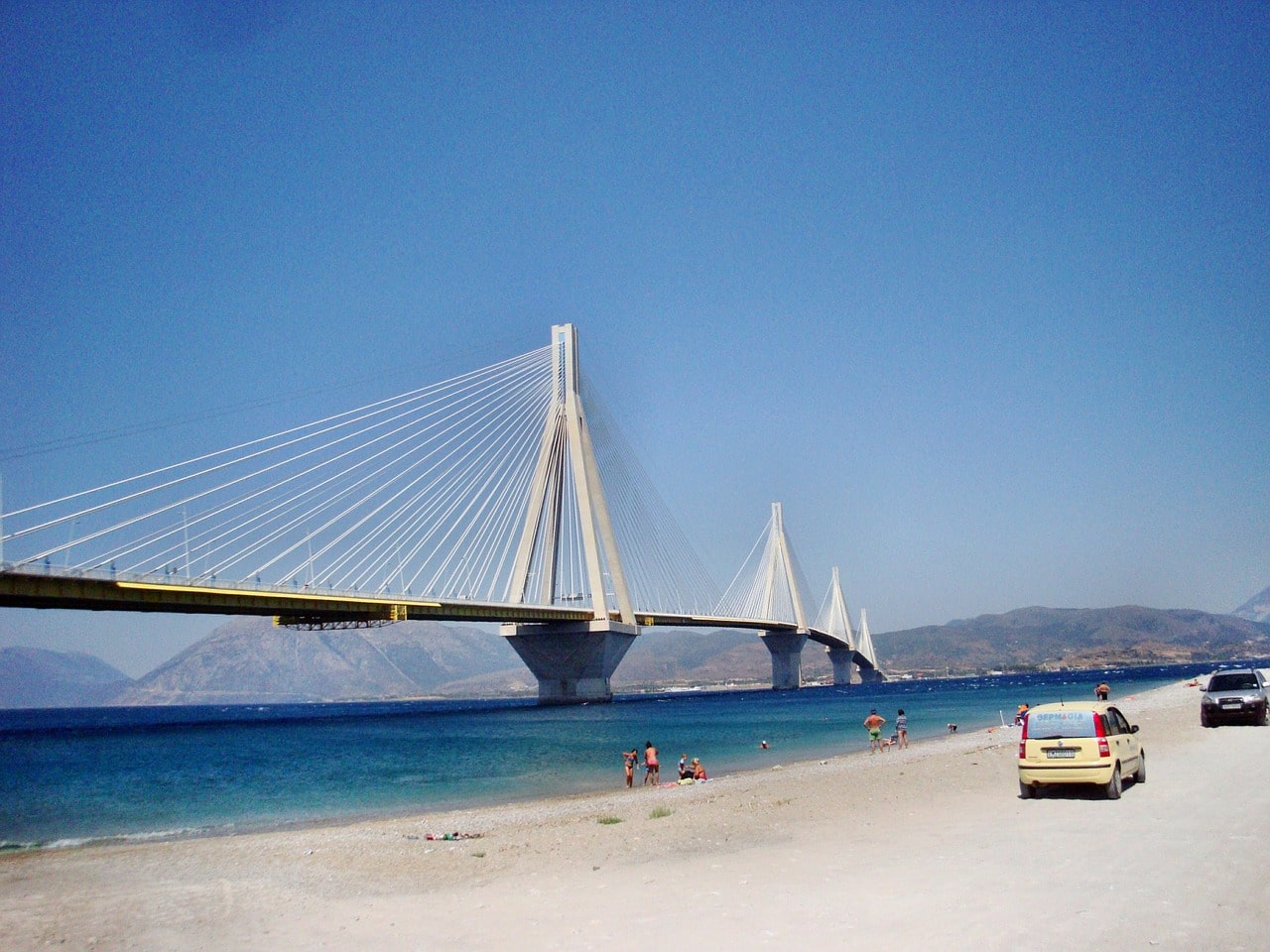
At Rio, the mile-and-a-half Rio-Antirrio bridge spans the the gulf’s cinched waist and we turned north toward the Greek mainland. The 13.50 euro bridge toll reminded us why we had the road almost to ourselves.

Three Days in Corfu
Rio Antirrio Bridge, Patras, Greece. Photo 75 Eisbaer, Pixabay

On the far side, the road carried us northwest to Igoumenitsa and the ferry to Corfu. 

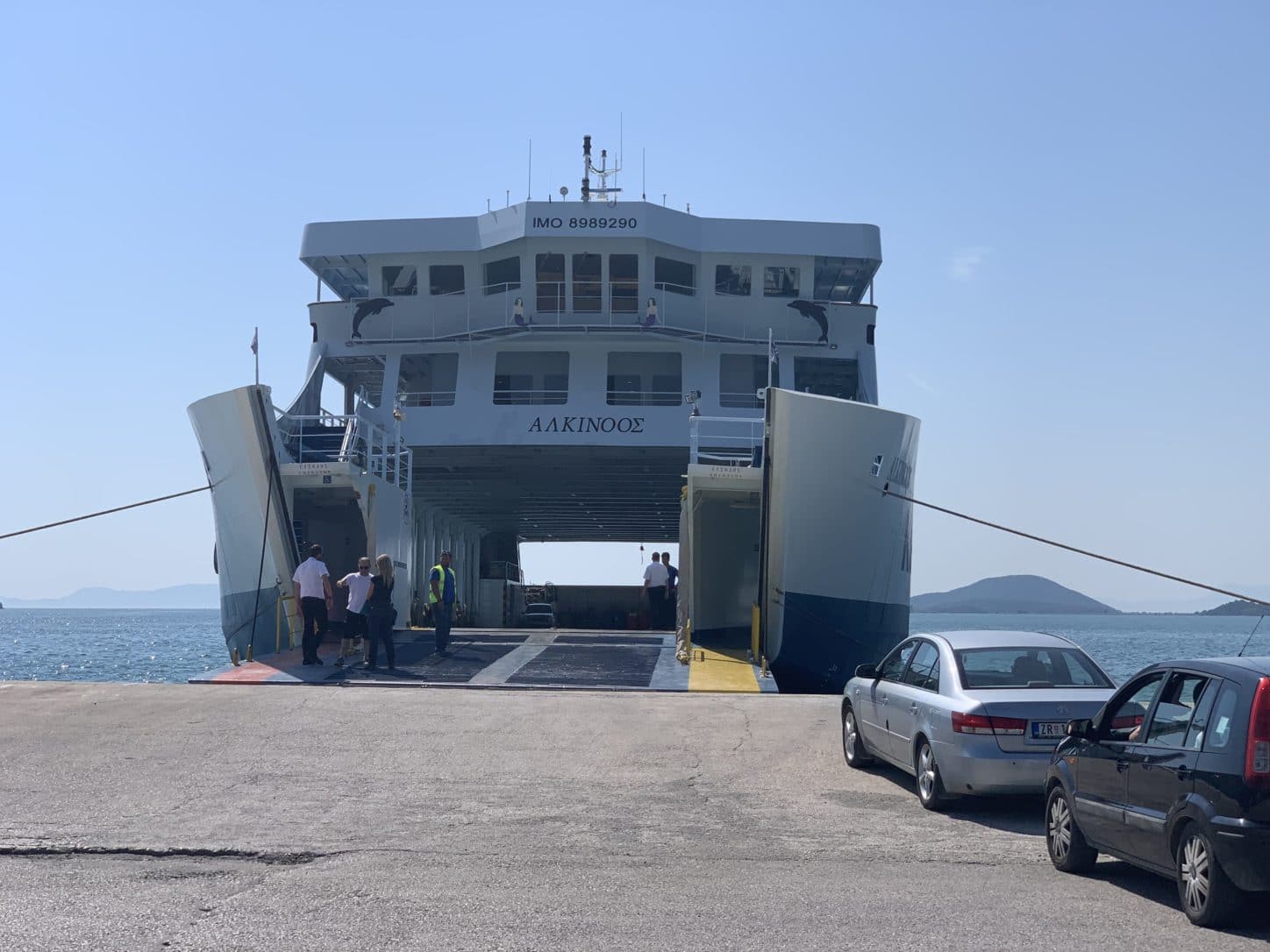
The huge KerkyraLines ferry waited nose-to at the dock, its bay doors open and pedestrians and drivers beginning to line up to board.

Kerkyra Lines ferry to Corfu. Photo by ConsumerMojo.com.

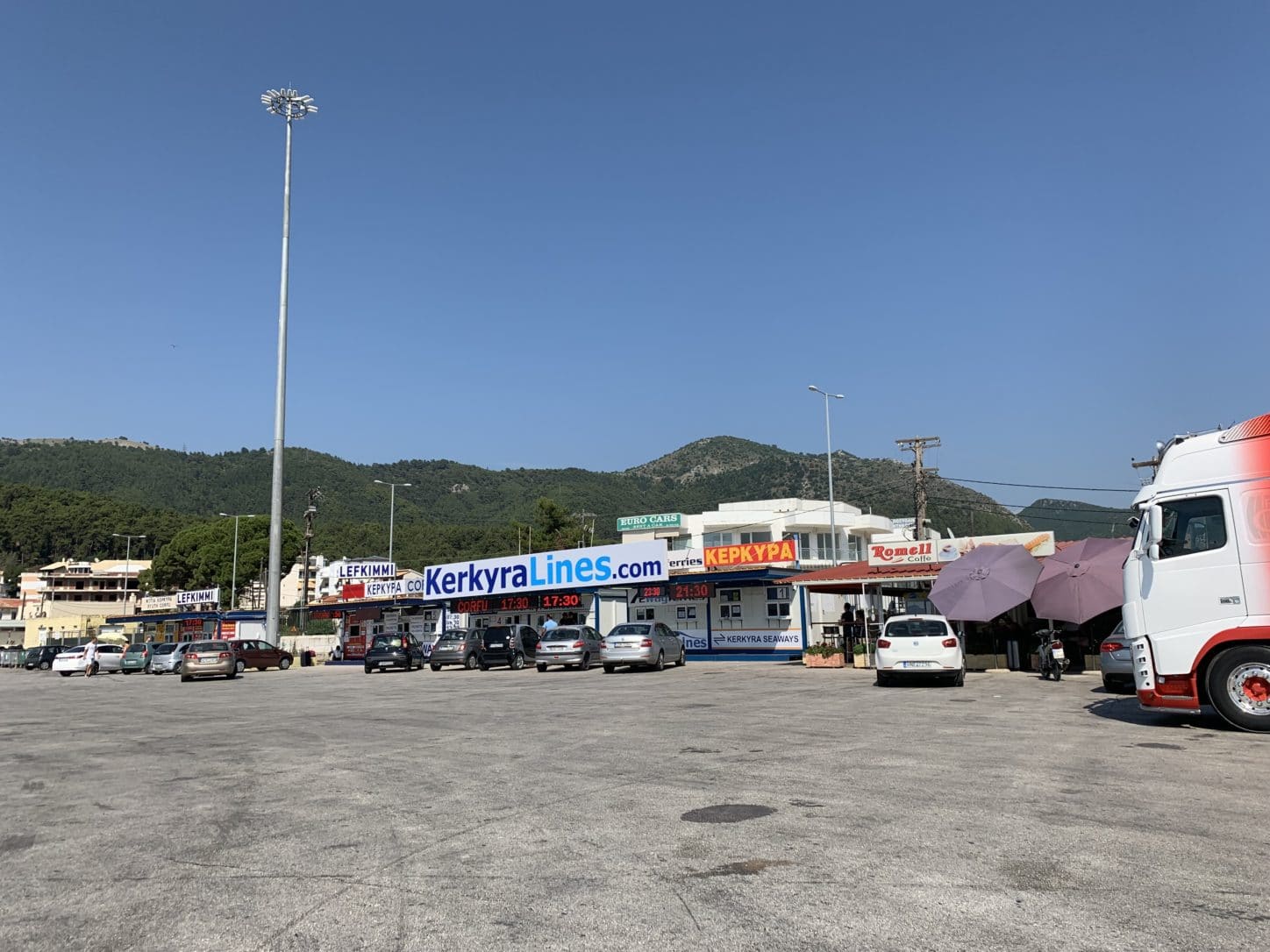
Barbara had to walk back to buy tickets before we could drive on. 

Three Days In Corfu
Ferry Terminal at Igoumenitsa, Greece. Photo by ConsumerMojo.com

The ferry workers started waving us aboard. They directed the drivers to line up so close to one another they had to climb out before their neighbor parked so as not to get trapped inside. 

Three Days on Corfu
Cars on the Ferry to Corfu. Photo by ConsumerMojo.com

We found a table in the air conditioned passenger lounge and sat side-by-side reading Barbara’s tattered copy of Edith Hamilton’s The Greek Way. She’d read it first as a student at the City College of New York, where she now teaches. The cover price was 50 cents. Soon the boat horn blew and the ferry eased away from the dock on its 5:30 departure. On a summer Friday afternoon, weekenders crowded the lounges and deck areas and we had a lot of company inside.

A couple with a young son and daughter sat down at the table next to ours and the kids, trying to get comfortable, tumbled into us. We started to talk and learned they were from Thessaloniki and were headed to visit the woman’s parents on Corfu. Her stepfather had been a Veterans Administration doctor in California and Boston, but after his wife died he rekindled a childhood romance with the woman’s mom and moved back to Greece and Corfu. 

The children warmed up as they watched their parents talk and laugh with us. The little boy began to practice his English, stuck out his hand to Barbara, “I’m Spiros from Thessaloniki,” he said. The little girl offered hard candy from a box she kept in her doll’s pocket, and when Barbara spoke to her, she turned to her mom and said in Greek, “She’s speaking English to me!”

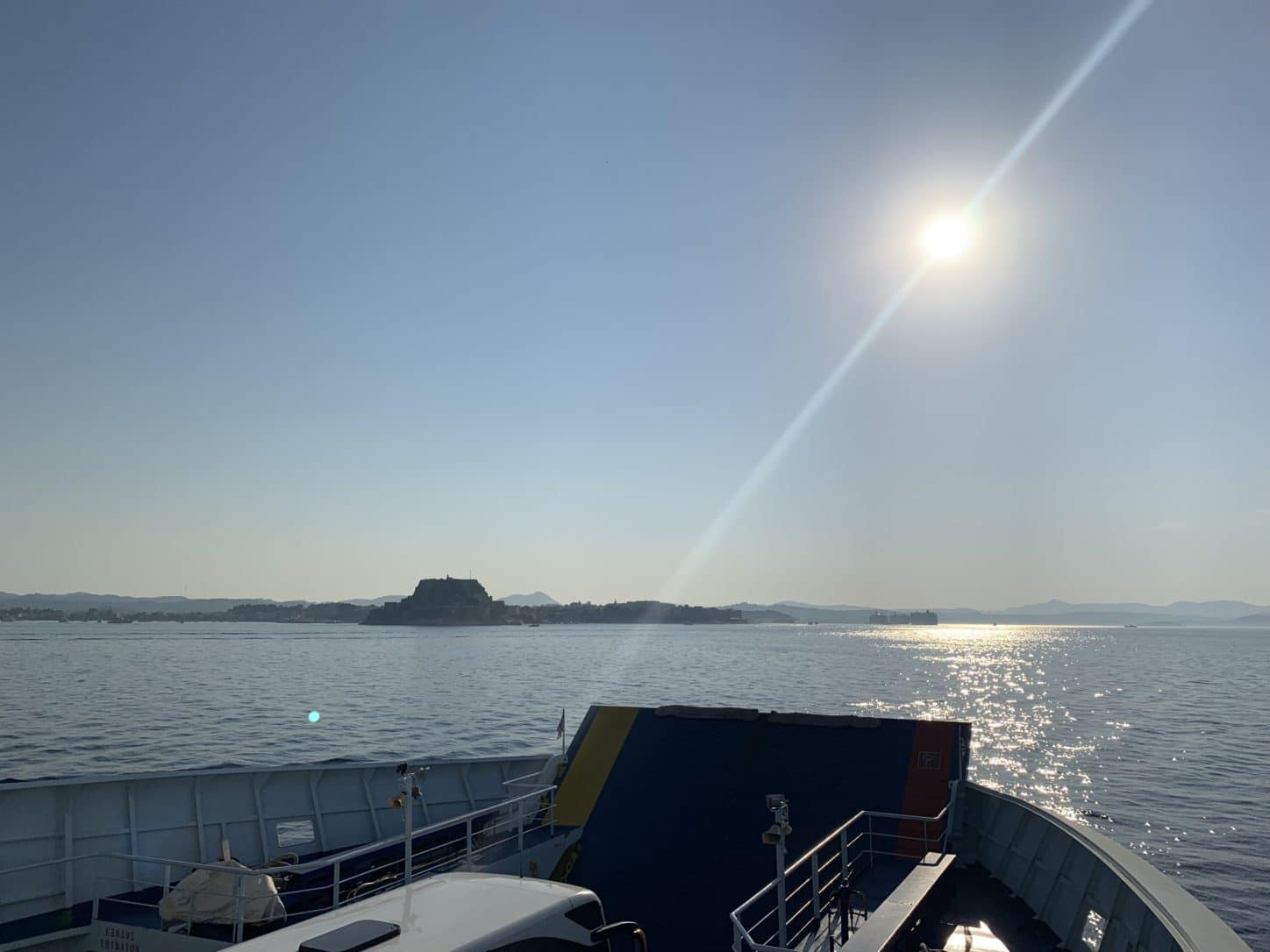
All our attention turned to port windows as we neared the island. Corfu first appeared as a lump on the horizon across the ferry’s bow.

Corfu’s Old Fortress from the ferry. Photo by ConsumerMojo.com

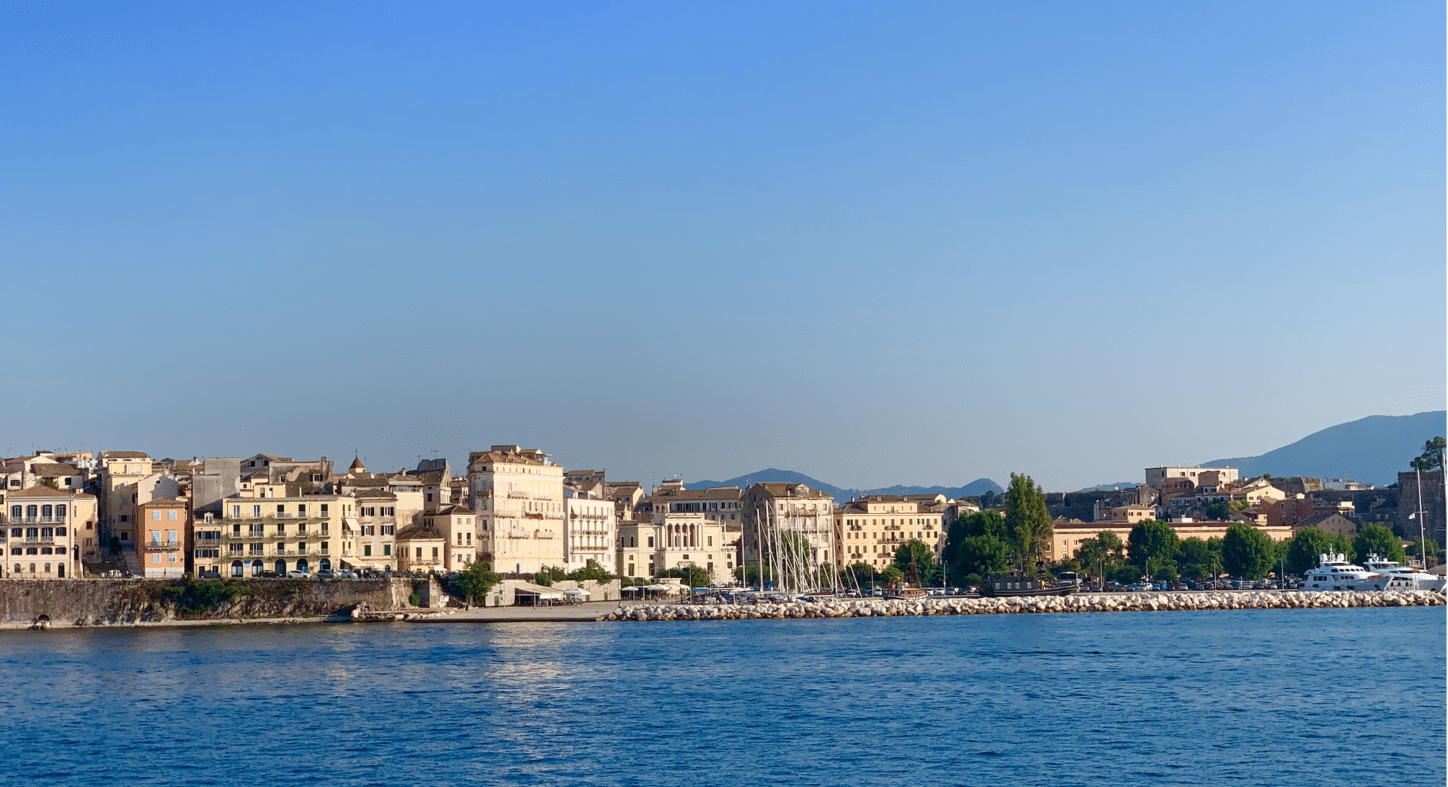
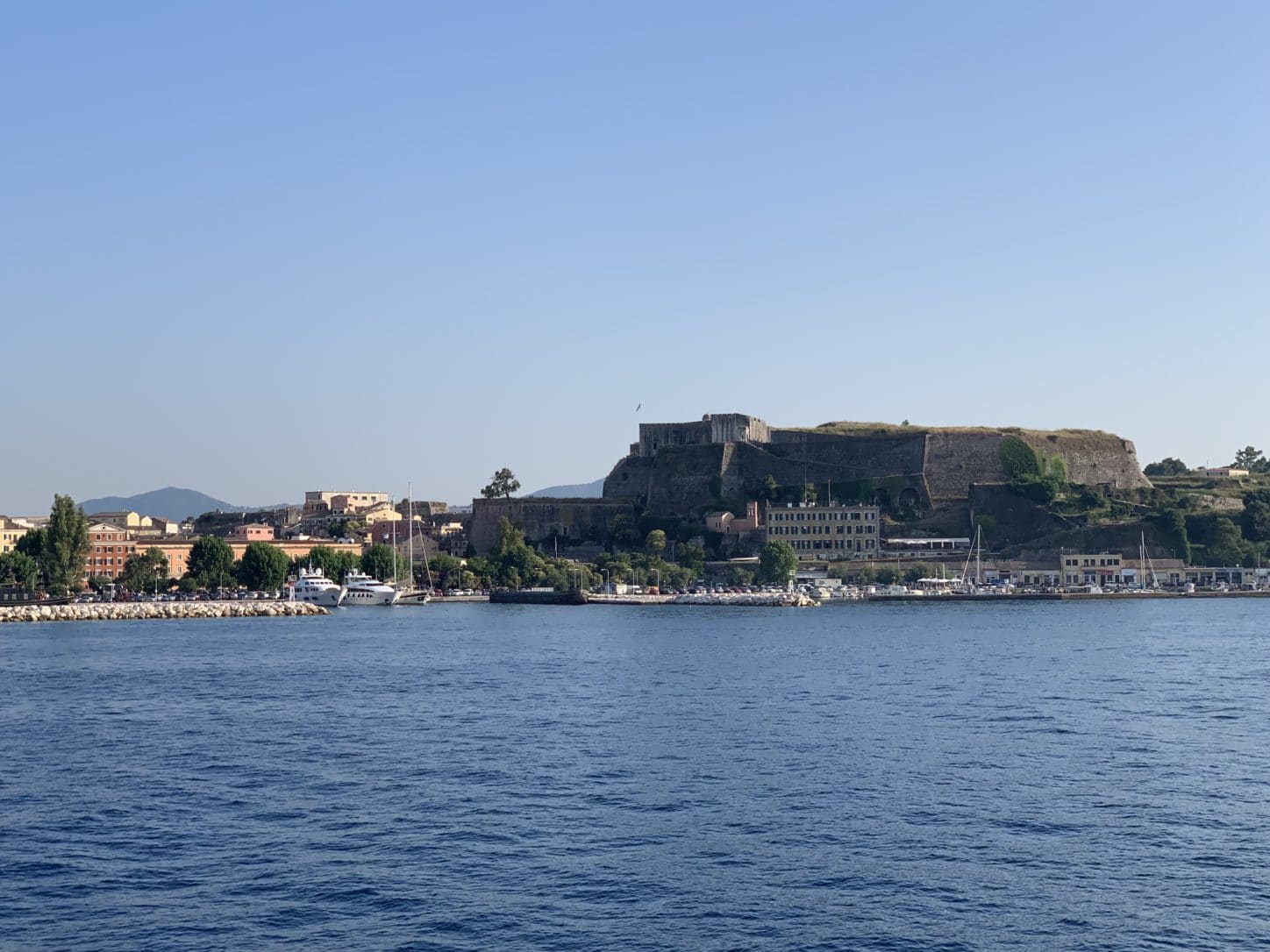
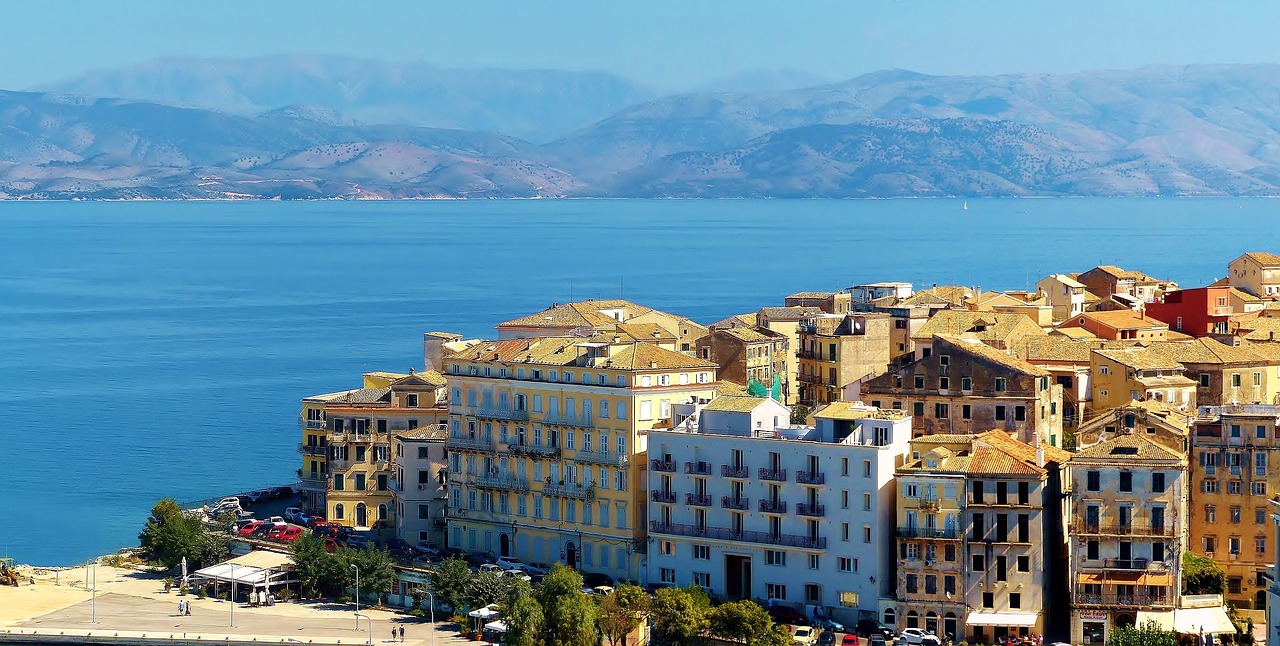
When we got closer the pastel colored buildings of the City of Corfu, the Old Town came into view. Some of the Venetian-style buildings date back more than 400 years when Venice began to rule Corfu.

Corfu from the Ferry. Photo by ConsumerMojo.com

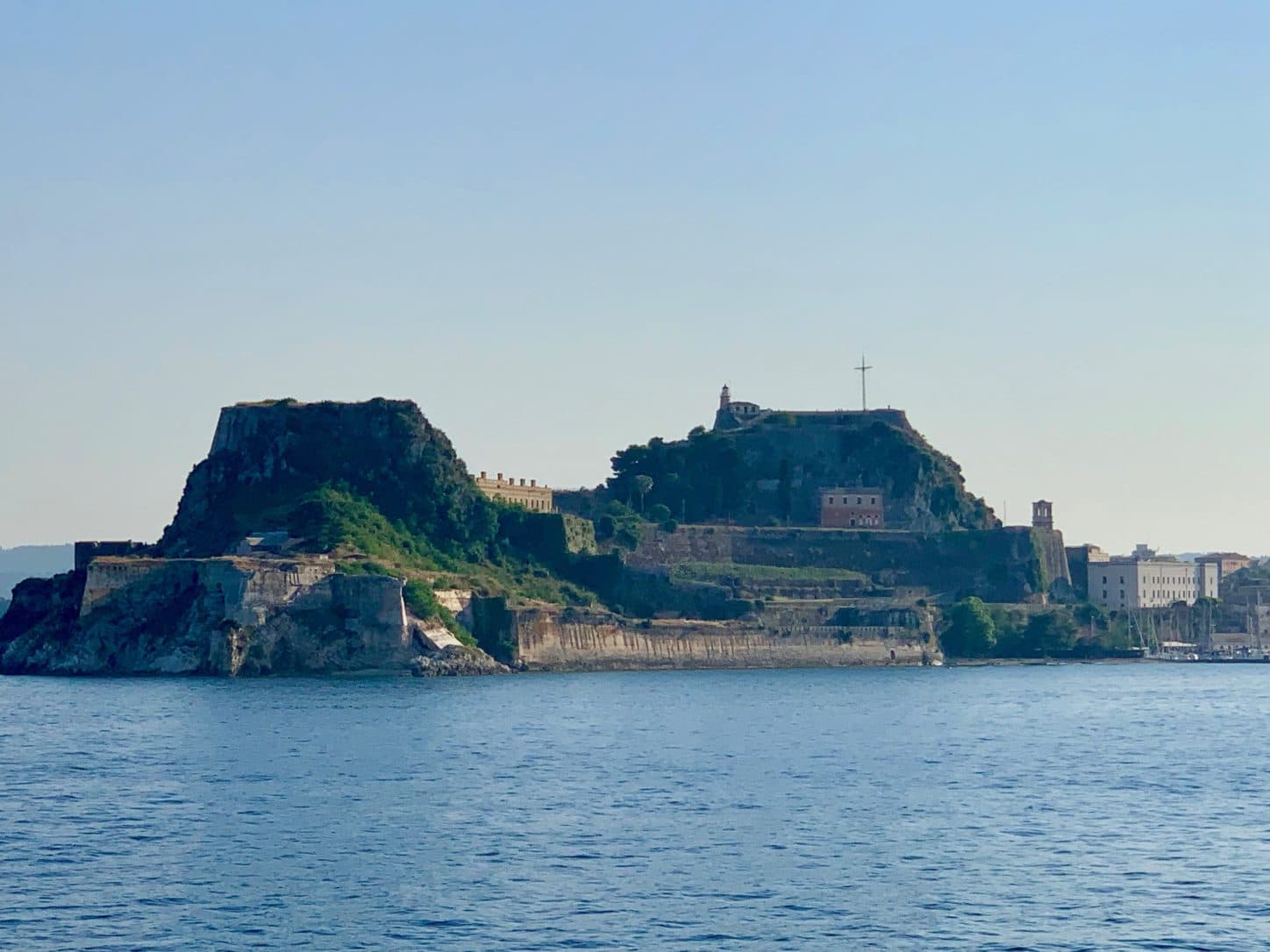
The lump we had seen at first resolved into the Old Venetian Fortress, predating the 16th century when the New Fortress was built, and together they held off three Ottoman invasions. Its twin towers gave the town its name by a roundabout path.

Three Days on Corfu
Corfu Old Fortress. Photo by ConsumerMojo.com

The town and island’s Greek name, Kerkyra, evolved in Byzantine Greek to Korypho, which some sources tell us means City of the Peaks referring to the Old Fortress. Corfu is the western version. The American cult TV name would have been Twin Peaks.

The Old Venetian Fortress at the port of Corfu. Photo by ConsumerMojo.com.

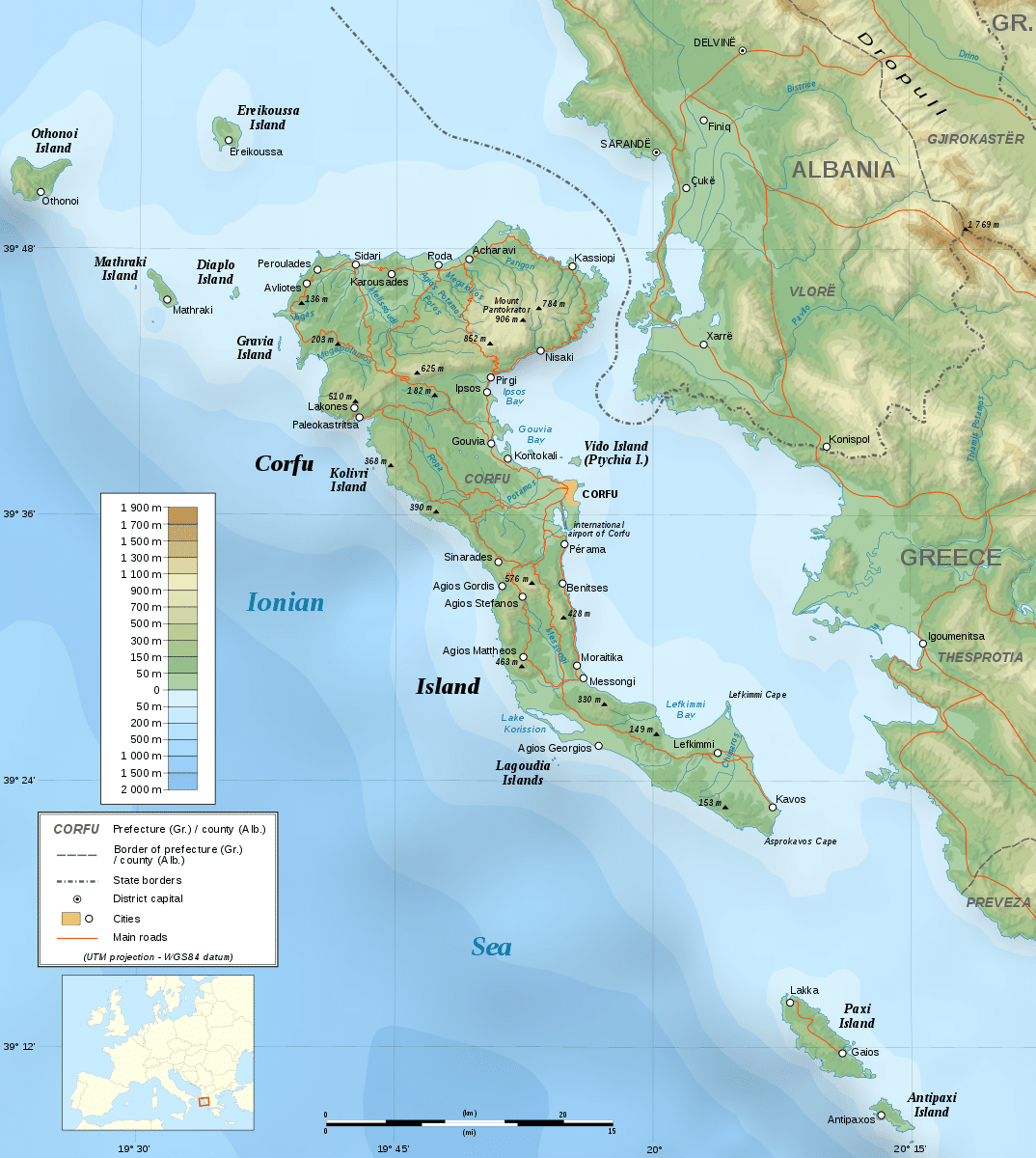
The origins of its name aside, we were at Corfu. It’s the northernmost of the Ionian Greek islands and the second largest, roughly 40 miles from north to south and 20 miles across at its northern bulge. Picture it as a ragged ice cream cone leaning left.

Three Days on Corfu
Corfu. Map by Eric Gabler, aka Sting, Courtesy Creative Commons License

Corfu Town, the island’s capital and port, lies on a bay below the bulge and is closer to Albania than Greece. The island is also close to the heel of Italy’s boot across the Ionian Sea.

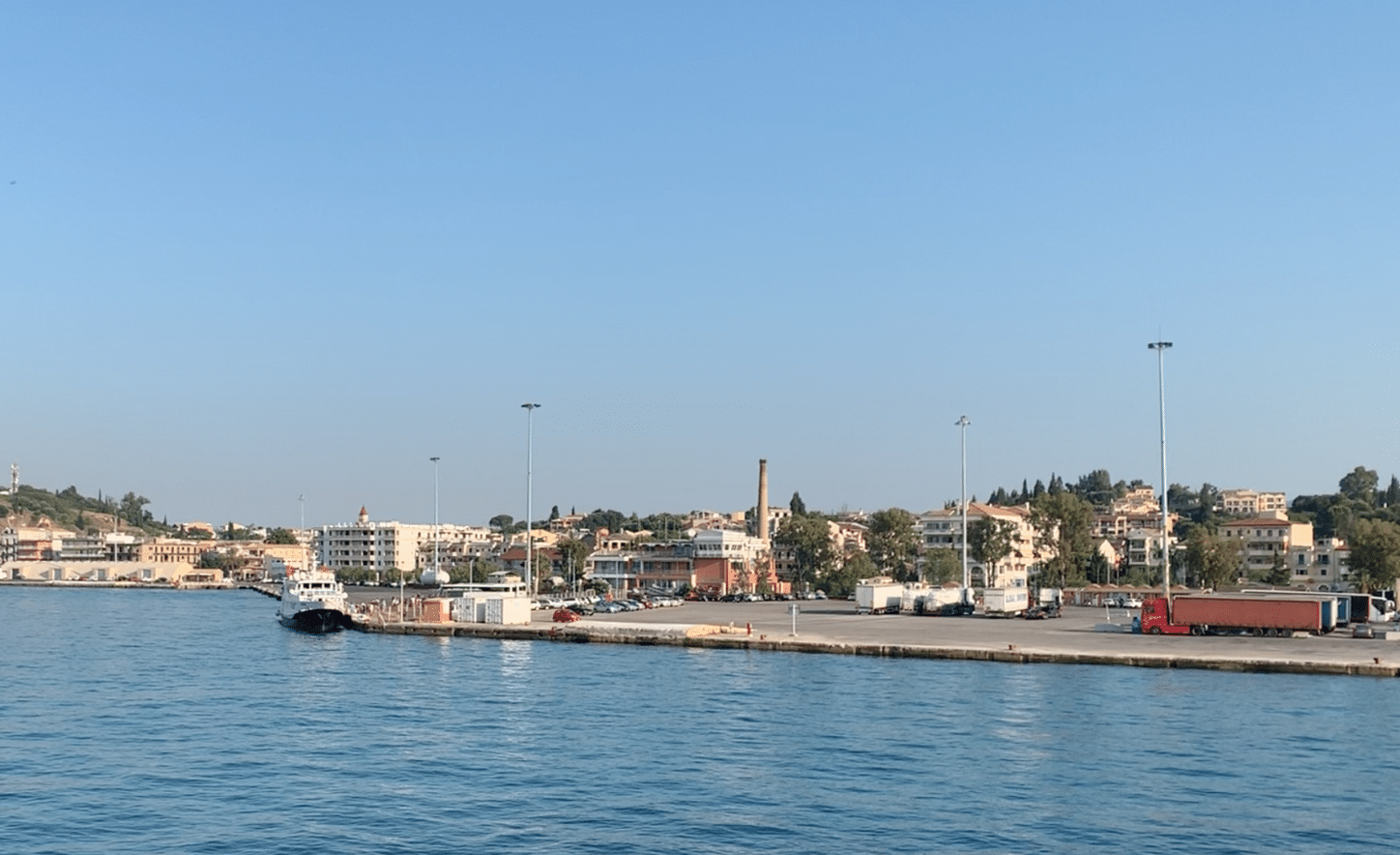
The ferry clanged into the dock at a little after 7 in the evening, with the sun still high and bright. Shouts and waves from the ferrymen directed a slow procession off the boat.

Corfu Ferry Dock, Photo by ConsumerMojo.com
Corfu Ferry Harbor. Photo by ConsumerMojo.com

Then we were in traffic with Google and the satellite guiding us to an area called Kato Korakiana and our hotel, Castello di Vista. If we thought this would be like finding the Hilton in Midtown Manhattan, we were wrong.

Three Days In Corfu, View from Castello di Vista Corfu Ferry Dock, Photo by ConsumerMojo.com
View from Castello di Vista, Corfu, Greece. Photo by ConsumerMojo.com

The road took us north along the coast with other traffic. Then the lady in the phone told us to turn left into the hills. Traffic disappeared along with signs and landmarks. A cafe-bar popped up, then a large square house. The road narrowed to one lane.

We turned up a sharp hill between intruding branches, then through somebody’s back yard where cars were parked. We reached a dead end, and a woman emerged from a house to see who the strangers were.

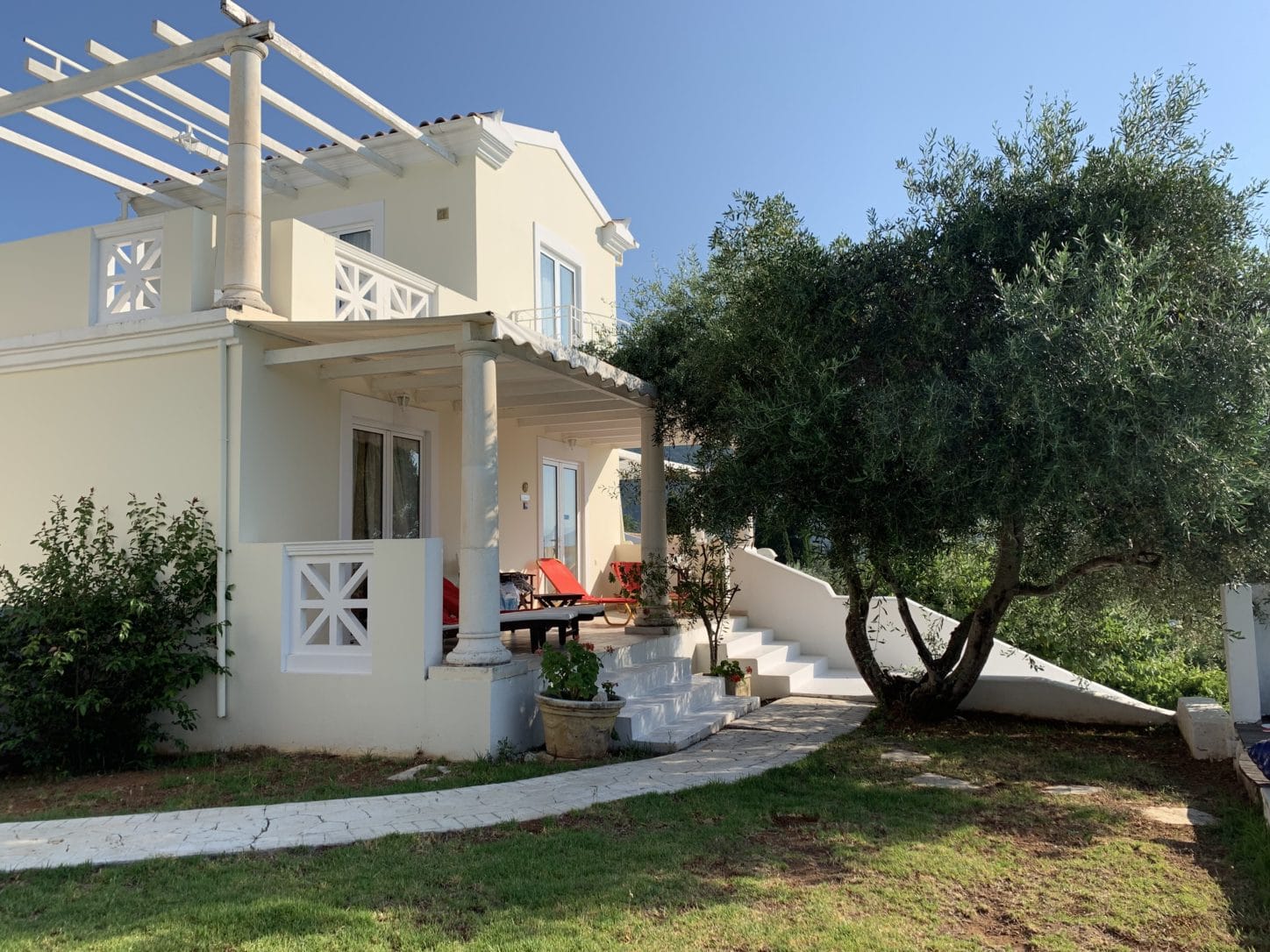
“Oh, Castello di Vista,” she said. “Nobody can find it. Go back and take the road to the right.” We finally found its gate and sign and took an uphill turn into an oasis of small detached villas. We saw no other cars and no people. “Maybe this was a mistake,” Nick said

Three Days on Corfu
Castello di Vista, Corfu, Greece. Photo by ConsumerMojo.com

But then a woman with a broad smile came down the drive and opened her arms to hug Barbara in a warm welcome embrace. Nota Psarapolous introduced us to her husband George, who stood at the top of the sloped drive.  He waved and ambled down to meet us. He and Nota built the unusual hotel and run it together in the summer when they take time away from their lives in Athens. George, we soon learned, was a world-class kibitizer. He chatted away, and joked as he helped roll our bags into our spacious suite.  He turned three slim angel figurines to face away from the king-size bed and said to Nick, “In case. You know . . .

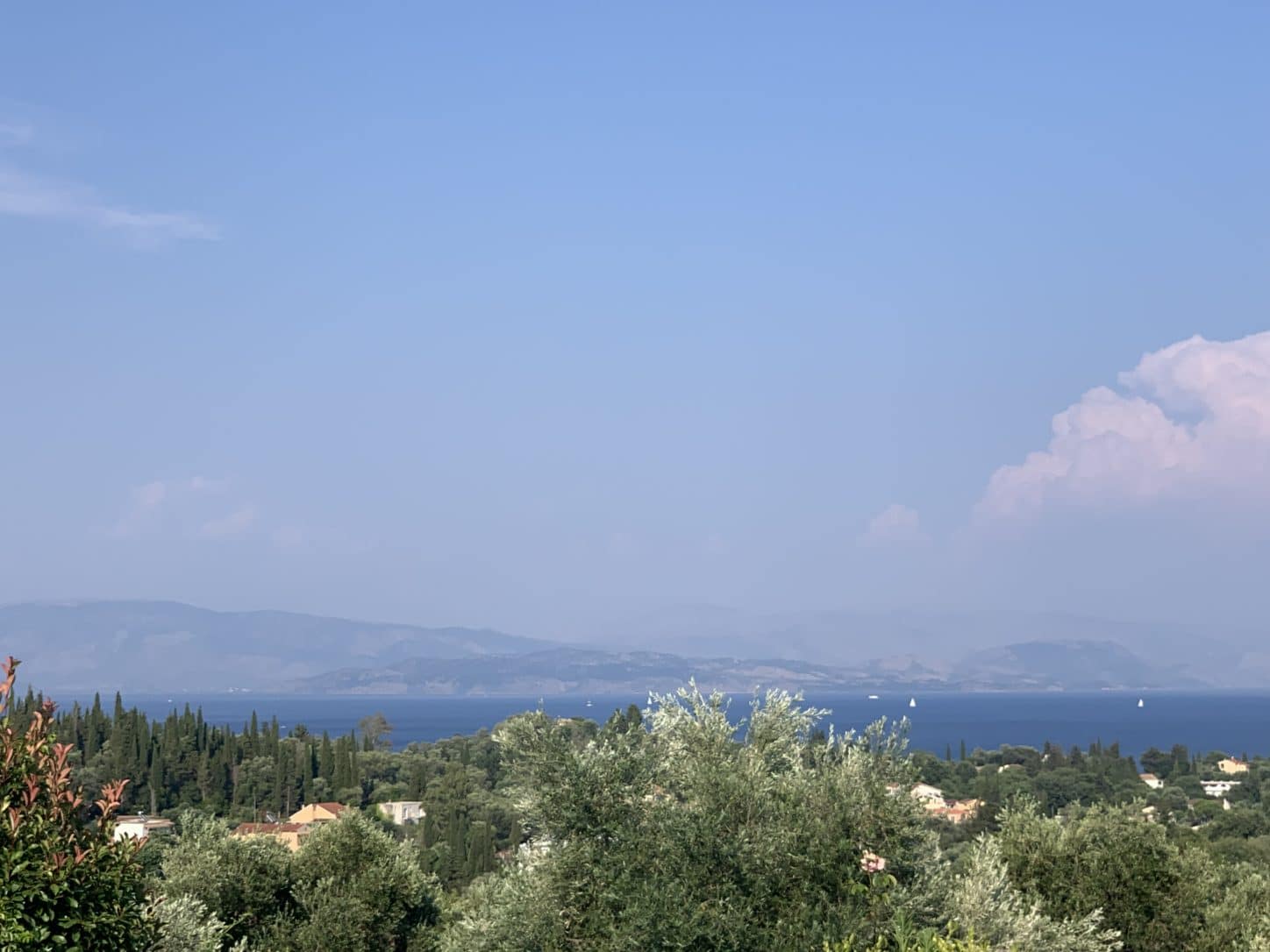
The wall of glass at the back of our suite opened to a small terrace, lounge chairs, and a walled lawn. Beyond, over the treetops glinted the Ionian Sea and the hazy Albanian coast. 

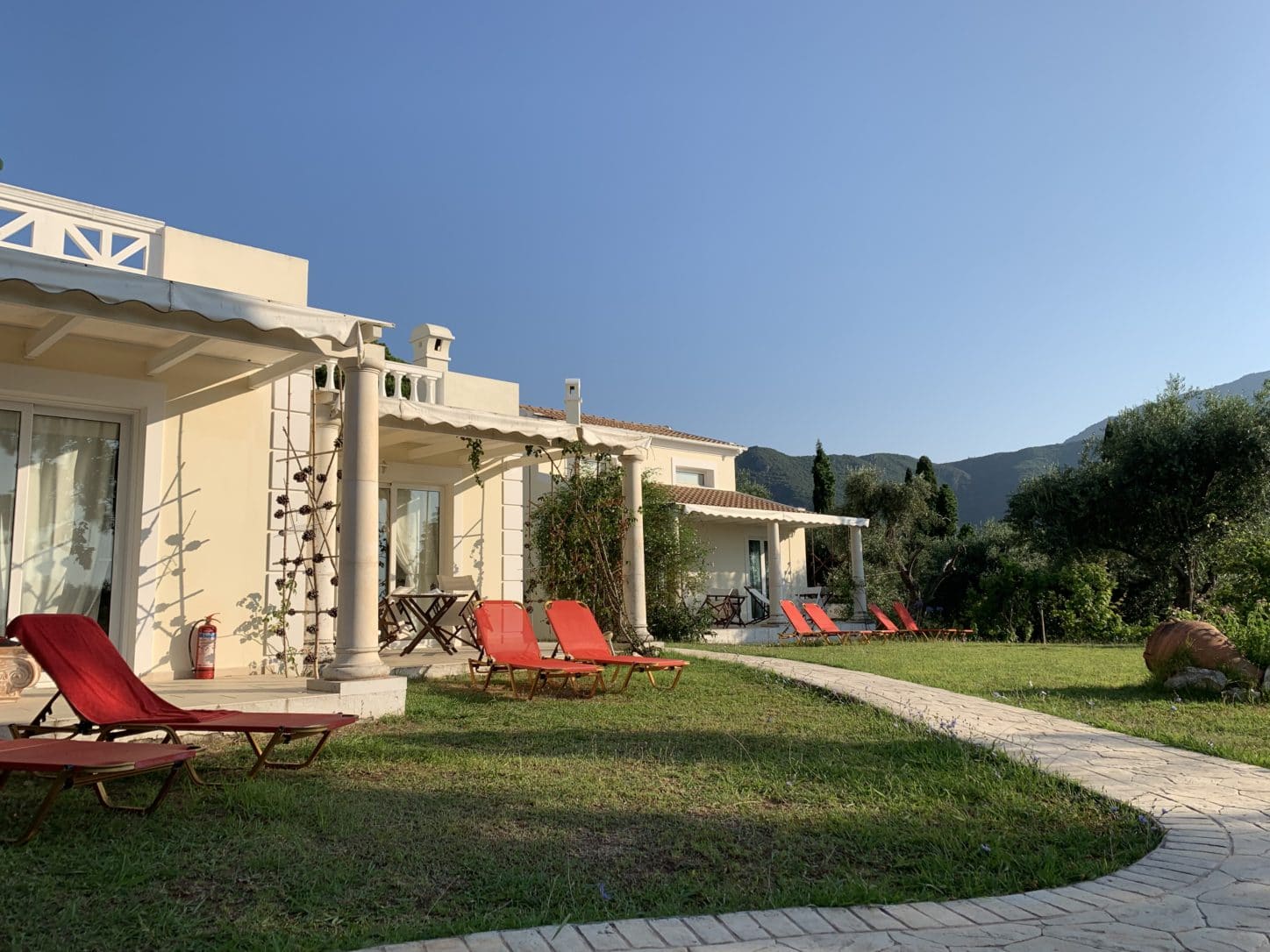
Three Days on Corfu. Villas at Castello di Vista, Corfu, Greece. Photo by ConsumerMojo.com
Castello di Vista, Corfu, Greece. Photo by ConsumerMojo.com

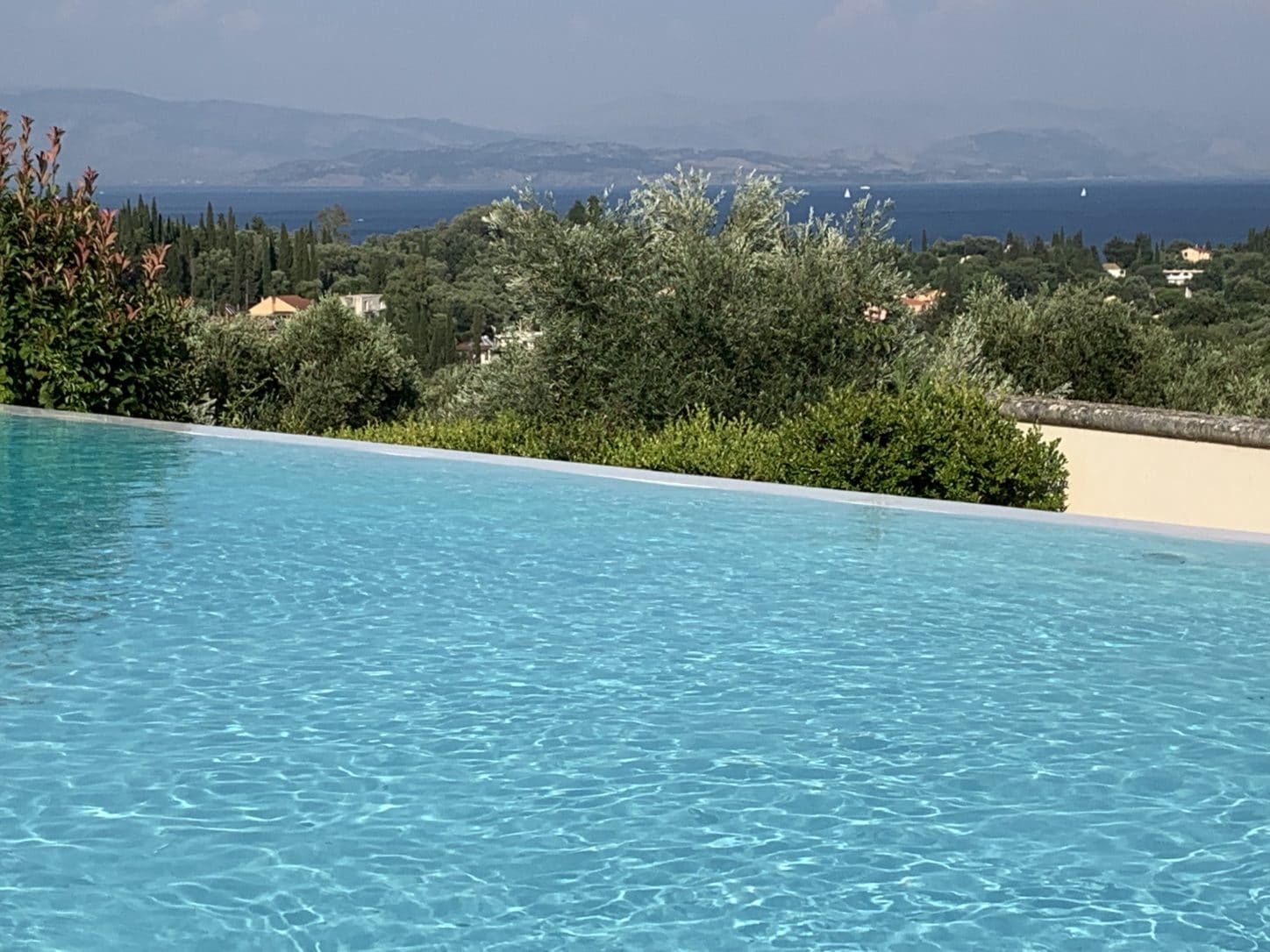
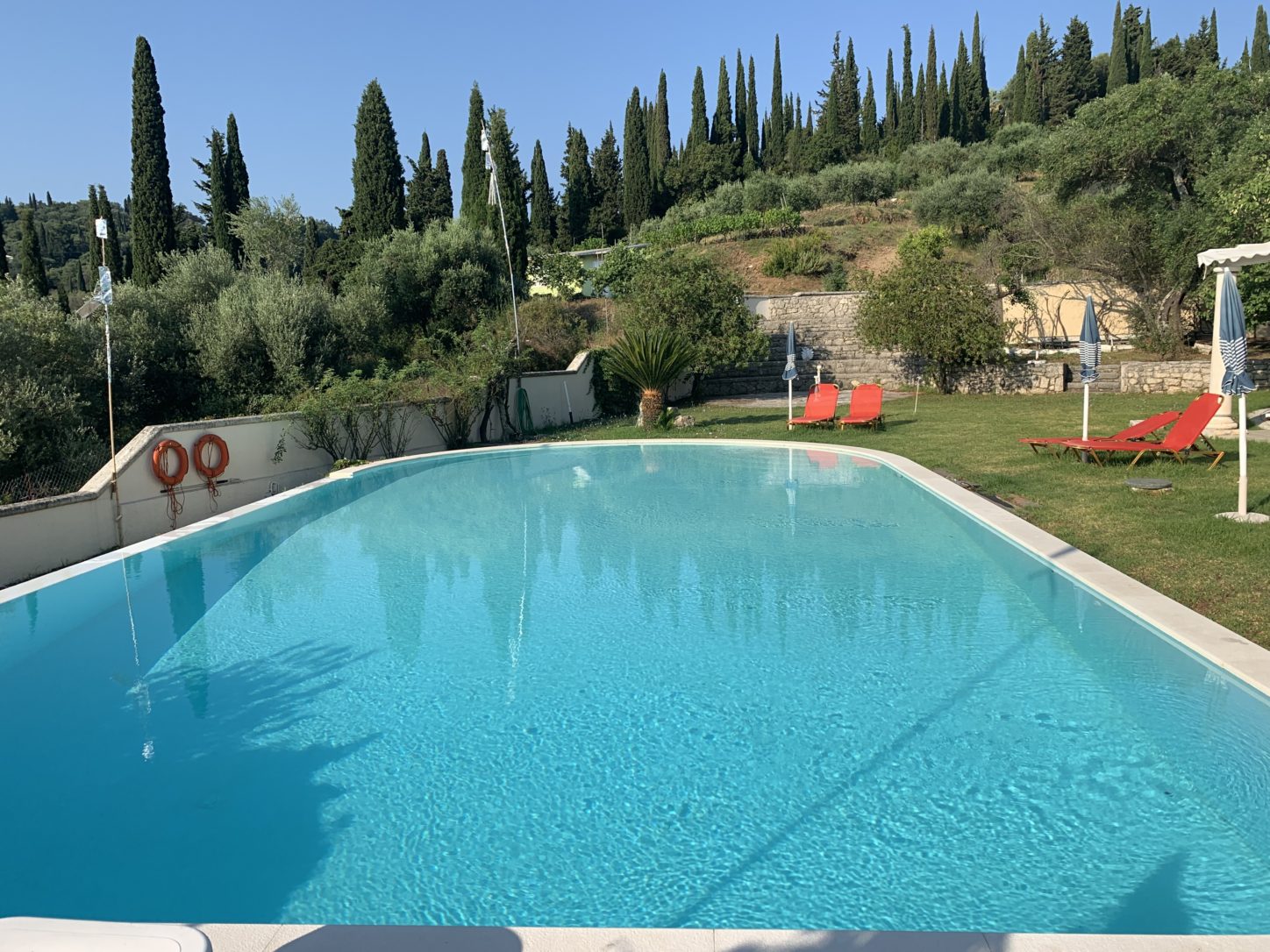
“Come up here,” George said. We followed him up some stone steps onto a terrace with a long glass table. Beyond this, an infinity pool ringed by lounge chairs and umbrellas looked out to the sea.

Three Days on Corfu, Infinity Pool at Castello di Vista
Infinity Pool at Castello di Vista, Corfu, Greece. Photo by ConsumerMojo.com

We sat down at the terrace table and Nota joined us. Oddly, Castello di Vista didn’t take credit cards. We’d reserved through booking.com and then had to wire a down payment to the Investment Bank of Greece. The wire transfer carried  a $35 fee. Nota had come up with a balance of around 300 euros that we’d have to pay in cash. So a trip to an ATM was in our future.

As we talked, we learned Nota was a cancer specialist at an Athens hospital and a former Greek representative to the European Union. George had been a civil engineer. They had bought the land intending to build a house for themselves and a guest house. “She asked me for money for a house, and we ended up with a hotel!” said George in mock chagrin.

We had spent a long day on the road and it was getting dark. “Where should we eat?” Barbara asked. “Someplace close,” Nick added. “That serves fish,” we both said.

George and Nota came up with a name. “It’s just at this end of Ipsos Beach,” George said. “Only ten minutes. I’ll let them know you’re coming.”

A combination of Google and Apple led us out of Kato Korakiana’s hills to a long, shallow arc of beach. Lights were starting to come on in the string of hotels, restaurants and shops behind the road along the beach. The Asterias restaurant was next to a marina at the close end, and we took one of the open tables at the edge of the terrace nearest to the water.

Three Days on Corfu, Barbara at Asterias, Ipsos Beach, Corfu, Greece, Photo by ConsumerMojo.com
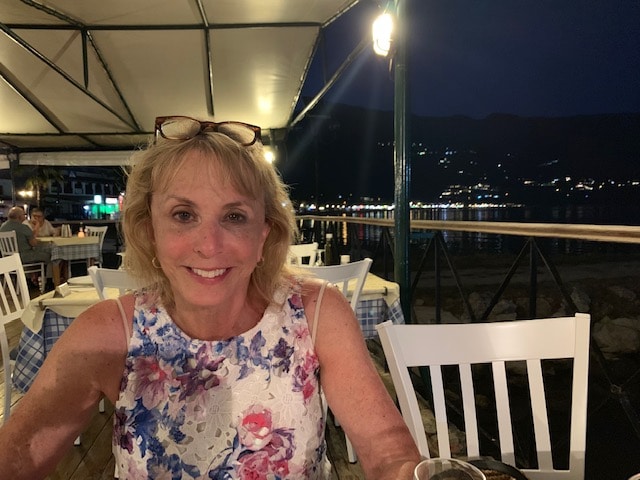
Barbara at Asterias, Ipsos Beach, Corfu, Greece. Photo by ConsumerMojo.com

Exhausted from the long day, we enjoyed the setting as Barbara ate swordfish and Nick grilled tuna, accompanied by a modest amount of house white wine because Nick had visions of getting lost in the Kato Korakiana maze and wandering till daylight. But we found our way back to Castello di Vista with no problems.

The sun woke us the next morning and a dip in the pool finished the job.

Pool at Castello di Vista, Corfu. Photo by ConsumerMojo.com.

Then we joined George and Nota for the second shift at breakfast on their terrace. A card at our place read: “Reserved for the best couple of the hotel.” We decided that was just George being over the top. Also, it looked like all the other guests were families with children. “You made a fatal mistake,” George informed us. “What’s that?,” we asked in unison.  “You did not pull the blackout curtains.  Without that the sun comes into your room, and you will roast.” We fixed that problem and George added a standing fan to circulate the air conditioning at night.

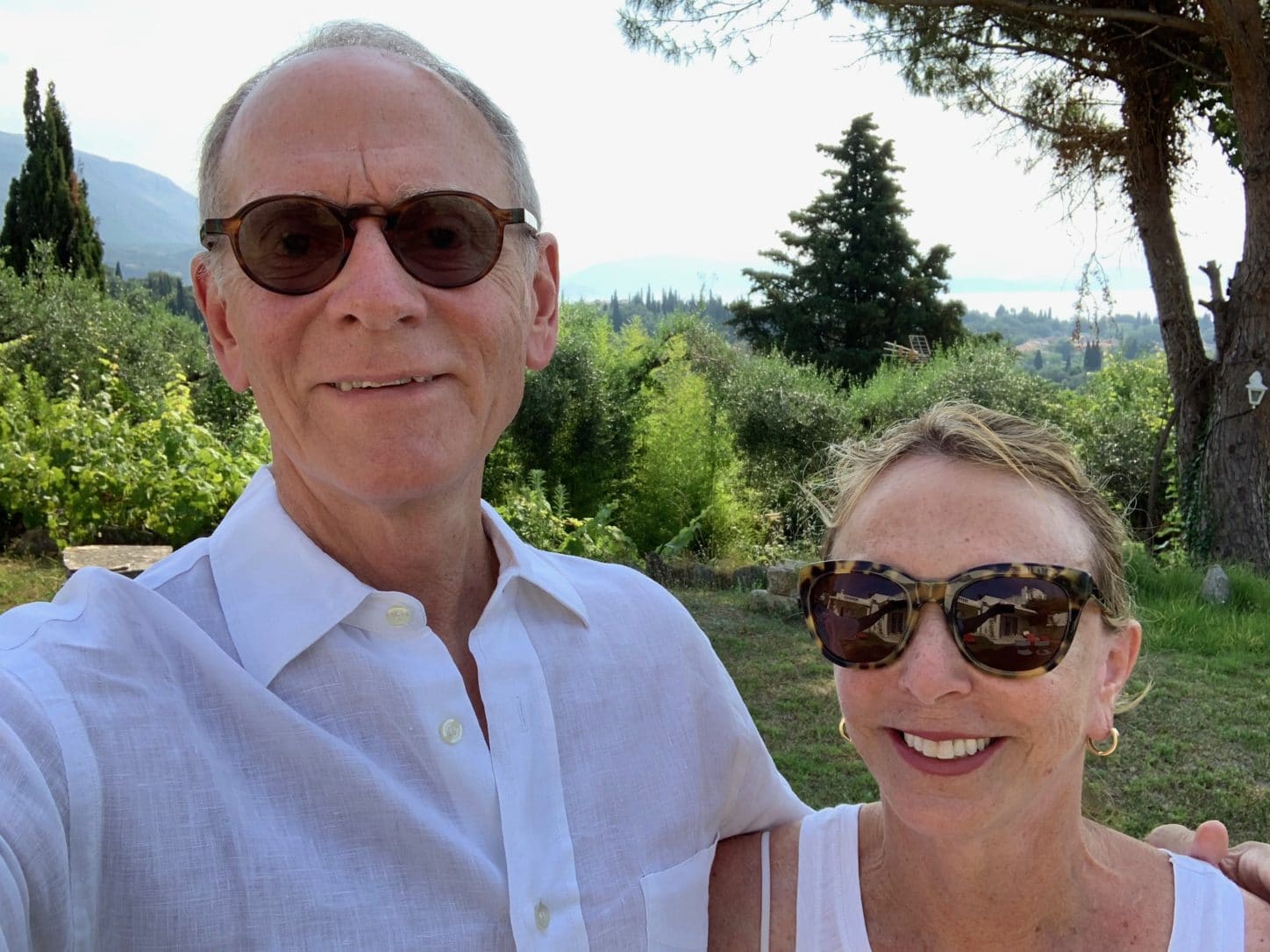
 Nick Taylor and Barbara Nevins Taylor at Castello di Vista, Corfu, Greece. Photo by ConsumerMojo.com.

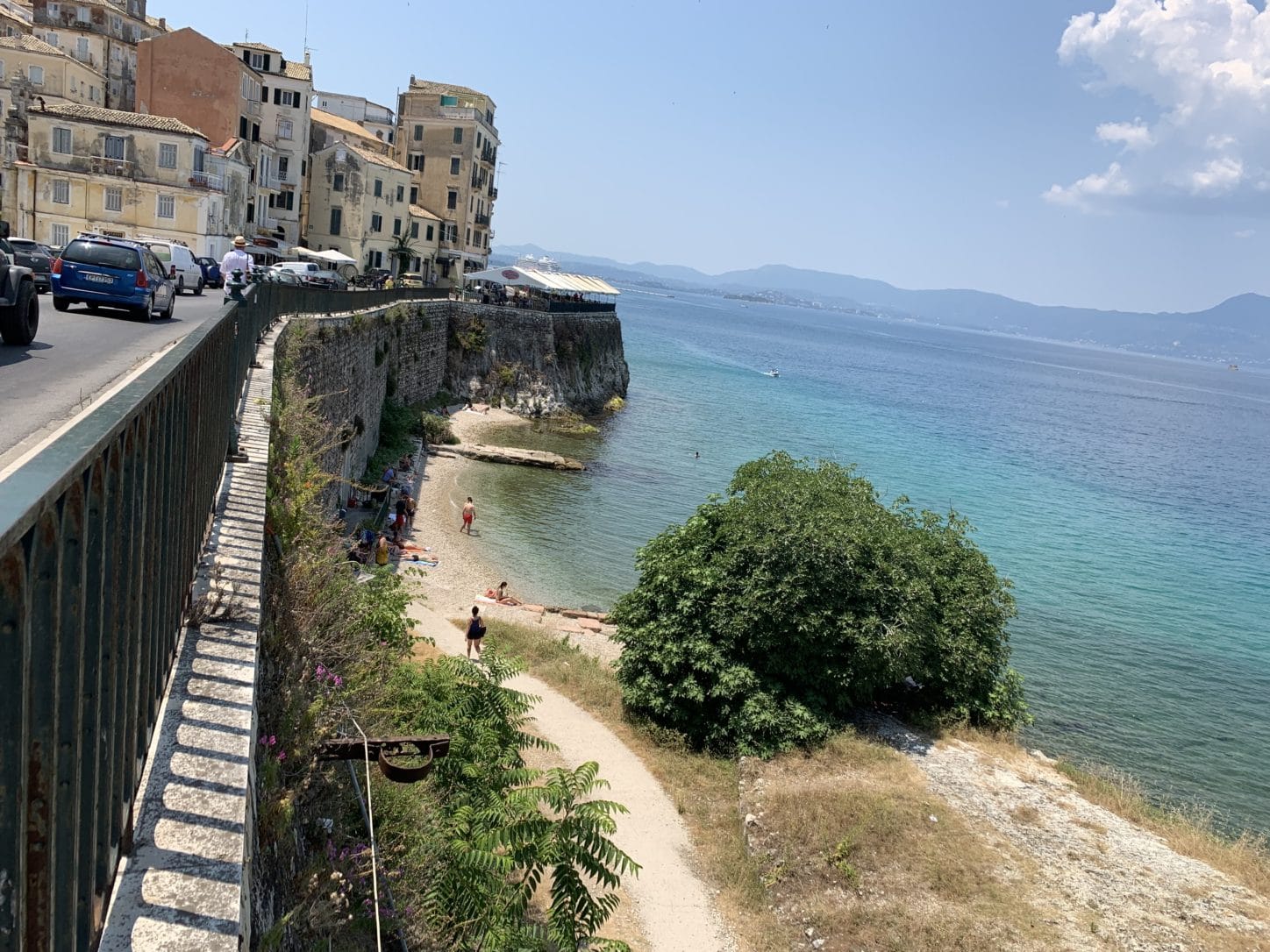
We had come to Corfu thinking we might see a little beach time. George and Nota recommended some spots and George loaded us up with an umbrella, a couple of mats and some beach towels. But first we decided to see what Corfu Town was like. We drove south, turned east into the town crowded with Saturday traffic, found police waving drivers away from the municipal parking lot, and captured an open roadside spot near the Old Harbor and close to an in-town beach. 

Three Days On Cofu, Parking beside the sea
Parking close to a beach in Corfu Town. Photo by ConsumerMojo.com

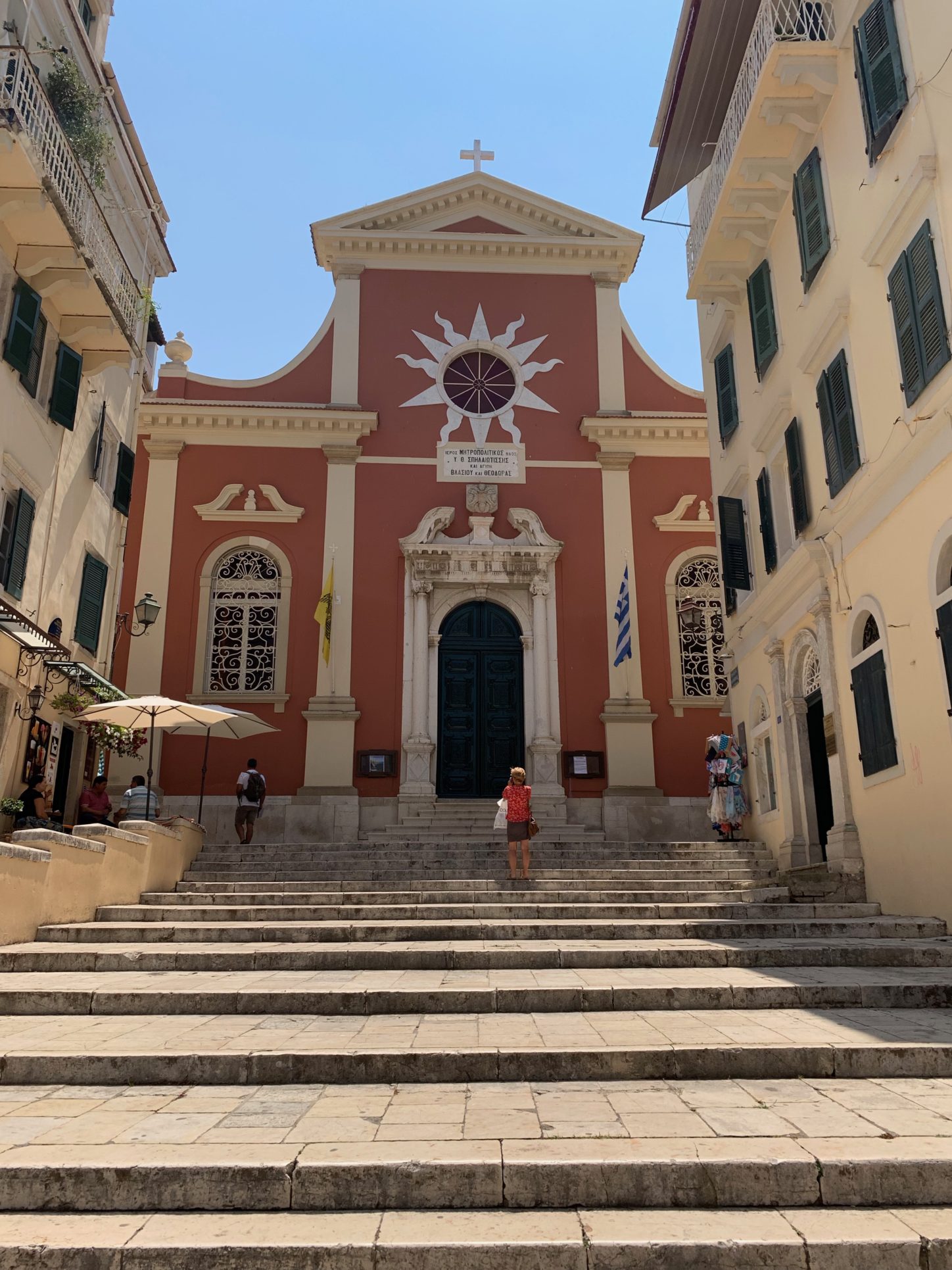
Nick went into a small hotel and got a tourist map. We found that all walks led up in the hilly town. The first thing we saw was Corfu Town’s Metropolitan Church, the Eastern Orthodox equivalent of a cathedral church.

Metropolitan Church, Corfu. Photo by ConsumerMojo.com.

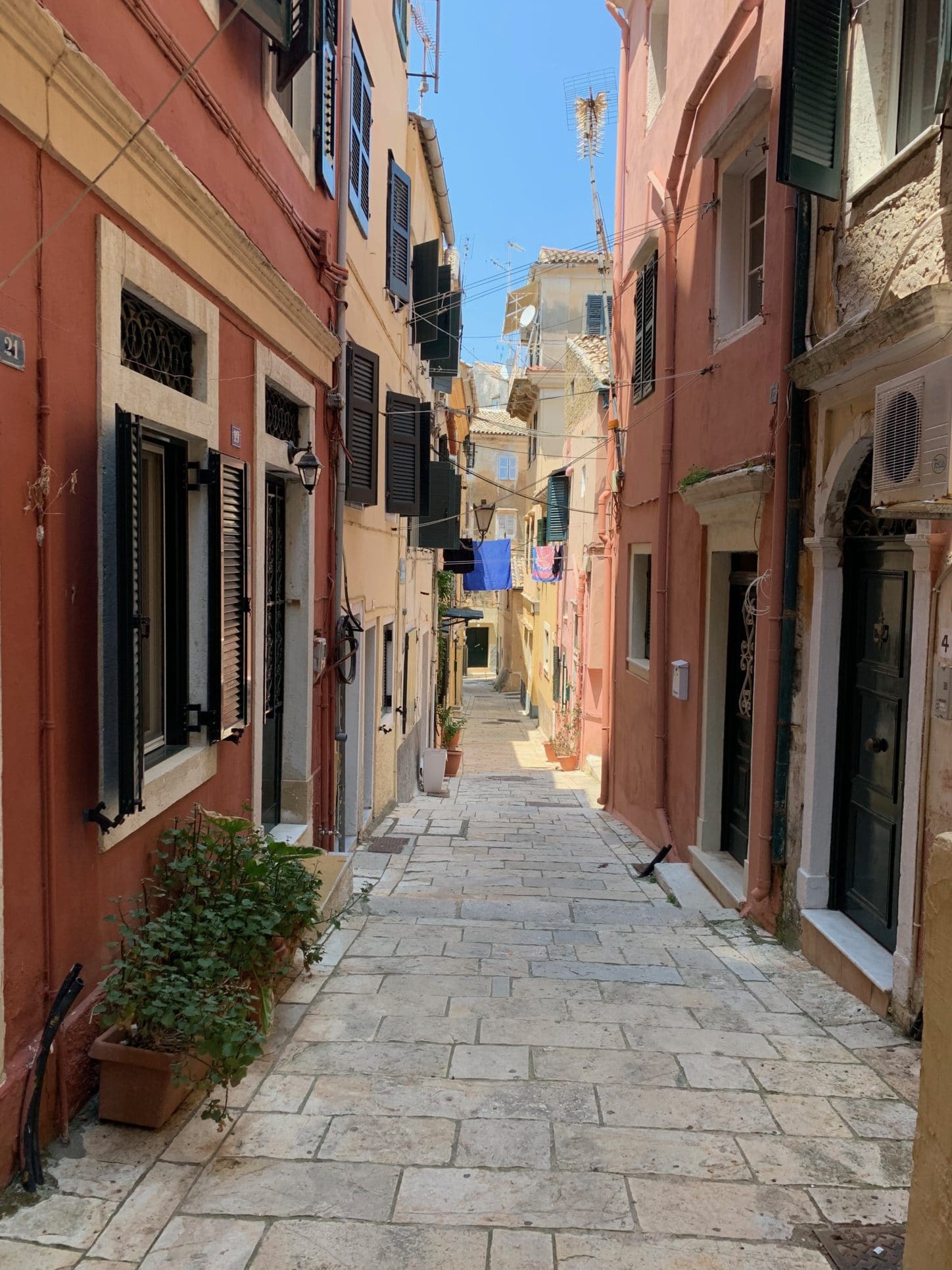
The church was closed up tight and we consulted our map and headed for the nearby Byzantine Museum. We got lost in the maze of streets and alleys and stopped a woman carrying groceries, and holding a leash for a small black dog. “I’m going that way,” she said. “Follow me.”  

Three Days On Corfu, Narrow Street Corfu Town
Street in Corfu Town. Photo by ConsumerMojo.com

We wandered around a bit to find the entrance and the two  people sitting at a small table, in dim light, took our 2 euro admission fees.  Older people get a break. Usually the fee is 4 euros. 

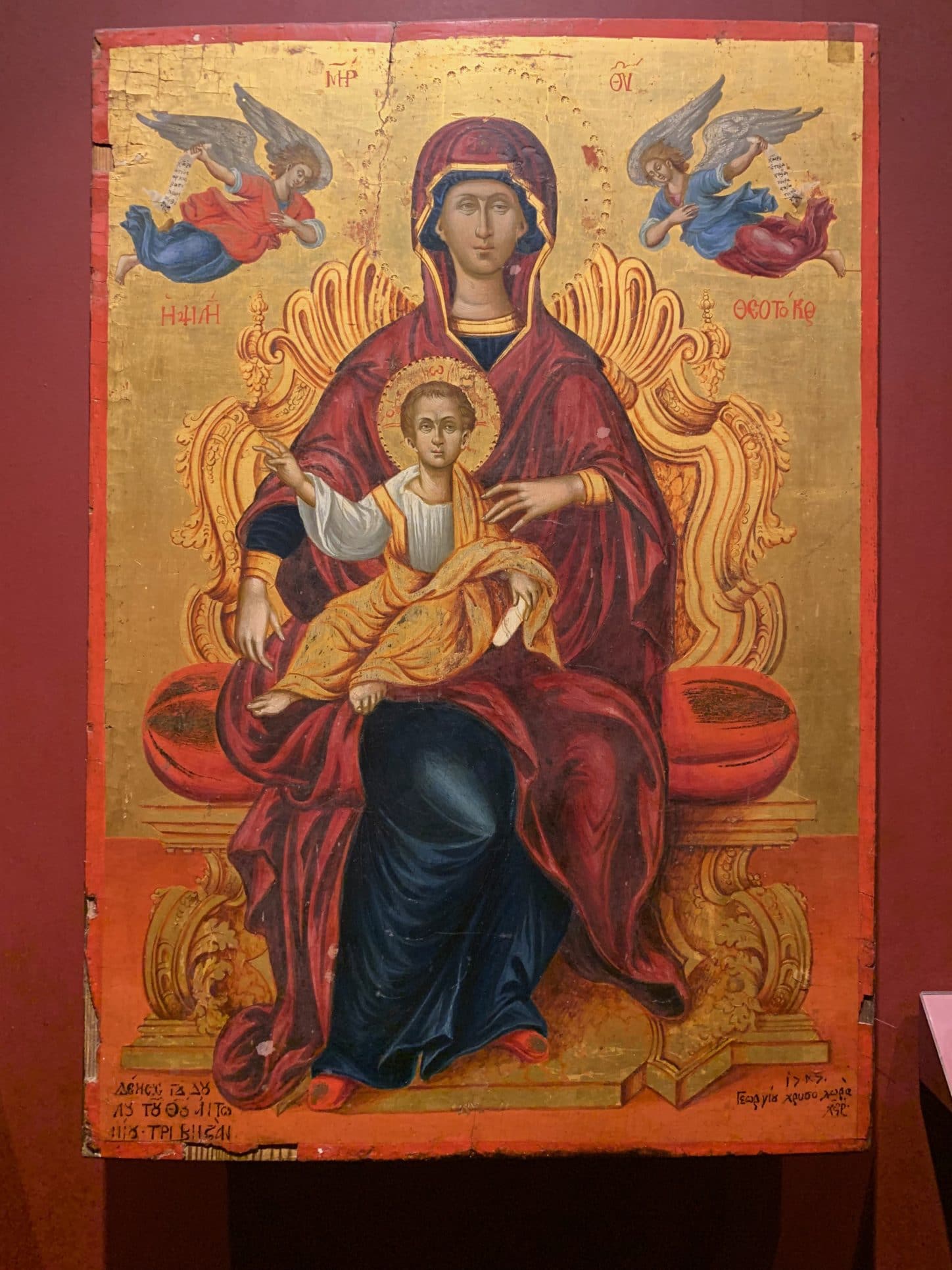
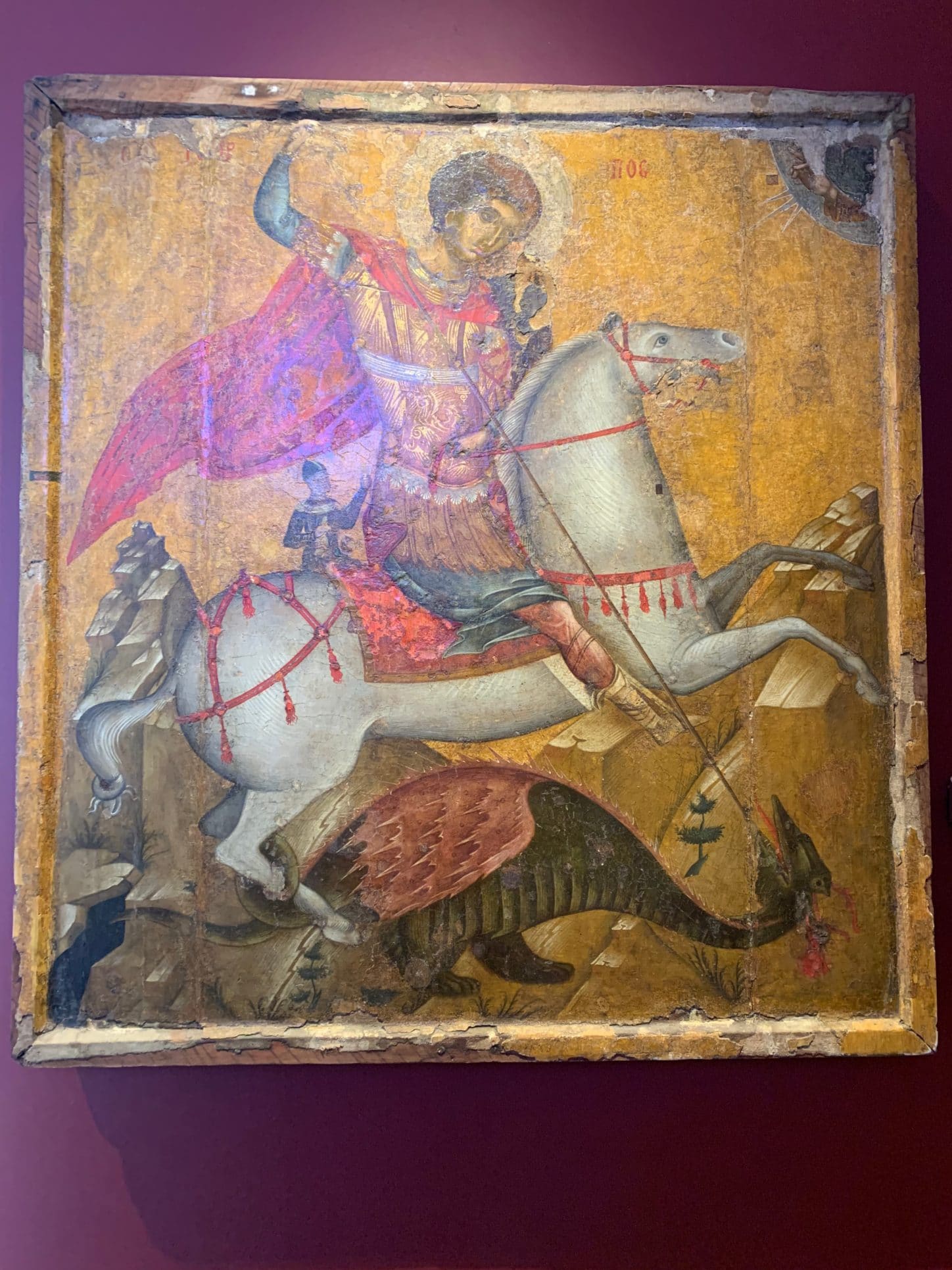
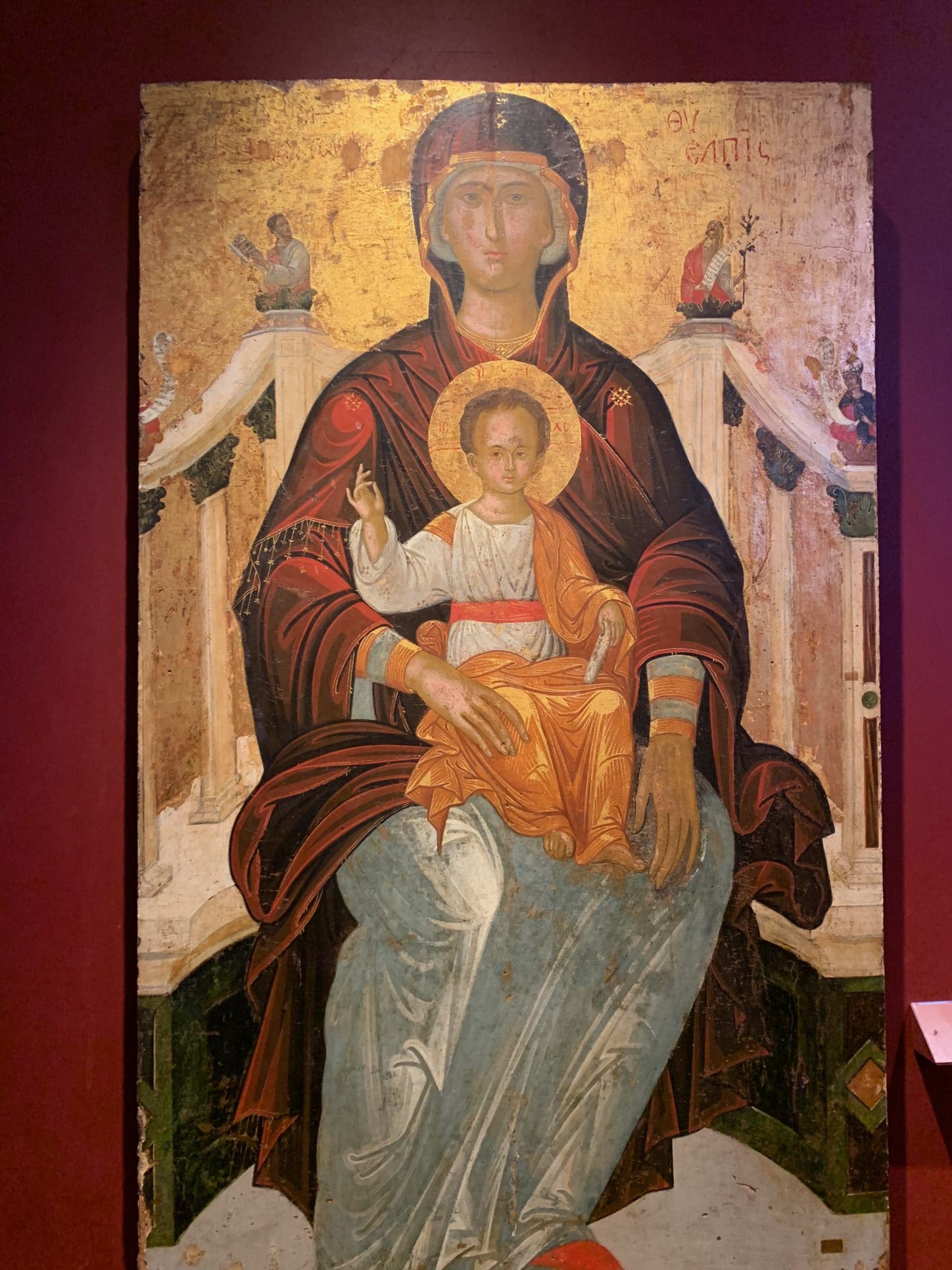
We realized quickly that we got a bargain and wondered why we were the only visitors. More people should visit this museum. It displays religious art and icons dating to the 16th century.  It surprised us to see that artists depicted the baby Jesus with a mature face.

Three Days on Corfu
Madonna and Child, Byzantine Museum, Corfu, Greece. Photo by ConsumerMojo.com
Three Days on Corfu
 Painting in the Byzantine Museum, Corfu, Greece. Photo by ConsumerMojo.com
Three Days on Corfu Madonna and Child, Byzantine Museum, Corfu. Photo by ConsumerMojo.com
Madonna and Child, Byzantine Museum, Corfu. Photo by ConsumerMojo.com

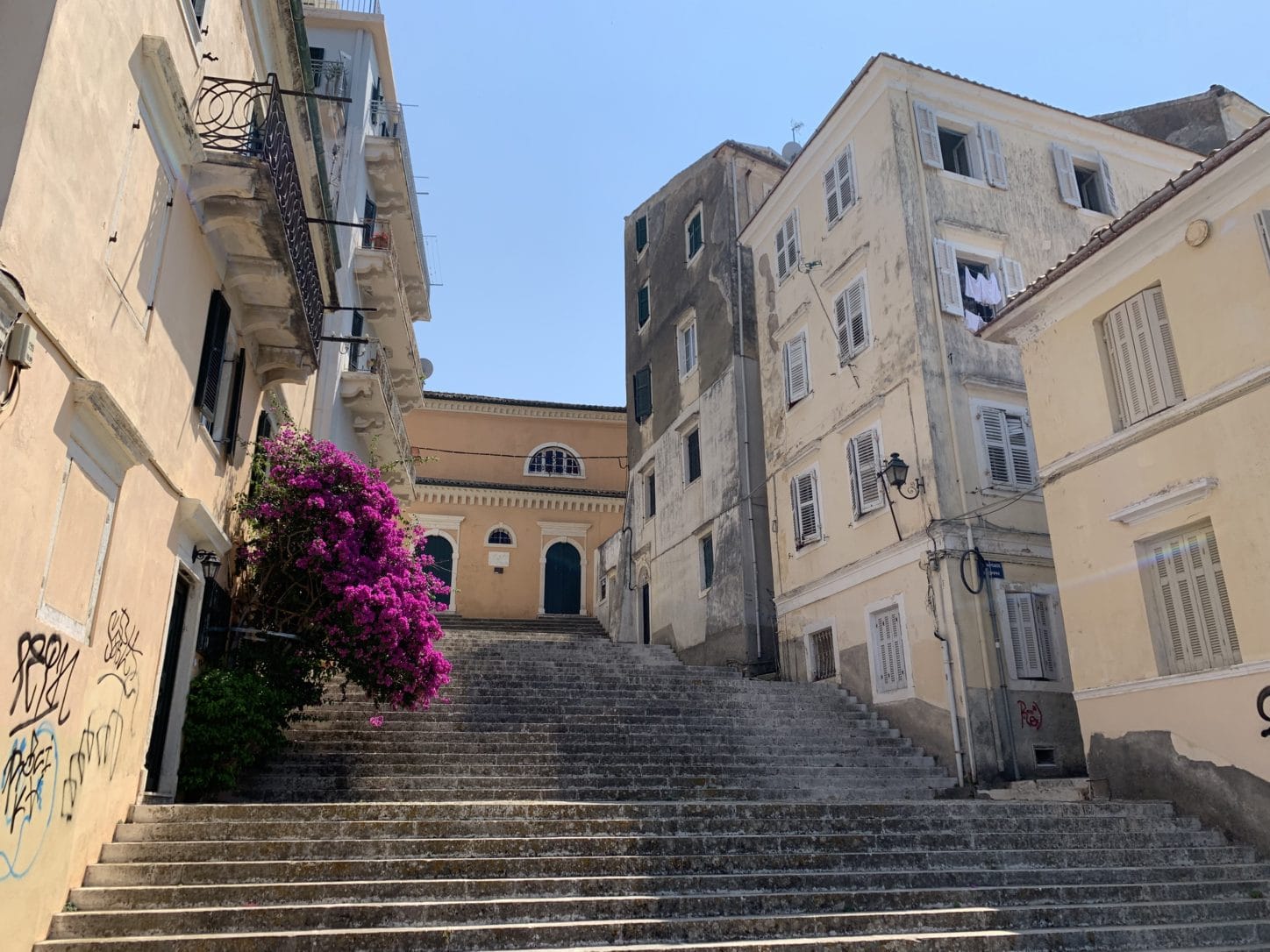
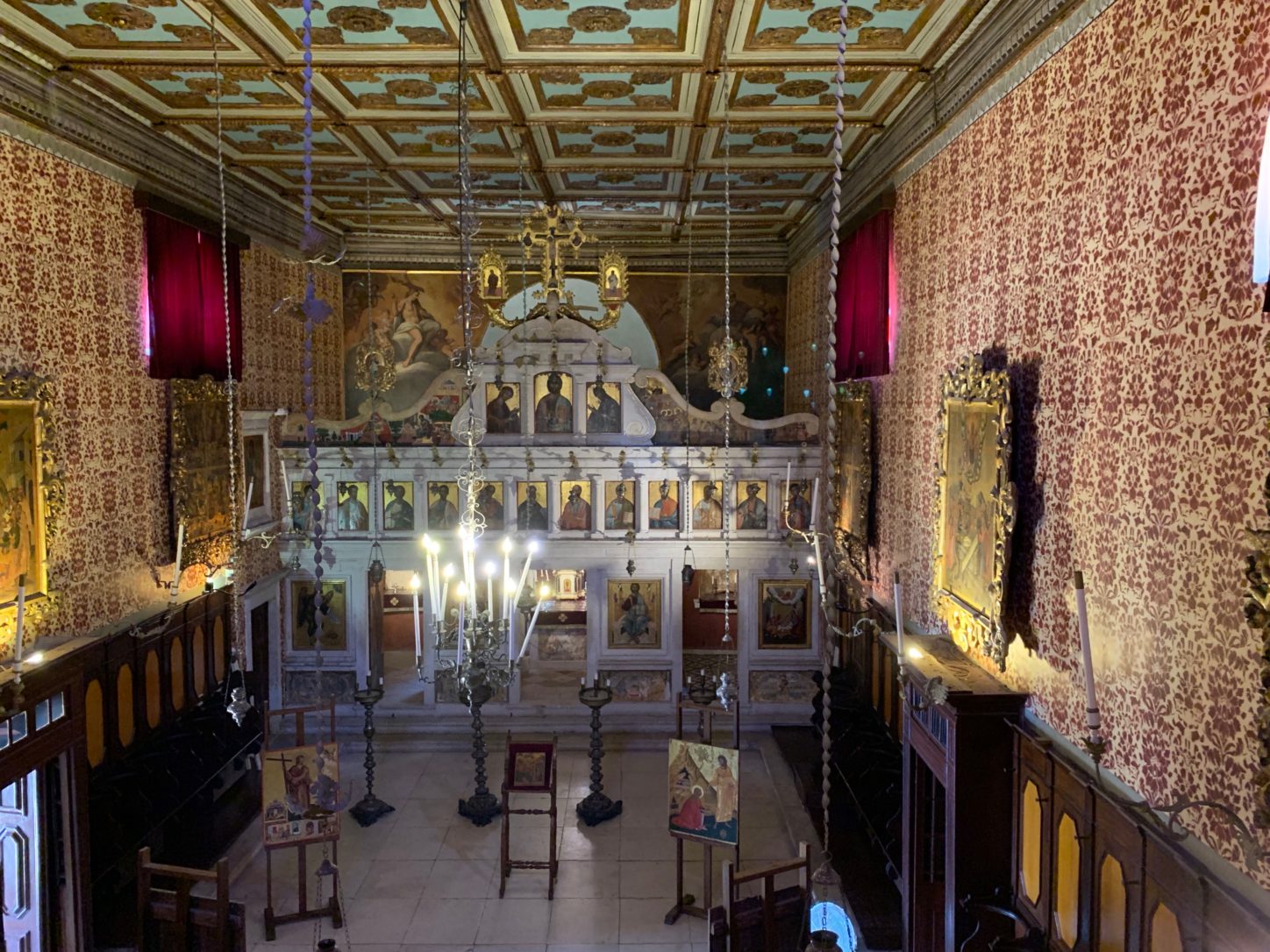
The place felt like a church because it had been one. Antivouniotissa, its pre-museum name, was a private church dedicated to the Holy Virgin. In 1979, three of the owner families donated the building along with its art, icons and heirlooms, to the Greek people on the condition it be used as a museum.

Three Days on Corfu
Steps to the Byzantine Museum, Corfu, Greece. Photo by ConsumerMojo.com

Actress Melina Mercouri, famous for her portrayal of a prostitute in the 1960 movie “Never on Sunday,” dedicated it in 1984 when she was the Greek Minister of Culture. And it’s still used twice a year, on August 23 and December 26, for religious services dedicated to the Virgin, making it Greece’s only church-museum.

The Byzantine Museum, Corfu. Photo by ConsumerMojo.com.

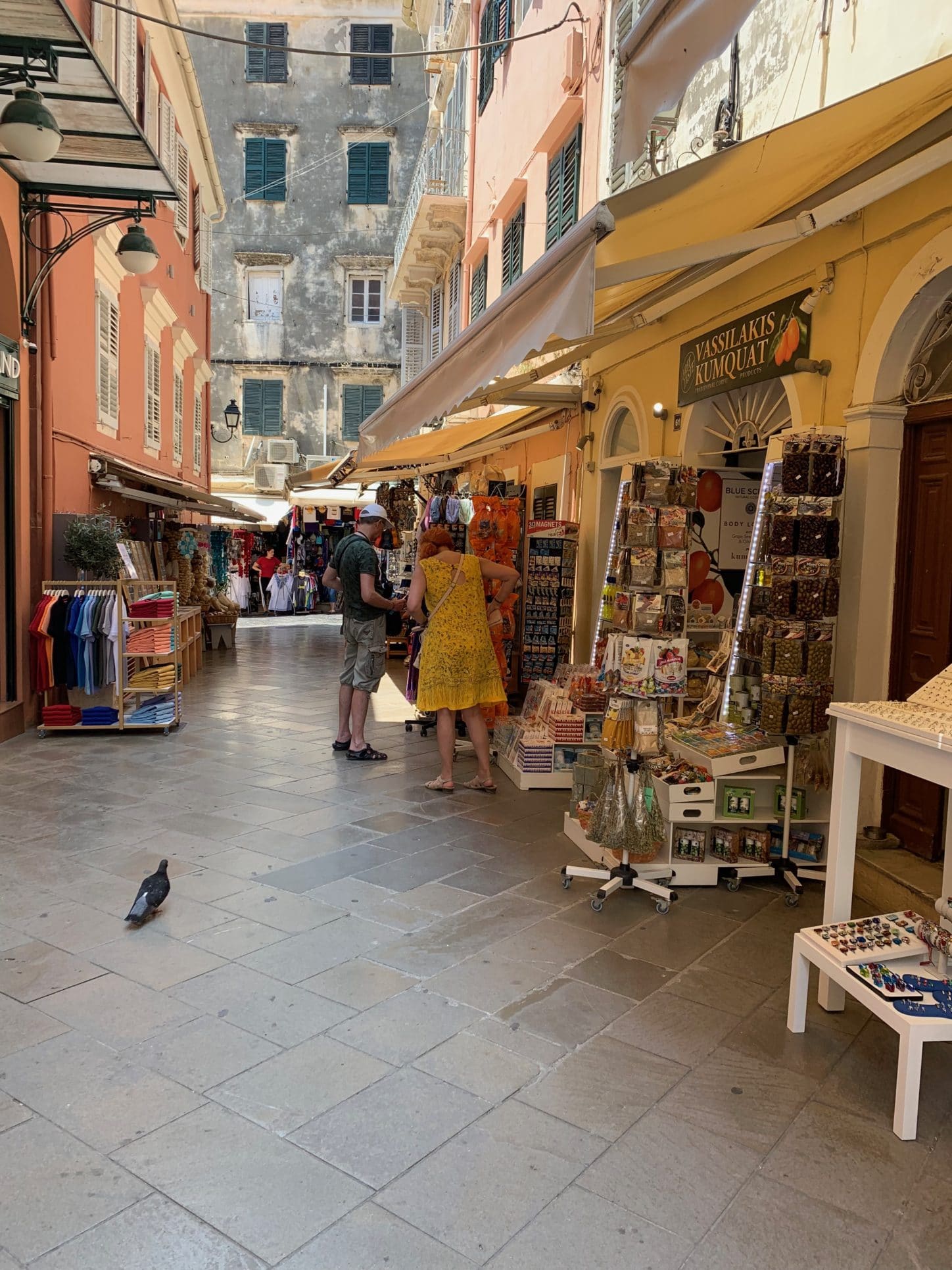
We stepped out into the bright sunshine and walked south and east along shop-lined pedestrian streets toward the Old Fortress.

Three Days on Corfu
 A Shopping Street near Corfu Town’s Old Fortress. Photo by ConsumerMojo.com

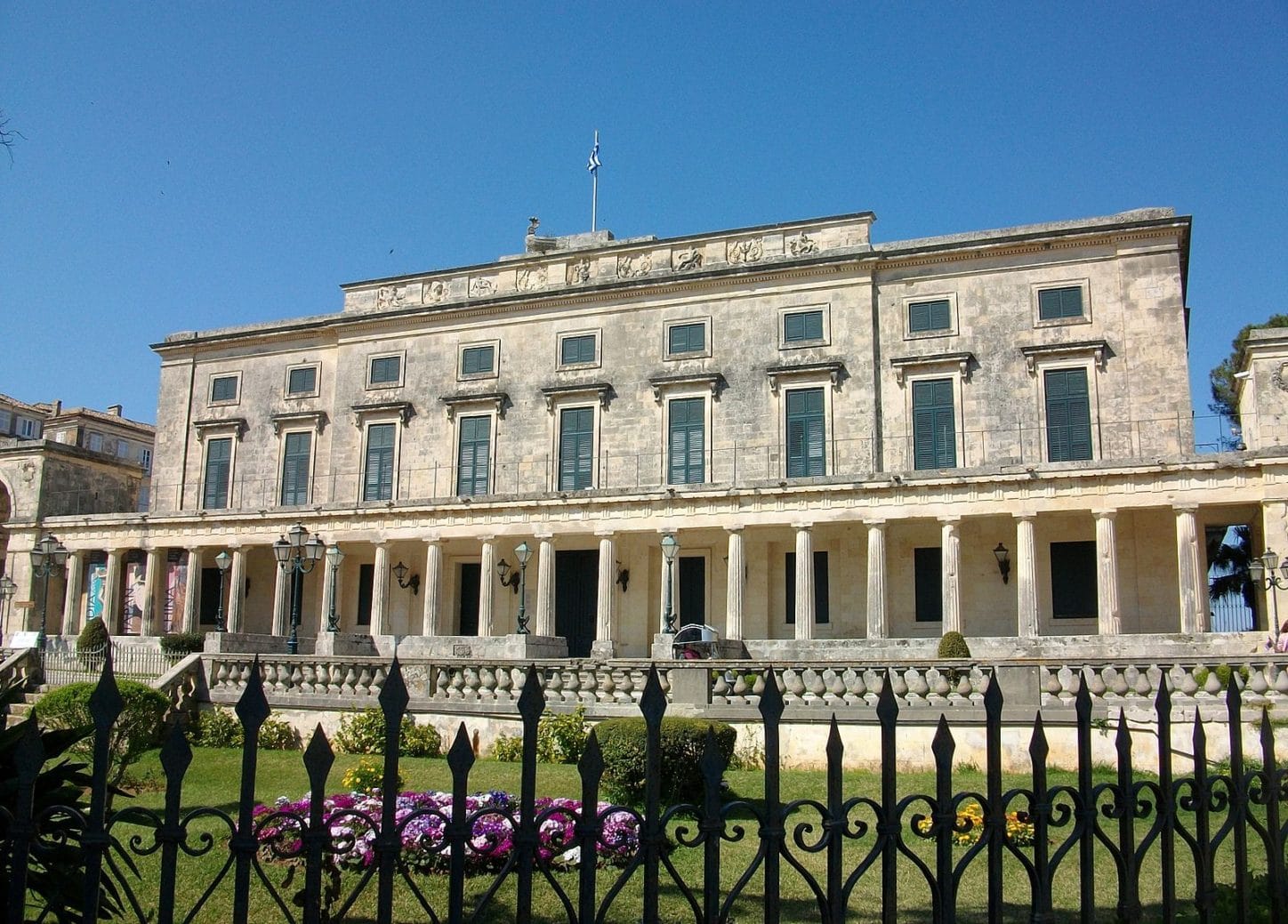
We began to think about lunch, and Barbara stopped into a store that sold eyeglass and asked for a recommendation. The woman thought for a minute. “Do you want to be near the sea?” she asked. “If possible,” Barbara said, and added that we wanted fish. “Ah,” she said knowingly and wrote down a name on the back of her business card.  She directed us to head through Corfu Town through the area of the Palace of St. Michael and St. George, that from 1814 to 1824 was the home of the British Governor of Corfu. Turn left when we saw the water and we’d find the Veranda Taverna easily.

Three Days in Corfu
Palace of Saint Michael and St. George, Corfu Town. Photo by joanbanjo, Creative Commons License

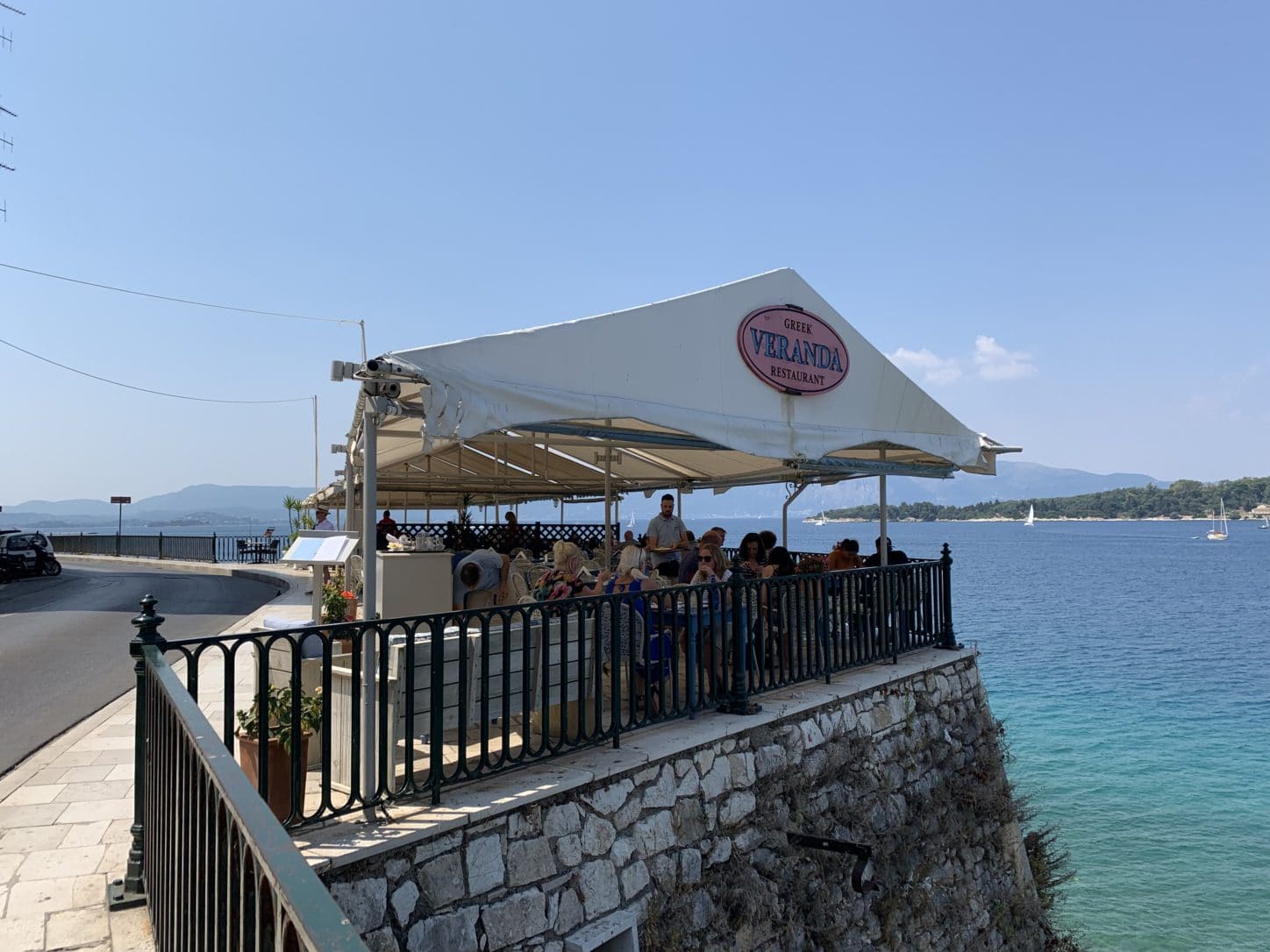
We walked through an archway out to the sea wall, wound our way around and there was a lovely restaurant jutting out over the water.

Three Days on Corfu
Veranda Taverna, Corfu Town, Greece. Photo by ConsumerMojo.com

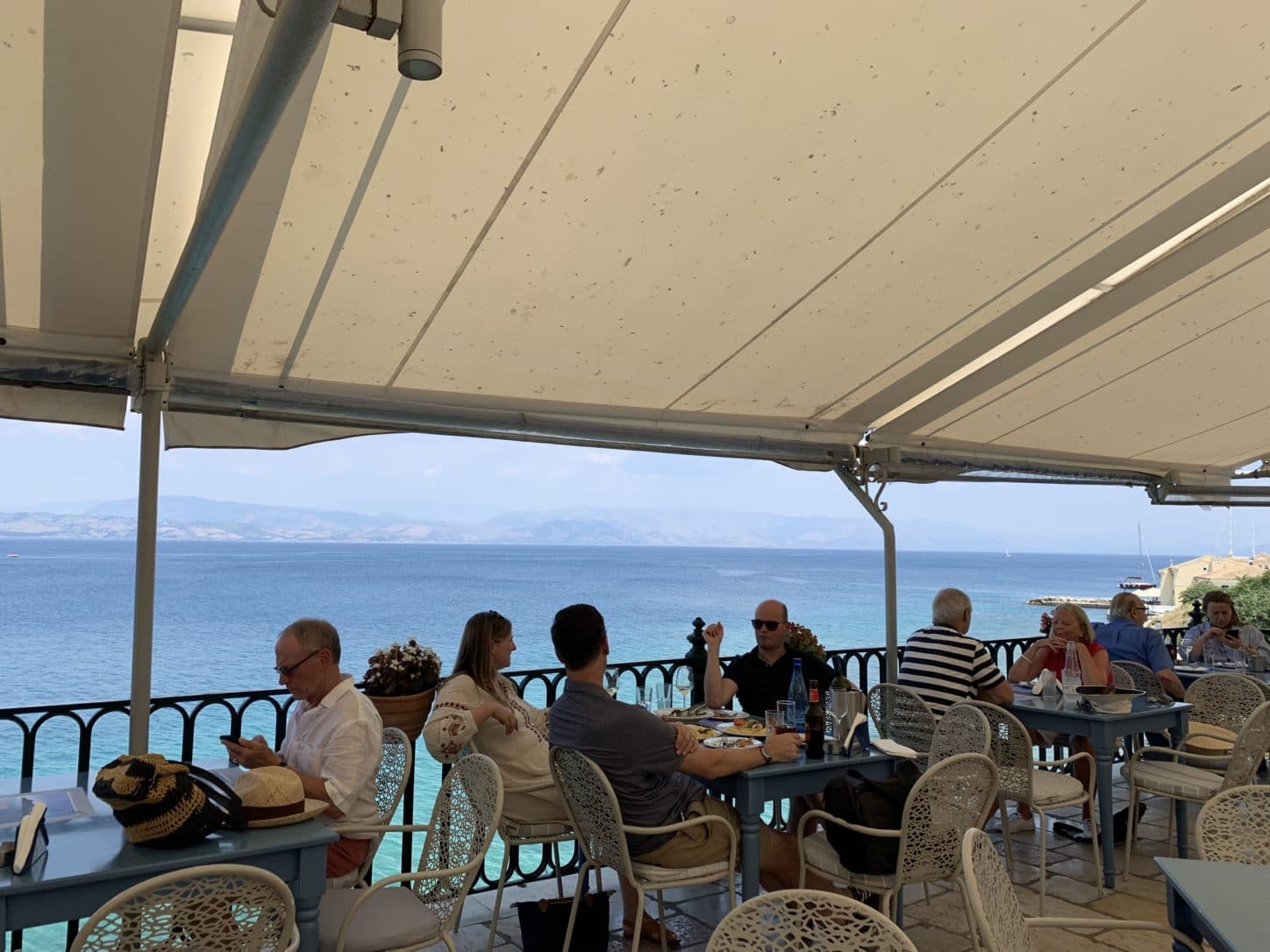
We took a table at the edge of the covered terrace and sat back to enjoy the view. 

Three Days on Corfu
Lunch on the Terrace of Veranda Taverna, Corfu Town, Greece. Photo by ConsumerMojo.com
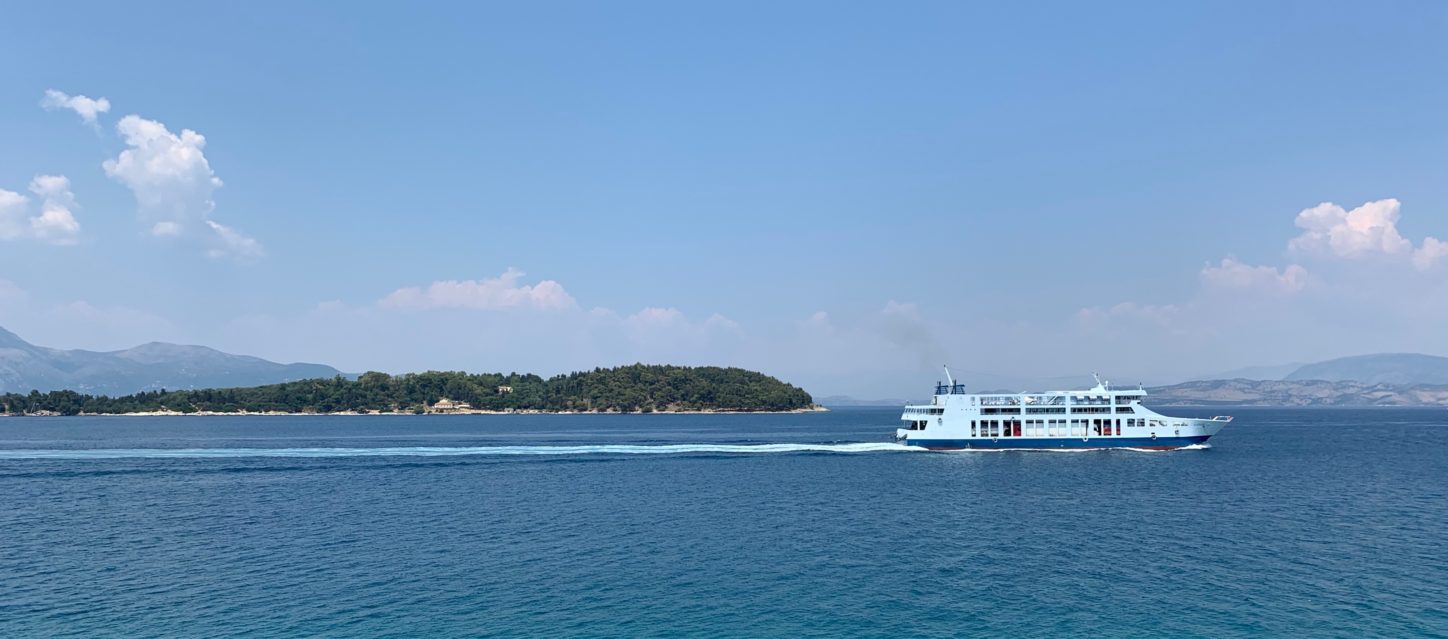
Ferry leaving Port of Corfu seen from the Veranda Taverna. Photo by ConsumerMojo.com.

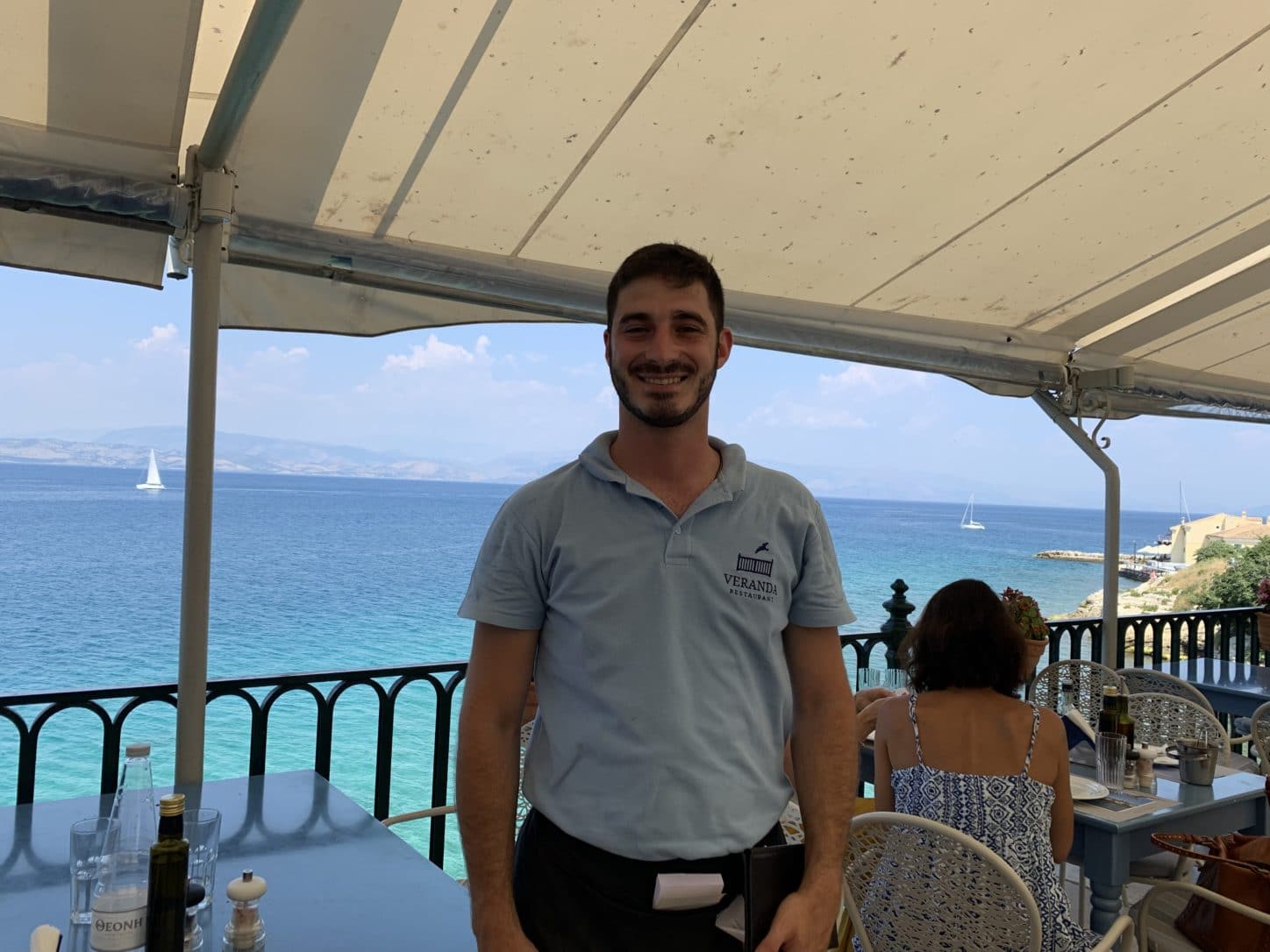
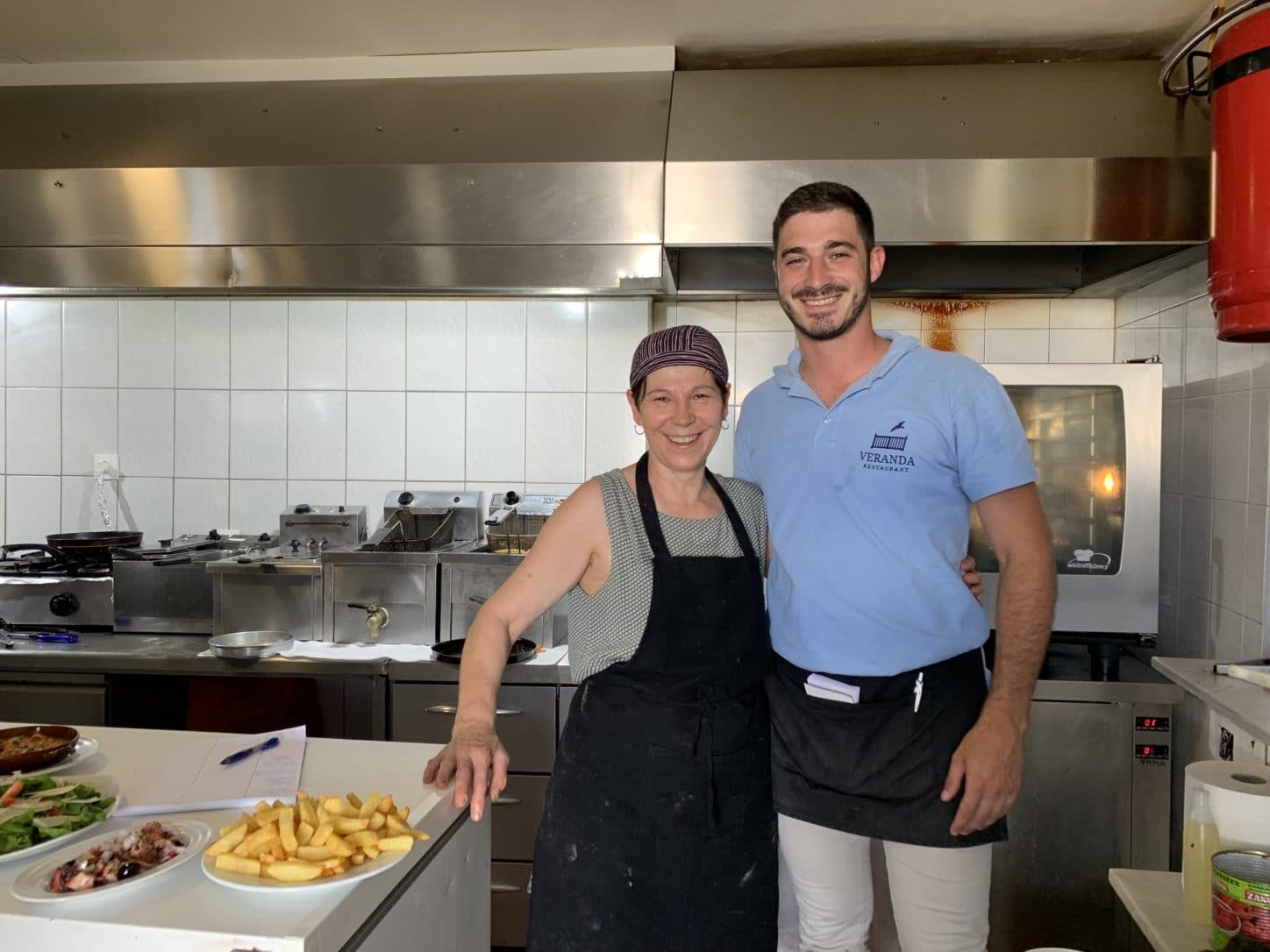
We split mussels in tomato sauce with feta and a couple of salads for a perfect lunch. We learned that Veranda Taverna is a family affair.  Spiros Grammenos owns it with his dad and brother Michael.

Three Days in Corfu
Spiros Grammenos, Veranda Taverna, Corfu Town, Greece. Photo by ConsumerMojo.com

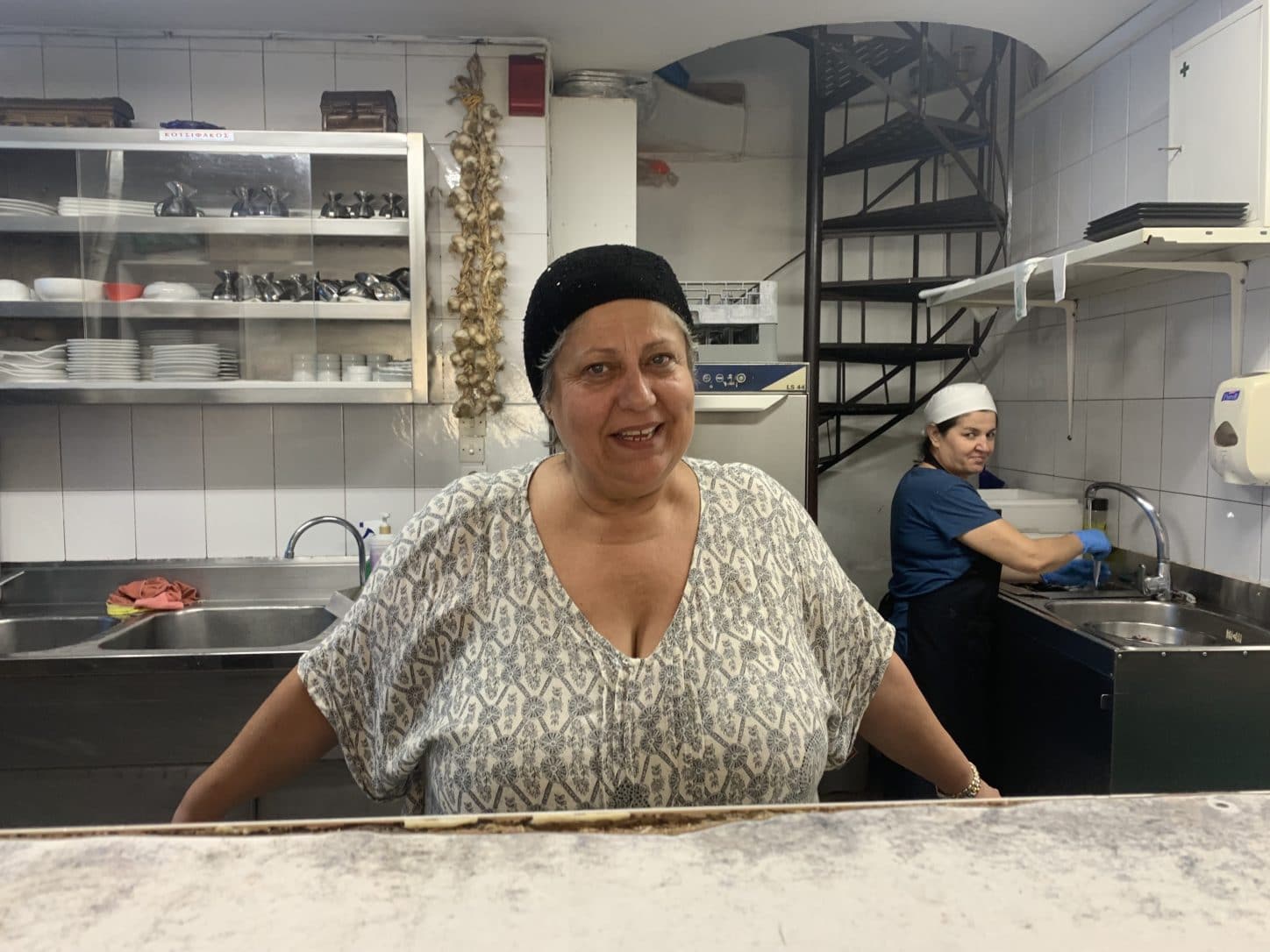
And in the kitchen Aunt Voula does the cooking.

Three Days on Corfu
Spiros Grammenos and Aunt Voula, the Chef, Veranda Taverna, Corfu Town, Greece. Photo by ConsumerMojo.com

After lunch we headed north and across the island to the beaches George and Nota had suggested. 

Three Days On Corfu
Swimming Hole near a Bar, Palaiokastritsa, Corfu, Greece. Photo by ConsumerMojo.com

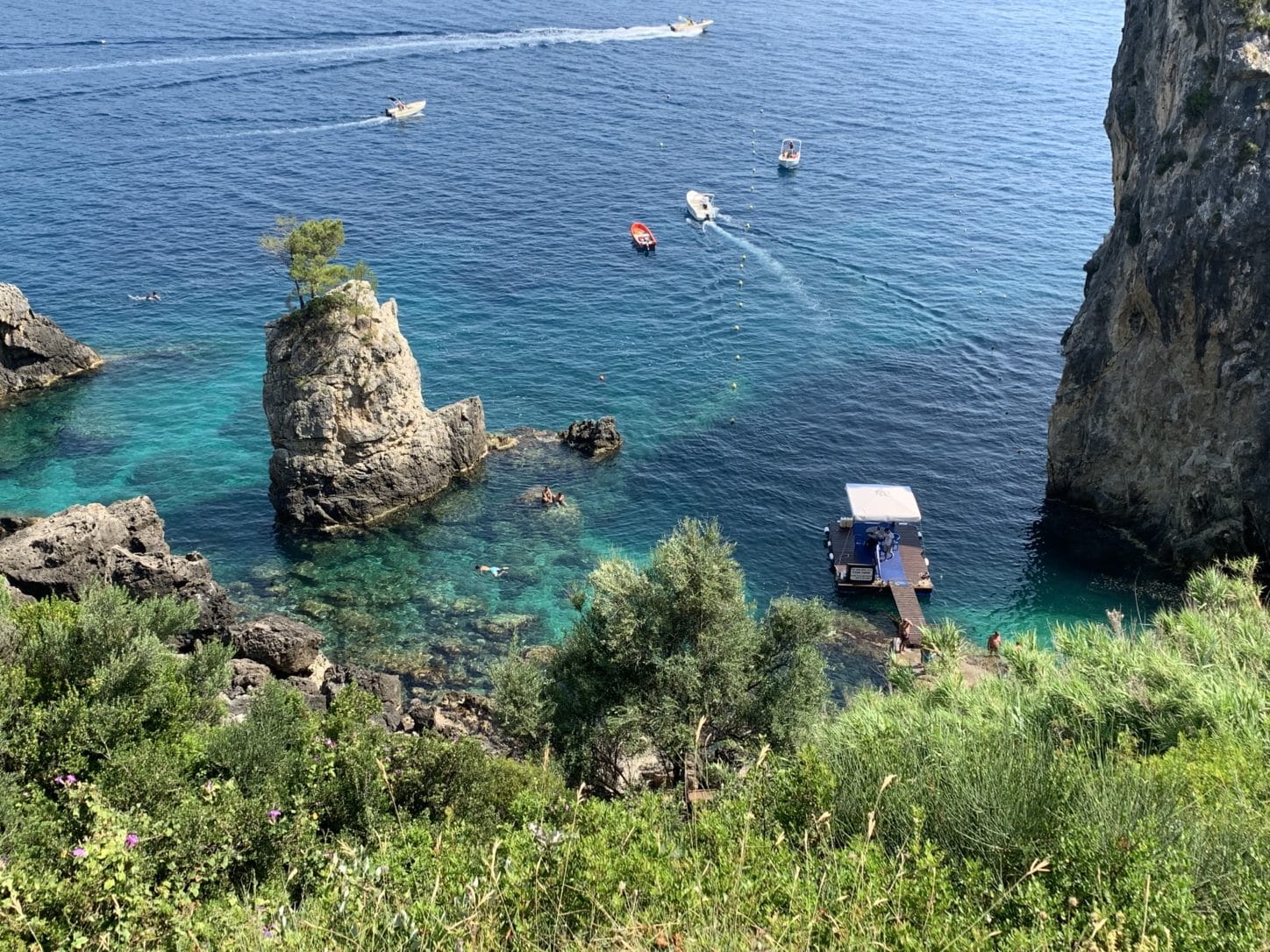
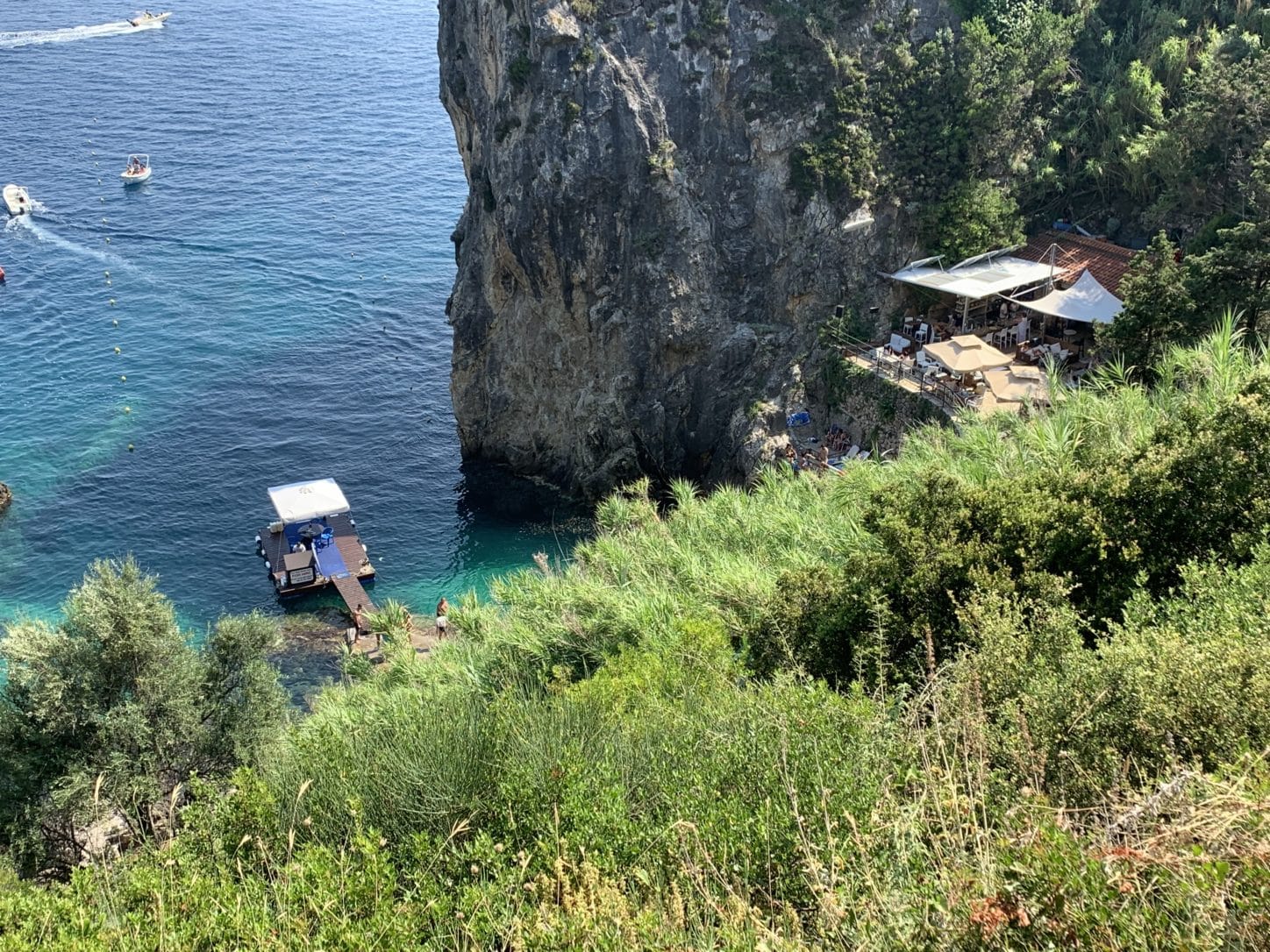
Half an hour later, we parked beside the road at Palaiokastritsa on Corfu’s west coast. Sounds of rock music rose from below, and from an overlook we saw a bar tucked into the creases of a steep hillside next to a sheer cliff. Blue water lapped at rock outcrops below the bar.

Three Days On Corfu
Palaiokastritsa, Corfu, Greece. Photo by ConsummerMojo.com

A small boat followed a straight line of white buoys to a square dock. People swam in the turquoise water and we were tempted but ultimately not so interested in the bar.

Three Days on Corfu
Paleokastritsa, Corfu, Greece. Photo by ConsumerMojo.com

We followed switchback turns along the seaside cliffs to another stopping point. Here we descended a long set of steps to find a narrow beach with a rocky shore.  It turns out a lot of the small beaches look better from far away.

Three Days on Corfu Beach on the Ionian Sea
Beach on the Ionian Sea. Photo by ConsumerMojo.com

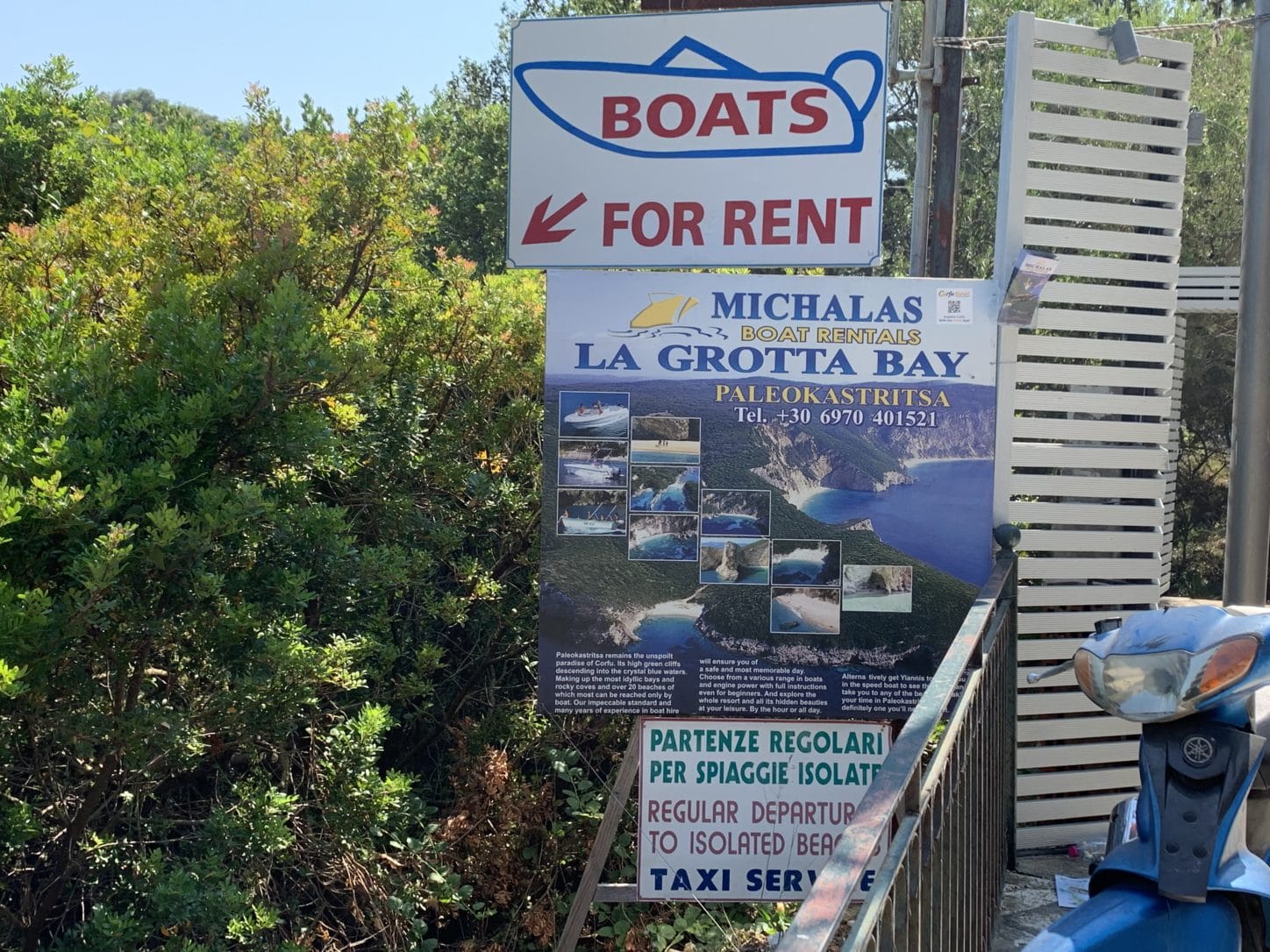
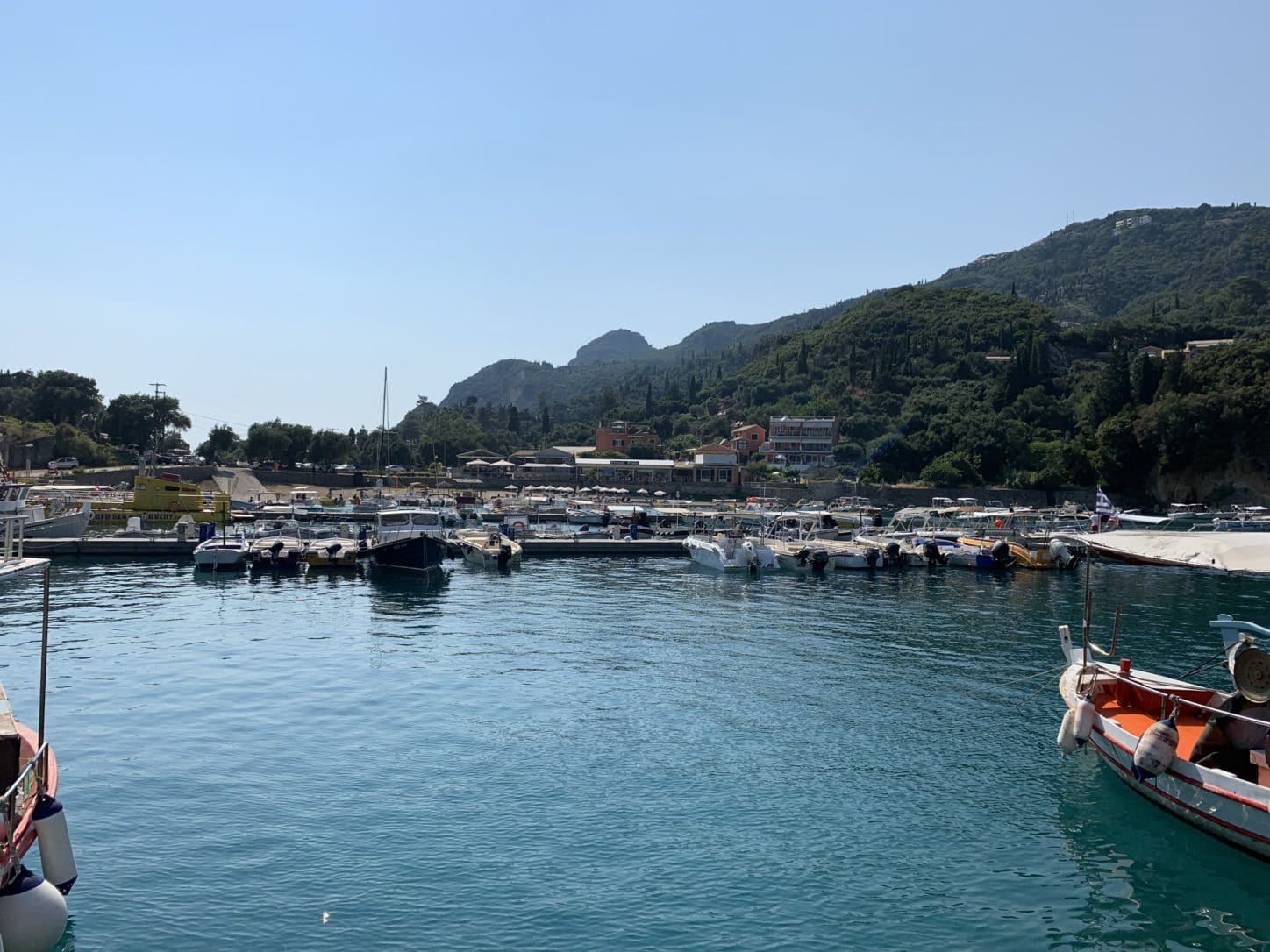
We like to sail and often see places from afar that look more intriguing than they actually are close up. But here on Corfu we persisted. A little farther on we turned into the Palaiokastritsa Harbor, where signs advertised boat rentals.

Three Days on Corfu
Boats in Palaiokastritsa Harbor. Photo by ConsumerMojo.com

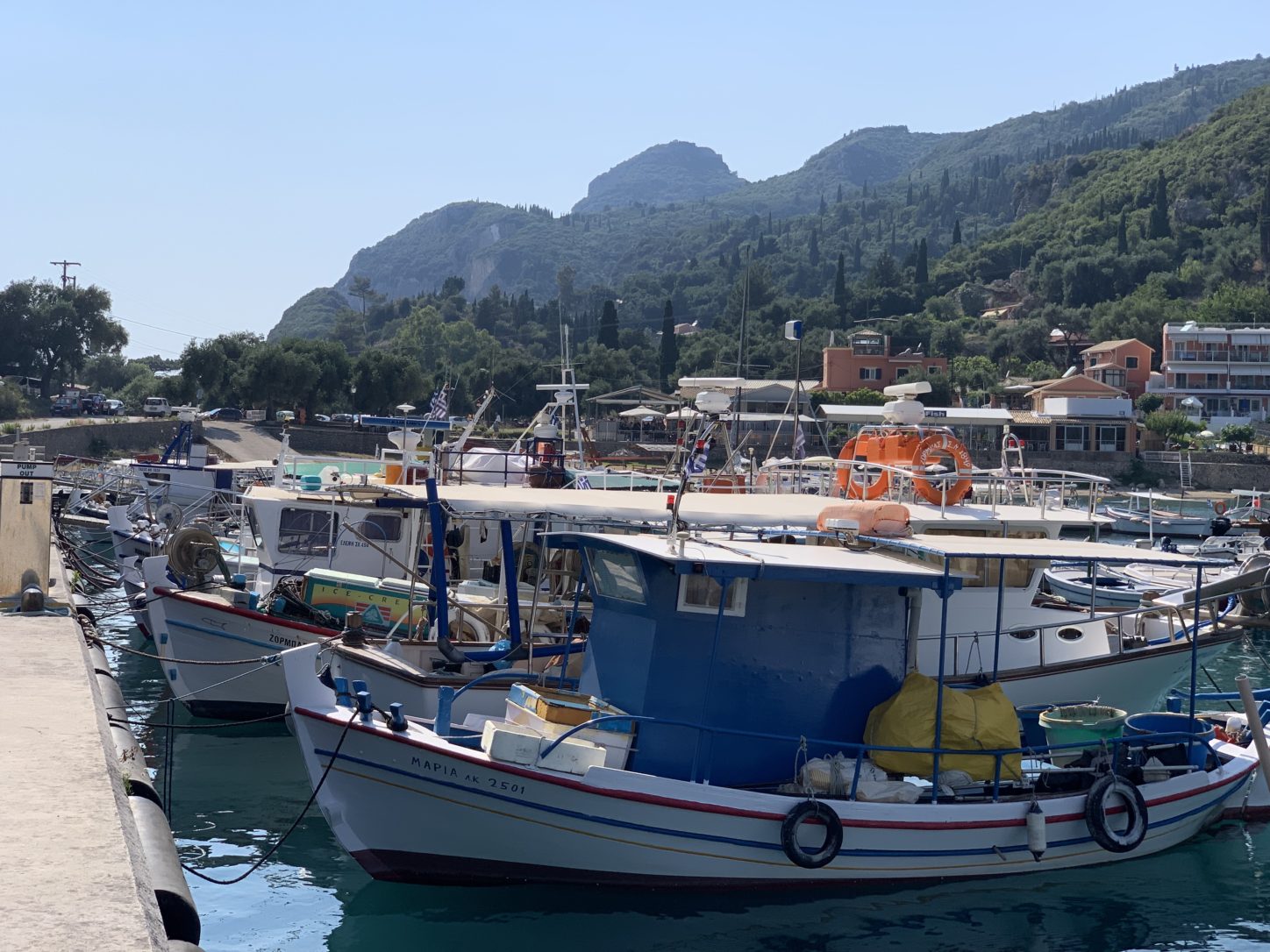
Fishing boats bobbed at the docks along with some private yachts and the small rental boats. 

Fishing boats at Palaiokastritsa Harbor. Photo by ConsumerMojo.com.

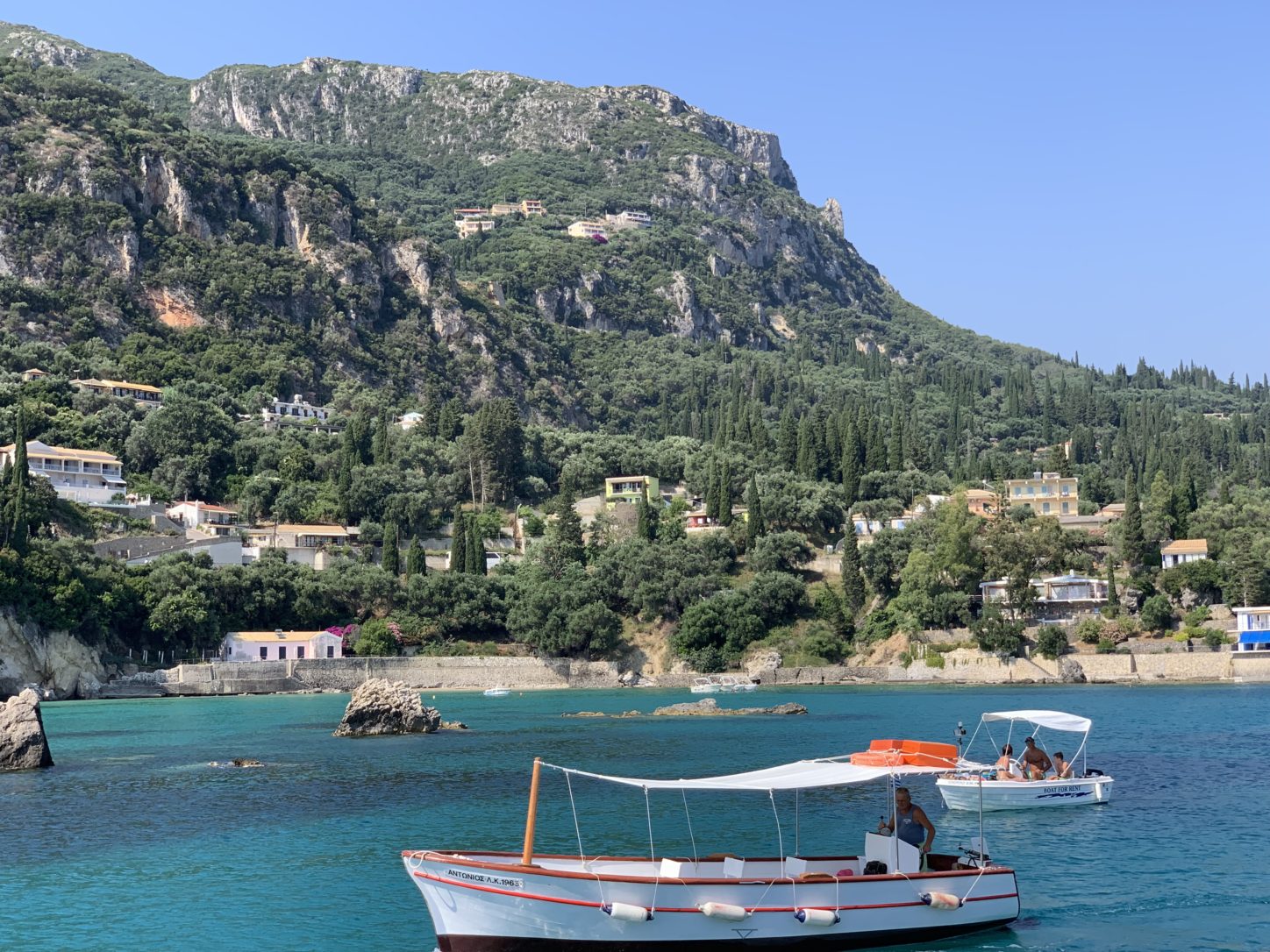
Boats shuttled in and out of the small harbor against the spectacular backdrop of Corfu’s rocky hills.

Hills of Corfu from Palaiokastritsa Harbor. Photo by ConsumerMojo.com.

Now it was late, and we still hadn’t felt sand between our toes or walked on a rocky beach. But we decided the Castello di Vista pool was our best before-dinner destination and drove back across Corfu. 

After some paddle ball in the pool and some down time, we headed out for George’s latest restaurant recommendation. He said this place had great food, spectacular views, and wasn’t far away.

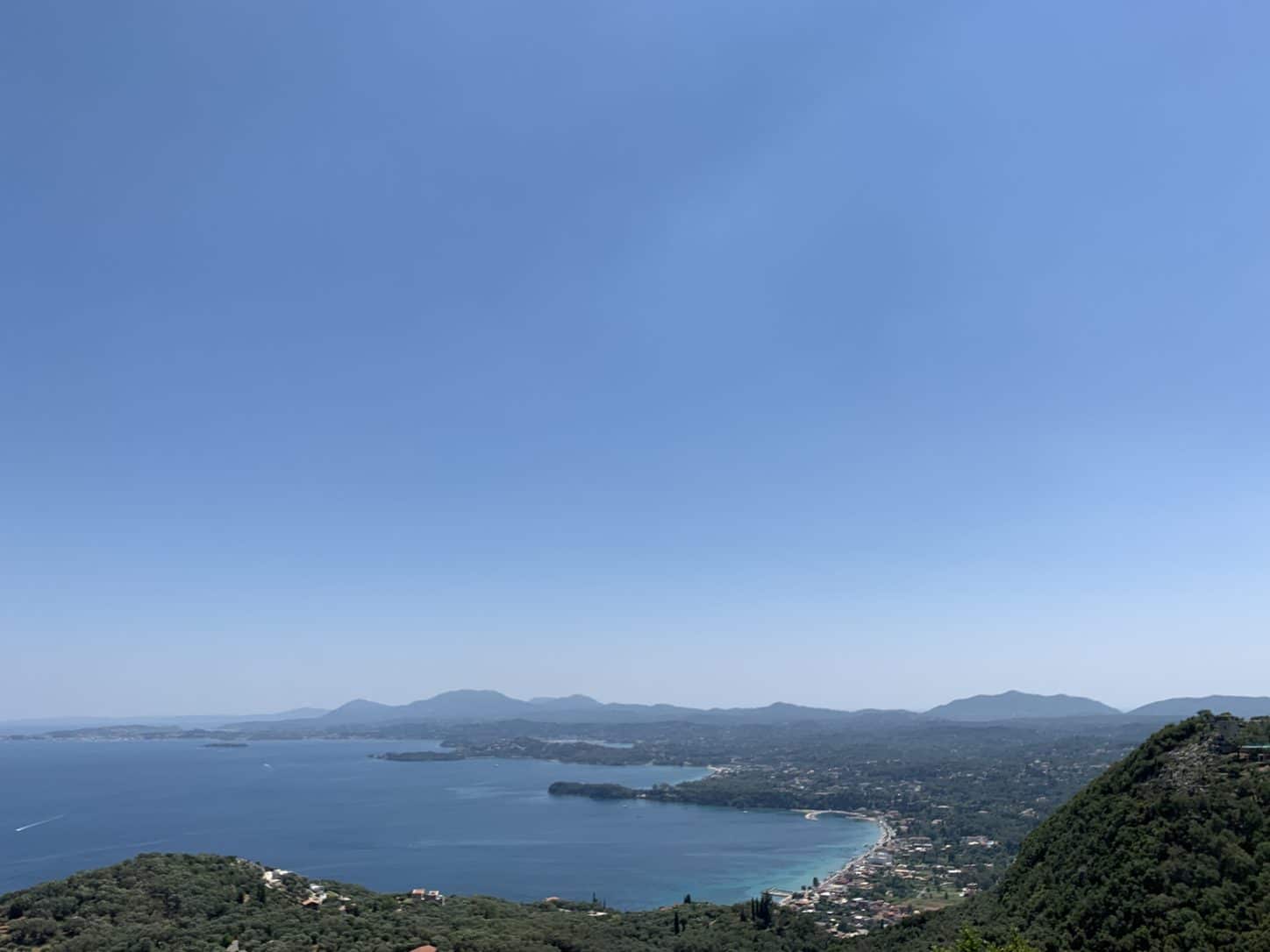
We descended through the warren of Kata Korakiana to Ipsos, followed the beach north and rose through some new hills.

Three Days on Corfu
Looking down on Ipsos, Corfu. Photo by ConsumerMojo.com

Another switchback road, hard twists of the steering wheel, up, up and up. And this time the satellite disappeared and neither Google nor Apple maps knew where we were going. We headed back down. Nick asked directions at a restaurant, which wasn’t the one we were looking for. We turned around and went up again. Finally prudence took hold. Wherever this Taverna Agnadio was, we weren’t going to have dinner and wine there and feel safe getting back to the hotel.

Down we went, all those switchbacks again, and came out at the north end of Ipsos Beach. The lights ahead advertised a wealth of possibilities.

Three Days on Corfu
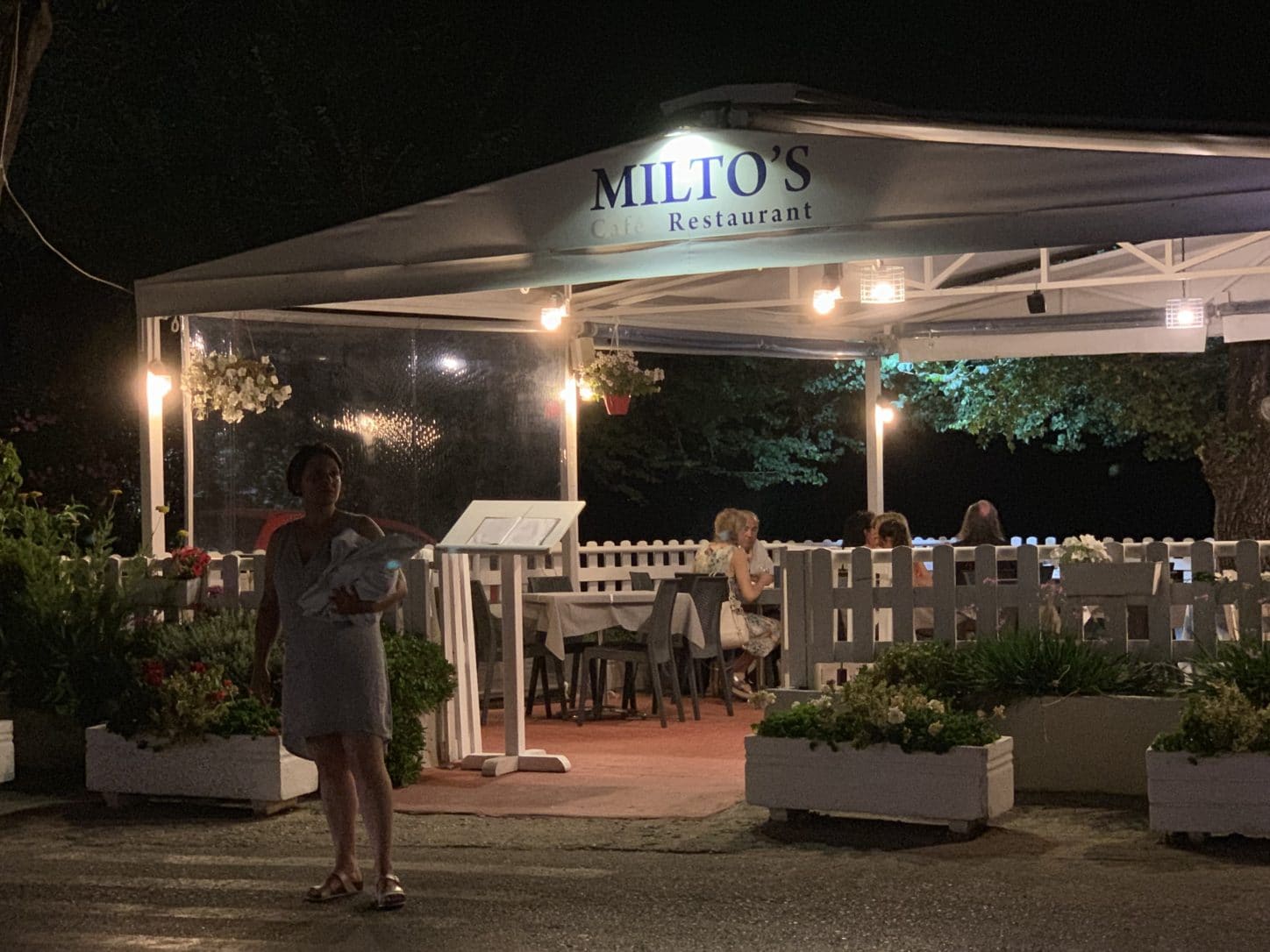
Miltos Restaurant, Ipsos Beach, Corfu, Greece. Photo by ConsumerMojo.com

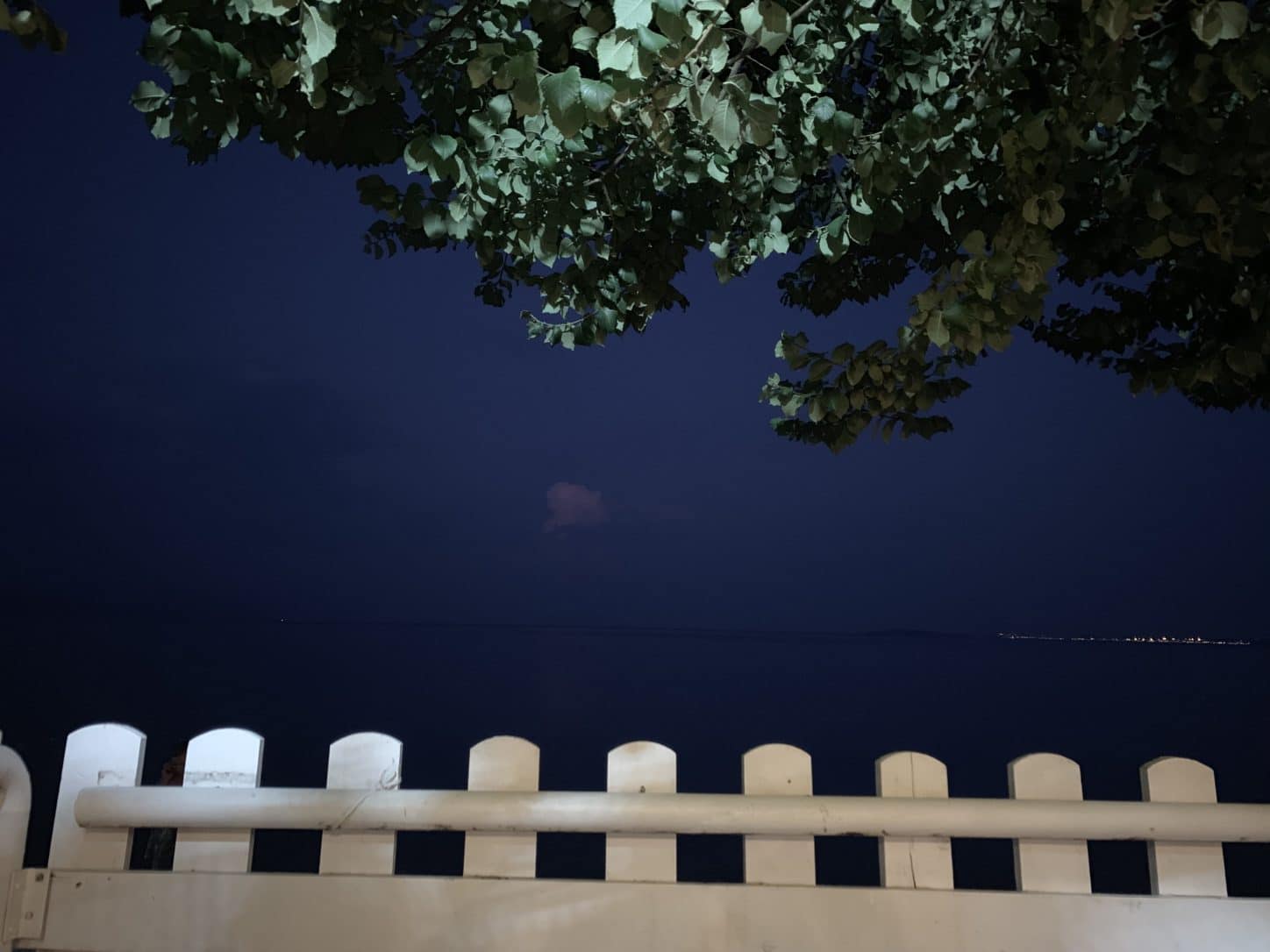
We parked and randomly chose the Miltos family taverna over the place next door. “I don’t want to eat at a place called Moby Dick,” said Barbara. A terrace table put us at the water’s edge with a view of a blue velvet night sky.

Three Days on Corfu
Night Sky from Miltos Family Taverna, Corfu, Greece. Photo by ConsumerMojo.com

We ate grilled fish and drank Assyrtiko and enjoyed the night.

Technology toyed with us on our way back to the hotel. So far it hadn’t made a difference whether we used Apple maps or Google maps for our GPS directions. This time it did. We didn’t know which one was the culprit, but in the maze around Castello di Vista we found ourselves on roads that didn’t look right and the dashboard voice told us we’d have to park and walk to our destination. That wasn’t going to happen. Barbara, the navigator, switched programs and we eventually found our way

The next morning, George asked us how we’d liked his restaurant recommendation. “We didn’t get there,” Nick explained. “The road was too much. We decided we didn’t want to come down the mountain after drinking wine.”

“Oh,” said George. “Is it far up?”

“You’ve never been there?” Barbara asked, her voice rising with incredulity.

“No. Other guests have said it’s nice,” he said, shrugging off the conversation. Then a family with two young girls appeared asking for beach gear. So he was off the hook.

We planned to head up again in the same direction. Our destination for the day was Mount Pantocrator, Corfu’s highest point. The wordsmiths in us wondered about the name. Christ Pantocrator is the Eastern Orthodox image of Jesus, holding the Gospels in his left hand and offering blessings with his right. In this context it means “all powerful lord of the universe.” It can also mean “ruler of all,” which we supposed could apply to the island’s highest point. Also, there was an Orthodox monastery there, so the meanings were all jumbled. 

We had to go through Ipsos again to get there.

Three Days on Corfu
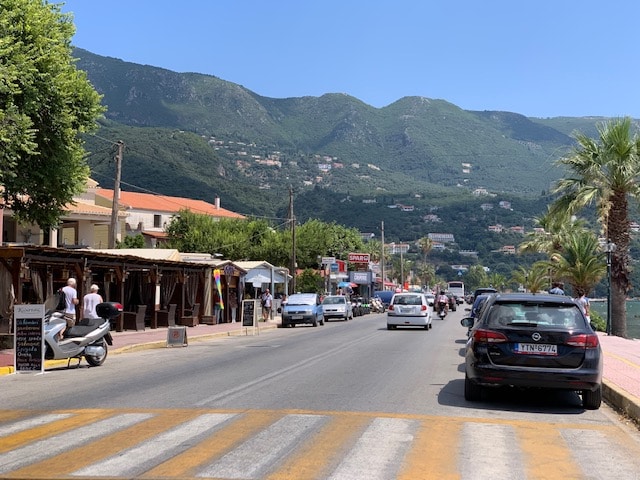
Ipos Town, Corfu, Greece.  Photo by ConsumerMojo.com

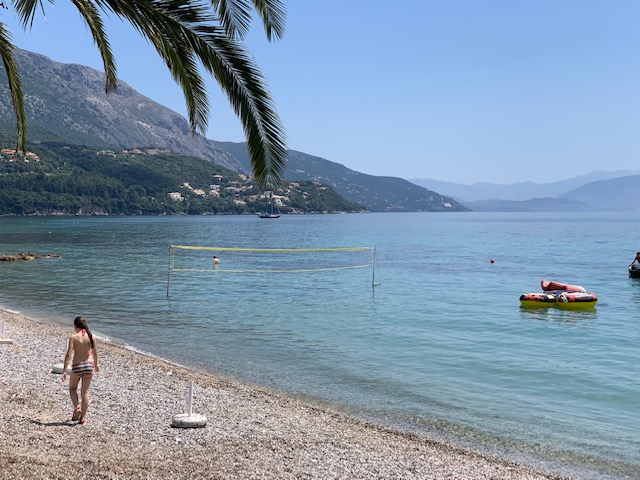
And we realized the long pebbly beach was as nice as any we had  seen. 

Three Days on Corfu
Ipsos Beach looking north. Photo by ConsumerMojo.com

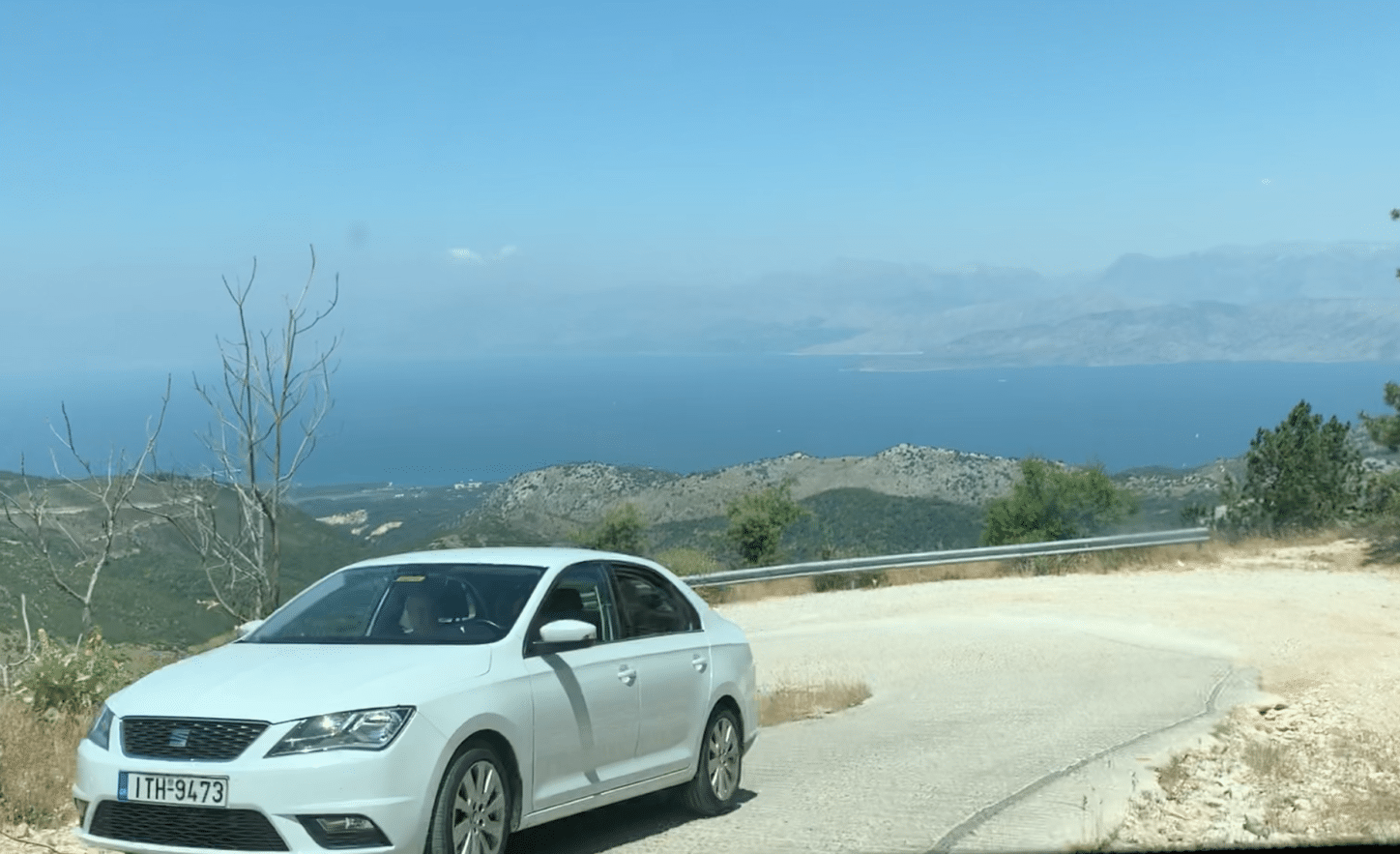
But we had other ideas for the day and drove up the same mountain road we were on the night before.

Three Days on Corfu
Driving up Pantocrator, Corfu, Greece. Photo by ConsumerMojo.com
Three Days on Corfu
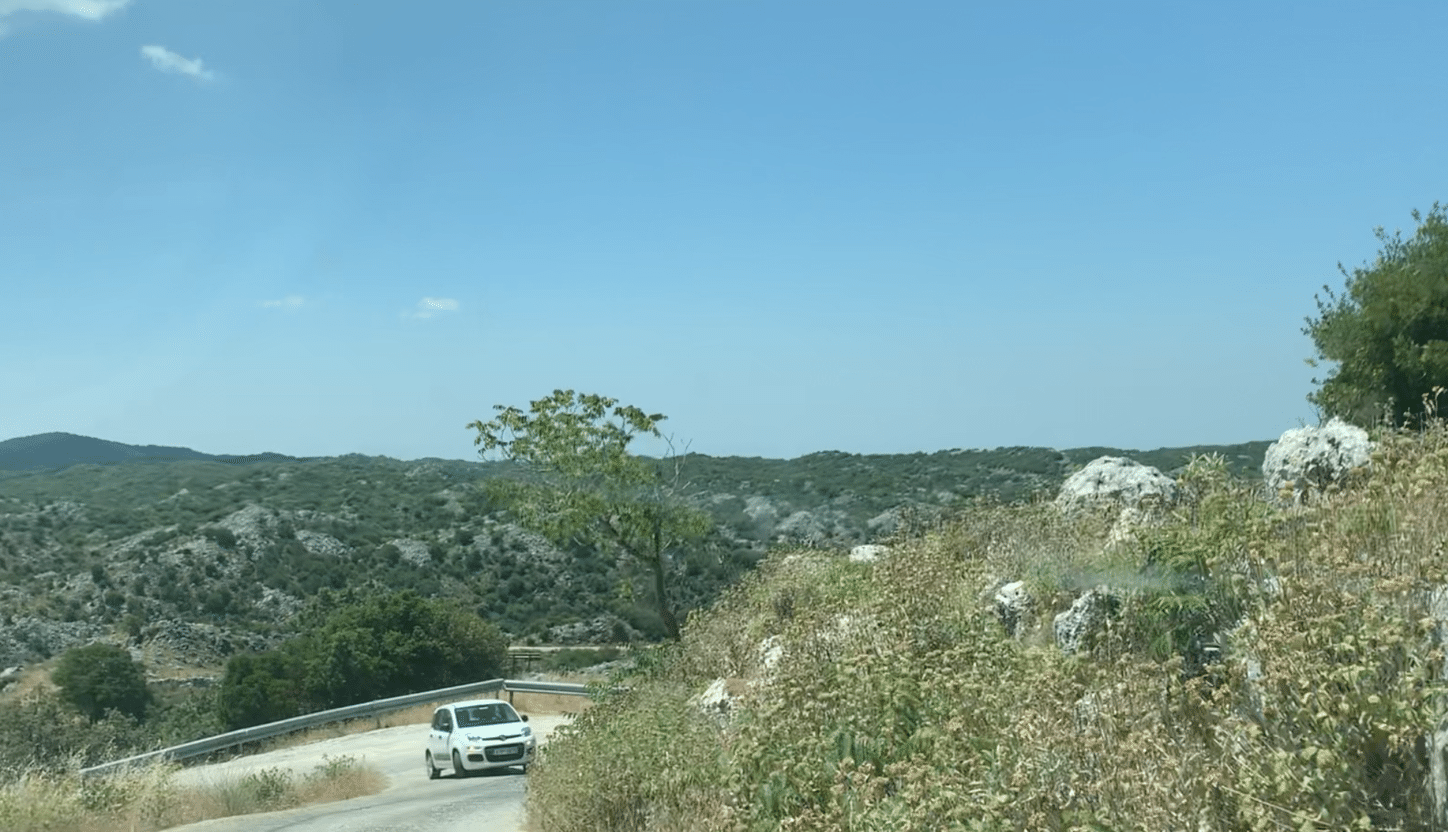
Hairpin Turn on Pantocrator, Corfu, Greece. Photo by ConsumerMojo.com

The hairpin turns and switchback climbs felt just as exciting in the daylight as they had in twilight.

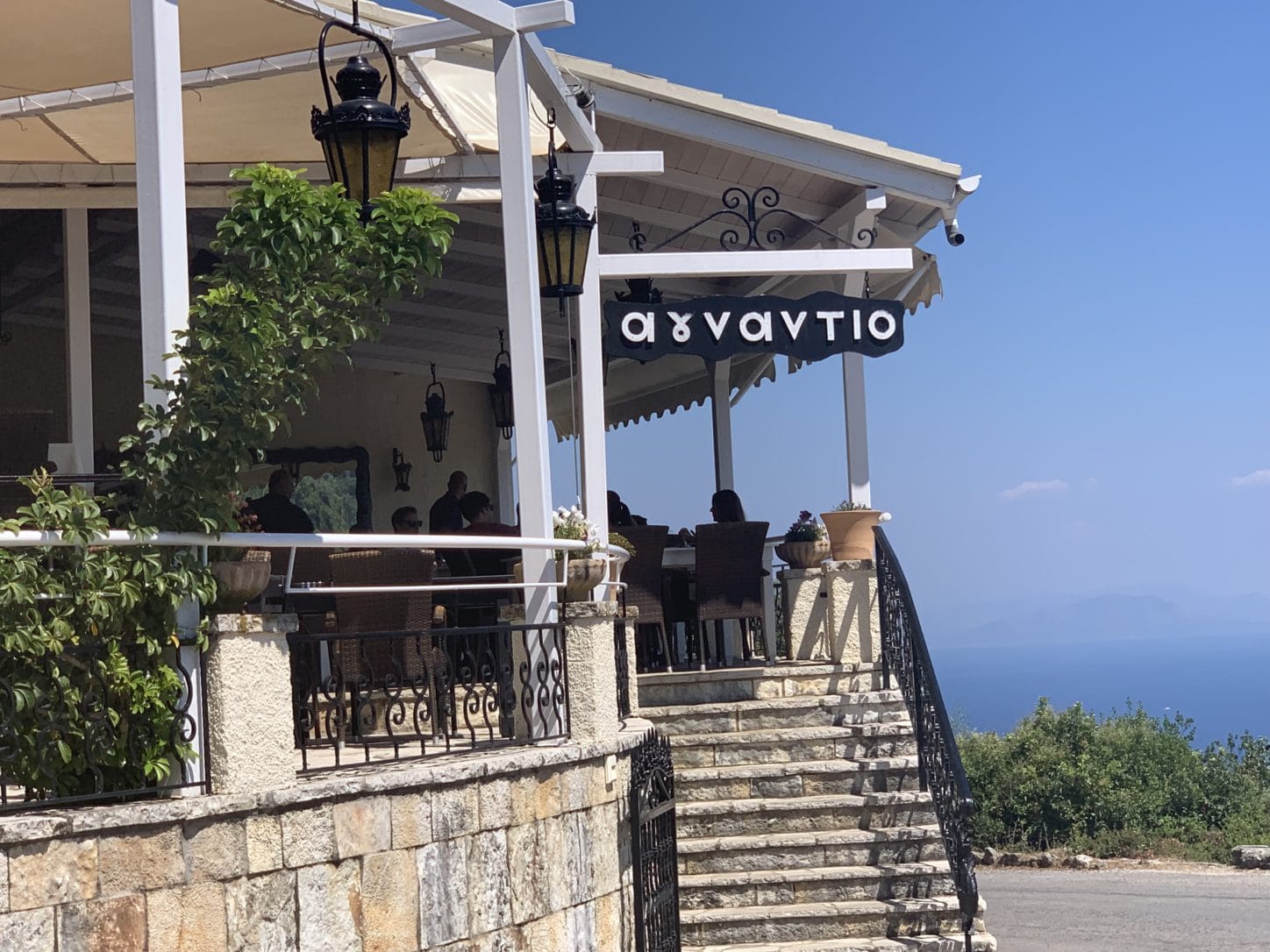
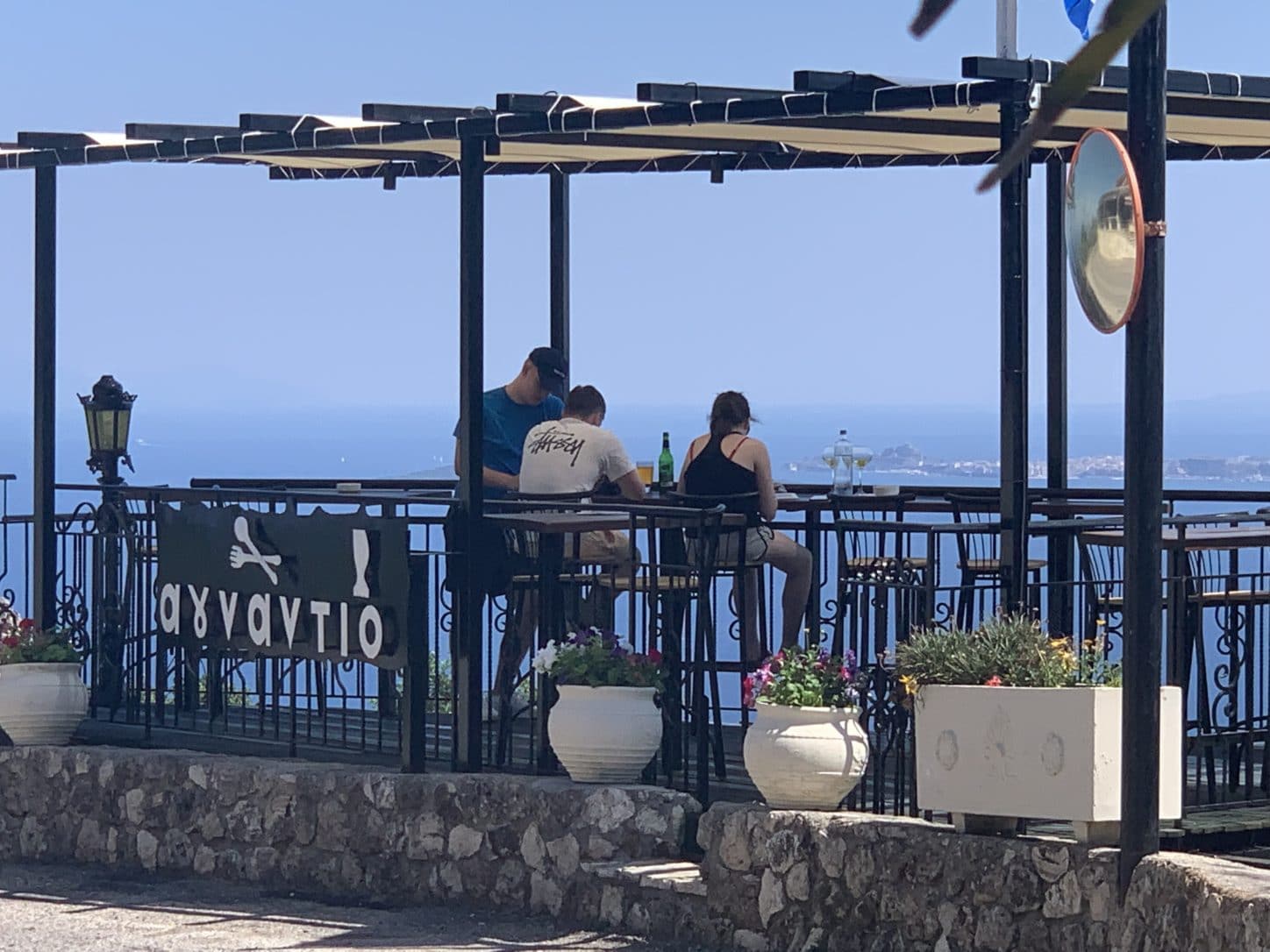
We finally came upon the Agnadio Taverna, yet we kept climbing.

Three Days on Corfu
Agnadio Taverna, Corfu, Greece. Photo by ConsumerMojo.com

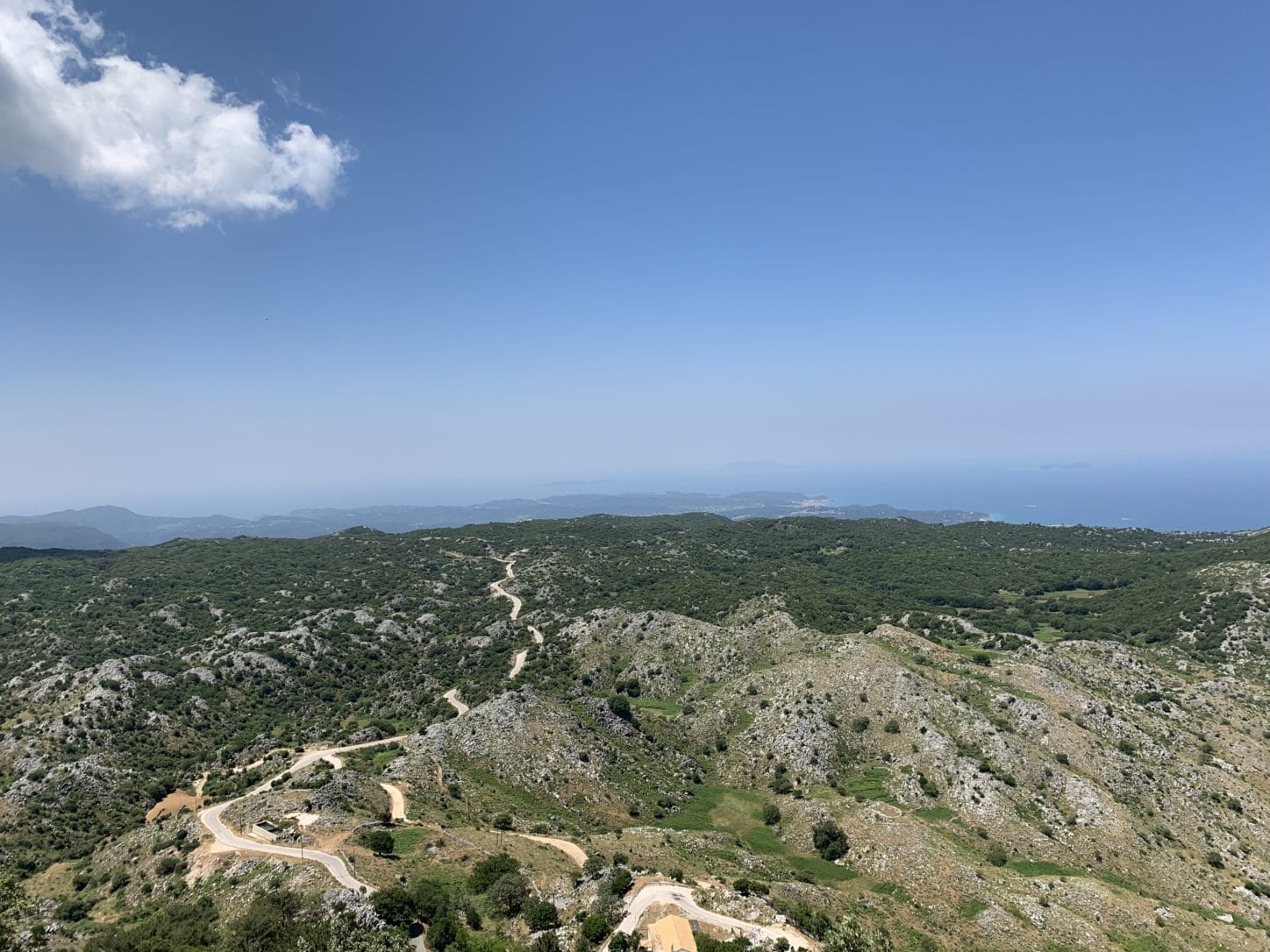
When the road leveled out it seemed like we were on top of Corfu. But we saw our destination far ahead, still higher.

Three Days on Corfu
Road to Pantocrator, Corfu, Greece. Photo by ConsumerMojo.com

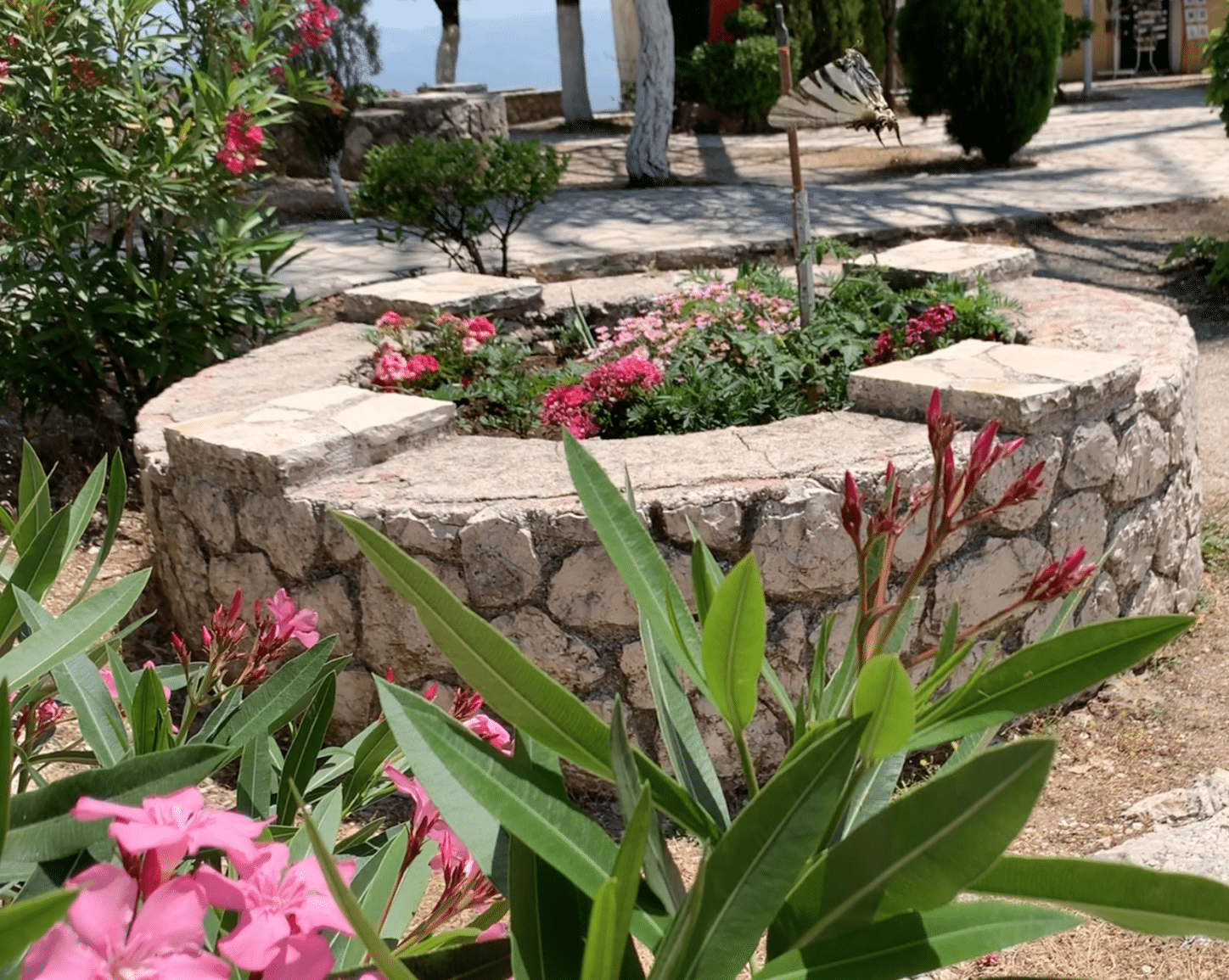
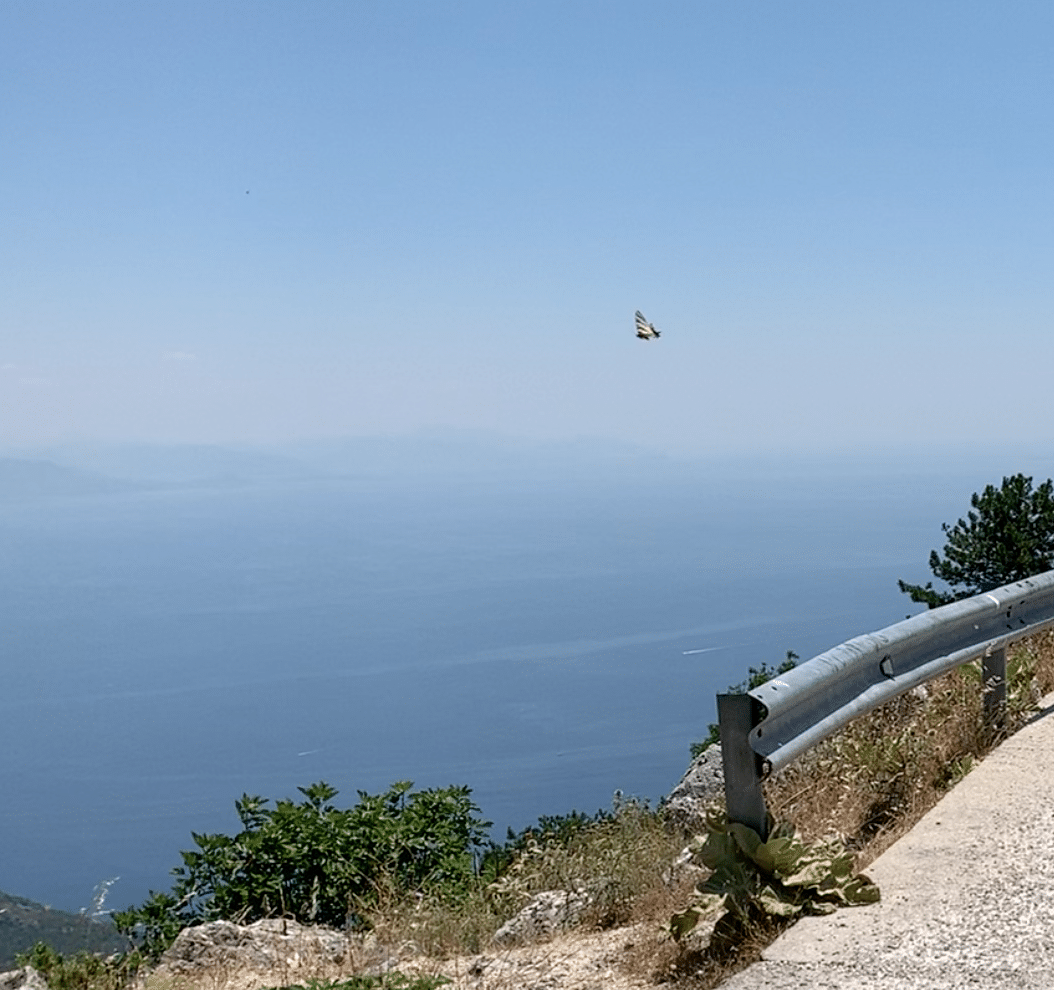
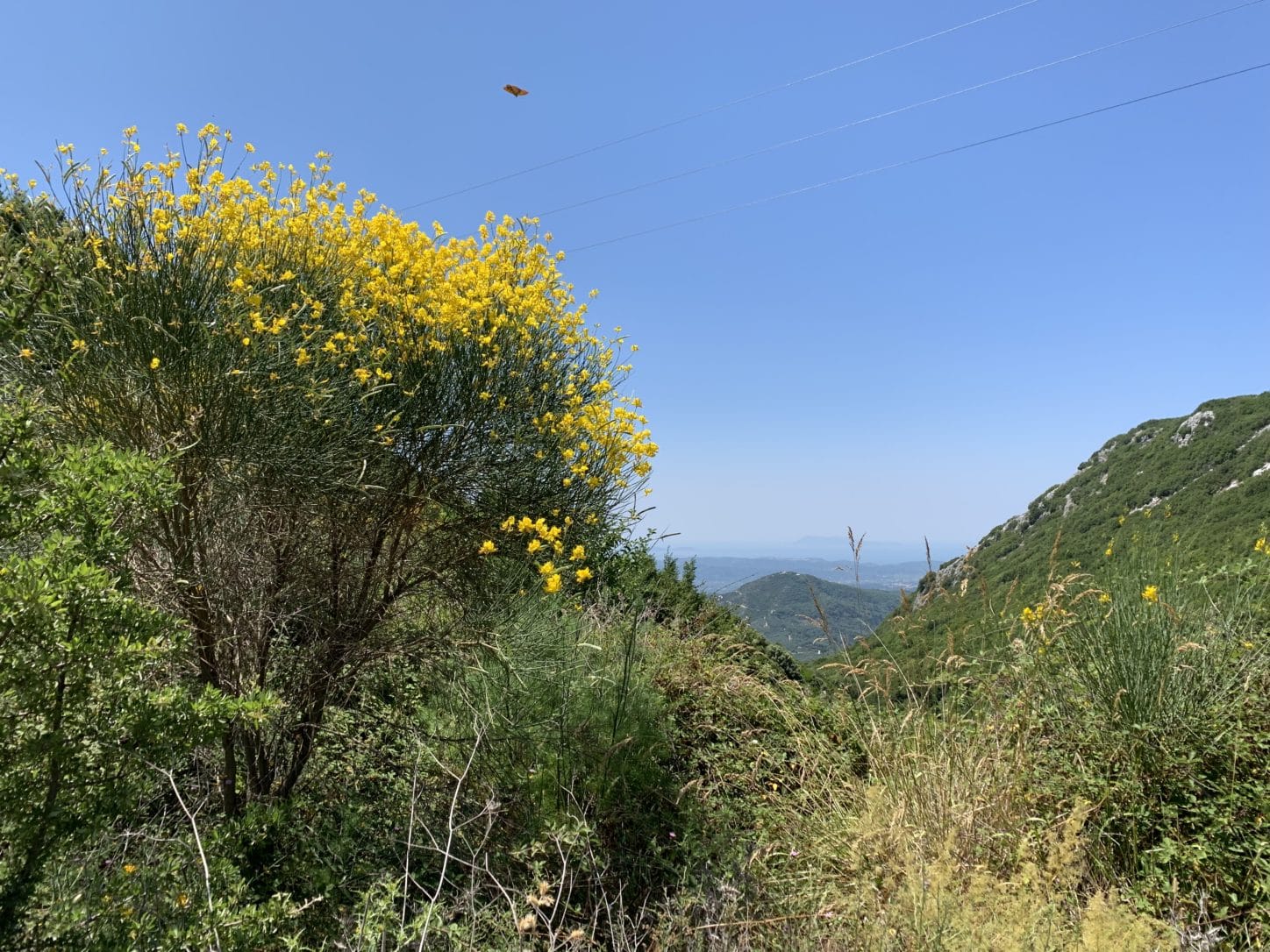
And the butterflies began to appear. Maybe they are drawn by the altitude, the breeze, the foliage, or Pantocrator. Who knows.

Three Days on Corfu
Butterfly at Pantocrator Monastery. Photo by ConsumerMojo.com
Three Days on Corfu
Butterfly on the edge of Pantocrator, Corfu, Greece. Photo by ConsumerMojo.com

The butterflies didn’t slow down for photos and we found them hard to capture on digital anything.  But they were everywhere.

Three Days on Corfu
Butterfly, Thinali, Corfu, Greece. Photo by ConsumerMojo.com

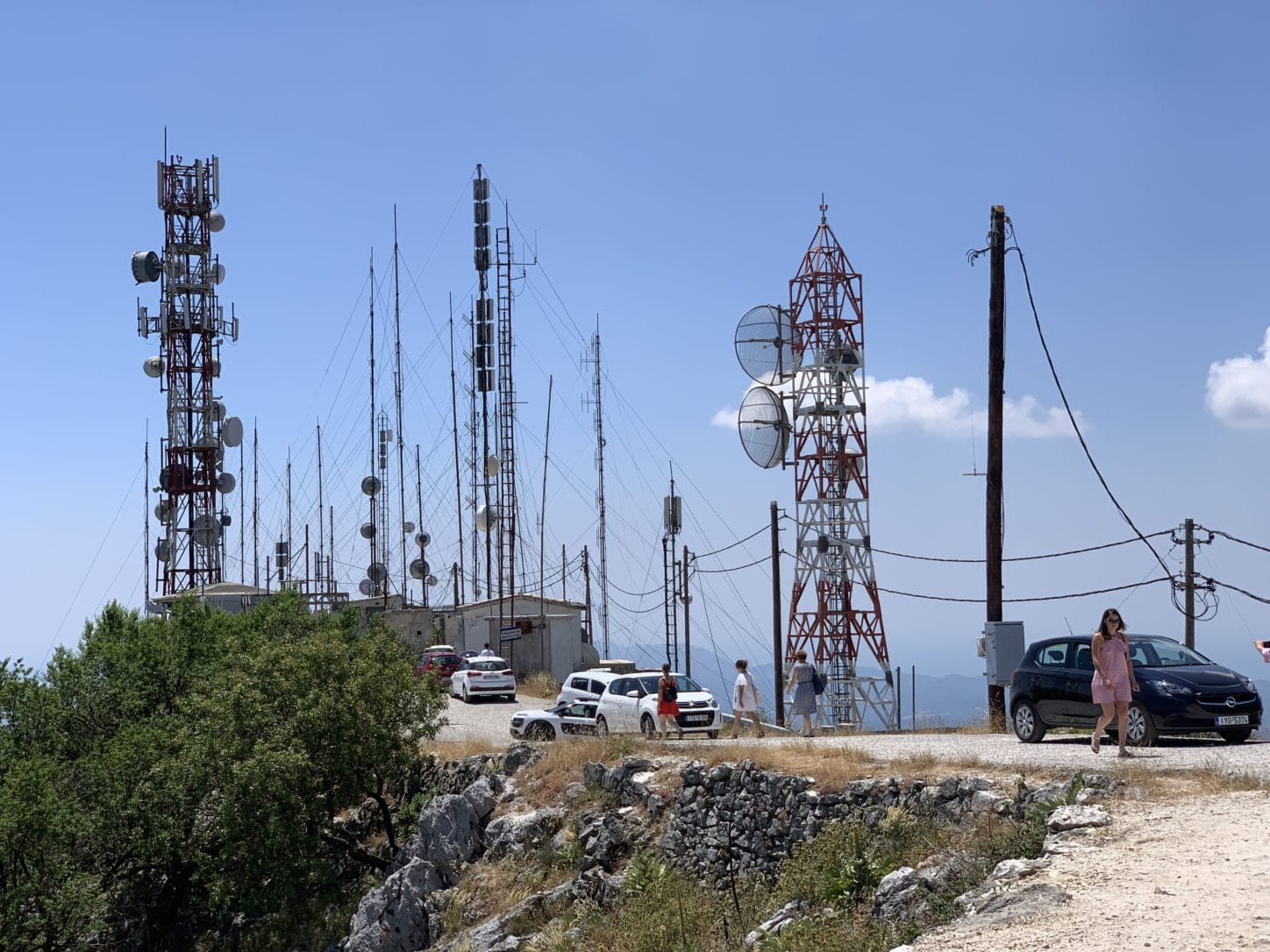
Approaching Pantocrator, we saw the secular world’s intrusions on this spiritual ground. The hilltop bristled with antennas. “Nearer, my God, to thee” in the words of the old hymn, is also better for communications.

Antennas on Mount Pantocrator, Corfu. Photo by ConsumerMojo.com.

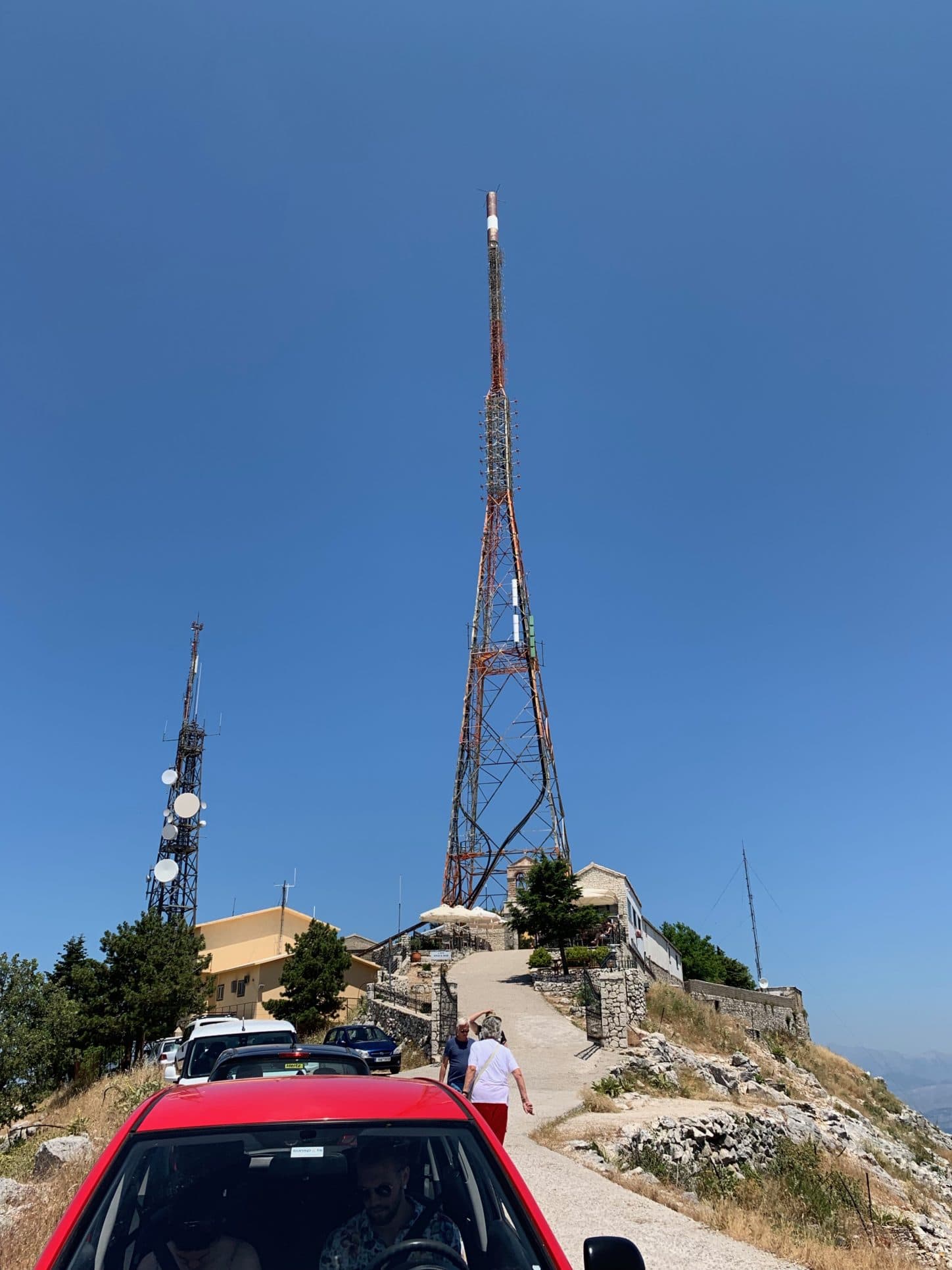
The tallest of these communication towers rose directly over the monastery at the summit. 

Antenna over the Pantocrator Monastery, Corfu. Photo by ConsumerMojo.com.

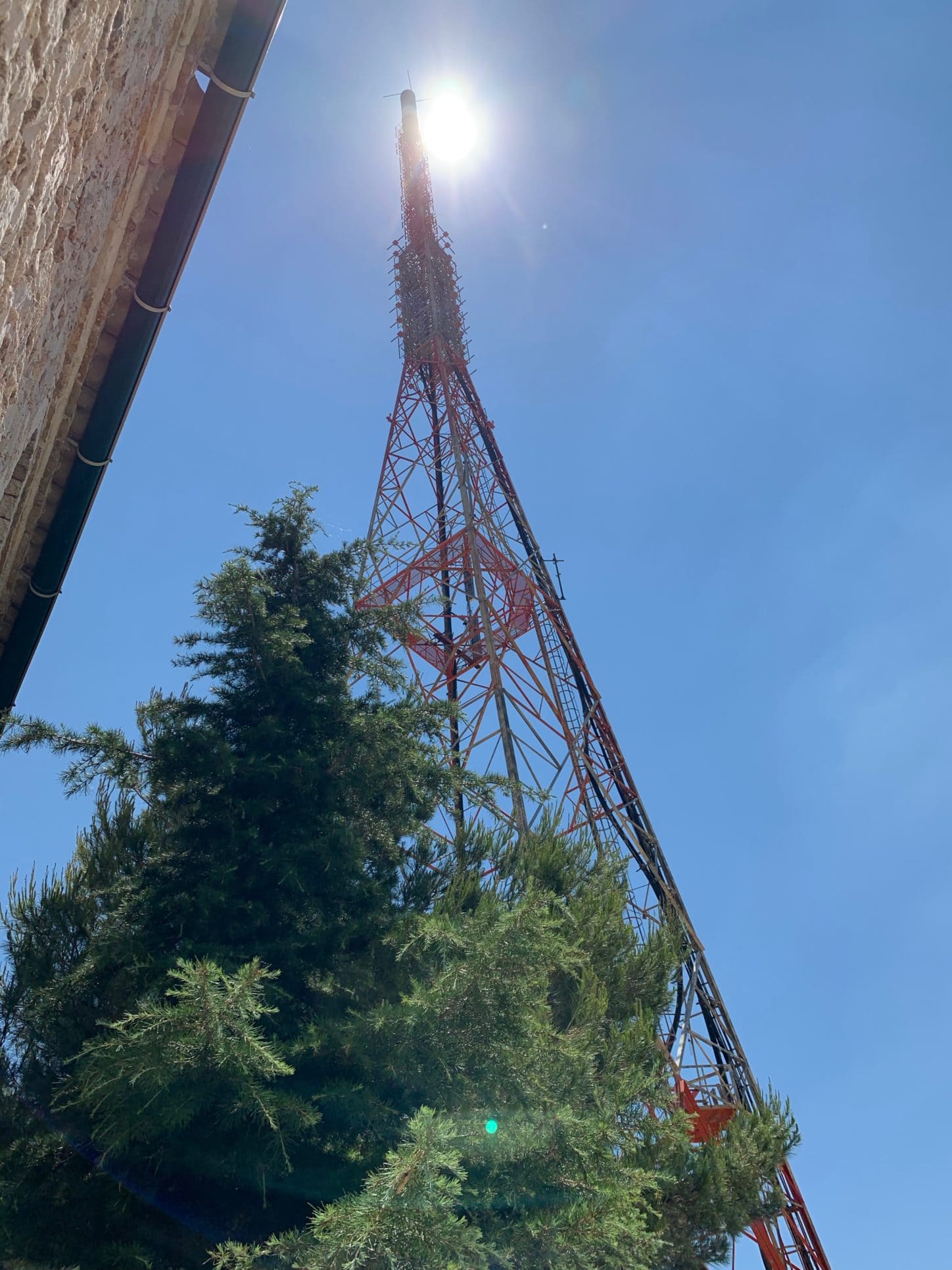
It did seem as if the monastery had its own hotline to heaven.

The Pantocrator monastery’s hotline to heaven. Photo by ConsumerMojo.com.

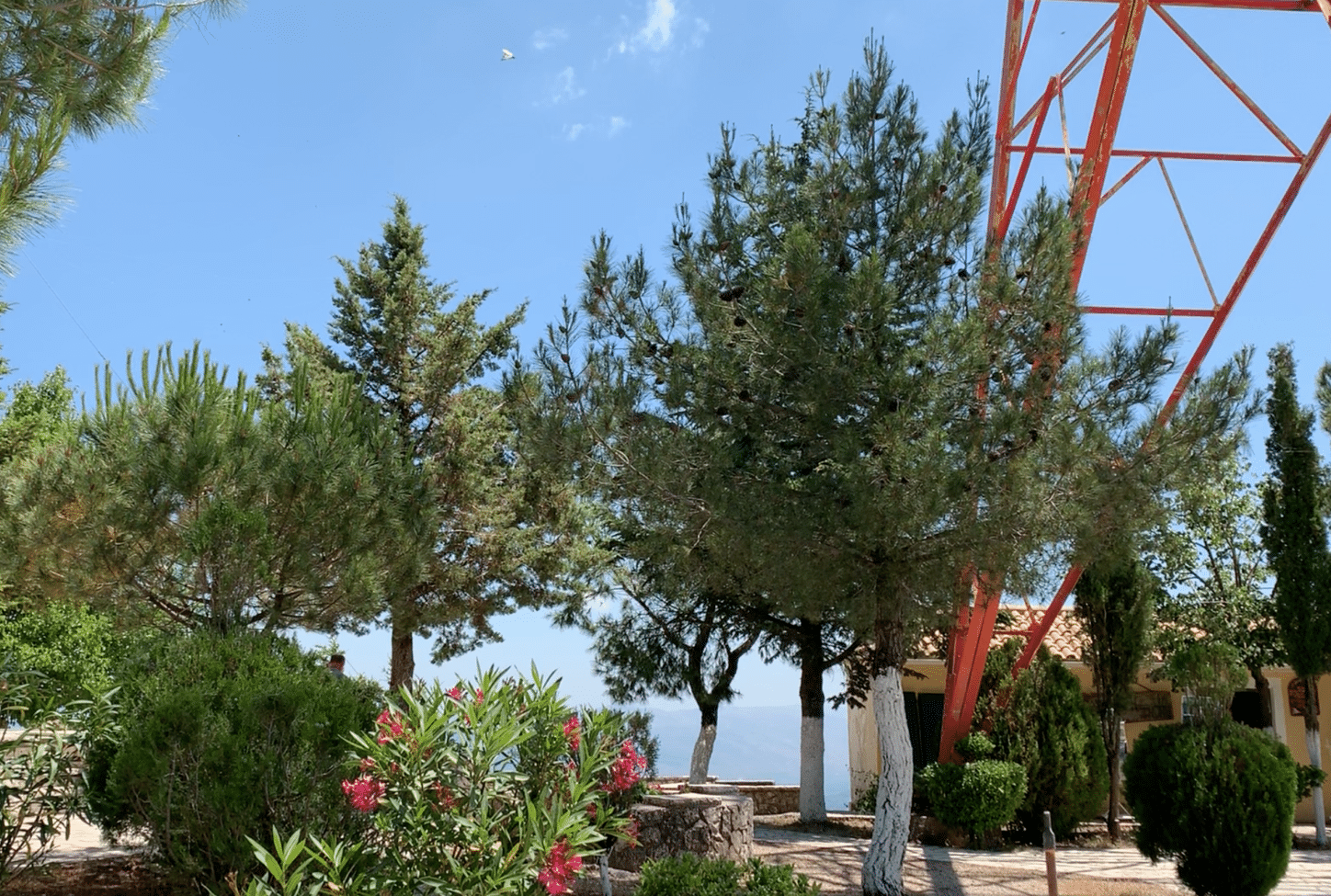
The grounds of the small monastery managed to be beautiful although the four legs of the antenna bracketed it. 

Three Days on Corfu
Courtyard of the Monastery at Pantocrator, Corfu, Greece. Photo by ConsumerMojo.com

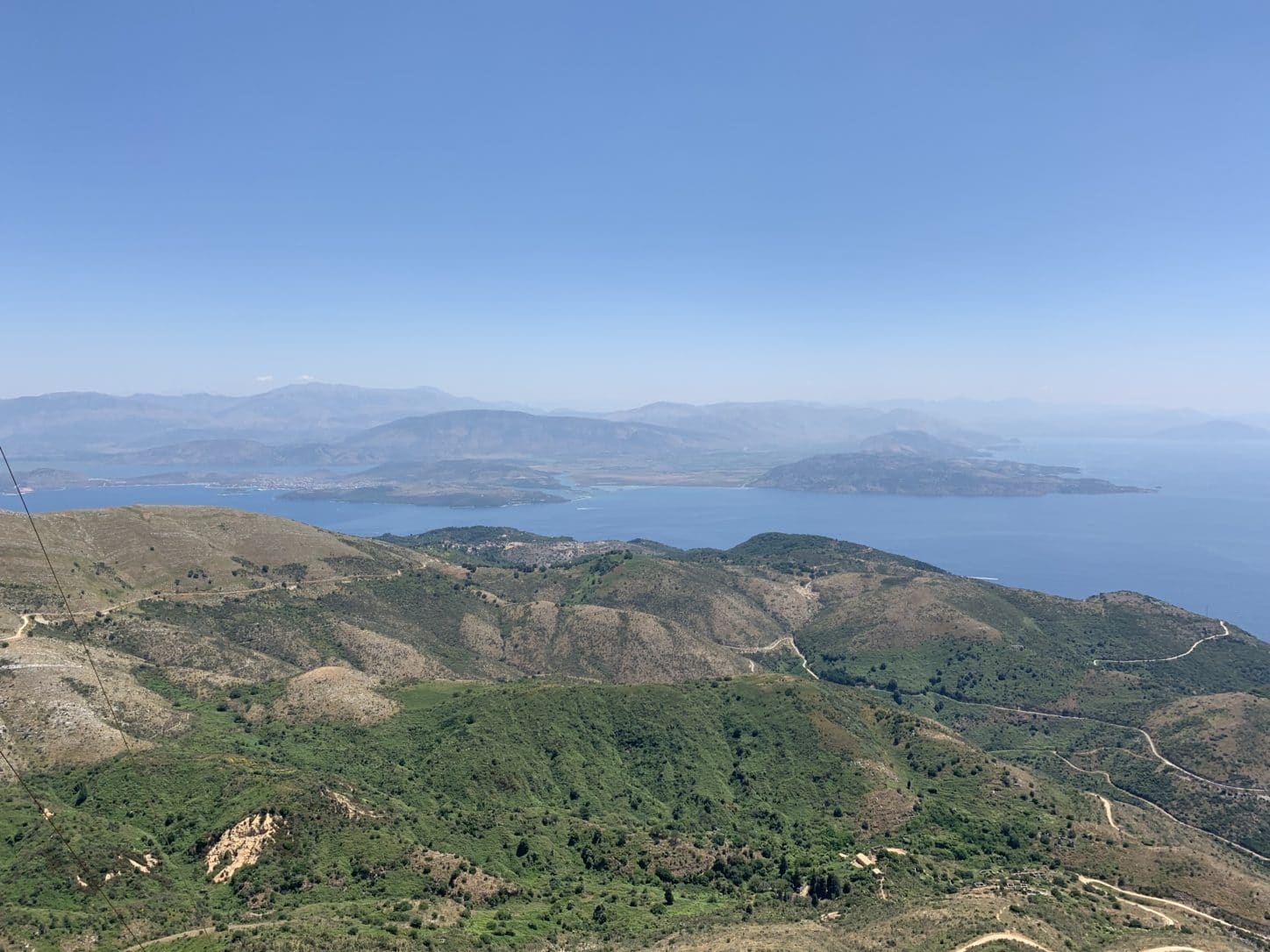
Nick’s fascination with the antennas turned to awe when we forgot them and looked to the horizon. This bright sunny day gave us a spectacular view east across the Ionian Sea to Albania’s Butrint National Park. 

Albania from Mt. Pantocrator, Corfu. Photo by ConsumerMojo.com.

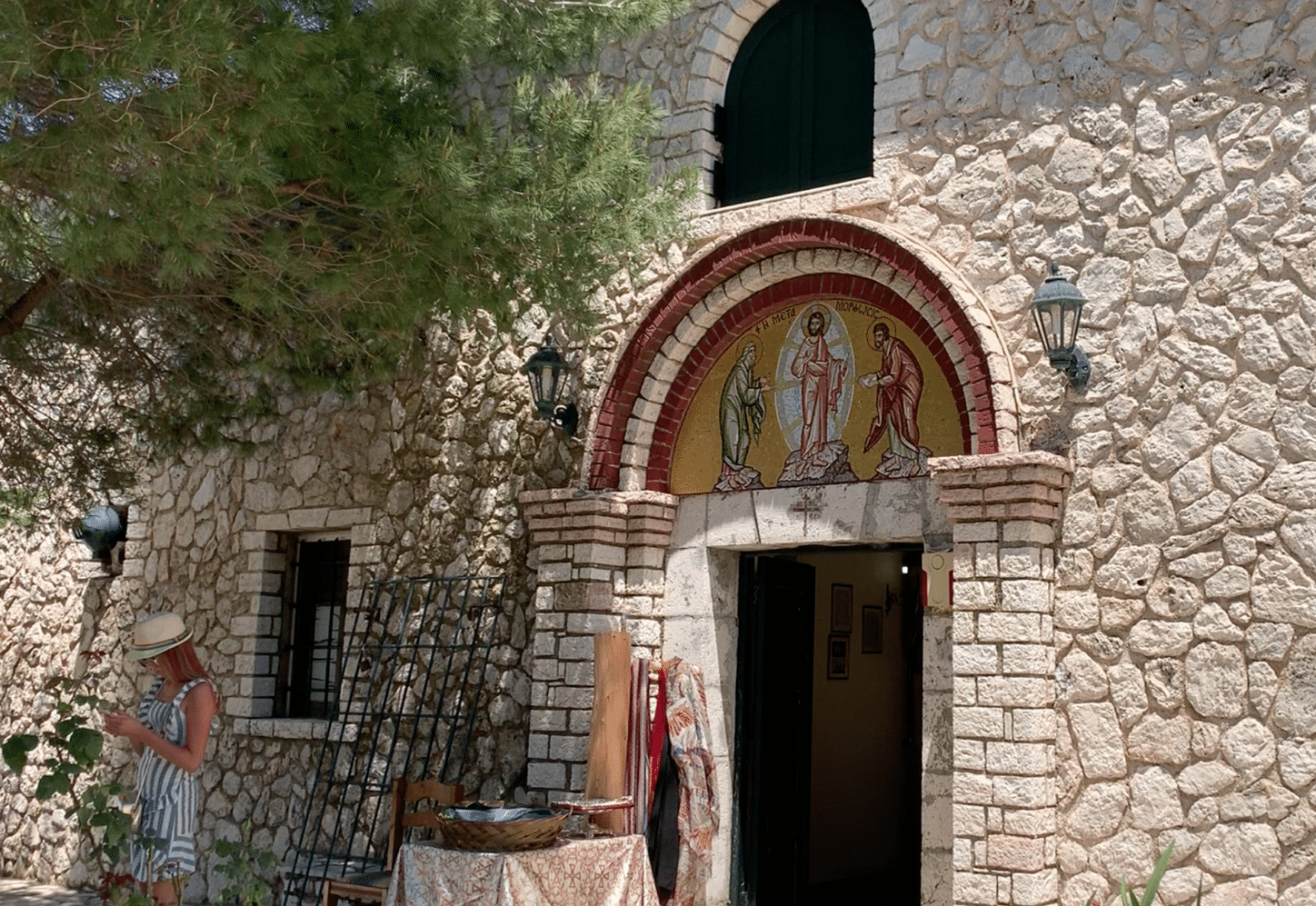
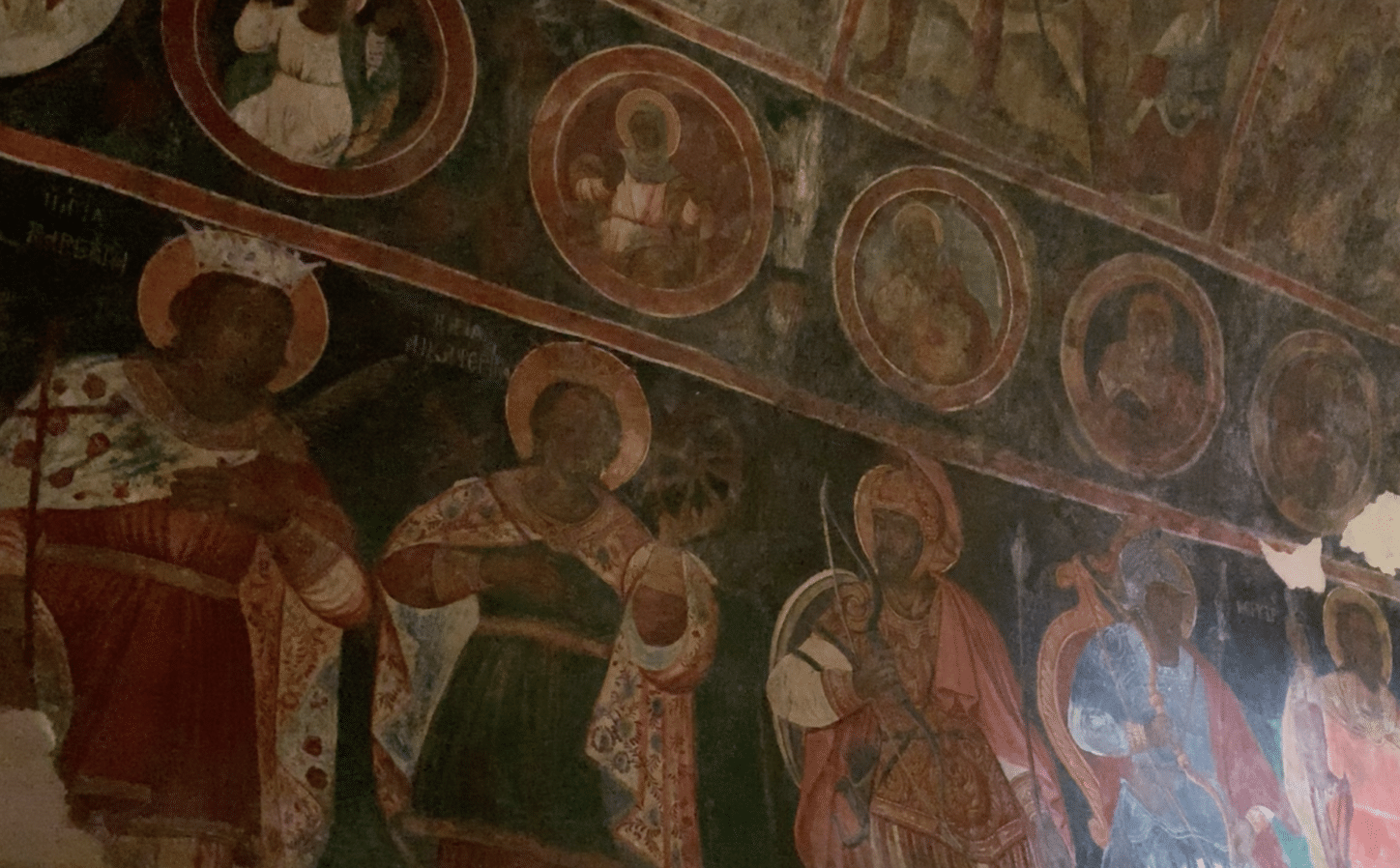
But right there on top of the mountain the monastery maintains a small church that dates to 1347. The outside isn’t much.

Three Days on Corfu
 Church on Pantokrator, Corfu, Greece. Photo by ConsumerMojo.com.

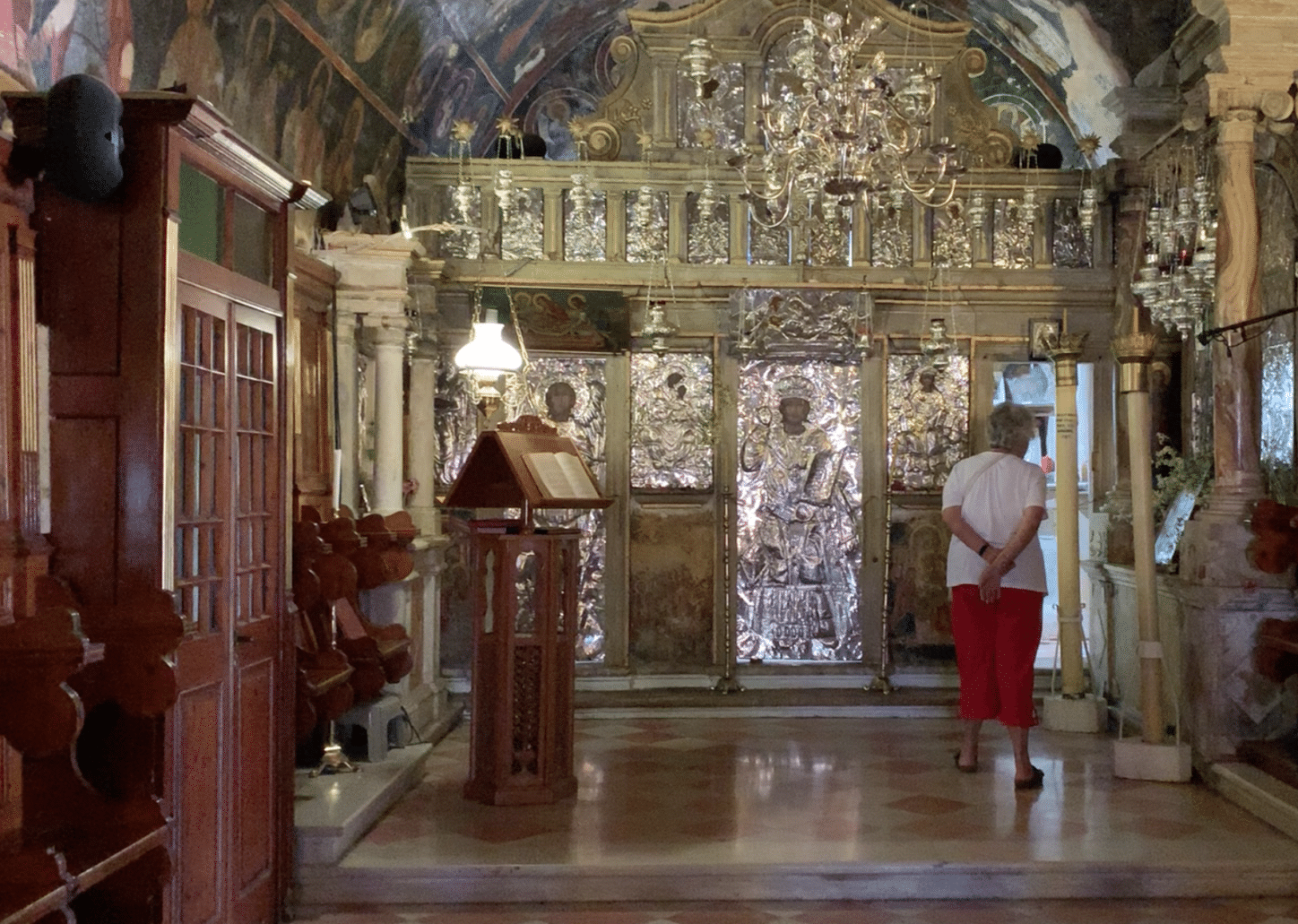
But when you step inside it feels like a little jewel box.

Three Days on Corfu
Inside the church at Pantokrator, Corfu, Greece. Photo by ConsumerMojo.com

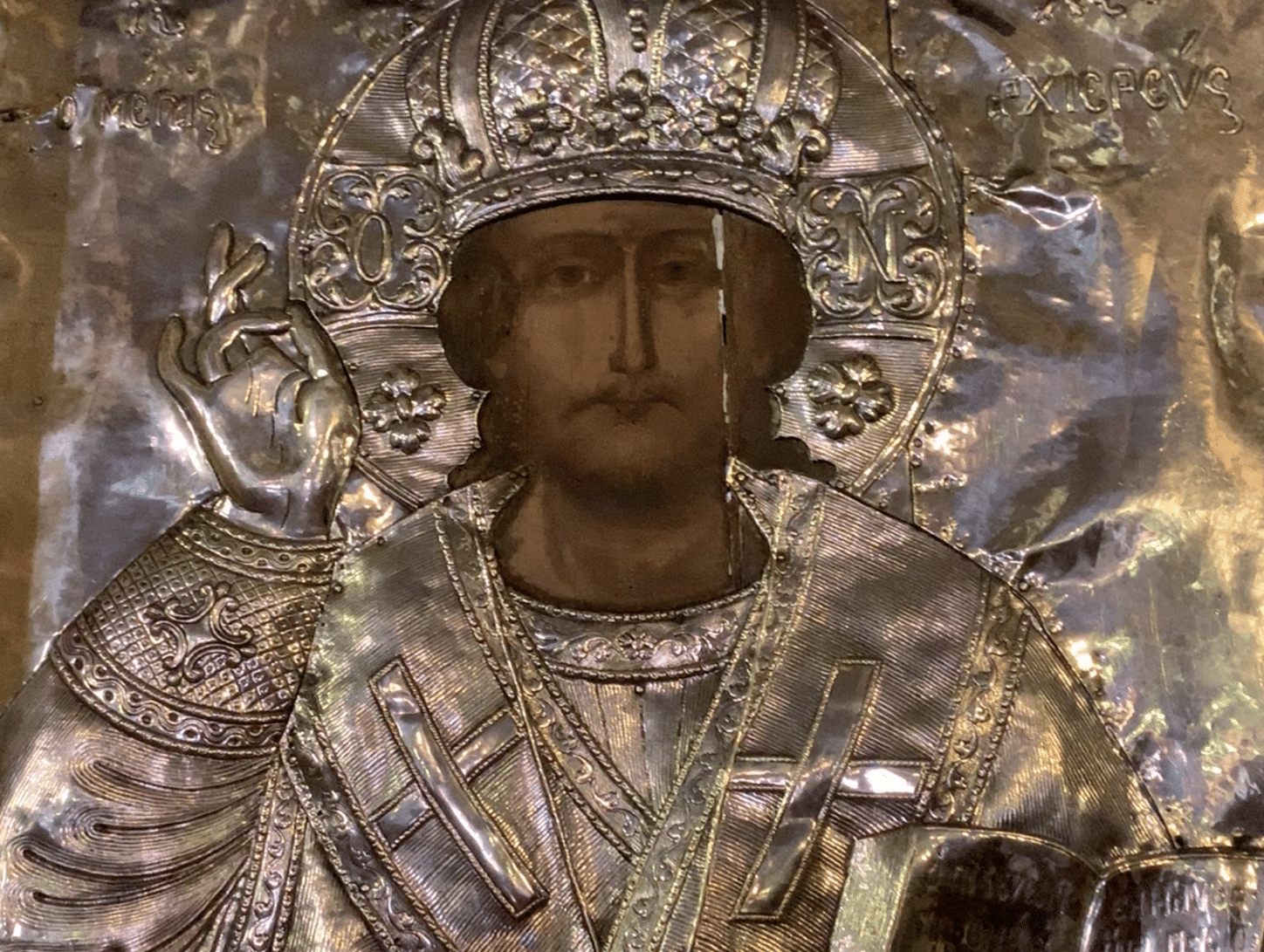
While it is a sacred space, the artistry and craftsmanship seem transcendent. 

Three Days on Corfu
Panel in the church on Pantokrator, Corfu, Greece. Photo by ConsumerMojo.com
Three Days on Corfu
Frescoes in the church on Pantokrator, Corfu, Greece. Photo by ConsumerMojo.com.

We took our last photos, chased some more butterflies, retraced our route and stopped in a small town on the mountain called Strinilas.

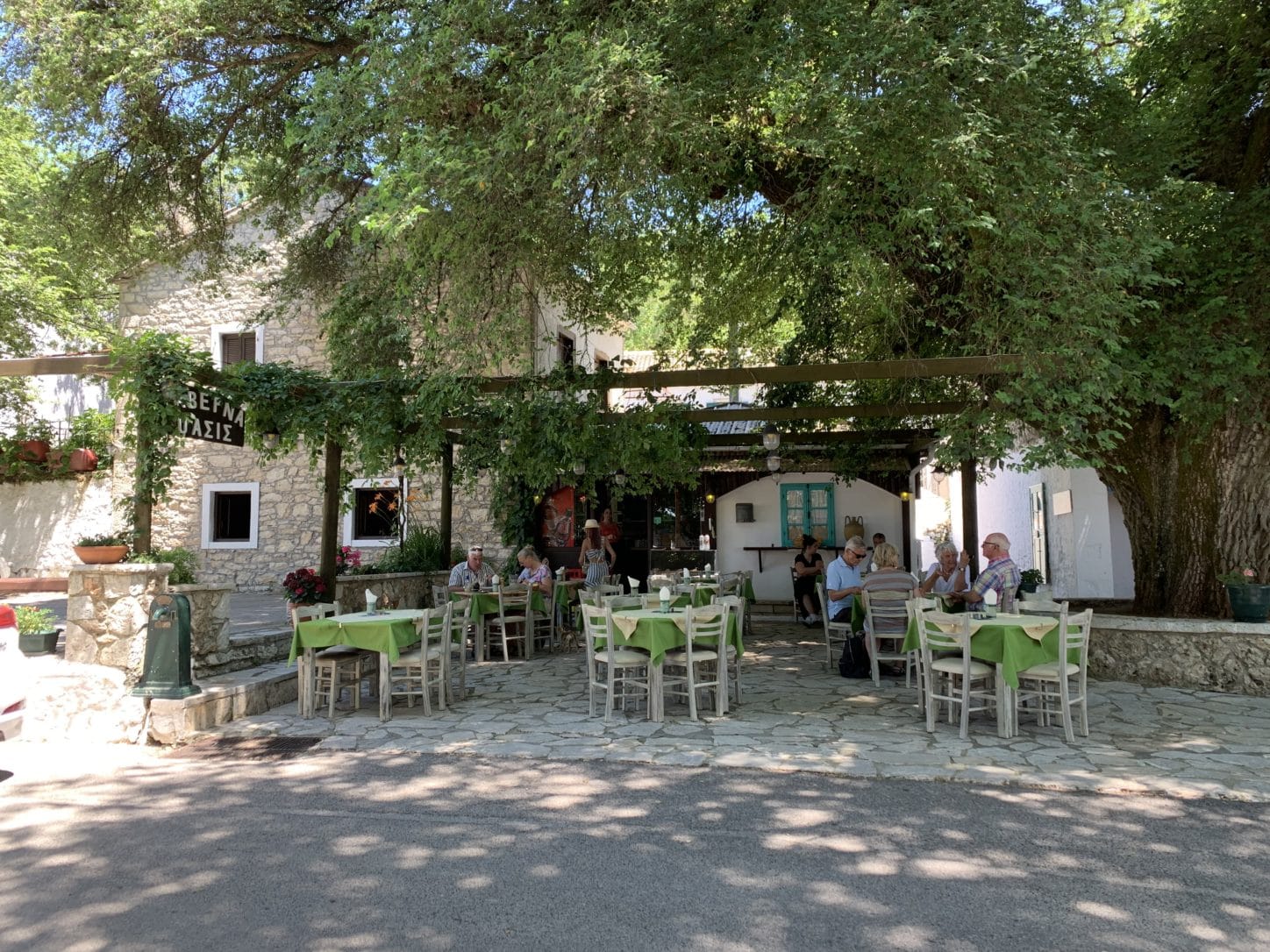
Three Days on Corfu, Taverna in Strinilas
Taverna at Strinylas, Corfu, Greece. Photo by ConsumerMojo.com

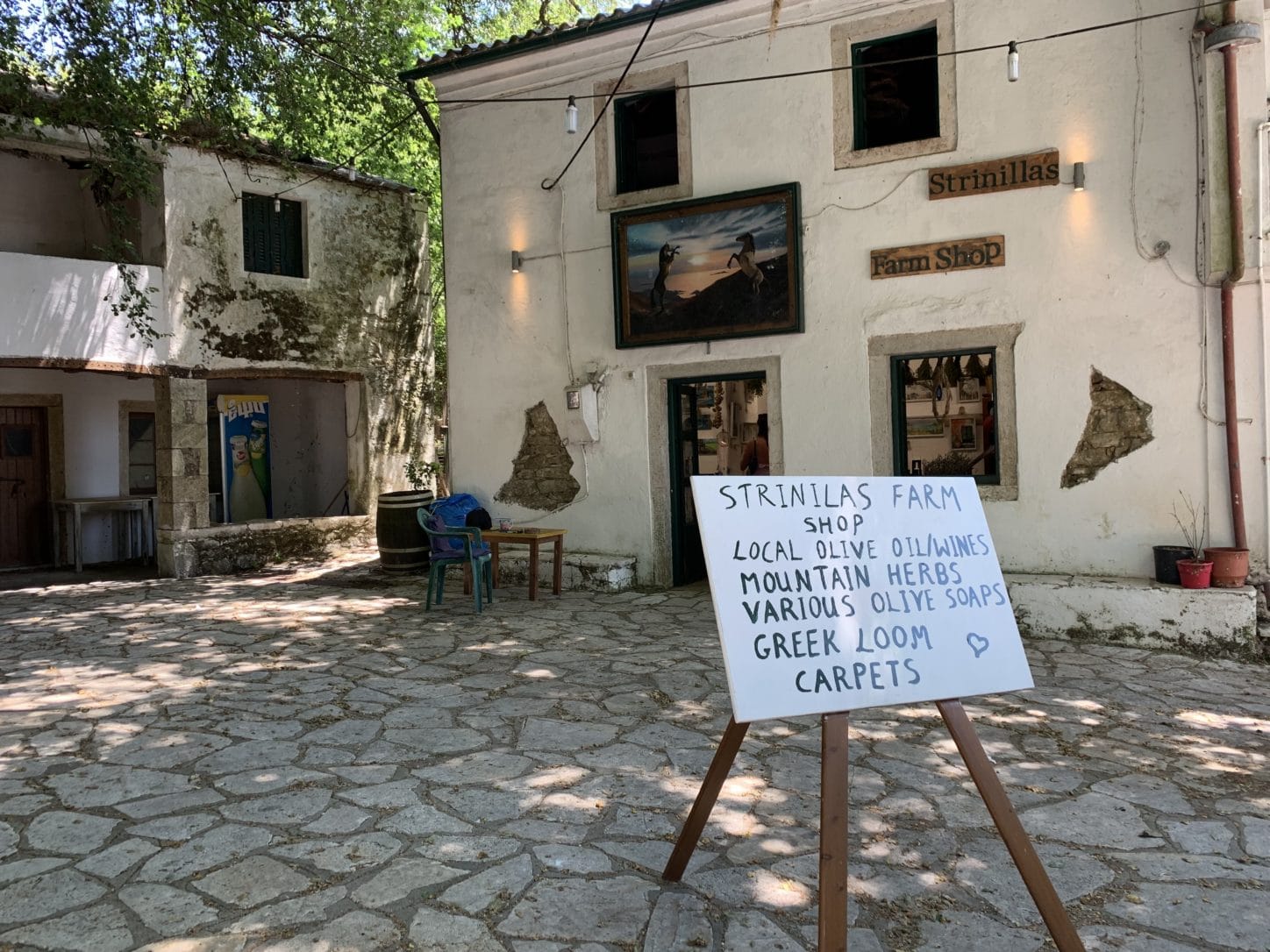
The local store beckoned.

Three Days on Corfu
Strinilas Store. Photo by ConsumerMojo.com

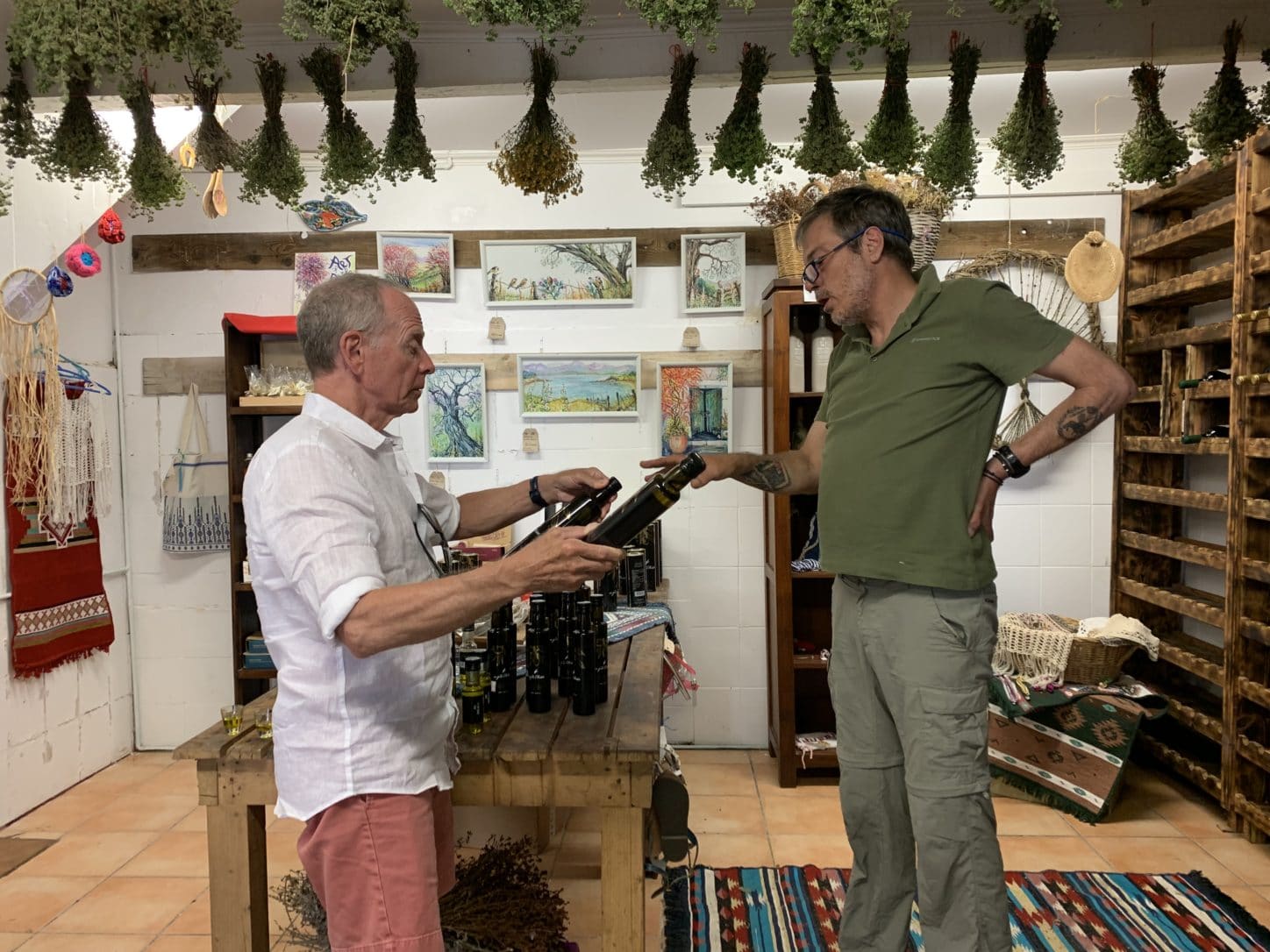
We struck up a conversation with the owner Mario Karas. He told us had lived and worked in the U.K. and the U.S., but his heart was in the hillside olive groves and he returned.

Three Days on Corfu
Mario Karas, right, and Nick Taylor at Strinilas Store, Corfu, Greece. Photo by ConsumerMojo.com

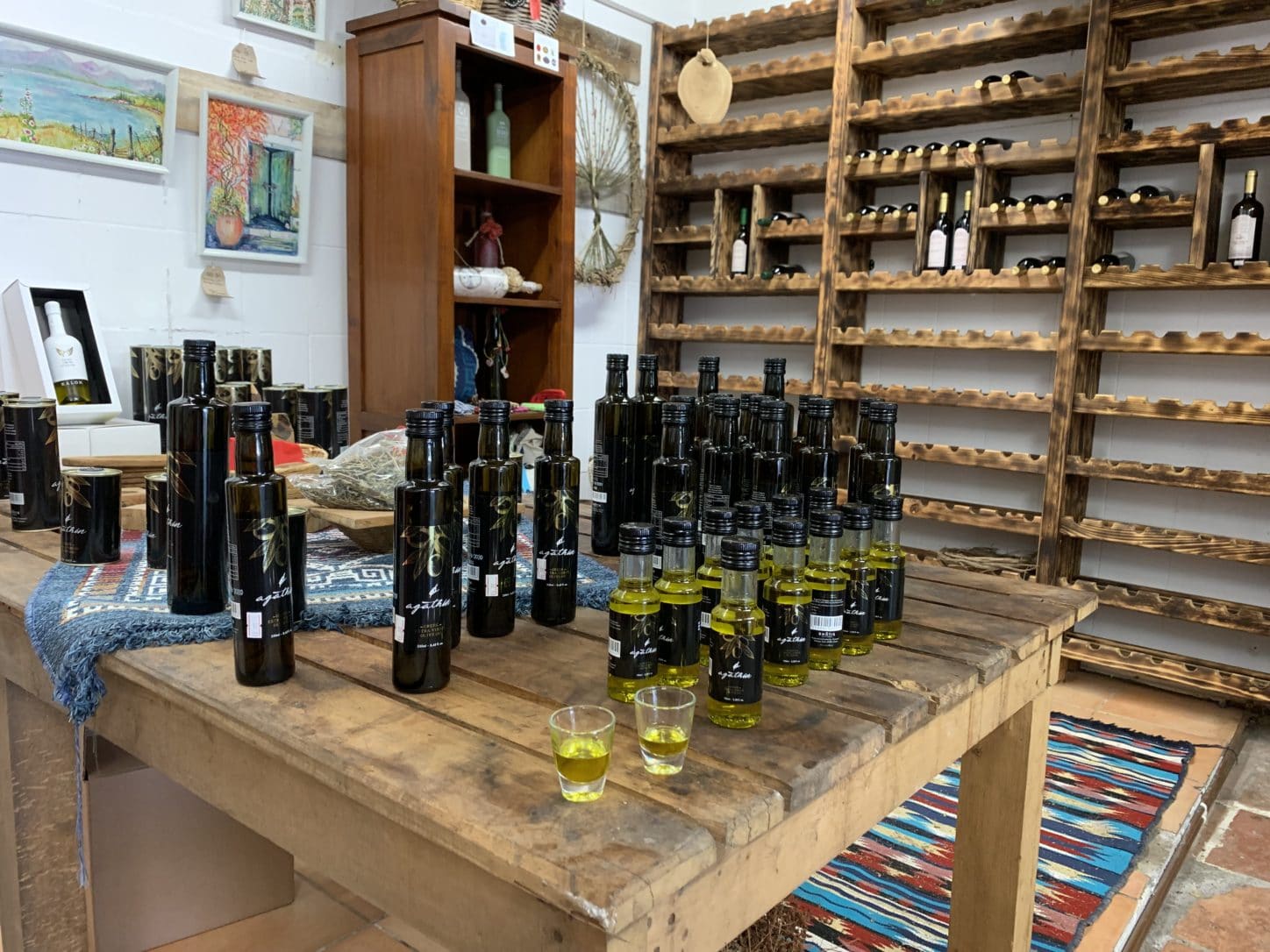
He made and sold olive oil and olive oil soap in his small shop, and also pressed oil from wild olives. “I can’t bottle that. Government regulations,” he said. “But I can sell you some,” he added, holding a plastic container under the tap of a bottle on a shelf.

Mario had little good to say about politicians in Greece and the European Union. He, like others we talked with, bemoaned the rules that govern commerce and seem to make everything harder.

Three Days on Corfu
 Olive Oil at Strinilas Store, Corfu, Greece. Photo by ConsumerMojo.com

Three airline flights from home was too much for a plastic soda bottle filled with olive oil in our luggage. But we  bought a small glass bottle of his regular stock, soap made locally and an embroidered apron. 

Three Days on Corfu
Outside dining at Agnadio Taverna, Corfu, Greece. Photo by ConsumerMojo.com

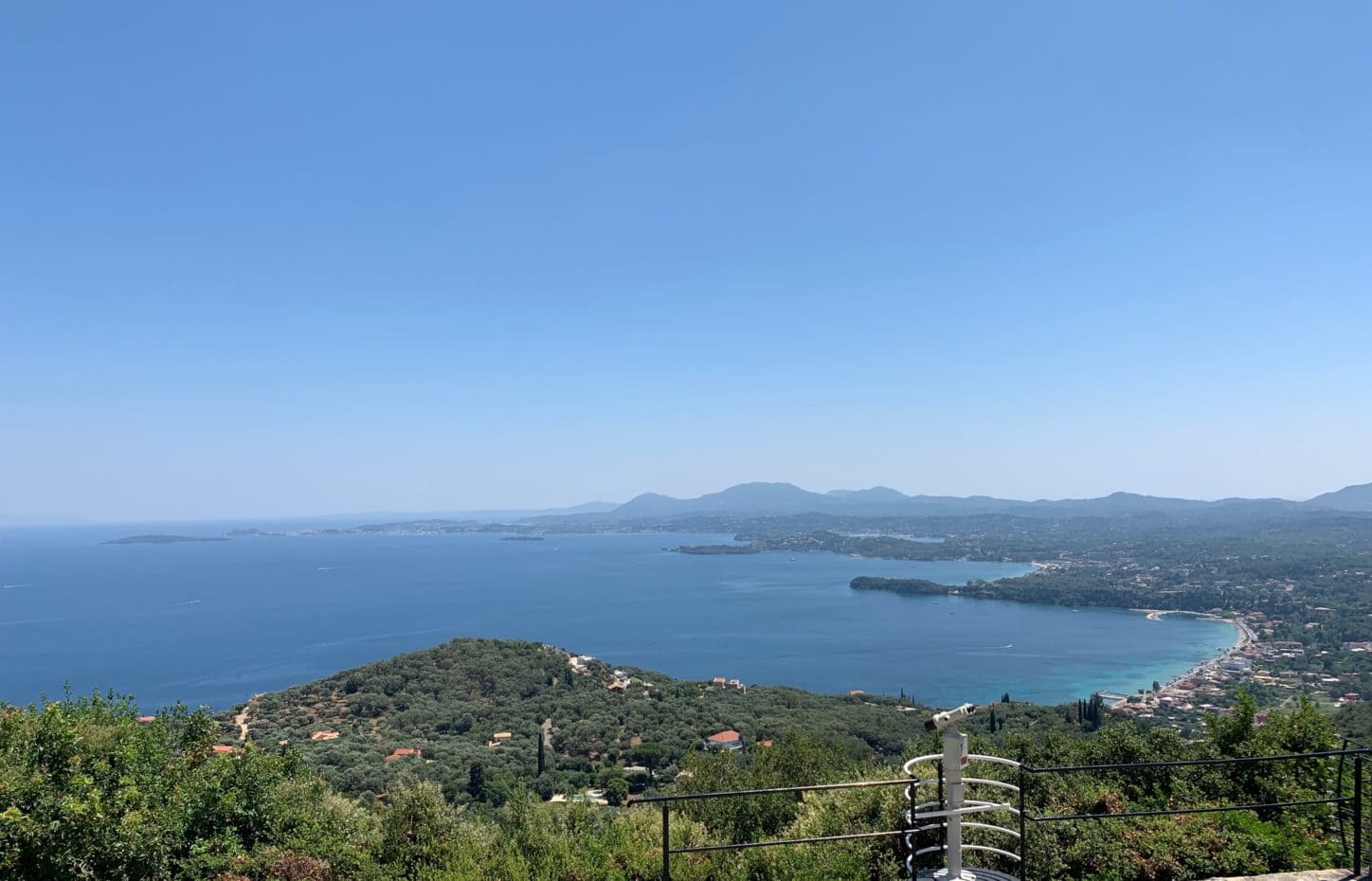
Now was the time to stop at Agnadio Taverna for lunch. George, whether he knew it or not, had been right about the view. The hillside taverna looked out on Ipsos Beach and down the east coast of Corfu.

Corfu’s east coast looking south from Taverna Agnadio. Photo by ConsumerMojo.com.

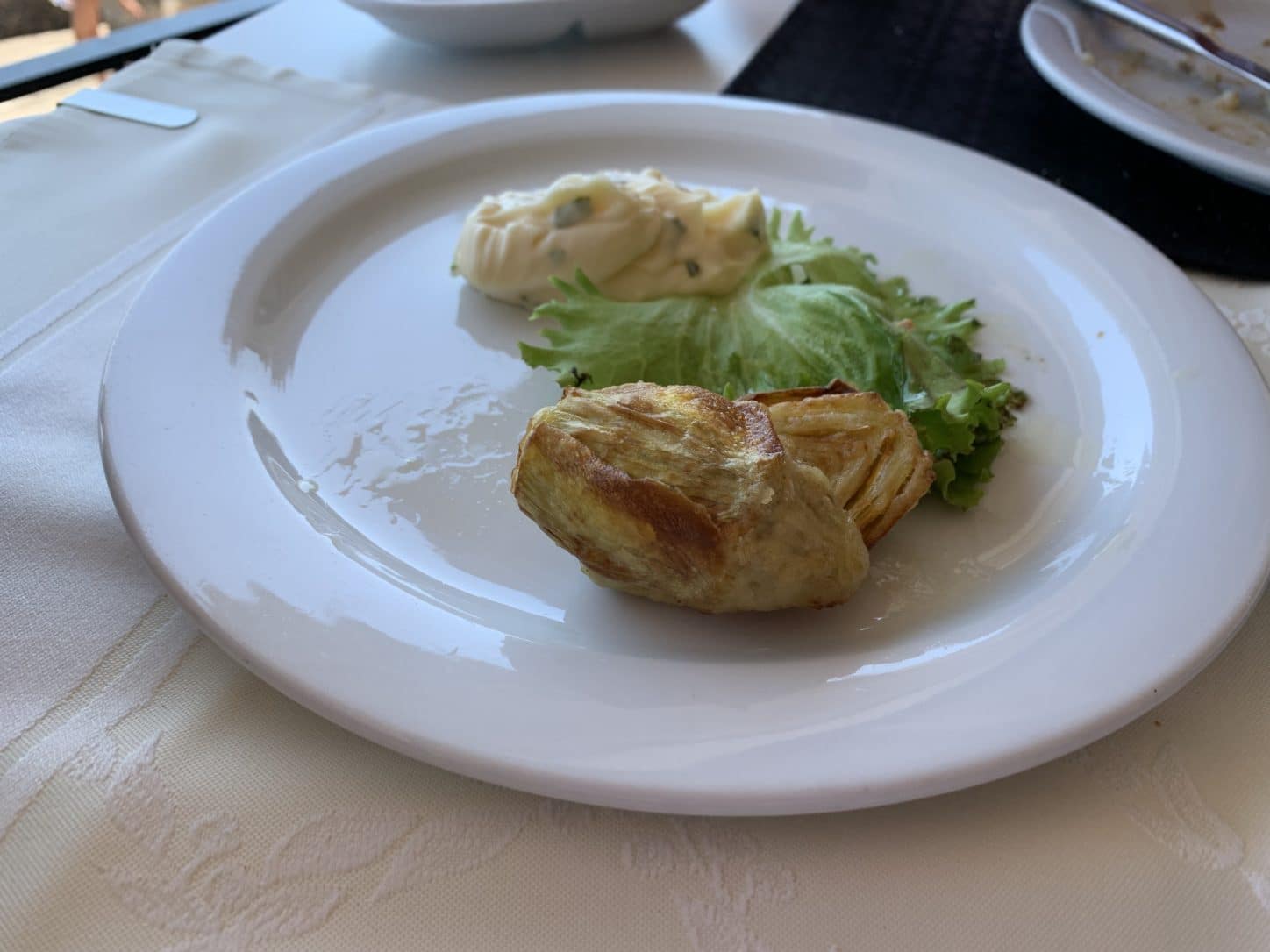
The food was good, too. 

Three Days on Corfu
Fried Artichoke, Taverna Agnadio, Corfu, Greece. Photo by ConsumerMojo.com

Leaving the tavern and descending the mountain, we took a short detour. Corfu’s northeast coast is known as Kensington-on-Sea for the well-off Brits that summer there. The Durrells lived in the area, and Gerald and his novelist brother Lawrence’s descriptions have lured their fellow Britons ever since. They’re discreet, though. We didn’t see their villas from the road, and we didn’t seek them out at any of the pebbled beaches. The more visible Brits, Corfiots told us, are those who flock to Corfu’s southern beaches to party from morning to night with other young Europeans. We took their word for it.
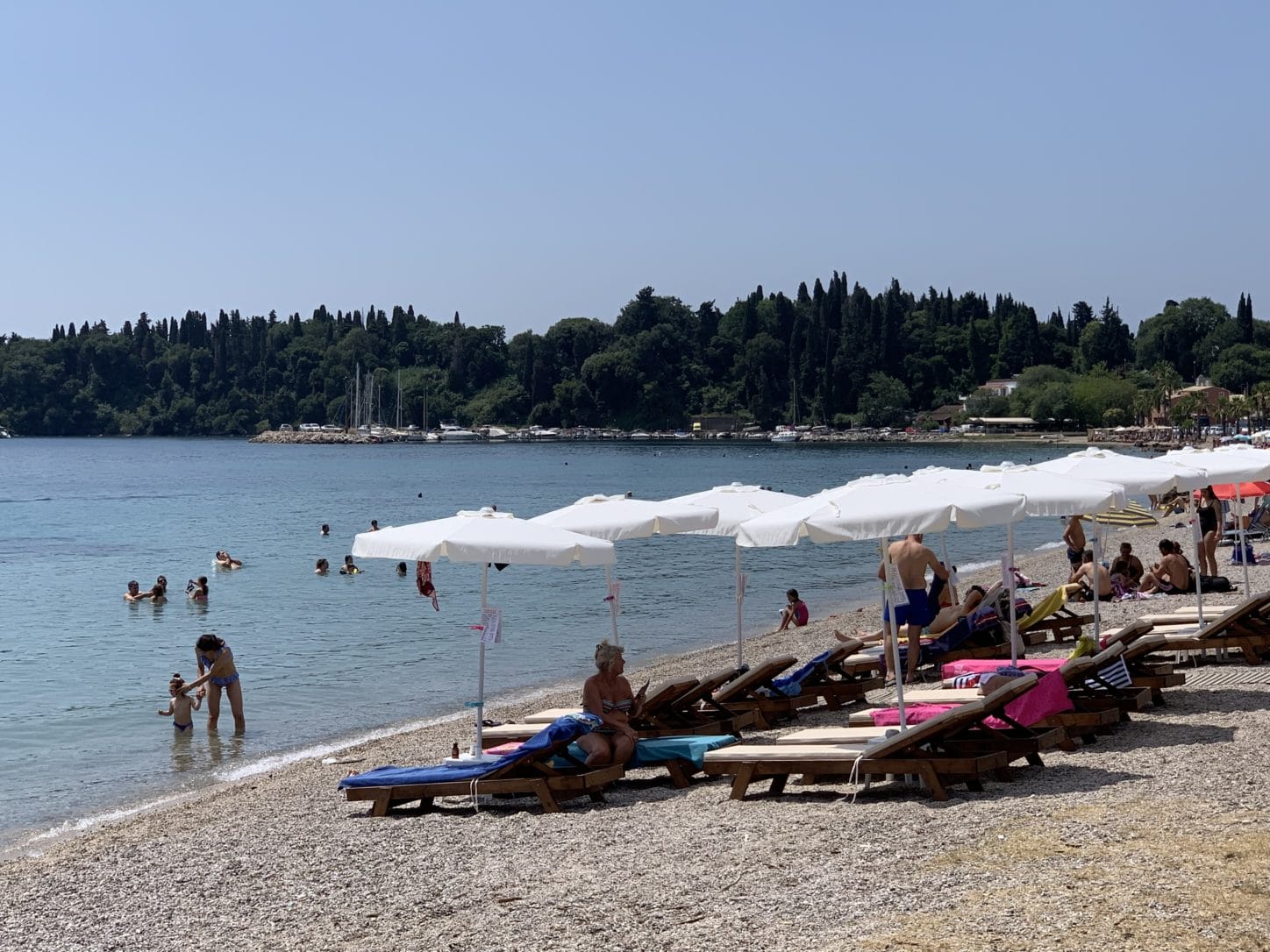
On the way back to Castello di Vista, we took a closer look at Ipsos Beach. Its pebbly beach didn’t seem to trouble the swimmers splashing in the water.

Ipsos Beach, Corfu. Photo by ConsumerMojo.com.

Our beach day was behind us, though. We had an early flight in the morning, first to Athens and from there to Paris. So we hit the hotel pool, played paddle ball as badly as we had the day before, and started packing.
We decided to take a taxi to Gerekos Taverna , a  fish place in a town called Gouvia about fifteen minutes south. George called a taxi and was telling us a story about a solo trip to Munich his father had sent him on when he was still a boy, to groom him for a diplomatic career. He sat down in a restaurant, looked at a menu he couldn’t understand, and ordered something. The waiter asked, “Are you sure?”

At that moment, before George could deliver the punchline, a large black Mercedes sedan pierced the gates of Castello di Vista and ascended the driveway. Our taxi had arrived. We’d known George only forty-eight hours and already knew his story had no quick ending. We climbed into the taxi with Christina, a blonde far too slight for the big car she piloted. She backed down the driveway eyeing the rear-view camera dash display, executed a neat turn and plunged into the maze of Kato Korakiana, which she seemed to know perfectly. “I’m from Kato Korakiana and I’ve been driving a taxi for years,” she said to quell any fears we might have had. 

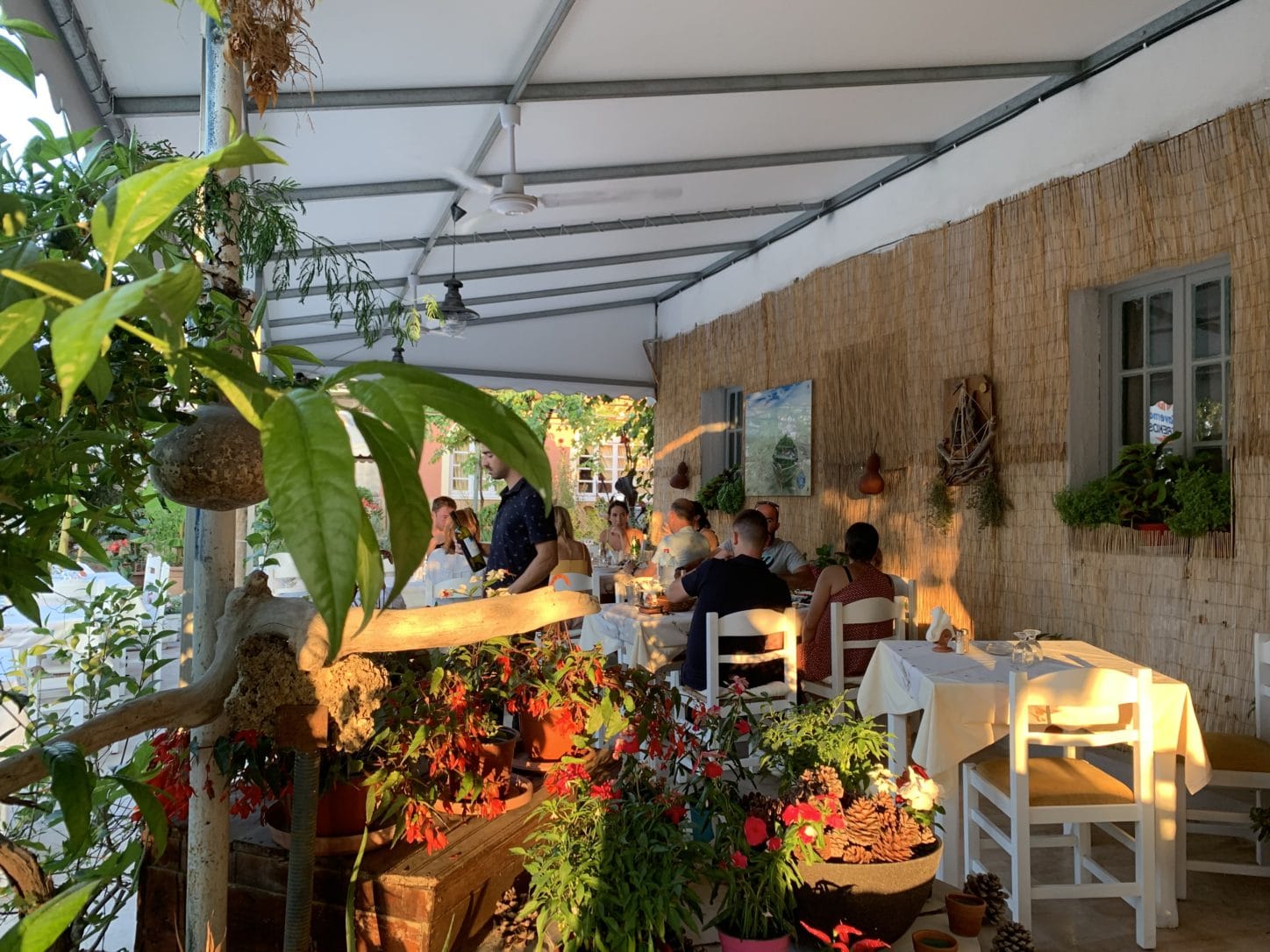
Within fifteen stress-free minutes we got out of the taxi, asked Christina to pick us up at 10 o’clock, and sat down outside Taverna Gerekos.

Three Days on Corfu
Gerekos Taverna, Corfu, Greece, Photo by ConsumerMojo.com

Minutes later the waiter — and owner’s son; it’s a family-run restaurant — came and invited us across the street into the kitchen.

Three Days on Corfu
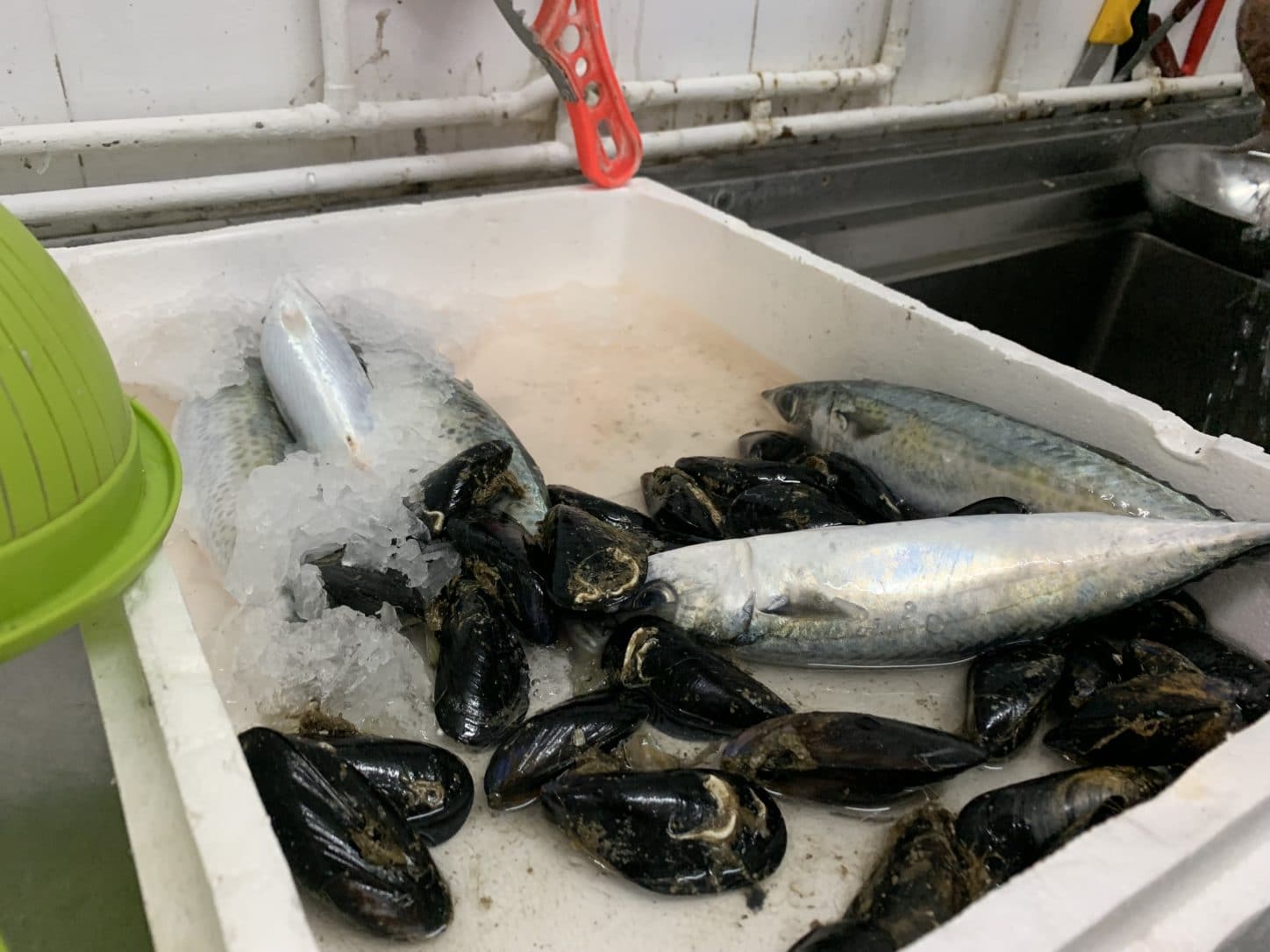
Fish and Mussels, Gerekos Taverna, Corfu, Greece

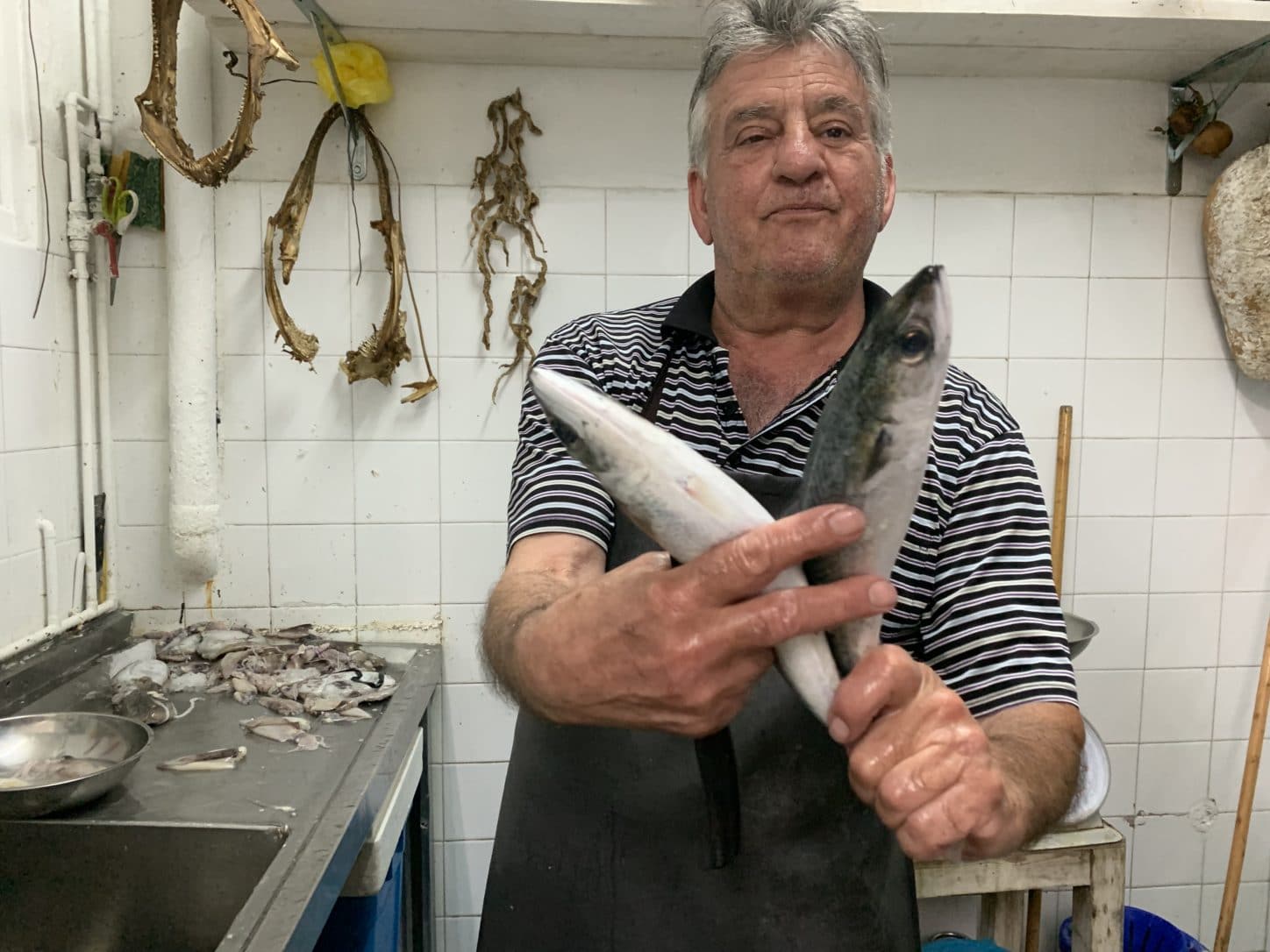
There a large man wearing an apron and a look that said he knew seafood stood in front of a deep sink edged with bins of the day’s catch.

Three Days on Corfu
The Chef, Gerekos Taverna, Corfu, Greece. Photo by ConsumerMojo.com.

He pointed to some squid and langoustine, then picked up two mackerel and waved them in front of us to show us they were fresh. “He says you should have this tonight,” the waiter said.

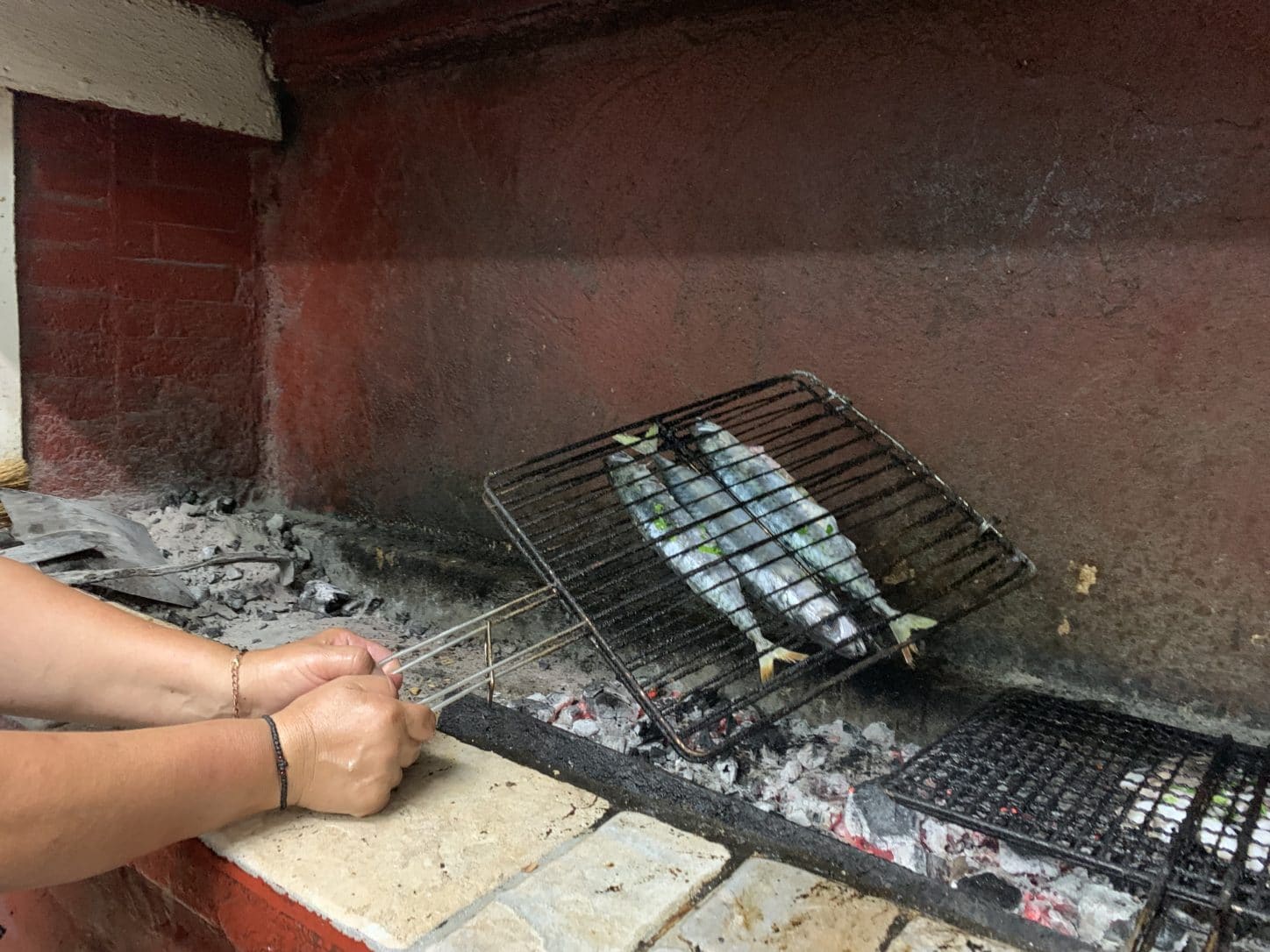
Nearby, two women gave us a preview of the cooking method.

Three Days on Corfu
Fish Cooked Over Coals, Gerekos Taverna, Corfu, Greece. Photo by ConsumerMojo.com.

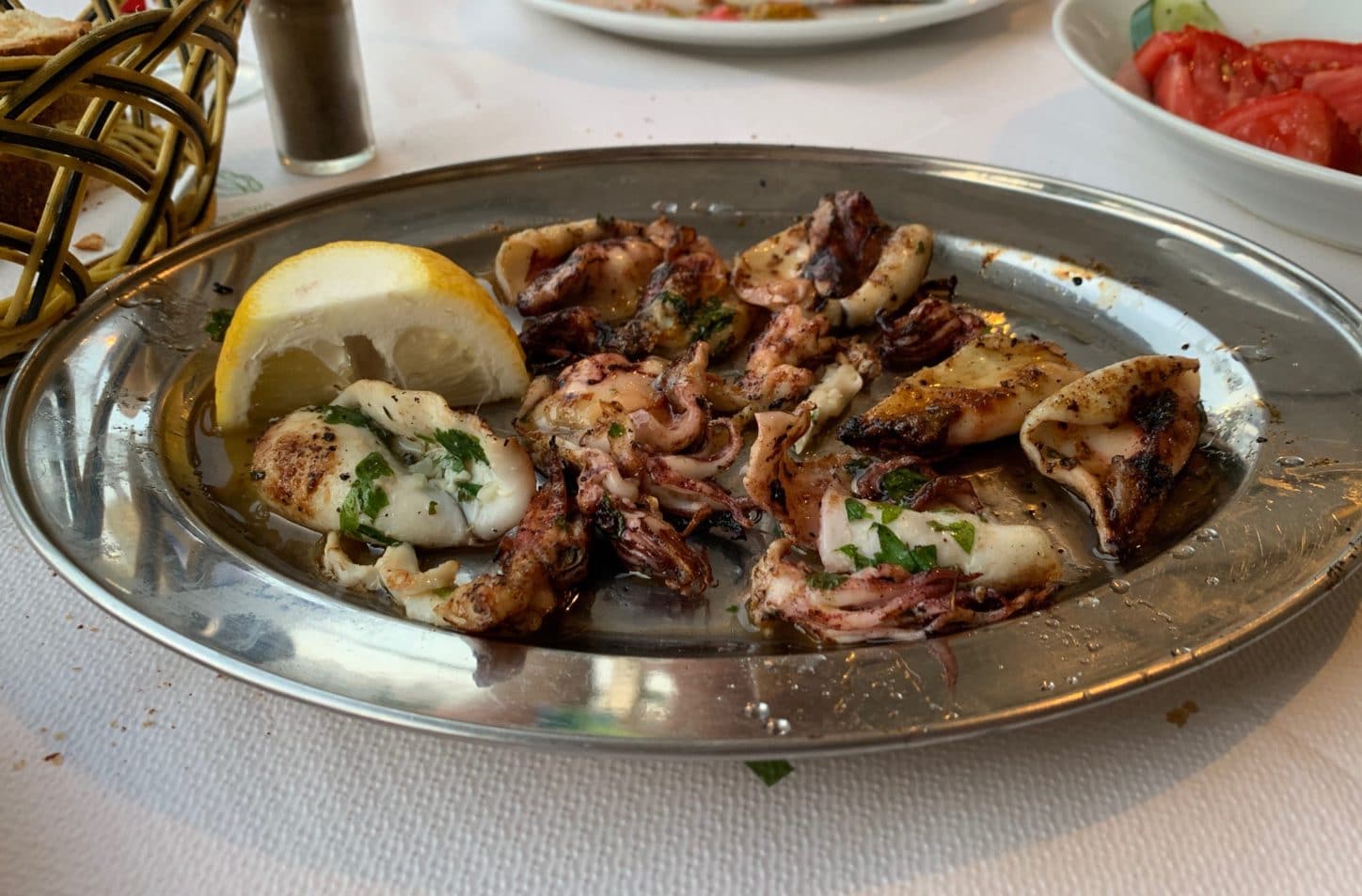
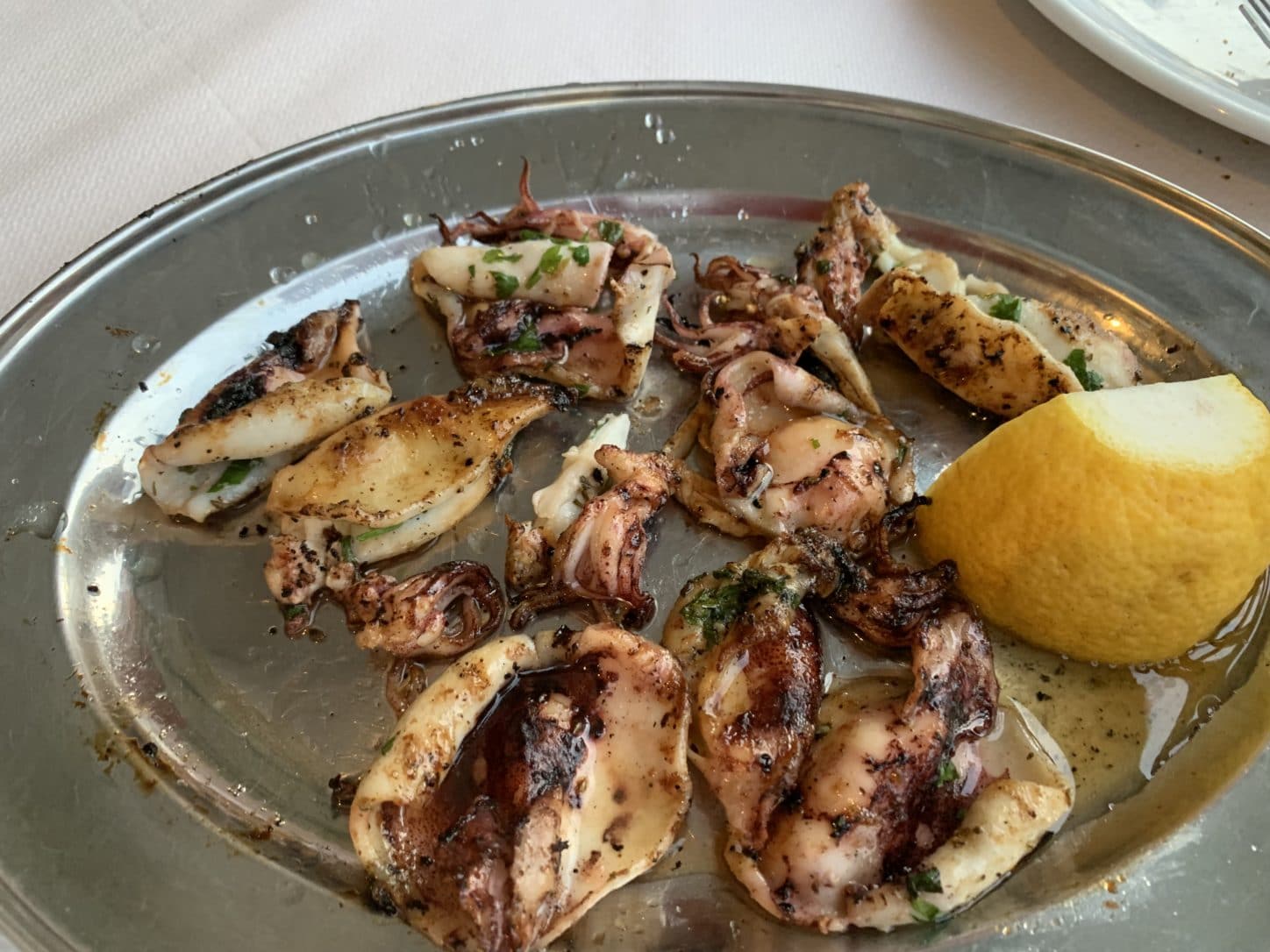
We went back to our table, enjoyed salads, and minutes later the waiter put  platters of squid before us.

Grilled squid at Taverna Gerekos, Corfu. Photo by ConsumerMojo.com.
Three Days on Corfu
Squid, Gerekos Taverna, Corfu, Greece. Photo by ConsumerMojo.com

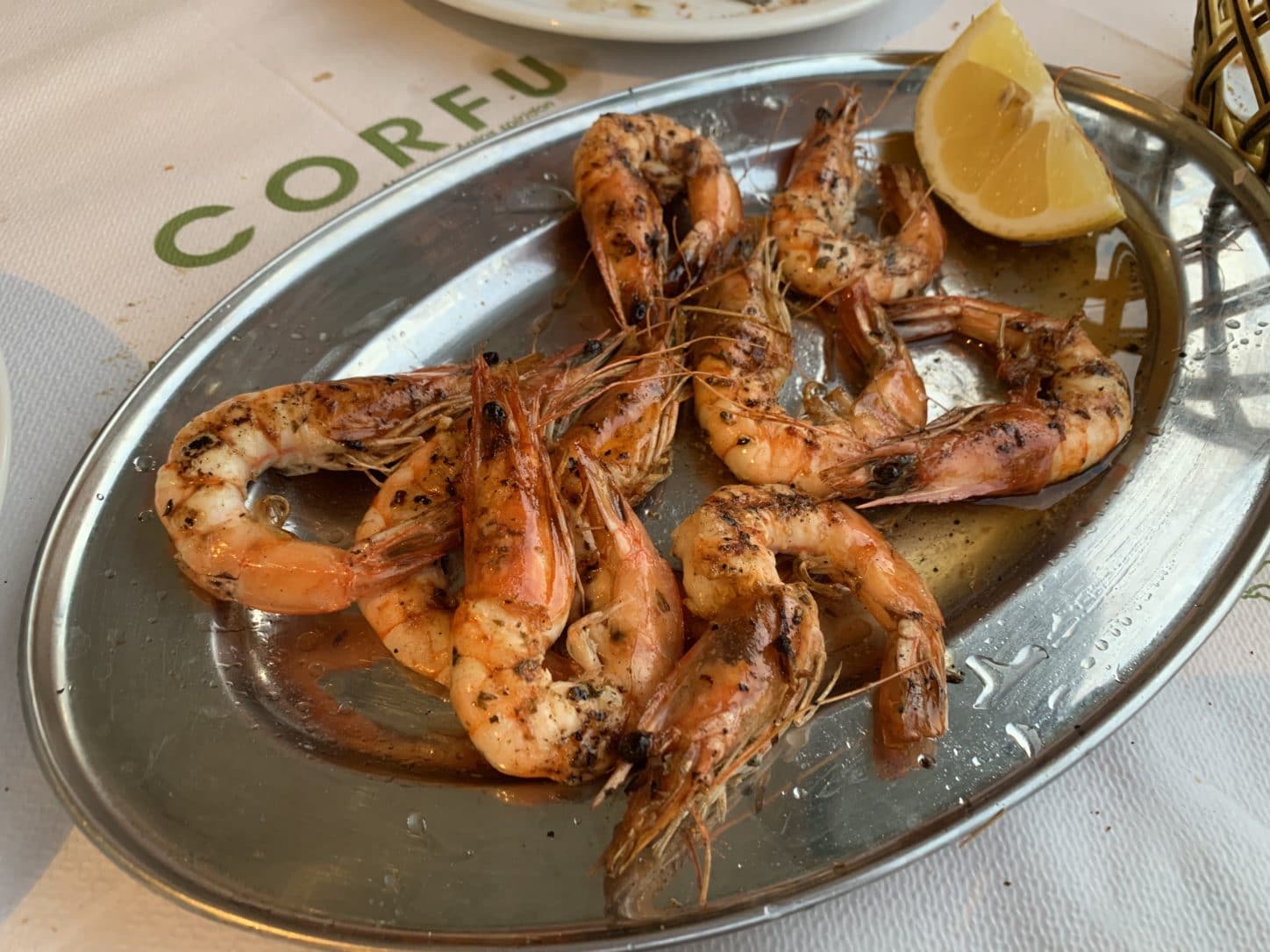
And then came a platter of langoustine.

Three Days on Corfu
 Langoustine, Gerekos Taverna, Corfu, Greece. Photo by ConsumerMojo.com

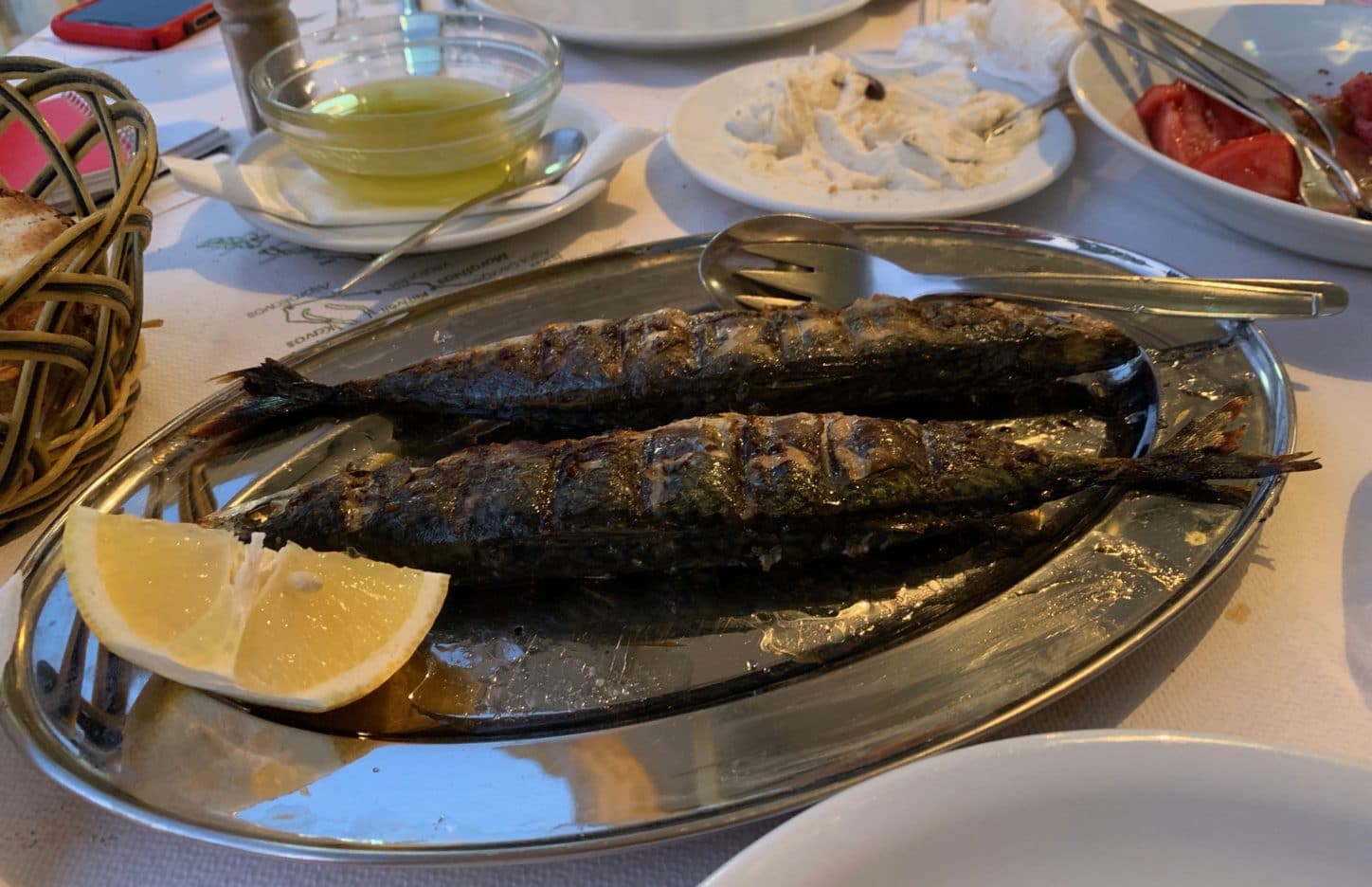
And then the promised mackeral.

Grilled mackeral at Taverna Gerekos, Corfu. Photo by ConsumerMojo.com.

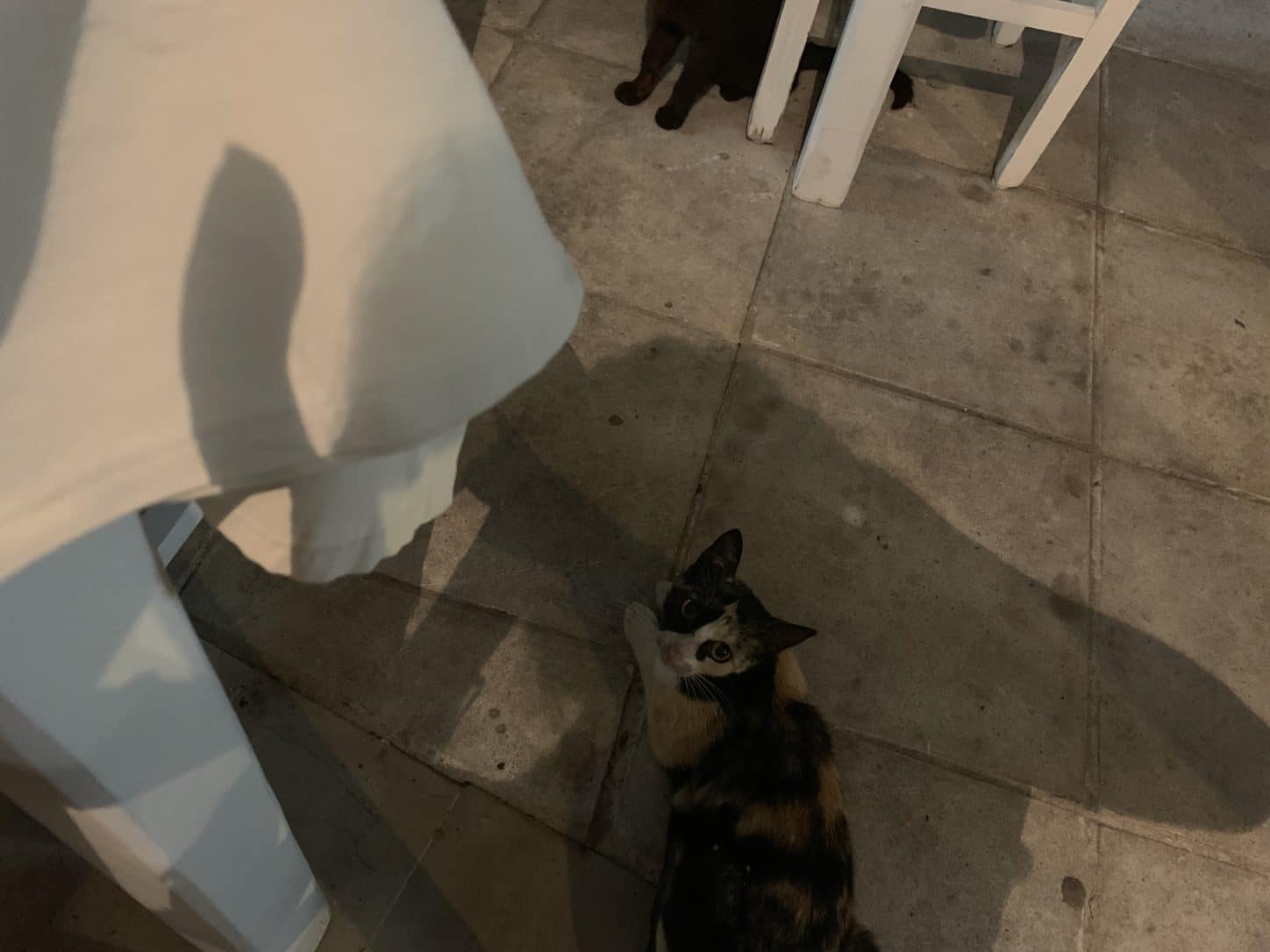
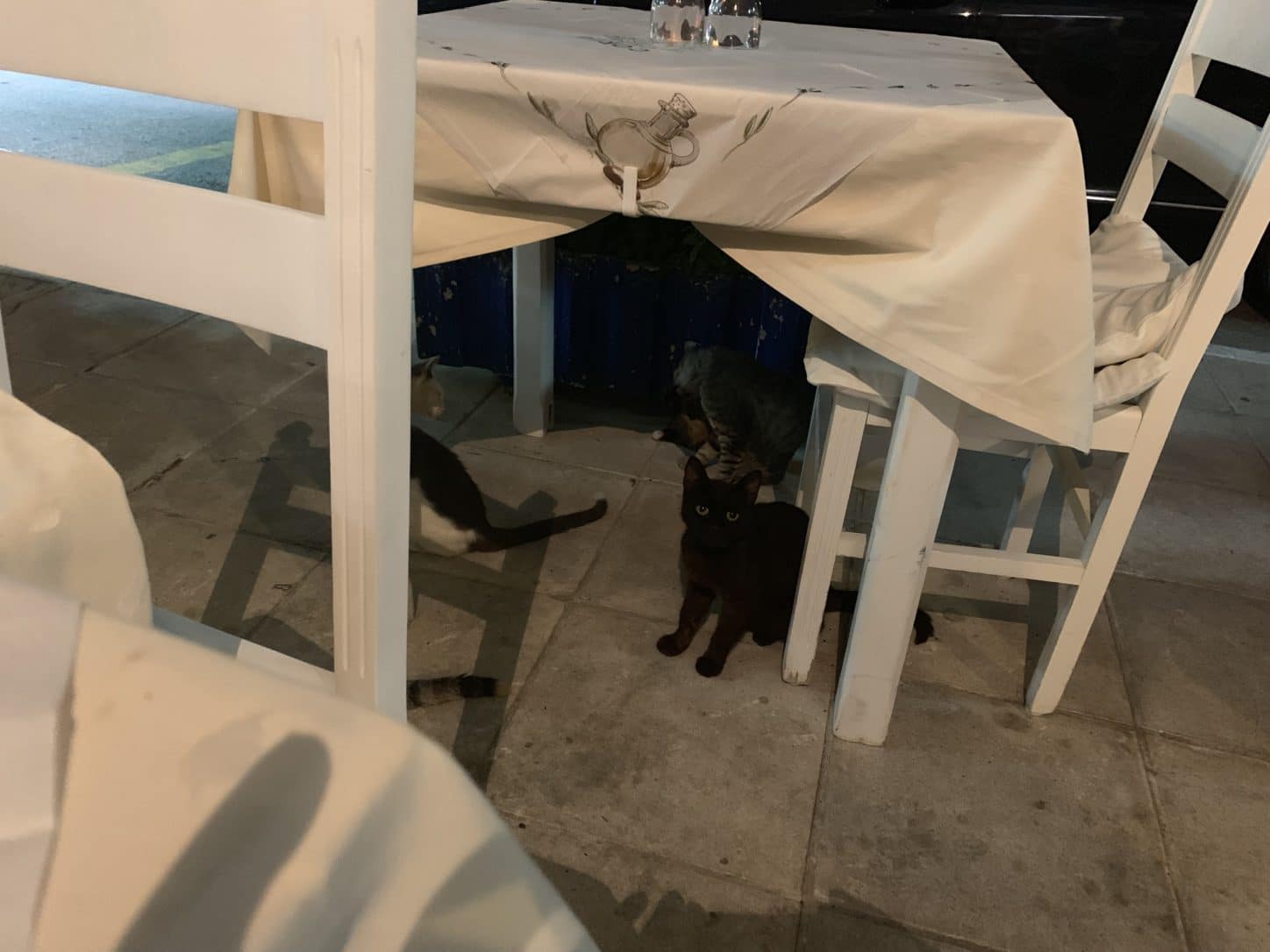
We loved the food and could eat in Gerekos every night. But we hadn’t reckoned on the cats. 

Three Days on Corfu
Cats under the tables at Gerekos Taverna, Corfu, Greece

The cats appeared as soon as the fish did and we made the mistake of throwing them a few bits. Nick put his hand down and one scratched and drew blood when it grabbed the food. 

Three Days on Corfu
Hungry cats under the table at Gerekos Taverna, Corfu, Greece

Despite the cats we enjoyed our meal and when Christina returned to pick us up  we took what was left of our bottle of Assyrtiko. She found Castello di Vista more easily than we would have. We fixed Nick’s cat scratch, had our nightcap and set the alarm for 5:30 a.m.

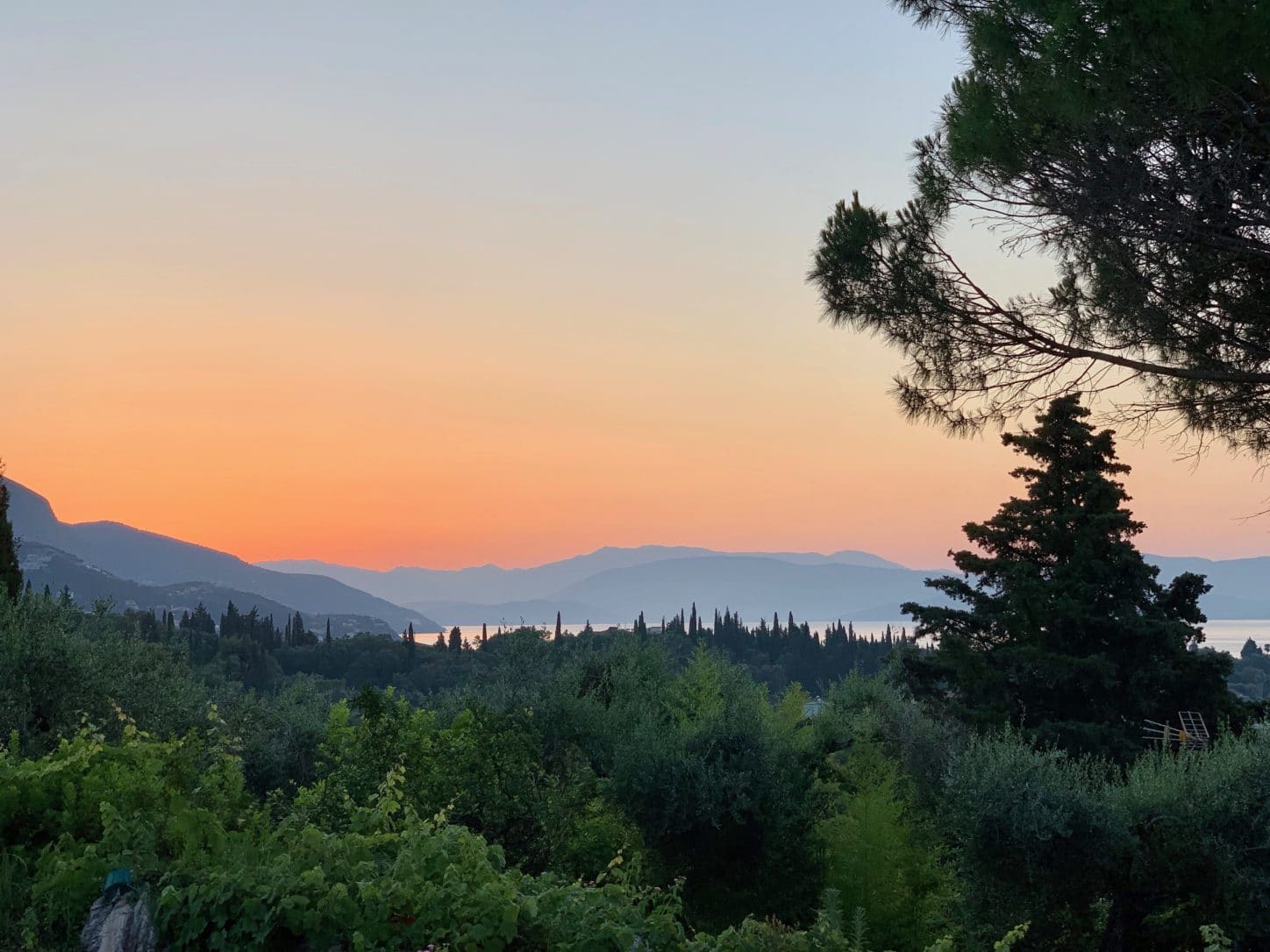
Our last morning on Corfu greeted us with a brilliant pink horizon to the east. 

Dawn on Corfu, July 1, 2019. Photo by ConsumerMojo.com.

We reached the airport by 7:00, put our car keys through a slot at the unmanned Avis counter, and had time to wait for our Sky Express flight to Athens.

Three Days on Corfu
Augie and the Kids from Mongolian Fitness Team at Corfu Airport, Photo by ConsumerMojo.com

We had a delightful time talking to Augie, a fellow traveler who led the Mongolian Children’s Fitness Team. That’s her pretty daughter in pink. This group of kids, ages 8 to 13, had joined a one-day competition, run by the International Federation of Body Building Fitness, in Corfu and come away with a couple of medals and were headed home via Athens to Moscow and then Mongolia.

We were headed to Paris to enjoy the The City of Light for few days.


New IRS Phishing Scam

We want to warn you about a new IRS phishing scam that just started to arrive in email inboxes. This fake IRS email uses the phrase “Automatic Income Tax Reminder” or “Electronic Tax Return Reminder.” The emails have links to an IRS.gov lookalike website with details that claim they have information about a tax refund, electronic return or tax account.

The emails offer you a “temporary password” or “one-time password” to “access” the files to submit the refund. But when you click on the link it turns out to be a malicious file, according to the IRS.

The malware allows the hackers to gain control of your computer or secretly download software that tracks every keystroke, eventually giving these bad actors passwords to financial accounts and other personal information.

 IRS Commissioner Chuck Rettig said, “The IRS does not send emails about your tax refund or sensitive financial information. This latest scheme is yet another reminder that tax scams are a year-round business for thieves. We urge you to be on-guard at all times.”

The new scam uses dozens of websites and web addresses that pose as IRS.gov, and that, the IRS says, makes it, “…a challenge to shut down.”

The IRS has formed partnerships with state agencies, tax and tax professionals and security experts to try to monitor frauds. The agency says it has made progress in fighting refund and identity frauds. But IRS officials also tell us something that many know all too well, “…people remain vulnerable to scams by IRS imposters sending fake emails or harassing phone calls.”

If one of these emails shows up in your inbox: Delete! Don’t click on the link. 

Beware of anyone who contacts you claiming a connection to the IRS. Here’s what the IRS says it doesn’t do:

The IRS doesn’t initiate contact with taxpayers by email, text messages or social media channels to request personal or financial information. This includes requests for PIN numbers, passwords or similar access information for credit cards, banks or other financial accounts.

The IRS also doesn’t call to demand immediate payment using a specific payment method such as a prepaid debit card, gift card or wire transfer. Generally, the IRS will first mail a bill to any taxpayer who owes taxes. 

If you do get one of these emails, the IRS asks that you: Forward – preferably with the full email headers – the email as-is to phishing@irs.gov. Don’t forward scanned images because this removes valuable information.

And again, delete the original email.


Audiobook For Last Days Of Summer


by Barbara Nevins Taylor 

Let me help you out with a few solid recommendations for an audiobook for the last days of summer. 

Choosing an audiobook presents the same kind of challenge you find when you look for something good on Netflix. There’s a lot of good stuff. But the struggle to discover something you want almost defeats the effort. 

P.J. Ochlan, a narrator and a coach for other narrators, mentioned Daisy Jones and the Six at the Audiobook Publishers Conference. “It’s a lot of fun,” he said. And he was right. Ochlan is part of the cast that features Jennifer Beals, Benjamin Bratt, Judy Greer, Robinne Lee and Pablo Schreiber, as well as other actors. 

Audiobook for the End of Summer

This romp through the seventies tells the stories of the characters who come together in a fabulously successful rock band. 

Taylor Jenkins Reid creates believable, talented and often troubled, drug-fueled characters who clash and love and make great rock-and-roll. I’ll be surprised if you don’t enjoy the trip you take with them.  All the narrators are terrific.

…….

We spent three days in Athens in June and I wanted a book that went along with the history and culture theme of our trip.                     

End of Summer Audiobook Listening

I happily downloaded The Marathon Conspiracy by Gary Corby. I didn’t realize that it’s part of a series, but that didn’t matter. This book is set in ancient Athens in 460 BC, 30 years after the battle at Marathon that routed the Persians and marked the end of the first Greco-Persian war. The story’s quirky charm makes you laugh, while you root for the hero-detective Nickolaos and his partner-fiancee Diotima. The two young detectives get hired by the leader of Athens, Pericles, to find out who murdered Hippias, the last tyrant of Athens. His skull, found at a girls school at the Temple of Artemis, gets the story rolling. 

There’s a lot of ancient Greece and its mores and enough tension to keep you listening and enjoying. Socrates plays a role here as Nickolaos’s younger brother, and the warrior-playwright Aeschylus comes along as the action heats up. Narrator Erik Davies is almost better than the story and made all the characters believable.

………

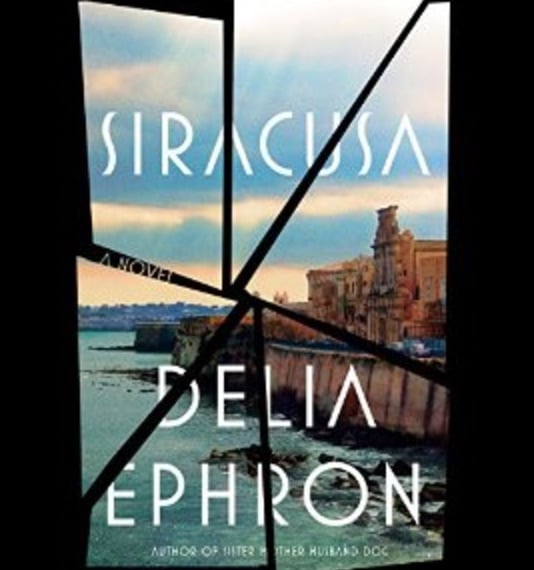
Siracusa puts you in southern Sicily, on an island called Ortigia linked by a bridge to the city of Siracusa. 

Audiobooks for End of Summer Listening

It’s a beautiful place with a history as a crossroads of civilizations and cultures. But for two couples on vacation, with the child of one couple, it turns into a place that reveals their personal weaknesses and throws their lives into chaos.

This psychologically tinged Delia Ephron romp will give you a taste of a magical place on the Ionian Sea in southern Sicily without making you feel like you checked your brains for the summer.

Talia Balsam, Katie Finneran, John Slattery and Darren Goldstein give voices to the travelers who don’t always share the same vision of fun. I won’t give the plot away, but this comes pretty close to a vacation from hell. A lot happens including one very bad thing. The excellent narrators make it real and keep you listening.

……….

If you haven’t read or listened to the IQ series by Joe Ide, start now.

Audiobooks for End of Summer Listening

 IQ kicks-off an all-American crime mystery series that puts Isaiah Quintabe, an African-American teenager in Long Beach, California to work solving crimes.

This extremely smart kid finds himself on his own after his brother, who’d been raising him, is mysteriously killed. He begins to investigate small crimes for neighbors, who initially pay him with baked goods, sweaters and other humble offerings.

Nicknamed IQ, he graduates quickly to the scary, and often hilarious, investigation of a crime involving a hip-hop star. Narrator Sullivan Jones gives a pitch-perfect performance.

The first book, IQ and the two that follow, Righteous and Wrecked feature an entertaining cast of young characters who make you want Joe Ide to write more. 7-favorite-audiobooks-to-jumpstart-2017

Seriously-good-audiobooks

Why Take Equifax Credit Monitoring?

You may ask yourself, why take credit monitoring in the Equifax settlement rather than the $125 that was initially announced. Just get the $125, right? It turns out there isn’t enough money set aside to pay the full amount to the 147 million people affected by the 2017 data breach.

Bottom line: you’re not likely to get close to that amount.

Millions of people visited the Equifax claims website after the settlement was announced in July. And the Federal Trade Commission, (FTC) on its website, now cautions: 

 “Because the total amount available for these alternative payments is $31 million, each person who takes the money option is going to get a very small amount. Nowhere near the $125 they could have gotten if there hadn’t been such an enormous number of claims filed.” 

Instead the FTC says, “The free credit monitoring provides a much better value, and everyone whose information was exposed can take advantage of it. If your information was exposed in the data breach, and you file a valid claim before the deadline, you are guaranteed at least four years of free monitoring at all three credit bureaus (Equifax, Experian, and TransUnion) and $1,000,000 of identity theft insurance, among other benefits. The market value of this product is hundreds of dollars per year.”

You must file a claim by January 20, 2020

So just in case you need a refresher on how all this came about:

In 2017 hackers, or a hacker, allegedly used a flaw in the technical system to break into the Equifax server. They stole consumers’ Social Security numbers, dates of birth, and other private information. Equifax did not immediately report its own discovery that the information had been compromised.

As a consequence, The Federal Trade Commission, the Consumer Financial Protection Bureau (CFPB) and 48 state attorneys general, and those from Puerto Rico and Washington, D.C., sued Equifax. In a settlement in July, Equifax did not admit guilt but agreed to pay restitution or pay another company, Experian, to monitor the credit of people affected, if that’s the option they choose. It also put aside money to pay people for time lost while trying to recover money or straighten out problems caused by identity theft. And it promised to provide those affected identity theft insurance.

Equifax agreed to pay $575 million and potentially up to $700 million. But only $31 million of that will go to consumers for restitution. Another $31 million was set aside for people who spent time dealing with claims.

The National Consumer Law Center (NCLC) said affected consumers still have something to worry about. “One huge concern is the long term consequences of the Equifax breach. The settlement provides some compensation right now, but the risk of identity theft is forever because our stolen Social Security numbers can be traded by hackers in perpetuity. The time period to file a claim, at most, is four years. What happens if a consumer is the victim of ID theft in the fifth year resulting from the breach, which costs the consumer tens of thousands of dollars?”

If you choose the credit monitoring option, the burden is on you to check to make sure that no one has tried to use your credit or steal your identity. You have to request the reports and check them. 

Freeze your credit report

Consumer advocates say if you were affected, put a freeze on your credit report. That offers the best protection. “Congress has already made free the single most effective measure to prevent identity theft – a security freeze. Consumers affected by the Equifax breach should just freeze their credit reports if they are concerned about identity theft,” the National Consumer Law Center advised.

To file a claim for credit monitoring, restitution or payment for time and money lost, here’s what you do.

1. Go to Equifax Data Breach Settlement 

Why take Equifax Settlement Credit Monitoring?

2.  Click on File a Claim.

3.  The next page again asks you to click on file a claim or download a claim form.

4. The next page explains the options.

Why Take Equifax Settlement Credit Monitoring

5. The next page asks for your name, address, phone number and email.

Why Take Equifax Settlement Credit Monitoring?

6. The next page gets to it and lets you choose the option you want, money or credit monitoring, and gives you a place to click if you want to submit a monetary claim for lost money, or time.

Why Chose Equifax Settlement Credit Monitoring?

The settlement is far from perfect.  

No one was prosecuted and apparently no one will go to prison for allowing the breach. An Equifax executive, Jung Ying, was sentenced to four months in prison in June 2019 for insider trading. He dumped his stock after learning of the hack before it was made public.  But top executives were not prosecuted.

If you are not sure if you were affected, you can click here and use this tool.

The court has to sign off on the deal and you will not see any benefits before January 23, 2020 at the earliest. 

Exploring Peloponnese Peninsula Legend and History

by Nick Taylor and Barbara Nevins Taylor

We wanted to explore the legends and history of the Peloponnese peninsula. When we looked at a map we realized some of the earliest and greatest stories of our western culture sprung from the rugged hills of the splayed-out foot of Greece south and west of Athens.  

Exploring Peloponnese Peninsula Legend and History

We admit to gaps in our education. So we hoped that by walking in ancient footsteps we’d get insight into the Greek imagination and understand more about the fragile underpinnings of the world and our democracy.

We drove out of the Avis lot at the Athens airport in a dark blue Opel wagon that was almost black.

Exploring Peloponnese Peninsula For Legend and History
Avis Rental Car, Athens Airport, Photo by ConsumerMojo.com

An attendant gave us a map but said it wouldn’t help. Pointing, he said, “That ramp will put you on the freeway. Follow the signs to Corinth, then to Tripoli, and you’ll see signs to Nafplio.” Corinth, Tripoli, silly, but the names of the ancient cities had us dreaming.

Exploring Peloponnese Peninsula Legend and History
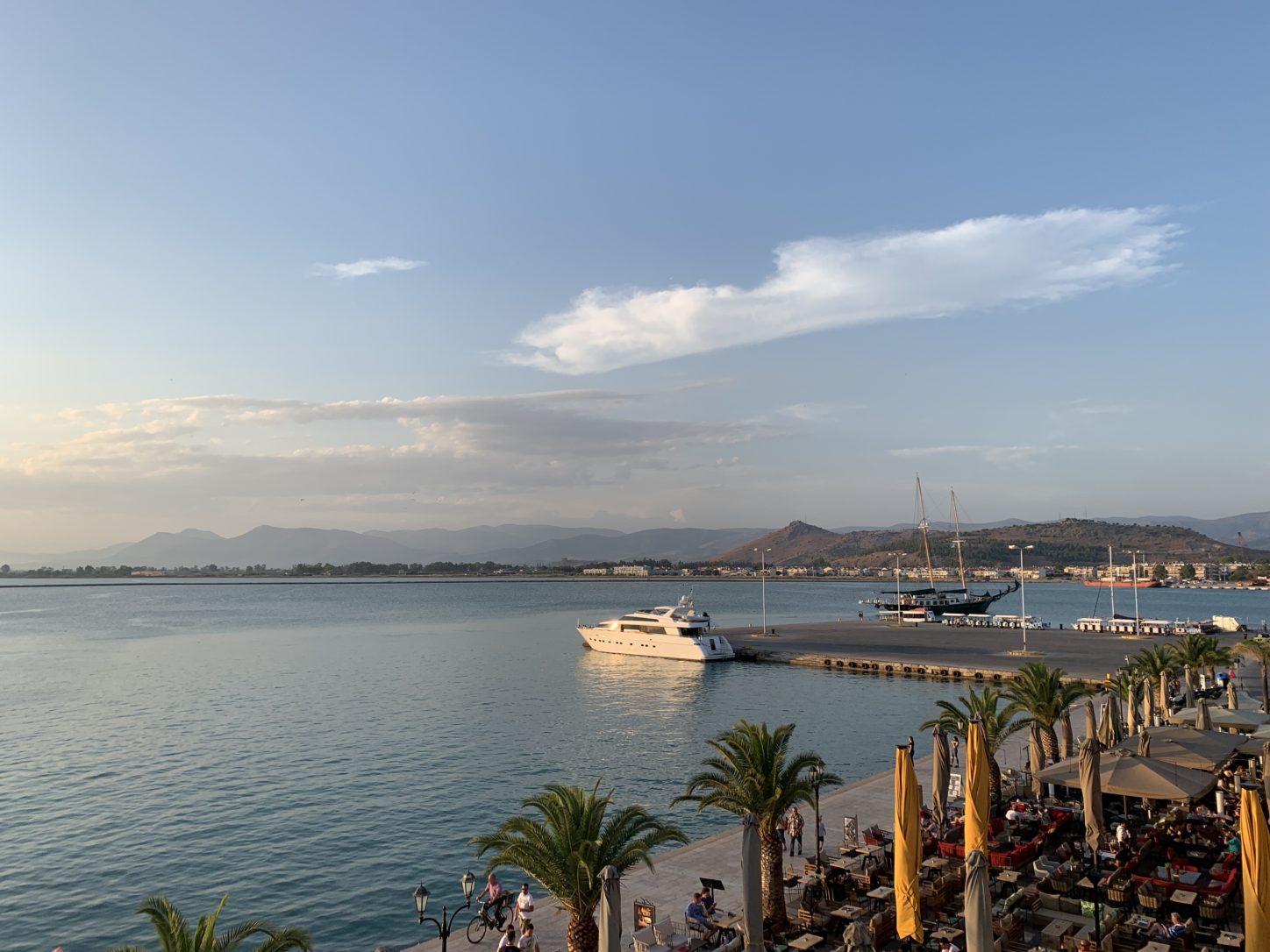
Napflio Harbor, Napflio, Greece. Photo by ConsumerMojo.com

Old maps and many travel sites render our destination’s name as Napflion. We couldn’t figure it out until we learned that it’s a so-called purist form of modern Greek called Katharevousa. But the country officially adopted Demotic Greek in 1976, and now the language drops the “n” at the end of neutral nouns and most Greeks write and say Nafplio.

Napflio or Napflion, we planned to make it our base for five days while we traveled the Peloponnese peninsula to visit the archeological sites and absorb the Homeric legends and the history.

Exploring Peloponnese Legend and History
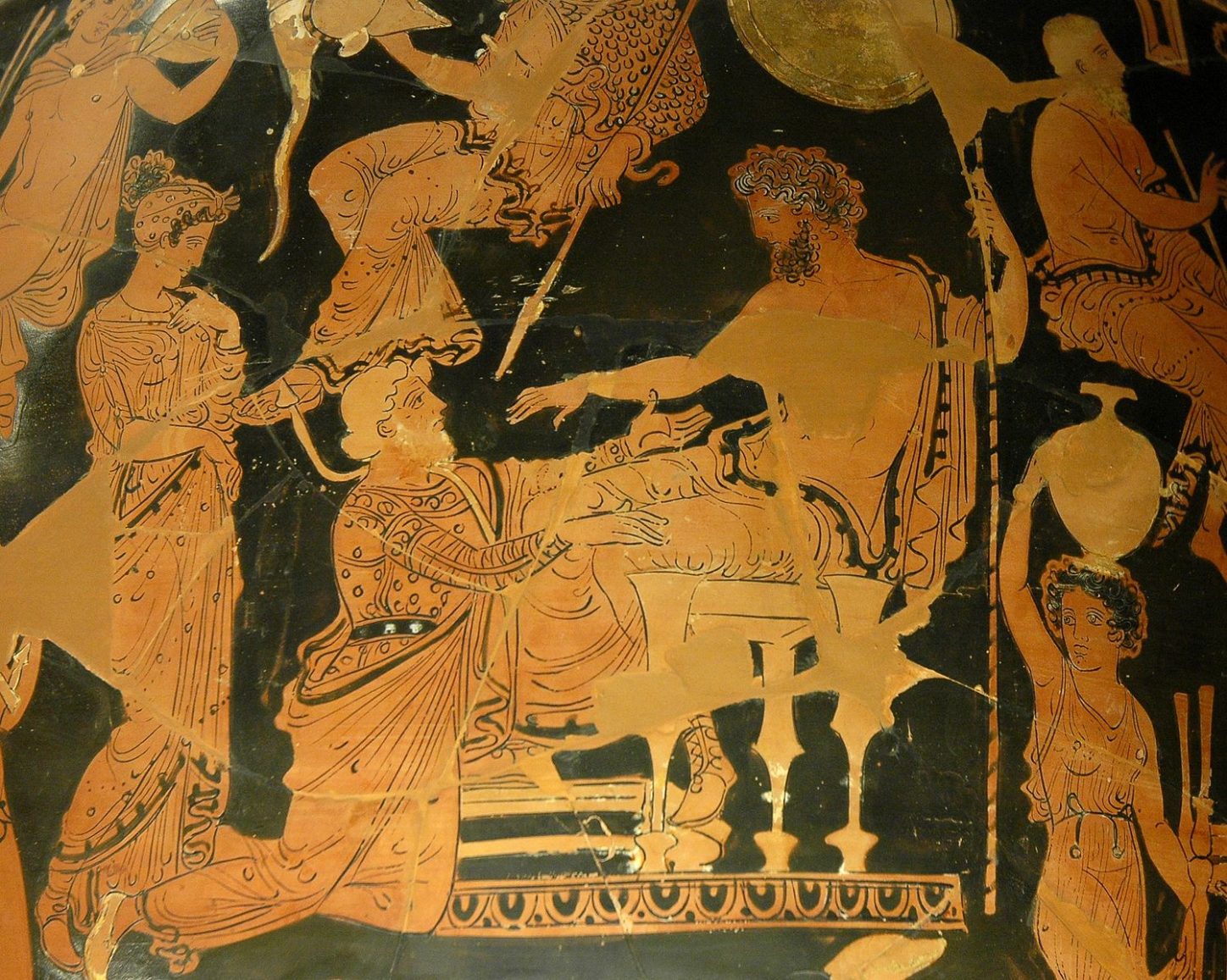
Chryses offering Agamemnon ransom for his daughter. Side A of an Apulian red-figure volute-crater, ca. 360 BC–350 BC, found in Taranto. Louvre. Creative Commons License

Contests of sport and skill we now call the Olympic games started at ancient Olympia, near the peninsula’s west coast. Sparta groomed its warriors, in counterpoint to Athens’ intellectuals, toward the south. Ancient theaters still held the echoes of the western world’s first plays. Ruins of palaces held mysteries, and castles and forts marked the battlegrounds of centuries of war.

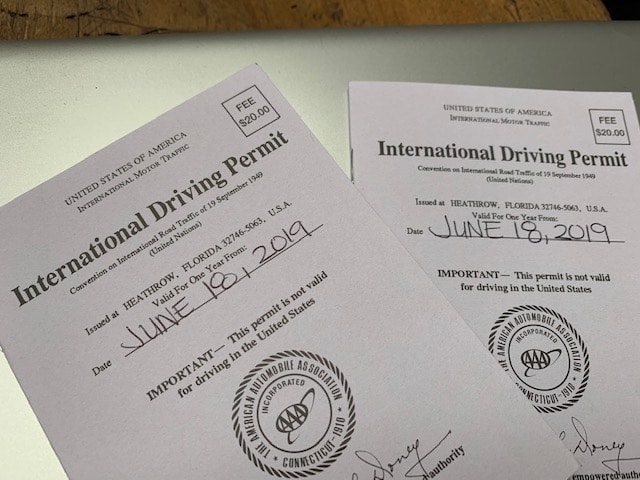
We sped west along the four-lane tollway averaging probably 110 kilometers per hour, skirting Athens to our south. We had international drivers licenses and were warned that we needed them if we were stopped by the police. Without them we’d face a 500 euro fine.

Google Maps told us we’d make the 167-kilometer trip in under two hours. We only slowed for the frequent toll booths, and as we handed euros to the toll-takers we began to understand why there wasn’t a lot of other traffic.

Exploring Peloponnese Peninsula Legend and History
Toll Road, Peloponnese Peninsula, Greece. Photo by ConsumerMojo.com

The tollways cost too much. We learned later, after talking to many Greeks, that they take back roads and the long way to avoid the tolls.

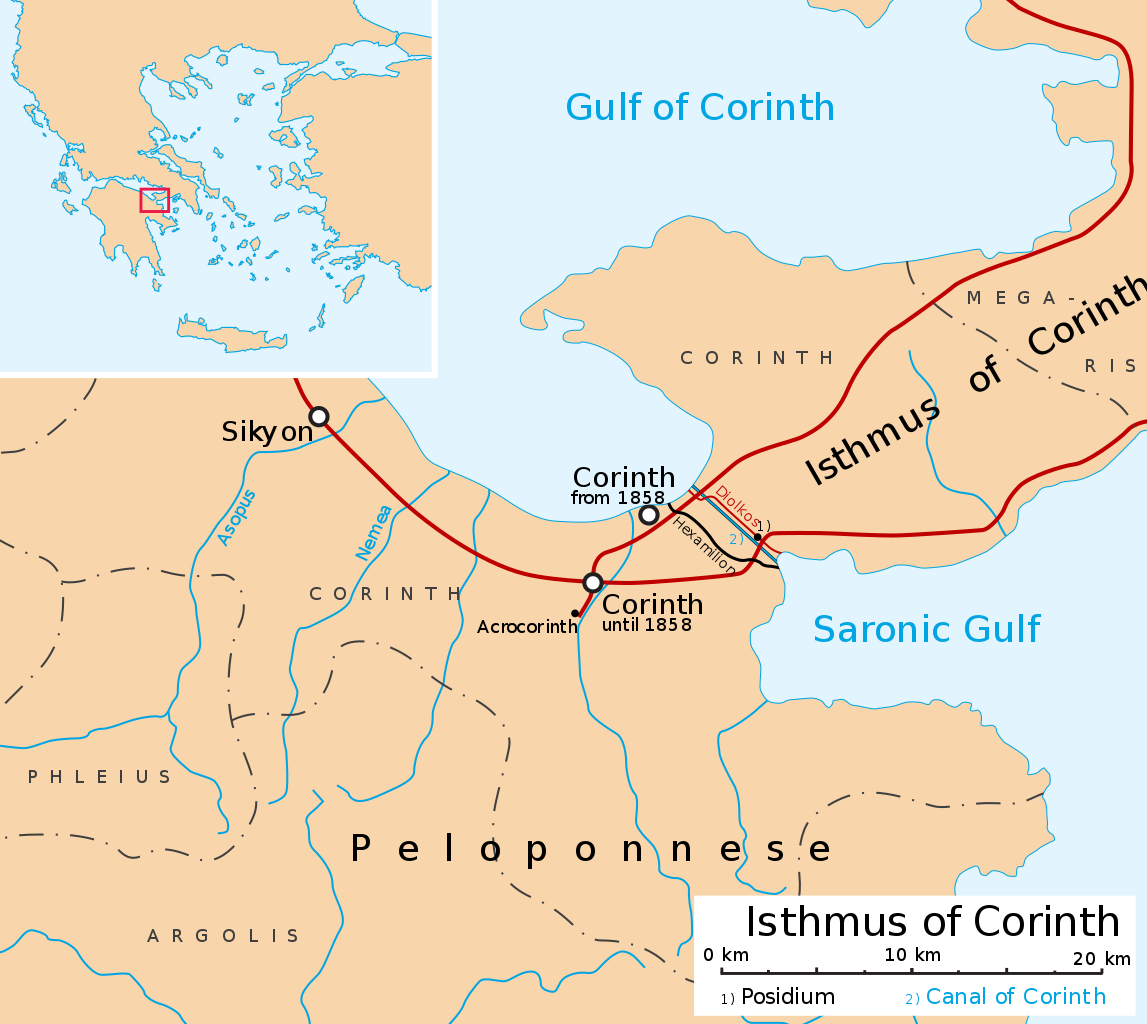
When we approached Corinth we saw signs to the Corinth Canal. The Peloponnesian peninsula joins the Greek mainland by a thin isthmus between the Gulf of Corinth on the west and the Saronic Gulf on the east.

Corinth Canal, Image by EcoChap. Courtesy Creative Commons License.

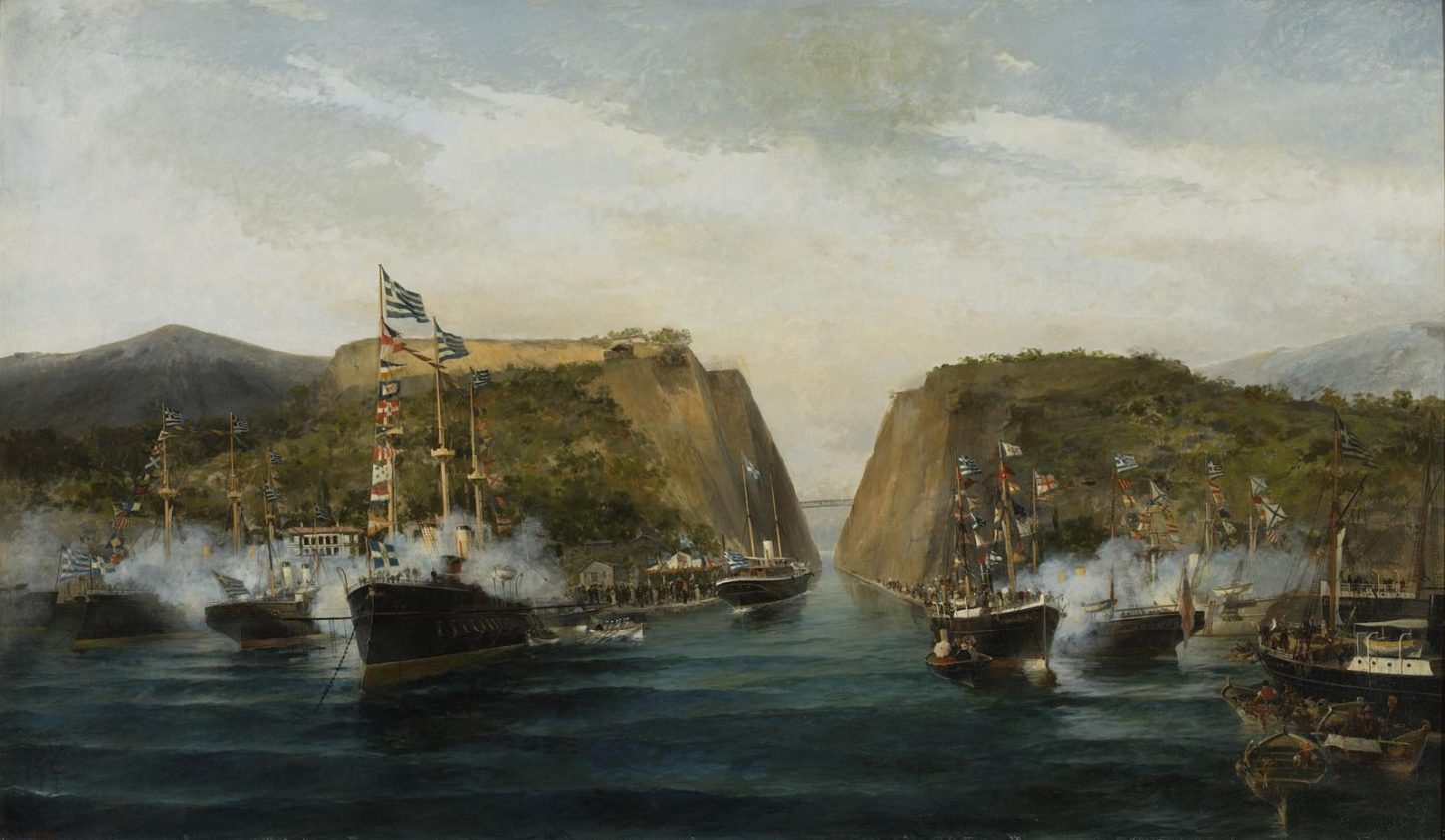
Greek and Roman rulers talked about building a canal for centuries. Nero even broke ground in 67 A.D., digging up a basketful of earth with a pickaxe in what today would be a photo op. But not until the late 19th century did the engineering and financing align, and the four-mile canal opened in 1893.

Exploring Peloponnese Legend and History
Corinth Canal Inauguration, 1893, by Volanakis, Public Domain. Creative Commons License

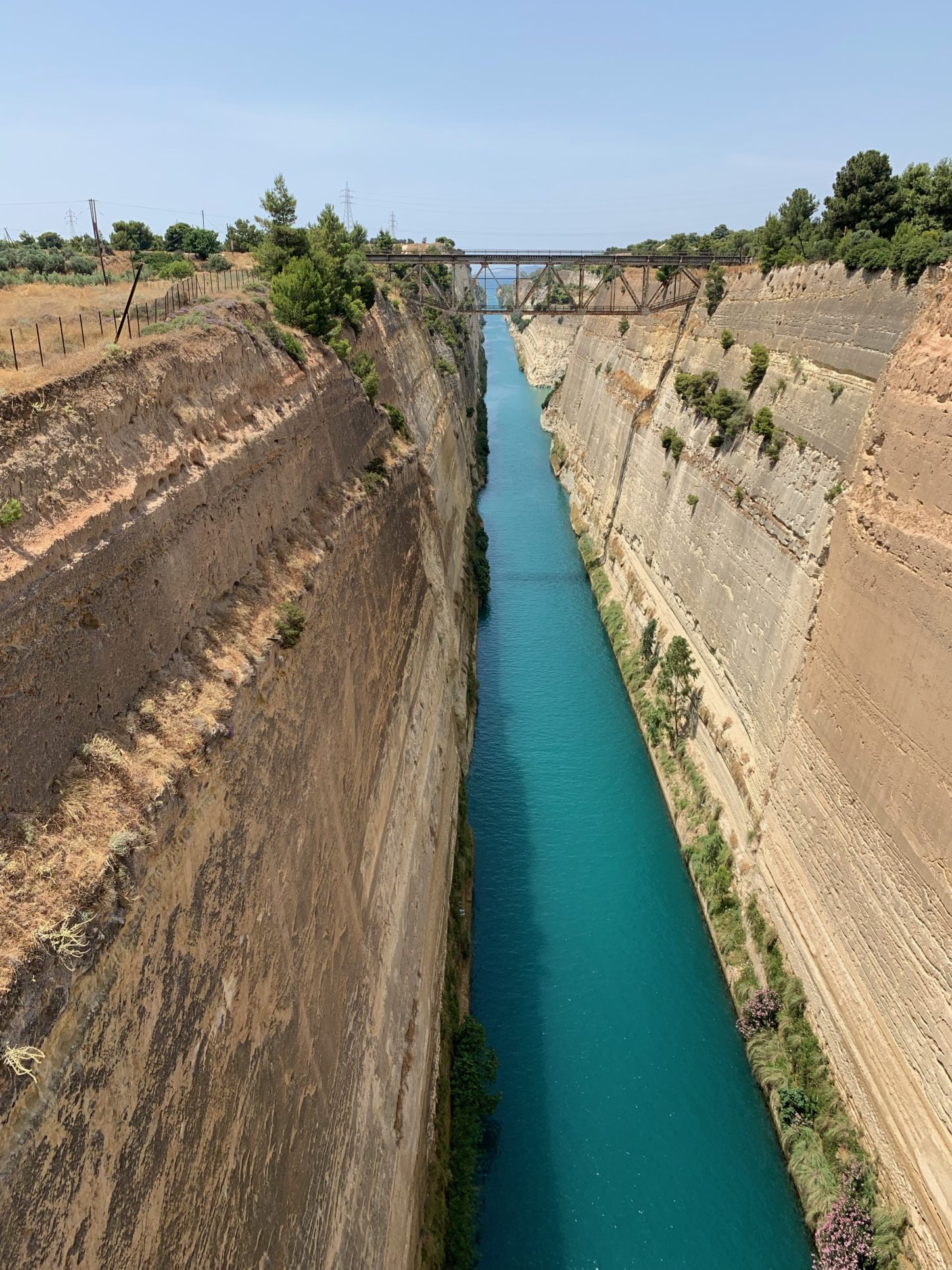
We spotted it from the car as we crossed a short bridge, a straight blue line a long way down.

Corinth Canal, Photo by ConsumerMojo.com

We parked and walked over to get a better look.  A pencil-straight path carved through steep limestone walls plunged 300 feet to the water below. It’s a sea-level canal, so it has no locks. And it’s narrow, only 70 feet wide, which means small cruise ships and tourist boats can use it, but not most cargo vessels. Technically, that cut makes the Peloponnese an island instead of a peninsula.

Exploring Peloponnese Legend and History
Restaurant at Corinth Canal, Greece. Photo by ConsumerMojo.com

We stopped at the adjacent roadside restaurant, ate some chicken souvlaki, a spinach pie and French fries and then headed south again toward Tripoli before signs and our GPS led us off the tollway and east to Nafplio.

The spectacular terrain was dramatically different from what we saw in the Athens area. Craggy tree-dotted mountains wrapped around the highway until Google Maps brought us through vineyards and farm roads as we wound toward the sea.

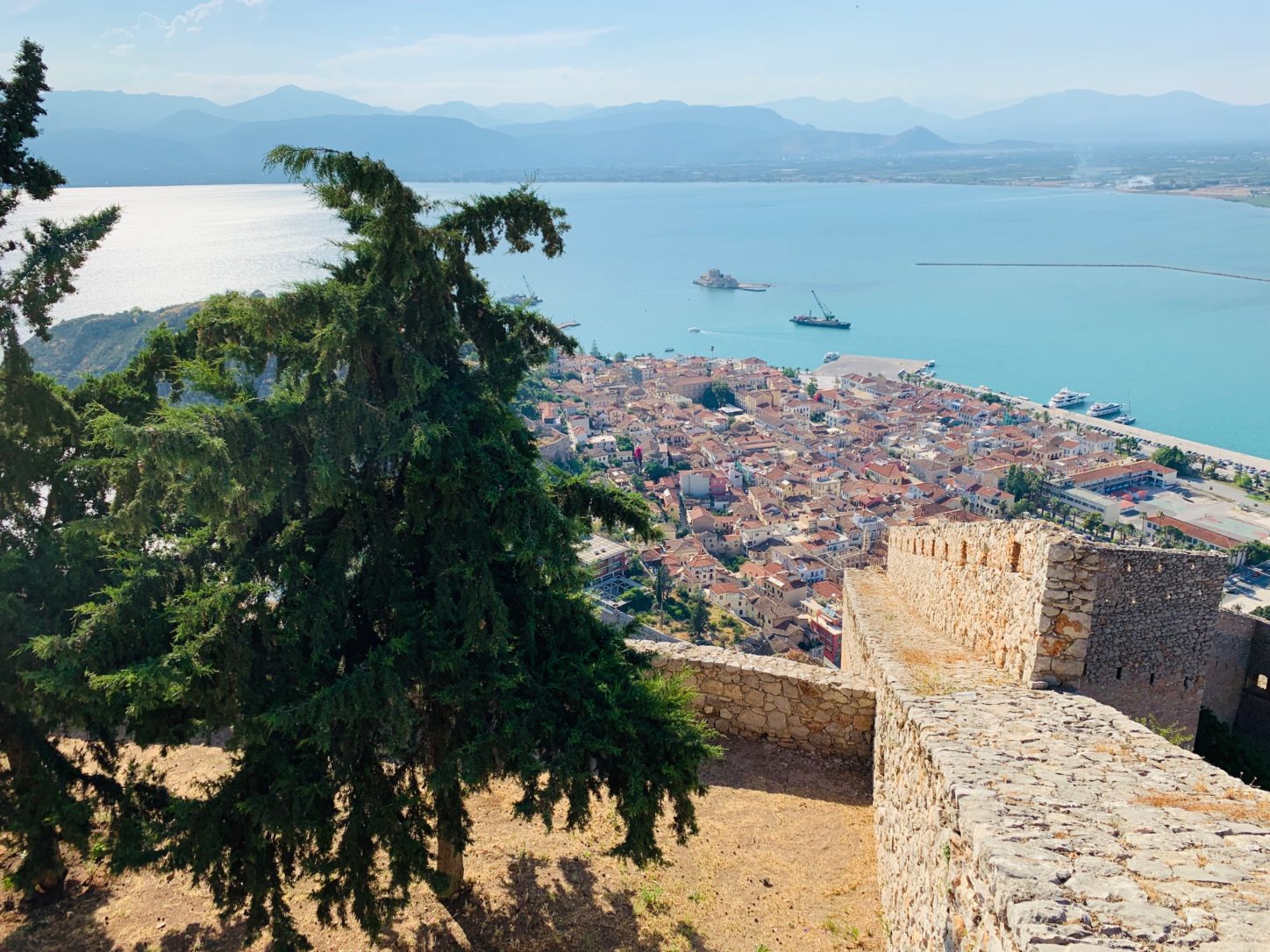
Nafplio lies on a northern tongue of the Argolic Gulf. It’s a town of some 14,000 people, with red-roofed buildings that rise from its harbor to a Venetian fortress that overlooks the water to the hills beyond.

Exploring Peloponnese Peninsula for Legend and History
Napflio from Palimidi Castle. Photo by ConsumerMojo.com

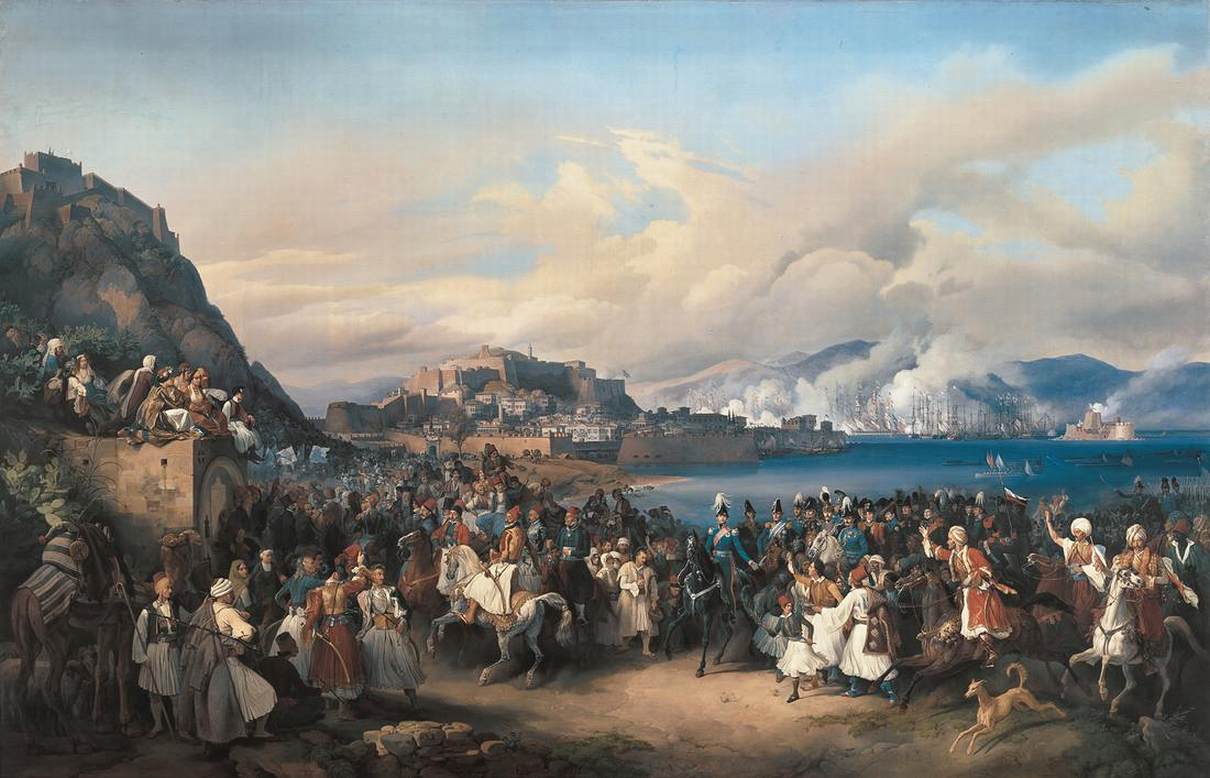
 It was the first capital of the new Greek state that emerged in 1823 after Greeks fought the Ottoman Empire for independence. We learned that the Greeks imported Otto, a Bavarian, to be their king. 

Exploring Napflio for History and Legend
King Otto Entering Napflio, Painting by Peter Von Hess. Public Domain via Wikimedia.

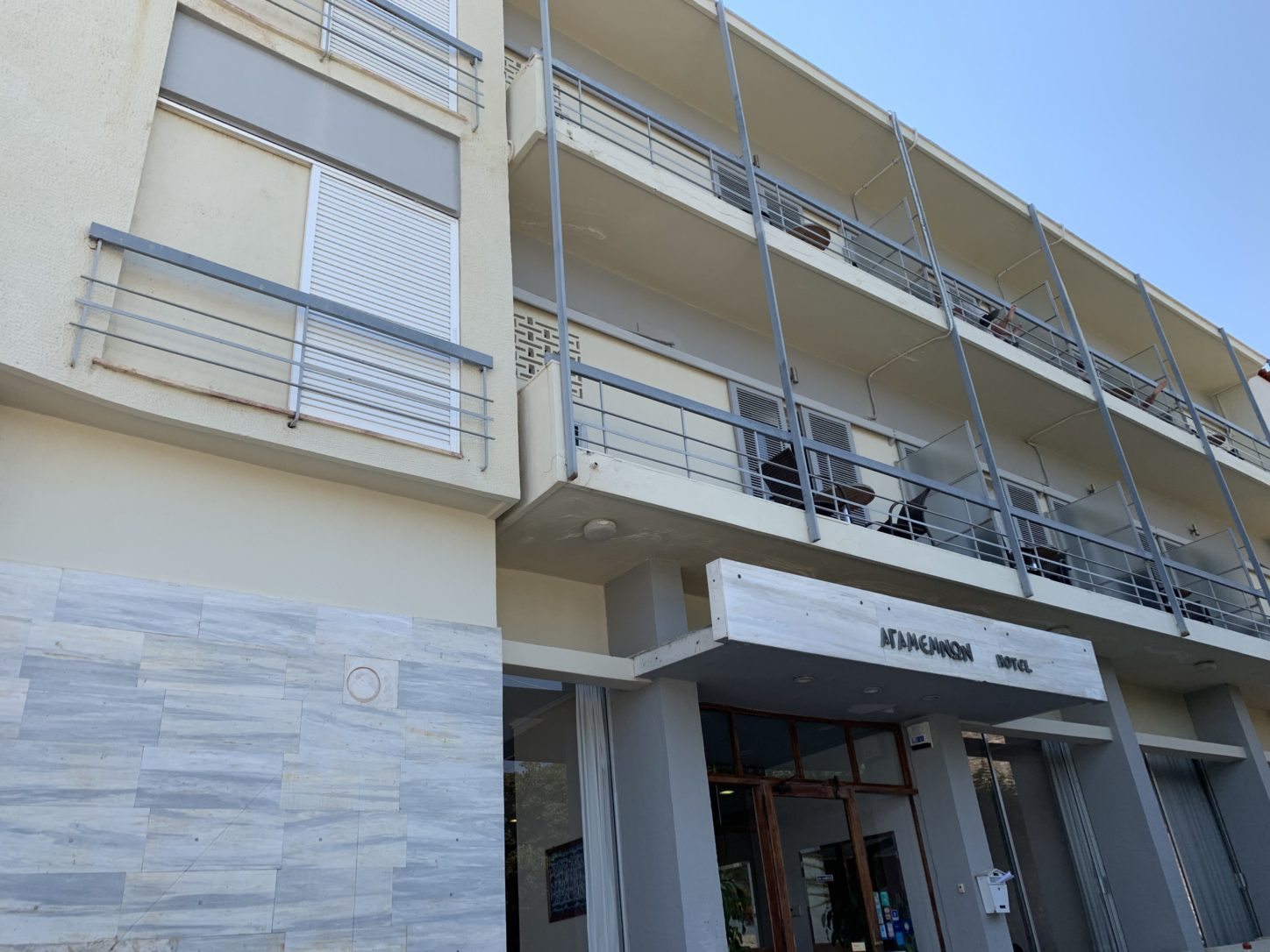
We unloaded at the three-star Agamemnon Hotel, which we found on booking.com. Once we dropped our bags off, the desk clerk told us about free parking up the hill not far away.

Exploring Peloponnese Peninsula for Legend and History

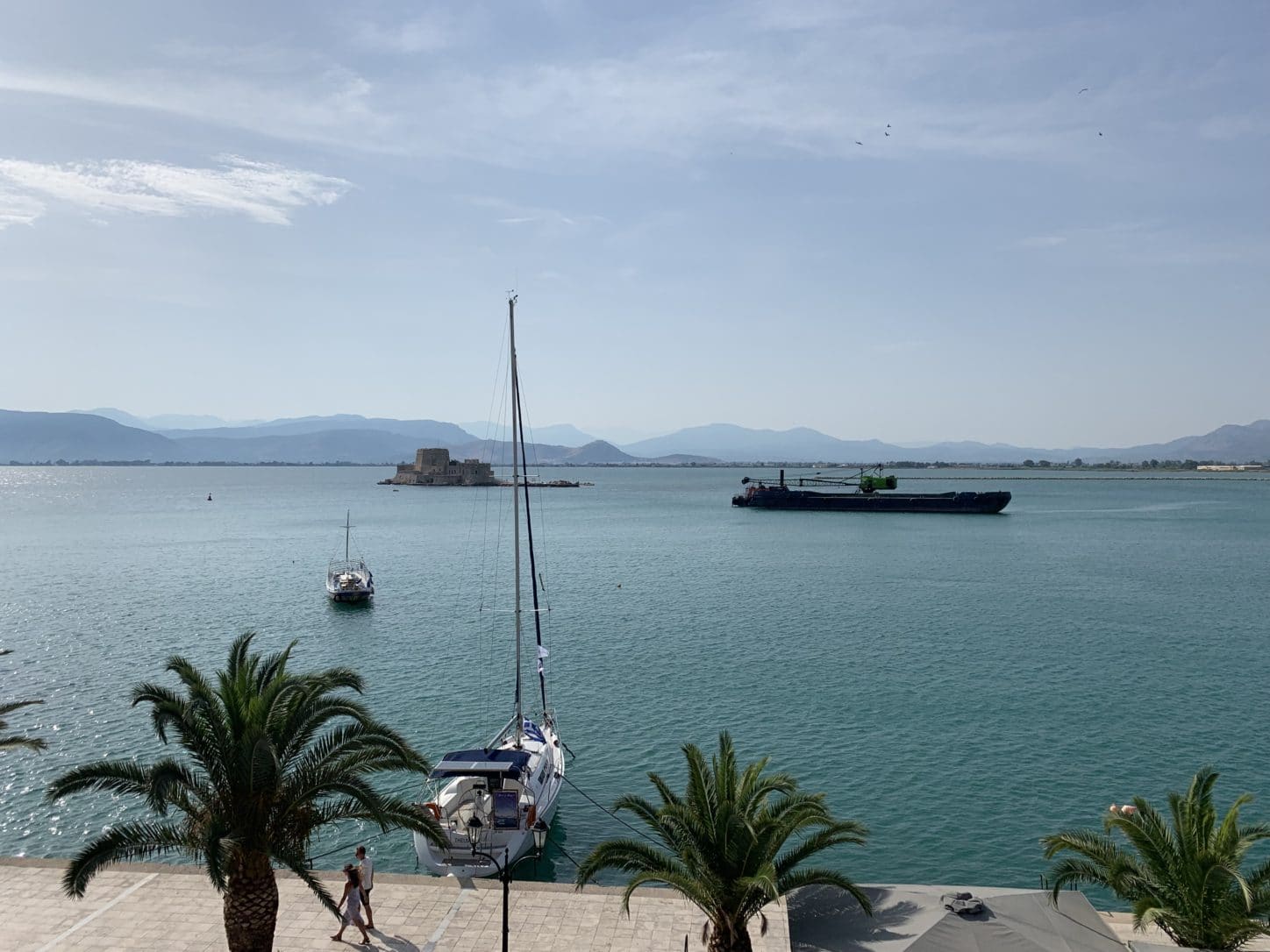
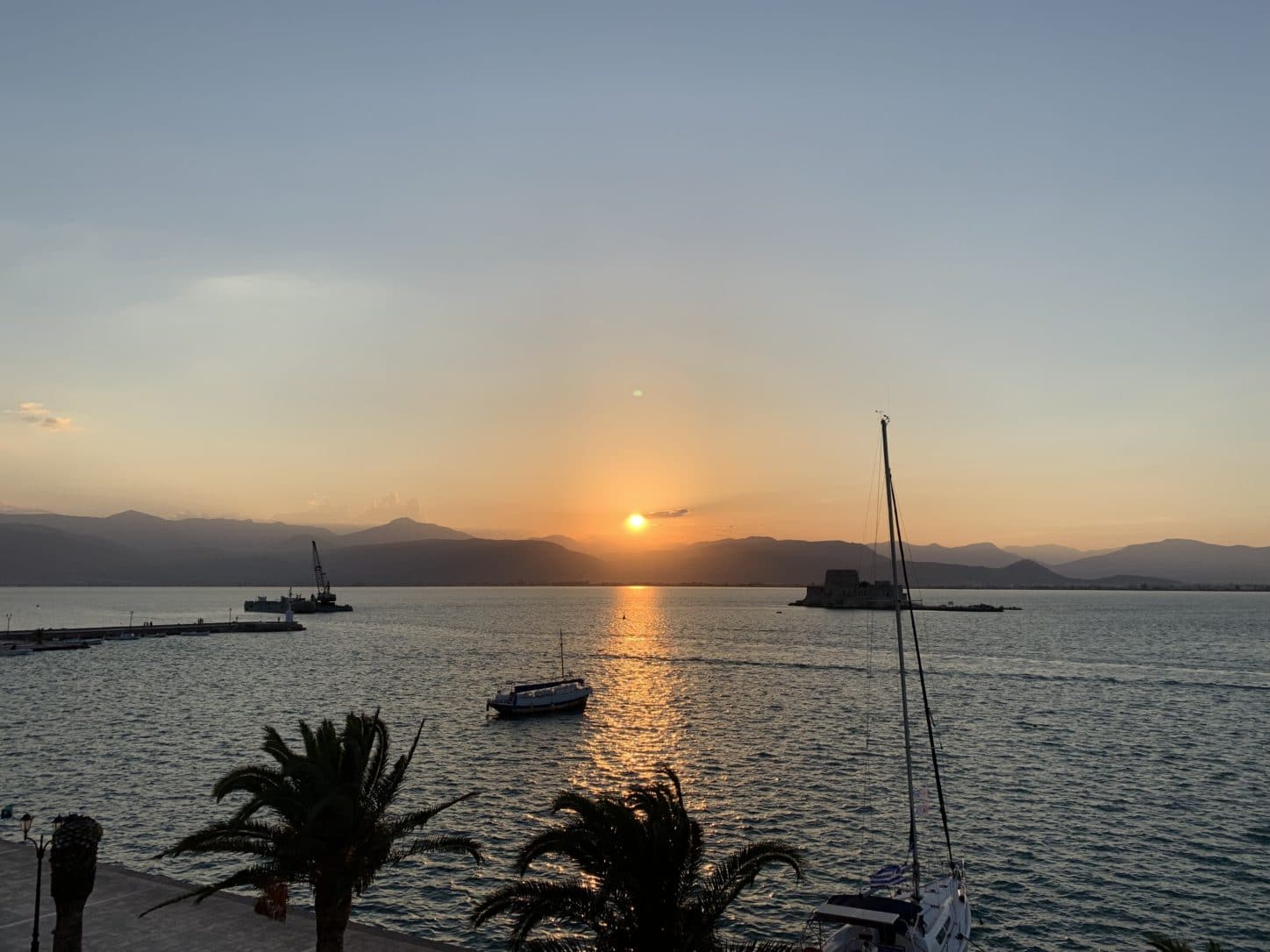
The clean room was spare and functional. Its only drawback, in common with many Greek hotels, was that you couldn’t put toilet paper in the toilet. But we  delighted in the view from our third-floor balcony overlooking Nafplio’s harbor, the Argolis Gulf, and Bourtzi Castle, a fort built in 1473 during Venetian rule.

Exploring Peloponnese Peninsula Legend and History
View of Napflio Harbor from Agamemnon Hotel, Photo by ConsumerMojo.com

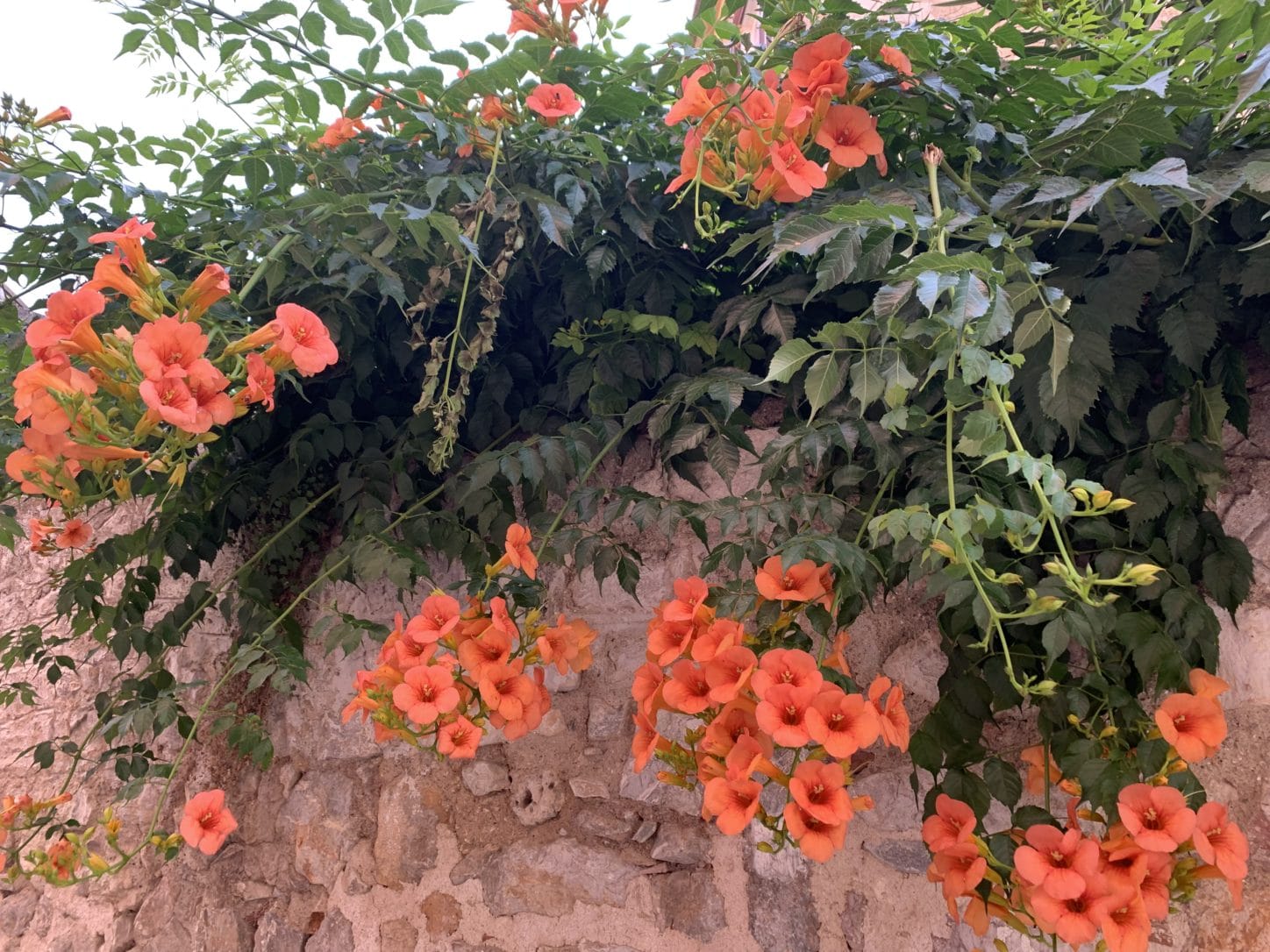
We made ourselves comfortable and went out to look around. We walked up the hill from the Agamemnon and passed a blooming orange trumpet vine spilling over a stone wall. It added to the beauty we’d seen in Nafplio in just a few short minutes.

Exploring Peloponnese Peninsula For Legend and History
Flowers in Napflio, Photo by ConsumerMojo.com

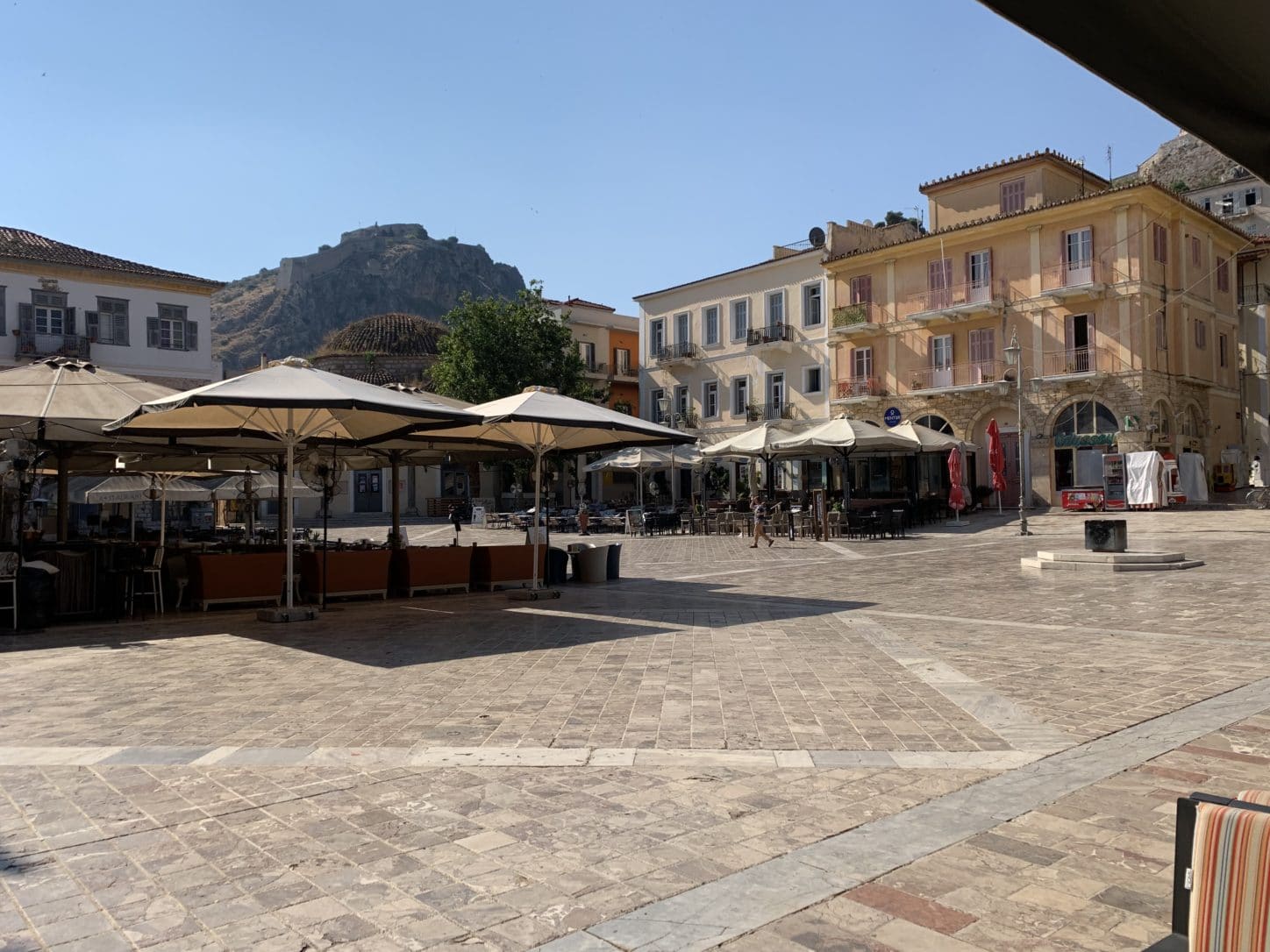
A left turn put us on a cobbled street that led into Syntagma Square. Pastel shaded neo-classical buildings bordered the marble-tiled square filled with cafés, small shops and a branch of the Bank of Greece.

Exploring Peloponnese Peninsula for Legend and History
Main Square Napflio, Greece. Photo by ConsumerMojo.com

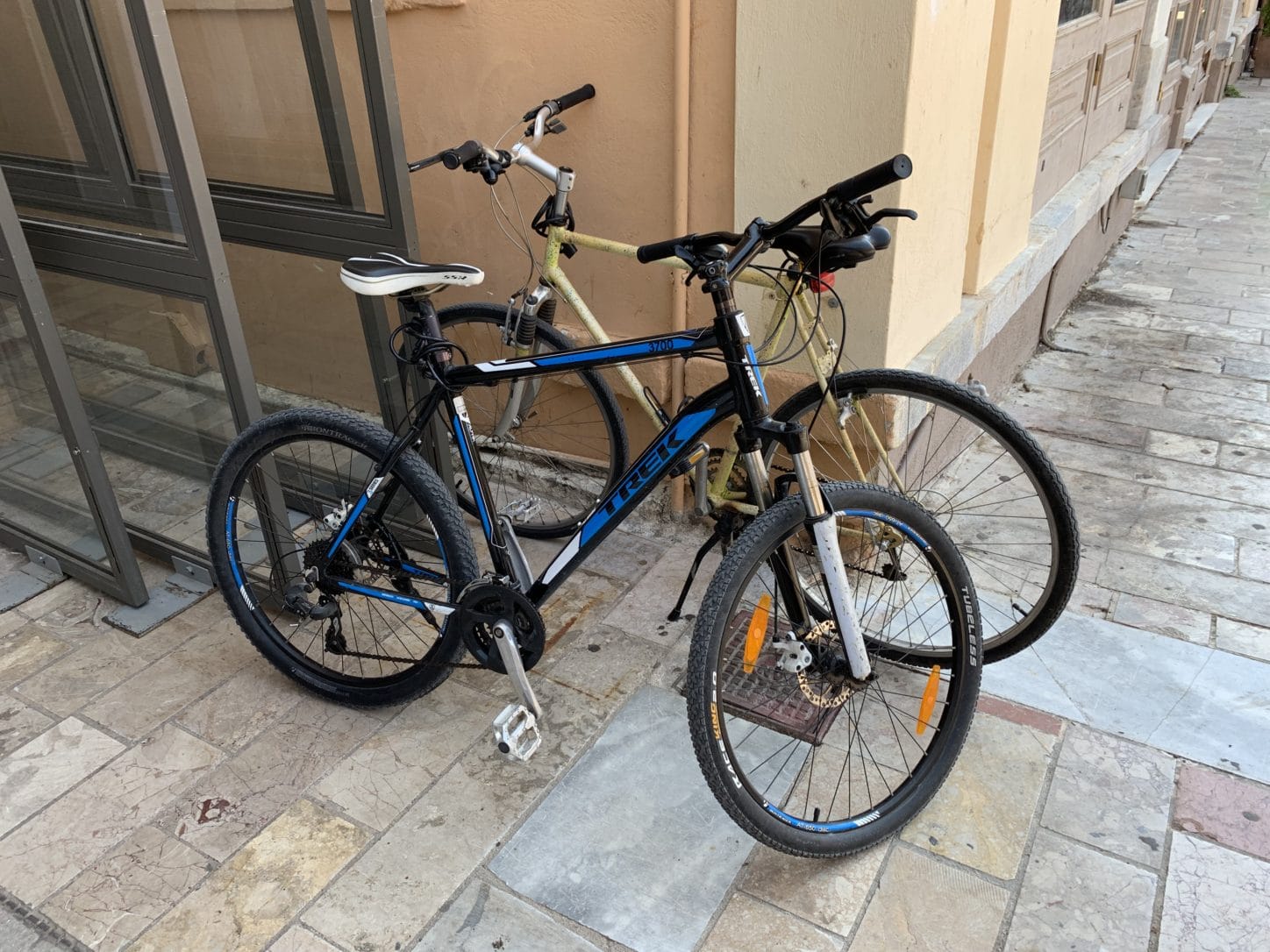
Bicycles leaning against buildings with not a lock in sight caught Nick’s attention.  This felt like his kind of place.

Unlocked bicycles at Syntagmatos Square, Nafplio. Photo by ConsumerMojo.com.

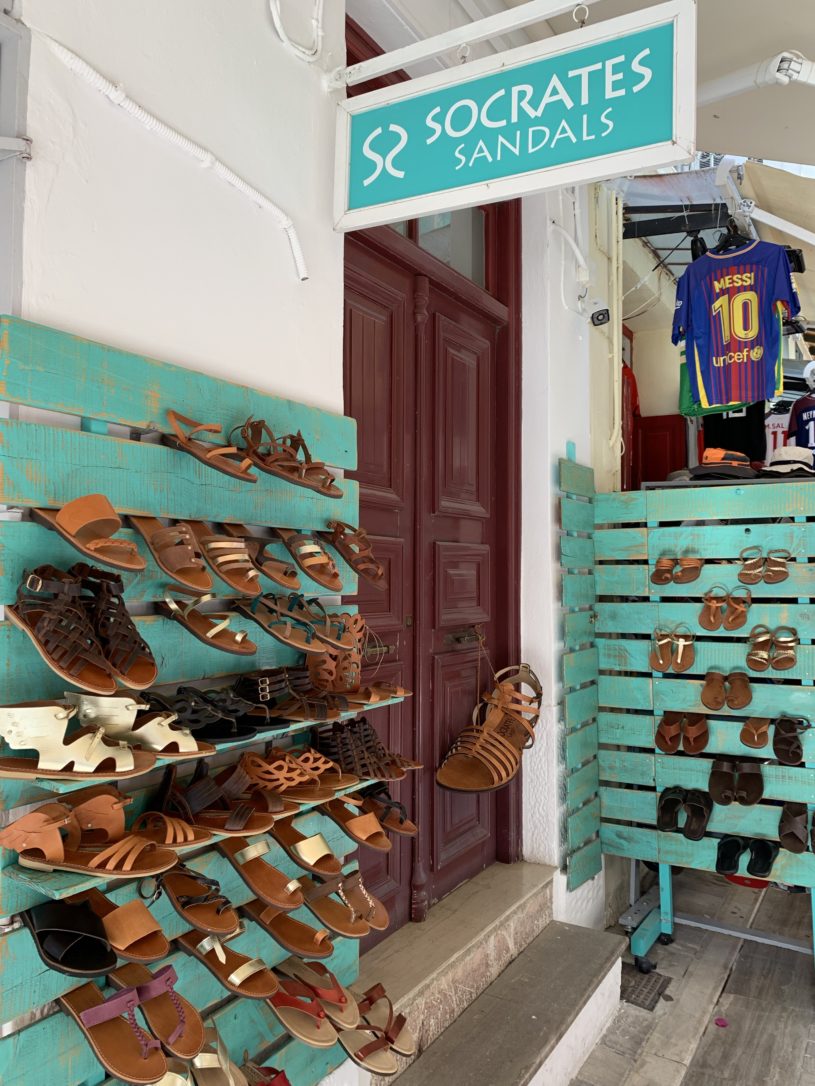
We found more to smile about on the main street of the old town filled with shops offering tourist stuff, clothes and sandals. Nick saw Socrates Sandals. He poked me. “Look at this. Imagine the Socratic dialogue he’d start with a question about feet: ‘What are bone spurs?'” he said, snapping pictures he was eager to share.

Socrates Sandals, photo by ConsumerMojo.com

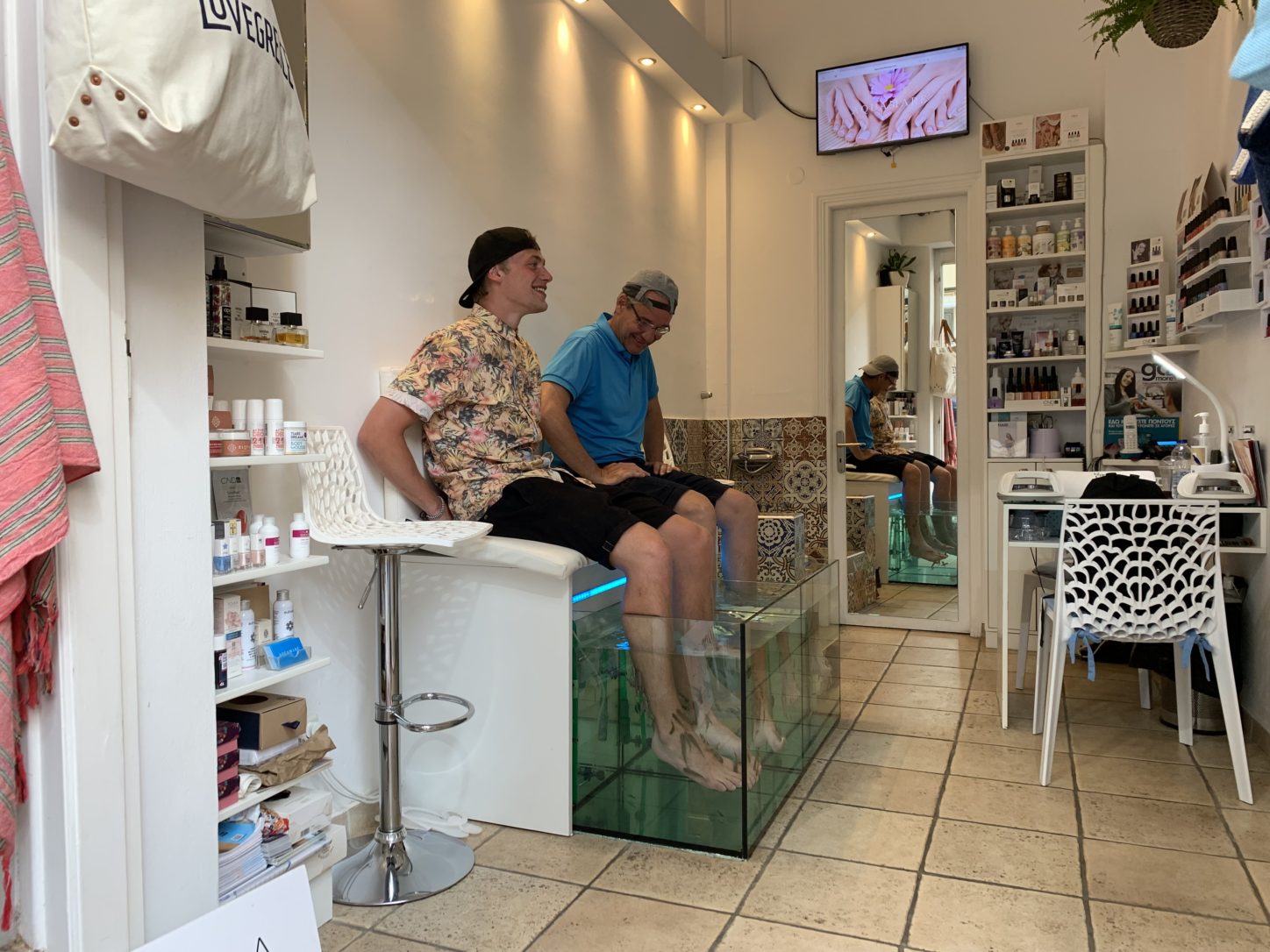
The foot theme continued when we spotted a shop with a couple of guys getting a pre-pedicure foot soak in a fish tank. No fish, though.
Exploring Peloponnese Peninsula for Legend and History
Fish Tank Feet, Napflio, Greece, Photo by ConsumerMojo.com

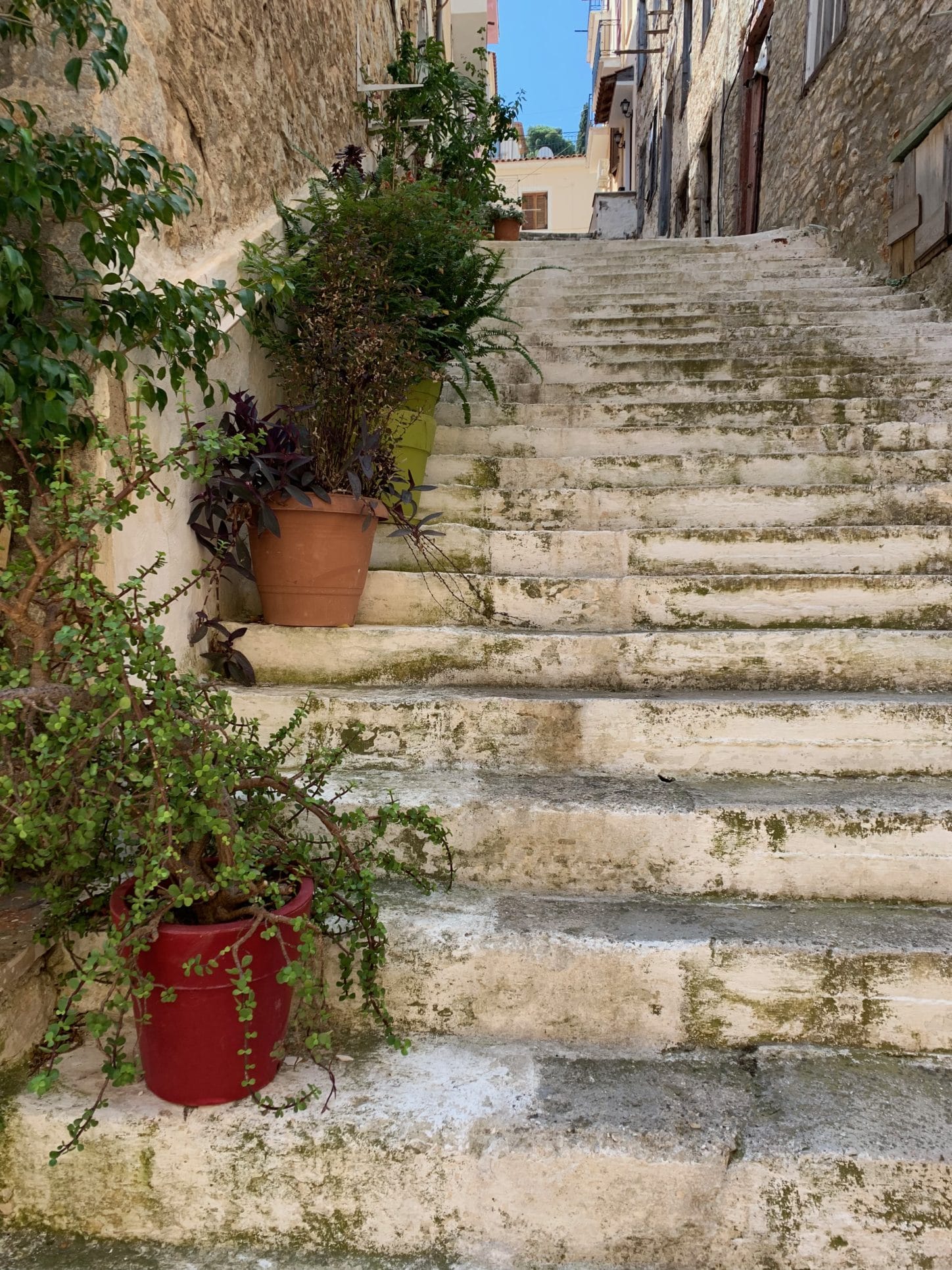
The rest of Nafplio rose up from sea level in winding streets and stone steps.

Exploring Peloponnese Peninsula Legend and History
Steps at Napflio, Greece, Photo by ConsumerMojo.com

The climbs would take you from one level to another and ultimately to the heights of Palamidi Castle. We decided to leave the high ground for another day and went in search of a cocktail.

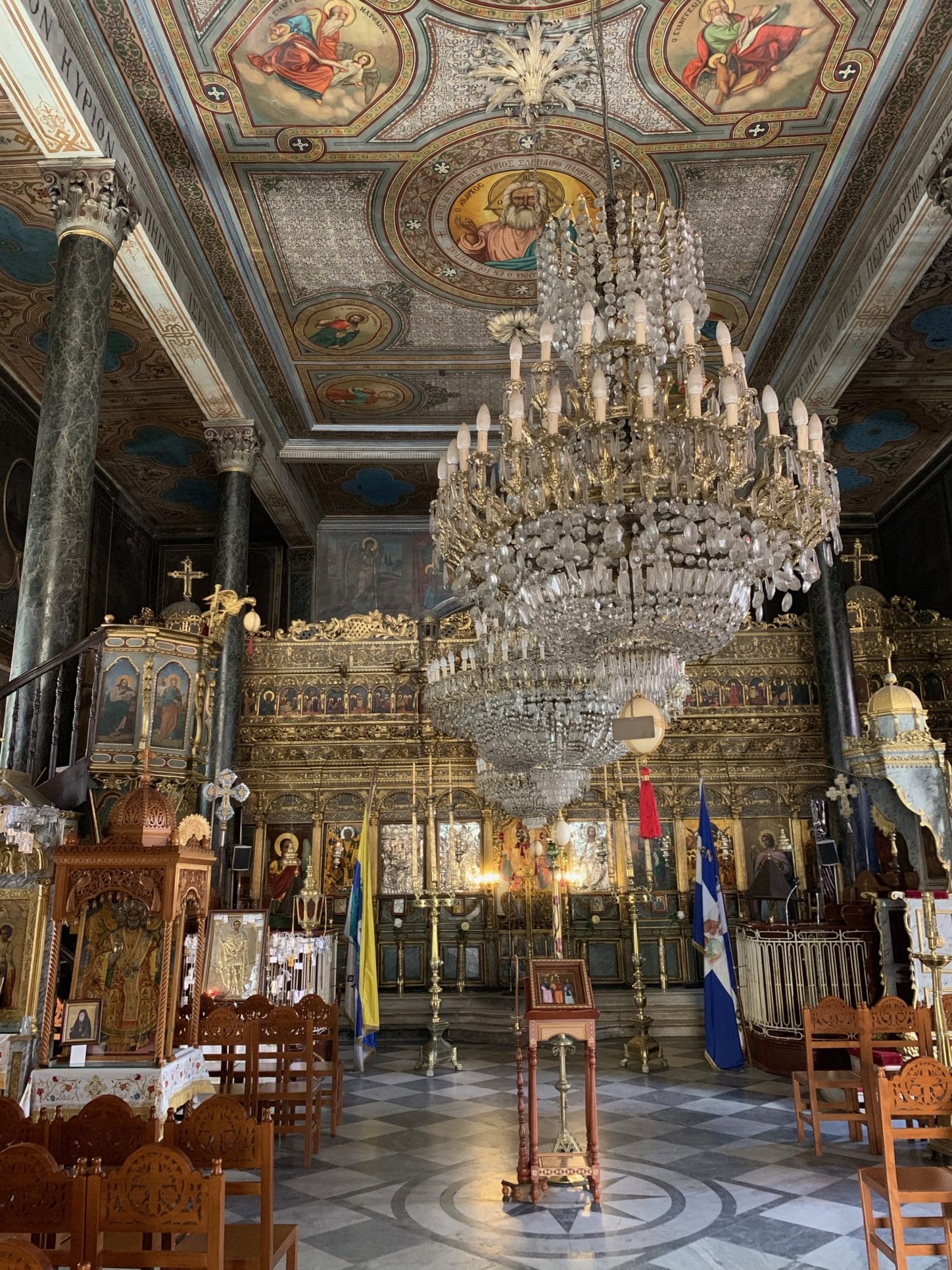
But first we stepped into the Church of Panagia. Modest on the outside, the church stunned us with its beautiful interior. Its name refers to the Virgin Mary, but it’s also the church of Nafplio’s patron saint, St. Anastasios. 

Church of Panagia, Nafolio. Photo by ConsumerMojo.com.

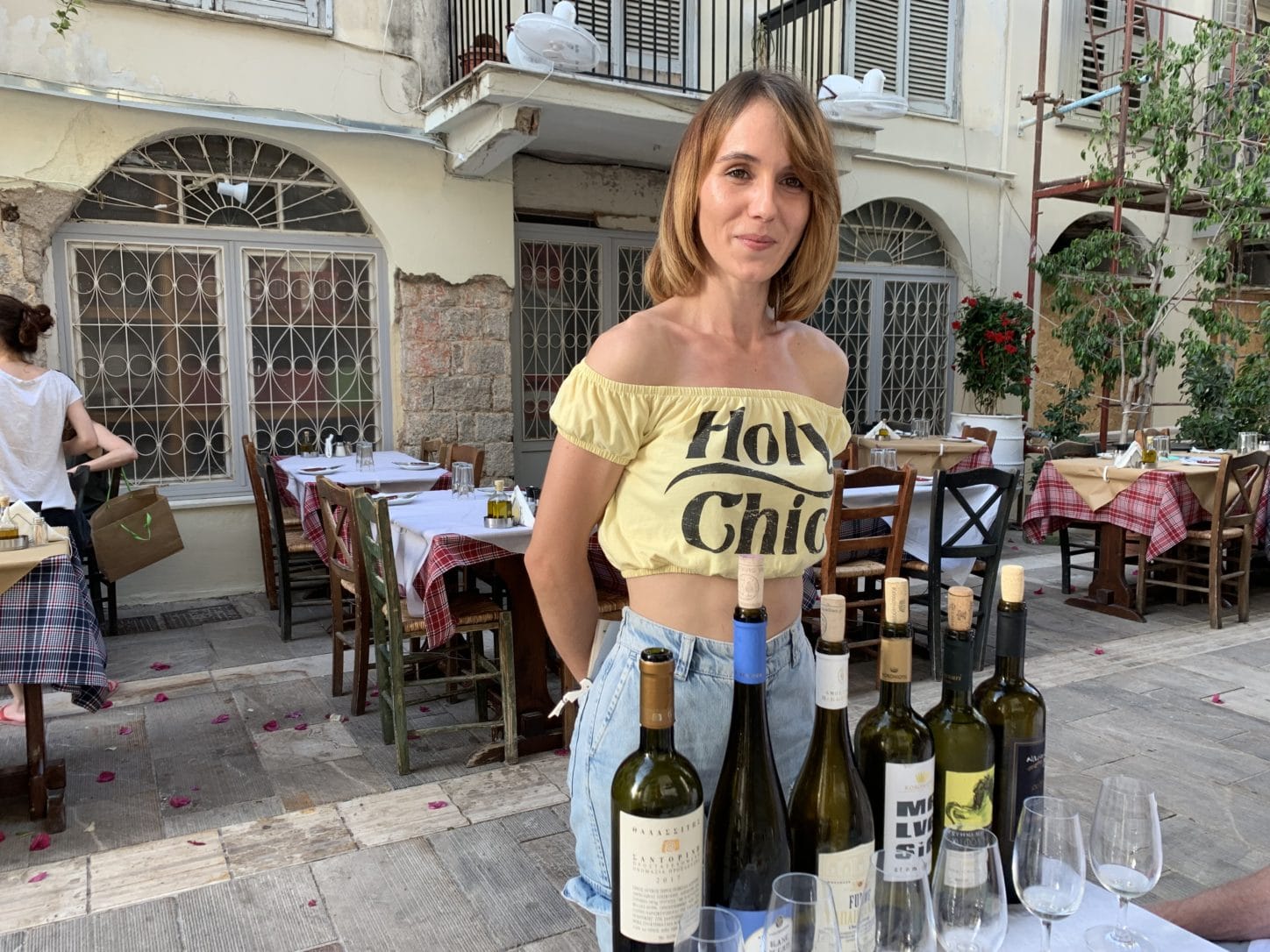
The side door took us to a stretch of tavernas with outside tables. When we paused under a sign for the Alkioni Wine Bar, a charming young woman urged us to enjoy a glass of wine with them.

Exploring Peloponnes Peninsula Legend and History
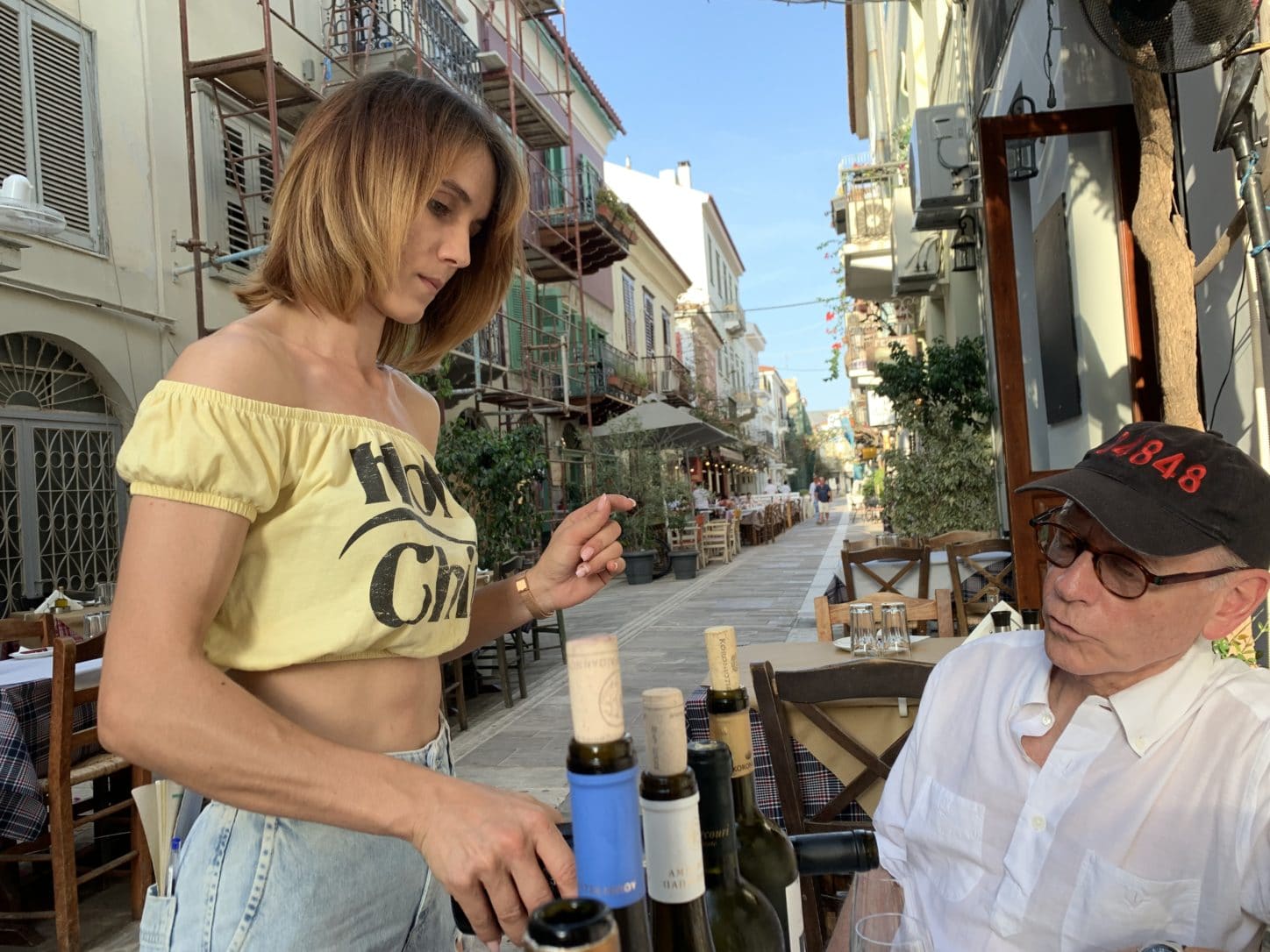
Giorgianna Serving at Alkioni Wine Bar, Napflio,,Greece. Photo by ConsumerMojo.com

We didn’t need much coaxing and learned her name was Giorgianna. She sat us down, disappeared and reappeared with four bottles of Greek wine and four glasses for a tasting.

Exploring Peloponnese Legend and History
Alkioni Wine Bar, Nick Taylor and Giorgianna, Napflio, Greece. Photo by ConsumerMojo.com

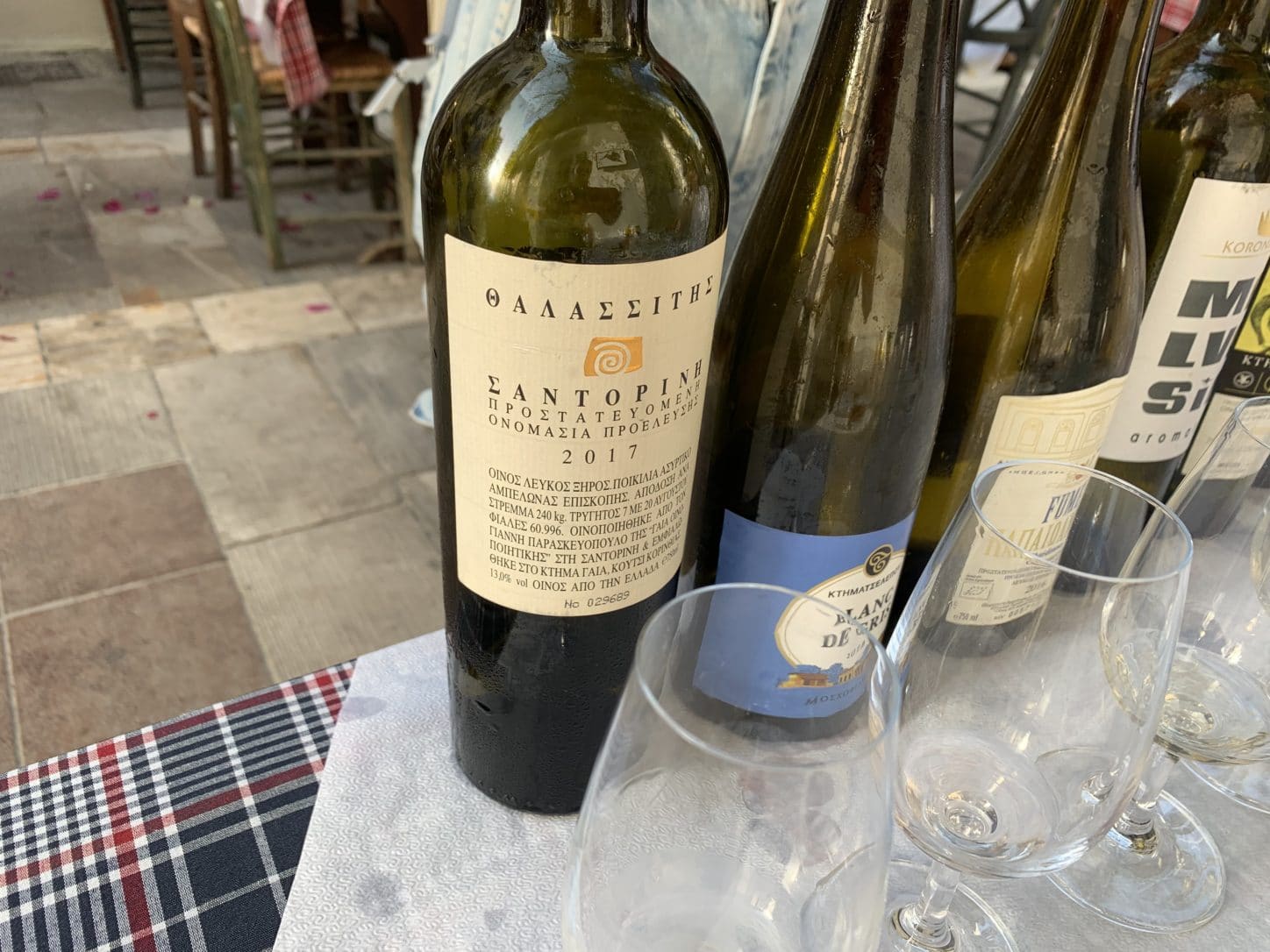
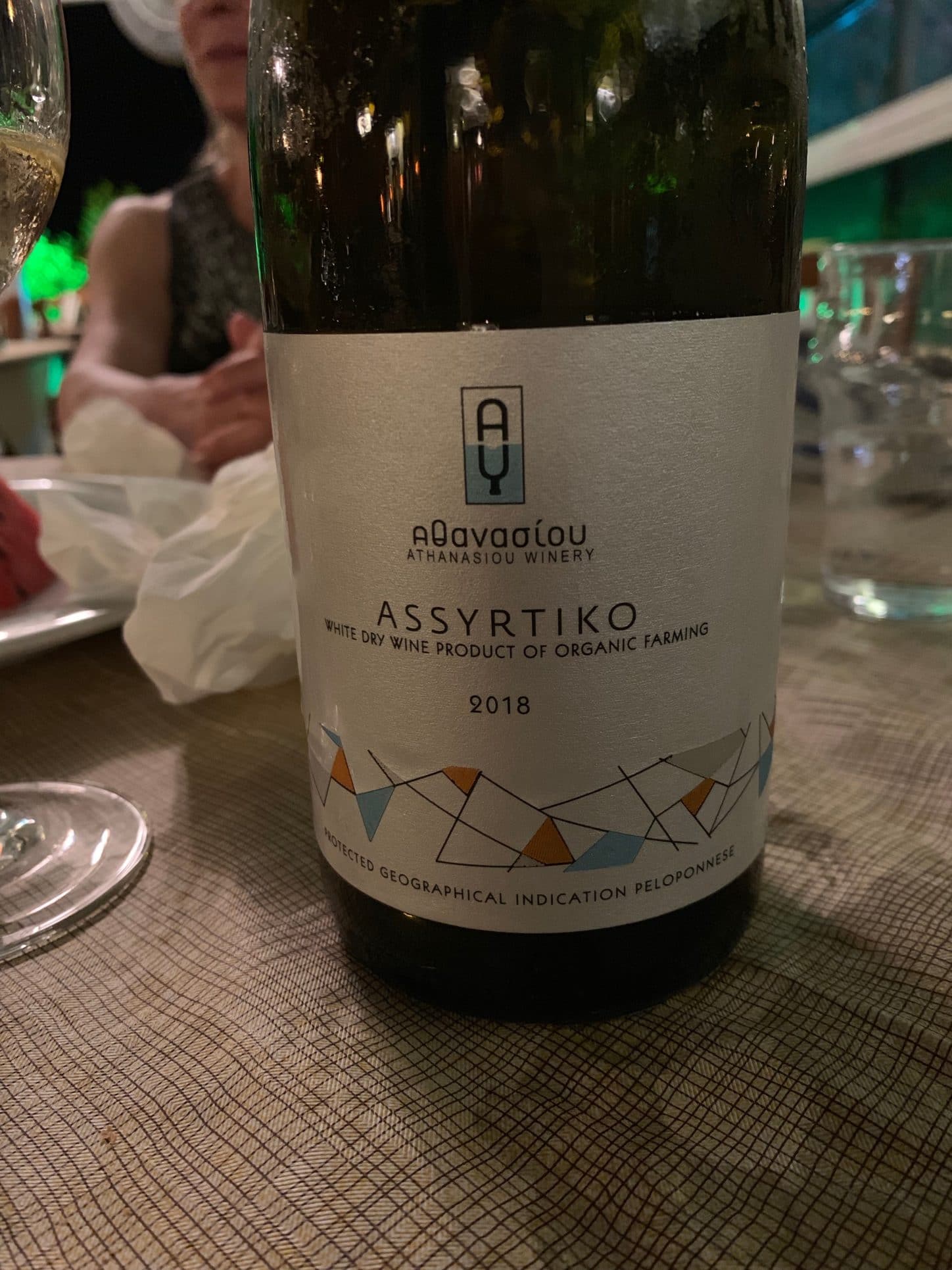
When we got to the last bottle she said, “Ah. Assyrtiko from Santorini. This one has a story. The bottles are placed in the sea for aging and that helps give the wine a distinct taste.”
Maybe it was the story, but the fourth wine was our choice.

Exploring Peloponnese Legend and History
Assyrtiko Wine from Santorini at Alkioni Wine Bar, Napflio, Greece. Photo by ConsumerMojo.com

We learned that Giorgianna had an immigrant’s story.  Her mother had come to Greece from Romania in search of work. Two years later she sent for thirteen-year-old Giorgianna and her twin sister. The young women made lives for themselves in Napflio. Her sister was an artist and Giorgianna was learning about wines, trying to become an expert.

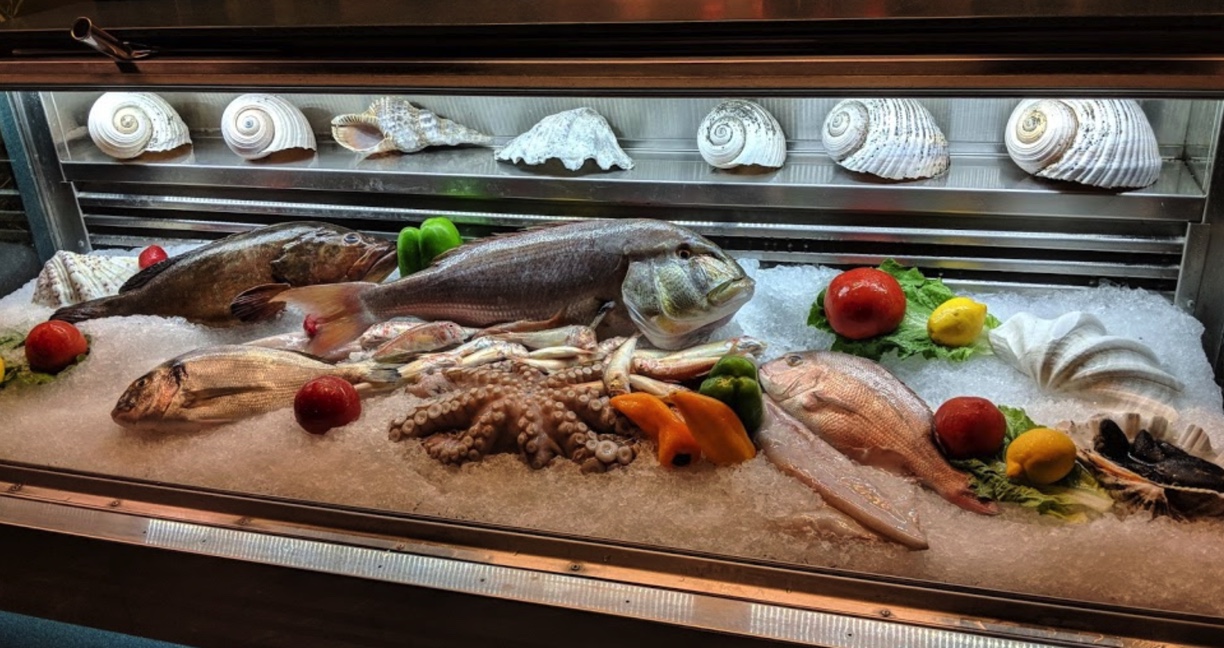
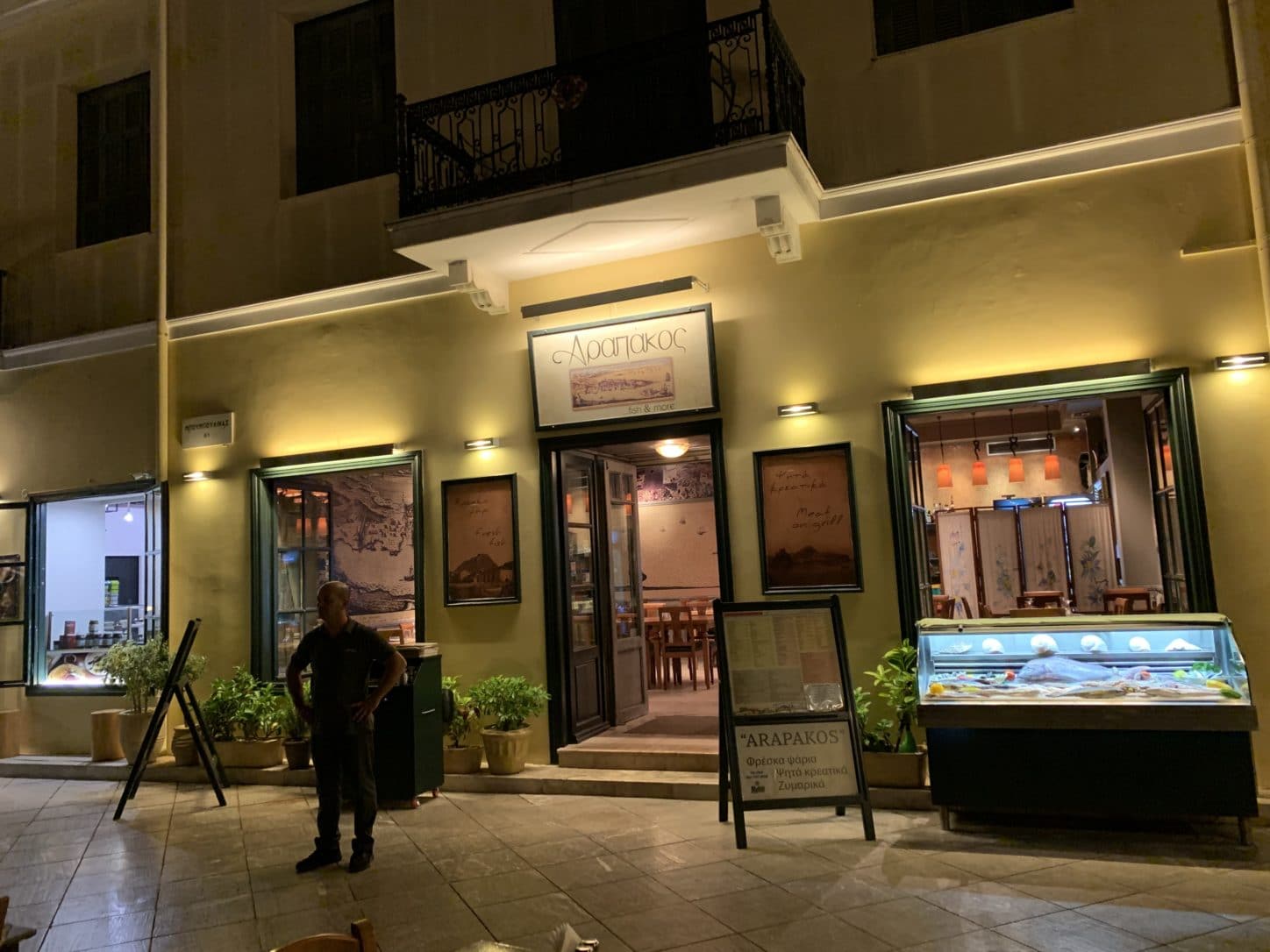
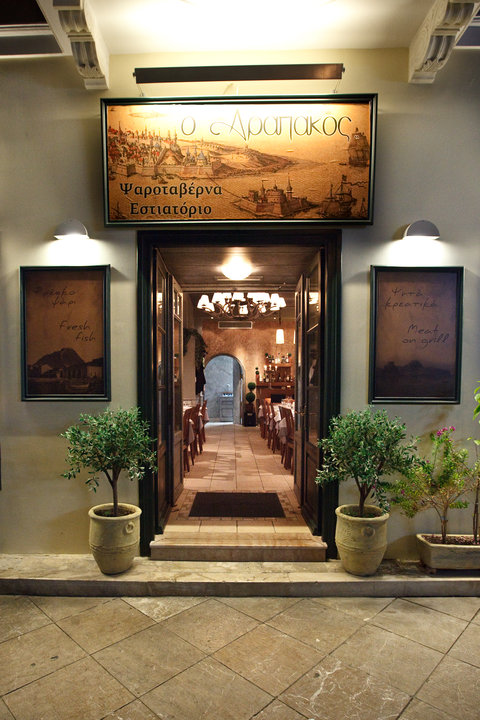
After our wine, we took a quick tour of the seaside tavernas looking for fresh fish. Some of the places displayed the day’s catch on ice in glass cases. At one, called Arapakos, the sidewalk spielmeister said it was “the best. If you believe me, I’ll see you later. If you don’t, have a good evening.”

The day’s catch on ice. Photo by ConsumerMojo.com.

We laughed and headed to the hotel for a nap.

Exploring Peloponnese Peninsula Legend and History
 Sun and Moon in Napflio, Greece. Photo by ConsumerMojo.com

When we back to Arapakos, Nick reminded the spielmeister we’d met earlier.  “We believed you and we’re back for dinner,” he said.

Exploring Peloponnese Legend and History
Arapakos Restaurant, Napflio, Greece. Photo by ConsumerMojo.com

As we lingered over the display of fish, the manager appeared by our sides. He introduced himself as Dimitri and said, “Come with me.” He whisked us past the indoor tables into a spotless kitchen and opened a drawer in the refrigerator showing fresh fish on ice. And then he opened another filled with mussels. “For whole fish, we have sea bass and snapper. Which would you like?” he asked. 

We chose sea bass and he brought us back out to a table under an awning. We ordered Assyrtiko.

Exploring Peloponnese Legend and History
Assyrtiko Wine, Napflio, Greece

And as we enjoyed the wine, we realized the painting over the restaurant’s door showed the Bourtzi Castle with a chain across the harbor entrance and here was another story.Exploring Peloponnese Peninsula Legend and History

The Republic of Venice and Ottoman Turks battled for territory on land and sea from 1396 to 1718. 

Exploring Peloponnese Peninsula Legend and History
Turkish Venetian War 1695

When the Venetians took strategically important Napflio in the 15th century, they built Bourtzi castle and put a  chain across the harbor to keep the Ottomans and pirates out. In the 17th century, the Turks captured it and dropped large stones in the water to make sure no large ships could enter the harbor.  Sounds a lot like an inspiration for George R. R. Martin’s “Game of Thrones” Battle of Blackwater Bay.

When Dimitri brought our fish we wondered about his excellent English. “Did you live in the U.S.?” Barbara asked.

“I’ve never been to the U.S. I worked for a multi-national company and everyone spoke English, even though it was German-based,” he said and then laughed, “I also learned from watching TV.  I’m a big Star Trek fan and some people say I sound like a Canadian. I blame William Shatner.” It turned out Dimitri was one of the sons of Arapakos’ owner, and he and his brother Costa share the job of running the place.

The fish was delicious and we finished up with watermelon slices and headed back on the harbor promenade to the hotel.

Exploring Peloponnese Peninsula Legend and History
Mycenae, Greece. Photo by ConsumerMojo.com

Our second day took us into the heart of our mission in Greece. We headed to explore Mycenae, half an hour by car and 3,600 years away in history. Last summer in Sardinia, we’d learned that the Mycenaeans traded with Sardinia’s Nuraghi and learned bronze smelting from them. That led to bronze weapons and armor. But it wasn’t until businessman-archeologist Heinrich Schliemann’s excavations in 1876 that the wealth of Mycenae emerged from Homeric legend as stark reality.

Three-Days-In-Athens
Mask of Agamemnon, Photo by DieBuche, Creative Commons License

As we traveled, we’d listened to Madeline Miller’s brilliant The Song of Achilles. It’s a prelude to and retelling of the Iliad from the view of Achilles and his companion Petroclus. Now, at the seat of Agamemnon’s kingdom, the audiobook brought a new dimension to the characters who made their home in these mountains. We bought tickets for 12 euros and headed for the hilltop citadel itself.

Exploring Peloponnese Legend and History
Nick Taylor at Mycenae Greece, Photo by ConsumerMojo.com

Our phones warned about a hot day with a predicted high of 95F. We shrugged it off, put on our hats and climbed toward the Lion Gate and the huge stone walls that legends claim the Cyclopes built. 

The Lion Gate at the citadel of Mycenae. Photo by ConsumerMojo.com.

The rampant lions carved in relief above the gate once had heads, perhaps of metal, but those have long been lost. Lions were guardian symbols, and the Lion Gate is the oldest sculpture of its kind in Europe. Beyond it, the terrain opened up to long views of mountains, distant farms and olive groves. The watchmen of Mycenae could see anyone approaching.

Exploring Peloponnese Peninsula for legend and history.
View from Mycenae toward the Aegean. Photo by ConsumerMojo.com.

The Mycenaeans lived from 1600 to 1100 B.C. during the last part of the Bronze Age. They farmed, they sailed, they explored, imported, exported, created art and a system of writing. And they provided Homer with plenty of stories. They also were architects and builders of large palaces like the one we visited at Mycenae

Exploring Peloponnese Legend and His
Barbara Nevins Taylor at Mycenae, Greece. Photo by ConsumerMojo.com

We walked on top of what was left of the palace and saw how the remnants of  walls outlined meeting rooms and living spaces within fortified walls that still stood tall.

On a lower level that may have led to craftsmen’s quarters, Mycenaean masons had formed enormous slabs of almond stone into a second gate at a corner of the citadel.

The Postern Gate at the citadel of Mycenae. Photo by ConsumerMojo.com.

Ripe figs drooped  and dropped from a tree against one of the stone walls. We couldn’t resist picking one up from the ground. The taste? Nothing, and our only disappointment of the day.

Exploring Peloponnese Peninsula for Legend and History
 Nick Taylor and Fig at Mycenae, Greece, Photo by ConsumerMojo.com

We followed the path from the heights of the palace down to a circle of stones.

Exploring Peloponnese Peninsula Legend and History
Grave Circles, Mycenae, Greece. Photo by ConsumerMojo.com

It marked the first of Heinrich Schliemann’s excavations of the graves he believed held the remains of Agamemnon and Clytemnestra. Schliemann, during twenty days in 1876, dug up three circular graves that held skeletons and treasures of the Mycenean glory days. 

Exploring Peloponnese Legend and History
Grave Circle at Mycenae, Photo by ConsumerMojo.com

He donated it all to the people of Greece and we had seen the fruits of his excavations in the National Archaeological Museum in Athens. 

Exploring Peloponnese Peninsula Legend and History
Nestor’s Cup, National Archeological Museum, Athens, Greece Photo by Anamnesis, Courtesy Creative Commons License

But here in the place where we, like Schlieman, chose to believe Agamemnon and Clytemnestra schemed, we tried to imagine their lives. They had riches, power and beauty and still they were venal, petty and lethal. Do we know people like that today?

We finally gave in to the blistery heat and retreated from the citadel to the site’s air conditioned museum. We had company. A big dog wandered in, flopped down on the floor and rolled over on its back, and soon had playmates.

Dog at the Mycenae Museum. Photo by ConsumerMojo.com.

The museum showed us, in more compact displays, much of what we’d seen at the National Archaeological Museum. Somehow that made the wonders of Mycenae — not just the golden treasures but the small human and animal figures and the artistic pottery — easier to grasp. We asked if any were original and a museum worker said ruefully, “All stolen, or in the museum in Athens.”

We started back down the mountain, and clicked on the audiobook to hear if Achilles would resolve his feud with Agamemnon and fight for the Greeks against the Trojans. Before we got very far, a sign for Agamemnon’s tomb made us pull over. Our Mycenae tickets gave us access, and we walked a short path to a stone entryway into a hill. 

Entrance to Agamemnon’s Tomb at Mycenae. Photo by ConsumerMojo.com.

A passage between the walls led to a tall door open to blackness within. A thin triangle opened over the massive lintel stone atop the door, lighting the inside. We found ourselves on the floor of a beehive of darkened stones rising over 40 feet.

Agamemnon’s “beehive” tomb. Photo by ConsumerMojo.com.

There are eight of these tholos, or beehive tombs, around Mycenae that were thought to hold treasure stores as well as graves. This one is the best-preserved. The hill it’s built into was opened to lay the stones and then piled up with dirt again. It dates to around 1250 B.C. and probably had nothing to do with Agamemnon. Legend says that he lived earlier. 

Exploring Peloponnese Legend and History
Argos, Greece, Photo by ConsumerMojo.com

Argos, where we stopped for lunch, ranks as one of the oldest continuously inhabited cities in the world, with a history going back 7,000 years. 

It’s also the legendary home of Odysseus’s friend and fellow warrior Diomedes who ruled Argos. The town’s ancient theater, now an archeological site, dates to 300-250 BC and held 20,000 people.

Exploring Peloponnese Legend and History
Theater at Argos, Photo by ConsumerMojo.com

We parked in a treeless town square and spotted what looked like a taverna. No one sat at the outdoor tables on the square. But on this late afternoon, in a shaded courtyard of the Salvanos Cafe, we found locals finished with their work for the day and hungry, like us, for something simple. 

Exploring Peloponnese Peninsula Legend and History
 Salvanos Cafe, Argos, Greece, Photo by ConsumerMojo.com

We ordered a tomato and cucumber salad and learned about tyrokafteri, a yoghurt and cheese dish. It’s similar to tzatziki, but with pepper instead of garlic, and lamb souvlaki on a skewer.

Exploring Peloponnese Legend and History
Tomato and Cucumber Salad, tyrokafteri, Argos, Greece
Exploring Peloponnese Peninsula for Legend and History
Lamb on Skewer, Salvanos Cafe, Argos, Greece

After lunch we followed the GPS up a climbing switchback road to the city’s acropolis, a hill that bears the name Larissa, and the mouldering Byzantine-Venetian fortress castle at its peak.

Byzantine fortress on Larissa, the acropolis of Argos. Photo by ConsumerMojo.com.

A gate leading to the fortress grounds hung open. There were no ticket takers, nor even any other cars. A couple on a motorcycle pulled up just after we did. We entered the gate with the fortress looming to our left A perimeter wall to our right gave a view across Argos all the way to Nafplio and the Argolic Gulf. 

Exploring Peloponnese Peninsula Legend and History
View of Nafplio and the Argolic Gulf from the acropolis of Argos. Photo by ConsumerMojo.com.

Back in Nafplio, we flopped into chairs at the harborfront restaurant-bar next to out hotel and sipped vodka-and-tonics.

Exploring Peloponnese Legend and History
Cocktails in Napflio, Greece. Photo by ConsumerMojo.com

We talked about what we’d seen at the archaeological sites, and what we’d heard in The Song of Achilles. The selfishness and destructive pride of Agamemnon and the stiff-necked stubbornness of Achilles showed us how little human nature has changed over the millennia. They offer great psychological insight, but also tell us how little we’ve learned from the past.

Exploring Peloponnese Peninsula Legend and History
Aiolos Taverna with Singer, Napflio, Greece. Photo by ConsumerMojo.com

Later we returned to the Alkioni wine bar where Giorgianna hooked us on the Assyrtiko from Santorini and found a table at the Aiolos Taverna across the alleyway. They’re owned by the same people, and owe their names to Greek legend. Alkioni was the daughter of Aiolos, god of the winds that so bedeviled Odysseus attempting to sail home from Troy.

Exploring Peloponnese Legend and History
Beans and Beets at Aiolos Restaurant, Napflio, Greece, Photo by ConsumerMojo.com

We had some more of the Assyrtiko, a bean and beet salad that was entirely too big, and delicious grilled sea bream. We were paying the bill when Georgianna appeared with two glasses and a small carafe of the Greek version of grappa, and after that we stumbled back to the hotel.

The next morning, we set out for Tiryns, which along with Mycenae is a UNESCO World Heritage site. Historians believe it served as the seaport gateway for Mycenae and is even older, dating to before the Bronze Age. History and legend were colliding like bumper cars inside our heads at that point.

Exploring Peloponnese Peninsula Legend and History
Tiryns Countryside, Greece, Photo by ConsumerMojo.com

The citadel of Tiryns, built on its acropolis, has massive limestone boulders forming its fortress walls, some weigh several tons, thicker than those at Mycenae.

Exploring Peloponnese Legend and History
Tiryns Walls from Outside. Photo by ConsumerMojo.com

Like those at Mycenae, legend tells us only the Cyclopes could have put them into place.

Exploring Peloponnese Peninsula Legend and History
Nick Taylor at the Cyclopes Wall, Tiryns, Greece. Photo by ConsumerMojo.com
Cyclopean walls at Tiryns. Photo by ConsumerMojo.com.

Archeologists are still working at Tiryns, and the day we were there a German team pointed us to the main chamber where the ruler held court.

Exploring Peloponnese Peninsula Legend and History
Main Chamber at Tiryns, Tiryns, Greece. Photo by ConsumerMojo.com

The ruler’s throne was typically in what’s called the Great Megatron and Tiyrns provides a good example of how big these gathering places were. Even though these archaeological sites often seem like a jumble of big stones, often a thing or two appears, like this pink marble, that reminds you of how beautiful the palaces must have been. 

Exploring Peloponnese Legend and History
Pink Marble at Tiryns Palace

From Tiryns we drove east 40 kilometers to ancient Epidaurus, a healing center called the Sanctuary of Asklepios, the earliest sanatorium complex and another UNESCO World Heritage site.

Exploring Peloponnese Legend and Histoy
Sanctuary of Asklepios at Epidaurus, Greece. Photo by ConsumerMojo.com

The complex includes a theater and that’s what we really wanted to see. 

Exploring Peloporyonnese Legend and Hist
Theater at Epidaurus, Greece, Photo by ConsumerMojo.com

The theater at Epidaurus was built into a hillside in 330-320 BC and expanded in the 2nd century AD. 55 rows of seats face the stage, which has perfect acoustics apparently because of the way the seats are set. 

Tourists like us took turns standing on stage, whispering to test whether the theater’s acoustics were as good as advertised.

The theater at Epidaurus, view from the top row. Photo by ConsumerMojo.com.

Barbara began to train her voice as an acting student at the High School of Performing Arts and worked on it during her years in television news, but here all she had to do was use her softest whisper to project to the top. She stood center stage and Nick started climbing.

Exploring Peloponnese Peninsula Legend and History

Nick stopped after the first tier, thirty-three rows up and heard her perfectly. He climbed to the top, and Barbara asked softly,  “Can you still hear me?” Amazingly, he and all around him could.

Exploring Peloponnese Peninsula Legend and History
Barbara and the Singer on the Epidaurus Stage, Photo by ConsumerMojo.com

And then a woman came up next to Barbara on the flat earth stage and began to sing softly. Her husband sat down to Nick and they both heard every word.  When she finished her song, people in the theater clapped.  

“I’ve always wanted to do something like that,” she told Barbara. She said she and her husband were from San Francisco and, like us, were sampling Greece both past and present.

That coming weekend, audiences of 12,000 would fill those same stone seats for two nights to see a presentation of Oresteia by Aeschylus. The 2,400-year-old theater is one of the venues for the Athens and Epidaurus theater festival for eight weeks every summer.

Now, close to the Peloponnese east coast on the Saronic Gulf, we headed to New Epidaurus to find a place near the water to eat lunch.

Exploring Peloponnese Peninsula Legend and History
Saronic Gulf. Photo by ConsumerMojo.com

We loved the turquoise water but decided to pass on the brown sand beach.

Exploring Peloponnese Legend and History
Beach at New Epidaurus, Photo by ConsumerMojo.com[/caption

The Hippocampus Taverna called to us. We took a table and learned that this hippocampus referred to the seahorse or sea monster. When we looked it up were surprised to find that the hippocampus, the critical part of our brain that deals with memory and navigation, is shaped like a seahorse.  That’s how it got its name. But on to lunch.

[caption id="attachment_45362" align="aligncenter" width="1448"]Exploring Peloponnese Peninsula Legend and History Hippocampus Restaurant, New Epiduras, Greece. Photo by ConsumerMojo.com

We enjoyed grilled calamari, a cucumber and tomato salad, and tyrokafteri. But unlike the dip we had in Argos, this had red peppers and tasted like a better version of pimento cheese spread.

That evening we watched another spectacular sunset in Napflio.

Exploring Peloponnese Peninsula Legend and History
Starburst Sunset Napflio, Greece. Photo by ConsumerMojo.com

And then we went to eat at Omorfo Tavernaki, recommended by our guide in Athens, Panos Papageorgoplous, whose family comes from Napflio. “It’s my favorite taverna there,” he said.

Exploring Peloponnese Peninsula for Legend and History
Onorfo Taverna, Napflio, Greece. Photo by ConsumerMojo.com

By this time we’d figured out that the huge portions in the tavernas were like those in the Greek diners in New York and we decided to order moderately. Strangely, tavernas and restaurants in Greece specialize more in lamb than seafood. And that night, when we sat down they first told us they were out of fish. Then the waiters put their heads together and somehow came up with a couple of fresh and tasty white snapper. We left the side of baked potato topped with cheese untouched, though.

Exploring Peloponnese Peninsula Legend and History
White Snapper at Omorfo Tavernaki, Napflio, Greece. Photo by ConsumerMojo.com

On Wednesday we and hit the tollway again, headed south to Sparti and Mystras, a drive of two hours or a little less

Exploring Peloponnese Peninsula Legend and History
Mountains on the way to Sparti. Photo by ConsumerMojo.com

Panos, our tour guide in Athens, told us that Sparti, the modern town near the site of ancient Sparta, is the most conservative place in Greece, perhaps an outgrowth of its warrior culture. Another outgrowth is the Spartathlon.

Statue of Pheidippides, Photo by Hammer of the Gods27, Courtesy Creative Commons

Legend says that in 490 B.C., Athens sent a runner to Sparta to ask for help fighting the Persians at Marathon. It’s 246 kilometers, or 153 miles, and Pheidippides arrived the day after he started. Some British Royal Air Force officers tried it in 1982, and three made it in under 40 hours. The next year it became an annual race, with the Greek winner Yiannis Kouros still holding the record of 20 hours and 25 minutes. We were glad we had the tollway.

Exploring Peloponnese Peninsula Legend and History
Mystras, Greece, Photo by ConsumerMojo.com

Sparti wasn’t our goal, in any case. Mystras, also a UNESCO World Heritage site, was. It’s a Byzantine site a couple of miles west of Sparti toward the southern Peloponnese city of Kalamata. The wars between the Franks and Byzantines played out on the peninsula, and Mystras in the 15th century was a learning center and the most important Byzantine site outside of Constantinople.

Exploring Peloponnese Peninsula Legend and History
Learning Center at Mystras, Greece. Photo by ConsumerMojo.com

Currents of reconciliation between the Eastern and Roman versions of the Christian church flowed through Mystras and went nowhere. Later the Ottoman Turks and Venetians fought over Mystras, too.

12-euro tickets in hand, we climbed stone steps on a path that took us to the lower town and Metropolis, the St. Demetrius Church, built in the 13th century.

Courtyard at Church, Mystras, Greece. Photo by ConsumerMojo.com

Its bell tower loomed over us, its dangling rope awaiting the next bell ringer to sound a call to worship.

Bell tower at the St. Demetrius Church at Mystras. Photo by ConsumerMojo.com.

The small church, an ornate jumble of turrets and arches and adorned inside with rich frescoes, hosts services on special occasions.

Exploring Peloponnese Peninsula Legend and History
Church at Mystras, Photo by ConsumerMojo.com

“No flash pictures,” said the lady at the door. She told us she had relatives in Chicago, Florida, and New York City, and hoped to visit them some day.

Exploring Peloponnese Peninsula Legend and History
Frescoes at Mystras, Photo by ConsumerMojo.com

We stopped at the small museum connected to the church and then climbed around the crumbling walls threading through the hills.

Exploring Peloponnese Peninsula Legend and History
Donkey at Mystras, Greece. Photo by ConsumerMojo.com
Exploring Peloponnese Peninsula Legend and History
Walls at Mystras, Greece. Photo by ConsumerMojo.com

We returned to the car and took another of those switchback roads up and up to Mystras’s upper town and its hilltop citadel.

Exploring Peloponnese Peninsula Legend and History
Top of Mystras, Greece, Photo by ConsumerMojo.com

The view stretched for miles, back to Sparti and beyond.

Exploring Peloponnese Peninsula Legend and History
View from Top of Mystras, Greece. Photo by ConsumerMojo.com

The Cafe Xenia looked inviting on the way back down the mountain, and we stopped for lunch.

Exploring Peloponnese Peninsula Legend and History
Cafe Xenia, Mystras, Greece. Photo by ConsumerMojo.com
Exploring Peloponnese Legend and History
Restaurant, Mystras, Greece, Photo by ConsumerMoj.com

Later, back in Nafplio, we rewarded ourselves with vodka and tonics and the harbor view.

Drinks on the harbor at Nafplio. Photo by ConsumerMojo.com.

That night we returned to the Aiolos Taverna, where we had learned to split a starter before our grilled fish mains.

Exploring Peloponnese Legend and History
Fish at Aiolos Taverna. Photo by ConsumerMojo.com

And once again Georgianna sent us home with a taste of grappa.

Thursday was our final day in Nafplio and we wanted to explore the nearby beaches. We set out after breakfast for Karathona, where we found a series of cabana colonies along a long arc of beach with pebbly sand.

Two swimmers at Karathona beach. Photo by ConsumerMojo.com.

Families sprawled under the umbrellas and a few kids were splashing in the water, but there was no one place that looked inviting. We returned to the car and headed for Drepano, a few kilometers east.

Following the GPS directions to the beach below the town, we wound up at campground central. Caravans, what we call campers or recreational vehicles in the United States, huddled under shade trees in a row of sites opposite the beach.

Umbrellas shaded lounge chairs at two places on the beach side. Following directions from a server, we walked five minutes to a taverna on the beach.

Exploring Peloponnese Peninsula Legend and History
Kallianos Restaurant, Asini Argolis, Greece. Photo by ConsumerMojo.com

We kept eating the same salad because every tomato we had in Greece was bursting with midsummer freshness and we ordered a tyrokafteri and grilled squid to accompany it.  

Exploring Peloponnese Peninsula Legend and History
Lunch at Kallianos, Asini,Argolis, Greece, PHoto by ConsumerMojo.com

We were surprised when the owner brought us a dessert gift.

Exploring Peloponnetoryse Peninsula Legend and His
Desserts at Kallianos, Asini, Argolis, Greece. Photo by ConsumerMojo.com

We chose the most inviting looking of the beachfronts at Deprano andtook lounge chairs under an umbrella for a cost of an iced tea and a lemonade, total 5 euros. We read our books and swam. The clear water showed a path between rocks into patches of sandy bottom.

And the show in the water was pretty good, too.

Exploring Peloponnese Peninsula Legend and History
Rowing at Deprano Beach, Greece, Photo by ConsumerMojo.com

Nick watched a man make water spouts from a clenched fist and tried it.  The man, he thought, would win the contest. Before heading back we explored the area around Vivari bay and found a spot fisherman seemed to like.

Exploring Peloponnese Peninsula Legend and History
Fisherman Near Deprano Beach, Greece. Photo by ConsumerMojo.com

On the way back to Napflio, we drove up to Palamidi Castle, the 18th century Venetian fortress that overlooks the town and the Argolic Gulf.

Exploring Peloponnese Legend and History
 Argolic Gulf from Palimidi Castle, Nafplio. Photo by ConsumerMojo.com.

The Ottoman Turks took it from the Venetians, and the Greeks took it from the Turks when they gained independence.

Exploring Peloponnese Peninsula  Legend and History
Palimidi Castle, Napflio, Greece. Photo by ConsumerMojo.com

For some time the Greeks used it as a prison.

Exploring Peloponnese Peninsula Legend and History
Levels of Palimidi Castle, Napflio, Greece

And if you’re a dedicated stair climber you can reach the fortress via the 999 steps its prisoners carved out of rock.

Exploring Peloponnese Peninsula Legend and History
Palimidi Castle Interior Stairs. Photo by ConsumerMojo.com

Nick made a much shorter climb to one of its eight bastions, the one named for Achilles. That’s Nick in the distance.

Palimidi Castle, Napflio, Greece

Along with the ruins and the views the most interesting — or maybe strangest — thing was a blonde woman in a red dress, looking at nothing but herself. She took selfies turning around and around.

Exploring Peloponnese Legend and His
Woman taking a selfie at Palimidi Castle, Napfio, Greece. Photo by ConsumerMojo.com

Down below a couple called to her, “Arianna, stop. We have to go.” They called over and over and she ignored them with eyes for herself only.  She seemed to pay scant attention to the beauty around her.

Exploring Peloponnese Peninsula Legend and Historys
View from Palimidi Castle, Napflio, Greece. Photo by ConsumerMojo.com

Back in Napflio, Nick took pleasure in our last sunset on the Peloponnese Peninsula

Exploring Peloponnese Peninsula Legend and History
Sunset in Napflio. Photo by ConsumerMojo.com

And Barbara went shopping. She’d spotted Iniochos, a shop in Napflio, with linen dresses that looked simple and cool for the 90F-plus heat.

Four Washington state women, Paula, Brynn, Leisa and Kaila, who had been on a cruise ship, had the same idea. And the local saleswoman Evie helped us all.

Exploring Peloponnese Peninsula Legend and HIstory
Shopping at Iniochos, Napflio, Greece. Photo by ConsumerMojo.com

Dining that night at Arapakos, we met a tennis-playing family from Princeton, New Jersey.  

Exploring Peloponnese Peninsula Legend and History
Diners at Arapeko Restaurant, Napflio, Greece. Photo by ConsumerMojo.com

And by this time, we were trying to learn the Greek alphabet so that we could decipher words. Dimitri and his brother Costa showed us the lower case letters and helped us correct our spelling.

Exploring Peloponnese Peninsula Legend and History
 Brothers Dimitri and Costa at Arapakos Restaurant, Napflio, Greece

Then it was back to the Agamemnon for our last night in Nafplio before we left the Peloponnese and drove up the western Greek coast to the island of Corfu.


Mueller Report Excerpts Easy To Read

Robert Mueller’s testimony before the two House committees disappointed, but the report issued by his team is clear and devastating. It’s lengthy and not bedtime reading. So we’ll present a few excerpts from the Mueller Report to help you make up your own mind about whether President Donald J. Trump  obstructed justice.  

First the Mueller Report lays out the definition of Obstruction of Justice.

Obstructive act. Obstruction-of-justice law “reaches all corrupt conduct capable of producing an effect that prevents justice from being duly administered, regardless of the means employed.” United States v. Silverman, 745 F.2d 1386, 1393 (11th Cir. 1984) (interpreting 18 U .S.C. § 1503). An “effort to influence” a proceeding can qualify as an endeavor to obstruct justice even if the effort was “subtle or circuitous” and “however cleverly or with whatever cloaking of purpose” it was made. United States v. Roe, 529 F.2d 629,632 (4th Cir. 1975); see also United States v. Quattrone, 441 F.3d 153, 173 (2d Cir. 2006). The verbs ‘”obstruct or impede’ are broad” and “can refer to anything that blocks, makes difficult, or hinders.” Marinello v. United States, 138 S. Ct. 1101, 1106 (2018)

Now here’s what the Mueller Report said about Trump’s attempt to fire the Special Counsel and stop the investigation. 

“A threshold question is whether the President in fact directed McGahn  [White House Counsel Donald McGahn] to have the Special Counsel removed. After news organizations reported that in June 2017 the President had ordered McGahn to have the Special Counsel removed, the President publicly disputed these accounts, and privately told McGahn that he had simply wanted McGahn to bring conflicts of interest to the Department of Justice’s attention.

See Volume II, Section II.I, infra.

Some of the President’s specific language that McGahn recalled from the calls is consistent with that explanation.

Substantial evidence, however, supports the conclusion that the President went further and in fact directed McGahn to call Rosenstein [Deputy Attorney General Rod Rosenstein, overseeing the Special Counsel investigation] to have the Special Counsel removed.

First, McGahn’s clear recollection was that the President directed him to tell Rosenstein not only that conflicts existed but also that “Mueller has to go.” McGahn is a credible witness with no motive to lie or exaggerate given the position he held in the White House.

McGahn spoke with the President twice and understood the directive the same way both times, making it unlikely that he misheard or misinterpreted the President’s request. In response to that request, McGahn decided to quit because he did not want to participate in events that he described as akin to the Saturday Night Massacre.

He called his lawyer, drove to the White House, packed up his office, prepared to submit a resignation letter with his chief of staff, told Priebus that the President had asked him to “do crazy shit,” and informed Priebus and Bannon that he was leaving.

Those acts would be a highly unusual reaction to a request to convey information to the Department of Justice.

Second, in the days before the calls to McGahn, the President, through his counsel, had already brought the asserted conflicts to the attention of the Department of Justice.

Accordingly, the President had no reason to have McGahn call Rosenstein that weekend to raise conflicts issues that already had been raised.

Third, the President’s sense of urgency and repeated requests to McGahn to take immediate action on a weekend–‘You gotta do this. You gotta call Rod.’–support McGahn’s recollection that the President wanted the Department of Justice to take action to remove the Special Counsel. Had the President instead sought only to have the Department of Justice re-examine asserted conflicts to evaluate whether they posed an ethical bar, it would have been unnecessary to set the process in motion on a Saturday and to make repeated calls to McGahn.

Finally, the President had discussed “knocking out Mueller” and raised conflicts of interest in a May 23, 2017 call with McGahn, reflecting that the President connected the conflicts to a plan to remove the Special Counsel. And in the days leading up to June 17, 2017, the President made clear to Priebus and Bannon, who then told Ruddy [Christopher Ruddy, a Trump supporter and Newsmax CEO] that the President was considering terminating the Special Counsel. Also during this time period, the President reached out to Christie [Chris Christie, Trump advisor, former prosecutor and New Jersey Governor] to get his thoughts on firing the Special Counsel. This evidence shows that the President was not just seeking an examination of whether conflicts existed but instead was looking to use asserted conflicts as a way to terminate the Special Counsel.”

We’ll publish more soon. 


Three Days in Athens

by Nick Taylor and Barbara Nevins Taylor

We’ve spent our last few vacations exploring Mediterranean Europe for history and the mix of cultures and religions that centuries of conquest, invasions, trade and forced and willing migration brought. But we’d never been to Greece. The  long, cold winter in New York made us crave sunshine and warmth and that was another factor that lured us in June to the cradle of democracy and the birthplace of enduring legends.

The sky was still bright when we reached our hotel on Lycabettus Hill.  

three-days-in-Athens

From the window of our fifth-floor room, we thrilled to see the table-top of the Acropolis standing out above the Athens low-rise buildings and the Aegean Sea beyond it. And practically everywhere we went, there was another view of it.

Three Days In Athens
View of the Acropolis from the Agora, Photo by ConsumerMojo.com

Acro means high point  and polis means city.  The Acropolis is where Athenians practiced self-government for the first time. It remains the city’s central image, historically and visually.

Our small terrace also gave us a sweeping view of Athens and the upscale residential neighborhood that perched around us on Lycabettus Hill.

Three-Days-In Athens
Lycabbettus Hill Neighborhood, Athens, Greece. Photo by ConsumerMojo.com

The city surprised us. The almost bleached-out quality of the sunlight against the landscape of densely-packed pale buildings, which can’t be higher than the Acropolis, makes Athens feel more Middle Eastern than European.

Our friends Israel and Gail Berger had recommended the St. George Lycabettus and we were instantly glad they had.  It describes itself as a “lifestyle hotel” and once we got settled, we paused to explore the swimming pool, work-out room and terrace bar, which gave us another great view of the Acropolis.

Terrace Bar at the St. George Lycabettus Hotel, Athens, Greece, Photo by ConsumerMojo.com

Then it was time for our first dinner in Athens. Barbara had researched and made reservations for two of our three nights in Athens. The first restaurant she chose promised to show us the Acropolis close-up.

Three-Days-In-Athens
Taxi Outside St. George Lycabettus Hotel, Athens, Greece, Photo by ConsumerMojo.com

We hopped in a taxi and had our first encounter with an Athens type: a chatty cabbie who spoke good English, loved his city and almost doubled as a tour guide. As we wound down narrow streets, he began by explaining that Lycabettus Hill was one of the best neighborhoods in Athens. When we entered Kolonaki at the bottom of the hill, he waved his hand dismissively. “A lot of expensive shops,” he said. The cab moved slowly through Athens traffic, a lot of it.

As we passed through Styntagma Square, he pointed to the 19th Century royal palace that houses the Parliament and said, “You see this on TV. All the protestors come here. ” 

You can also watch the changing of the guard here in front of the presidential palace. It changes every hour, but you’ll find the big show with a full squad of Evzones, the specially trained guards, on Sundays at 11:00 a.m.

Three-Days-In-Greece
Changing of the Guard in Athens, Greece, Photo by KarinKarin, Courtesy Pixabay. Creative Commons License

A little farther down the road the cabbie slowed and urged us to look to the left into a lighted stadium. “This is the first Olympic stadium when they started the modern Olympics in 1896. It is the only stadium in the world that is all marble. In ancient times, the messenger ran from Marathon to here to tell everyone the Greeks had beat the Persians.” He went on. “You see the u-shape? They kept it open to give a view of the Acropolis,” he said proudly.

Three-Days-In Greece

He chatted on as he drove up another hill into the Thissio/Makriyanni neighborhood hard by the slopes of the Acropolis.  “You know,” he said, “Acropolis means high end. That’s where we are, at the highest point of the city.” He was almost right, and we appreciated his enthusiasm. We thanked him for the great ride and tour and checked in at Strofi. The hostess led us up a series of stairs to its rooftop terrace.

Three-Days-In Athens
View of the Acropolis from Strofi Restaurant. Photo by ConsumerMojo.com

Twilight had deepened and over the houses in the neighborhood, lights shone on the columned Parthenon, the focal point of the Acropolis complex. It looked close enough to touch.

The terrace buzzed with a crowd of people in their twenties and thirties that sat at three long tables. 

We thought they’d come from a cruise ship but when we asked one the people who seemed to be in charge of them, she said, “We are a small tech company. We’re team building.”  

“Where is everyone from?” we asked.

“All over. Some from Romania, Turkey, Germany, Sweden, the U.K. and the United States.”

Curiosity satisfied, we turned to the food. Strofi’s traditional Athenian menu favored slow-cooked meat dishes. We started with a smoked eggplant salad for Barbara and octopus in olive oil and oregano for Nick, along with our own tradition, glasses of Prosecco.

Then we moved on to lamb with thyme and rosemary for Barbara and, for Nick, a dish originating on Corfu called sofrito — veal with rosemary, mashed potatoes and roasted cherry tomatoes. We hadn’t learned Greek wines yet, so we ordered a half-liter of the house white, from a grape called moshofilero, and it was just right. Our last indulgence was a piece of walnut cake that even Barbara, who’s usually dessert-averse, wolfed down.

Three-Days-In-Athens

We lingered when the team builders left and we and a handful of other diners had the lights on the Parthenon all to ourselves. 

Three-Days-In-Athens

The next morning, we slept late.  We made it to breakfast just before the 10 o’clock cutoff and found a corner table on the wrap-around terrace with again a  spectacular view of the Acropolis.

You’d expect yoghurt to star at a Greek breakfast and it did, along with honey, an omelet station, lots of fruit, every kind of bread you’d want, and the standard cereals and juices. Necessary and bracing coffee arrived at our table in a carafe big enough for two.

Barbara had arranged for a guided walking tour of the Acropolis through an outfit called ToursByLocals. Conventional wisdom suggested the time to go would be the morning, before the heat rose toward the 90F that was predicted. Our guide said no, the cruise ship passengers all come in the morning and the late afternoon and early evening is better, cooler and less crowded.

So that morning, we walked down the steep streets of Lycabettus Hill and wandered through through the cafes in Kolonaki,

Three-Days-In-Athens
Sidewalk Cafe in Kolonaki, Greece. Photo by ConsumerMojo.com

found an HSBC bank to refresh our supply of euros and looked at the boutiques the cab driver had disdained. Many are standard brand name and designer shops. But we saw one with a distinctly local style.

Three-Days-In-Athens
Boutique Window, Kolonaki, Greece, Photo by ConsumerMojo.com

An up-close look at the dress in the center brought the religious iconography into full view.

Three Days In Greece
A Fabulous Dress With A Religious Theme in Athens Boutique Window, Photo by ConsumerMojo.com.

We decided to head to Piraeus for lunch. We could see Athens’ port off in the distance from our hotel room and didn’t think it would be too far a trip.

Cash-strapped Greece sold management rights to half of its capacity to a Chinese port operator for half a billion euros a few years ago, and China is expanding Piraeus as a gateway to Europe for its goods. We saw it as a destination for a seafood lunch.

The quick trip turned into a slow ride. Like most big cities, Athens chokes on its cars at times during the work day. Our taxi, whose driver spoke limited English, crawled, then picked up speed, then crawled again.

Three- days-in Athens
Taxidevontas Restaurant, Piraeus, Greece, Photo by ConsumerMojo.com

We finally reached Taxidevontas on a quiet street in the Piraeus neighborhood of Keratsini, and took an outside table.  Barbara’s research said the restaurant was a local favorite that served fresh fish from local fisherman, and a large and happy group of couples at a nearby table proved the point.

We didn’t have a lot of time before we headed back to meet our tour guide. The waiter asked how long we had and said he would get us the good food and out on time.

We ordered a tarama, the classic white fish roe, a fried octopus appetizer and steamed mussels.

And when we asked for the check, pieces of orange cake and cheese cake magically appeared along with small glasses of lemon sorbet.

Three-Days-In-Athens
Desserts Taxidevontis Restaurant, Piraeus, Greece. Photo by ConsumerMojo.com

We regretted we couldn’t stay longer, but stopped in the kitchen to thank Vicky for a tasty lunch.

Thre-Days-in-Athens
Vicky in the Kitchen, Taxidevontis, Piraeus, Greece, Photo by ConsumerMojo.com

After another stop-and-start cab ride, we arrived near the entrance to the Acropolis complex.

Panos Papageorgopoulos, our guide, met us near the booth and we purchased two 30 euro tickets to the Acropolis grounds that would allow us to get into other historic sites during the next day.

Three Days In Athens
Panos Papageorgopoulos, Guide at the Acropolis, Photo by ConsumerMojo.com

Panos, who we learned had just turned forty, bounced on the balls of his feet with enthusiasm. We chose him from the Tours By Locals roster because he has a degree in history, a masters in international relations and is licensed by the Greek Ministry of Tourism to go into the archaeological as well as the historic sites. He seemed just right to help us explore the past in our quest to try to make sense of our present.

He suggested that we start with the Acropolis Museum and go to the site itself when it got a little cooler. This seemed right to us because of the heat and for what we would learn. On our trip to Sardinia in 2018, we visited the archaeological museum first and got a better understanding of the ancient Nuraghi culture whose sites we planned to visit later.

As we approached the museum entrance, Panos said, “Look down there.”

Three-Days-In-Athens
Ruins Under the Acropolis Museum, Athens, Greece, Photo by Lessomore, Courtesy Creative Commons License.

We did, and through clear panels underfoot and from nearby railings, we saw that the museum literally stood atop its history. Panos explained that when the museum’s architects realized the building site lay over ancient Byzantine and Roman sections of the city, instead of filling them in or moving to a different site, they designed columns that showed the sites to visitors and opened them to archaeologists and gave them room to work.  

Three-Days-In-Athens
Archaeological Remains Under the Acropolis Museum,Athens, Greece, Photo by Lessormore, Courtesy Creative Commons License

“I was down there earlier, with a few other guides before I met you, to get familiar with it. The archeologists still have a lot of work to do to identify everything,” he said.

We quickly realized that this man loves his job. He told us his passion for history puzzled his father, who didn’t understand why he studied it in school or why he had made it his career.

The museum tickets were 10 euros, or 5 if you visit in the winter. The modern building opened in 2009 in part to display the artifacts dating back to the Bronze Age that archaeologists kept unearthing from the Acropolis itself.  The building mirrors the dimensions of the Parthenon, the main structure on the hill, erected as a temple to Athena, the city’s patron goddess. This allows visitors to imagine the structure and its decorations as they were 2,500 years ago when it was built, before the blemishes of time, war, neglect and theft. 

As we moved through the collection, we began to understand with Panos’ help the Greek argument for the repatriation of archaeological treasures now scattered in museums worldwide.

Three-Days-In-Athens
Elgin Marbles from East Frieze, Hera and Zeus, British Museum, Photo by Yair Haklai, Courtesy Creative Commons License

The best known of these treasures are the Elgin Marbles, so-called because a horde of full and relief sculptures were removed by Thomas Bruce the seventh Earl of Elgin.

Three-Days-In-Athens
Thomas Bruce, 7th Earl of Elgin, by Anton Graff, likely 1788, Public Domain.

He was Britain’s ambassador to the Ottoman Empire, which controlled Greece at the turn of the 19th Century.

Three-Days-In-Athens
Elgin Marbles, British Museum, Photo by Jewels, Pixabay, Courtesy Creative Commons License.

Lord Elgin claimed he took the sculptures, which he later sold to the British Museum, with the permission of the Turkish sultan, but scholars now say there’s no proof of that. Since at least 1982 the Greeks have pressed the United Kingdom to return the works.

The museum highlights what’s missing by displaying gaps and sometimes inserting reproductions. One demonstration of this is particularly powerful. Caryatids are draped female forms used as columns, and six of them supported what’s now called the Caryatid Porch of the Erechtheion, one of the temples on the Acropolis. Panos explained that the statues were likely modeled after young women from Karayi, a town in the Peloponnese, where we were headed.

Three Days in Athen
Five of the Six Caryatid Statues, Acropolis Museum, Athens, Greece. Photo by ConsumerMojo.com

The museum shows the five still in Athens as they appeared. There’s a missing space for the one Lord Elgin took to London. 

Panos said indignantly, “I looked for it in the British Museum and found it in the basement. When I asked why it wasn’t in a more prominent place, they told me they had a lot of things to display.”

Panos shared interesting details about ancient Greek sculpture. During the time Greece emerged from the 400-year dark age that followed the Bronze Age Mycenaean culture that inspired Homer’s Iliad  and Odyssey, archaic sculptors shaped male figures that stood stiffly, left leg slightly forward, hands clenched at their sides in the Egyptian style of the time.

Three Days in Athens
Kouros Statue, National Archeological Museum, Athens, Greece, Photo by ConsumerMojo.com

The male statues were naked but the female Kore statues were clothed.  Both had intricately braided hair that was often colored red. 

Kore Female Statute Acropolis, Athens, about_500-490 BC,National Archaeological Museum of Athens, Photo by Carole Raddato, Courtesy Creative Commons License.

Around 500 B.C. the stone carvers loosened up a little and classical sculpture became more fluid, and beautifully captured true body forms that implied movement. His knowledge deepened our understanding of how the artistry evolved.

Three-Days-In-Athens
Reconstructed Sculpture From the East Pediment of the Parthenon, Photo by Tilemahos Efthimiadis, Creative Commons License

The museum’s top floor is where the Parthenon’s dimensions come into play. It allows full-scale renditions of the temple’s friezes and pediments, combining original artifacts with reproductions and gaps that once again remind you of what Lord Elgin got away with. Panos pointed out the back sides of frieze sculptures that the carvers knew would never be seen, yet left out no detail. “Look at how much care they put in. They were artists,” he said proudly.

Now it was time to climb to the Acropolis itself. Panos led us up a series of steep stone steps and ramps onto the fortified tabletop with its scattering of temples. We passed a theater that is used for performances today.

Three Days In Athens
Theater at The Acropolis, Photo by ConsumerMojo.com
Three Days In Athens
 Pi-shaped Archway Leading into Acropolis Complex. Photo by ConsumerMojo.com

We walked in the dusty footsteps of Athenians, Persians, Ottomans, Byzantines, Venetians. We had a lot of company but it wasn’t crowded. The sun was still high but the heat was dropping.

Three Days In Athens
Parthenon, Athens Greece, Photo by ConsumerMojo.com

The Parthenon rose over us. The temple of Athena Parthenos — Athena the virgin — has been under renovation off and on for years. Pericles ordered it built on a site the Persians had sacked and the nine-year job was completed in 438 B.C.

Time inflicted wounds since then — a fire in the 3rd Century A.D., conversion to a church, then a mosque with a minaret added. The Ottoman Turks, at war with the Venetians since the 14th Century, in 1687 used it to store gunpowder which, predictably, exploded in an enemy artillery barrage.

And an earthquake struck in 1981. Scaffolding raised to work on restoration has seemed, to many tourists, as much a part of the Parthenon as its columns. 

Seventeen of those columns march along the sides of the Parthenon, and eight across the front and back, a ratio of nine-to-four. Some people attribute magical qualities to 9-4 rectangles, others snort and laugh. Ratios aside, the architects Iktinos and Kalikrates used visual tricks to make the viewer believe every line of the Parthenon is straight.

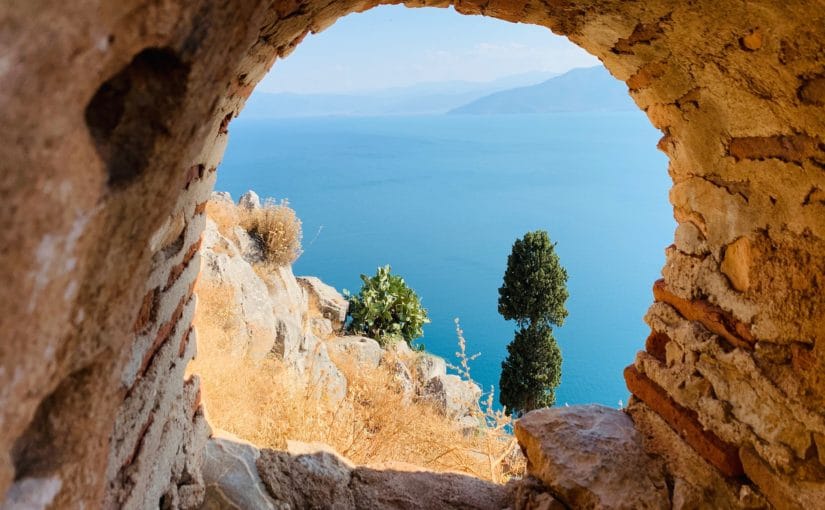
Three Days in Athens

They only look that way. Sighting the length of the long wall shows the slight rise in the middle of the base. The columns bulge by centimeters in the middle. And they are slightly closer to one another at the ends. The brain adjusts the picture to straight lines and even gaps.

While work continues on the Parthenon, restoration of two smaller temples, the Temple of Athena Nike and the intricate Erechtheion, is complete. 


Three-Days-In-Athens
Erechtheion, Acropolis, Athens, Greece, Photo by ConsumerMojo.com

Leading us to the edge of the Acropolis so we could look down over its surrounding limestone circuit wall, Panos pointed at the foot of the wall to the Theater of Dionysus, the god of wine and the patron of drama. Its semi-circle of stone seats, dating to the 6th Century B.C., makes it the world’s oldest theater. The first audiences saw the plays of Euripides, Sophocles and Aristophanes. With renovations, excavations, and restoration over the centuries the theater remains in use today.

Nearby, we met a couple from Portland, Oregon reflecting, like us, on what they’d seen.

A little after 8 p.m., we retraced our steps down the stone access paths and parted with Panos at the bottom of the hill.

He’d been great company and a fountain of information about the history he loves. If you’re looking for a tour guide in Greece, he’s your man. He speaks German and French as well as English in addition to his native Greek. For all of his enthusiasm we found a wistful quality about him and asked if his father had ever come around from his disappointment about his interest in history. He smiled and said, “Maybe some day.”

Barbara’s research had produced a reservation for the 10 p.m. seating at another restaurant with a terrace that looked out on the Acropolis and the nearby Temple of Haephestus.

Three Days In Athens
Kuzina Restaurant with a View of the Temple of Hepaestus, Photo by ConsumerMojo.com

A short taxi ride took us to the edge of Adrianou Street, in the Plaka neighborhood. It’s a pedestrian zone, and a few doors in we found the old mansion that was now Kuzina. Chef Aris Tsanaklidis started the place in 1992 when he returned to Greece after cooking all over the word. His menu showed that wide experience.

We decided to find out about the native grape, assyrtiko and ordered a wine from Crete that blended it with athiri, vilana and vidiano grapes.

Three Days in Athens

We split an appetizer of scallops with green pea puree, wasabi and butter sauce. For mains we usually order something different to get as many tastes as possible. But tonight neither of us could resist the spicy tuna with ginger and wasabi over greens.

Three-Days-In-Athens
Tuna Served at Kuzina Restaurant, Athens, Greece

Both dishes looked great and tasted better. We finished splitting a dessert of lemon curd and blueberries.

Three-Days-In-Athens
Blue Berries and Lemon Curd, Kuzina Restaurant, Athens, Greece, Photo by ConsumerMojo.com

Again, we barely made the hotel breakfast after our late restaurant night. Then we climbed in a taxi and asked the driver to take us to the agora. That showed we were Athens greenhorns. Agora means an assembly place, but it also means a marketplace. Our driver took us first to the modern agora, which looked from the street like a flea market where you could buy stuff that fell off a truck. A few blocks farther on we got out at a public square bustling with tour groups, performance artists, and sharp-eyed bystanders. I switched my wallet into a front pocket. 

A sign to the site of Hadrian’s Library rescued us. The people there told us how to find the ancient Agora, the city’s original gathering place.

Three-Days-In-Athens

From Adrianou Street, where we’d been the night before, we entered a sprawling hilly site dotted with trees and thin cypresses that speared the sky.

A brutal heat wave was searing Europe to the north, making the 90F in Athens seem balmy, but the shade of the trees in the Agora was welcome nonetheless. Up a hill beyond a statue of the Roman Emperor Hadrian that now showed us nothing but his toga, we saw another temple.

Three-Days-In-Athens
Emperor Hadrian, Athens, Greece, Photo by ConsumerMojo.com

We climbed to it and found ourselves before the Temple of Haephestus, the best-preserved of the ancient Greek temples. That seemed right, since Haephestus was the god of fire and construction.

Three-Days-In-Athens
Columns at Temple of Hephaestus, Athens, Greece. Photo by ConsumerMojo.com
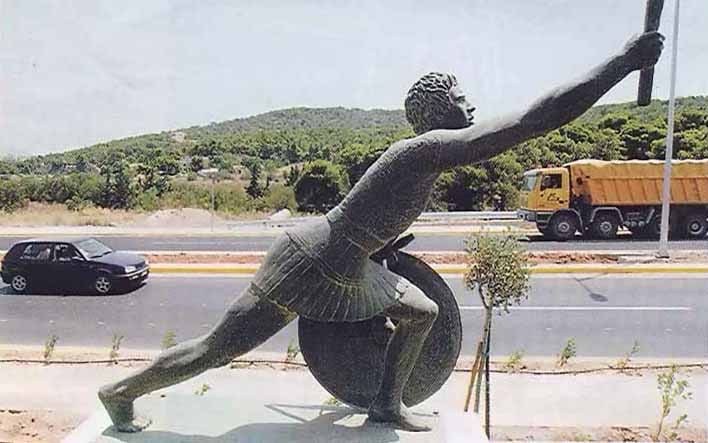
Iktinos was its architect, and with thirteen columns on the sides and six across the front and back it’s the same rectangular proportion as the Parthenon. And like the Parthenon, it’s had multiple uses since it was built around 450 B.C., including centuries as an Orthodox church and later a museum.

Three-Days-in-Athens
Temple of Hephaestus, Athens, Greece, Photo by ConsumerMojo.com

The temperature was climbing, and we wandered quickly around the rest of the Agora and its surrounding park.

Three-Days-In Athens
Ancient Agora, Athens, Greece, Photo by ConsumerMojo.com
Three-Days-In-Athens
Columns Separating Passageways of Largest Building in the Ancient Agora, Athens, Greece. Photo by ConsumerMojo.com
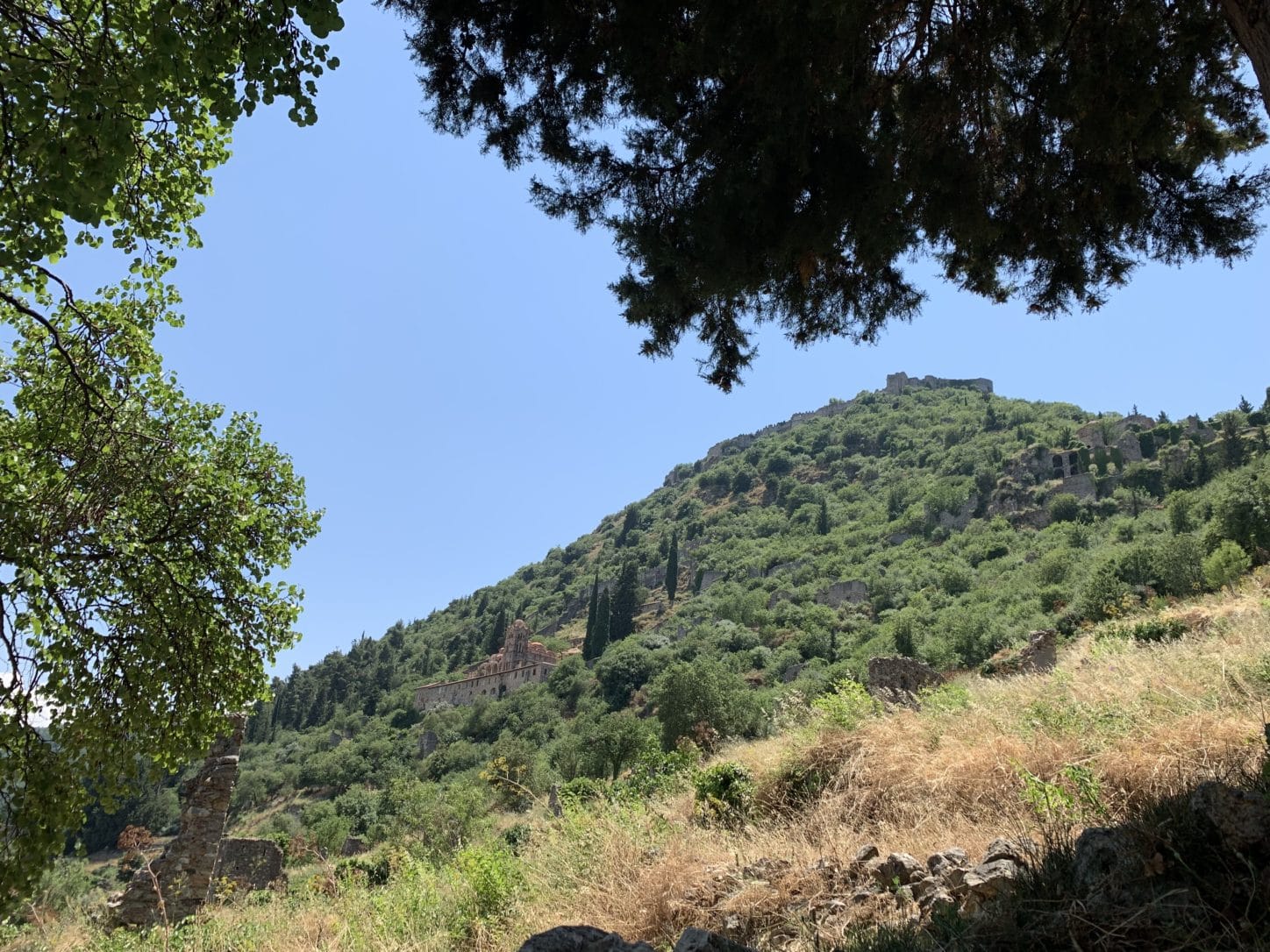
We found a taxi and minutes later we mounted the steps of the columned neoclassical facade of  the National Archaeological Museum and slipped into the air conditioning.

We decided to visit the section that had the Mycenaean treasures discovered in 1876 by Henrich Schliemann, a self-funded German-American businessman turned archaeologist. What he discovered provided proof that the legendary kingdom was indeed, as Homer wrote, “Mycenae rich in gold,” and that the legendary characters may have been real people. Unlike Lord Elgin, Schliemann donated everything he found to Greece.

Three-Days-In-Athens
Mask of Agamemnon, Photo by DieBuche, Creative Commons License
Nestor’s Cup, National Archeological Museum, Athens, Greece Photo by Anamnesis, Courtesy Creative Commons License
Three Days In Athens
Mycenaean Swords, National Archeologial Museum, Athens, Greece. Photo by Janmad, Courtesy Creative Commons License.

Three Days In Athens

Three Days In Athens
Rhyton Bull’s Head from Mycenae, NAMA, Author Unknown, Photo Courtesy Creative Commons License

A sign for a special exhibition caught our attention and we headed to it, pausing along the way to enjoy some of the spectacular pieces of the permanent collection.

Three-Days-In Athens
Artemision Bronze of Zeus or Poseidon Found in the Sea, Photo by ConsumerMojo.com

A bronze statue from 140 B.C. of a boy astride a running horse, called the Jockey of Artemsia, recovered from a shipwreck and perfectly preserved, pulsed with energy and captured the will to win.

Three Days In Athens
Jockey of Artemisa, Photo by Marsyas, National Archeological Museum, Athens, Greece,Courtesy Creative Commons License

Then we found our way to the special exhibit, “The Countless Aspects of Beauty.”  The ancient Greeks developed theories of aesthetics and saw physical beauty as divine. They looked for perfection in all things they created and sculpted gods to embody the ideals they imagine. When it came to building, the “Golden Mean” of the 9-4 rectangle governed the construction of their temples. They strove for simplicity and grace and took care with the proportions of things they used every day and this exhibit displayed objects that told a story.

Three-Days-In-Athens
Countless Aspects of Beauty, National Archeological Museum, Athens, Greece[/caption

Some of the perfectly crafted pieces stood out to us.  This small pitcher with an upswept neck.

[caption id="attachment_45111" align="aligncenter" width="480"]Three Days In Athens

Small pitcher from Countless Aspects of Beauty, National Archeological Museum, Athens, Greece. Photo by ConsumerMojo.com
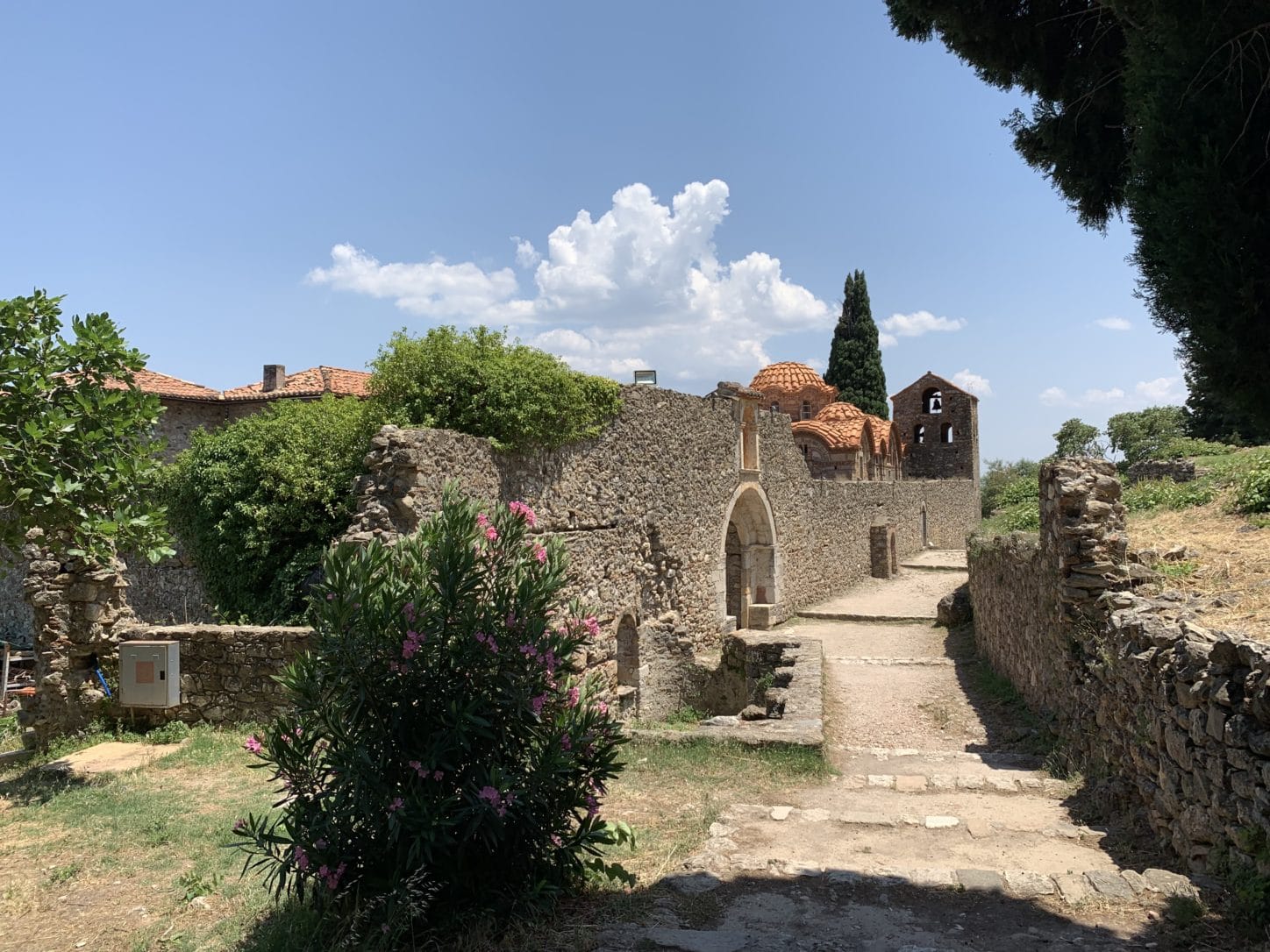
We understood why the curators chose this painted vase with perfect symmetry. The objects were more than beautiful. They spoke to the way design and artistry can inject pleasure into ordinary objects.

Three Days In Greece
Vase Countless Aspect of Beauty, National Archeological Museum, Athens, Greece, Photo by ConsumerMojo.com[/caption

The show displayed a range of objects including jewelry and fabric and also reminded us that pleasant and intoxicating scent stimulates thoughts, feelings and can envelope you in beauty. 

[caption id="attachment_45108" align="aligncenter" width="480"]Three-Days-In-Greece Aphrodite, Countless Aspects of Beauty, National Archeological Museum, Athens, Greece, Photo by ConsumerMojo.com
A statue of Aphrodite, the Greek goddess of love and beauty, stood before two flasks of perfume created by Korres cosmetics from ancient recipes. You could lean into individual flasks to inhale and find the aroma that pleased you.  

But the highlight for us was the head of a man in contemplation.

His expression invited the viewer into his thoughts, perhaps about beauty, its impact, its brevity, its loss. We left the museum pondering the same questions. 

Outside, the waiting taxis were asking a 15 euro flat fare to local hotels. We hailed one passing in the street and reached our hotel with 6 euros on the meter.

We hadn’t booked a restaurant for that night and when we said we wanted fish,  the hotel recommended Barbounaki, a ten-minute walk away. The doorman pointed us in a a convoluted direction that sent us twisting through steep, dark streets. On the way we met a New Zealand couple, Ian and Liz Thompson, from Aukland. They were looking for the same restaurant, and we found it together.

We ordered incorrectly. Ian and Liz ordered simple grilled sea bass. Nick ordered red mullet, which turned out to be too bony for his taste. 

Three-Days-In-Athens
Red Mullett at Barbounaki, Athens, Greece, Photo by ConsumerMojo.com
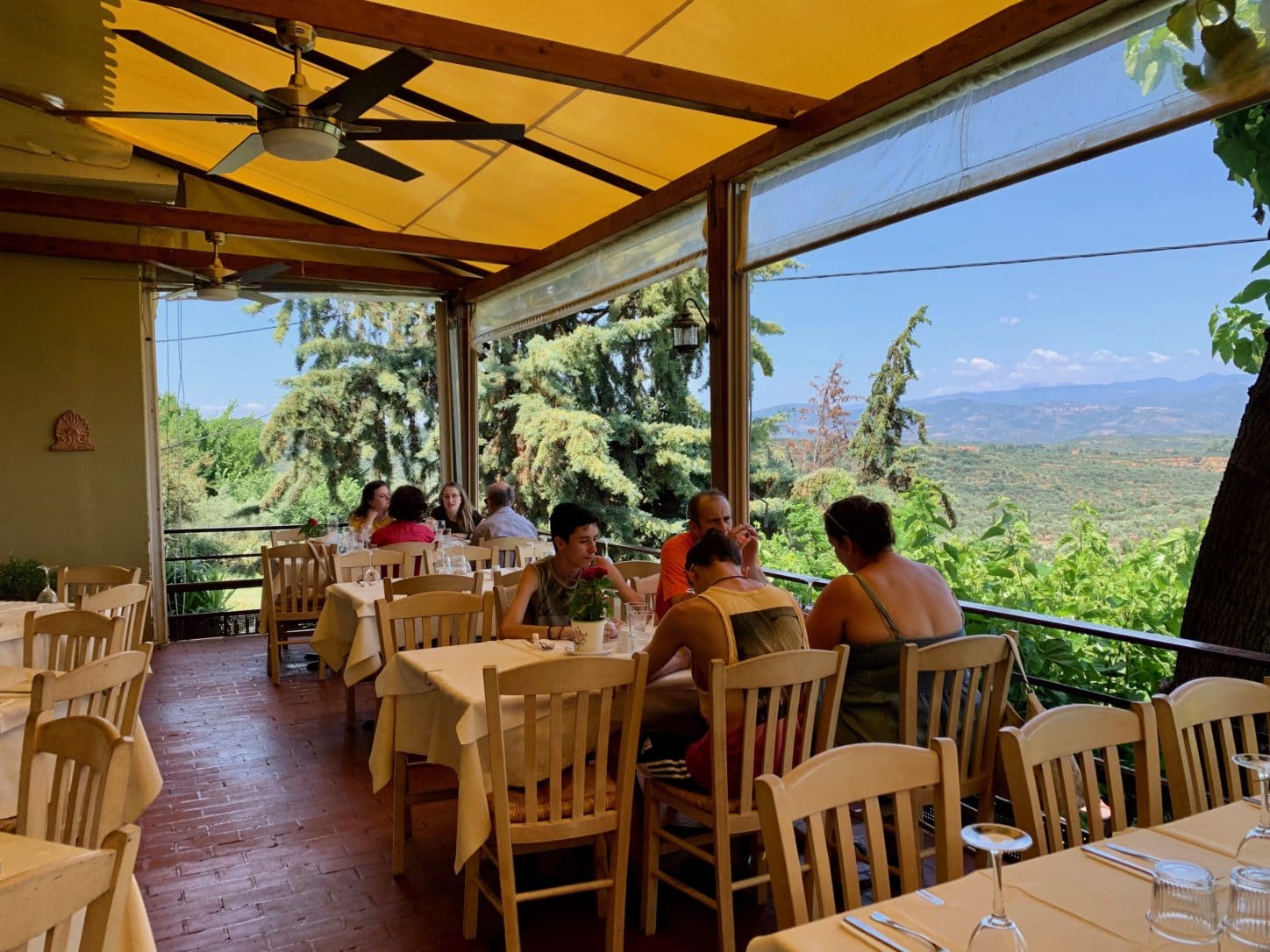
 

Three Days In Athens
Small Shrimp, Barbounaki Restaurant, Athens, Greece, Photo by ConsumerMojo.com
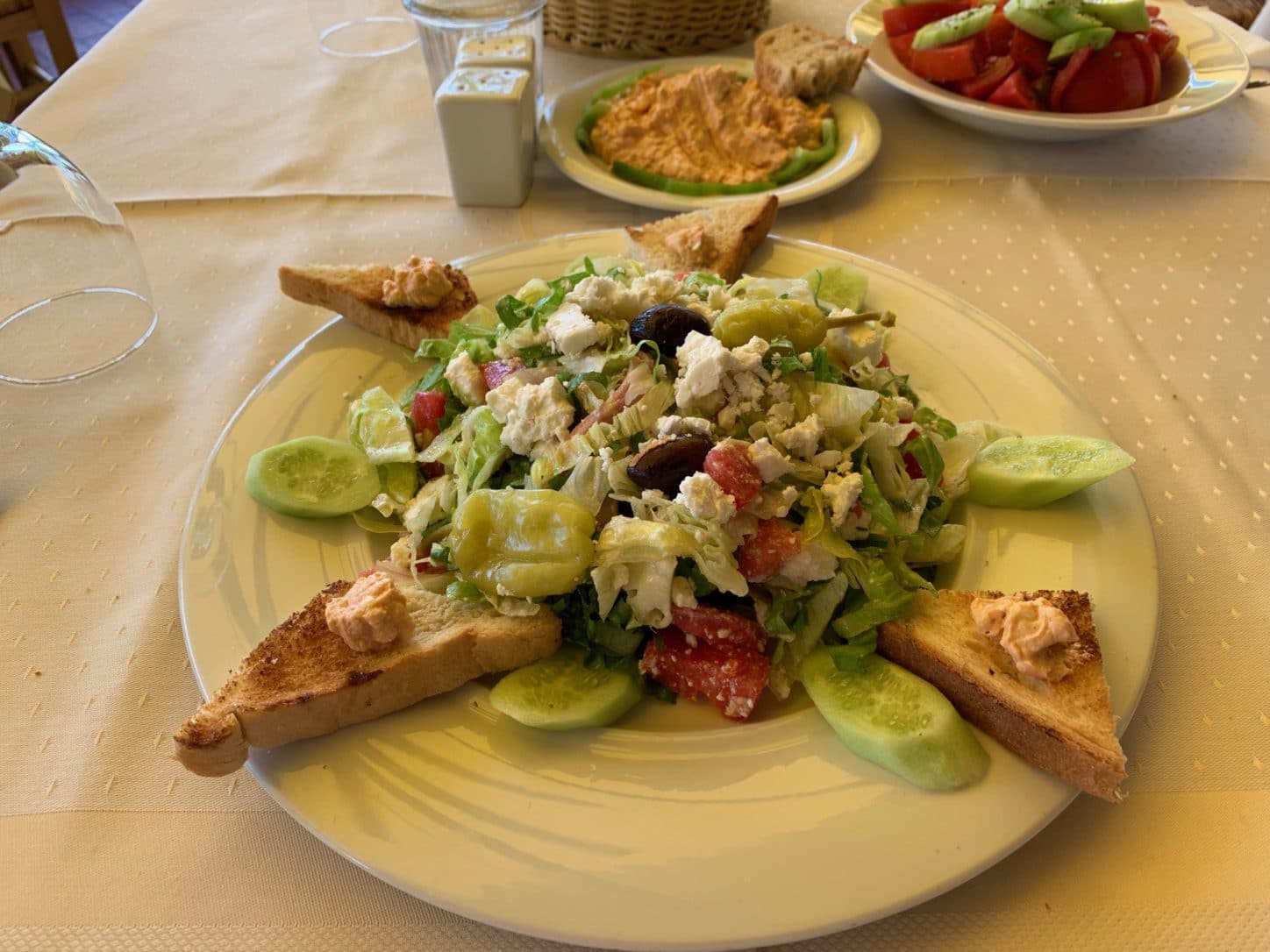
Three Days In Athens
Greens, Barbounaki Restaurant, Athens, Greece, Photo by ConsumerMojo.com
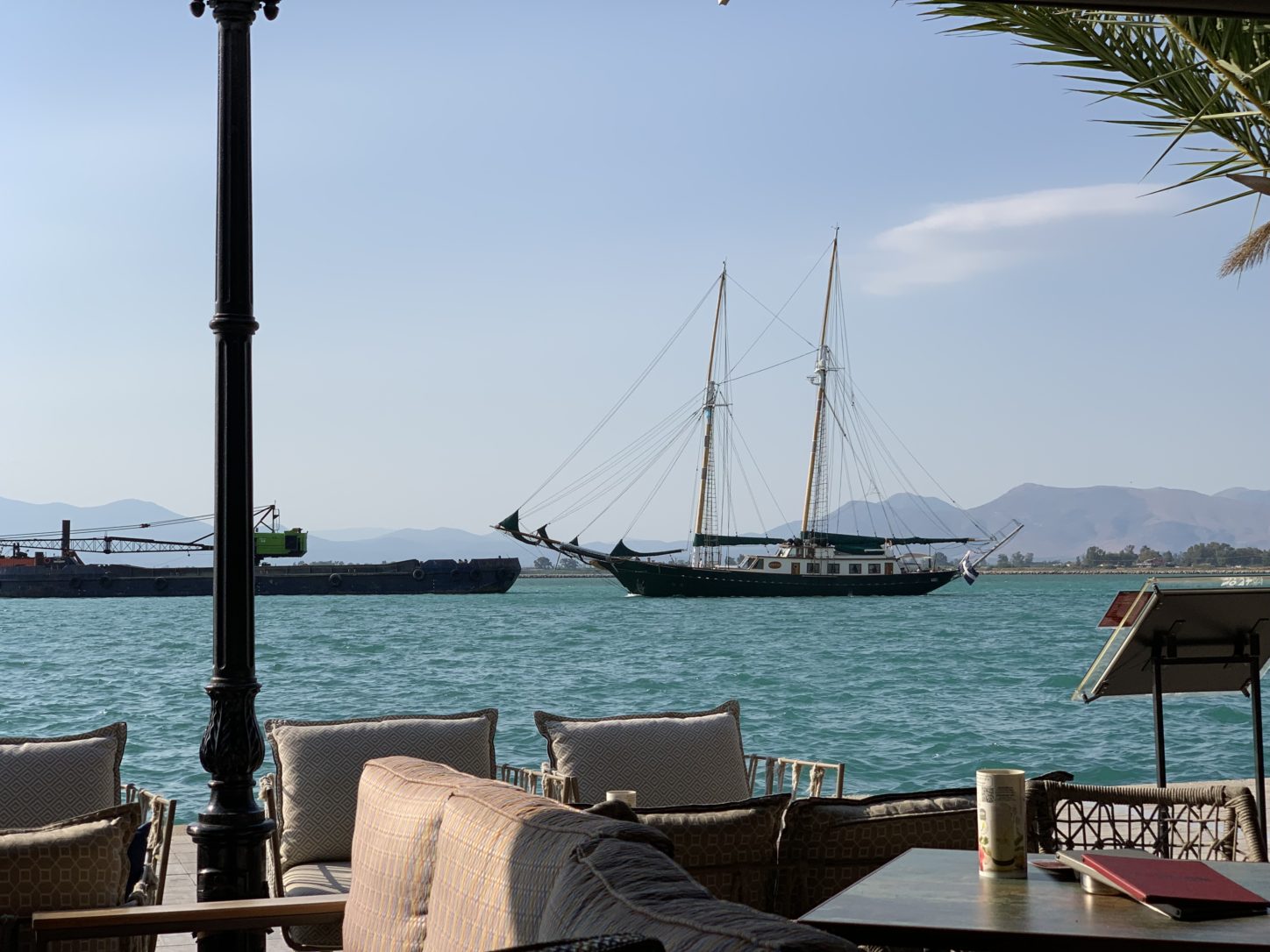
Barb’s small shrimp weren’t great, either. Her second try with a sushi-like fillet was more satisfying. The conversation was better than the meal and we were happy to have bumped into Liz and Ian.

Three Days In Athens
View from St. George Lycabettus Hotel Room, Athens, Greece, Photo by ConsumerMojo.cm

The next morning after breakfast we taxied to the airport to pick up a rental car to drive to the next leg of our Greek journey, the Peloponnesian peninsula of history and legend.


International Driving Permits Easy To Get

by Nick Taylor

Barbara and I started to prepare for our first-ever trip to Greece and read the small print in information about car travel. It told us that we needed International Driving Permits (IDP) if we were going to rent a car and drive in Greece. This was a first.

We love to drive on our vacations.  

Maladroxia, Sant’Antioco, Sardinia, Photo by ConsumerMojo.com
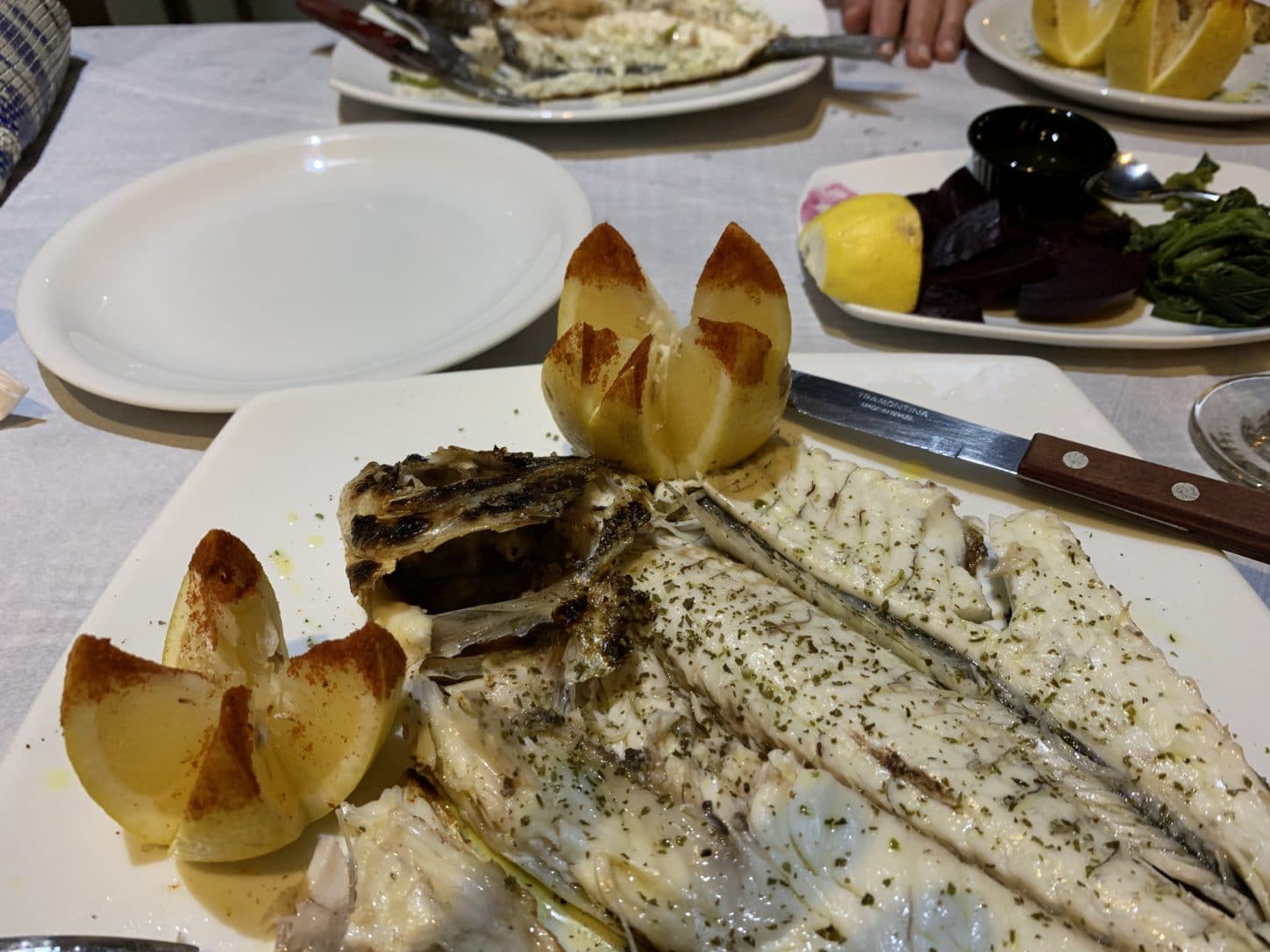
We’ve driven all over the British Isles, Europe east and west, and even into Belarus not long after the end of the Soviet Union.

International-driver's-permit-easy-to-get
Farms in Ivye, Belarus, Photo by ConsumerMojo.com
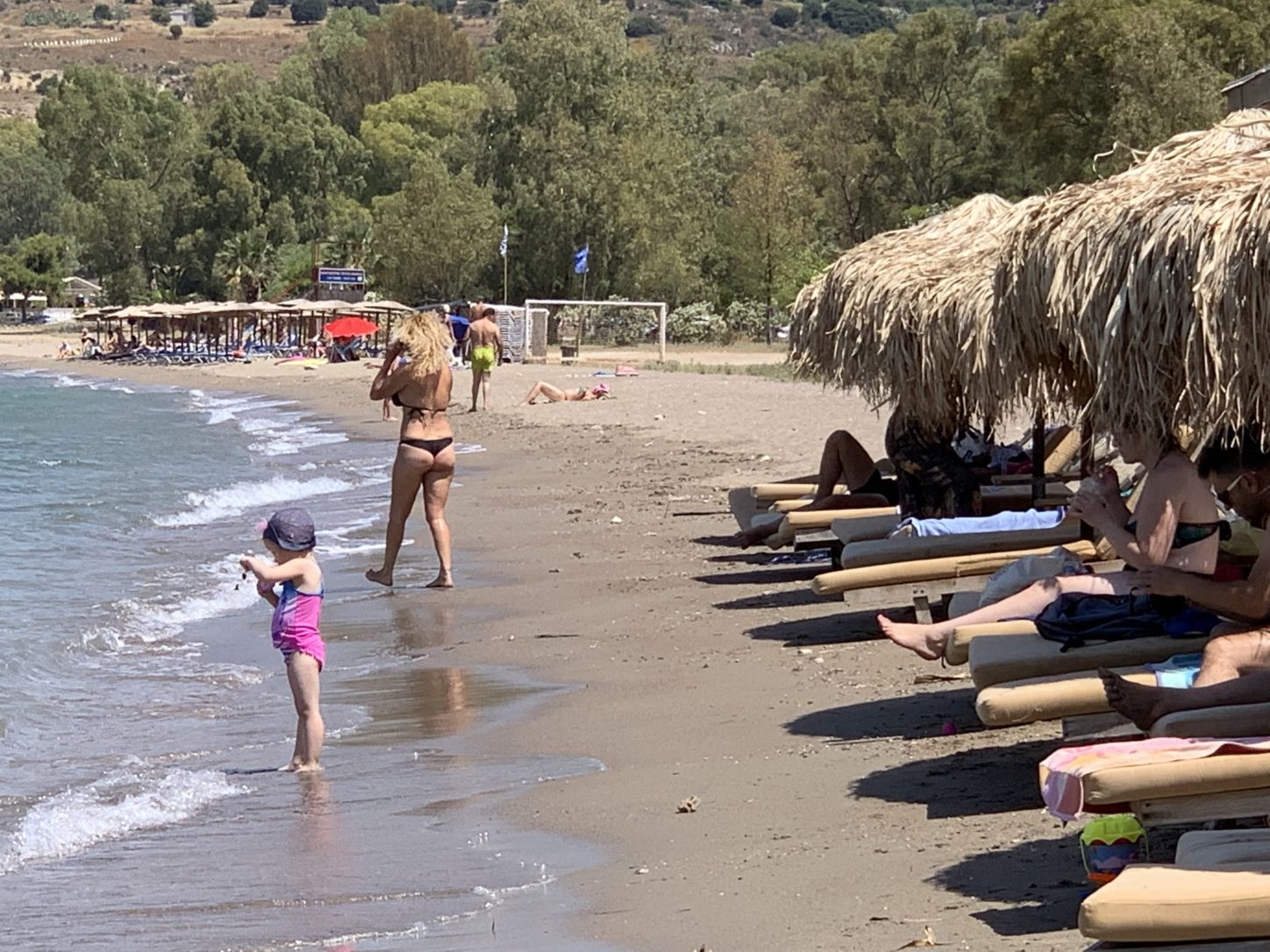
We paid cash in advance for the black Volvo we drove that day and left a credit card with the rental company in Vilnius, Lithuania, until we brought it back, but nobody asked for an International Driving Permit (IDP).

International-Drivers-Permit-Easy-To-Get
Vilnius, Lithuania, Photo by 3dman, Courtesy Pixabay, Creative Commons License
International-Drivers-License-Easy-to-Get
Cadaqués, Spain, Photo by ConsumerMojo.com
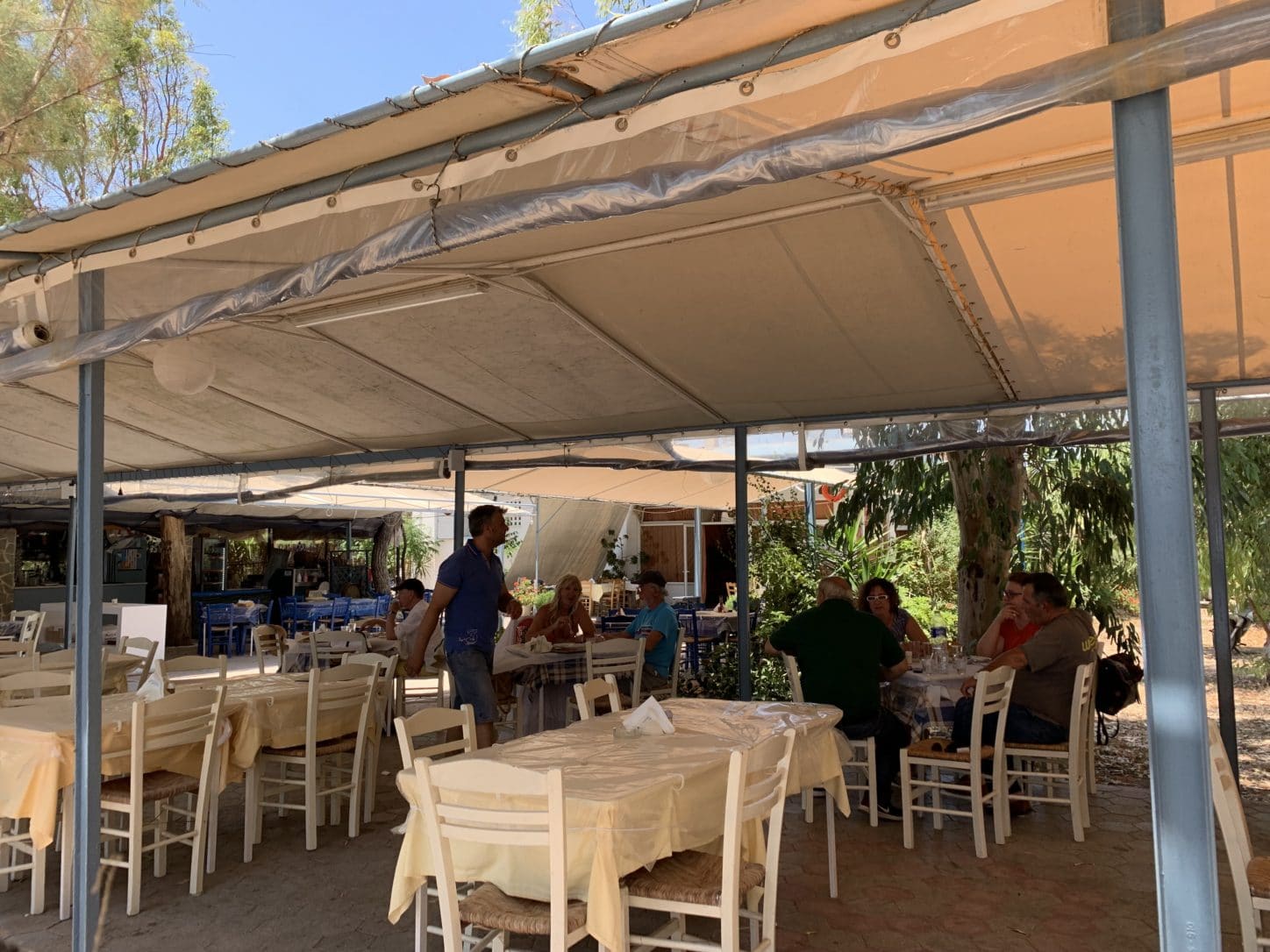
More recently, we’ve driven from Barcelona into France and back again, from Madrid south and then east to Granada, covered most of Sicily,

International-Drivers-License-Easy-To-Get
Autostrada Cinisi, Sicily Photo by ConsumerMojo.com
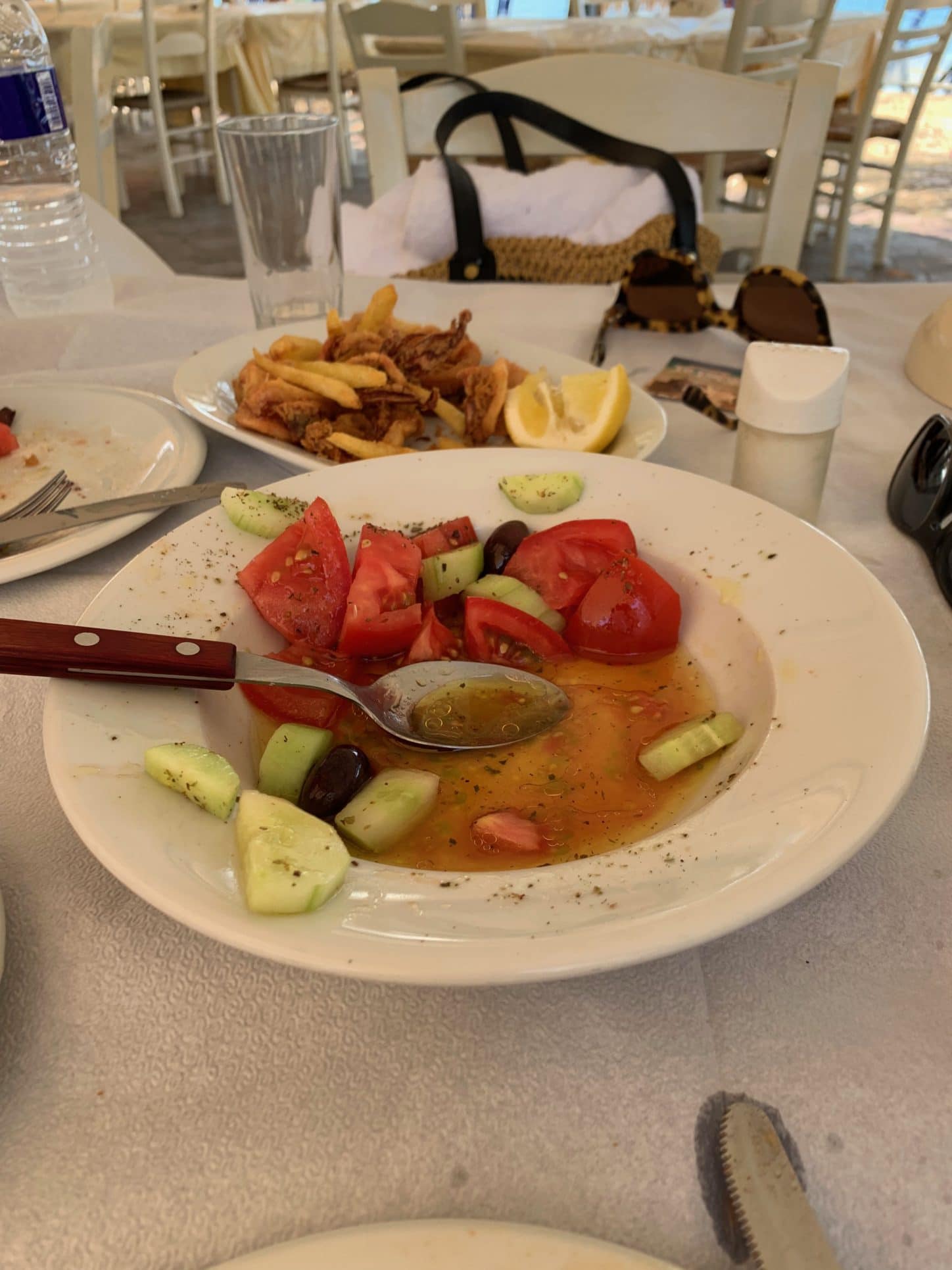
driven Croatia to Bosnia

International-Drivers-License-Easy-To-Get
Mostar, Bosnia, Photo by ConsumerMojo.com jpg
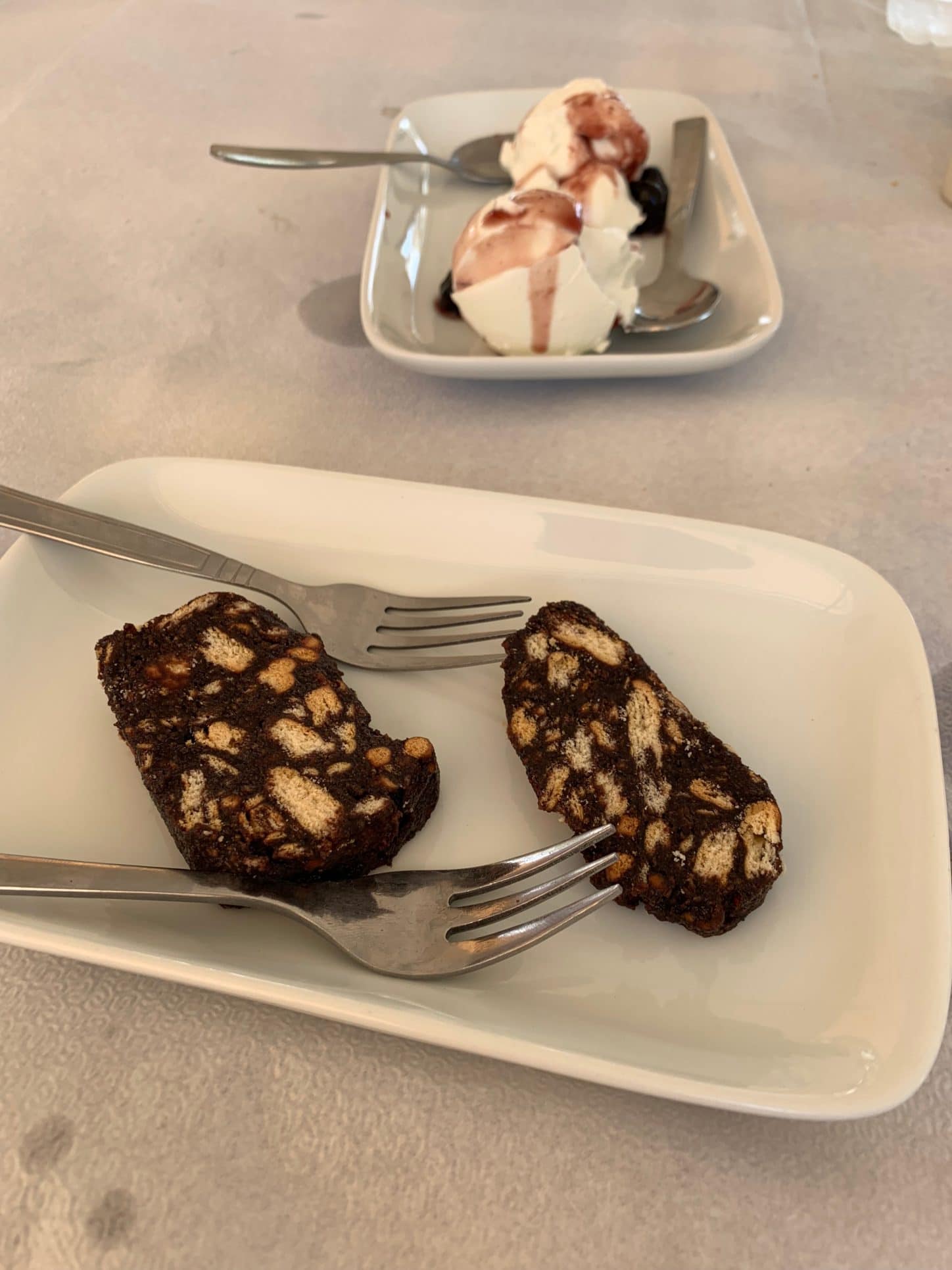
and Montenegro

International-Drivers-License-Easy-to-Get
Bay of Kotor Table on the Water, Photo by ConsumerMojo

and back to Croatia,

International-Drivers-License-Easy-To-Get
Twilight Dubrovnik, Croatia, Photo by ConsumerMojo.com
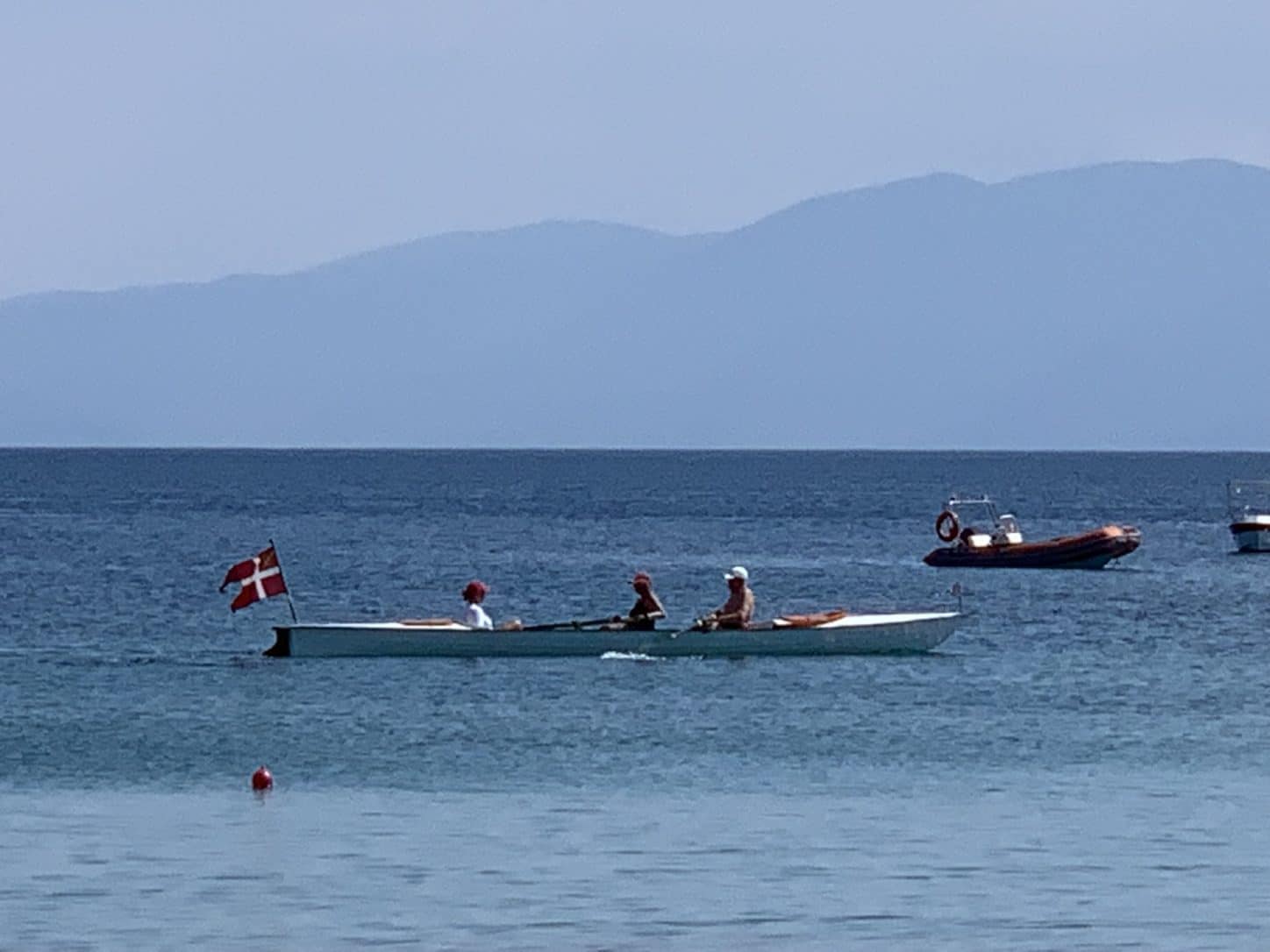
and climbed the spectacular mountains of Sardinia.

International-Drivers-License-Easy-To-Get
View of Nuoro, Sardinia, Photo by ConsumerMojo.com
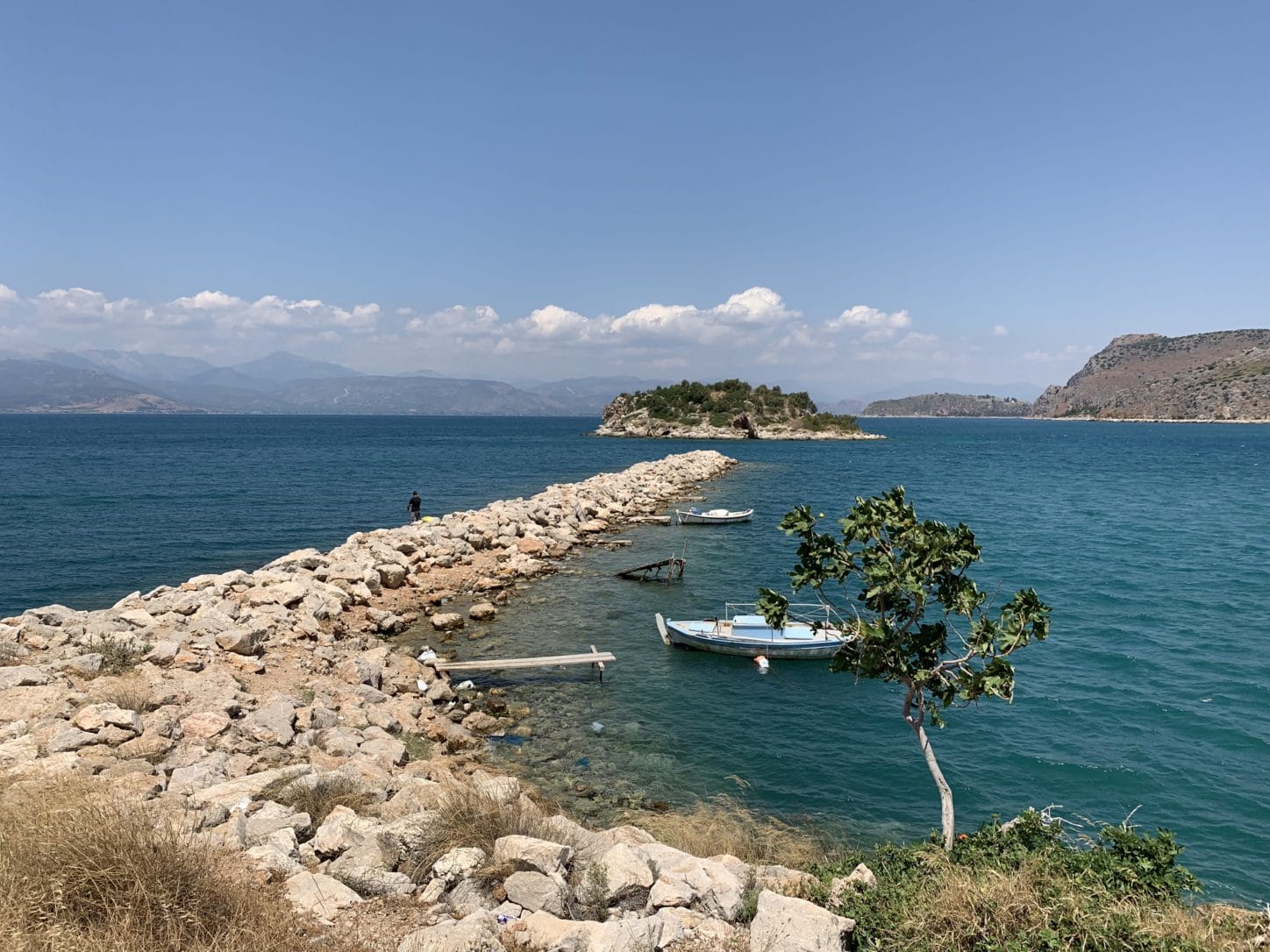
 

Nobody asked for an International Driving Permit in any of those destinations, either.

But Greece treats non-EU citizens differently and we want to drive.  We reserved a car to pick up in Athens, from where we plan to drive through Corinth into the Peloponnesian peninsula.  We’ll use Nafplion

International-Drivers-License-Easy-To-Get
Napflion, Greece, Photo by Twalmedia, Pixabay, Courtesy Creative Commons License

as a base from which to explore the sites where the ancient Myceneans held sway over the rest of the Mediterranean for 400 years, where the Spartans grew their reputation as fierce warriors, where the Olympic games began,

International-Drivers-License-Easy-To-Get
Olympia, Greece, Photo by Neufla54, Courtesy Pixabay, Creative Commons License

where Agamemnon set sail on his odyssey to Troy to rescue his brother’s wife Helen. 

From there we’ll drive off the peninsula and follow the west coast of Greece until we reach the ferry to the island of Corfu.

International-Drivers-Permit-Easy-To-Get
Corfu, Photo by Jeffntt, Courtesy Pixabay, Creative Commons LIcense

We’ll spend a few days there not so much exploring history as nice beaches and the local cuisine.  We’ll turn the car in at the airport there and fly back to Athens.

But none of this would happen without our International Driving Permits.  Fortunately, they’re easy to get and not expensive. 

Getting an International Drivers Permit, Photo by ConsumerMojo.com
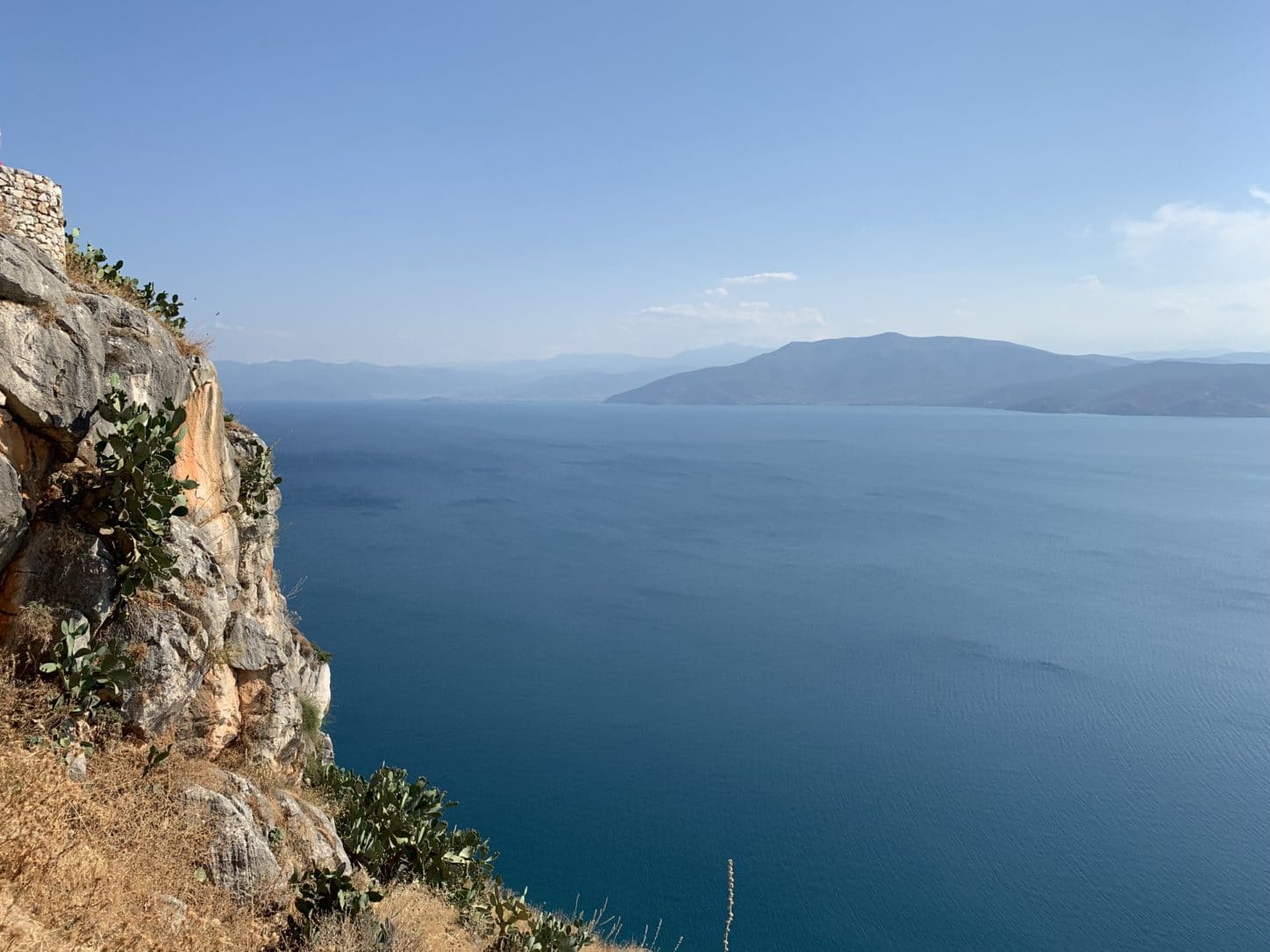
They’re available from most American Automobile Association branch offices, and the AAA website will give you locations.  Or if you have time, you can get the IDPs by mail.  You can get an application online, fill it out and send it back with the following documentation:

  • Your completed IDP application form
  • Two original passport pictures each signed on the back
  • $20 USD permit fee
  • A photocopy of both sides of your driver’s license
  • For a speedy return mail service, include the money or prepaid envelopes needed. See USPS.com, Fedex.com or UPS.com for rates.

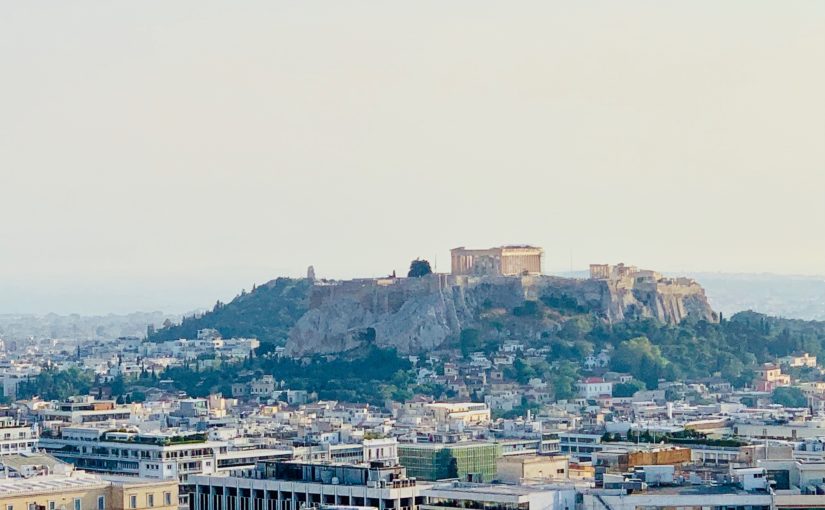
We’re AAA members so we dropped by the Manhattan AAA office at 1881 Broadway with our driver’s licenses and our passport-sized photos to fill out the brief forms.  Then we parted with $20 each and received our IDPs that are good for a year.  We were in and out in half an hour.

International Driving Permits Easy to Get

Now we’re off!


Why Renew 9/11 Victims Compensation Fund?

Comedian Jon Stewart made members of Congress squirm during a recent hearing about renewal of a program to help 9/11 first responders and survivors. Stewart teared up and accused Congress of “callous indifference.”  After the hearing the committee voted to extend the September 11 Victims Compensation Fund (VCF) until 2090.  The full House of Representatives is expected to approve it in July. But Stewart and activists expect an uphill battle in the Senate, where Republicans seem reluctant to put aside the billions the program needs.

Why renew the the September 11 Victims Compensation Fund?

The Victims Compensation Fund  provides money for people who got sick as a result of the terrorist attack on the United States and their exposure to the toxic dust. But the $7.3 billion set aside to help victims cope with their health problems is running out and the program ends on December 18, 2020.

First responders and people who lived, worked, went to school and played in the area and can prove that they have an illness linked to 9/11 are eligible for money from the Victims Compensation Fund. The money goes a long way to help pay living expenses for many and for expensive medicine not covered by insurance.

But more and more people are getting sick with cancers and other diseases that are just showing up eighteen years after the terrorist attack.

Why-Renew-The-Victims-Compensation-Fund
Residents of Lower Manhattan a Victims Compensation Fund Briefing Organized by Congressman Gerald Nadler and Manhattan Borough President Gale Brewer

Survivors who were not first responders account for 40 percent of the people now applying for help from the 9/11 Victims Compensation Fund, according to testimony before a House of Representatives subcommittee by the fund’s Special Master Rupa Bhattachayra. Many have cancer.
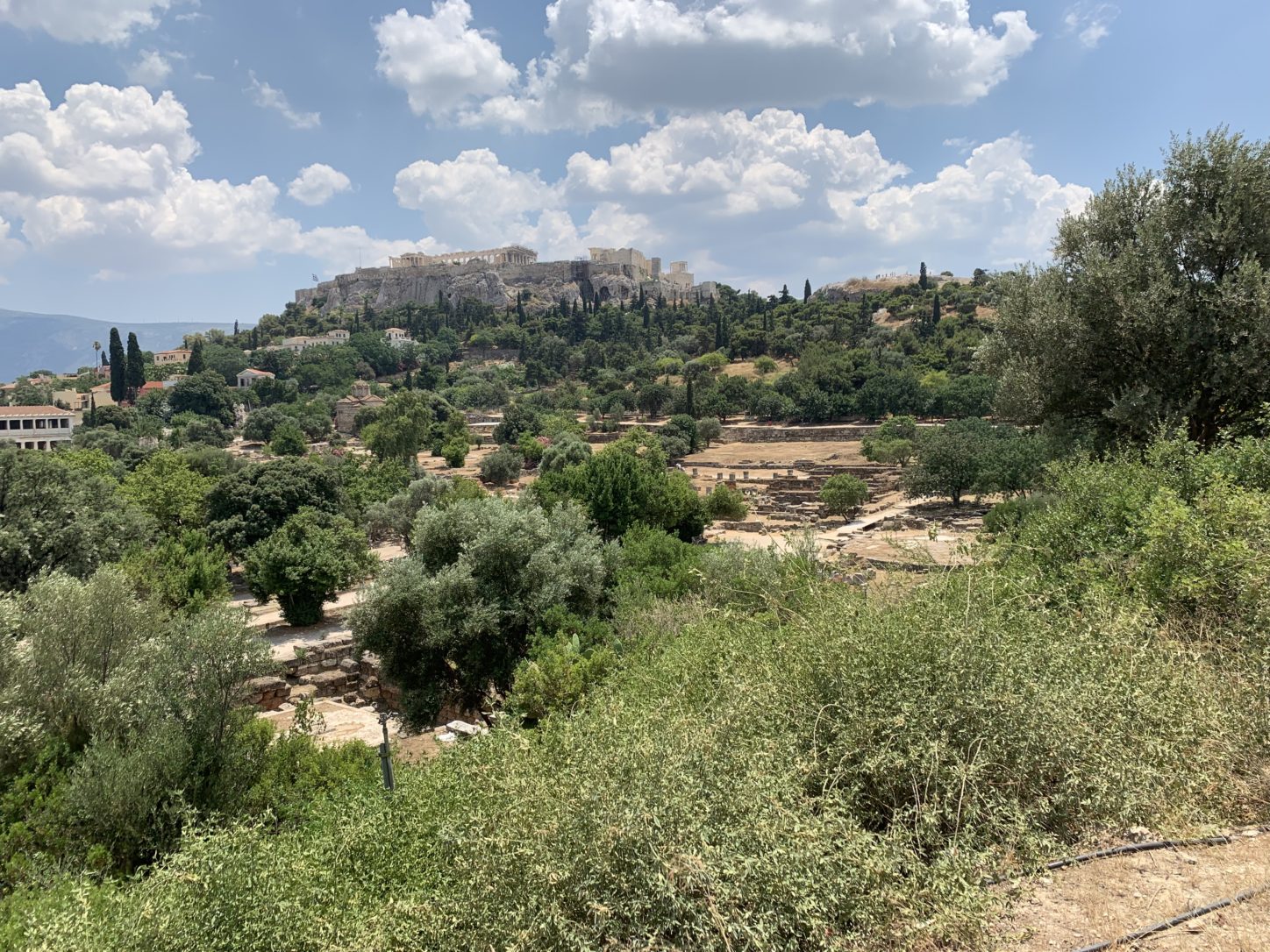
I’m one of those affected. As a reporter for UPN9 and FOX5, I went to the World Trade Towers shortly after the first plane struck and was nearby when they collapsed.  I’m working on a documentary about people, including me, discovering that 9/11 caused serious health problems.

Contact your U.S. senator and let him, or her, know that you expect a “Yes” vote to extend the 9/11 Victims Compensation Fund.

U.S. Capitol Switchboard at (202) 224-3121.


Green New Deal: What’s Old Is New Again

by Nick Taylor

Spring blooms in Hyde Park on the Hudson River and Franklin D. Roosevelt must be smiling in his grave. Fighting the Great Depression of the 1930s, he created a “new deal for the American people” that unlocked their access to the great bounties of our country. Now a new generation calls for a Green New Deal. A smart, bold Green New Deal can use the Roosevelt playbook in the same way. 

First, Roosevelt jumped on bold ideas.

He created the Civilian Conservation Corps that sent young men to restore national parks and forests where they planted three billion trees.

Green New Deal What's Old Is New Again
North Dakota Civil Conservation Corps Workers, Public Domain Photo

His Tennessee Valley Authority built dams that electrified rural Appalachia and lifted the region out of abject poverty.

Green New Deal What's Old Is New Again
TVA Workers Norris Dam, Photo Courtesy National Archives, Public Domain

He backed a plan to generate electricity from the rise and fall of the tides in Passamaquoddy Bay in northern Maine. Congress ultimately blocked it but today Scotland draws hydropower from the tides with turbines anchored to the floor of the North Sea.

Men Drilling for Passamaquoddy Tidal Power Project, Photo by Dexter P. Cooper, National Archives, Public Domain

The New Deal’s job-creating engine, the Works Progress Administration, put men and women to work in every county, state and U.S. territory.

Green-New-Deal-What's-Old-Is-New-Again
Family Walking on Highway 19361 Dorothea Lange, Photo Courtesy National Archives, Public Domain

In Ohio, in a precursor of the Green New Deal, miners cut gaps in coal seams to extinguish an underground fire that had been burning, spewing methane and carbon dioxide, for more than fifty years.

Green-New-Deal-What's- Old-Is-New-Again
New Straightsville, Ohio Mine Fire, Courtesy WPA Writer’s Project, Public Domain

Workers paved roads and improved sidewalks, repaired bridges, installed new water lines and built hospitals, stadiums, schools and golf courses.

Green-New-Deal-What's-Old-Is-New-Again
Pelham Bay Golf Course, New York, Photo Courtesy WPA, Public Domain

Teachers laid off by impoverished local school boards taught for WPA paychecks. Bookbinders repaired tattered books in libraries and schools. Artists painted murals, writers chronicled the times.

Green-New-Deal-What's-Old-Is-New-Again
WPA Science & Invention by John Augustus Walker on display at History Museum of Mobile, Alabama, Public Domain

In eastern Kentucky,  women loaded saddlebags with magazines, books and catalogues and carried them on mules to isolated families and schools.

Green-New-Deal-What's-Old-Is-New Again
 Packhorse Librarian in Eastern Kentucky, With Books, WPA Photo, University of Kentucky Digital Archive

All this work brought new hope to an America in despair from the Depression, when 25 percent of workers had no jobs, homeless families lived in shantytowns, and city food lines stretched for blocks.

Green-New-Deal-What's-Old-Is-New-Again
Migrant Family, Library of Congress WPA Photo


Green-New-Deal-What's-Old-Is-New-Again
Food Line, New York City Courtesy Franklin D. Roosevelt Library, Public Domain

Real change followed on the heels of hope. Social Security and unemployment compensation created pensions and security for workers. Union collective bargaining raised wages. Banking laws protected depositors and encouraged homebuyers. Price supports and enforced crop rotation restored the depleted farmlands of the Dust Bowl.

Green-New-Deal-What's-Old-Is-New-Again
Dust Storm in Rolla, Kansas, Franklin D. Roosevelt Library

A smart, bold Green New Deal can use the Roosevelt playbook in the same way. The New Deal showed Americans what it was doing. People saw the thousand small ways their communities improved, and that produced support for the big programs that followed. 

Local initiative is the second takeaway.

FDR’s New Dealers believed people at ground level understood better than Washington what their communities needed. Federal dollars (mostly) paid for the flurry of transformative work around the country, but the idea for those projects bubbled up from state and city governments and even some private entities. This removed the work from the taint of national arguments over ideology. Nobody from someplace far away, some fancy orator with a point to prove, was shoving anything down people’s throats.

Green-New-Deal-What's-Old-Is-New-Again
Timberline Lodge, Mount Hood, Oregon. WPA Photo, Public Domain

Critics scoffed and called many of these jobs “boondoggles,” a term for make-work tasks of little value. Cartoonists drew “WPA shovels” equipped with fold-down seats and arm rests. But thousands of these sturdily-built projects, maintained and restored, remain part of the American landscape. Many of us learned in WPA-built classrooms, read in WPA libraries, and camped at CCC-built campgrounds that will serve generations yet to come.

Green-New-Deal-What's-Old-Is-New-Again
Red Rocks Amphitheater, Denver, Colorado, Library of Congress Photo, Public Domain

None of this was easy. FDR faced virulent critics. Boondoggles was a gentle word compared to most. “Socialism!” was much scarier, and conservatives blared it every chance they got to suggest that a government that was simply doing a good job aimed to take away their “freedom.” But Roosevelt and his team kept their eyes on the important things and pushed ahead.

That’s the third point. Conservatives have no new ammunition, so they dusted off their one-word arsenal from eighty years ago to lob at the Green New Dealers. They hope the same scare tactics will distract voters from the abundant evidence that calls for action, fast. But today’s New Dealers have the ear of younger generations and a better story. It’s a story about hard work and changes that can sweep the nation and improve home towns. Americans who believe in a future that their country, its children, and the world deserve are listening.

For more about the WPA, read my American-Made: The Enduring Legacy of the WPA, When FDR Put the Country To Work.

Gardening Generation To Generation

by Barbara Nevins Taylor

Who knows if the love of gardening is genetic? Does the feel for beautiful flowers and plants pass from one generation to the next? I do know that even on a rainy, cool May day when my garden continues to shrug off winter and breathe itself back to life, I smile and give thanks to my mother and grandmother for inspiring me to take pleasure in flowers and plants.

Our grandma, crippled with arthritis for as long as I knew her, gardened inside. Mom tended her beautiful backyard garden just a few houses away in Laurelton, Queens.

gardening passion generation to generation

Mother liked this photo because she was with her daughters. That’s me on the left and my sister Hope Tudanger on the right.

Grandma filled her sunporch window sills with snake plants, aloe and cacti.  Like pets, they rubbed up against her as she worked her ancient Singer treadle sewing machine. She watered and fussed with the greenery and shrugged off any suggestion from her grown children that maybe she had too many “ugly” plants.  

gardening passion generation to generation
    Grandma Sarah Robin


Mom’s garden was something else. In the summer when we opened the kitchen windows and hung wash on the line, the fresh scent of flowers and trees filled our small kitchen

A splashy red rambling rose bush sprawled crazily across the back fence. Tiger lilies bloomed underneath and alongside the big rambler, and a sickle pear tree with sweet fruit bloomed in the corner.

Whenever my sister Hope and I drove past the house we left as young adults, we shook our heads, amazed that on this postage stamp-sized property our mom created a garden filled with beauty.

My memory sees a garden-lover’s plan. It wasn’t just a jumble of plants, but an understanding of order with a bit of chaos stirred in. A pussy willow lolled along a side fence. Then came perfumed tea roses with flame-like petals in a neat row of bushes. A rose with soft pink petals blossomed beside yellow roses and another with lavender blooms and yet another soft red. A giant peony exploded into a blur of pink under a pear tree that almost leaned into our house. 

A gnarly apple tree grew on the other side of the patch of grass we called a lawn. It shaded purple hydrangeas that stretched out along a narrow bed under its branches. A patch of cement led to our junk-filled garage and on the other side, along a fence, mom planted purple and white irises, lilies of the valley and a small tree she called an orange blossom.

She always did most of the gardening herself. She would say, “My husband says, ‘I garden to the best of my wife’s ability.'” Years after they divorced, she repeated his self-indictment and his praise for her talent. She loved that garden and it showed.

Things changed for her and us. She moved from Laurelton, realized different dreams and accomplished different things. But almost until her last days at 95, like her mother she found places for small green plants indoors and kept alive her passion and interest in growing something green and beautiful.

She also, somehow, infused me with the passion. And for that and many other things, I’m grateful.


Spring Audiobook Listening

My spring audiobook recommendations tilt toward the mystery-thriller genres, but you’ll also find historical fiction and an inventive literary work on the list.  All of the audiobooks I like have strong stories, good writing and terrific narration with voices you don’t mind having in your head. The creaky women’s voices popular today distract me and seem hard to understand. Full disclosure here: I return a lot of books. That’s something you can do for free on Audible.

I rejoice and settle in for a great listen when I hear women like the actors in There There, the first novel by Tommy Orange. The clever writing, sharp storytelling and excellent narration made it a spring audiobook standout. The New York Times and the Washington Post put the book on their lists of bests for 2018.

spring audiobook listening

Orange, an enrolled member of the Cheyenne and Arapaho tribes, takes us into the world of the urban Indian, or “Native,” as many of his twelve characters say.  Each speaks in the present tense and tells funny, heartbreaking, maddening stories about their struggles with life and identity.  We also get a sweeping sense of history and the lingering affects of the colonizers’ drive against Native Americans.  At first the characters and their stories seem disconnected and you wonder where Orange will take you. But he twists and turns and keeps you in suspense, laughing and frightened as he weaves his magic and pulls the characters together as they all head for the Big Oakland Powwow.  I won’t spoil it.  But the meaning of home and the city of Oakland, California, play central roles.

The book’s title comes from a Gertrude Stein quote. A character describes how most people get it all wrong. Stein wasn’t panning Oakland, he explains. Stein’s family moved to Oakland in 1880 when she was six. She left at 17 but came back to give a talk in 1935. She looked around and saw her family home, farm and orchard replaced by dozens of houses. She reflected, in her autobiography, with all beautiful things she remembered gone, for her in Oakland “there is no there there.”  It is very much “there” for Orange and his characters. 

Narrators Darrell Dennis, Shaun Taylor-Corbett, Alma Ceurvo and Kyla Garcia do an outstanding job making the characters into real people. 

I admit that I was queasy about reading a book about a man who tattooed numbers on Jews for the Germans. But the story The Tattooist of Auschwitz, by Heather Morris, with narration by Richard Armitage, won me over quickly. I listened to this harrowing love story rooting for the optimism and charm of the hero. The story is based on the true story of Slovakian Holocaust survivor Ludwig, or Lale, Sokolov.

In the novel Lale Eisenberg finds himself in Auschwitz forced to tattoo others, and to do much more, to stay alive. Armitage gives a low-key performance as Lale, his love Gita and all the other characters. His work won him, and the book, the 2019 Best Fiction Audi Award from the Audiobook Publishers Association (APA). 

Be prepared. The history, the story and the evil cruelty infuriates, frustrates and keeps you worrying about Lale and Gita’s chances for survival. Ultimately, one comes away in awe of how human beings can survive in a senselessly savage, inhumane world. 


Career of Evil by Robert Galbraith, narrated by Robert Glennister, is the second book in the Cormoran Strike series written by J.K. Rowling. For some reason I listened out-of-order and enjoyed The Silkworm first. But no matter, it is perfect for the spring audiobook list. If you like a good complicated plot that delivers at every turn and features compelling characters, you’ll like Career of Evil.

Cormoran Strike and Robin Ellacot hunt for a killer who sends body parts to their London office. The search will keep you on edge and nervously jiggling your legs.  Almost everything seems surprising. The story plays out agains the backdrop of the personal struggles of Strike and Robin. He’s a former Royal Army military police officer, who lost part of a leg to an IED in Afghanistan. Robin struggles  with uncertainty about her upcoming marriage and she and Strike dance around the sexual tension between them. 

The body parts pile up as police join the hunt for the Shaklewell Ripper and the appealing characters find themselves at risk repeatedly. Through the harrowing story tinged with romance, Robert Glennister inhabits the characters and creates a believable world. 

Lethal White, also by Robert Galbraith and narrated by Robert Glenister, came at just the right time. When I finished Career of Evil, I jumped at the opportunity to remain in the Cormoron Strike world and downloaded Lethal White. It’s the  fourth and most recent book in the series.

J.K. Rowling, using the Galbraith pseudonym, builds another multi-layered story. This one revolves around corrupt members of Parliament, opportunistic socialists and a greedy, dysfunctional upper class family. The 2012 Olympics in London serve as the backdrop as MPs try to use the Olympics to their advantage. 

It begins when Billy Knight, an unstable young man, bursts into Strikes’ office  and tells him he thinks he witnessed a murder when he was a child. He infers the killer was his brother Jimmy, an anti-Semitic radical socialist.

When Billy disappears, Strike and Robin Ellacot, now his partner, try to find him. At the same time they launch an investigation for a Conservative member of Parliament.

Strike’s success as a detective has made him too famously recognizable to play an open role in the case. So Robin goes undercover to work for MP Jasper Chiswell and finds evidence that the husband of the sports minster, in the office next door, is blackmailing Chiswell. At the same time, Robin struggles with her failing marriage and symptoms of Post Traumatic Stress Disorder she suffers as result of their last investigation. 

Class and the culture wars underpin the plot. Billy Knight’s memory of the killing leads Strike to his parliamentary client’s estate. There the greedy, spoiled, dysfunctional Chiswell family contrasts sharply with the working class people who live on their property.  There’s also tension between the MP’s children, daughters called Izzy and Fizzy, their nutty stepmother Kinvara, and half-brother Raf, the child of an Italian mother. And then there is a murder. 

Robert Glennister, again, does a perfect job keeping the characters living and breathing through the labyrinth of the plot. He also does a fine job keeping the sexual tension between Robin and Strike simmering.


The Punishment She Deservesby Elizabeth George and narrated by Simon Vance, also won an Audi Award for best mystery. Lethal White and Robert Glennister were finalists in this category and I would have chosen Glennister.

Nevertheless, fans of the Lynley novels will enjoy the nuanced, quick-paced mystery that takes Barbara Havers and Chief Inspector Isabel Ardery to Shropshire to investigate the suicide, or possible murder, of a popular deacon. Ardery investigates while she struggles with alcohol as she tries to prevent her ex-husband from taking her sons to live in Australia. Havers struggles to keep her job with the Met, but discovers that Ardery’s eagerness to get the case finished and return to London leaves questions unanswered. Enter Lynley who with Havers begins a thorough investigation that will solve the case. 

Familiar characters like Simon St. James and his wife Debra make late appearances in the book. Winston Nkata also turns up and Assistant Commissioner Sir David Hillier continues his political manipulation and efforts to advance himself. 

Simon Vance doesn’t really sound like the Lynley that I imagine, but he does do a great job with the other characters including the townspeople in the middle of a culture war and the villains who hide in plain sight.

Here’s a bit of self-promotion. But first a couple of reviews that appear on Audible. “The narrator did an excellent job!!! “I liked it!  And another. “The narration was great and kept you entertained.”

Of Shame and Joy, by Lawrence Block and narrated by Barbara Nevins Taylor. Here’s one of mine. Lawrence Block, the mystery writer, also writes in a variety of genres using different names. He wrote this coming-of-age love story in 1960 and brought it out of retirement as an audiobook. It’s billed as erotic. But it’s not really. It has all the hallmarks of a classic romance. It just happens to be between two women. 

Enjoy what suits you on the Spring audiobook list and let me know what you think. 

And here are some other audiobook suggestions.


Did Citibank Discriminate Against You?

If you took a mortgage loan from Citibank, from August 2011 to April 2015, it’s possible Citi discriminated against you and you didn’t get the financial breaks you deserved. The Office the Comptroller of the Currency (OCC) found that the bank did not make sure loan officers told all customers about mortgage discounts available to them.

The bank had set up a program for customers who banked with them regularly. It offered these customers who applied for a mortgage, a discount on closing costs, or an interest rate deduction. But the bank’s written policy wasn’t clear and apparently some loan officers went their own way. They made arbitrary decisions and discriminated against people to whom they offered the discounts.  Not everyone who qualified got the same deal. 

Citibank discovered the problem during an internal review and reported it to the Comptroller of the Currency, which regulates banks. “The errors affected borrowers across gender, race and ethnicity. Citi has no tolerance for discrimination in any form. Across its products, Citi provides equal access and opportunity for credit for applicants, regardless of race, ethnicity and gender and is committed to ensuring that customers are treated fairly,” Citibank said in a news release. 

No criminal charges were filed.  But as a result of an agreement with Comptroller of the Currency, Citibank must repay $24 million to 24,000 customers who didn’t get the full benefits they deserved. 

The Comptroller of the Currency also required Citibank to pay a $25 million dollar civil fine to the federal government. 

The bank said, “We apologize to our customers for the errors and are pleased to have the matter resolved.”

If you think Citibank owes you money let them know. Here’s a number you can call 1-800-283-7918. 

In the years before the Trump administration took over, The Consumer Financial Protection Bureau aggressively investigation bank fraud and discrimination.  The CFPB required banks, including Citi, to pay hundreds of millions of dollars in restitution and fines.  State attorneys general also pursued banks that cheated customers and levied large fines

The CFPB has slowed its enforcement under the Trump Administration. But the CFPB still is a good place to complain if you think you have been cheated or discriminated against by a bank.  


Medicare’s Wellness Visit Isn’t The Same As An Annual Physical

When Beverly Dunn called her new primary care doctor’s office last November to schedule an annual checkup, she assumed her Medicare coverage would pick up most of the tab.

The appointment seemed like a routine physical, and she was pleased that the doctor spent a lot of time with her.

Until she got the bill: $400.

Dunn, 69, called the doctor’s office assuming there was a billing error. But it was no mistake, she was told. Medicare does not cover an annual physical exam.

Dunn, of Austin, Texas, was tripped up by Medicare’s confusing coverage rules. Federal law prohibits the health care program from paying for annual physicals, and patients who get them may be on the hook for the entire amount. But beneficiaries pay nothing for an “annual wellness visit,” which the program covers in full as a preventive service.

“It’s very important that someone, when they call to make an appointment, uses those magic words, ‘annual wellness visit,’” said Leslie Fried, senior director of the Center for Benefits Access at the National Council on Aging. Otherwise, “people think they are making an appointment for an annual wellness visit and it ends up they are having a complete physical.”

An annual physical typically involves an exam by a doctor along with blood work or other tests. The annual wellness visit generally doesn’t include a physical exam, except to check routine measurements such as height, weight and blood pressure.

The focus of the Medicare wellness visit is on preventing disease and disability by coming up with a “personalized prevention plan” for future medical issues based on the beneficiary’s health and risk factors.

At their first wellness visit, patients will often fill out a risk-assessment questionnaire and review their family and personal medical history with their doctor, a nurse practitioner or physician assistant. The clinician will typically create a schedule for the next decade of mammograms, colonoscopies and other screenings and evaluate people for cognitive problems and depression as well as their risk of falls and other safety issues.

They may also talk about advance care planning with beneficiaries to make decisions about what type of medical treatment they want in the future if they can’t make decisions for themselves.

At subsequent annual wellness visits, the doctor and patient will review these issues and check basic measurements. Beneficiaries can also receive other covered preventive services such as flu shots at those visits without charge.

When the Medicare program was established more than 50 years ago, its purpose was to cover the diagnosis and treatment of illness and injury in older people. Preventive services were generally not covered, and routine physical checkups were explicitly excluded, along with routine foot and dental care, eyeglasses and hearing aids.

Over the years, preventive services have gradually been added to the program, and the Affordable Care Act established coverage of the annual wellness visit. Medicare beneficiaries pay nothing as long as their doctor accepts Medicare.

However, if a wellness visit veers beyond the bounds of the specific covered preventive services into diagnosis or treatment — whether at the urging of the doctor or the patient — Medicare beneficiaries will typically owe a copay or other charges. (This can be an issue when people in private plans get preventive care, too. And it can affect patients of all ages. The ACA requires insurers to provide coverage, without a copay, for a range of preventive services, including immunizations. But if a visit goes beyond prevention, the patient may encounter charges.)

And to add more confusion, Medicare beneficiaries can opt for a “Welcome to Medicare” preventive visit within the first year of joining Medicare Part B, which covers physician services.

Meanwhile, some Medicare Advantage plans cover annual physicals for their members free of charge.

Many patients want their doctor to evaluate or treat chronic conditions like diabetes or arthritis at the wellness visit, said Dr. Michael Munger, who chairs the board of the American Academy of Family Physicians. But Medicare generally won’t cover lab work, such as cholesterol screening, unless it’s tied to a specific medical condition.

At Munger’s practice in Overland Park, Kan., staffers routinely ask patients who come in for a wellness visit to sign an “advance beneficiary notice of noncoverage” acknowledging that they understand Medicare may not pay for some of the services they receive.

As long as beneficiaries understand the coverage rules, it’s not generally a problem, Munger said.

“They don’t want to come back for a separate visit, so they just understand that there may be extra charges,” he said.

Beneficiaries may not be the only ones who are unclear about what an annual wellness visit involves, said Munger. Providers may be put off if they think that it’s just another task that adds to their paperwork.

A recent study published in the journal Health Affairs found that in 2015 just over half of practices with eligible Medicare patients didn’t offer the annual wellness visit. That year, 18.8 percent of eligible beneficiaries received an annual wellness visit, the analysis found.

Primary care physicians generally want to see their patients at least once a year, Munger said, but it needn’t be for a complete physical exam.

A wellness visit or even a visit for a sprained ankle could give doctors an opportunity to check in with patients and make sure they’re on track with preventive and other care, Munger said.

When Dunn called the doctor’s office about the $400 bill, she said, the staff told her she had signed papers agreeing to pay whatever Medicare didn’t cover.

Dunn doesn’t dispute that.

“There were lots of papers that I signed,” she said. “But nobody told me I would get a bill for $400. I would remember that.”

In the end, the clinic waived all but $100 of the charge, but warned her that next year she’ll have to pay $300 if she wants an annual physical with that doctor. If she comes in just for an annual wellness visit, she’ll be seen by a physician assistant.

Dunn is considering her options. She would like to stay with her new doctor, who came highly recommended, and she’s worried she might have trouble finding another one just as good who accepts Medicare. But $300 seems steep to her for a checkup.

“This whole thing was so stressful for me,” she said. “I lost sleep for nights. It’s not that I couldn’t afford it, but it didn’t seem right.”