All posts by Barbara Nevins Taylor

Fourth Of July American Values

by Barbara Nevins Taylor

We returned from vacation just in time to reflect on the meaning of the Fourth of July and American values. Last week in Sardinia, we sat at a table in a beautiful mountain resort with another American couple and a British couple at an outdoor feast eating wood roasted lamb and suckling pig. And then there was the conversation.

We talked about democracy and the barrage of depressing news from the United States. The highlights included Donald Trump’s impetuous foreign policy, his frightening economic decisions, the foul immigration policy, the separation of families at the border, Russian interference in our election, the hypocritical and seemingly corrupt self-dealing of Trump, his wife and his children while he erodes consumer protections, and the prospect of him shaping the Supreme Court for years to come. Everyone had plenty to say.

“Do you ever think about leaving the U.S.?,” Liz, the British woman, asked.

“No. Never,” I said instantly. “We’re American. We stay and fight for what we believe.” Sure we have plenty to groan about but we also  have the possibility to change what’s wrong. That’s the beauty of our democracy. Yet for our democracy to reflect our American values it’s essential that we all participate, help good people get elected and vote. Not enough of us did that last time around.

We believe in the same kind of American values that impelled the founders of this country to break away from England. And it’s worth taking a couple of minutes to remind yourself about why the thirteen colonies became the United States of America.

Some of the things Thomas Jefferson wrote in the Declaration of Independence sound eerily like freedoms that the Republicans and Trump would like to restrict today We can remind ourselves that those restrictions go against the grain of our American values.
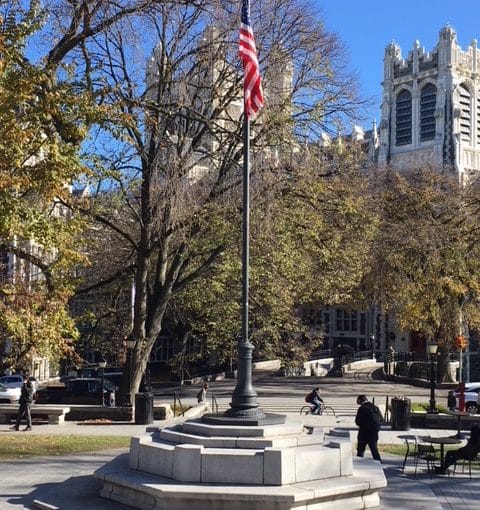
fourth-of-July-American-Values

What you can read below is a transcription from the National Archives of the William Stone engraving of the Declaration of Independence.  The spelling and punctuation reflect the original.

In Congress, July 4, 1776.

The unanimous Declaration of the thirteen united States of America, When in the Course of human events, it becomes necessary for one people to dissolve the political bands which have connected them with another, and to assume among the powers of the earth, the separate and equal station to which the Laws of Nature and of Nature’s God entitle them, a decent respect to the opinions of mankind requires that they should declare the causes which impel them to the separation.

We hold these truths to be self-evident, that all men are created equal, that they are endowed by their Creator with certain unalienable Rights, that among these are Life, Liberty and the pursuit of Happiness.–That to secure these rights, Governments are instituted among Men, deriving their just powers from the consent of the governed, –That whenever any Form of Government becomes destructive of these ends, it is the Right of the People to alter or to abolish it, and to institute new Government, laying its foundation on such principles and organizing its powers in such form, as to them shall seem most likely to effect their Safety and Happiness. Prudence, indeed, will dictate that Governments long established should not be changed for light and transient causes; and accordingly all experience hath shewn, that mankind are more disposed to suffer, while evils are sufferable, than to right themselves by abolishing the forms to which they are accustomed. But when a long train of abuses and usurpations, pursuing invariably the same Object evinces a design to reduce them under absolute Despotism, it is their right, it is their duty, to throw off such Government, and to provide new Guards for their future security.–Such has been the patient sufferance of these Colonies; and such is now the necessity which constrains them to alter their former Systems of Government. The history of the present King of Great Britain is a history of repeated injuries and usurpations, all having in direct object the establishment of an absolute Tyranny over these States. To prove this, let Facts be submitted to a candid world.

He has refused his Assent to Laws, the most wholesome and necessary for the public good.

He has forbidden his Governors to pass Laws of immediate and pressing importance, unless suspended in their operation till his Assent should be obtained; and when so suspended, he has utterly neglected to attend to them.

He has refused to pass other Laws for the accommodation of large districts of people, unless those people would relinquish the right of Representation in the Legislature, a right inestimable to them and formidable to tyrants only.

He has called together legislative bodies at places unusual, uncomfortable, and distant from the depository of their public Records, for the sole purpose of fatiguing them into compliance with his measures.

He has dissolved Representative Houses repeatedly, for opposing with manly firmness his invasions on the rights of the people.

He has refused for a long time, after such dissolutions, to cause others to be elected; whereby the Legislative powers, incapable of Annihilation, have returned to the People at large for their exercise; the State remaining in the mean time exposed to all the dangers of invasion from without, and convulsions within.

He has endeavoured to prevent the population of these States; for that purpose obstructing the Laws for Naturalization of Foreigners; refusing to pass others to encourage their migrations hither, and raising the conditions of new Appropriations of Lands.

He has obstructed the Administration of Justice, by refusing his Assent to Laws for establishing Judiciary powers.

He has made Judges dependent on his Will alone, for the tenure of their offices, and the amount and payment of their salaries.

He has erected a multitude of New Offices, and sent hither swarms of Officers to harrass our people, and eat out their substance.

He has kept among us, in times of peace, Standing Armies without the Consent of our legislatures.

He has affected to render the Military independent of and superior to the Civil power.

He has combined with others to subject us to a jurisdiction foreign to our constitution, and unacknowledged by our laws; giving his Assent to their Acts of pretended Legislation:

For Quartering large bodies of armed troops among us:

For protecting them, by a mock Trial, from punishment for any Murders which they should commit on the Inhabitants of these States:

For cutting off our Trade with all parts of the world:

For imposing Taxes on us without our Consent:

For depriving us in many cases, of the benefits of Trial by Jury:

For transporting us beyond Seas to be tried for pretended offences

For abolishing the free System of English Laws in a neighbouring Province, establishing therein an Arbitrary government, and enlarging its Boundaries so as to render it at once an example and fit instrument for introducing the same absolute rule into these Colonies:

For taking away our Charters, abolishing our most valuable Laws, and altering fundamentally the Forms of our Governments:

For suspending our own Legislatures, and declaring themselves invested with power to legislate for us in all cases whatsoever.

He has abdicated Government here, by declaring us out of his Protection and waging War against us.

He has plundered our seas, ravaged our Coasts, burnt our towns, and destroyed the lives of our people.

He is at this time transporting large Armies of foreign Mercenaries to compleat the works of death, desolation and tyranny, already begun with circumstances of Cruelty & perfidy scarcely paralleled in the most barbarous ages, and totally unworthy the Head of a civilized nation.

He has constrained our fellow Citizens taken Captive on the high Seas to bear Arms against their Country, to become the executioners of their friends and Brethren, or to fall themselves by their Hands.

He has excited domestic insurrections amongst us, and has endeavoured to bring on the inhabitants of our frontiers, the merciless Indian Savages, whose known rule of warfare, is an undistinguished destruction of all ages, sexes and conditions.

In every stage of these Oppressions We have Petitioned for Redress in the most humble terms: Our repeated Petitions have been answered only by repeated injury. A Prince whose character is thus marked by every act which may define a Tyrant, is unfit to be the ruler of a free people.

Nor have We been wanting in attentions to our Brittish brethren. We have warned them from time to time of attempts by their legislature to extend an unwarrantable jurisdiction over us. We have reminded them of the circumstances of our emigration and settlement here. We have appealed to their native justice and magnanimity, and we have conjured them by the ties of our common kindred to disavow these usurpations, which, would inevitably interrupt our connections and correspondence. They too have been deaf to the voice of justice and of consanguinity. We must, therefore, acquiesce in the necessity, which denounces our Separation, and hold them, as we hold the rest of mankind, Enemies in War, in Peace Friends.

We, therefore, the Representatives of the united States of America, in General Congress, Assembled, appealing to the Supreme Judge of the world for the rectitude of our intentions, do, in the Name, and by Authority of the good People of these Colonies, solemnly publish and declare, That these United Colonies are, and of Right ought to be Free and Independent States; that they are Absolved from all Allegiance to the British Crown, and that all political connection between them and the State of Great Britain, is and ought to be totally dissolved; and that as Free and Independent States, they have full Power to levy War, conclude Peace, contract Alliances, establish Commerce, and to do all other Acts and Things which Independent States may of right do. And for the support of this Declaration, with a firm reliance on the protection of divine Providence, we mutually pledge to each other our Lives, our Fortunes and our sacred Honor.


 

What You Should Know About Medicare Part D

Nothing is easy in the Medicare world. If you have Medicare Supplemental, Part F or Part G, to fill the gaps in what original Medicare insurance doesn’t offer, you need a Part D prescription drug plan. So what should you know about medicare Part D?

Be Aware There’s a Penalty for Not Signing Up

You face a monetary penalty for failing to sign up for Medicare Part D. If you don’t have any other type of prescription medication coverage, you have 63 days after you sign up for Medicare to also join a Part D plan. If not, Medicare will add a late penalty to your Medicare premium. They have a formula that gives them a base figure-$31.17 for 2013 and $32.42 for 2014. And they multiply it by the number of months you went without prescription drug coverage.

Tip 1

 COMPARISON SHOP

Not all Medicare Plan D programs are the same. Plans offered by private insurers vary from state to state. The same insurers provide the range of Medicare supplemental plans. So you may already be familiar with them. Jennifer Cohen-Smith of United HealthCare says, “It’s really important to investigate the Part D options. Take stock of the prescription drugs that you are taking and what plans are available to you.”

  • Make a list of your prescription drugs
  • Match your list to what the plans offer
  • Check to see if an insurer limits the amount of prescription medication you can take.

Joe Baker of the Medicare Rights Center says, “You want to look when you choose a Part D plan not only for price, not only is your drug covered but are there any tricky rules that may hit you in the pocketbook.

next


Watch and Read: Figuring Out Medicare Basics

Medicare Basics for Boomers and Everyone Else

Medicare Part B, Boomers and Costly Mistakes

Choosing Power of Attorney Tips

LIKE OUR POSTS AND COMMENT PLEASE!


Father’s Day Memories


by Barbara Nevins Taylor

A couple of weeks I got a Facebook message from Lewis Bailey. Lewis found the Segal’s Eagles “press pass” and it brought back a flood of memories. It also brought back plenty of Father’s Day memories for me. 

When our dad Zeke Segal died of a heart attack in 1996, we started going through his things. We found a lot about him we knew, and a lot we didn’t. For example, although he was married to Theo, his childhood dancing school sweetheart, not our mother, he liked women and they like him. So it was only mildly shocking when going over the credit card bills, we found that someone had returned a green print caftan to a fancy ladies’ lingerie shop in Atlanta. We never learned who.

We also found many other things that convinced me I knew very little about my father, although I thought I knew it all. He remained in part a mystery to me, one that after his death I could never solve.

So when Lewis sent his message, I perked up. It reminded me of the best things about Zeke Segal and I reached out to Lewis for his recollection.

Zeke hired Lewis as a photographer for the CBS Bureau in Atlanta where he was, according The New York Times, “the dean of Atlanta’s media corps when what has been called the New South was emerging.”

He headed the bureau from 1973 to 1983 and worked with an outstanding group of journalists covering everything south of the Mason-Dixon line through Texas, down through Latin America and Tierra del Fuego.

Lewis is from North Georgia and might have been an outlier for another news boss. But Zeke liked underdogs. He hired Phillip Ghee, the bureau’s first African-American photographer. He hired women and pushed CBS to give them good assignments. 

But back to Lewis. He said that he, as part of what the team called the Segal’s Eagles’ flying squad, worked on special events for CBS, setting up live shots and remote broadcasts in places like Plains, Georgia, the home of candidate and then President Jimmy Carter.

On these special events he worked with the legendary producers Bernard Birnbaum and Shad (Robert J.) Northshield, who started the great CBS program “Sunday Morning.” 

Lewis said, “Zeke punished Shad by assigning me to do anything ‘Sunday Morning’ had to do that Zeke could assign a crew to.” On one assignment, Lewis had an equipment problem, very common, and when Northshield pushed him to hurry up, Lewis said, “God damn it. Shut up, or help.” Northshield apparently reported him to Zeke. Lewis said, “I called Zeke and Zeke had my back.”

Lewis has plenty of stories, but here’s the one that really got me. He said, “Zeke helped to make me rich enough to send my wife to college, allowed me to pay off my college and send all my children to college. I have three doctors, one accountant and my oldest daughter is a child welfare worker. I owe it all to Zeke.”

That salute to my dad and the way he practiced journalism came out of nowhere, and it adds up to a pretty good bunch of Father’s Day memories for me.


Consumer Advocates Fired By Consumer Watchdog

You have to wonder whether the people running the Consumer Financial Protection Bureau (CFPB) really want to help or protect consumers. The Trump administration’s actions seem to undermine the bureau’s mission

The latest attack on consumer protection came when the CFPB fired consumer advocates appointed to make recommendations and help the watchdog bureau do its job. 

Just a little history here. The CFPB became the go-to place in government to protect consumers harmed by big banks, financial institutions and predators after Congress established the bureau in response to the 2008 financial meltdown.

You may remember that the CFPB forced Wells Fargo to pay restitution and fines totaling $175 million for opening credit card accounts for 1.5 million customers without their authorization and then charging them fees.  The CFPB also went after other big banks, including  J.P. Morgan Chase, for illegal credit card practices, and that brought a $309 million fine. 

It has gone after Citibank, debt collectors, payday lenders, mortgage companies and the big credit bureaus like Equifax, Experian and TransUnion, which collect our financial data but often fail to respond to our complaints or inquiries adequately.


The Trump administration has nibbled away at the bureau’s work and the latest move dispirited the advocates committed to helping consumers. Ann Baddour, chairperson of the Consumer Advisory Board (CAB), said, “Firing the current CAB members is another move indicating Acting Director Mick Mulvaney is only interested in obtaining views from his inner circle, and has no interest in hearing the perspectives of those who work with struggling American families.”

Congress created the Consumer Financial Protection Bureau in 2010 as part of the Dodd-Frank protections after the 2008 financial meltdown. The advisory boards were included in law and required to meet several times a year.

But this year, Mulvaney cancelled the meetings. Two days before he fired the consumer advocates, they talked to reporters about the importance of following the law, holding the meetings and taking advice from knowledgable advocates.

The advocates share what the bureau told them after they were fired.  They said, “Anthony Welcher, a political hire brought in by Acting Director Mick Mulvaney, cited these reasons for the termination:

  • The Bureau wanted to save a few hundred thousand dollars, which is estimated to be less than .08 percent of the agency’s overall budget. This is despite the fact that members on today’s call offered to pay to attend meetings from their own budgets.
  • The Bureau cited responses to a Request for Information (RFI) on External Engagement as a justification for the change. When pressed, Welcher admitted that the decision was made before the Request for Information had closed, and he could point to no RFI response calling for dissolving the advisory boards. A review of the RFI responses reveals there was no response calling for a restructuring or dissolution of the current advisory boards.
  • The Bureau cited wanting a more diverse, smaller and inclusive group of people involved. Yet, the advisory groups are inherently a small, diverse group of members, based on the Dodd-Frank Act. Members questioned how Acting Director Mulvaney could have come to this conclusion based on the fact that there had been no meaningful interaction with members.
  • One of the additional explanations for the firing of the Advisory Board members is a “new” plan to hold Town Hall meetings and intimate roundtable discussions — two long-standing practices of the CFPB — and therefore not a justification for firing over 60 committed and diverse volunteers.”

Call your U.S. Senators and Representative if you think the CFPB needs to continue to do its job of protecting consumers.

The U.S. Capitol switchboard will connect to you to your senator or representative. 202 224 3121


Desperate For That Designer Handbag?

updated May 19, 2018

by Barbara Nevins Taylor

This story started out as a cautionary tale about buying counterfeit anything from China. But we added a happy ending, because that’s the way it turned out. So we hope you’ll read through.

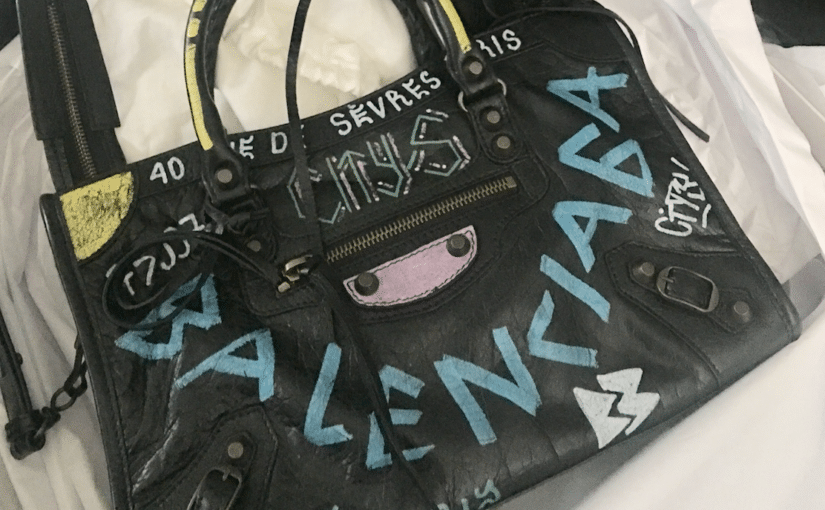
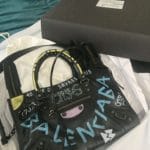
The elegant doctor walked in carrying a Balenciaga graffiti handbag and Lee Lee Brown fell in lust. “I just had to have one,” she said.  But when she looked on the Balenciaga website she found it cost $2,190 and she groaned. “That’s a month and half for my co-op maintenance payments. Clearly, I have champagne taste with beer pockets.”

Can-you-buy-counterfeits-online-safely-from-China
Balenciaga Website

So Lee Lee, a 51-year-old receptionist in a doctor’s office, began to look online for a cheaper alternative. Another doctor said, “You’d be crazy to spend that much. Get a fake.” He sent her a link to a global marketplace site that linked to a company selling counterfeit handbags in Guangzhou, in Guangdong Province, China. 

“I found a counterfeit handbag for $544 and tried to buy it immediately. But Chase wouldn’t transfer the money to China,” she said.

It turns out that Guangzhou and Guangdong Province are at the center of Chinese counterfeiting, according to the U.S. Trade Representative’s 2017 list of Notorious Markets for counterfeits.

Counterfeit goods from China add up to about 12 percent of Chinese exports, according to the office of the U.S. Trade Representative. Designer rip-offs are lumped into the massive intellectual property theft that includes trade secrets, technology and software that costs the United States an estimated $600 billion a year. The Trump administration says China is responsible for 80 percent of it. 

The threats of sanctions and a trade war by Trump and the Chinese government also highlight the problem of counterfeits from Guangzhou. The seemingly innocent purchase of a counterfeit handbag falls smack in the middle of it.

If you’re like Lee Lee and desperate for a designer handbag you can afford, international commerce and protection of intellectual property may not matter to you. 

But when you consider buying Chinese counterfeits, you might think about what happens during the sale and whether you’ll get what you paid for. The Chinese counterfeiters site Lee Lee used did not accept PayPal payments. The website says, “. . . unfortunately PayPal doesn’t work with replica sellers.”

That’s a warning. PayPal offers protection by putting a hold on money when there is a dispute. With PayPal you also may qualify for purchase protection. But when you buy counterfeits, you fall into a consumer protection black hole.

The seller of Chinese counterfeits suggested that Lee Lee use Western Union. That meant he would get the money up front and he might or might not send the counterfeit Balenciaga handbag.

Still Lee Lee wanted the handbag. But when she learned it would cost her at least an additional $80 dollars for the Western Union fee, she slowed down and put off the purchase.

She could consider that a wise decision. Even if the seller proved honest, agents with U.S. Customs and Border Patrol (USCBP) might have confiscated her package when it arrived in the U.S.

Desperate-For-That-Designer-Handbag?

The agency says it’s on the lookout for counterfeit handbags and wallets, which account for 10 percent of counterfeits entering the U.S. It warns that if agents find you importing counterfeits, you could face fines or a prison sentence.

The International AntiCounterfeiting Coalition (IACC) cautions that you put yourself at risk when you visit websites that offer counterfeit handbags. 

In a statement, the IACC told ConsumerMojo.com, “Downloading or streaming from illegal websites could put you at risk for malware – which can steal your personal or credit card information.” The group also stresses that counterfeiting steals money from legitimate manufacturers and causes people to lose jobs.

The IACC points out that money from counterfeiting operations may support terrorism, organized crime and drug trafficking.

But when you want something as desperately as Lee Lee wanted the Balenciaga handbag, you have to remind yourself about the potential danger of buying counterfeits.

Even after we talked about it, Lee Lee still tried to get the handbag. She said, “I went back to Western Union and they wouldn’t allow me to send the money. So I just forgot about it.” And then on Mother’s Day, her fiancé Robert, better known as DJ Knuckles for his work with the rapper Fatman Scoop, gave her the real thing as a gift.


“He went to Saks and bought it for me,” she said, laughing as she shared the happy ending.

 desperate-for-that-designer-handbag


Lunch With Mom


by Barbara Nevins Taylor

Our mom called Mother’s Day a greeting card holiday. Yet the mushy romantic side of her wanted a card, a gift and a wonderful lunch. I wish we had a chance to have one of those lunches again. 

I took my mom to lunch the day before she died and neither of us thought that it would be our last. I thought I’d still be driving her to lunch when I was 102, and I have to say that at the moment the idea flashed in my mind it didn’t make me happy.

We had recently celebrated her 95th birthday and while she was getting wobbly, she seemed okay. She suffered from dementia.

She knew me and my sister, her sons-in-law, her brother and his wife, her best friend from childhood, who visited often, and the assisted living staff at Atria Tanglewood in Lynbrook, Long Island, her home in her last years.

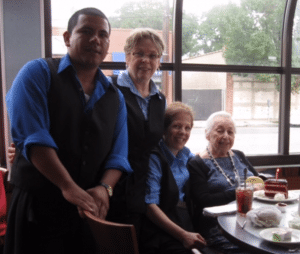
She liked going to lunch. “Let’s go to our place,” she’d say. She had a crush on Bill Tsemplis, the owner of the Valbrook Diner, and flirted with him.

He flirted back. She also liked the people who waited on us.  Most of the time, we had fun at these lunches and laughed a lot. She carried on a conversation up to a point.


She often ordered pancakes and drenched them in syrup. One day she saw someone eating a mound of french fries and ordered them too.  When the server brought the pancakes and the french fries. She shook her head, laughed and asked, “Who orders french fries with pancakes?”

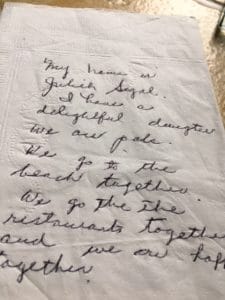
Because she refused to wear a hearing aide, I had to sit across from her so that she could read my lips. “Speak up. Stop mumbling,” she often said. At that point I resorted to writing notes on napkins.


Many of these written conversations involved her family. “How are the folks?” she’d ask. She thought her mother and father were still alive. A few years earlier, when she was still using the telephone, she discovered a Sarah Robin, her mother’s name, in the phone book and called this woman frequently. 

After the first time, she called me crying. “Why won’t my mother talk to me?” she said. “She hung up on me.” I was with my husband in South Carolina where he was giving a talk, and I felt like laughing and crying at the same time. All I could think to say was, “Mom, that’s not Grandma. It’s someone with the same name. Grandma wouldn’t hang up on you.”  

Grandma Sarah Robin

Then she demanded, “Well, where is she?” I knew this was tricky territory but I went there anyway: “Mom, she died a long time ago.”  

“That’s not true,” she said indignantly and went rolling down the rabbit hole. “Why did my mother hang up on me?” she asked again and again. When I didn’t give her the right answer, she called my sister. Then she called her brother. 

Our mom was persistent and this went on for a bit until the woman changed her number. 

 At our lunches, the conversation turned frequently to her age. “I can’t be that old,” she would say. “Do the numbers,” I suggested. She had been a teacher and a bookkeeper before that. She knew her math. “What year were you born?” I asked. She’d write it down on the napkin and she says, “What year is it?” I’d tell  her. She’d do the subtraction and say, “Impossible. Impossible.”

“How old are you?” she challenged me. “I never tell my age,” I would say.  She laughed and said, “That’s ridiculous. I’m your mother.”

She died peacefully in her sleep. It was her time and all of that. But I do miss her and those lunches and wish we had a chance to it again. I know my sister Hope feels exactly the same way. 


Mom, Hope & Bob Way Back

 Read Nick Taylor’s story about an orphan and his mother 


Trump Administration Fails Student Loan Borrowers

Cruel ironies abound as the Trump administration fails student loan borrowers. The man who brought you a phony university and paid a $25 million settlement to repay students for cheating them, now will kill the watchdog office that protects student borrowers from getting fleeced by lenders and collectors.  This move comes in the same week that Americans’ student loan debt topped $1.5 trillion.

Consumer Financial Protection Bureau (CFPB)  Mick Mulvaney told his staff he plans to shut down the Consumer Financial Protection Bureau’s (CFPB) Office for Students and Young Consumers, an investigative unit. He’ll move it into the office of consumer information.

The Office for Students and Young Consumer monitors predatory practices in student lending and is the only group that protects 44 million student loan borrowers from fraud and abuse. Since it began its work in 2010, the Office for Students and Young Consumers has:

  • Returned more than $750 million to student loan borrowers.
  • Helped more than 60,000 borrowers demand answers from student loan companies.
  • Held companies like Navient and ITT Tech accountable for predatory practices.

On the CFPB website, it clearly shows how it helps students. Just read this:

“In response to our public inquiry into student loan servicing practices, we received over 30,000 comments from the public, highlighting the costly surprises and runarounds some borrowers face when dealing with their servicers. We documented these widespread servicing failures reported by borrowers in our recent report, Student Loan Servicing.”

Christopher Peterson, Financial Services Director at the Consumer Federation of America (CFA), said,  “This action actively promotes greater profits for a handful of debt collection businesses at the expense of mistakes, neglect, and confusion for millions of student loan borrowers.”

Persis Yu, staff attorney and director of the National Consumer Law Center’s (NCLC) Student Loan Borrower Assistance Project, said,
“Mr. Mulvaney’s action is a naked ploy to silence an effective team looking out for student loan borrowers.”

The NCLC detailed ways that the Office for Students and Young Consumers attempted to ease the burden of the student loan system.

“In particular, the Office uncovered problems with the U.S. Department of Education’s implementation of income-driven repayment plans, eventually leading to a lawsuit against student loan servicer Navient for practices that caused borrowers to pay thousands of additional dollars on their federal student loans and added years to their repayment.”

Without adequate protection, consumer advocates worry that predatory practices will begin again and continue to trap students in debt for decades. 

Wells Fargo Could Owe You Money Again

update December 28, 2018

Wells Fargo could owe you money, yet again. Investigators found Wells Fargo cheated mortgage customers and auto loan customers and now has to repay those who were harmed. The Consumer Financial Protection bureau hit the bank with a $1 billion fine and the Comptroller of the Currency fined the bank $500 million and ordered it to clean up its management practices.  There is a new settlement as of December 28, 2018 and we explain all of that here

Wells Fargo previously paid a $100 million fine for opening credit card accounts for 3.5 million customers who did not authorize them to do it. 

In the latest settlement with the Consumer Financial Protection Bureau (CFPB), Wells Fargo acknowledged it overcharged mortgage customers who needed to extend the period for locking-in an interest rate. Although an internal bank audit, in 2013, found the bank routinely over-charged customers for extending the rate-lock, Wells Fargo continue to cheat customers through October 2016. 

The settlement also lays out how the bank’s bad practices affected auto loan customers going back to 2005. Wells Fargo forcibly placed insurance on the vehicles of about 2 million people who took auto loans with the bank. What the insurance industry calls forced-placed insurance typically is ordered by a lender when a customer’s insurance policy lapses. 

But Wells Fargo apparently ordered blanket forced-placed insurance policies for hundreds of thousands of auto loan borrowers who already had insurance, or replaced lapsed insurance policies with new ones. 

The additional cost to some consumers caused late payments and in some cases led to borrowers losing their cars to repossession. 

The settlement with the CFPB and the Comptroller of the Currency requires Wells Fargo to clean up its management practices and to repay customers who have been harmed.

Wells Fargo has 120 days to come up with a plan to reimburse mortgage and auto loan borrowers. If you think Wells Fargo could owe money, theoretically you should not have to do anything. Wells Fargo should notify you. 

But it might help to let the CFPB know that you are among the people to whom Wells Fargo could owe money. You can submit a complaint here.


Your Trump University Payback

If you fell for the promises and then discovered that Trump University ripped you off, it’s time for your Trump University payback. 

U.S. District Judge Gonzalo Curiel in San Diego approved the final $25 million settlement that will allow money to go to former students immediately. The decision came after former student Sherri Simpson decided not to challenge the judge’s settlement order. She wanted the right to sue on her own and for awhile it looked like she would continue to hold things up. Her attorney told Reuters that they “gave it our best shot,” and decided it was time to agree to the settlement.

Simpson spent about $19,000 on Trump University and originally resisted the idea of settling because that meant she couldn’t sue to reclaim the entire amount, or more than what she paid.

When Judge Curiel granted the settlement in March 2017, he pointed out that it granted a payback to thousands of students who could recoup 90 percent of the money they shelled out to Trump University. 

In 2013, New York Attorney General Eric Schneiderman got the ball rolling against Trump University when he sued Donald Trump  for “swindling students.”

Schneiderman hailed the judge’s final order. He said,“Judge Curiel’s order finalizing the $25 million Trump University settlement means that victims of Donald Trump’s fraudulent university will finally receive the relief they deserve. We are particularly pleased that the final settlement we negotiated with class counsel ensures that members of the class will receive an even higher settlement than anyone originally anticipated. This settlement marked a stunning reversal by President Trump, who for years refused to compensate the victims of his sham university. My office won’t hesitate to hold those who commit fraud accountable, no matter how rich or powerful they may be.”

If you were part of this class action lawsuit, attorneys are likely to get in touch with you. 

Facebook Will Require Political Advertisers To Disclose

Facebook stepped up its effort to pull back the curtain on political advertisers. The move is an effort to combat fake accounts and the kind of manipulation that the Russians pulled off during the 2016 presidential election.

CEO Mark Zuckerberg posted, “. . . from now on, every advertiser who wants to run political or issue ads will need to be verified. To get verified, advertisers will need to confirm their identity and location. Any advertiser who doesn’t pass will be prohibited from running political or issue ads. We will also label them and advertisers will have to show you who paid for them. We’re starting this in the US and expanding to the rest of the world in the coming months.”

Zuckerberg said that earlier this week, Facebook took down “a large network of Russian fake accounts that included a Russian news organization.” Facebook previously removed tens of thousands fake accounts in the run-up to the French and German elections and Alabama Senate special election. 

Facebook also will require people who run pages with large followings to verify they are who they say they are. It plans to hire thousands more people to get the new systems in place before the 2018 elections. 

Zuckerberg said he thinks the problem of fake accounts and political interference is bigger than any one platform. He said he supports a bill pending in Congress called The Honest Ads Act, sponsored by senators Amy Klobuchar (D), Mark Warner (D) and John McCain (R). It would require regulation of online political ads similar to the kind of regulation that covers TV and radio.

In a statement from its media department, Facebook said, “We know we were slow to pick up on interference in the 2016 elections. Today’s updates are designed to prevent future abuse in elections.”

Facebook began to make changes after it was revealed that a political consulting firm, Cambridge Analytica, harvested profiling data of 87 million Facebook users.

Zuckerberg is scheduled to testify before Congress next week. 


Who Protects Student Loan Borrowers?

by Barbara Nevins Taylor

Who protects student loan borrowers? The Trump administration just told states to back off consumer protections and the states and consumer advocates said, “Wait a minute.”

The conflict arose because states like Massachusetts, Washington and New York enacted laws and rules to protect student loan borrowers from loan servicer predatory practices. In 2017, Washington sued Navient, an offshoot of Sallie Mae, and charged the company with unfair and deceptive practices.

Recently, Massachusetts sued the Pennsylvania Higher Assistance Corporation, which manages student loans and grants on behalf of the government. The U.S. Justice Department challenged the state’s right to sue, but a Massachusetts Superior Court judge ruled that Massachusetts can go forward with the lawsuit.

In the latest salvo, the U.S. Department of Education posted a notice of new guidelines aimed at preventing states from regulating loan servicers.  It said state regulation is “preempted by Federal law.” It also says, “State servicing laws also may undermine Congress’s goal of saving taxpayer dollars in administering the Direct Loan Program.”

State officials and consumer advocates reacted angrily. New York’s Financial Services Superintendent Maria Vullo said, “The U.S. Department of Education’s attempt to undermine states’ protections for student loan borrowers exceeds the scope of authority Congress granted to the Department of Education, disrupts states’ traditional role of protecting their residents and regulating financial services providers, and would harm the very borrowers the Department should be aiming to protect.”

The New York State Department of Financial Services (DFS) has mediated complaints about fraudulent and abusive practices, including steering borrowers to costlier repayment plans. Vullo said, “Now more than ever, with the federal assault on our struggling middle class, states must retain the ability to rein in these troubling practices in order to protect students and student debt holders within their own borders.”

The National Consumer Law Center’s Persis Yu said the Education Department’s effort “. . . is an outrageous effort to protect unfair and deceptive actions by student loan servicers and to deprive borrowers of their right to prompt, accurate, and timely service on their student loans,” Servicers and collectors who mistreat student loan borrowers and steer them into inappropriate payment plans should not be above the law,”

In a letter to Education Secretary Betsy DeVos, the Conference of Bank Supervisors wrote that the effort to override state protections “. . . runs counter to the Congressionally mandated state federal balance in financial regulation and exceeds the Department’s authority.” 

So you can stay tuned to see if anyone ends up protecting people who need it most. 

Hackers Steal Your Drivers License Info From Equifax?

I guess it’s no longer hard to believe that hackers could steal your drivers license information from Equifax. The company recently discovered that hackers stole the names and partial drivers license information of an additional 2.4 million consumers. In the fall of 2017, Equifax revealed that its lax security allowed identity thieves to steal the personal information of 143 million people. The new number piles on.

The credit reporting company‘s investigation first focused on people whose Social Security and home addresses were stolen. Now it says it recently discovered that while the Social Security numbers of 2.4 million were not stolen, thieves did steal information about their drivers’ licenses.

As if it makes a difference to those of us with compromised personal financial data, interim CEO Paulino do Rego Barros, Jr., said, “This is not about newly discovered stolen data. It’s about sifting through the previously identified stolen data, analyzing other information in our databases that was not taken by the attackers, and making connections that enabled us to identify additional individuals.”

So what happens now?

Equifax says it will notify you directly by mail and will offer free identity theft protection and credit file monitoring services to you, if thieves stole your information. The company plans to explain how to register when it gives you the bad news.

The Equifax website says if you call the company, it will not be able to tell you if your drivers license information was stolen. But it suggests you use the tool on the website to find out if your Social Security number was hacked.  You press the “Am I Impacted?” button and it will ask for information.

If your Social Security number was stolen in the breach you can:

  • Get free copies of Your Credit Report.
  • Put a freeze on your credit report.
  • Place a fraud alert on your credit reports

 Acting Equifax CEO Barros says “We are committed to regaining the trust of consumers, improving transparency, and enhancing security across our network.”

To try to fix things after the fact, Equifax launched Lock & Alert, a free tool that consumers can use throughout their lifetimes. It enables them to quickly lock and unlock their Equifax credit report using a computer or an app downloaded on their mobile device.

www.equifaxsecurity2017.com offers updates and information about the hack.

New Threatening Scam Robocall

by Barbara Nevins Taylor

A new threatening scam robocall hit my mobile phone voicemail this week to let me know “the local cops” are after me. The caller sounds like someone for whom English is not the first language.  Maybe they speak Russian. I don’t know. This is what I heard:

“. . . by the local cops as there are four serious allegations pressed on your name at this moment. We would request you to get back to us so that we can discuss this case before taking any legal action against you. The number to reach us at is 708-432-8161. I repeat 708-432-8161”

That’s all crazy. And I would never call back. But someone fearful, naive or just not fully capable might. The scammers could bully them into sending money, or giving up banking or other personal financial information. It happens and these calls present a potential danger.

The 708 area code goes to Chicago suburbs. But the phone number belongs to what’s call a non-fixed VoIP, or Voice over Internet Protocol. That means it’s a disposal internet account that can be attached to any address. The scammers don’t have to reside in the locality connected to the area code or even in the country. Non-fixed VoIP tells us they use an internet or cable service and bypass phone companies. This helps them keep their identities hidden as they churn out 1,000 numbers per second. 

The creation of these barely regulated non-fixed VoIP accounts seems like a gift to thieves. Theoretically, the Federal Communications Commission (FCC) oversees interstate communication that includes VoIP business. But under the Trump administration and the leadership of FCC Chairman Ajit Pai, consumer protection takes a back seat to business.

What should you do if you receive a threatening scam robocall?

The Federal Trade Commission (FTC), which does pursue consumer complaints about robocalls, suggests you do a few things to keep yourself out of harm’s way.

Put your number on the federal and your state’s  Do Not Call Registry (I’m on both and these calls still get through.) 

do-not-call-registry
Federal Trade Commission via Wikimedia,

Report illegal calls to the FTC. Under past administrations they have sued more than 600 companies for making illegal calls.

You can call the FTC-1-877-FTC Help or go to www.ftc.gov/complaint

          • .

 Listen to the call here:  

 https://soundcloud.com/barbara-nevins-taylor/threatening-scam-robocall

Happy Year of the Dog

Happy Year of the Dog! The eleventh animal in the Chinese lunar calendar symbolizes justice, loyalty, honesty, and a sense of duty. The dog is my birth symbol and anyone born in 1934, 1946, 1958, 1970, 1982, 1994, 2006, 2018 theoretically should get the good luck that comes with the Year of the Dog. I looked forward to it.

But then I discovered that as a “fire dog,” I share the good luck with George Bush, Bill Clinton, Donald Trump and — thank you at least for this — Steven Spielberg. I’m sure that a lot of other wonderful people also fall in the “fire dog” category. But it gave me pause to think my “luck” was in any way connected with Donald Trump.

Okay. So what does it all mean? Chinese astrologers divide dog years into categories: Water dog 1982, Metal dog 1970, Earth dog 1958, Fire dog 1946, and Wood dog 1934.

People born under this sign, again according to the astrologers, make good politicians, philosophers, teachers, doctors, judges, writers, nurses, actors, counselors, priests and psychologists and other professions that combine skills and help people.

The website China Family Adventure suggests that Year of the Dog will bring rewards for persistent people with long-standing projects. It also advises that you exercise vigilance to make sure people don’t take advantage of your good intentions.

It also says, after the chaotic Year of the Rooster, the Year of the Dog should provide a much-needed sense of harmony and peace.  But the South China Morning Post says Chinese astrologers predict that “Donald Trump faces a fiery 12 months.” One astrologer, Singapore-based Clarice Chan, told the paper, “If he is more flexible and tones down his approach, it is likely he will stay on as president. But if he is very forceful, he will face trouble.” She predicts that he will face a political crisis in 2018. 

Well. Happy Year of the Dog.


DACA Can Continue Federal Court Rules

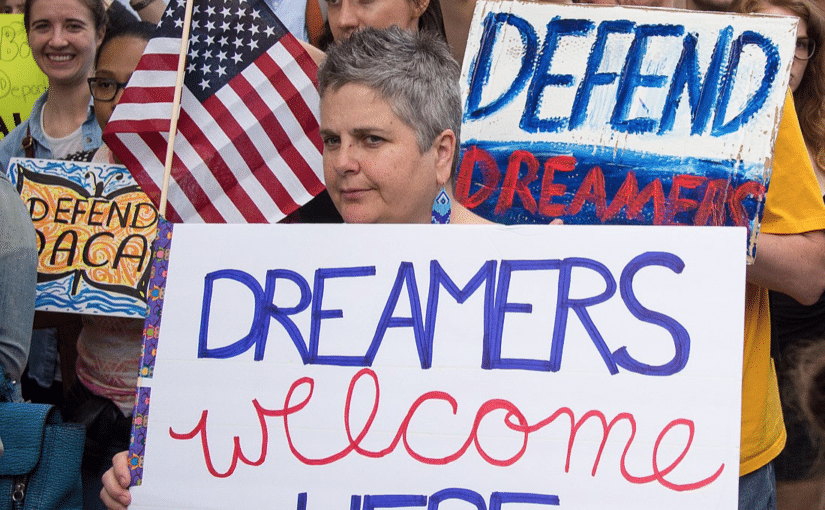
DACA can continue, thanks to a federal judge in Brooklyn who gave a boost to the young people who depend upon the Deferred Action for Childhood Arrivals Program  to live legally in the United States. Judge Nicholas G. Garaufis issued a nationwide injunction to prevent the Trump administration from ending the program.

Judge Garaufis said the Trump administration did not offer adequate legal grounds for ending the program created by President Obama. He wrote that the Trump Justice Department claimed the creation of DACA was unconstitutional, and he said that “conclusion was erroneous.”

This ruling gave heart to Dreamers and advocates who have struggled to protect young people brought to the United States as children by their parents, who know only the U.S. as their home.

Marielena Hincapé of the National Immigration Law Center said, “This ruling is particularly important as the arbitrary March 5th deadline that resulted in the crisis President Trump created is right around the corner.”

This is the second time in two months that a federal judge ruled against the Trump administration in favor of DACA. On January 9, 2018 Judge William Alsup of the Federal District Court in San Francisco ruled that the administration must “maintain the program on a nationwide basis.”

New York Attorney General Eric Schneiderman led a coalition of 17 attorneys general and a group of non-profits including the National Immigration Law Center and Make the Road by Walking.

He said, “Federal courts from coast to coast have now reviewed the record and reached the same conclusion: President Trump’s decision to rescind DACA was illegal. Today’s federal court ruling is a victory for the over 42,000 New York Dreamers and more than 700,000 Dreamers across the country. There is much more work ahead to permanently preserve DACA and protect the millions of American families, businesses, hospitals, and universities that depend on Dreamers every day to succeed, but today is an important step forward in that fight.”

It’s expected that the Trump administration will ask the U.S. Supreme Court to take up the case quickly.